SHM-Agents: A Generalist-Specialist Integrated Agent System for Structural Health Monitoring
Pith reviewed 2026-06-30 21:47 UTC · model grok-4.3
The pith
SHM-Agents combines large language models with specialized algorithms so engineers can run structural health monitoring tasks through natural language.
A machine-rendered reading of the paper's core claim, the machinery that carries it, and where it could break.
Core claim
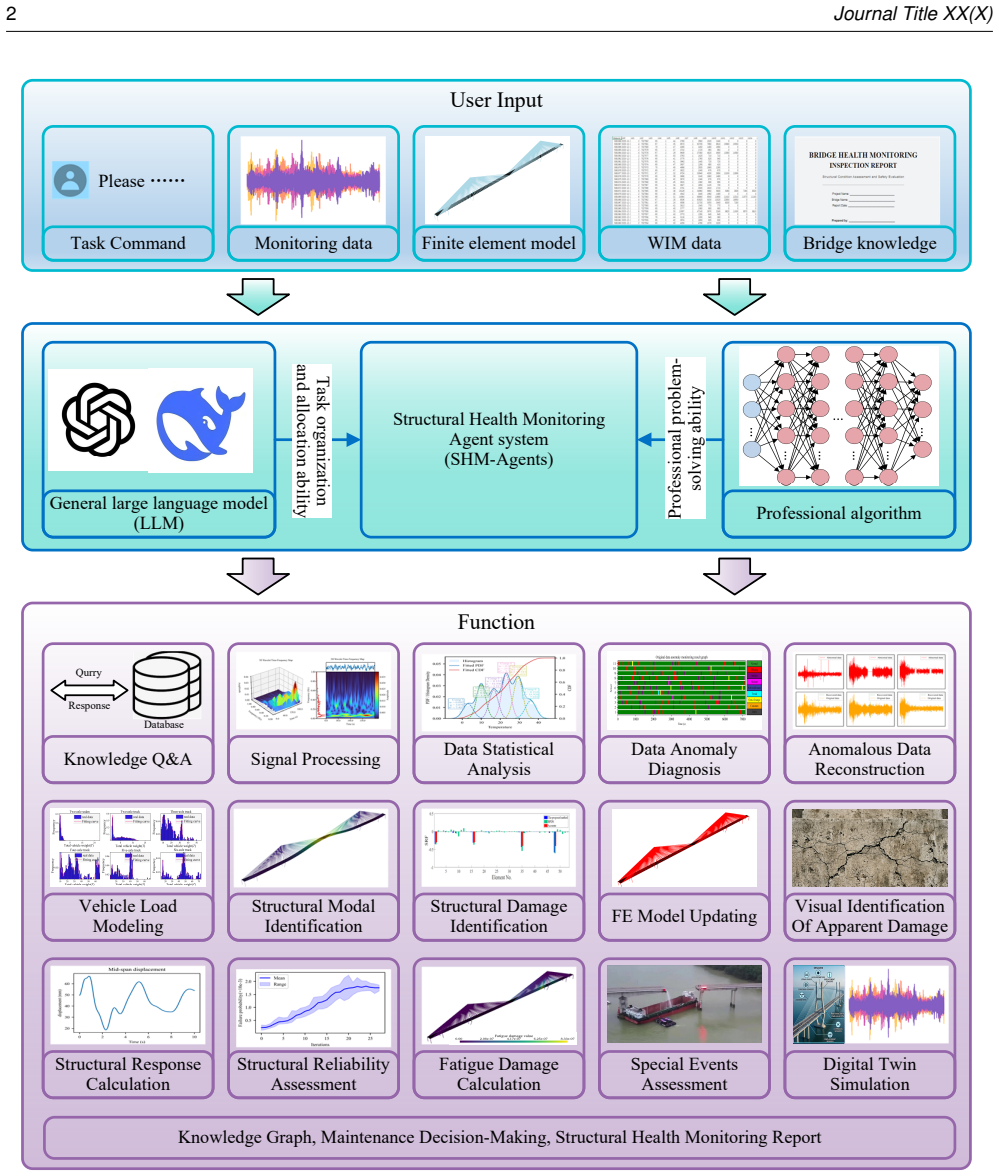
SHM-Agents is a generalist-specialist agent system that integrates the reasoning and planning abilities of large language models with the problem-solving strengths of specialized algorithms, enabling end-to-end execution of single and combined SHM tasks via natural language and supporting deep learning pre-training and modular expansion, with experiments demonstrating accurate and efficient performance across data anomaly diagnosis and recovery, signal processing, statistical analysis, modal identification, damage identification, finite element model updating, vehicle load modeling, response calculation, reliability assessment, fatigue estimation and bridge knowledge Q&A on a long-span cable
What carries the argument
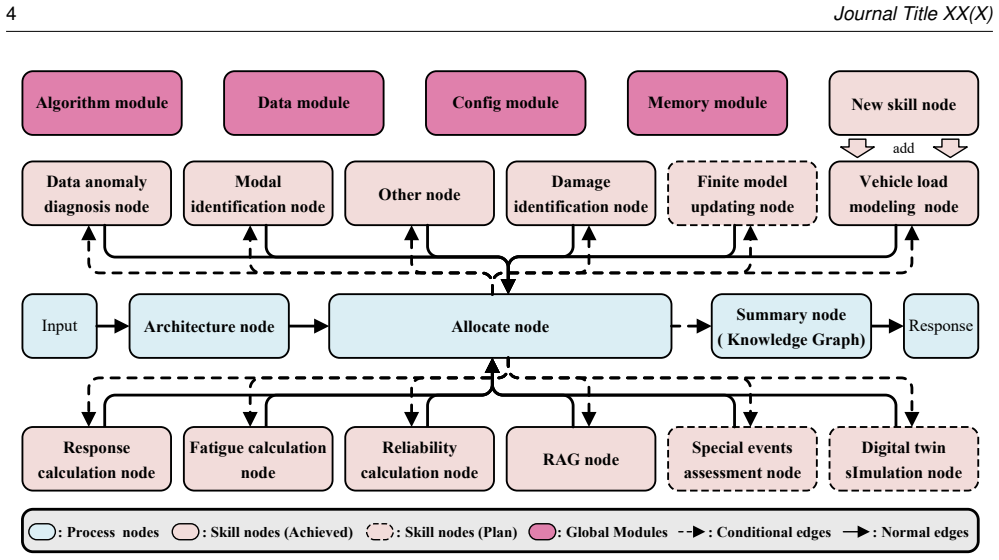
The SHM-Agents generalist-specialist agent system, which wraps specialized SHM algorithms for invocation by an LLM-based planner.
If this is right
- Users can execute diverse SHM tasks end-to-end through natural language instructions.
- Deployment is simplified by support for deep learning pre-training.
- New capabilities can be added through the modular design without rebuilding the system.
- A single platform handles the full range from data anomaly diagnosis to reliability assessment and fatigue estimation.
Where Pith is reading between the lines
- The same wrapping pattern could be tested on monitoring problems outside civil engineering where specialized tools already exist.
- Real-time conversational dashboards might emerge if the planner can maintain state across sequential tasks on streaming sensor data.
- Standardized wrapper interfaces for legacy SHM code would reduce the engineering effort needed to adopt the approach.
Load-bearing premise
Specialized SHM algorithms can be wrapped and invoked reliably by the LLM planner without introducing new implementation barriers or accuracy losses.
What would settle it
A side-by-side test on the same bridge dataset where the agent-invoked versions of the specialized algorithms produce measurably lower accuracy or higher error rates than direct execution of those algorithms.
Figures







read the original abstract
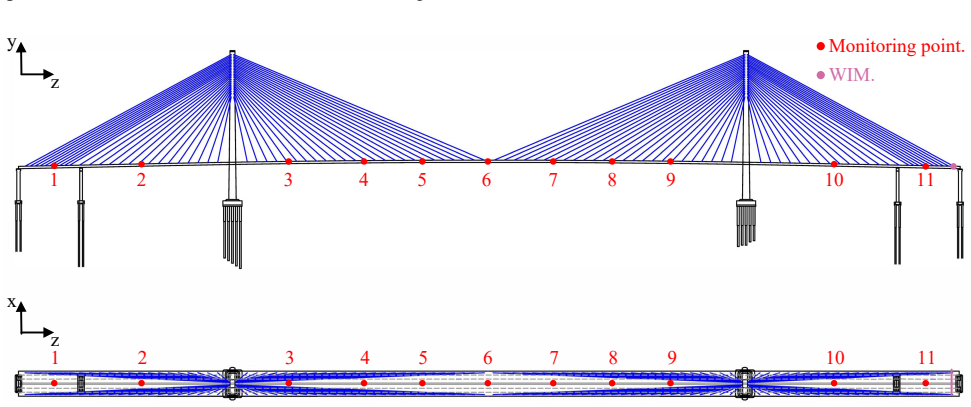
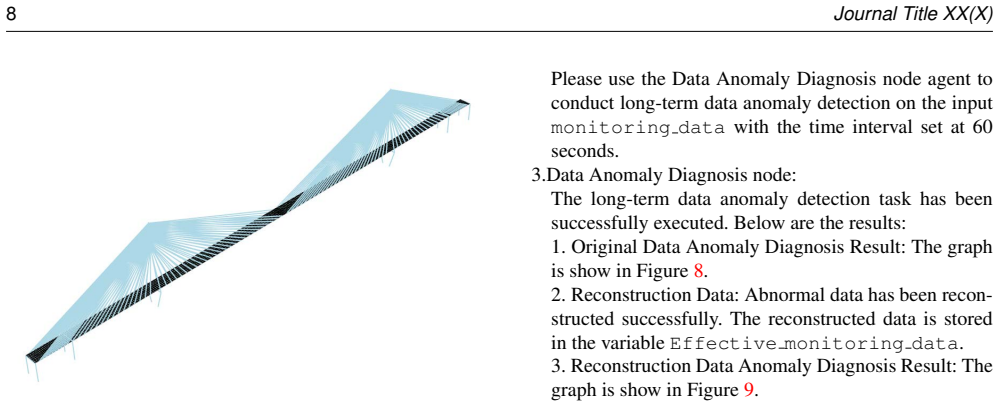
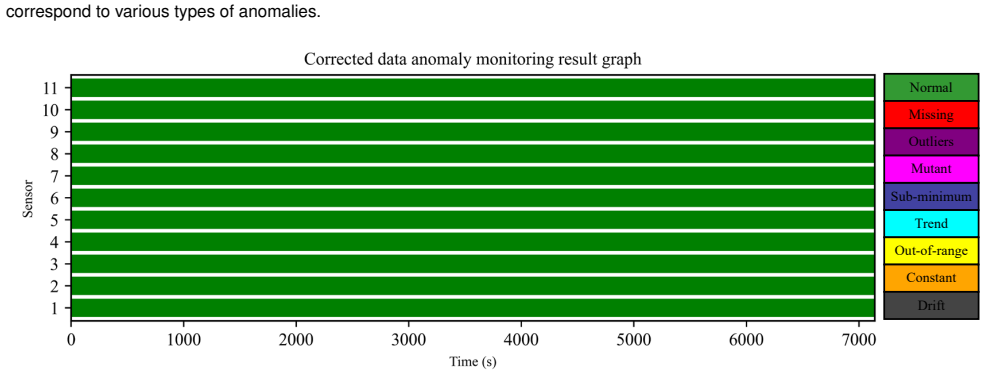
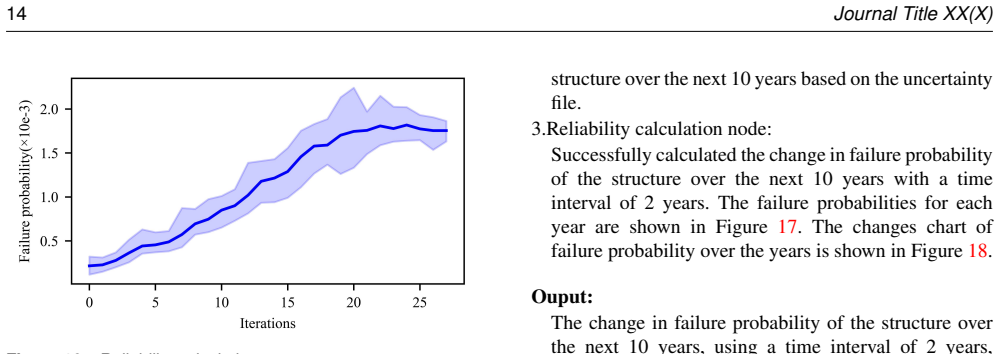
Artificial intelligence is increasingly used to simplify complex tasks. In engineering applications of structural health monitoring (SHM), existing specialized algorithms, while effective, often face high implementation barriers, limited interoperability and complex training procedures. To overcome these challenges, this paper proposes SHM-Agents, a generalist-specialist agent system that integrates the reasoning and planning abilities of large language models with the problem-solving strengths of specialized algorithms. SHM-Agents enables end-to-end execution of single and combined SHM tasks via natural language, supports deep learning pre-training to simplify deployment and allows flexible expansion through a modular design. Experiments on a long-span cable-stayed bridge show that SHM-Agents can accurately and efficiently perform diverse SHM tasks, including data anomaly diagnosis and recovery, signal processing, statistical analysis, modal identification, damage identification, finite element model updating, vehicle load modeling, response calculation, reliability assessment, fatigue estimation and bridge knowledge Q\&A.
Editorial analysis
A structured set of objections, weighed in public.
Referee Report
Summary. The manuscript proposes SHM-Agents, a generalist-specialist agent system integrating large language models for reasoning and planning with specialized structural health monitoring (SHM) algorithms. It enables end-to-end natural-language execution of single and combined SHM tasks, supports modular expansion and deep learning pre-training for simplified deployment, and is evaluated on a long-span cable-stayed bridge for tasks including data anomaly diagnosis/recovery, signal processing, modal identification, damage identification, finite element model updating, vehicle load modeling, response calculation, reliability assessment, fatigue estimation, and bridge knowledge Q&A.
Significance. If the results hold, the approach could meaningfully reduce implementation barriers and interoperability issues in SHM by allowing natural-language orchestration of proven specialized tools without new accuracy losses. The modular wrapper design and reported task success rates on a real bridge dataset are strengths; the work also demonstrates practical multi-task capability across diagnosis, identification, updating, and assessment stages.
minor comments (3)
- [Abstract] Abstract: the claim of 'accurate and efficient' performance would be strengthened by including one or two key quantitative metrics (e.g., success rates or error measures) from the cable-stayed bridge experiments.
- [Experiments] Experiments section: while task success rates are reported, adding a brief comparison against direct invocation of the same specialized algorithms (without the LLM planner) would clarify whether the integration introduces any overhead.
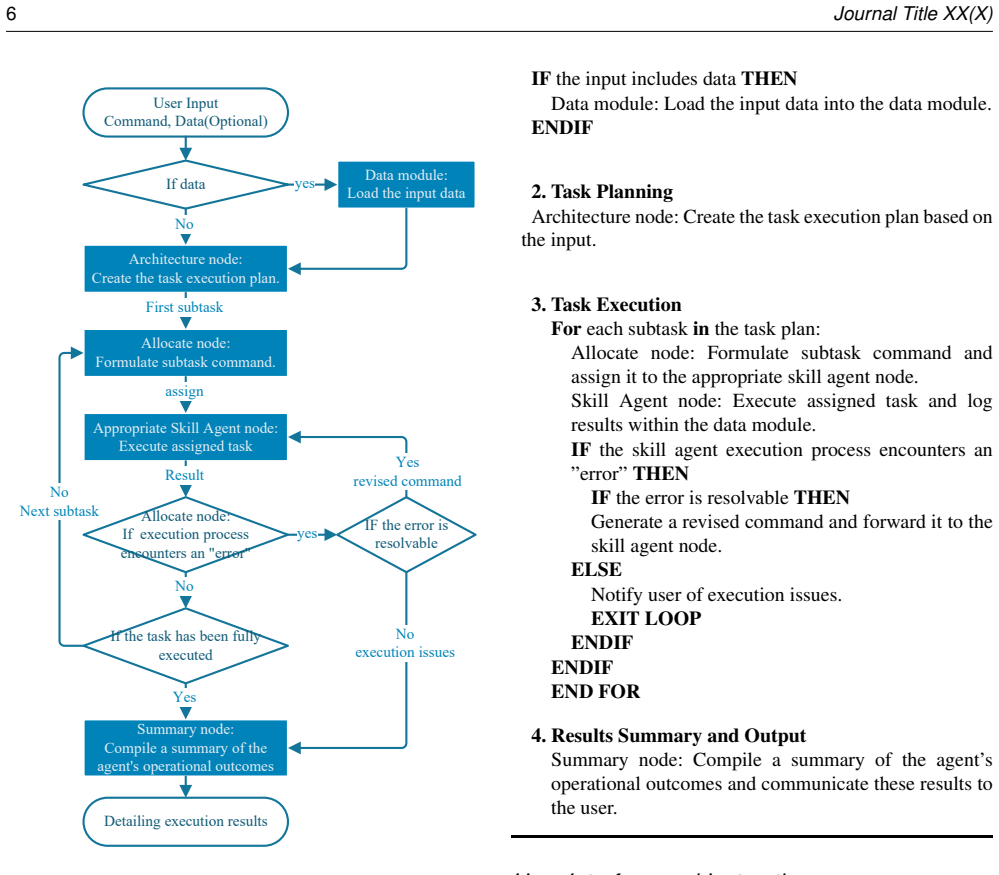
- [Methodology] Methodology: the description of the modular wrappers would benefit from an explicit data-flow diagram or pseudocode showing how the LLM planner selects and invokes the specialist modules.
Simulated Author's Rebuttal
We thank the referee for the positive summary of SHM-Agents, the recognition of its practical contributions to reducing implementation barriers in SHM, and the recommendation for minor revision. No specific major comments were provided in the report.
Circularity Check
No significant circularity identified
full rationale
The paper describes a modular agent system (SHM-Agents) that wraps existing specialized SHM algorithms under LLM planning and reports experimental success rates on a cable-stayed bridge. No derivation chain, equations, fitted parameters, or self-citation load-bearing steps are present; the claims rest on empirical task performance rather than any reduction of outputs to inputs by construction.
Axiom & Free-Parameter Ledger
invented entities (1)
-
SHM-Agents
no independent evidence
Reference graph
Works this paper leans on
-
[1]
Alavi AH, Jiao P, Buttlar WG and Lajnef N (2018) Internet of things-enabled smart cities: State-of-the-art and future trends. Measurement 129: 589--606. doi:10.1016/j.measurement.2018.07.067
-
[2]
Code2vec: Learning distributed representations of code,
Alon U, Zilberstein M, Levy O and Yahav E (2019) code2vec: Learning distributed representations of code. Proceedings of the ACM on Programming Languages 3(POPL): 1--29. doi:10.1145/3290353
-
[3]
Procedia Computer Science 246: 3781--3790
Arslan M, Ghanem H, Munawar S and Cruz C (2024) A survey on rag with llms. Procedia Computer Science 246: 3781--3790. doi:10.1016/j.procs.2024.09.178
-
[4]
Journal of Sound and Vibration 333(23): 6057--6073
Asgarieh E, Moaveni B and Stavridis A (2014) Nonlinear finite element model updating of an infilled frame based on identified time-varying modal parameters during an earthquake. Journal of Sound and Vibration 333(23): 6057--6073. doi:10.1016/j.jsv.2014.04.064
-
[5]
Bao Y, Chen Z, Wei S, Xu Y, Tang Z and Li H (2019) The state of the art of data science and engineering in structural health monitoring. Engineering 5(2): 234--242. doi:10.1016/j.eng.2018.11.027
-
[6]
Structural Health Monitoring 19(6): 1963--1975
Bao Y, Guo Y and Li H (2020) A machine learning--based approach for adaptive sparse time--frequency analysis used in structural health monitoring. Structural Health Monitoring 19(6): 1963--1975. doi:10.1177/1475921720909440
-
[7]
Mechanical Systems and Signal Processing 216: 111458
Bao Y, Liu D and Li H (2024) A mechanics-informed neural network method for structural modal identification. Mechanical Systems and Signal Processing 216: 111458. doi:10.1016/j.ymssp.2024.111458
-
[8]
Bao Y and Tian Y (2025) A graph neural network-based method for orthotropic steel deck fatigue damage assessment due to vehicular loading. doi:10.2139/ssrn.5099636. SSRN
-
[9]
Nature Communications 12(1): 6136
Chen Z, Liu Y and Sun H (2021) Physics-informed learning of governing equations from scarce data. Nature Communications 12(1): 6136. doi:10.1038/s41467-021-26434-1
-
[10]
DeepSeek-V2: A Strong, Economical, and Efficient Mixture-of-Experts Language Model
DeepSeek-AI et al. (2024) DeepSeek-V2 : A strong, economical, and efficient mixture-of-experts language model. doi:10.48550/arXiv.2405.04434
work page internal anchor Pith review Pith/arXiv arXiv doi:10.48550/arxiv.2405.04434 2024
-
[11]
Engineering Structures 178: 309--317
Deng L, Yan W and Nie L (2019) A simple corrosion fatigue design method for bridges considering the coupled corrosion-overloading effect. Engineering Structures 178: 309--317. doi:10.1016/j.engstruct.2018.10.028
-
[12]
Duan Z and Wang J (2024) Exploration of llm multi-agent application implementation based on langgraph+crewai. doi:10.48550/arXiv.2411.18241
-
[13]
Fang R, Bindu R, Gupta A, Zhan Q and Kang D (2024) Llm agents can autonomously hack websites. doi:10.48550/arXiv.2402.06664
-
[14]
Gemini: A Family of Highly Capable Multimodal Models
Gemini Team et al. (2025) Gemini: A family of highly capable multimodal models. doi:10.48550/arXiv.2312.11805
work page internal anchor Pith review Pith/arXiv arXiv doi:10.48550/arxiv.2312.11805 2025
-
[15]
Han J et al. (2025) From llms to agents: A comparative evaluation of llms and llm-based agents in security patch detection. doi:10.48550/arXiv.2511.08060
-
[16]
Han Z, Jiao P and Zhu Z (2021) Combination of piezoelectric and triboelectric devices for robotic self-powered sensors. Micromachines 12(7): 813. doi:10.3390/mi12070813
-
[17]
Automation in Construction 136: 104168
He Z, Li W, Salehi H, Zhang H, Zhou H and Jiao P (2022) Integrated structural health monitoring in bridge engineering. Automation in Construction 136: 104168. doi:10.1016/j.autcon.2022.104168
-
[18]
MetaGPT: Meta Programming for A Multi-Agent Collaborative Framework
Hong S et al. (2024) Metagpt: Meta programming for a multi-agent collaborative framework. doi:10.48550/arXiv.2308.00352
work page internal anchor Pith review Pith/arXiv arXiv doi:10.48550/arxiv.2308.00352 2024
-
[19]
Structural Health Monitoring : 14759217251395197doi:10.1177/14759217251395197
Hou R, Che L and Bao Y (2025) Accelerating bayesian inference of structural damage detection based on physics-guided cnn and zero-shot transfer learning. Structural Health Monitoring : 14759217251395197doi:10.1177/14759217251395197
-
[20]
In: Introduction to Transformers for NLP
Jain SM (2022) Hugging face. In: Introduction to Transformers for NLP. Berkeley, CA: Apress, pp. 51--67. doi:10.1007/978-1-4842-8844-3_4
-
[21]
International Journal of Remote Sensing 42(14): 5277--5316
Jiao P, Wang J, Chen X, Ruan J, Ye X and Alavi AH (2021) Next-generation remote sensing and prediction of sand and dust storms: State-of-the-art and future trends. International Journal of Remote Sensing 42(14): 5277--5316. doi:10.1080/01431161.2021.1912433
-
[22]
(2025) Agent4vul: multimodal llm agents for smart contract vulnerability detection
Jie W et al. (2025) Agent4vul: multimodal llm agents for smart contract vulnerability detection. Science China Information Sciences 68(6): 160101. doi:10.1007/s11432-024-4402-2
-
[23]
In: Proceedings of the 40th ACM/SIGAPP Symposium on Applied Computing
Kim J, Hur M and Min M (2025) From rag to qa-rag: Integrating generative ai for pharmaceutical regulatory compliance process. In: Proceedings of the 40th ACM/SIGAPP Symposium on Applied Computing. Catania International Airport, Catania, Italy: ACM, pp. 1293--1295. doi:10.1145/3672608.3707749
-
[24]
Engineering, Technology & Applied Science Research 14(3): 14219--14224
Kumar A, Sharma R and Bedi P (2024) Towards optimal nlp solutions: Analyzing gpt and llama-2 models across model scale, dataset size, and task diversity. Engineering, Technology & Applied Science Research 14(3): 14219--14224. doi:10.48084/etasr.7200
-
[25]
Computer Communications 160: 71--80
Li D, Cai Z, Qin B and Deng L (2020) Signal frequency domain analysis and sensor fault diagnosis based on artificial intelligence. Computer Communications 160: 71--80. doi:10.1016/j.comcom.2020.05.034
-
[26]
Reliability Engineering & System Safety 243: 109898
Li W, Geng R and Chen S (2024) Csp-free adaptive kriging surrogate model method for reliability analysis with small failure probability. Reliability Engineering & System Safety 243: 109898. doi:10.1016/j.ress.2023.109898
-
[27]
StarCoder 2 and The Stack v2: The Next Generation
Lozhkov A et al. (2024) Starcoder 2 and the stack v2: The next generation. doi:10.48550/arXiv.2402.19173
work page internal anchor Pith review Pith/arXiv arXiv doi:10.48550/arxiv.2402.19173 2024
-
[28]
Journal of Traffic and Transportation Engineering (English Edition) 2(4): 242--248
Mei K, Li Y and Lu Z (2015) Application study on the first cable-stayed bridge with cfrp cables in china. Journal of Traffic and Transportation Engineering (English Edition) 2(4): 242--248. doi:10.1016/j.jtte.2015.05.004
-
[29]
Molecular Systems Design & Engineering 10(7): 585--598
Mendible-Barreto OA, Díaz-Maldonado M, Carmona Esteva FJ, Torres JE, Córdova-Figueroa UM and Colón YJ (2025) Dynamate: leveraging ai-agents for customized research workflows. Molecular Systems Design & Engineering 10(7): 585--598. doi:10.1039/D5ME00062A
-
[30]
OpenAI et al. (2024) GPT-4 technical report. doi:10.48550/arXiv.2303.08774
work page internal anchor Pith review Pith/arXiv arXiv doi:10.48550/arxiv.2303.08774 2024
-
[31]
Structural Health Monitoring : 14759217251322943doi:10.1177/14759217251322943
Pan Q and Bao Y (2025) A hybrid attention hierarchical network-based extreme event detection method for structural health monitoring. Structural Health Monitoring : 14759217251322943doi:10.1177/14759217251322943
-
[32]
Structural Health Monitoring 22(5): 3077--3091
Pan Q, Bao Y and Li H (2023) Transfer learning-based data anomaly detection for structural health monitoring. Structural Health Monitoring 22(5): 3077--3091. doi:10.1177/14759217221142174
-
[33]
Prasai S, Du M, Zhang Y and Yang F (2025) Knowthyself: An agentic assistant for llm interpretability. doi:10.48550/arXiv.2511.03878
-
[34]
(2024) Chatdev: Communicative agents for software development
Qian C et al. (2024) Chatdev: Communicative agents for software development. In: Proceedings of the 62nd Annual Meeting of the Association for Computational Linguistics (Volume 1: Long Papers). Bangkok, Thailand: Association for Computational Linguistics, pp. 15174--15186. doi:10.18653/v1/2024.acl-long.810
-
[35]
Engineering Structures 40: 413--435
Ribeiro D, Calçada R, Delgado R, Brehm M and Zabel V (2012) Finite element model updating of a bowstring-arch railway bridge based on experimental modal parameters. Engineering Structures 40: 413--435. doi:10.1016/j.engstruct.2012.03.013
-
[36]
Engineering Structures 102: 66--79
Sanayei M, Khaloo A, Gul M and Catbas FN (2015) Automated finite element model updating of a scale bridge model using measured static and modal test data. Engineering Structures 102: 66--79. doi:10.1016/j.engstruct.2015.07.029
-
[37]
(2023) Toolformer: Language models can teach themselves to use tools
Schick T et al. (2023) Toolformer: Language models can teach themselves to use tools. Advances in Neural Information Processing Systems 36: 68539--68551
2023
-
[38]
Advances in Neural Information Processing Systems 36: 8634--8652
Shinn N, Cassano F, Gopinath A, Narasimhan K and Yao S (2023) Reflexion: Language agents with verbal reinforcement learning. Advances in Neural Information Processing Systems 36: 8634--8652
2023
-
[39]
Reliability Engineering & System Safety 262: 111169
Sun H and Bao Y (2025) An active learning method based on monte carlo dropout neural network for high-dimensional reliability analysis. Reliability Engineering & System Safety 262: 111169. doi:10.1016/j.ress.2025.111169
-
[40]
Structure and Infrastructure Engineering 21(5): 742--754
Sun H, Guan X, Bao Y, Xu Y and Li H (2025 a ) Normalising flow-based vehicle load modeling for bridges. Structure and Infrastructure Engineering 21(5): 742--754. doi:10.1080/15732479.2023.2236600
-
[41]
Sun L et al. (2025 b ) Llm agent meets agentic ai: Can llm agents simulate customers to evaluate agentic-ai-based shopping assistants? doi:10.48550/arXiv.2509.21501
-
[42]
Sun Y et al. (2024) Bring game characters to the social space: Developing storytelling community ai agents driven by llms. doi:10.2139/ssrn.4806067. SSRN
-
[43]
(2025) Llm agent for hyper-parameter optimization
Wang W et al. (2025) Llm agent for hyper-parameter optimization. doi:10.48550/arXiv.2506.15167
-
[44]
Robotics and Computer-Integrated Manufacturing 97: 103120
Wang Y, Guo Q, Zheng L, Wang B, Zheng P and Qi Z (2026) Llm based autonomous agent of human-robot collaboration for aerospace wire harnessing assembly. Robotics and Computer-Integrated Manufacturing 97: 103120. doi:10.1016/j.rcim.2025.103120
-
[45]
Wang Z, Liu J, Zhang S and Yang Y (2024) Poisoned langchain: Jailbreak llms by langchain. doi:10.48550/arXiv.2406.18122
-
[46]
Nature Communications 16(1): 8633
Webb T, Mondal SS and Momennejad I (2025) A brain-inspired agentic architecture to improve planning with llms. Nature Communications 16(1): 8633. doi:10.1038/s41467-025-63804-5
-
[47]
ACM Transactions on Software Engineering and Methodology 34(7): 1--42
Wu JJ and Fard FH (2025) Humanevalcomm: Benchmarking the communication competence of code generation for llms and llm agents. ACM Transactions on Software Engineering and Methodology 34(7): 1--42. doi:10.1145/3715109
-
[48]
Xiong G, Jin Q, Lu Z and Zhang A (2024) Benchmarking retrieval-augmented generation for medicine. doi:10.48550/ARXIV.2402.13178
-
[49]
Structural Health Monitoring 18(3): 653--674
Xu Y, Bao Y, Chen J, Zuo W and Li H (2019 a ) Surface fatigue crack identification in steel box girder of bridges by a deep fusion convolutional neural network based on consumer-grade camera images. Structural Health Monitoring 18(3): 653--674. doi:10.1177/1475921718764873
-
[50]
Structural Control and Health Monitoring 26(3): e2313
Xu Y, Wei S, Bao Y and Li H (2019 b ) Automatic seismic damage identification of reinforced concrete columns from images by a region-based deep convolutional neural network. Structural Control and Health Monitoring 26(3): e2313. doi:10.1002/stc.2313
-
[51]
Smart Structures and Systems 12(3\_4): 363--379
Ye XW, Ni YQ, Wai TT, Wong KY, Zhang XM and Xu F (2013) A vision-based system for dynamic displacement measurement of long-span bridges: Algorithm and verification. Smart Structures and Systems 12(3\_4): 363--379. doi:10.12989/SSS.2013.12.3\_4.363
-
[52]
Engineering Structures 45: 166--176
Ye XW, Ni YQ, Wong KY and Ko JM (2012) Statistical analysis of stress spectra for fatigue life assessment of steel bridges with structural health monitoring data. Engineering Structures 45: 166--176. doi:10.1016/j.engstruct.2012.06.016
-
[53]
Yepes AJ, You Y, Milczek J, Laverde S and Li R (2024) Financial report chunking for effective retrieval augmented generation. doi:10.48550/ARXIV.2402.05131
-
[54]
, " * write output.state after.block = add.period write newline
ENTRY address author booktitle chapter doi edition editor eid howpublished institution isbn journal key month note number organization pages publisher school series title type url volume year label extra.label sort.label short.list INTEGERS output.state before.all mid.sentence after.sentence after.block FUNCTION init.state.consts #0 'before.all := #1 'mid...
-
[55]
write newline
" write newline "" before.all 'output.state := FUNCTION n.dashify 't := "" t empty not t #1 #1 substring "-" = t #1 #2 substring "--" = not "--" * t #2 global.max substring 't := t #1 #1 substring "-" = "-" * t #2 global.max substring 't := while if t #1 #1 substring * t #2 global.max substring 't := if while FUNCTION word.in bbl.in capitalize ":" * " " *...
discussion (0)
Sign in with ORCID, Apple, or X to comment. Anyone can read and Pith papers without signing in.