Recognition: unknown
A Spatially Resolved HI Survey of Seyfert Galaxies: the Role of AGN Feedback in Shaping Atomic Gas Reservoirs
Pith reviewed 2026-05-14 18:42 UTC · model grok-4.3
The pith
Seyfert galaxy HI disks follow the same mass-size relation as star-forming spirals within uncertainties.
A machine-rendered reading of the paper's core claim, the machinery that carries it, and where it could break.
Core claim
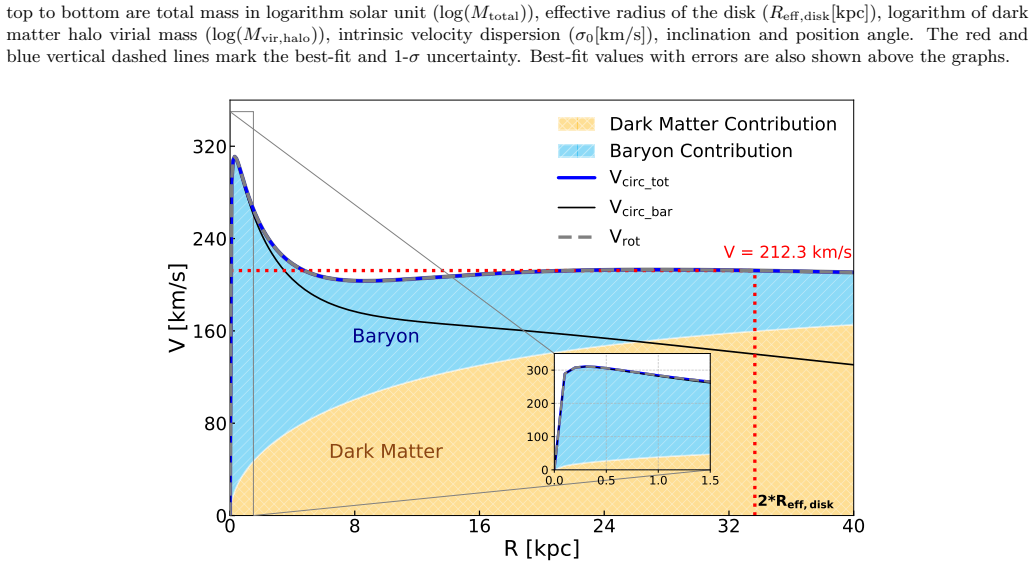
Observations of eight Seyfert AGN host galaxies reveal that their atomic hydrogen mass-size relation has a slope consistent with the canonical value for star-forming galaxies within 2 sigma. This implies AGN feedback does not significantly disrupt the global extent or large-scale structure of HI reservoirs. Kinematic analysis of UGC 4503 shows elevated velocity dispersion of 14.9 km/s and V/sigma of 14.28, pointing to possible AGN-driven turbulence in the gas disk.
What carries the argument
The HI mass-size relation, which links total neutral hydrogen mass to the radius of the gas disk and acts as a diagnostic for large-scale disruption by feedback.
Load-bearing premise
The small sample of eight Seyfert galaxies is representative of the broader AGN population and can be directly compared to large samples of star-forming spirals without major selection biases.
What would settle it
A larger sample of Seyfert galaxies showing a statistically significant deviation in the HI mass-size relation slope from the canonical value would falsify the central claim.
Figures


read the original abstract
Active galactic nucleus (AGN) feedback is a key ingredient in galaxy evolution, yet its impact on the cold atomic gas reservoir -- the neutral hydrogen (HI) phase -- remains poorly constrained. We present the most extensive spatially resolved HI 21-cm survey of Seyfert AGN hosts to date, based on observations with the Giant Metrewave Radio Telescope (GMRT). Our high-resolution HI maps of eight Seyfert galaxies reveal detailed kinematics and surface density distributions of their atomic gas disks. We find that AGN-host galaxies exhibit a slightly shallower HI mass-size relation than the canonical relation or the SIMBA simulation predictions; however, the measured slope remains consistent with the canonical value within $2\sigma$ uncertainties. This result suggests that AGN feedback does not significantly disrupt the global extent or large-scale structure of atomic gas reservoirs. To investigate the internal HI kinematics in greater detail, we perform a 3D kinematic forward modeling of the HI disk in UGC 4503. Our analysis reveals an elevated intrinsic velocity dispersion of $\sigma = 14.9^{+6.1}_{-3.8}$ km/s and a reduced level of rotational support, with $V/\sigma = 14.28_{-4.17}^{+4.97}$, compared to large-sample star-forming spirals. These kinematic signatures, together with localized residuals in the velocity field, indicate that AGN-driven outflows or jets may inject or indirectly affect the turbulence in the atomic gas disk, potentially regulating the cold gas reservoir. Future GMRT observations, combined with optical integral-field spectroscopy from MaNGA, will enable quantitative constraints on the role of AGN feedback in regulating star formation efficiency across a larger and more representative galaxy sample.
Editorial analysis
A structured set of objections, weighed in public.
Referee Report
Summary. The paper reports GMRT HI 21-cm observations of eight Seyfert galaxies, providing spatially resolved maps of atomic gas disks. It measures the HI mass-size relation slope, finding it slightly shallower than the canonical value but consistent within 2σ uncertainties, and concludes that AGN feedback does not significantly disrupt the global extent or large-scale structure of HI reservoirs. For UGC 4503, 3D kinematic modeling yields elevated intrinsic velocity dispersion (σ = 14.9^{+6.1}_{-3.8} km/s) and reduced rotational support (V/σ = 14.28_{-4.17}^{+4.97}), interpreted as possible AGN-driven turbulence, with plans for future larger samples.
Significance. If the central result holds, the work would add rare high-resolution HI data for AGN hosts and constrain feedback models by indicating limited global impact on atomic gas reservoirs despite local kinematic perturbations. The resolved maps and forward modeling provide a useful template for multi-wavelength studies combining radio and optical IFU data.
major comments (2)
- [Abstract] Abstract: the claim that AGN feedback 'does not significantly disrupt the global extent or large-scale structure' is based solely on the fitted HI mass-size slope remaining consistent with the canonical relation within 2σ for N=8. With such a small sample the slope uncertainty is dominated by sampling variance; a 15-25% shallower slope (plausible for moderate feedback) would still lie inside the reported interval, so the data cannot yet distinguish 'no disruption' from 'disruption below detection threshold'. A power analysis or direct scatter comparison to a feedback-free control sample is required.
- [Kinematic analysis (UGC 4503)] Kinematic modeling of UGC 4503: the reported σ = 14.9^{+6.1}_{-3.8} km/s and V/σ = 14.28_{-4.17}^{+4.97} are presented as evidence for AGN-induced turbulence, yet the large asymmetric uncertainties and absence of a quantitative statistical test against a matched sample of non-AGN spirals prevent a firm attribution to feedback rather than other disk properties.
minor comments (3)
- [Abstract] The abstract states consistency 'within 2σ uncertainties' but does not quote the actual fitted slope value and its uncertainty; these numbers should be reported explicitly.
- [Results] No data table listing individual galaxy HI masses, sizes, uncertainties, or kinematic parameters is mentioned; such a table is needed for reproducibility and independent verification.
- [Discussion] The comparison to 'large-sample star-forming spirals' requires explicit discussion of selection biases and matching criteria to justify the claim that the sample is representative.
Simulated Author's Rebuttal
We thank the referee for their careful reading and constructive comments, which have prompted us to clarify the statistical limitations of our sample and strengthen the presentation of the kinematic results. We address each major comment below and have revised the manuscript accordingly.
read point-by-point responses
-
Referee: [Abstract] Abstract: the claim that AGN feedback 'does not significantly disrupt the global extent or large-scale structure' is based solely on the fitted HI mass-size slope remaining consistent with the canonical relation within 2σ for N=8. With such a small sample the slope uncertainty is dominated by sampling variance; a 15-25% shallower slope (plausible for moderate feedback) would still lie inside the reported interval, so the data cannot yet distinguish 'no disruption' from 'disruption below detection threshold'. A power analysis or direct scatter comparison to a feedback-free control sample is required.
Authors: We agree that the small sample size (N=8) limits the strength of any claim regarding the absence of disruption. The slope consistency within 2σ does not rule out moderate feedback effects, as the referee correctly notes. We have revised the abstract to remove the phrasing 'does not significantly disrupt' and instead state that the HI mass-size relation 'remains consistent with the canonical value within 2σ uncertainties, indicating that any global disruption lies below the detection threshold of the current sample.' We have added a dedicated paragraph in the discussion section acknowledging the dominance of sampling variance and the need for larger samples. A brief power analysis assuming a 20% shallower slope (as suggested) has been included, showing that N≈25 would be required for 80% power to detect such an effect at 2σ. We have also compared the observed scatter in our sample to literature values for non-AGN spirals from the THINGS and HALOGAS surveys, finding no significant excess. revision: yes
-
Referee: [Kinematic analysis (UGC 4503)] Kinematic modeling of UGC 4503: the reported σ = 14.9^{+6.1}_{-3.8} km/s and V/σ = 14.28_{-4.17}^{+4.97} are presented as evidence for AGN-induced turbulence, yet the large asymmetric uncertainties and absence of a quantitative statistical test against a matched sample of non-AGN spirals prevent a firm attribution to feedback rather than other disk properties.
Authors: We acknowledge that the large uncertainties on σ and V/σ preclude a definitive statistical attribution to AGN feedback alone. We have revised the relevant section to present these values as 'suggestive of elevated turbulence' rather than firm evidence, and we explicitly note the asymmetric errors. To address the lack of a matched control sample, we have added a direct comparison to the median intrinsic velocity dispersion (≈10 km/s) and V/σ ratios (typically >20) reported for star-forming spirals in the THINGS survey and in the kinematic modeling of Leroy et al. (2008). While a formal Kolmogorov-Smirnov test against a new matched sample is not possible with the current data, the UGC 4503 values lie outside the 1σ range of the literature distribution. We have also clarified that the localized velocity residuals provide supporting (though not conclusive) evidence for AGN influence. These changes are presented as preliminary indications motivating future observations rather than a robust detection. revision: partial
Circularity Check
No circularity: purely observational measurements with no self-referential derivations
full rationale
The paper reports direct GMRT HI observations of eight Seyfert galaxies, constructs the HI mass-size relation from the measured masses and sizes of those galaxies, and performs a standard 3D kinematic forward model on the velocity field of UGC 4503 to extract dispersion and V/σ. The slope consistency statement is a statistical comparison of the fitted value against an external canonical relation; it does not reduce to a fitted parameter being renamed as a prediction, nor does any step invoke self-citation for uniqueness or smuggle an ansatz. The derivation chain is self-contained against the telescope data and standard modeling assumptions.
Axiom & Free-Parameter Ledger
axioms (1)
- domain assumption Standard assumptions in 3D kinematic forward modeling of HI disks hold for UGC 4503
Reference graph
Works this paper leans on
-
[1]
Abazajian, K. N., Adelman-McCarthy, J. K., Ag¨ ueros, M. A., et al. 2009, ApJS, 182, 543, doi: 10.1088/0067-0049/182/2/543 Astropy Collaboration, Price-Whelan, A. M., Lim, P. L., et al. 2022, ApJ, 935, 167, doi: 10.3847/1538-4357/ac7c74
-
[2]
R., Wuyts, S., F¨ orster Schreiber, N
Avery, C. R., Wuyts, S., F¨ orster Schreiber, N. M., et al. 2021, MNRAS, 503, 5134, doi: 10.1093/mnras/stab780 Bah´ e, Y. M., Crain, R. A., Kauffmann, G., et al. 2016, MNRAS, 456, 1115, doi: 10.1093/mnras/stv2674
-
[3]
Baldwin, J. A., Phillips, M. M., & Terlevich, R. 1981, PASP, 93, 5, doi: 10.1086/130766
-
[4]
2006, A&A, 447, 49, doi: 10.1051/0004-6361:20053210
Battaglia, G., Fraternali, F., Oosterloo, T., & Sancisi, R. 2006, A&A, 447, 49, doi: 10.1051/0004-6361:20053210
-
[5]
Begeman, K. G. 1989, A&A, 223, 47
1989
-
[6]
2010, AJ, 140, 1194, doi: 10.1088/0004-6256/136/6/2846
Bigiel, F., Leroy, A., Walter, F., et al. 2010, AJ, 140, 1194, doi: 10.1088/0004-6256/136/6/2846
-
[7]
1981, AJ, 86, 1825, doi: 10.1086/113063
Bosma, A. 1981, AJ, 86, 1825, doi: 10.1086/113063
-
[8]
H., & Rhee, M.-H
Broeils, A. H., & Rhee, M.-H. 1997, A&A, 324, 877
1997
-
[9]
Overview of the SDSS-IV MaNGA Survey: Mapping Nearby Galaxies at Apache Point Observatory
Bundy, K., Bershady, M. A., Law, D. R., et al. 2014, ApJ, 798, 7, doi: 10.1088/0004-637X/798/1/7
-
[10]
2014, A&A, 562, A21, doi: 10.1051/0004-6361/201322464
Cicone, C., Maiolino, R., Sturm, E., et al. 2014, A&A, 562, A21, doi: 10.1051/0004-6361/201322464
-
[11]
Ciotti, L., Ostriker, J. P., & Proga, D. 2010, ApJ, 717, 708, doi: 10.1088/0004-637X/717/2/708
-
[12]
2021, CARTA: Cube Analysis and Rendering Tool for Astronomy, Astrophysics Source Code Library, record ascl:2103.031
Comrie, A., Wang, K.-S., Hsu, S.-C., et al. 2021, CARTA: Cube Analysis and Rendering Tool for Astronomy, Astrophysics Source Code Library, record ascl:2103.031. http://ascl.net/2103.031
2021
-
[13]
Costa-Souza, J. H., Riffel, R. A., Souza-Oliveira, G. L., et al. 2024, ApJ, 974, 127, doi: 10.3847/1538-4357/ad702a
-
[14]
Crain, R. A., Schaye, J., Bower, R. G., et al. 2015, MNRAS, 450, 1937, doi: 10.1093/mnras/stv725
-
[15]
Cresci, G., Hicks, E. K. S., Genzel, R., et al. 2009, ApJ, 697, 115, doi: 10.1088/0004-637X/697/1/115
-
[16]
Croton, D. J., Springel, V., White, S. D., et al. 2006, MNRAS, 365, 11, doi: 10.1111/j.1365-2966.2005.09675.x
-
[17]
Schombert, J., & Dwarakanath, K. 2020, ApJ, 889, 10, doi: 10.3847/1538-4357/ab5fcd 15 Dav´ e, R., Angl´ es-Alc´ azar, D., Narayanan, D., et al. 2019, MNRAS, 486, 2827, doi: 10.1093/mnras/stz937
-
[18]
Davies, R., F¨ orster Schreiber, N. M., Cresci, G., et al. 2011, ApJ, 741, 69, doi: 10.1088/0004-637X/741/2/69
-
[19]
Davies, R. I., Tacconi, L. J., & Genzel, R. 2004a, ApJ, 602, 148, doi: 10.1086/380995 —. 2004b, ApJ, 613, 781, doi: 10.1086/423315
-
[20]
L., Belli, S., Park, M., et al
Davies, R. L., Belli, S., Park, M., et al. 2024, MNRAS, 528, 4976, doi: 10.1093/mnras/stae327 De Blok, W., Walter, F., Brinks, E., et al. 2008, AJ, 136, 2648, doi: 10.1088/0004-6256/136/6/2648
-
[21]
Deconto-Machado, A., Riffel, R. A., Ilha, G. S., et al. 2022, A&A, 659, A131, doi: 10.1051/0004-6361/202140613
-
[22]
Dey, A., Schlegel, D. J., Lang, D., et al. 2019, AJ, 157, 168, doi: 10.3847/1538-3881/ab089d
-
[23]
Diamond-Stanic, A. M., & Rieke, G. H. 2012, ApJ, 746, 168, doi: 10.1088/0004-637X/746/2/168
-
[24]
Diemer, B., Stevens, A. R. H., Lagos, C. d. P., et al. 2019, MNRAS, 487, 1529, doi: 10.1093/mnras/stz1323 do Nascimento, J. C., Dors, O. L., Storchi-Bergmann, T., et al. 2022, MNRAS, 513, 807, doi: 10.1093/mnras/stac771
-
[25]
L., Brown, T., Catinella, B., & Cortese, L
Ellison, S. L., Brown, T., Catinella, B., & Cortese, L. 2019, MNRAS, 482, 5694, doi: 10.3847/2041-8213/ac794f
-
[26]
Ellison, S. L., Wong, T., S´ anchez, S. F., et al. 2021, MNRAS, 505, L46, doi: 10.1093/mnrasl/slab047
-
[27]
Esparza-Arredondo, D., Almeida, C. R., Audibert, A., et al. 2025, A&A, 693, A174, doi: 10.1051/0004-6361/202452488
-
[28]
, archivePrefix = "arXiv", eprint =
Fabello, S., Kauffmann, G., Catinella, B., et al. 2011, MNRAS, 416, 1739, doi: 10.1111/j.1365-2966.2011.18825.x
-
[29]
Fabian, A. C. 2012, ARA&A, 50, 455, doi: 10.1146/annurev-astro-081811-125521
work page internal anchor Pith review doi:10.1146/annurev-astro-081811-125521 2012
-
[30]
and Lang, Dustin and Goodman, Jonathan , title =
Foreman-Mackey, D., Hogg, D. W., Lang, D., & Goodman, J. 2013, PASP, 125, 306, doi: 10.1086/670067 Garc´ ıa-Burillo, S., Alonso-Herrero, A., Ramos Almeida, C., et al. 2021, A&A, 652, A98, doi: 10.1051/0004-6361/202141075
-
[31]
2023, MNRAS, 521, 5645, doi: 10.1093/mnras/stad792
Gebek, A., Baes, M., Diemer, B., et al. 2023, MNRAS, 521, 5645, doi: 10.1093/mnras/stad792
-
[32]
G., Garc´ ıa-Burillo, S., & Combes, F
Haan, S., Schinnerer, E., Mundell, C. G., Garc´ ıa-Burillo, S., & Combes, F. 2007, AJ, 135, 232, doi: 10.1088/0004-6256/135/1/232
-
[33]
Haynes, M. P., Giovanelli, R., Kent, B. R., et al. 2018, ApJ, 861, 49, doi: 10.3847/1538-4357/aac956 Hermosa Mu˜ noz, L., Alonso-Herrero, A., Pereira-Santaella, M., et al. 2024, A&A, 690, A350, doi: 10.1051/0004-6361/202450262
-
[34]
Hopkins, P. F., Hernquist, L., Cox, T. J., et al. 2006, ApJS, 163, 1, doi: 10.1086/499298
-
[35]
2017, MNRAS, 470, 3071, doi: 10.1093/mnras/stx1447
Jensen, J., H¨ onig, S., Rakshit, S., et al. 2017, MNRAS, 470, 3071, doi: 10.1093/mnras/stx1447
-
[36]
2025, Science and Technology Review, 43, 55, doi: 10.3981/j.issn.1000-7857.2024.10.01446
Jiang, P., LIU, b., & Yu, D. 2025, Science and Technology Review, 43, 55, doi: 10.3981/j.issn.1000-7857.2024.10.01446
-
[37]
2019, Science China
Jiang, P., Yue, Y., Gan, H., et al. 2019, Science China
2019
-
[38]
Physics, Mechanics & Astronomy, 62, 959502, doi: 10.1007/s11433-018-9376-1
-
[39]
2024, Astronomical Techniques and Instruments, 1, 84, doi: 10.61977/ati2024012
Jiang, P., Chen, R., Gan, H., et al. 2024, Astronomical Techniques and Instruments, 1, 84, doi: 10.61977/ati2024012
-
[40]
, archivePrefix = "arXiv", eprint =
Jones, M. G., Haynes, M. P., Giovanelli, R., & Moorman, C. 2018, MNRAS, 477, 2, doi: 10.1093/mnras/sty521
-
[41]
2021, Experimental Astronomy, 51, 95, doi: 10.1007/s10686-020-09677-6
Kale, R., & Ishwara-Chandra, C. 2021, Experimental Astronomy, 51, 95, doi: 10.1007/s10686-020-09677-6
-
[42]
2019, MNRAS, 483, L98, doi: 10.1093/mnrasl/sly203
Katz, H., Desmond, H., McGaugh, S., & Lelli, F. 2019, MNRAS, 483, L98, doi: 10.1093/mnrasl/sly203
-
[43]
Kauffmann, G., Heckman, T. M., Tremonti, C., et al. 2003, MNRAS, 346, 1055, doi: 10.1111/j.1365-2966.2003.07154.x
-
[44]
Ram Pressure Stripping of Disc Galaxies: The Role of the Inclination Angle , shorttitle =
Kewley, L. J., Groves, B., Kauffmann, G., & Heckman, T. 2006, MNRAS, 372, 961, doi: 10.1111/j.1365-2966.2006.10859.x
-
[45]
Kormendy, J., & Ho, L. C. 2013, ARA&A, 51, 511, doi: 10.1146/annurev-astro-082708-101811
work page internal anchor Pith review doi:10.1146/annurev-astro-082708-101811 2013
-
[46]
Krumholz, M. R., & Burkhart, B. 2016, MNRAS, 458, 1671, doi: 10.1093/mnras/stw434
-
[47]
Lammers, C., Iyer, K. G., Ibarra-Medel, H., et al. 2023, ApJ, 953, 26, doi: 10.3847/1538-4357/acdd57
-
[48]
Lang, P., F¨ orster Schreiber, N. M., Genzel, R., et al. 2017, ApJ, 840, 92, doi: 10.3847/1538-4357/aa6d82
-
[49]
Lee, L. L., F¨ orster Schreiber, N. M., Price, S. H., et al. 2025, ApJ, 978, 14, doi: 10.3847/1538-4357/ad90b5
-
[50]
Lelli, F., McGaugh, S. S., & Schombert, J. M. 2016, AJ, 152, 157, doi: 10.3847/0004-6256/152/6/157
-
[51]
Li, S.-L., Grasha, K., Krumholz, M. R., et al. 2024a, Monthly Notices of the Royal Astronomical Society, 529, 4993, doi: 10.1093/mnras/stae869
-
[52]
Li, S.-L., Li, Z., Wisnioski, E., Krumholz, M. R., & S´ anchez, S. F. 2024b, Monthly Notices of the Royal Astronomical Society, 536, 430, doi: 10.1093/mnras/stae2603
-
[53]
Liu, D., Schreiber, N. F., Genzel, R., et al. 2023, ApJ, 942, 98, doi: 10.3847/1538-4357/aca46b
-
[54]
2022, The Astrophysical Journal, 941, 205, doi: 10.3847/1538-4357/aca326 16
Ma, W., Liu, K., Guo, H., et al. 2022, The Astrophysical Journal, 941, 205, doi: 10.3847/1538-4357/aca326 16
-
[55]
2007, in Astronomical Society of the Pacific Conference Series, Vol
Golap, K. 2007, in Astronomical Society of the Pacific Conference Series, Vol. 376, Astronomical Data Analysis Software and Systems XVI, 127
2007
-
[56]
2011, International Journal of Modern Physics D, 20, 989, doi: 10.1142/S0218271811019335
Nan, R., Li, D., Jin, C., et al. 2011, International Journal of Modern Physics D, 20, 989, doi: 10.1142/S0218271811019335
-
[57]
Narayanan, D., Smith, J.-D., Hensley, B. S., et al. 2023, ApJ, 951, 100, doi: 10.3847/1538-4357/accf8d
-
[58]
Navarro, J. F., Frenk, C. S., & White, S. D. M. 1996, ApJ, 462, 563, doi: 10.1086/177173
-
[59]
Newville, M., Stensitzki, T., Allen, D. B., et al. 2016, Astrophysics Source Code Library, ascl, doi: 10.5281/zenodo.11813
-
[60]
Oh, S.-H., Hunter, D. A., Brinks, E., et al. 2015, AJ, 149, 180, doi: 10.1088/0004-6256/149/6/180
-
[61]
Penny, S. J., Masters, K. L., Smethurst, R., et al. 2018, MNRAS, 476, 979, doi: 10.1093/mnras/sty202
-
[62]
Piotrowska, J. M., Bluck, A. F. L., Maiolino, R., & Peng, Y. 2022, MNRAS, 512, 1052, doi: 10.1093/mnras/stab3673
-
[63]
Price, S. H., Shimizu, T. T., Genzel, R., et al. 2021, ApJ, 922, 143, doi: 10.3847/1538-4357/ac22ad
-
[64]
2025, arXiv preprint arXiv:2512.04582
Rabyang, O., & Elson, E. 2025, arXiv preprint arXiv:2512.04582
-
[65]
2021, ApJ, 910, 139, doi: 10.3847/1538-4357/abdcad
Revalski, M., Meena, B., Martinez, F., et al. 2021, ApJ, 910, 139, doi: 10.3847/1538-4357/abdcad
-
[66]
Rhee, J., Lah, P., Briggs, F. H., et al. 2018, MNRAS, 473, 1879, doi: 10.1093/mnras/stx2461
-
[67]
Scannapieco, C. e. a., Wadepuhl, M., Parry, O., et al. 2012, MNRAS, 423, 1726, doi: 10.1111/j.1365-2966.2012.20993.x
-
[68]
Schaye, J., Crain, R. A., Bower, R. G., et al. 2015, MNRAS, 446, 521, doi: 10.1093/mnras/stu2058
-
[69]
2020, ApJ, 899, 112, doi: 10.3847/1538-4357/aba8a1
Treister, E. 2020, The Astrophysical Journal, 899, 112, doi: 10.3847/1538-4357/aba8a1
-
[70]
Shangguan, J., Ho, L. C., & Xie, Y. 2018, The Astrophysical Journal, 854, 158, doi: 10.3847/1538-4357/aaa9be
-
[71]
2022, A&A, 659, A123, doi: 10.1051/0004-6361/201936803
Singha, M., Husemann, B., Urrutia, T., et al. 2022, A&A, 659, A123, doi: 10.1051/0004-6361/201936803
-
[72]
Springel, V., Di Matteo, T., & Hernquist, L. 2005, MNRAS, 361, 776, doi: 10.1111/j.1365-2966.2005.09238.x
-
[73]
Stevens, A. R., Diemer, B., Lagos, C. d. P., et al. 2019, MNRAS, 490, 96, doi: 10.1093/mnras/stz2513
-
[74]
R., Brown, T., Diemer, B., et al
Stevens, A. R., Brown, T., Diemer, B., et al. 2023, The Astrophysical Journal Letters, 957, L19, doi: 10.3847/2041-8213/ad014b
-
[75]
1991, Current science, 60, 95
Swarup, G., Ananthakrishnan, S., Kapahi, V., et al. 1991, Current science, 60, 95
1991
-
[76]
2002, A&A, 390, 829, doi: 10.1051/0004-6361:20011755
Swaters, R., Van Albada, T., Van Der Hulst, J., & Sancisi, R. 2002, A&A, 390, 829, doi: 10.1051/0004-6361:20011755
-
[77]
2009, AJ, 137, 4424, doi: 10.1088/0004-6256/137/5/4424 Van Albada, T
Tamburro, D., Rix, H.-W., Leroy, A., et al. 2009, AJ, 137, 4424, doi: 10.1088/0004-6256/137/5/4424 Van Albada, T. S., Bahcall, J. N., Begeman, K., & Sancisi, R. 1985, AJ, 295, 305, doi: 10.1086/163375
-
[78]
Veilleux, S., Maiolino, R., Bolatto, A. D., & Aalto, S. 2020, A&A Rv, 28, 2, doi: 10.1007/s00159-019-0121-9
-
[79]
Veilleux, S., & Osterbrock, D. E. 1987, ApJS, 63, 295, doi: 10.1086/191166
-
[80]
2017, Frontiers in Astronomy and Space Sciences, 4, 46, doi: 10.3389/fspas.2017.00046
Venturi, G., Marconi, A., Mingozzi, M., et al. 2017, Frontiers in Astronomy and Space Sciences, 4, 46, doi: 10.3389/fspas.2017.00046
discussion (0)
Sign in with ORCID, Apple, or X to comment. Anyone can read and Pith papers without signing in.