Recognition: unknown
A Persistence-Aware Framework for Age Violation Control in Wireless Status Update Systems
Pith reviewed 2026-05-14 18:39 UTC · model grok-4.3
The pith
A consecutive age violation rate vector unifies persistence objectives in wireless status updates and is optimized by quantile regression deep Q-learning.
A machine-rendered reading of the paper's core claim, the machinery that carries it, and where it could break.
Core claim
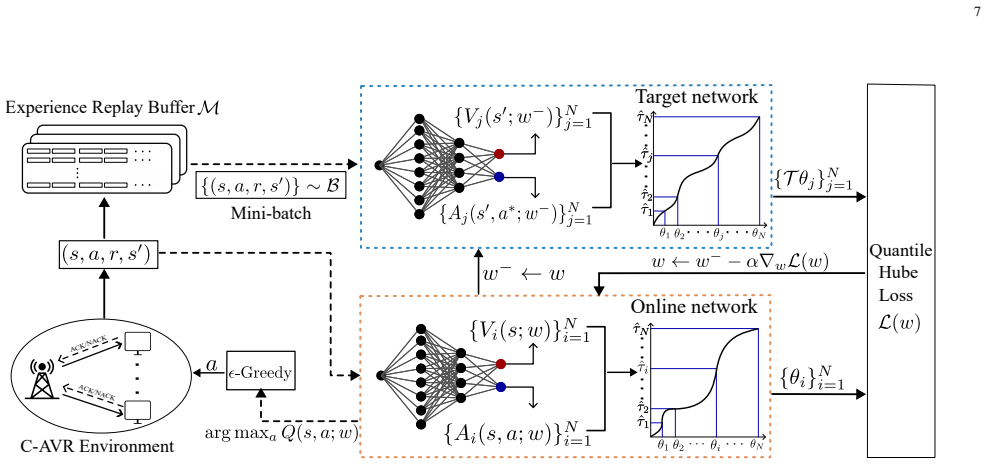
The C-AVR vector quantifies AoI threshold violations over consecutive windows of different lengths; weighting its components produces a family of persistence-aware reliability objectives that are solved by QR-D3QN, which models return distributions rather than scalar expectations and thereby supplies usable learning signals for rare prolonged violation sequences under stochastic arrivals, unreliable channels, and transmission costs.
What carries the argument
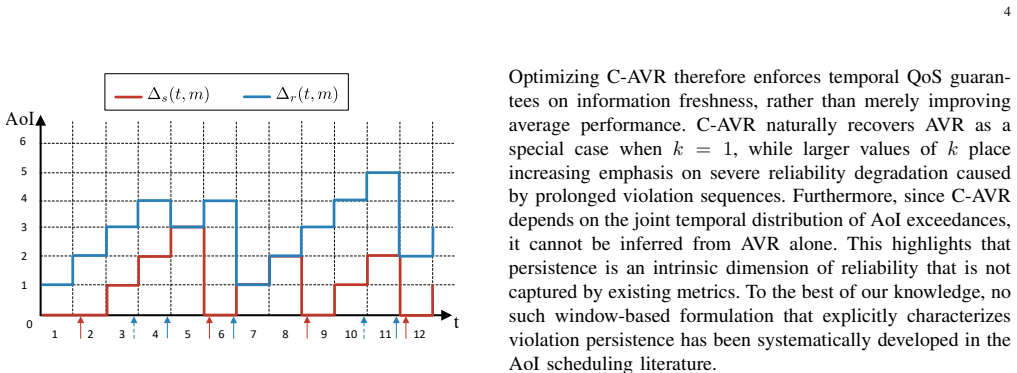
The consecutive age violation rate (C-AVR) vector, whose components record the fraction of time slots that begin a streak of AoI threshold violations of exact length k.
If this is right
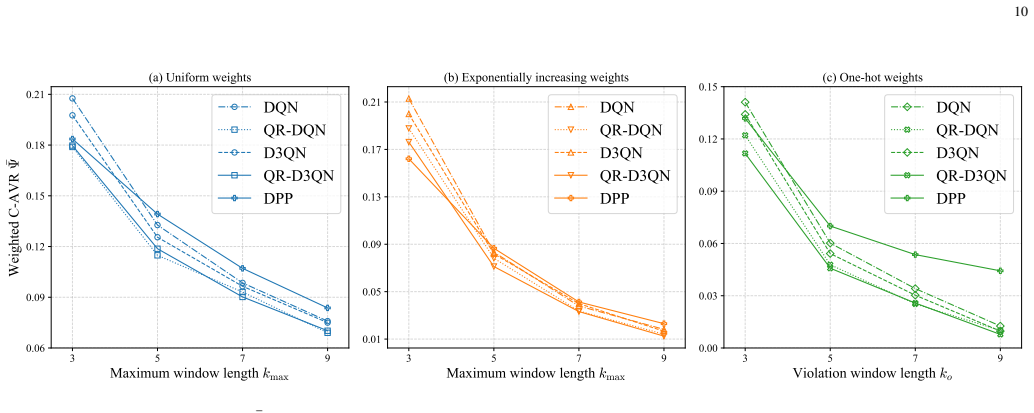
- Weighted C-AVR objectives let designers trade average persistence against the probability of very long violation runs without changing the underlying learner.
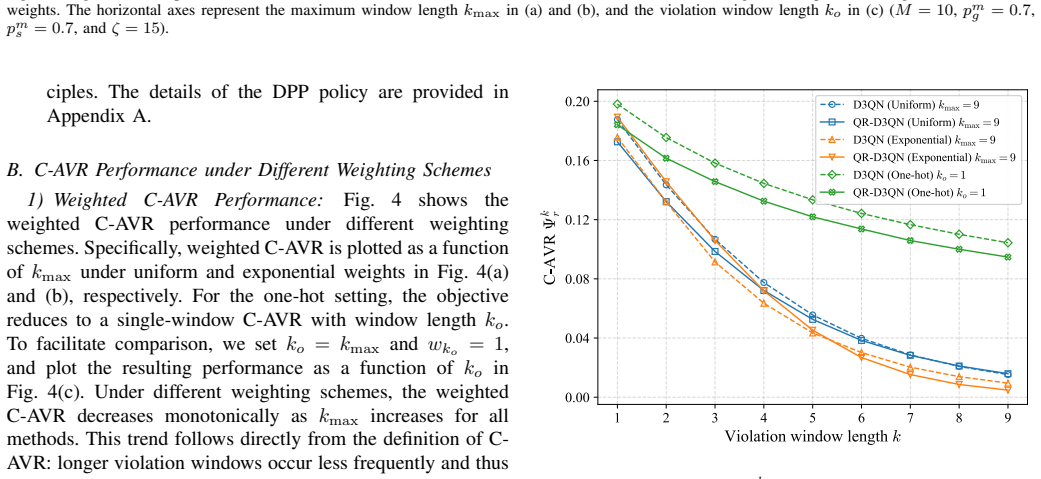
- Quantile regression supplies value estimates for rare long sequences that scalar critics miss, improving reliability at every persistence scale.
- Component-wise gains are largest for the longest violation windows, exactly where tail-sensitive applications care most.
- The same architecture works across wide ranges of weighting vectors, arrival rates, and cost budgets without retuning the network.
Where Pith is reading between the lines
- The C-AVR idea could be applied to other rare-event control problems where consecutive failures matter more than isolated ones.
- If real channels exhibit longer memory than the simulated models, the distributional advantage would likely increase rather than disappear.
- Hybrid policies that switch between C-AVR weightings based on observed violation history could be learned with the same QR-D3QN backbone.
Load-bearing premise
The simulated packet arrivals, channel errors, and cost constraints reproduce the temporal correlation patterns that occur in actual wireless deployments.
What would settle it
A hardware experiment in which the QR-D3QN policy fails to produce fewer long consecutive violation sequences than an expectation-based policy under matched traffic and channel statistics would falsify the performance claim.
Figures



read the original abstract
Timely and reliable status updates are essential for emerging QoS-sensitive wireless applications. Common age of information (AoI)-based metrics, such as average AoI and age violation rate (AVR), characterize time-averaged freshness or violation frequency but do not explicitly capture the temporal persistence of consecutive age violations, which can be critical in safety-sensitive wireless applications. We develop a persistence-aware reliability framework based on the consecutive age violation rate (C-AVR) vector, whose components quantify AoI threshold violations over consecutive time windows of different lengths. Through flexible weighting schemes, the proposed framework unifies reliability objectives ranging from average persistence to tail-sensitive performance. Optimizing weighted C-AVR objectives is challenging because consecutive violations are temporally correlated, leading to sparse learning signals. To address this issue, we develop a distributional reinforcement learning approach based on a quantile regression dueling double deep Q-network (QR-D3QN). By modeling a quantile-based return distribution rather than only a scalar expected return, QR-D3QN provides richer value-estimation signals for rare but prolonged violation sequences under stochastic packet arrivals, unreliable channels, and transmission cost constraints. Simulation results show that QR-D3QN consistently outperforms expectation-based baselines across a wide range of weighting schemes and system settings, with particularly significant gains under tail-sensitive persistence objectives. Component-wise analysis further shows that distributional value learning substantially improves reliability across multiple persistence scales, especially for long consecutive violation sequences. Overall, our results establish the proposed C-AVR framework as an effective foundation for persistence-aware reliability evaluation.
Editorial analysis
A structured set of objections, weighed in public.
Referee Report
Summary. The manuscript develops a persistence-aware reliability framework for wireless status update systems based on the consecutive age violation rate (C-AVR) vector, which measures AoI threshold violations over consecutive time windows of varying lengths. It proposes a quantile regression dueling double deep Q-network (QR-D3QN) to optimize flexibly weighted C-AVR objectives under stochastic packet arrivals, unreliable channels, and cost constraints. The approach is motivated by the temporal correlation in consecutive violations leading to sparse signals for standard RL. Simulation results indicate that QR-D3QN consistently outperforms expectation-based baselines, with larger gains for tail-sensitive weighting schemes, and component-wise analysis shows improvements especially for long violation sequences.
Significance. This work meaningfully extends AoI-based metrics by incorporating persistence, which is relevant for applications where prolonged violations are particularly harmful. The distributional RL method is well-suited to the problem of rare events. If the simulation results are robust to more realistic channel models, the framework could serve as a foundation for designing control policies in real-time wireless systems. The paper provides credit for using distributional methods to handle the specific challenge of correlated violations.
major comments (2)
- [Simulation Setup] Simulation Setup: The models for packet arrivals and channel unreliability (Bernoulli or Markovian) are described, but there is no validation or comparison showing that they reproduce the long-range temporal correlations typical in real wireless deployments, which is critical for the claimed advantages of QR-D3QN on prolonged violation sequences.
- [Results and Discussion] Results and Discussion: The abstract reports consistent outperformance across weighting schemes, but without details on the number of independent runs, variance estimates, or statistical significance tests, it is difficult to assess the reliability of the 'particularly significant gains' under tail-sensitive objectives.
minor comments (1)
- [Abstract] The definition of the C-AVR vector components could be stated more explicitly in the abstract and early sections to aid readers unfamiliar with the metric.
Simulated Author's Rebuttal
We thank the referee for the constructive comments and positive assessment of the significance of our persistence-aware C-AVR framework and QR-D3QN approach. We address each major comment below and outline the revisions we will incorporate.
read point-by-point responses
-
Referee: The models for packet arrivals and channel unreliability (Bernoulli or Markovian) are described, but there is no validation or comparison showing that they reproduce the long-range temporal correlations typical in real wireless deployments, which is critical for the claimed advantages of QR-D3QN on prolonged violation sequences.
Authors: We thank the referee for this important point. The Bernoulli and Markovian models are standard in the AoI literature and the Markovian channel does introduce temporal correlations relevant to consecutive violations. We acknowledge that these may not fully capture long-range dependencies observed in some real deployments. In the revised manuscript, we will add a discussion subsection on model limitations with references to wireless measurement studies, and include additional simulation results using a long-range dependent channel model (e.g., ARMA-based) to demonstrate robustness of the QR-D3QN gains on prolonged sequences. revision: yes
-
Referee: The abstract reports consistent outperformance across weighting schemes, but without details on the number of independent runs, variance estimates, or statistical significance tests, it is difficult to assess the reliability of the 'particularly significant gains' under tail-sensitive objectives.
Authors: We agree that providing these details is necessary to substantiate the reported gains. In the revised manuscript, we will specify the number of independent runs (at least 20 per setting with varied seeds), report mean and standard deviation for all key metrics, and include statistical significance tests (e.g., paired t-tests) to confirm improvements, particularly under tail-sensitive weightings. These will be added to the simulation results section and updated figures/tables. revision: yes
Circularity Check
No significant circularity: C-AVR metric and QR-D3QN application defined independently
full rationale
The paper introduces the consecutive age violation rate (C-AVR) vector as a new persistence-aware metric whose components are defined directly from AoI threshold violations over consecutive windows, without reference to prior fitted quantities or self-citations. It then applies the standard QR-D3QN algorithm (a distributional variant of D3QN) to optimize weighted C-AVR objectives under the stated stochastic arrival and channel model. No equations reduce a claimed prediction to a fitted input by construction, no uniqueness theorem is imported from the authors' prior work, and no ansatz is smuggled via self-citation. Simulation results are presented as empirical outcomes rather than derivations that collapse to the input data. The central claims therefore remain self-contained against external benchmarks.
Axiom & Free-Parameter Ledger
Reference graph
Works this paper leans on
-
[1]
Real-time status: How often should one update?
S. Kaul, R. Yates, and M. Gruteser, “Real-time status: How often should one update?” inProc. IEEE INFOCOM, Mar. 2012, pp. 2731–2735
2012
-
[2]
On the role of age of information in the internet of things,
M. A. Abd-Elmagid, N. Pappas, and H. S. Dhillon, “On the role of age of information in the internet of things,”IEEE Commun. Mag., vol. 57, no. 12, pp. 72–77, Dec. 2019
2019
-
[3]
Y . Sun, I. Kadota, R. Talak, E. Modiano, and R. Srikant,Age of Information: A New Metric for Information Freshness. Morgan & Claypool, 2019
2019
-
[4]
Minimizing the aoi in resource-constrained multi-source relaying systems: Dynamic and learning-based scheduling,
A. Zakeri, M. Moltafet, M. Leinonen, and M. Codreanu, “Minimizing the aoi in resource-constrained multi-source relaying systems: Dynamic and learning-based scheduling,”IEEE Trans. Wireless Commun., vol. 23, no. 1, pp. 450–466, Jan. 2024
2024
-
[5]
Aequitas: A 5G scheduler for minimizing outdated information in IoT networks,
C. Li, Q. Liu, Y . T. Hou, W. Lou, and S. Kompella, “Aequitas: A 5G scheduler for minimizing outdated information in IoT networks,”IEEE Internet Things J., vol. 11, no. 13, pp. 23 322–23 335, Jul. 2024
2024
-
[6]
Age of information: An introduction and survey,
R. D. Yates, Y . Sun, D. R. Brown, S. K. Kaul, E. Modiano, and S. Ulukus, “Age of information: An introduction and survey,”IEEE J. Sel. Areas Commun., vol. 39, no. 5, pp. 1183–1210, Mar. 2021
2021
-
[7]
Timely status update in relay-assisted cooperative communications,
H. Pan, J. Feng, T.-T. Chan, V . C. Leung, and J. Li, “Timely status update in relay-assisted cooperative communications,”IEEE Trans. Veh. Tech., vol. 72, no. 12, pp. 15 745–15 761, Dec. 2023
2023
-
[8]
Age-optimal packet scheduling with resource constraint and feedback delay,
Y . Ji, Y . Lu, X. Xu, and X. Huang, “Age-optimal packet scheduling with resource constraint and feedback delay,”IEEE Trans. Commun., vol. 72, no. 7, pp. 4041–4054, Jul. 2024
2024
-
[9]
Average aoi minimization with directional charging for wireless-powered network edge,
Q. Chen and et al., “Average aoi minimization with directional charging for wireless-powered network edge,”IEEE Trans. Mobile Comput., vol. 24, no. 6, pp. 4889–4906, Jun. 2025
2025
-
[10]
Age of information in internet of things: A survey,
˙I. Kahraman, A. K ¨ose, M. Koca, and E. Anarim, “Age of information in internet of things: A survey,”IEEE Internet Things J., vol. 11, no. 6, pp. 9896–9914, Mar. 2024
2024
-
[11]
Scheduling algorithms for optimizing age of information in wireless networks with throughput constraints,
I. Kadota, A. Sinha, and E. Modiano, “Scheduling algorithms for optimizing age of information in wireless networks with throughput constraints,”IEEE/ACM Trans. Netw., vol. 27, no. 4, pp. 1359–1372, Aug. 2019
2019
-
[12]
Statistical guarantee optimization for age of information for the D/G/1 queue,
J. P. Champati, H. Al-Zubaidy, and J. Gross, “Statistical guarantee optimization for age of information for the D/G/1 queue,” inProc. IEEE INFOCOM Workshops, Apr. 2018, pp. 130–135
2018
-
[13]
Delay and peak-age violation probability in short-packet transmissions,
R. Devassy, G. Durisi, G. C. Ferrante, O. Simeone, and E. Uysal- Biyikoglu, “Delay and peak-age violation probability in short-packet transmissions,” inProc. IEEE ISIT, Jun. 2018, pp. 2471–2475
2018
-
[14]
Information update: TDMA or FDMA?
H. Pan and S. C. Liew, “Information update: TDMA or FDMA?”IEEE Wirel Commun Lett., vol. 9, no. 6, pp. 856–860, Jun. 2020
2020
-
[15]
Information freshness and timeliness analysis in the finite blocklength regime for mission-critical applications,
D. Zhang and et al., “Information freshness and timeliness analysis in the finite blocklength regime for mission-critical applications,”IEEE Trans. Commun., vol. 73, no. 12, pp. 14 458–14 468, Dec. 2025
2025
-
[16]
Age-based multi-channel- scheduling under constraints: Optimal and online designs,
X. Zhou, I. Koprulu, and A. Eryilmaz, “Age-based multi-channel- scheduling under constraints: Optimal and online designs,”IEEE Trans. Netw., vol. 33, no. 1, pp. 51–64, Feb. 2025
2025
-
[17]
State-aware resource allocation for wireless closed-loop control systems,
L. Scheuvens, T. H ¨oßler, P. Schulz, N. Franchi, A. N. Barreto, and G. P. Fettweis, “State-aware resource allocation for wireless closed-loop control systems,”IEEE Trans. Commun., vol. 69, no. 10, pp. 6604–6619, Oct. 2021
2021
-
[18]
Scheduling algorithms for minimizing age of information in wireless broadcast networks with random arrivals,
Y .-P. Hsu, E. Modiano, and L. Duan, “Scheduling algorithms for minimizing age of information in wireless broadcast networks with random arrivals,”IEEE Trans. Mobile Comput., vol. 19, no. 12, pp. 2903–2915, Dec. 2020
2020
-
[19]
Age-optimal multi-channel- scheduling under energy and tolerance constraints,
X. Zhou, I. Koprulu, and A. Eryilmaz, “Age-optimal multi-channel- scheduling under energy and tolerance constraints,” inProc. IEEE INFOCOM Workshops, Aug. 2023, pp. 1–8
2023
-
[20]
Multi- source aoi-constrained resource minimization under harq: Heterogeneous sampling processes,
S. S. Vilni, M. Moltafet, M. Leinonen, and M. Codreanu, “Multi- source aoi-constrained resource minimization under harq: Heterogeneous sampling processes,”IEEE Trans. Veh. Technol., vol. 73, no. 1, pp. 1084– 1099, Jan. 2024
2024
-
[21]
The frontiers of deep reinforcement learning for resource management in future wireless HetNets: Techniques, challenges, and research direc- tions,
A. Alwarafy, M. Abdallah, B. S. C ¸ iftler, A. Al-Fuqaha, and M. Hamdi, “The frontiers of deep reinforcement learning for resource management in future wireless HetNets: Techniques, challenges, and research direc- tions,”IEEE Open J. Commun. Soc., vol. 3, pp. 322–365, 2022
2022
-
[22]
Age of information minimization for UA V-assisted internet of things networks: A safe actor-critic with policy distillation approach,
F. Fu, X. Wei, Z. Zhang, L. T. Yang, L. Cai, J. Luo, Z. Zhang, and C. Wang, “Age of information minimization for UA V-assisted internet of things networks: A safe actor-critic with policy distillation approach,” IEEE Trans. Netw. Sci. Eng., vol. 11, no. 1, pp. 1265–1276, Feb. 2024
2024
-
[23]
Double Q-learning,
H. V . Hasselt, “Double Q-learning,” inProc. Adv. Neural Inf. Process. Syst. (NeurIPS), vol. 23, Feb. 2010, pp. 2613–2621
2010
-
[24]
Dueling network architectures for deep reinforcement learning,
Z. Wang, T. Schaul, M. Hessel, H. van Hasselt, M. Lanctot, and N. de Freitas, “Dueling network architectures for deep reinforcement learning,” inProc. Int. Conf. Mach. Learn. (ICML), vol. 4, Nov. 2016, p. 2939–2947
2016
-
[25]
A distributional perspec- tive on reinforcement learning,
M. G. Bellemare, W. Dabney, and R. Munos, “A distributional perspec- tive on reinforcement learning,” inProc. Int. Conf. Mach. Learn. (ICML), 2017
2017
-
[26]
Distribu- tional reinforcement learning with quantile regression,
W. Dabney, M. Rowland, M. G. Bellemare, and R. Munos, “Distribu- tional reinforcement learning with quantile regression,” inProc. AAAI Conf. Artif. Intell., 2018
2018
-
[27]
M. G. Bellemare, W. Dabney, and M. Rowland,Distributional Rein- forcement Learning. MIT Press, 2023
2023
-
[28]
Conservative offline distribu- tional actor critic,
Y . Ma, D. Jayaraman, and O. Bastani, “Conservative offline distribu- tional actor critic,” inProc. Adv. Neural Inf. Process. Syst. (NeurIPS), 2021
2021
-
[29]
Risk-averse offline reinforcement learning,
N. Urp ´ı, M. C. Campagnolo, S. Curi, and A. Krause, “Risk-averse offline reinforcement learning,” inProc. Int. Conf. Learn. Represent. (ICLR), 2021. 16
2021
-
[30]
Deep distributional reinforcement learning- based adaptive routing with guaranteed delay bounds,
J. Liu, D. Li, and Y . Xu, “Deep distributional reinforcement learning- based adaptive routing with guaranteed delay bounds,”IEEE/ACM Trans. Netw., vol. 32, no. 6, pp. 4692–4706, Dec. 2024
2024
-
[31]
Distributional soft actor-critic with three refine- ments,
J. Duan, W. Wang, L. Xiao, J. Gao, S. E. Li, C. Liu, Y .-Q. Zhang, B. Cheng, and K. Li, “Distributional soft actor-critic with three refine- ments,”IEEE Trans. Pattern Anal. Mach. Intell., vol. 47, no. 5, pp. 3935–3946, May. 2025
2025
-
[32]
Distributional reinforcement learning for mmWave communications with intelligent reflectors on a UA V,
Q. Zhang, W. Saad, and M. Bennis, “Distributional reinforcement learning for mmWave communications with intelligent reflectors on a UA V,” inProc. IEEE Global Commun. Conf., 2020, pp. 1–6
2020
-
[33]
A distributional perspective on multiagent cooperation with deep reinforce- ment learning,
L. Huang, M. Fu, A. Rao, A. A. Irissappane, J. Zhang, and C. Xu, “A distributional perspective on multiagent cooperation with deep reinforce- ment learning,”IEEE Trans. Neural Netw. Learn. Syst., vol. 35, no. 3, pp. 4246–4259, Mar. 2024
2024
-
[34]
Offline and distributional reinforcement learning for wireless communications,
E. Eldeeb and H. Alves, “Offline and distributional reinforcement learning for wireless communications,”IEEE Commun. Mag., vol. 63, no. 8, pp. 71–76, Aug. 2025
2025
-
[35]
Con- strained risk-sensitive deep reinforcement learning for eMBB-URLLC joint scheduling,
W. Zhang, M. Derakhshani, G. Zheng, and S. Lambotharan, “Con- strained risk-sensitive deep reinforcement learning for eMBB-URLLC joint scheduling,”IEEE Trans. Wireless Commun., vol. 23, no. 9, pp. 10 608–10 624, Sept. 2024
2024
-
[36]
Neely,Stochastic Network Optimization with Application to Com- munication and Queueing Systems, ser
M. Neely,Stochastic Network Optimization with Application to Com- munication and Queueing Systems, ser. Synthesis lectures on communi- cation networks. Morgan & Claypool Publishers, 2010
2010
-
[37]
Altman,Constrained Markov Decision Processes
E. Altman,Constrained Markov Decision Processes. CRC Press, 1999, vol. 7
1999
discussion (0)
Sign in with ORCID, Apple, or X to comment. Anyone can read and Pith papers without signing in.