Recognition: 2 theorem links
· Lean TheoremToward Practical Age-of-Information Scheduling in 5G Cellular
Pith reviewed 2026-05-14 18:29 UTC · model grok-4.3
The pith
A low-complexity estimator enables practical Age-of-Information scheduling in 5G despite limited observability.
A machine-rendered reading of the paper's core claim, the machinery that carries it, and where it could break.
Core claim
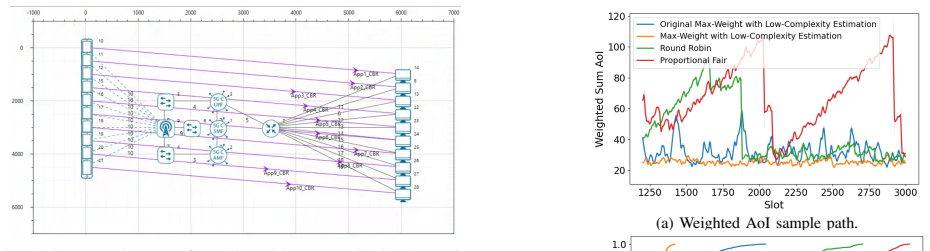
The paper establishes that a low-complexity estimator can infer UE-side packet timestamps and destination-side AoI from gNB-visible observations, allowing a Max-Weight low-complexity (MW-LC) policy to achieve performance close to richer estimator-based AoI policies while satisfying 5G slot-level runtime constraints. The estimator and MW-LC policy are implemented and tested in the NetSim 5G emulator against baseline schedulers, with additional MATLAB simulations confirming the near-equivalent results.
What carries the argument
The low-complexity (LC) estimator that reconstructs hidden timestamps and AoI values from base-station-visible packet receptions and feedback to drive real-time Max-Weight scheduling decisions.
If this is right
- MW-LC can be implemented directly in NetSim using a standards-compatible 5G protocol stack and outperforms conventional 5G scheduling policies.
- The LC estimator enables AoI-aware scheduling decisions without requiring full destination visibility.
- Performance remains close to that of richer estimator-based policies across the tested scenarios.
- Scheduling can respect stringent slot-level timing while still prioritizing low Age of Information.
Where Pith is reading between the lines
- The estimator's design could extend AoI-aware algorithms to other wireless systems that face similar partial-observability constraints.
- The paper notes the estimator may be of independent interest, suggesting it could support AoI methods beyond 5G uplink scheduling.
- Hardware testbed validation would be needed to confirm whether inference accuracy holds under real radio impairments not captured in simulation.
Load-bearing premise
The low-complexity estimator can accurately infer UE-side packet timestamps and destination-side AoI from gNB-visible observations under realistic 5G slot-level constraints.
What would settle it
A MATLAB simulation comparing average AoI under MW-LC with the LC estimator against the richer estimator policy; if the gap exceeds the paper's reported closeness by a significant margin under the same traffic and channel conditions, the performance claim does not hold.
Figures




read the original abstract
We consider a 5G cellular network where a gNB schedules time-sensitive uplink transmissions from multiple UEs and forwards received packets to remote destinations. In practical 5G networks, the gNB does not directly observe the destination-side Age of Information (AoI) and must make scheduling decisions under stringent slot-level runtime constraints. In this paper, we develop a low-complexity AoI-aware scheduling policy for 5G cellular under limited observability. We first design a low-complexity estimator that infers UE-side packet timestamps and destination-side AoI from gNB-visible observations. Based on these estimates, we propose and implement a Max-Weight policy (MW-LC) in NetSim, a 5G emulator with a standards-compatible protocol stack, to showcase its performance against baseline 5G scheduling policies. Furthermore, we use MATLAB simulations to show that the LC estimator and MW-LC achieve performance close to a richer estimator-based AoI policy from the literature. The estimator may be of independent interest to the community, enabling AoI-aware algorithms beyond 5G scheduling.
Editorial analysis
A structured set of objections, weighed in public.
Referee Report
Summary. This paper addresses practical AoI scheduling in 5G cellular networks under limited observability at the gNB. It introduces a low-complexity estimator (LC) to infer UE-side packet timestamps and destination-side AoI from gNB-visible observations, proposes a Max-Weight policy (MW-LC) based on these estimates, implements it in NetSim for comparison with baseline 5G policies, and uses MATLAB simulations to show that the LC estimator and MW-LC achieve performance close to richer estimator-based AoI policies from the literature.
Significance. Should the LC estimator accurately recover the required state information, this contribution would be significant for enabling AoI-aware scheduling in real 5G deployments with stringent runtime constraints and without destination feedback. The low-complexity nature and emulator implementation make it relevant for practical systems, and the estimator could be useful for other AoI-related algorithms in partially observable settings.
major comments (1)
- [MATLAB Simulations] The headline claim that MW-LC achieves performance close to richer estimator-based AoI policies rests on the LC estimator correctly recovering UE packet timestamps and destination AoI from gNB-visible data. No explicit error statistics (bias, variance, or per-slot inference error) are reported for the estimator itself under slot-level constraints, HARQ, or multi-UE contention (see MATLAB simulation results).
minor comments (2)
- [Abstract] The abstract supplies no error bars, statistical tests, or details on traffic models and parameter choices, leaving the 'close to' claim only moderately supported.
- [NetSim Implementation] The NetSim emulation results would benefit from additional details on the traffic models, parameter choices, and statistical significance of the performance differences versus baselines.
Simulated Author's Rebuttal
We thank the referee for the constructive feedback. We address the major comment below and will incorporate revisions to strengthen the validation of the LC estimator.
read point-by-point responses
-
Referee: [MATLAB Simulations] The headline claim that MW-LC achieves performance close to richer estimator-based AoI policies rests on the LC estimator correctly recovering UE packet timestamps and destination AoI from gNB-visible data. No explicit error statistics (bias, variance, or per-slot inference error) are reported for the estimator itself under slot-level constraints, HARQ, or multi-UE contention (see MATLAB simulation results).
Authors: We agree that direct error statistics would strengthen the claims. The current MATLAB results focus on end-to-end AoI performance to demonstrate closeness to richer policies, but we did not include explicit bias, variance, or per-slot error metrics for the LC estimator under HARQ and multi-UE contention. In the revised manuscript we will add these statistics (new figures/tables) computed from the same MATLAB simulation setup, including slot-level inference errors, to directly validate the estimator's accuracy. revision: yes
Circularity Check
No significant circularity; claims rest on empirical comparisons to external literature baselines
full rationale
The paper introduces a low-complexity estimator for inferring timestamps and AoI from gNB observations, then implements an MW-LC Max-Weight policy in NetSim. Performance is evaluated via simulation against standard 5G baselines and a richer estimator-based policy drawn from the external literature. No equations, fitted parameters, or self-citations are presented that reduce the reported closeness of MW-LC to the richer policy by construction. The derivation chain is self-contained against independent benchmarks and does not rely on renaming, ansatz smuggling, or load-bearing self-citation.
Axiom & Free-Parameter Ledger
Lean theorems connected to this paper
-
IndisputableMonolith/Cost/FunctionalEquationwashburn_uniqueness_aczel unclear?
unclearRelation between the paper passage and the cited Recognition theorem.
We develop a low-complexity (LC) estimator for UE-side packet timestamps and destination-side AoI based on gNB-visible observations... using a Bernoulli approximation parameterized by λi
-
IndisputableMonolith/Foundation/RealityFromDistinctionreality_from_one_distinction unclear?
unclearRelation between the paper passage and the cited Recognition theorem.
the resulting MW-LC policy achieves AoI performance close to that of richer estimator-based policies
What do these tags mean?
- matches
- The paper's claim is directly supported by a theorem in the formal canon.
- supports
- The theorem supports part of the paper's argument, but the paper may add assumptions or extra steps.
- extends
- The paper goes beyond the formal theorem; the theorem is a base layer rather than the whole result.
- uses
- The paper appears to rely on the theorem as machinery.
- contradicts
- The paper's claim conflicts with a theorem or certificate in the canon.
- unclear
- Pith found a possible connection, but the passage is too broad, indirect, or ambiguous to say the theorem truly supports the claim.
Reference graph
Works this paper leans on
-
[1]
Minimizing age of information in vehicular networks,
S. Kaul, M. Gruteser, V . Rai, and J. Kenney, “Minimizing age of information in vehicular networks,” inProc. IEEE SECON, 2011
2011
-
[2]
Update or wait: How to keep your data fresh,
Y . Sun, E. Uysal-Biyikoglu, R. D. Yates, C. E. Koksal, and N. B. Shroff, “Update or wait: How to keep your data fresh,”IEEE Trans. Inf. Theory, vol. 63, no. 11, pp. 7492–7508, 2017
2017
-
[3]
Age of information: An introduction and survey,
R. D. Yates, Y . Sun, D. R. Brown, S. K. Kaul, E. Modiano, and S. Ulukus, “Age of information: An introduction and survey,”IEEE J. Sel. Areas Commun., vol. 39, no. 5, pp. 1183–1210, 2021
2021
-
[4]
Scheduling algorithms for optimizing age of information in wireless networks with throughput constraints,
I. Kadota, A. Sinha, and E. Modiano, “Scheduling algorithms for optimizing age of information in wireless networks with throughput constraints,”IEEE/ACM Trans. Netw., vol. 27, no. 4, pp. 1359–1372, 2019
2019
-
[5]
AoI-QPS: Age-of- information aware efficient queue-proportional scheduling,
A. R. Gorle, S. Bhattacharya, and J. M. Cioffi, “AoI-QPS: Age-of- information aware efficient queue-proportional scheduling,” inProc. IEEE GLOBECOM, 2025
2025
-
[6]
Optimizing age of information in networks with large and small updates,
Z. Zhao, V . Tripathi, and I. Kadota, “Optimizing age of information in networks with large and small updates,” inProc. IEEE WiOpt, 2025
2025
-
[7]
Goal- oriented semantic communications for 6G networks,
H. Zhou, Y . Deng, X. Liu, N. Pappas, and A. Nallanathan, “Goal- oriented semantic communications for 6G networks,”IEEE Internet Things Mag., vol. 7, no. 5, pp. 104–110, 2024. [8]3GPP TS 38.211 V16.2.0: NR; Physical Channels and Modulation, 3rd Generation Partnership Project (3GPP) Technical Specification 3GPP TS 38.211, July 2020, release 16
2024
-
[8]
Optimizing age of information without knowing the age of information,
Z. Zhao and I. Kadota, “Optimizing age of information without knowing the age of information,” inProc. IEEE INFOCOM, 2025
2025
-
[9]
WiSwarm: Age-of-information-based wireless net- working for collaborative teams of UA Vs,
V . Tripathi, I. Kadota, E. Tal, M. S. Rahman, A. Warren, S. Karaman, and E. Modiano, “WiSwarm: Age-of-information-based wireless net- working for collaborative teams of UA Vs,” inProc. IEEE INFOCOM, 2023
2023
-
[10]
Minimizing AoI in a 5G-based IoT network under varying channel conditions,
C. Li, Y . Huang, S. Li, Y . Chen, B. A. Jalaian, Y . T. Hou, W. Lou, J. H. Reed, and S. Kompella, “Minimizing AoI in a 5G-based IoT network under varying channel conditions,”IEEE Internet Things J., vol. 8, no. 19, pp. 14 543–14 558, 2021
2021
-
[11]
Aequitas: A 5G scheduler for minimizing outdated information in IoT networks,
C. Li, Q. Liu, Y . T. Hou, W. Lou, and S. Kompella, “Aequitas: A 5G scheduler for minimizing outdated information in IoT networks,”IEEE Internet Things J., 2024
2024
-
[12]
WiFresh: Age-of-information from theory to implementation,
I. Kadota, M. Rahman, and E. Modiano, “WiFresh: Age-of-information from theory to implementation,” inProc. IEEE ICCCN, 2021
2021
-
[13]
An experimental framework for age of information and networked control via software-defined radios,
O. Ayan, H. Y . ¨Ozkan, and W. Kellerer, “An experimental framework for age of information and networked control via software-defined radios,” inProc. IEEE ICC, 2021
2021
-
[14]
Fairness for freshness: Optimal age of information based OFDMA scheduling with minimal knowledge,
B. Han, Y . Zhu, Z. Jiang, M. Sun, and H. D. Schotten, “Fairness for freshness: Optimal age of information based OFDMA scheduling with minimal knowledge,”IEEE Trans. Wireless Commun., vol. 20, no. 12, pp. 7903–7919, 2021
2021
-
[15]
Neely,Stochastic Network Optimization With Application to Com- munication and Queueing Systems
M. Neely,Stochastic Network Optimization With Application to Com- munication and Queueing Systems. Springer Nature, 2022
2022
-
[16]
MATLAB code for Low-Complexity AoI estimation,
Z. Zhao, “MATLAB code for Low-Complexity AoI estimation,” https://github.com/zhuoyijoeyzhao/AoI LCEstimator, 2026. [18]NetSim Network Simulator, Tetcos, Bangalore, India, 2024, version 14.2
2026
-
[17]
Rate control for communication networks: Shadow prices, proportional fairness and stability,
F. P. Kelly, A. K. Maulloo, and D. K. H. Tan, “Rate control for communication networks: Shadow prices, proportional fairness and stability,”J. Oper . Res. Soc., vol. 49, no. 3, pp. 237–252, 1998
1998
discussion (0)
Sign in with ORCID, Apple, or X to comment. Anyone can read and Pith papers without signing in.