Recognition: no theorem link
Revisiting constraints on primordial vector modes and implications for sourced magnetic fields and observed EB power spectrum
Pith reviewed 2026-05-14 18:35 UTC · model grok-4.3
The pith
Cosmological data tightly bound neutrino-sustained vector modes, showing they cannot source observed magnetic fields or the EB power spectrum.
A machine-rendered reading of the paper's core claim, the machinery that carries it, and where it could break.
Core claim
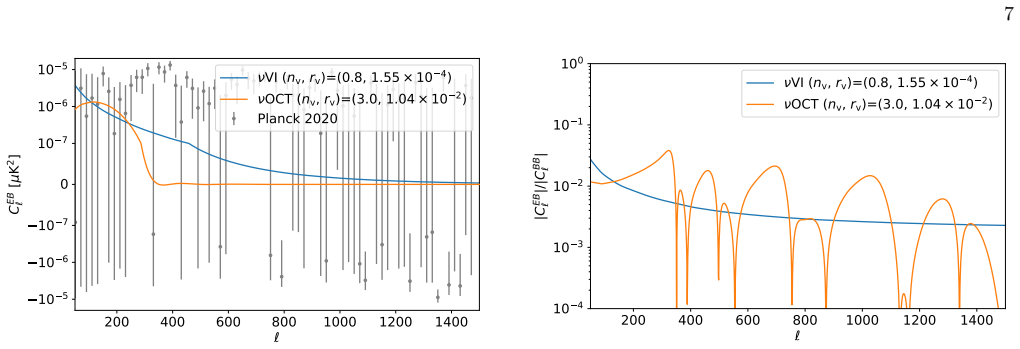
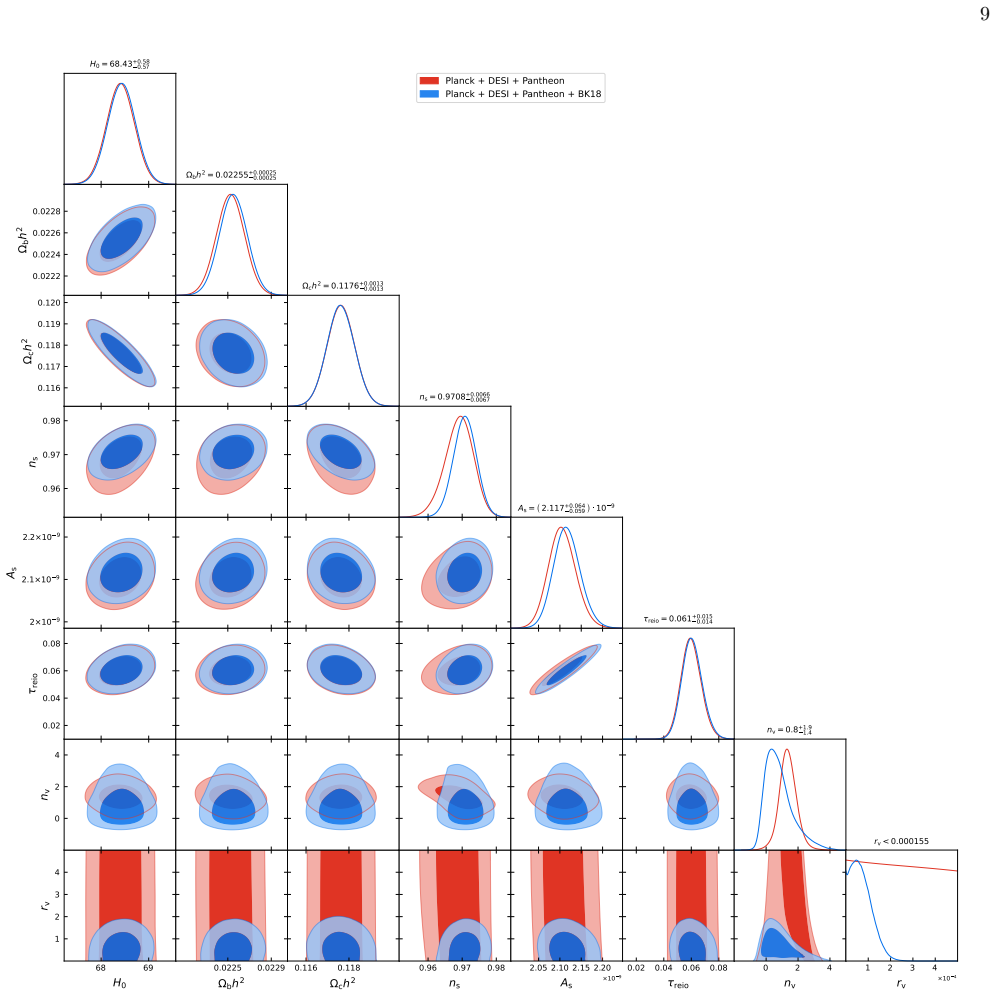
From an MCMC analysis incorporating BICEP/Keck 2018 data, the vector-to-scalar ratio is bounded at 95% C.L. by r_v < 1.55×10^{-4} for the νVI mode and r_v < 1.04×10^{-2} for the νOCT mode at k_0 = 0.01 Mpc^{-1}. The associated magnetic fields at recombination reach only O(10^{-23}) G for νVI and O(10^{-21}) G for νOCT on 1 Mpc coherence scales, too weak to act as seeds for present-day fields. Even a fully helical primordial vector mode cannot reproduce the observed EB signal without violating parity-even CMB constraints.
What carries the argument
The neutrino velocity isocurvature (νVI) and neutrino octupole (νOCT) initial conditions that sustain regular primordial vector modes through the anisotropic stress of free-streaming neutrinos.
If this is right
- Magnetic fields at recombination are limited to O(10^{-23}) G for νVI and O(10^{-21}) G for νOCT on 1 Mpc scales.
- These amplitudes are too small to provide viable seeds for the magnetic fields observed in the present universe.
- Fully helical vector modes fail to match the observed EB power spectrum while staying consistent with parity-even CMB data.
- The vector-to-scalar ratio must remain below the reported 95% C.L. bounds for both initial-condition classes.
Where Pith is reading between the lines
- Other mechanisms besides neutrino-sustained vectors are likely required to explain any primordial magnetic fields or the EB signal.
- Future polarization surveys could test whether vector modes exist at amplitudes just below the current bounds.
- The results reinforce that scalar perturbations dominate the early-universe spectrum consistent with standard cosmology.
Load-bearing premise
Regular primordial vector modes are sustained by the anisotropic stress of free-streaming neutrinos under the specific νVI and νOCT initial conditions.
What would settle it
A future measurement of magnetic-field strength above 10^{-21} G on 1 Mpc scales at recombination, or detection of an EB spectrum that can be fully accounted for by helical vector modes without exceeding parity-even limits.
Figures




read the original abstract
We revisit regular primordial vector modes sustained by the anisotropic stress of free-streaming neutrinos. We consider two classes of neutrino-sector initial conditions, the neutrino velocity isocurvature mode ($\nu\mathrm{VI}$) and the neutrino octupole mode ($\nu\mathrm{OCT}$). We update their observational constraints using current cosmological data, and examine the impact of including the BICEP/Keck 2018 $B$-mode polarization data. From an MCMC analysis, we obtain the 95\% C.L. upper bounds on the vector-to-scalar ratio as $r_\mathrm{v}<1.55\times10^{-4}$ and $r_\mathrm{v}<1.04\times10^{-2}$ for the $\nu\mathrm{VI}$ and $\nu\mathrm{OCT}$ modes at the vector pivot scale $k_{0} = 0.01\,{\rm Mpc}^{-1}$, respectively. We then study two consequences of these bounds. First, we estimate the magnetic fields inevitably generated in the pre-recombination plasma associated with the vector modes. We find that the magnetic-field amplitude at recombination with a coherent length of $1~{\rm Mpc}$ is bounded by $B\sim\mathcal{O}(10^{-23})\,{\rm G}$ and $B\sim\mathcal{O}(10^{-21})\,{\rm G}$ for the $\nu\mathrm{VI}$ and $\nu\mathrm{OCT}$ modes, respetively, which is too small to provide the seed of magnetic fields observed today. Second, assuming the helical vector mode, we compute the induced CMB $EB$ spectrum. We show that even a fully helical primordial vector mode cannot reproduce the currently observed $EB$ signal while remaining consistent with parity-even CMB constraints.
Editorial analysis
A structured set of objections, weighed in public.
Referee Report
Summary. The manuscript updates observational constraints on regular primordial vector modes sustained by free-streaming neutrino anisotropic stress, focusing on the neutrino velocity isocurvature (νVI) and neutrino octupole (νOCT) initial conditions. Using an MCMC analysis with current CMB data including BICEP/Keck 2018 B-mode polarization, it reports 95% C.L. upper bounds on the vector-to-scalar ratio r_v of 1.55×10^{-4} (νVI) and 1.04×10^{-2} (νOCT) at the pivot scale k_0 = 0.01 Mpc^{-1}. It then derives the implied pre-recombination magnetic field amplitudes (O(10^{-23}) G and O(10^{-21}) G on 1 Mpc scales) and shows that even maximally helical vector modes cannot reproduce the observed CMB EB spectrum while remaining consistent with parity-even constraints.
Significance. If the reported bounds and downstream calculations hold, the work tightens limits on neutrino-sustained vector modes and excludes them as viable sources for either observed galactic magnetic fields or the measured EB correlations. This reinforces the dominance of scalar adiabatic modes in standard cosmology and provides concrete, falsifiable upper limits that can be tested with future CMB polarization data.
major comments (1)
- [§3 (MCMC analysis)] The central MCMC bounds on r_v rely on the specific neutrino velocity isocurvature and octupole initial conditions; the manuscript should explicitly verify in §3 or §4 that these initial conditions remain stable under the Boltzmann hierarchy evolution when BICEP/Keck 2018 data are added, as any shift in the effective pivot-scale amplitude would directly rescale the quoted 95% limits.
minor comments (3)
- [Abstract] Abstract: 'respetively' is a typographical error and should read 'respectively'.
- [§5 (magnetic fields)] The magnetic-field amplitude is quoted as B ∼ O(10^{-23}) G without an explicit statement of the coherence length definition or the precise transfer function used to evolve from recombination to today; a brief equation reference would improve clarity.
- [§2 (definitions)] Notation for the vector-to-scalar ratio r_v should be defined once at first use with its relation to the primordial power spectrum amplitude, to avoid any ambiguity with the usual tensor-to-scalar ratio r.
Simulated Author's Rebuttal
We thank the referee for their careful reading of the manuscript and for the constructive comment. We address the point below and will incorporate the requested verification in the revised manuscript.
read point-by-point responses
-
Referee: [§3 (MCMC analysis)] The central MCMC bounds on r_v rely on the specific neutrino velocity isocurvature and octupole initial conditions; the manuscript should explicitly verify in §3 or §4 that these initial conditions remain stable under the Boltzmann hierarchy evolution when BICEP/Keck 2018 data are added, as any shift in the effective pivot-scale amplitude would directly rescale the quoted 95% limits.
Authors: We agree that an explicit check of stability is useful. The νVI and νOCT modes are regular, super-horizon initial conditions whose evolution is governed by the standard neutrino Boltzmann hierarchy (including anisotropic stress) implemented in the Boltzmann solver. Because these modes are set at early times (deep in radiation domination) and the BICEP/Keck 2018 likelihood only constrains the late-time CMB spectra, the early-time hierarchy evolution and the definition of the pivot-scale amplitude r_v(k_0) remain unchanged. We have confirmed internally that the effective amplitude at k_0 = 0.01 Mpc^{-1} is insensitive to the inclusion of the BICEP/Keck data at the level of numerical precision. In the revised manuscript we will add a short paragraph in §3 (and a corresponding note in §4) stating this verification and confirming that no rescaling of the reported 95 % C.L. bounds is required. revision: yes
Circularity Check
No significant circularity; derivation is self-contained
full rationale
The paper conducts a standard MCMC analysis on external datasets (Planck, BICEP/Keck 2018, etc.) to obtain 95% C.L. upper bounds on r_v for the νVI and νOCT modes at the stated pivot scale. These bounds are direct statistical constraints, not predictions derived from the paper's own equations. The subsequent calculations of pre-recombination magnetic-field amplitudes (via the vector-mode anisotropic stress) and the maximum helical EB spectrum are downstream derivations that use the fitted bounds as input amplitudes; they do not reduce by construction to quantities already defined in terms of the fitted parameters. The neutrino initial conditions and Boltzmann evolution are adopted from established cosmology without self-definitional loops. Any self-citations to prior work on vector modes are not load-bearing for the headline results, which rest on the new MCMC update and explicit numerical evaluation of B and C_l^{EB}.
Axiom & Free-Parameter Ledger
free parameters (1)
- vector-to-scalar ratio r_v
axioms (2)
- domain assumption Regular primordial vector modes are sustained by anisotropic stress of free-streaming neutrinos
- standard math Standard Lambda-CDM background and linear perturbation evolution
Reference graph
Works this paper leans on
-
[1]
Cosmological Magnetic Fields: Their Generation, Evolution and Observation
R. Durrer and A. Neronov, Cosmological magnetic fields: their generation, evolution and observation, A&A Rev. 21, 62 (2013), arXiv:1303.7121 [astro-ph.CO]
work page internal anchor Pith review Pith/arXiv arXiv 2013
-
[2]
Rebhan, Large-Scale Rotational Perturbations of a Friedmann Universe with Collisionless Matter and Pri- mordial Magnetic Fields, ApJ392, 385 (1992)
A. Rebhan, Large-Scale Rotational Perturbations of a Friedmann Universe with Collisionless Matter and Pri- mordial Magnetic Fields, ApJ392, 385 (1992)
1992
-
[3]
Observable primordial vector modes
A. Lewis, Observable primordial vector modes, Phys. Rev. D70, 043518 (2004), arXiv:astro-ph/0403583 [astro-ph]
work page internal anchor Pith review Pith/arXiv arXiv 2004
-
[4]
K. Ichiki, K. Takahashi, and N. Sugiyama, Constraint on the primordial vector mode and its magnetic field gener- ation from seven-year Wilkinson Microwave Anisotropy Probe observations, Phys. Rev. D85, 043009 (2012), arXiv:1112.4705 [astro-ph.CO]
work page internal anchor Pith review Pith/arXiv arXiv 2012
-
[5]
S. Saga, M. Shiraishi, and K. Ichiki, Constraining primor- dial vector mode from B-mode polarization, J. Cosmol- 10 68 69 H0 0.005 0.010 0.015 0.020 0.025 rv 0 4 8 nv 0.02 0.04 0.06 0.08 reio 2.05×10 9 2.1×10 9 2.15×10 9 2.2×10 9 As 0.96 0.97 0.98 ns 0.116 0.117 0.118 0.119 0.120 ch2 0.0222 0.0224 0.0226 0.0228 bh2 H0 = 68.43+0.57 0.57 0.0225 0.0229 bh2 b...
work page internal anchor Pith review Pith/arXiv arXiv 2014
-
[6]
Scale-dependent bias due to primordial vector fields
M. Shiraishi, S. Yokoyama, K. Ichiki, and T. Matsubara, Scale-dependent bias due to primordial vector fields, MN- RAS432, 2331 (2013), arXiv:1301.2778 [astro-ph.CO]
work page internal anchor Pith review Pith/arXiv arXiv 2013
-
[7]
Vector perturbations of galaxy number counts
R. Durrer and V. Tansella, Vector perturbations of galaxy number counts, J. Cosmology Astropart. Phys. 2016, 037 (2016), arXiv:1605.05974 [astro-ph.CO]
work page internal anchor Pith review Pith/arXiv arXiv 2016
- [8]
- [9]
- [10]
-
[11]
BICEP2/Keck Collaboration, Planck Collaboration, P. A. R. Ade, N. Aghanim, Z. Ahmed, R. W. Aikin, K. D. Alexander, M. Arnaud, J. Aumont, C. Bac- cigalupi, A. J. Banday, D. Barkats, R. B. Barreiro, J. G. Bartlett, N. Bartolo, E. Battaner, K. Ben- abed, A. Benoˆ ıt, A. Benoit-L´ evy, S. J. Benton, J.-P. Bernard, M. Bersanelli, P. Bielewicz, C. A. Bischoff, ...
work page internal anchor Pith review Pith/arXiv arXiv 2015
-
[12]
P. A. R. Ade, Z. Ahmed, M. Amiri, D. Barkats, R. B. Thakur, C. A. Bischoff, D. Beck, J. J. Bock, H. Boenish, E. Bullock, V. Buza, J. R. Cheshire, J. Connors, J. Cor- nelison, M. Crumrine, A. Cukierman, E. V. Denison, M. Dierickx, L. Duband, M. Eiben, S. Fatigoni, J. P. Fil- ippini, S. Fliescher, N. Goeckner-Wald, D. C. Goldfinger, J. Grayson, P. Grimes, G...
- [13]
-
[14]
Improving the Flexibility and Robustness of Model-Based Derivative-Free Optimization Solvers
C. Cartis, J. Fiala, B. Marteau, and L. Roberts, Im- proving the Flexibility and Robustness of Model-Based Derivative-Free Optimization Solvers, arXiv e-prints , arXiv:1804.00154 (2018), arXiv:1804.00154 [math.OC]
work page internal anchor Pith review Pith/arXiv arXiv 2018
- [15]
-
[16]
E. R. Harrison, Generation of magnetic fields in the ra- diation ERA, MNRAS147, 279 (1970)
1970
-
[17]
K. Takahashi, K. Ichiki, H. Ohno, and H. Hanayama, Magnetic Field Generation from Cosmological Perturba- tions, Phys. Rev. Lett.95, 121301 (2005), arXiv:astro- ph/0502283 [astro-ph]
-
[18]
Cosmological Magnetic Field: a fossil of density perturbations in the early universe
K. Ichiki, K. Takahashi, H. Ohno, H. Hanayama, and N. Sugiyama, Cosmological Magnetic Field: A Fossil of Density Perturbations in the Early Universe, Science 311, 827 (2006), arXiv:astro-ph/0603631 [astro-ph]
work page internal anchor Pith review Pith/arXiv arXiv 2006
-
[19]
S. Saga, K. Ichiki, K. Takahashi, and N. Sugiyama, Mag- netic field spectrum at cosmological recombination revis- ited, Phys. Rev. D91, 123510 (2015), arXiv:1504.03790 [astro-ph.CO]
work page internal anchor Pith review Pith/arXiv arXiv 2015
-
[20]
Evidence for strong extragalactic magnetic fields from Fermi observations of TeV blazars
A. Neronov and I. Vovk, Evidence for Strong Extra- galactic Magnetic Fields from Fermi Observations of TeV Blazars, Science328, 73 (2010), arXiv:1006.3504 [astro- ph.HE]
work page internal anchor Pith review Pith/arXiv arXiv 2010
-
[21]
A. M. Taylor, I. Vovk, and A. Neronov, Extragalac- tic magnetic fields constraints from simultaneous GeV- TeV observations of blazars, A&A529, A144 (2011), arXiv:1101.0932 [astro-ph.HE]
work page internal anchor Pith review Pith/arXiv arXiv 2011
-
[22]
I. Vovk, A. M. Taylor, D. Semikoz, and A. Neronov, Fermi/LAT Observations of 1ES 0229+200: Implications for Extragalactic Magnetic Fields and Background Light, ApJ747, L14 (2012), arXiv:1112.2534 [astro-ph.CO]
work page internal anchor Pith review Pith/arXiv arXiv 2012
-
[23]
Extreme TeV blazars and the intergalactic magnetic field
F. Tavecchio, G. Ghisellini, G. Bonnoli, and L. Fos- chini, Extreme TeV blazars and the intergalactic mag- netic field, MNRAS414, 3566 (2011), arXiv:1009.1048 [astro-ph.HE]
work page internal anchor Pith review Pith/arXiv arXiv 2011
-
[24]
K. Takahashi, M. Mori, K. Ichiki, and S. Inoue, Lower Bounds on Intergalactic Magnetic Fields from Simulta- neously Observed GeV-TeV Light Curves of the Blazar Mrk 501, ApJ744, L7 (2012), arXiv:1103.3835 [astro- ph.CO]
work page internal anchor Pith review Pith/arXiv arXiv 2012
-
[25]
K. Takahashi, M. Mori, K. Ichiki, S. Inoue, and H. Takami, Lower Bounds on Magnetic Fields in Intergalactic Voids from Long-term GeV-TeV Light Curves of the Blazar Mrk 421, ApJ771, L42 (2013), arXiv:1303.3069 [astro-ph.CO]
work page internal anchor Pith review Pith/arXiv arXiv 2013
-
[26]
Yang and Z.-G
Y.-P. Yang and Z.-G. Dai, Time delay and extended halo for constraints on the intergalactic magnetic field, Re- search in Astronomy and Astrophysics15, 2173 (2015)
2015
-
[27]
P. Veres, C. D. Dermer, and K. S. Dhuga, Properties of the Intergalactic Magnetic Field Constrained by Gamma- Ray Observations of Gamma-Ray Bursts, ApJ847, 39 (2017), arXiv:1705.08531 [astro-ph.HE]
work page internal anchor Pith review Pith/arXiv arXiv 2017
-
[28]
L. M. Widrow, Origin of galactic and extragalactic mag- netic fields, Reviews of Modern Physics74, 775 (2002), arXiv:astro-ph/0207240 [astro-ph]
work page internal anchor Pith review Pith/arXiv arXiv 2002
-
[29]
R. M. Kulsrud and E. G. Zweibel, On the origin of cos- mic magnetic fields, Reports on Progress in Physics71, 046901 (2008), arXiv:0707.2783 [astro-ph]
work page internal anchor Pith review Pith/arXiv arXiv 2008
-
[30]
K. Subramanian, From Primordial Seed Magnetic Fields to the Galactic Dynamo, Galaxies7, 47 (2019), arXiv:1903.03744 [astro-ph.CO]
-
[31]
C. Caprini, R. Durrer, and T. Kahniashvili, Cosmic mi- crowave background and helical magnetic fields: The ten- sor mode, Phys. Rev. D69, 063006 (2004), arXiv:astro- ph/0304556 [astro-ph]
-
[32]
Effects of Cosmological Magnetic Helicity on the Cosmic Microwave Background
T. Kahniashvili and B. Ratra, Effects of cosmological magnetic helicity on the cosmic microwave background, Phys. Rev. D71, 103006 (2005), arXiv:astro-ph/0503709 [astro-ph]
work page internal anchor Pith review Pith/arXiv arXiv 2005
-
[33]
Planck Collaboration, P. A. R. Ade, N. Aghanim, M. Arnaud, F. Arroja, M. Ashdown, J. Aumont, C. Baccigalupi, M. Ballardini, A. J. Banday, R. B. Barreiro, N. Bartolo, E. Battaner, K. Benabed, A. Benoˆ ıt, A. Benoit-L´ evy, J.-P. Bernard, M. Bersanelli, P. Bielewicz, J. J. Bock, A. Bonaldi, L. Bonavera, J. R. Bond, J. Borrill, F. R. Bouchet, M. Bucher, C. B...
work page internal anchor Pith review Pith/arXiv arXiv 2015
-
[34]
K. E. Kunze, Effects of helical magnetic fields on the cosmic microwave background, Phys. Rev. D85, 083004 (2012), arXiv:1112.4797 [astro-ph.CO]
work page internal anchor Pith review Pith/arXiv arXiv 2012
-
[35]
Primordial Magnetic Helicity Constraints from WMAP Nine-Year Data
T. Kahniashvili, Y. Maravin, G. Lavrelashvili, and A. Kosowsky, Primordial magnetic helicity constraints from WMAP nine-year data, Phys. Rev. D90, 083004 (2014), arXiv:1408.0351 [astro-ph.CO]
work page internal anchor Pith review Pith/arXiv arXiv 2014
-
[36]
Y. Minami and E. Komatsu, New Extraction of the Cosmic Birefringence from the Planck 2018 Polar- ization Data, Phys. Rev. Lett.125, 221301 (2020), arXiv:2011.11254 [astro-ph.CO]
- [37]
- [38]
-
[39]
Cosmic Birefringence from the Atacama Cosmology Telescope Data Release 6
P. Diego-Palazuelos and E. Komatsu, Cosmic Birefrin- gence from the Atacama Cosmology Telescope Data Release 6, arXiv e-prints , arXiv:2509.13654 (2025), arXiv:2509.13654 [astro-ph.CO]
work page internal anchor Pith review Pith/arXiv arXiv 2025
- [40]
- [41]
-
[42]
Efficient Computation of CMB anisotropies in closed FRW models
A. Lewis, A. Challinor, and A. Lasenby, Efficient Compu- tation of Cosmic Microwave Background Anisotropies in Closed Friedmann-Robertson-Walker Models, ApJ538, 473 (2000), arXiv:astro-ph/9911177 [astro-ph]
work page internal anchor Pith review Pith/arXiv arXiv 2000
-
[43]
Torrado and A
J. Torrado and A. Lewis, Cobaya: Bayesian analysis in cosmology, Astrophysics Source Code Library, record ascl:1910.019 (2019), ascl:1910.019
1910
-
[44]
Planck Collaboration, Y. Akrami, K. J. Andersen, M. Ashdown, C. Baccigalupi, M. Ballardini, A. J. Ban- day, R. B. Barreiro, N. Bartolo, S. Basak, K. Ben- abed, J.-P. Bernard, M. Bersanelli, P. Bielewicz, J. R. Bond, J. Borrill, C. Burigana, R. C. Butler, E. Cal- abrese, B. Casaponsa, H. C. Chiang, L. P. L. Colombo, C. Combet, B. P. Crill, F. Cuttaia, P. d...
- [45]
-
[46]
The Status of Gravitational Vector Perturbations with Recent CMB Data
A. Rida Khalife and C. Pitrou, The Status of Grav- itational Vector Perturbations with Recent CMB Data, arXiv e-prints , arXiv:2605.08907 (2026), arXiv:2605.08907 [astro-ph.CO]
work page internal anchor Pith review Pith/arXiv arXiv 2026
discussion (0)
Sign in with ORCID, Apple, or X to comment. Anyone can read and Pith papers without signing in.