Recognition: no theorem link
Separable surfaces that are critical points of the Dirichlet energy
Pith reviewed 2026-05-14 02:14 UTC · model grok-4.3
The pith
When the constant Λ is nonzero, the only separable surfaces satisfying the PDE φ_xx + φ_yy = Λ/2 are surfaces of revolution or graphs of the form z = f(x) + g(y).
A machine-rendered reading of the paper's core claim, the machinery that carries it, and where it could break.
Core claim
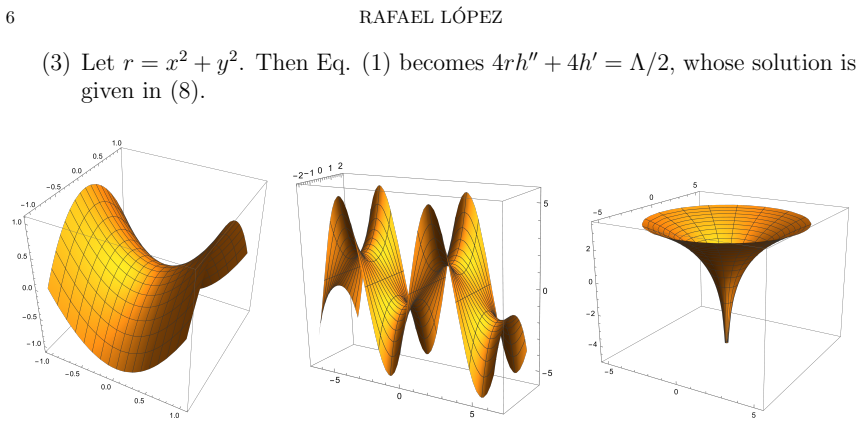
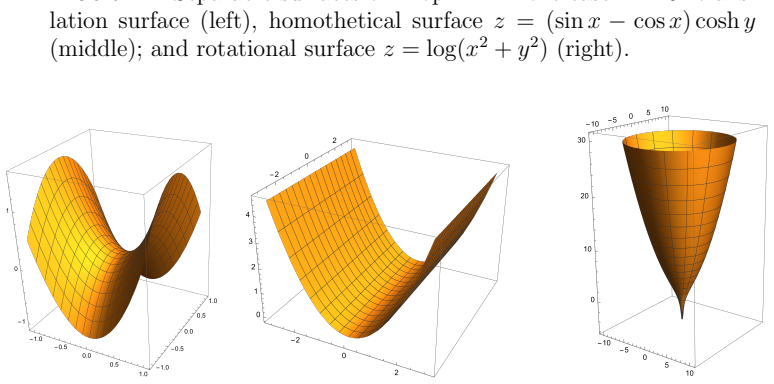
Any surface that is the zero set of f(x) + g(y) + h(z) = 0 and obeys φ_xx + φ_yy = Λ/2 must, when Λ ≠ 0, belong to one of two explicit families: surfaces of revolution or graphs z = f(x) + g(y).
What carries the argument
The separability assumption expressed by the implicit equation f(x) + g(y) + h(z) = 0, which reduces the second-order PDE to ordinary differential equations whose solutions are then classified.
If this is right
- For nonzero Λ the surfaces fall into exactly two parametrized families.
- Explicit parametrizations give all solutions inside the separable class.
- When Λ = 0 the same separability condition permits a larger collection of surfaces possessing additional symmetries.
- The classification supplies concrete candidates for critical points of the Dirichlet energy under the given constraint.
Where Pith is reading between the lines
- The same reduction technique could be applied to other variational problems whose Euler-Lagrange equations are second-order PDEs on graphs.
- Numerical checks could verify whether the explicit families indeed achieve lower Dirichlet energy than nearby non-separable competitors.
- Analogous separability conditions might classify constant-mean-curvature surfaces in other three-dimensional space forms.
Load-bearing premise
The surfaces under study can be written as the zero level set of a sum of three functions each depending on a single coordinate.
What would settle it
An explicit example of a graph z = φ(x,y) obeying φ_xx + φ_yy = Λ/2 with Λ ≠ 0 that is the zero set of some f(x) + g(y) + h(z) = 0 but is neither a surface of revolution nor of the form z = f(x) + g(y).
Figures


read the original abstract
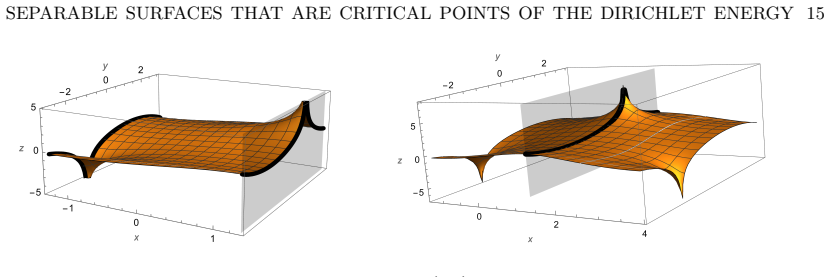
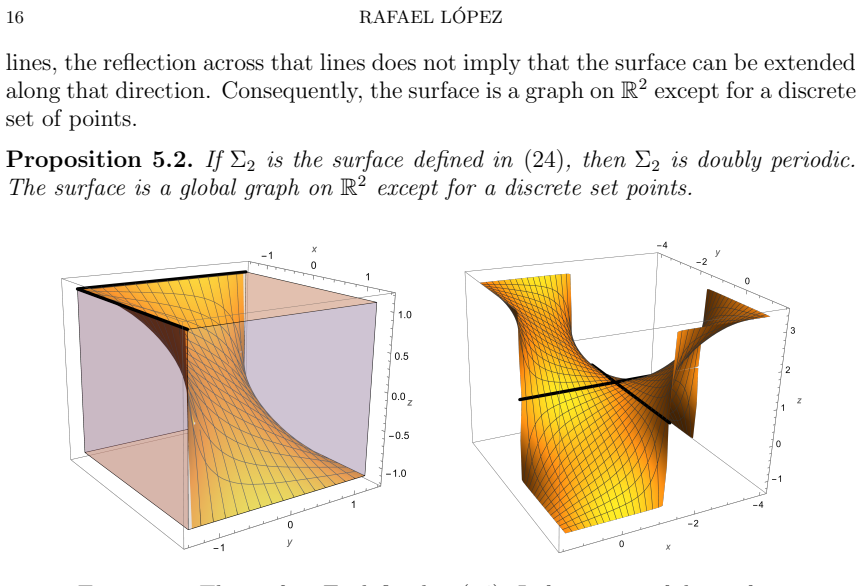
In this paper, we study surfaces $z=\varphi(x,y)$ in Euclidean space that satisfy the equation $\varphi_{xx}+\varphi_{yy}=\frac{\Lambda}{2}$ where $\Lambda\in\r$ is a real constant. We classify these surfaces when they are the zero level sets of an implicit equation of the type $f(x)+g(y)+h(z)=0$, where $f$, $g$ and $h$ are smooth functions of one variable. If $\Lambda=0$, we find a large family of surfaces with interesting symmetry properties. However, if $\Lambda\not=0$, we show that the surfaces must be either surfaces of revolution or of the type $z=f(x)+g(y)$; furthermore, explicit parametrizations of these surfaces are obtained.
Editorial analysis
A structured set of objections, weighed in public.
Referee Report
Summary. The paper classifies surfaces z=φ(x,y) in Euclidean 3-space satisfying the PDE φ_xx + φ_yy = Λ/2 (Λ constant) that arise as zero level sets of separable implicit equations f(x)+g(y)+h(z)=0 with f,g,h smooth. For Λ=0 a large symmetric family is obtained; for Λ≠0 the surfaces are shown to be either surfaces of revolution or graphs of the form z=f(x)+g(y), with explicit parametrizations supplied in each case.
Significance. If the classification is complete, the explicit forms supply concrete examples of separable critical points for the Dirichlet energy functional whose Euler-Lagrange equation reduces to the given Poisson equation. The result is technically straightforward but useful for constructing test surfaces or for further analysis of symmetry-constrained variational problems in differential geometry.
major comments (1)
- [classification for Λ≠0 (implicit differentiation and substitution steps)] The derivation for Λ≠0 proceeds by implicit differentiation of f(x)+g(y)+h(φ(x,y))=0 to obtain φ_x = −f'(x)/h'(φ) and φ_y = −g'(y)/h'(φ), followed by substitution into the PDE. This step divides by h'(φ) and therefore excludes loci where h'=0. No separate analysis is given of the h'=0 locus (or isolated zeros) while still requiring the level set to remain a global graph over the xy-plane. If such loci admit additional solutions satisfying both the implicit form and the constant-Laplacian condition, the claimed dichotomy is incomplete.
minor comments (2)
- [abstract/introduction] The connection between the PDE and the Dirichlet energy is stated in the title but not derived or referenced in the abstract or introduction; a brief sentence recalling the Euler-Lagrange equation would improve context.
- [introduction] Notation for the constant Λ is introduced without specifying its geometric meaning (e.g., relation to mean curvature or energy density); a short remark would help readers outside the immediate subfield.
Simulated Author's Rebuttal
We thank the referee for the careful reading of the manuscript and for highlighting this important technical point in the derivation for the case Λ ≠ 0. We address the comment in detail below and will revise the paper to incorporate the requested clarification.
read point-by-point responses
-
Referee: The derivation for Λ≠0 proceeds by implicit differentiation of f(x)+g(y)+h(φ(x,y))=0 to obtain φ_x = −f'(x)/h'(φ) and φ_y = −g'(y)/h'(φ), followed by substitution into the PDE. This step divides by h'(φ) and therefore excludes loci where h'=0. No separate analysis is given of the h'=0 locus (or isolated zeros) while still requiring the level set to remain a global graph over the xy-plane. If such loci admit additional solutions satisfying both the implicit form and the constant-Laplacian condition, the claimed dichotomy is incomplete.
Authors: We agree that the derivation as written assumes h'(φ) ≠ 0 when obtaining the first partial derivatives and substituting into the PDE. To close this gap, consider a point (x₀, y₀) on the surface where h'(φ(x₀, y₀)) = 0. Differentiating the implicit equation F = f(x) + g(y) + h(φ(x, y)) = 0 immediately yields f'(x₀) = 0 and g'(y₀) = 0. If h' vanishes on a positive-measure subset of the surface, then by continuity h is locally constant on an interval in the z-direction. The level-set equation then becomes independent of z, describing a vertical cylinder (or union of cylinders) that cannot be expressed as a single-valued smooth graph z = φ(x, y) over the entire xy-plane. For isolated zeros, the smoothness of φ together with the requirement that φ_{xx} + φ_{yy} = Λ/2 holds at every point forces f' and g' to vanish identically in a neighborhood (by the implicit-function theorem and the non-vanishing of the gradient of F), again reducing to the constant-h case already excluded. Consequently, no additional solutions exist that satisfy both the separable implicit form and the constant-Laplacian condition while remaining global graphs. We will add a short dedicated subsection (or paragraph) spelling out this case distinction, thereby making the classification fully rigorous without altering the stated dichotomy. revision: yes
Circularity Check
No circularity; direct substitution of separable ansatz into PDE yields explicit classification
full rationale
The derivation begins from the given implicit form f(x)+g(y)+h(z)=0, performs implicit differentiation to express first and second partials of φ, substitutes into the target PDE φ_xx + φ_yy = Λ/2, and solves the resulting ODE system. When Λ≠0 the solutions are forced to be revolution surfaces or z=f(x)+g(y) with explicit parametrizations. This is a standard algebraic reduction under the stated ansatz; no fitted parameters are relabeled as predictions, no self-citations are invoked as load-bearing uniqueness theorems, and the output is not definitionally identical to the input. The division by h'(φ) simply restricts the domain of the argument; it does not create a circular loop. The paper therefore supplies an independent classification within its hypotheses.
Axiom & Free-Parameter Ledger
axioms (1)
- domain assumption f, g, h are smooth functions of one variable
Reference graph
Works this paper leans on
-
[1]
J. E. Brothers, F. Morgan, The isoperimetric theorem for general integrands, Michigan Math. J. 41 (1994), 419--431
work page 1994
-
[2]
T. Hasanis, R. L\'opez, A characteristic property of Delaunay surfaces. Proc. Amer. Math. Soc. 148 (2020), 5291--5298
work page 2020
-
[3]
D. Hoffman, H. Karcher, Complete embedded minimal surfaces of finite total curvature, Geometry, V, Encyclopaedia Math. Sci., vol. 90, Springer, Berlin, 1997, pp. 5--93
work page 1997
-
[4]
M. Koiso and B. Palmer, Geometry and stability of surfaces with constant anisotropic mean curvature, Indiana Univ. Math. J. 54 (2005), 1817--1852
work page 2005
-
[5]
M. Koiso and B. Palmer, Stability of anisotropic capillary surfaces between two parallel planes, Calc. Var. Partial Differ. Equ. 25, (2006), 275--298
work page 2006
-
[6]
M. Koiso and B. Palmer, Equilibria for anisotropic surface energies with wetting and line tension, Calc. Var. Partial Differ. Equ.43 (2012), 555--587
work page 2012
-
[7]
L\'opez, Classification of the ruled surfaces that are critical points of the Dirichlet energy, J
R. L\'opez, Classification of the ruled surfaces that are critical points of the Dirichlet energy, J. Math. Study, to appear
-
[8]
L\'opez, Circles-foliated stationary surfaces of the Dirichlet energy, preprint
R. L\'opez, Circles-foliated stationary surfaces of the Dirichlet energy, preprint
-
[9]
J. C. C. Nitsche, Lectures on minimal surfaces. Vol. 1, Cambridge University Press, Cambridge, 1989
work page 1989
-
[10]
R. C. Reilly, The relative differential geometry of nonparametric hypersurfaces, Duke Math.J. 43 (1976), 705--721
work page 1976
-
[11]
J. E. Taylor, Crystalline variational problems, Bull. Amer. Math. Soc. 84 (1978), 568--588
work page 1978
-
[12]
Wolfram Research, Inc. Mathematica, Version 13.3. Champaign, IL (2023)
work page 2023
discussion (0)
Sign in with ORCID, Apple, or X to comment. Anyone can read and Pith papers without signing in.