Recognition: 2 theorem links
· Lean TheoremIdentifiability Limits in Ultrasonic Microstructure Characterisation: A Canonical and Stochastic Framework
Pith reviewed 2026-05-14 01:53 UTC · model grok-4.3
The pith
Identifiability limits in ultrasonic microstructure characterization arise from forward-map structure and intrinsic variability rather than rank deficiency alone.
A machine-rendered reading of the paper's core claim, the machinery that carries it, and where it could break.
Core claim
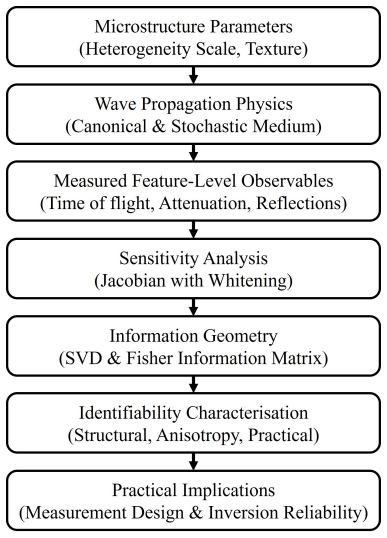
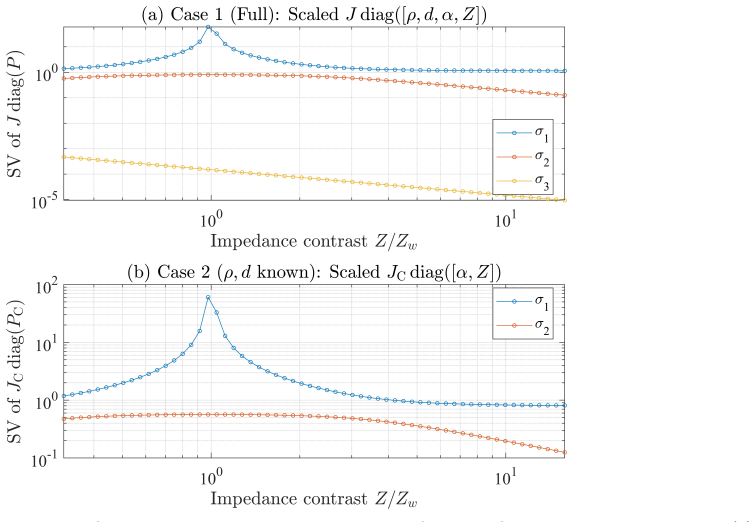
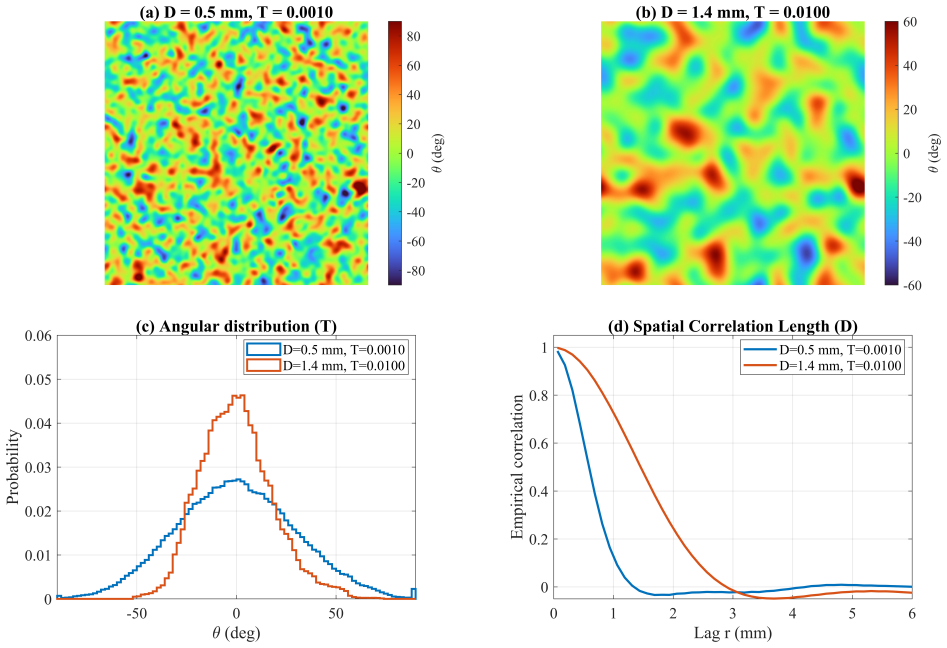
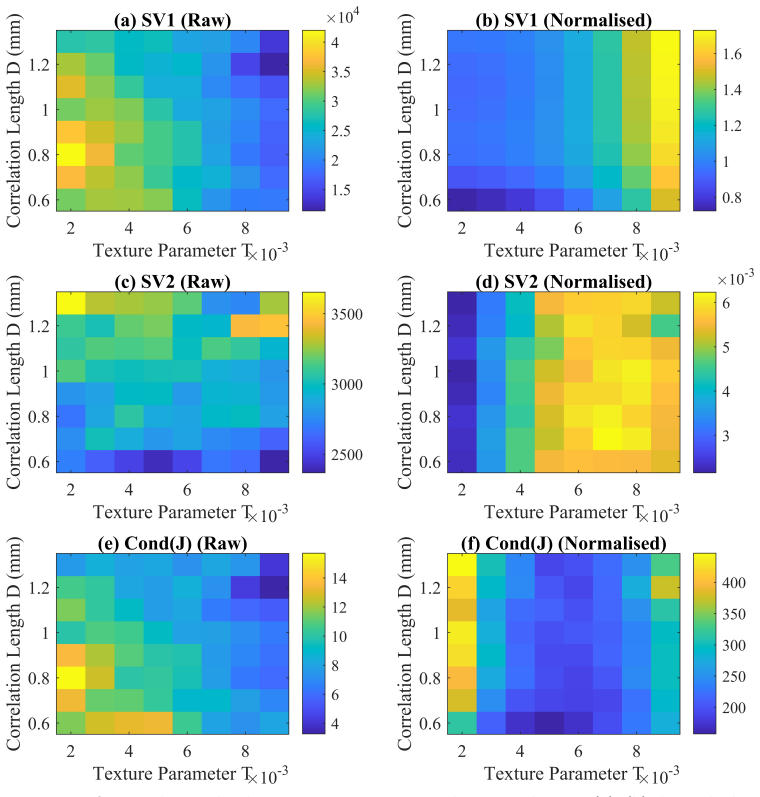
Within the feature-level framework, identifiability limits are governed primarily by forward-map structure and intrinsic variability. For the canonical model, closed-form sensitivity analysis reveals information limits from parameter coupling, dimensional restriction, and interface-driven saturation. For Gaussian random field surrogates, the map from D and T to attenuation and velocity remains structurally full rank, but the sensitivity geometry is anisotropic and practical identifiability decreases further when microstructural variability is incorporated; recoverability is then set by the balance between sensitivity magnitude and stochastic variability rather than structural rank alone.
What carries the argument
Variance-weighted Fisher information applied to the sensitivity geometry of the forward operator mapping correlation length D and texture-coherence T to attenuation and velocity observables.
If this is right
- Single attenuation or velocity observables alone produce elongated and weakly constrained objective landscapes during inversion.
- Combined use of attenuation and velocity observables improves conditioning through their complementary sensitivities.
- Practical recoverability decreases as intrinsic microstructural variability increases, even when the forward map is full rank.
- Observable selection and measurement design should prioritize configurations that exploit the anisotropic sensitivity structure.
Where Pith is reading between the lines
- Measurement protocols could be optimized by first estimating expected variability levels to decide whether combined observables are required.
- Similar forward-map geometry analysis might apply to other wave-based techniques such as elastic or electromagnetic scattering for microstructure recovery.
- Sensor array designs could target frequency ranges where sensitivity to D versus T is most balanced to reduce anisotropy effects.
- The framework suggests testing whether real-material deviations from Gaussian statistics further degrade identifiability beyond the modeled limits.
Load-bearing premise
The Gaussian random fields used as surrogate microstructures capture the essential statistical properties of real materials and the forward map remains structurally full rank under these choices.
What would settle it
Inversion trials on measured ultrasonic data from actual microstructures where the recovered uncertainty in D and T fails to match the variance-weighted Fisher predictions for the modeled attenuation and velocity observables.
Figures





read the original abstract
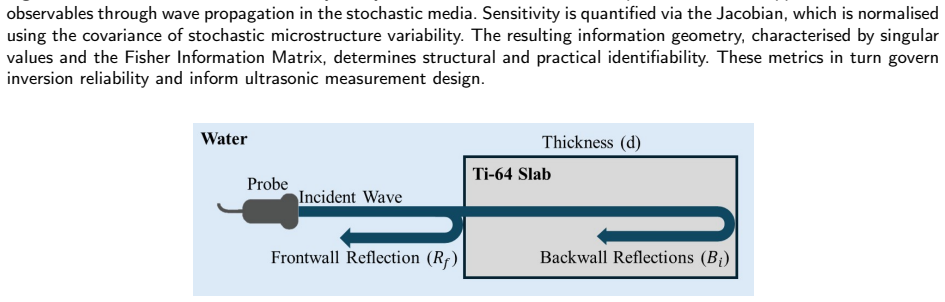
Ultrasound for microstructure characterisation is increasingly studied and is often assessed through inversion performance. However, the framework is fundamentally constrained by the information content available in the measured response. Hence, this work examines identifiability directly by analysing the geometry of the forward operator in both a canonical pulse-echo model and a stochastic surrogate microstructure. For the canonical model, a closed-form sensitivity analysis reveals information limits arising from parameter coupling, dimensional restriction, and interface-driven saturation. For the surrogate microstructures represented by Gaussian random fields, the forward map from correlation length $D$ and texture-coherence parameter $T$ to the attenuation and velocity observables remains structurally full rank. However, the sensitivity geometry is strongly anisotropic, with uneven parameter influence across the observable space. When intrinsic microstructural variability is incorporated, practical identifiability is further reduced. A variance-weighted Fisher framework shows that recoverability is governed by the balance between sensitivity magnitude and stochastic variability, rather than by structural rank alone. Inversion results confirm this behaviour: single observables produce elongated and weakly constrained objective landscapes, whereas combined observables improve conditioning through complementary sensitivities. These results show that, within the feature-level framework considered here, identifiability limits are governed primarily by forward-map structure and intrinsic variability, with direct implications for observable selection and measurement design.
Editorial analysis
A structured set of objections, weighed in public.
Referee Report
Summary. The manuscript examines identifiability limits in ultrasonic microstructure characterisation by analysing the geometry of the forward operator. In a canonical pulse-echo model, closed-form sensitivity analysis identifies limits from parameter coupling, dimensional restriction, and interface saturation. For stochastic surrogates based on Gaussian random fields with parameters D (correlation length) and T (texture coherence), the forward map to attenuation and velocity observables is shown to be structurally full rank but strongly anisotropic in sensitivity. A variance-weighted Fisher framework demonstrates that intrinsic microstructural variability further reduces practical recoverability, with numerical inversions confirming that single observables yield elongated objective landscapes while combined observables improve conditioning. The central conclusion is that identifiability is governed primarily by forward-map structure and variability, with implications for observable selection and measurement design.
Significance. If the results hold, this work provides a useful theoretical lens on why ultrasound inversion for microstructure parameters is often ill-conditioned, directly informing experimental choices in nondestructive evaluation. The combination of analytical closed-form results, Fisher-information geometry, and supporting inversions is a strength, as is the explicit separation of structural rank from practical recoverability due to variability. The framework yields concrete guidance on when and why combining observables helps, which could be tested experimentally.
major comments (2)
- [Stochastic surrogate microstructures] Stochastic surrogate section (abstract and main text): The conclusion that identifiability limits are governed by forward-map structure and intrinsic variability, with direct implications for real materials, rests on the premise that Gaussian random fields with parameters D and T adequately capture the essential statistical properties of real microstructures. No comparison is provided to measured statistics such as grain-size distributions or spatial correlations from EBSD maps, which is load-bearing for the claim that the reported anisotropy and rank properties reflect physical limits rather than surrogate artifacts.
- [Variance-weighted Fisher framework] Variance-weighted Fisher framework (abstract): The statement that recoverability is governed by the balance between sensitivity magnitude and stochastic variability requires explicit derivation of the weighting procedure and the resulting information matrix; without this, it is unclear whether the reduction in practical identifiability is quantitatively demonstrated or follows by construction from the chosen variance model.
minor comments (1)
- [Notation and model definition] Clarify the precise definition of the texture-coherence parameter T and its relation to the correlation function in the Gaussian random field model to avoid ambiguity in the forward-map description.
Simulated Author's Rebuttal
We thank the referee for the constructive and insightful comments. We address each major comment point by point below and indicate the planned revisions.
read point-by-point responses
-
Referee: [Stochastic surrogate microstructures] Stochastic surrogate section (abstract and main text): The conclusion that identifiability limits are governed by forward-map structure and intrinsic variability, with direct implications for real materials, rests on the premise that Gaussian random fields with parameters D and T adequately capture the essential statistical properties of real microstructures. No comparison is provided to measured statistics such as grain-size distributions or spatial correlations from EBSD maps, which is load-bearing for the claim that the reported anisotropy and rank properties reflect physical limits rather than surrogate artifacts.
Authors: We agree that direct validation against experimental microstructure statistics (e.g., EBSD grain-size distributions or spatial correlations) would strengthen the link to real materials. The Gaussian random field model is adopted as a canonical, analytically tractable surrogate that encodes the key statistical features of correlation length and texture coherence, enabling the closed-form sensitivity analysis. The reported anisotropy and structural rank properties derive directly from the geometry of the forward map for this class of models rather than from specific distributional details. In the revision we will expand the discussion of the surrogate's scope and limitations, explicitly noting that the framework is extensible to other microstructure representations while clarifying that the present results pertain to this standard stochastic class. revision: partial
-
Referee: [Variance-weighted Fisher framework] Variance-weighted Fisher framework (abstract): The statement that recoverability is governed by the balance between sensitivity magnitude and stochastic variability requires explicit derivation of the weighting procedure and the resulting information matrix; without this, it is unclear whether the reduction in practical identifiability is quantitatively demonstrated or follows by construction from the chosen variance model.
Authors: We will make the derivation explicit in the revised manuscript. The variance-weighted Fisher information matrix is obtained by premultiplying the conventional Fisher matrix by the inverse of the covariance matrix of the microstructure-induced fluctuations in the observables. This weighting quantitatively attenuates the information content in directions where stochastic variability is large relative to sensitivity, producing the observed reduction in practical recoverability. The effect is not tautological but follows from embedding the measured variance structure into the information geometry; we will include the full algebraic steps and a brief numerical illustration in a dedicated subsection or appendix. revision: yes
Circularity Check
No significant circularity: identifiability limits derived from independent forward-operator geometry and Fisher analysis
full rationale
The paper derives its identifiability conclusions through explicit mathematical examination of the forward operator in a canonical pulse-echo model (closed-form sensitivity analysis revealing parameter coupling and saturation) and in Gaussian random field surrogates (structural rank and anisotropic sensitivity of the map from D and T to attenuation/velocity). The variance-weighted Fisher framework then incorporates intrinsic variability to assess practical recoverability. None of these steps reduce by construction to fitted parameters renamed as predictions, self-definitions, or load-bearing self-citations; the rank and anisotropy properties follow directly from the stated model definitions and are presented as verifiable via the described numerical inversions and objective landscapes. The framework is therefore self-contained against external benchmarks of the forward map.
Axiom & Free-Parameter Ledger
free parameters (2)
- correlation length D
- texture-coherence parameter T
axioms (1)
- domain assumption Microstructures can be represented by Gaussian random fields
Lean theorems connected to this paper
-
IndisputableMonolith/Cost/FunctionalEquation.leanwashburn_uniqueness_aczel unclearthe forward map from correlation length D and texture-coherence parameter T to the attenuation and velocity observables remains structurally full rank. However, the sensitivity geometry is strongly anisotropic... variance-weighted Fisher framework
-
IndisputableMonolith/Foundation/AlexanderDuality.leanalexander_duality_circle_linking unclearsingular values... condition number... Fisher information matrix
Reference graph
Works this paper leans on
-
[1]
Rose.Unbounded Isotropic and Anisotropic Media
Joseph L. Rose.Unbounded Isotropic and Anisotropic Media. Cambridge University Press, 1999
work page 1999
-
[2]
Fred E. Stanke and G. S. Kino. A unified theory for elastic wave propagation in polycrystalline materials.The Journal of the Acoustical Society of America, 75(3):665–681, 1984. ISSN 0001-4966. doi: 10.1121/1.390577
-
[3]
Richard L. Weaver. Diffusivity of Ultrasound in Polycrystals.Journal of the Mechanics and Physics of Solids, 38(1):55–86, 1990. doi: 10.1007/978-3-662-44324-8_1289
-
[4]
Modeling Ultrasonic Microstructural Noise in Titanium Alloys
F J Margetan and R B Thompson. Modeling Ultrasonic Microstructural Noise in Titanium Alloys. InReview of Progress in Quantitative Nondestructive Evaluation, volume 12, pages 1735–1742, 1993
work page 1993
-
[5]
F.J.Margetan,R.B.Thompson,andI.Yalda-Mooshabad. BackscatteredMicrostructuralNoiseinUltrasonicToneburstInspections.Journal of Nondestructive Evaluation, 13(3):111–136, 1994. ISSN 1573-4862. doi: 10.1007/BF00728250
-
[6]
A.VanPamel,G.Sha,M.J.S.Lowe,andS.I.Rokhlin. Numericalandanalyticmodellingofelastodynamicscatteringwithinpolycrystalline materials.The Journal of the Acoustical Society of America, 143(4):2394–2408, 2018. ISSN 0001-4966. doi: 10.1121/1.5031008
-
[7]
Effectoftextureandgrainshapeonultrasonicbackscatteringinpolycrystals.Ultrasonics,54(7):1789–1803,
J.Li,L.Yang,andS.I.Rokhlin. Effectoftextureandgrainshapeonultrasonicbackscatteringinpolycrystals.Ultrasonics,54(7):1789–1803,
-
[8]
doi: 10.1016/j.ultras.2014.02.020
-
[9]
Yu Liu, Qiang Tian, Ping Yu, Jingjing He, and Xuefei Guan. Shape and size evaluations of elongated grains using phased array ultrasound and directional backscattering method.NDT & E International, 129:102634, 2022. doi: 10.1016/j.ndteint.2022.102634
-
[11]
Ningyue Sheng and Shahram Khazaie. A new correlation model for ultrasonic attenuation in polycrystals with broad grain size distributions. Ultrasonics, 160:107924, 2026. doi: 10.1016/j.ultras.2025.107924
-
[12]
Juan Camilo Victoria-Giraldo, Denis Solas, Jérôme Laurent, Alain Lhémery, and Bing Tie. Propagation and scattering of ultrasonic waves in macroscopically anisotropic polycrystalline materials with fiber texture.Ultrasonics, 164:108026, 2026. doi: 10.1016/j.ultras.2026.108026
-
[13]
Ultrasonicbackscatteringinpolycrystalswithelongatedsinglephaseandduplexmicrostructures
O.I.Lobkis,L.Yang,J.Li,andS.I.Rokhlin. Ultrasonicbackscatteringinpolycrystalswithelongatedsinglephaseandduplexmicrostructures. Ultrasonics, 52(6):694–705, 2012. ISSN 0041624X. doi: 10.1016/j.ultras.2011.12.002
-
[14]
Shan Li, Ming Huang, Yongfeng Song, Bo Lan, and Xiongbing Li. Ultrasonic backscattering model for rayleigh waves in polycrystals with born and independent scattering approximations.Ultrasonics, 140:107297, 2024. doi: 10.1016/j.ultras.2024.107297
-
[15]
A. Van Pamel, G. Sha, S. I. Rokhlin, and M. J. S. Lowe. Finite-element modelling of elastic wave propagation and scattering within heterogeneous media.Proceedings of the Royal Society A: Mathematical, Physical and Engineering Science, 473(2197), 2017. ISSN 1364-
work page 2017
-
[16]
doi: 10.1098/rspa.2016.0738
-
[17]
VincentDorval,NicolasLeymarie,AlexandreImperiale,EdouardDemaldent,andPierre-EmileLhuillier. Numericalestimationofultrasonic phase velocity and attenuation for longitudinal and shear waves in polycrystalline materials.Ultrasonics, 148:107517, 2025. doi: 10.1016/j.ultras.2024.107517
-
[18]
Comparison of ultrasonic attenuation within two- and three-dimensional polycrystalline media
X Bai, B Tie, J Schmitt, and D Aubry. Comparison of ultrasonic attenuation within two- and three-dimensional polycrystalline media. Ultrasonics, 100(December 2018):105980, 2020. ISSN 0041-624X. doi: 10.1016/j.ultras.2019.105980
-
[20]
Large-scale3Drandompolycrystalsforthefiniteelementmethod:Generation,meshingandremeshing
R.Quey,P.R.Dawson,andF.Barbe. Large-scale3Drandompolycrystalsforthefiniteelementmethod:Generation,meshingandremeshing. ComputerMethodsinAppliedMechanicsandEngineering,200(17-20):1729–1745,2011. ISSN00457825. doi:10.1016/j.cma.2011.01.002
-
[21]
AndreaP.Arguelles,ChristopherM.Kube,PingHu,andJosephA.Turner.Mode-convertedultrasonicscatteringinpolycrystalswithelongated grains.The Journal of the Acoustical Society of America, 140(3):1570–1580, 2016. ISSN 0001-4966. doi: 10.1121/1.4962161
-
[22]
M. Huang, G. Sha, P. Huthwaite, S. I. Rokhlin, and M. J. S. Lowe. Elastic wave velocity dispersion in polycrystals with elongated grains: Theoretical and numerical analysis.The Journal of the Acoustical Society of America, 148(6):3645–3662, 2020. ISSN 0001-4966. doi: 10.1121/10.0002916
-
[23]
M. Huang, P. Huthwaite, S. I. Rokhlin, and M. J. S. Lowe. Finite-element and semi-analytical study of elastic wave propagation in strongly scattering polycrystals.Proceedings of the Royal Society A: Mathematical, Physical and Engineering Sciences, 478, 2022. ISSN 14712946. doi: 10.1098/rspa.2021.0850
-
[24]
ShaojieGong,ShifengGuo,YiXiong,ShiyuanZhou,FangsenCui,andMenglongLiu. Wavepropagationinhighlyanisotropicpolycrystals: A numerical perspective from an unstructured-mesh-based high-order finite element method.Ultrasonics, 159:107882, 2026. doi: 10.1016/j.ultras.2025.107882
-
[25]
J. Li and S. I. Rokhlin. Propagation and scattering of ultrasonic waves in polycrystals with arbitrary crystallite and macroscopic texture symmetries.Wave Motion, 58:145–164, 2015. ISSN 01652125. doi: 10.1016/j.wavemoti.2015.05.004
-
[26]
W. Y. Yeoh, B. Lan, and M. J. S. Lowe. Investigation of the influence of macrozones in titanium alloys on the propagation and scattering of ultrasound.Proceedings of the Royal Society A: Mathematical, Physical and Engineering Sciences, 479, 9 2023. ISSN 1364-5021. doi: 10.1098/rspa.2023.0176. URLhttps://royalsocietypublishing.org/doi/10.1098/rspa.2023.0176
-
[27]
Zenghua Liu, Jinlong Li, Yang Zheng, and Cunfu He. Ultrasonic backscattering model of lamellar duplex phase microstructures in polycrystalline materials.Ultrasonics, 149:107581, 2025. doi: 10.1016/j.ultras.2025.107581. 20
-
[28]
Tomáš Grabec, István A. Veres, and Martin Ryzy. Surface acoustic wave attenuation in polycrystals: Numerical modeling using a statistical digital twin of an actual sample.Ultrasonics, 119:106585, 2022. doi: 10.1016/j.ultras.2021.106585
-
[29]
W. Y. Yeoh, B. Lan, and M. J. S. Lowe. Representative microstructures for two-dimensional computational studies of ultrasonic wave propagationintitaniumalloys.ProceedingsoftheRoyalSocietyA:Mathematical,PhysicalandEngineeringSciences,481(2323):20240776,
-
[30]
doi: 10.1098/rspa.2024.0776
-
[31]
Kalkowski, Ming Huang, Michael J.S
Yuan Liu, Michał K. Kalkowski, Ming Huang, Michael J.S. Lowe, Vykintas Samaitis, Vaidotas Cic˙enas, and Andreas Schumm. Can ultrasound attenuation measurement be used to characterise grain statistics in castings?Ultrasonics, 115, 2021. ISSN 0041624X. doi: 10.1016/j.ultras.2021.106441
-
[32]
Rodríguez, Heriberto Granados Becerra, and Jin-Yeon Kim
Alberto Ruiz, Vania M. Rodríguez, Heriberto Granados Becerra, and Jin-Yeon Kim. Ultrasonic characterization of microstructural changes due to static recrystallization and grain growth in inconel 625 and inconel 718 superalloys.Ultrasonics, 142:107383, 2024. doi: 10.1016/j.ultras.2024.107383
-
[33]
BohanLiu,MingHuang,DehanZhang,andXudongYu. Ultrasonicbackscatteringmethodforcharacterizingthenon-uniformmicrostructure of polycrystals.International Journal of Mechanical Sciences, 306:110831, 2025. doi: 10.1016/j.ijmecsci.2025.110831
-
[34]
LeiLi,YangYing,MinZhou,ZuhanCao,DiziGuo,HaiyingYang,LiDing,FeixiaoHan,andJiVincent. Effectofmicrostructureandtexture gradient on the backscattered ultrasound amplitude of ti-6al-4v bars for aeroengine blade.Journal of Alloys and Compounds, 1010:177604,
-
[35]
doi: 10.1016/j.jallcom.2024.177604
-
[36]
IIIVela,Ramon,NathanialJ.Matz,WaledHassan,andJosephA.Turner. Characterizationofmicrotextureinti-6al-4vusingultrasonicpolar forward scattering.Ultrasonics, 165:108113, 2026. doi: 10.1016/j.ultras.2026.108113
-
[37]
BLan,M.J.S.Lowe,andF.P.E.Dunne. Experimentalandcomputationalstudiesofultrasoundwavepropagationinhexagonalclose-packed polycrystals for texture detection.Acta Materialia, 63:107–122, 2014. ISSN 1359-6454. doi: 10.1016/j.actamat.2013.10.012
-
[38]
PaulDryburgh,RichardJ.Smith,PaulMarrow,StevenJ.Lainé,SteveD.Sharples,MattClark,andWenqiLi. Determiningthecrystallographic orientation of hexagonal crystal structure materials with surface acoustic wave velocity measurements.Ultrasonics, 108:106171, 2020. doi: 10.1016/j.ultras.2020.106171
-
[39]
ZeqingSun,ShangziWu,AbhishekSaini,andZhengFan. Characterizingpolycrystallinemicrostructuresbyreconstructinggrainboundaries and velocity map from ultrasonic surface wave field.Ultrasonics, 137:107175, 2024. doi: 10.1016/j.ultras.2023.107175
-
[40]
Ben Britton, Tea-Sung Jun, Weimin Gan, Michael Hofmann, Fionn P.E
Bo Lan, T. Ben Britton, Tea-Sung Jun, Weimin Gan, Michael Hofmann, Fionn P.E. Dunne, and Michael J.S. Lowe. Direct volumetric measurementofcrystallographictextureusingacousticwaves.ActaMaterialia,159:384–394,2018. ISSN13596454. doi:10.1016/j.actamat. 2018.08.037
-
[41]
Yu Liu, Xinyan Wang, J. P. Oliveira, Jingjing He, and Xuefei Guan. Spatial and directional characterization of wire and arc additive manufactured aluminum alloy using phased array ultrasonic backscattering method.Ultrasonics, 132:107024, 2023. doi: 10.1016/j.ultras. 2023.107024
-
[42]
WeiWang,JieZhang,andPaulD.Wilcox. Metallicmaterialmicrostructuregrainsizemeasurementsfrombackscatteredultrasonicarraydata using full matrix capture.NDT & E International, 149:103251, 2025. doi: 10.1016/j.ndteint.2024.103251
-
[43]
Yu Liu, Qiang Tian, Shuzeng Zhang, and Xuefei Guan. Combined effect of frequency, grain size, and sound path on phased array ultrasonic spectrum and attenuation.Ultrasonics, 149:107593, 2025. doi: 10.1016/j.ultras.2025.107593
-
[44]
Bo Lan, Michael A Carpenter, Weimin Gan, Michael Hofmann, Fionn P E Dunne, and Michael J S Lowe. Rapid measurement of volumetric texture using resonant ultrasound spectroscopy.Scripta Materialia, 157:44–48, 2018. ISSN 1359-6462. doi: 10.1016/j.scriptamat.2018.07
-
[45]
URLhttps://doi.org/10.1016/j.scriptamat.2018.07.029
-
[46]
MichałK.Kalkowski,MichaelJ.S.Lowe,MartinBarth,MarekRjelka,andBerndKöhler. Howdoesgrazingincidenceultrasonicmicroscopy work? a study based on grain-scale numerical simulations.Ultrasonics, 114:106387, 2021. doi: 10.1016/j.ultras.2021.106387
-
[47]
Jingjing He, Chenjun Gao, Xun Wang, Jinsong Yang, Qiang Tian, and Xuefei Guan. Average grain size evaluation using scattering-induced attenuation of coda waves.Ultrasonics, 141:107334, 2024. doi: 10.1016/j.ultras.2024.107334
-
[48]
M.C.A.Viana,P.Pereira,A.A.Buenos,andA.A.Santos. Identifyinggrainsizeinastma36steelusingultrasonicbackscatteredsignalsand machine learning.NDT & E International, 2024. In press
work page 2024
-
[49]
LishuaiLiu,PengWu,YanxunXiang,andFu-ZhenXuan. Autonomouscharacterizationofgrainsizedistributionusingnonlinearlambwaves based on deep learning.The Journal of the Acoustical Society of America, 152(3):1913–1921, 2022. doi: 10.1121/10.0014289
-
[50]
Jonathan Singh, Katherine Tant, Anthony Mulholland, and Charles MacLeod. Deep learning based inversion of locally anisotropic weld properties from ultrasonic array data.Applied Sciences, 12(2):532, 2022. doi: 10.3390/app12020532
-
[51]
RikeshPatel,WenqiLi,RichardJ.Smith,andMattClark. Developingneuralnetworkstorapidlymapcrystallographicorientationusinglaser ultrasound measurements.Scripta Materialia, 256:116415, 2025. doi: 10.1016/j.scriptamat.2024.116415
-
[52]
KhemrajShukla,AmeyaD.Jagtap,JamesL.Blackshire,DanielSparkman,andGeorgeEmKarniadakis. Aphysics-informedneuralnetwork for quantifying the microstructural properties of polycrystalline nickel using ultrasound data: A promising approach for solving inverse problems.IEEE Signal Processing Magazine, 39(1):68–77, 2022. doi: 10.1109/MSP.2021.3118904
-
[53]
S. I. Rokhlin, G. Sha, J. Li, and A. L. Pilchak. Inversion methodology for ultrasonic characterization of polycrystals with clusters of preferentially oriented grains.Ultrasonics, 115(March), 2021. ISSN 0041624X. doi: 10.1016/j.ultras.2021.106433
-
[54]
ZixinGuo,YongfengSong,andXiongbingLi. Decouplinganalysisofultrasonicscatteringcharacteristicsinporouspolycrystallinematerials using phase field and finite element methods.Ultrasonics, 159:107864, 2026. doi: 10.1016/j.ultras.2025.107864
-
[55]
R. Bellman and K. J. Åström. On structural identifiability.Mathematical Biosciences, 7(3-4):329–339, 1970. ISSN 0025-5564. doi: 10.1016/0025-5564(70)90132-X
-
[56]
C. Cobelli and J. J. DiStefano, III. Parameter and structural identifiability concepts and ambiguities: a critical review and analysis.American Journal of Physiology-Regulatory, Integrative and Comparative Physiology, 239(1):R7–R24, 1980. doi: 10.1152/ajpregu.1980.239.1.R7
-
[57]
Joseph H. A. Guillaume, John D. Jakeman, Stefano Marsili-Libelli, Michael Asher, Philip Brunner, Barry Croke, Mary C. Hill, Anthony J. Jakeman, Karel J. Keesman, Saman Razavi, and Johannes D. Stigter. Introductory overview of identifiability analysis: A guide to evaluating 21 whether you have the right type of data for your modeling purpose.Environmental ...
work page 2019
-
[58]
doi: 10.1016/j.envsoft.2019.07.007
-
[59]
Rose.Reflection and Refraction
Joseph L. Rose.Reflection and Refraction. Cambridge University Press, 2014
work page 2014
-
[60]
R. M. Alford, K. R. Kelly, and D. M. Whitmore. Accuracy of finite-difference modeling of the acoustic wave equation.Geophysics, 39(6): 834–842, 1974. doi: 10.1190/1.1440470
-
[61]
Phd thesis, Curtin University of Technology, May 2003
Ahmad Zakaria.Numerical Modelling of Wave Propagation Using Higher Order Finite-Difference Formulas. Phd thesis, Curtin University of Technology, May 2003. URLhttps://espace.curtin.edu.au/handle/20.500.11937/190
work page 2003
-
[62]
Frank Schubert. Numerical time-domain modeling of linear and nonlinear ultrasonic wave propagation using finite integration tech- niques––theory and applications.Ultrasonics, 42(1-9):221–229, 2004. ISSN 0041-624X. doi: 10.1016/j.ultras.2004.01.013
-
[63]
F. Anstett-Collin, L. Denis-Vidal, and G. Millérioux. A priori identifiability: An overview on definitions and approaches.Annual Reviews in Control, 50:139–149, 2020. ISSN 1367-5788. doi: 10.1016/j.arcontrol.2020.10.006
-
[64]
Christopher M. Kube and Joseph A. Turner. Voigt, Reuss, Hill, and Self-Consistent Techniques for Modeling Ultrasonic Scattering. In41st Annual Review of Progress in Quantitative Nondestructive Evaluation, volume 1650, pages 926–934, 2015. doi: 10.1063/1.4914698
-
[65]
Advancesingaussianrandomfieldgeneration:Areview.IEEEAccess,7:153123–153139,2019
YangLiu,JingfaLi,ShuyuSun,andBoYu. Advancesingaussianrandomfieldgeneration:Areview.IEEEAccess,7:153123–153139,2019. doi: 10.1109/ACCESS.2019.2948616
-
[66]
Bo Lan, Michael J. S. Lowe, and Fionn P. E. Dunne. A spherical harmonic approach for the determination of HCP texture from ultrasound: A solution to the inverse problem.Journal of the Mechanics and Physics of Solids, 83:179–198, 2015. ISSN 00225096. doi: 10.1016/j.jmps.2015.06.014. URLhttp://dx.doi.org/10.1016/j.jmps.2015.06.014
-
[67]
Peter Huthwaite. Accelerated finite element elastodynamic simulations using the GPU.Journal of Computational Physics, 257:687–707,
-
[68]
doi: 10.1016/j.jcp.2013.10.017
ISSN 00219991. doi: 10.1016/j.jcp.2013.10.017
-
[69]
M. Huang, G. Sha, P. Huthwaite, S. I. Rokhlin, and M. J. S. Lowe. Maximizing the accuracy of finite element simulation of elastic wave propagation in polycrystals.The Journal of the Acoustical Society of America, 148:1890–1910, 2020. ISSN 0001-4966. doi: 10.1121/10.0002102
-
[70]
Brett, Peter Huthwaite, and Michael J
Anton Van Pamel, Colin R. Brett, Peter Huthwaite, and Michael J. S. Lowe. Finite element modelling of elastic wave scattering within a polycrystalline material in two and three dimensions.The Journal of the Acoustical Society of America, 138(4):2326–2336, 2015. ISSN 0001-4966. doi: 10.1121/1.4931445
-
[71]
Yonghong Zhang, Yu Wang, Ming J. Zuo, and Xiaodong Wang. Ultrasonic time-of-flight diffraction crack size identification based on cross-correlation.Canadian Conference on Electrical and Computer Engineering, pages 1797–1800, 2008. ISSN 08407789. doi: 10.1109/CCECE.2008.4564854
-
[72]
Bo Lan, Michael J S Lowe, and Fionn P E Dunne. A generalized spherical harmonic deconvolution to obtain texture of cubic materials from ultrasonicwavespeed.JournaloftheMechanicsandPhysicsofSolids,83:221–242,2015. ISSN0022-5096. doi:10.1016/j.jmps.2015.06.012. URLhttp://dx.doi.org/10.1016/j.jmps.2015.06.012
-
[73]
Cambridge University Press, 2017
Zhilin Li, Zhonghua Qiao, and Tao Tang.Numerical Solution of Differential Equations: Introduction to Finite Difference and Finite Element Methods. Cambridge University Press, 2017. doi: 10.1017/9781316671528
-
[74]
NicholasN.Lam,PaulD.Docherty,andRuaMurray. Practicalidentifiabilityofparametrisedmodels:Areviewofbenefitsandlimitationsof various approaches.Mathematics and Computers in Simulation, 199:202–216, 2022. ISSN 0378-4754. doi: 10.1016/j.matcom.2022.03.020
-
[75]
Andrea P Arguelles and Joseph A Turner. Ultrasonic attenuation of polycrystalline materials with a distribution of grain sizes.The Journal of the Acoustical Society of America, 141(6):4347 – 4353, 2017. doi: 10.1121/1.4984290
-
[76]
Yuan Liu, Anton Van Pamel, Peter B. Nagy, and Peter Cawley. Investigation of ultrasonic backscatter using three-dimensional finite element simulations.The Journal of the Acoustical Society of America, 145(3):1584–1595, 2019. ISSN 0001-4966. doi: 10.1121/1.5094783
-
[77]
Xun Huan and Youssef M. Marzouk. Optimal experimental design: Formulations and computations.Acta Numerica, 33:1–140, 2024. doi: 10.1017/S0962492924000013
-
[78]
Caroline Holmes, Bruce W. Drinkwater, and Paul D. Wilcox. Post-processing of the full matrix of ultrasonic transmit-receive array data for non-destructive evaluation.NDT and E International, 38(8):701–711, 2005. ISSN 09638695. doi: 10.1016/j.ndteint.2005.04.002
-
[79]
Wilcox, Caroline Holmes, and Bruce W
Paul D. Wilcox, Caroline Holmes, and Bruce W. Drinkwater. Advanced reflector characterization with ultrasonic phased arrays in nde applications.IEEE Transactions on Ultrasonics, Ferroelectrics, and Frequency Control, 54(8):1541–1550, 2007. doi: 10.1109/TUFFC. 2007.424
-
[80]
Unsupervisedlearningfromincompletemeasurementsforinverseproblems
JulianTachella,SamuelHurault,andMikeDavies. Unsupervisedlearningfromincompletemeasurementsforinverseproblems. InAdvances in Neural Information Processing Systems, volume 35, pages 4981–4993, 2022
work page 2022
-
[81]
doi: 10.1017/S0962492919000059
SimonArridge,PeterMaass,OzanÖktem,andCarola-BibianeSchönlieb.Solvinginverseproblemsusingdata-drivenmodels.ActaNumerica, 28:1–174, 2019. doi: 10.1017/S0962492919000059
-
[82]
Anton Van Pamel, Peter Huthwaite, Colin R. Brett, and Michael J.S. Lowe. Numerical simulations of ultrasonic array imaging of highly scattering materials.NDT and E International, 81:9–19, 2016. ISSN 09638695. doi: 10.1016/j.ndteint.2016.02.004. URLhttp: //dx.doi.org/10.1016/j.ndteint.2016.02.004. 22
discussion (0)
Sign in with ORCID, Apple, or X to comment. Anyone can read and Pith papers without signing in.