Recognition: 2 theorem links
· Lean TheoremRevisiting Voltage and Synchronization Stability Analysis in Converter-Integrated Weak Grids: Insights from Non-Minimum-Phase Zeros
Pith reviewed 2026-05-14 19:01 UTC · model grok-4.3
The pith
Non-minimum phase zeros in the grid Jacobian transfer matrix cause both voltage instability and synchronization issues in weak grids with converter-interfaced generators.
A machine-rendered reading of the paper's core claim, the machinery that carries it, and where it could break.
Core claim
The paper establishes that the two stability issues originate from NMP zeros in the grid Jacobian transfer matrix, with a zero at the origin corresponding to voltage instability and low-frequency zeros constraining synchronization dynamics. The short-circuit ratio is shown to be a special case of the NMP-zero factor at the rated operating point, providing a unified stability assessment method for multi-converter systems using only this factor and individual converter models.
What carries the argument
The NMP-zero (NMP-Z) factor derived from non-minimum phase zeros in the grid Jacobian transfer matrix, which serves as a unified metric for both voltage and synchronization stability.
If this is right
- A zero at the origin in the transfer matrix directly indicates voltage instability.
- Low-frequency NMP zeros impose fundamental constraints on synchronization dynamics.
- The NMP-Z factor generalizes the short-circuit ratio for assessment at various operating points.
- The approach enables a unified stability margin check for multi-converter systems using only the NMP-Z factor and individual converter models.
Where Pith is reading between the lines
- The NMP-Z factor could guide placement of converters or reactive support to avoid creating low-frequency zeros.
- It may extend to stability checks in other networked dynamical systems whose Jacobians exhibit similar zero structures.
- Control tuning of converters could explicitly target shifting these zeros to improve operating margins without full-system eigenvalue computation.
Load-bearing premise
The analysis assumes small-signal linearization around an operating point fully captures the dynamics via the grid Jacobian transfer matrix.
What would settle it
Finding a case where the system remains stable despite a zero at the origin in the Jacobian transfer matrix, or becomes unstable when no such zeros exist.
Figures




read the original abstract
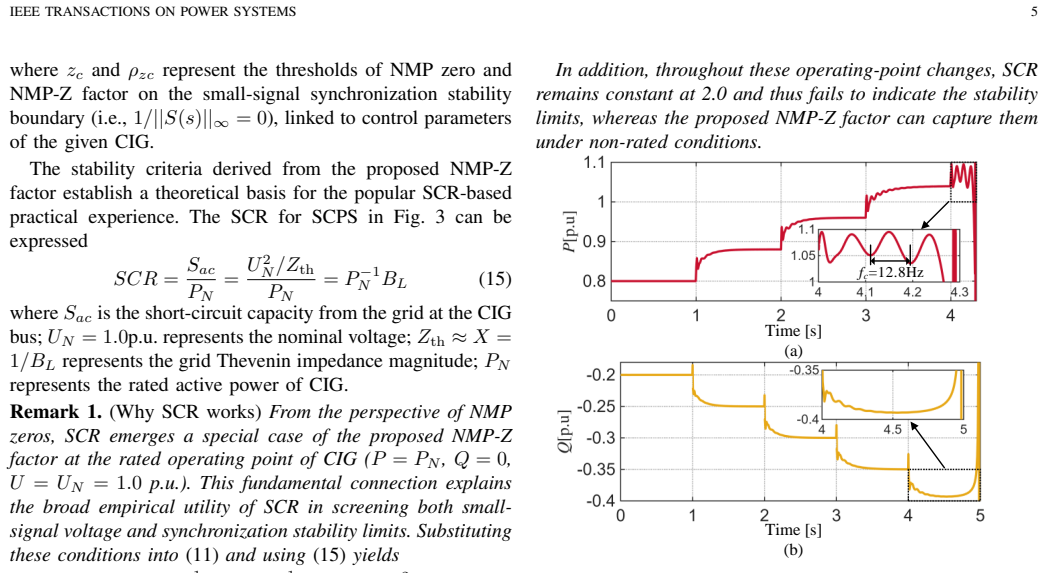
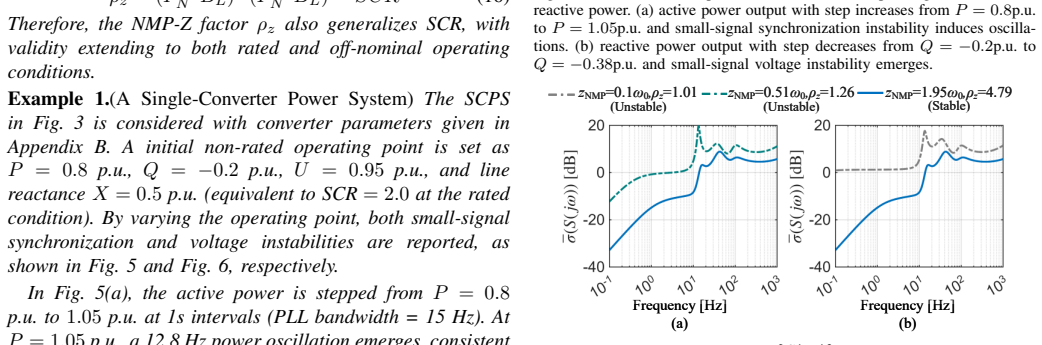
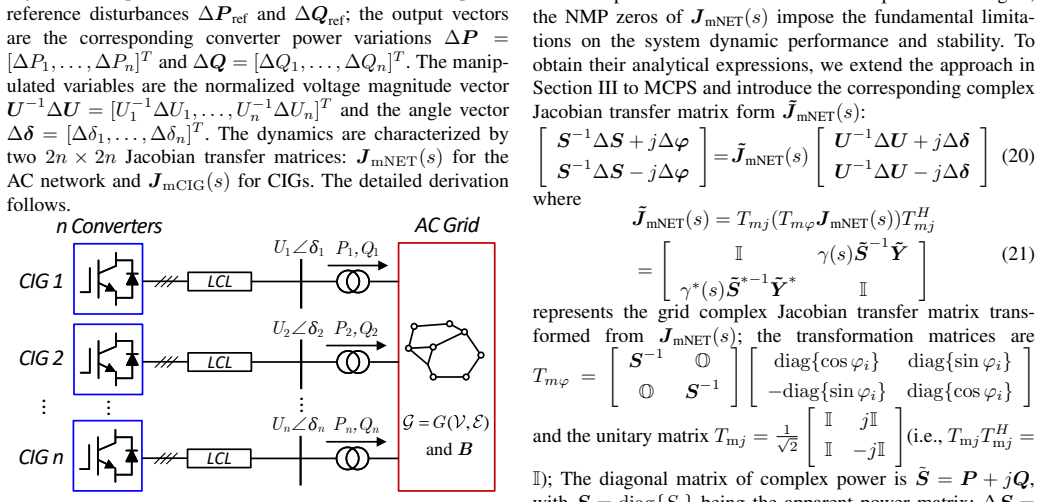
The increasing penetration of converter-interfaced generators (CIGs) intensifies concerns over small-signal voltage and synchronization stability. While existing theories treat these two stability issues distinctly, practical wisdom in contrast employs a unified and static metric, short-circuit ratio (SCR), to assess both in weak grids. This paper aims to bridge this theory-practice gap by introducing the insight of non-minimum phase (NMP) zeros. First, we demonstrate that the two stability issues in weak grids originate from NMP zeros in the grid Jacobian transfer matrix: a zero at the origin corresponds to voltage instability, while low-frequency zeros impose fundamental constraints on synchronization dynamics. The traditional SCR is proven to be a special case of our proposed novel stability metric, NMP-zero (NMP-Z) factor, evaluated at the rated operating point. This establishes the theoretical foundation for the empirical success of SCR. Building on this insight, we then develop a unified stability assessment method for multi-converter systems. The method retains the simplicity of SCR, requiring only the NMP-Z factor together with individual CIG dynamic models and enabling stability margin assessment under various operating points. Our work provides a simple yet theoretically rigorous framework for stability analysis in CIG-integrated weak grids, with all theoretical findings and the proposed method validated through detailed time-domain simulations.
Editorial analysis
A structured set of objections, weighed in public.
Referee Report
Summary. The paper claims that voltage and synchronization stability problems in weak grids with converter-interfaced generators (CIGs) originate from non-minimum-phase (NMP) zeros in the grid Jacobian transfer matrix: a zero at the origin produces voltage instability while low-frequency NMP zeros constrain synchronization dynamics. It proves that the short-circuit ratio (SCR) is a special case of the proposed NMP-zero (NMP-Z) factor evaluated at the rated operating point, and develops a unified stability assessment method for multi-converter systems that combines the NMP-Z factor with individual CIG models; all findings are stated to be confirmed by time-domain simulations.
Significance. If the direct correspondence between Jacobian NMP zeros and closed-loop poles holds without cancellation, the work supplies a theoretically grounded dynamic metric that explains the empirical utility of SCR and extends it to varying operating points and multi-CIG interactions, offering a simple yet rigorous alternative to separate voltage and synchronization analyses.
major comments (1)
- [Derivation of NMP-Z factor from grid Jacobian transfer matrix] The central claim that NMP zeros in the grid Jacobian transfer matrix directly produce voltage instability (zero at s=0) and synchronization constraints (low-frequency zeros) requires that these zeros appear uncancelled in the system characteristic equation. Small-signal linearization around an operating point permits converter current/voltage controllers to cancel or shift the zeros, especially under multi-CIG interaction; this assumption is load-bearing and must be verified explicitly in the transfer-function derivation rather than asserted from the Jacobian alone.
minor comments (2)
- Provide an explicit equation for the NMP-Z factor (including how it reduces to SCR at the rated point) rather than describing it only in prose.
- Clarify the exact small-signal model assumptions (e.g., whether all converter controllers are included in the closed-loop transfer functions) when stating that the Jacobian alone dictates stability.
Simulated Author's Rebuttal
We thank the referee for the constructive and insightful review. The single major comment has been addressed by expanding the transfer-function derivations in the revised manuscript to explicitly demonstrate that the NMP zeros from the grid Jacobian appear uncancelled in the closed-loop characteristic equation.
read point-by-point responses
-
Referee: [Derivation of NMP-Z factor from grid Jacobian transfer matrix] The central claim that NMP zeros in the grid Jacobian transfer matrix directly produce voltage instability (zero at s=0) and synchronization constraints (low-frequency zeros) requires that these zeros appear uncancelled in the system characteristic equation. Small-signal linearization around an operating point permits converter current/voltage controllers to cancel or shift the zeros, especially under multi-CIG interaction; this assumption is load-bearing and must be verified explicitly in the transfer-function derivation rather than asserted from the Jacobian alone.
Authors: We appreciate the referee's emphasis on this key assumption. In the original derivation the grid Jacobian transfer matrix is obtained directly from the linearized network equations (Y_bus-based admittance model) and is treated as the plant seen by the converters. The closed-loop characteristic equation is formed as det(I + C(s)G(s)) = 0, where G(s) is the Jacobian transfer matrix and C(s) collects the individual CIG admittance models. Because the NMP zeros lie in G(s) and the converter controllers are strictly proper with stable, minimum-phase dynamics, they cannot cancel right-half-plane or origin zeros without introducing unstable pole-zero cancellations (which are excluded by the small-signal stability assumption itself). For multi-CIG cases the aggregated Jacobian preserves the same structural zeros. In the revised manuscript we have added an explicit step-by-step derivation (new Appendix A and expanded Section III) that computes the full transfer-function matrix, lists the zeros of G(s), and verifies numerically that they remain roots of the characteristic polynomial for the controller parameters and operating points considered. Time-domain simulations already shown in the paper are now cross-checked against these pole-zero locations to confirm absence of cancellation. revision: yes
Circularity Check
NMP-Z factor derived directly from grid Jacobian zeros; SCR equivalence is algebraic special case with no self-referential reduction
full rationale
The paper constructs the NMP-Z factor explicitly from the locations of non-minimum-phase zeros in the grid Jacobian transfer matrix obtained via small-signal linearization. It then shows algebraically that the classical SCR equals the NMP-Z factor evaluated at the rated operating point. This is a direct substitution, not a fitted parameter renamed as a prediction, nor a self-citation chain. No load-bearing step reduces to a prior result by the same authors; the central mapping from Jacobian zeros to voltage and synchronization constraints follows from the transfer-matrix characteristic equation without external uniqueness theorems or ansatzes smuggled via citation. The derivation remains self-contained against the stated linearization assumptions and is validated by independent time-domain simulations.
Axiom & Free-Parameter Ledger
axioms (1)
- domain assumption Small-signal linearization around an operating point is sufficient to capture voltage and synchronization stability limits
invented entities (1)
-
NMP-Z factor
no independent evidence
Lean theorems connected to this paper
-
IndisputableMonolith/Cost/FunctionalEquation.leanwashburn_uniqueness_aczel unclear?
unclearRelation between the paper passage and the cited Recognition theorem.
NMP zeros in the grid Jacobian transfer matrix: a zero at the origin corresponds to voltage instability, while low-frequency zeros impose fundamental constraints on synchronization dynamics. The traditional SCR is proven to be a special case of our proposed novel stability metric, NMP-zero (NMP-Z) factor
-
IndisputableMonolith/Foundation/RealityFromDistinction.leanreality_from_one_distinction unclear?
unclearRelation between the paper passage and the cited Recognition theorem.
ρz := λ1 = λ(H_eq) = λ(˜S^{-1} ˜Y ˜S^{*-1} ˜Y^*)
What do these tags mean?
- matches
- The paper's claim is directly supported by a theorem in the formal canon.
- supports
- The theorem supports part of the paper's argument, but the paper may add assumptions or extra steps.
- extends
- The paper goes beyond the formal theorem; the theorem is a base layer rather than the whole result.
- uses
- The paper appears to rely on the theorem as machinery.
- contradicts
- The paper's claim conflicts with a theorem or certificate in the canon.
- unclear
- Pith found a possible connection, but the passage is too broad, indirect, or ambiguous to say the theorem truly supports the claim.
Reference graph
Works this paper leans on
-
[1]
Power system stability with a high penetration of inverter-based resources,
Y . Gu and T. C. Green, “Power system stability with a high penetration of inverter-based resources,”Proceedings of the IEEE, vol. 111, no. 7, pp. 832–853, 2022
work page 2022
-
[2]
Definition and Classification of Power System Stability – Revisited & Extended,
N. Hatziargyriou, J. Milanovic, C. Rahmann,et al., “Definition and Classification of Power System Stability – Revisited & Extended,”IEEE Transactions on Power Systems, vol. 36, no. 4, pp. 3271–3281, 2021
work page 2021
-
[3]
Small-Disturbance V oltage Stability of Power Systems: Dependence on Network Structure,
W. Huang, D. J. Hill, and X. Zhang, “Small-Disturbance V oltage Stability of Power Systems: Dependence on Network Structure,”IEEE Transactions on Power Systems, vol. 35, no. 4, pp. 2609–2618, jul 2020
work page 2020
-
[4]
Y . Cheng, L. Fan, J. Rose,et al., “Real-world subsynchronous oscillation events in power grids with high penetrations of inverter-based resources,” IEEE Transactions on Power Systems, vol. 38, no. 1, pp. 316–330, 2022
work page 2022
-
[5]
Grid-synchronization stability of converter-based resources—an overview,
X. Wang, M. G. Taul, H. Wu,et al., “Grid-synchronization stability of converter-based resources—an overview,”IEEE Open Journal of Industry Applications, vol. 1, pp. 115–134, 2020
work page 2020
-
[6]
Operating wind power plants under weak grid conditions considering voltage stability constraints,
T. Lund, H. Wu, H. Soltani,et al., “Operating wind power plants under weak grid conditions considering voltage stability constraints,”IEEE Transactions on Power Electronics, vol. 37, no. 12, pp. 15 482–15 492, 2022
work page 2022
-
[7]
X. Peng, F. Liu, P. Yang,et al., “Measuring short-term voltage stability of power systems dominated by inverter-based resources part i: System- wise generalized voltage damping index,”Journal of Modern Power Systems and Clean Energy, 2025
work page 2025
-
[8]
J. Machowski, Z. Lubosny, J. W. Bialek,et al.,Power system dynamics: stability and control. John Wiley & Sons, 2020
work page 2020
-
[9]
Small-Signal Stability Analysis of Inverter-Fed Power Systems Using Component Connection Method,
Y . Wang, X. Wang, Z. Chen,et al., “Small-Signal Stability Analysis of Inverter-Fed Power Systems Using Component Connection Method,” IEEE Transactions on Smart Grid, vol. 9, no. 5, pp. 5301–5310, sep 2018
work page 2018
-
[10]
Modeling of Three-Phase Dynamic Systems Using Com- plex Transfer Functions and Transfer Matrices,
L. Harnefors, “Modeling of Three-Phase Dynamic Systems Using Com- plex Transfer Functions and Transfer Matrices,”IEEE Transactions on Industrial Electronics, vol. 54, no. 4, pp. 2239–2248, Aug. 2007
work page 2007
-
[11]
J. F. Morris, K. H. Ahmed, and A. Egea-Alvarez, “Analysis of Controller Bandwidth Interactions for Vector-Controlled VSC Connected to Very Weak AC Grids,”IEEE Journal of Emerging and Selected Topics in Power Electronics, vol. 9, no. 6, pp. 7343–7354, Dec. 2021
work page 2021
-
[12]
Conseil international des grands r ´eseaux ´electriques, Ed.,Connection of Wind Farms to Weak AC Networks. CIGR ´E, 2016. [13]IEEE Standard for Interconnection and Interoperability of Inverter- Based Resources (IBRs) Interconnecting with Associated Transmission Electric Power Systems, IEEE Std., 2022
work page 2016
-
[13]
W. Dong, H. Xin, D. Wu,et al., “Small signal stability analysis of multi- infeed power electronic systems based on grid strength assessment,” IEEE transactions on Power Systems, vol. 34, no. 2, pp. 1393–1403, 2018
work page 2018
-
[14]
D. Wu, G. Li, M. Javadi,et al., “Assessing Impact of Renewable Energy Integration on System Strength Using Site-Dependent Short Circuit Ratio,”IEEE Transactions on Sustainable Energy, vol. 9, no. 3, pp. 1072–1080, July 2018
work page 2018
-
[15]
Y . Xiao, X. Zhang, X. Zhan,et al., “Design-Oriented Small-Signal Sta- bility Assessment of Grid-Following Inverter-Based Resources Based on Virtual Dynamic Short-Circuit Ratio,”IEEE Transactions on Industrial Electronics, pp. 1–12, 2025
work page 2025
-
[16]
Impedance Margin Ratio: A New Metric for Small-Signal System Strength,
Y . Zhu, T. C. Green, X. Zhou,et al., “Impedance Margin Ratio: A New Metric for Small-Signal System Strength,”IEEE Transactions on Power Systems, pp. 1–13, 2024
work page 2024
-
[17]
S. Skogestad and I. Postlethwaite,Multivariable feedback control: analysis and design. john Wiley & sons, 2005
work page 2005
-
[18]
Analysis of stability limitations of a vsc-hvdc link using power-synchronization control,
L. Zhang, H.-P. Nee, and L. Harnefors, “Analysis of stability limitations of a vsc-hvdc link using power-synchronization control,”IEEE Trans- actions on Power Systems, vol. 26, no. 3, pp. 1326–1337, 2010
work page 2010
-
[19]
Impact of Non-Minimum-Phase Zeros on the Weak-Grid-Tied VSC,
G. Wu, B. Zhao, X. Zhang,et al., “Impact of Non-Minimum-Phase Zeros on the Weak-Grid-Tied VSC,”IEEE Transactions on Sustainable Energy, vol. 12, no. 2, pp. 1115–1126, Apr. 2021
work page 2021
-
[20]
Effect of rhp zeros and poles on the sen- sitivity functions in multivariable systems,
K. Havre and S. Skogestad, “Effect of rhp zeros and poles on the sen- sitivity functions in multivariable systems,”Journal of Process Control, vol. 8, no. 3, pp. 155–164, 1998
work page 1998
-
[21]
N. d. M. D. Campos, T. Sarnet, and J. Kilter, “Novel Gramian-based Structure-preserving Model Order Reduction for Power Systems with High Penetration of Power Converters,”IEEE Transactions on Power Systems, pp. 1–11, 2022
work page 2022
-
[22]
Comparison of impedance model and amplitude–phase model for power-electronics-based power system,
Z. Yang, C. Mei, S. Cheng,et al., “Comparison of impedance model and amplitude–phase model for power-electronics-based power system,” IEEE Journal of Emerging and Selected Topics in Power Electronics, vol. 8, no. 3, pp. 2546–2558, 2019
work page 2019
-
[23]
Complex-frequency synchronization of converter-based power systems,
X. He, V . H ¨aberle, and F. D ¨orfler, “Complex-frequency synchronization of converter-based power systems,”IEEE Transactions on Control of Network Systems, vol. 12, no. 1, pp. 787–799, 2024
work page 2024
-
[24]
Zhang,The Schur complement and its applications
F. Zhang,The Schur complement and its applications. Springer Science & Business Media, 2006, vol. 4
work page 2006
-
[25]
Harmonic stability in power electronic-based power systems: Concept, modeling, and analysis,
X. Wang and F. Blaabjerg, “Harmonic stability in power electronic-based power systems: Concept, modeling, and analysis,”IEEE Transactions on Smart Grid, vol. 10, no. 3, pp. 2858–2870, 2018
work page 2018
-
[26]
Kron Reduction of Graphs With Applications to Electrical Networks,
F. Dorfler and F. Bullo, “Kron Reduction of Graphs With Applications to Electrical Networks,”IEEE Transactions on Circuits and Systems I: Regular Papers, vol. 60, no. 1, pp. 150–163, 2013
work page 2013
-
[27]
Zhang,Matrix theory: basic results and techniques
F. Zhang,Matrix theory: basic results and techniques. Springer Science & Business Media, 2011
work page 2011
discussion (0)
Sign in with ORCID, Apple, or X to comment. Anyone can read and Pith papers without signing in.