Recognition: unknown
RoSplat: Robust Feed-Forward Pixel-wise Gaussian Splatting for Varying Input Views and High-Resolution Rendering
Pith reviewed 2026-05-14 19:58 UTC · model grok-4.3
The pith
Alpha normalization and a 3D regularizer make pixel-wise Gaussian splatting produce consistent brightness and fewer holes regardless of input view count or output resolution.
A machine-rendered reading of the paper's core claim, the machinery that carries it, and where it could break.
Core claim
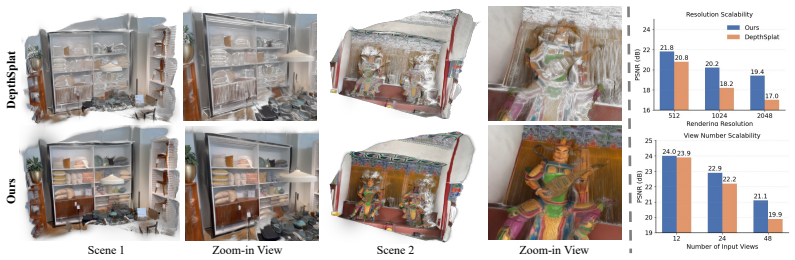
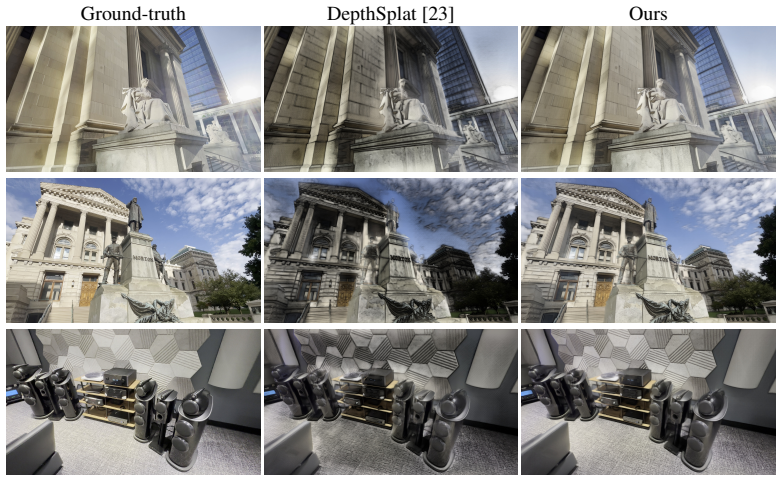
Existing pixel-wise feed-forward methods suffer from over-bright renderings when the number of input views varies during inference, as well as insufficient supervision for accurate Gaussian scale estimation, which leads to hole artifacts, particularly in high-resolution renderings. To address these issues, we identify that the over-brightness is caused by the varying number of overlapping Gaussians and propose a simple alpha normalization strategy to maintain brightness consistency across different number of input views. In addition, we introduce an auxiliary 3D sampling-based regularizer to improve Gaussian scale estimation, thereby mitigating hole artifacts in high-resolution rendering.
What carries the argument
Alpha normalization that scales output brightness according to the number of overlapping Gaussians, combined with an auxiliary 3D sampling-based regularizer that supplies additional supervision on Gaussian scale.
If this is right
- Renderings keep the same brightness level when the number of input views changes at test time.
- High-resolution outputs contain fewer holes because Gaussian scales are estimated more accurately.
- Baseline feed-forward models improve on benchmark datasets under both varying-view and high-resolution test conditions.
- The entire pipeline remains feed-forward and efficient while gaining robustness to view count.
Where Pith is reading between the lines
- The same normalization idea could be applied to other point-based or splatting representations to achieve view-count invariance.
- Capture pipelines could drop the requirement for a fixed number of cameras without needing extra post-processing.
- Integration with dynamic or video-based scenes might extend the consistency gains beyond static novel-view synthesis.
Load-bearing premise
Over-brightness arises only from changes in the number of overlapping Gaussians and the normalization plus regularizer will not create new artifacts on unseen scenes or data distributions.
What would settle it
Render the same target viewpoint once with three input views and once with five input views, then check whether the two outputs have identical pixel brightness values that also match a ground-truth photograph.
Figures



read the original abstract
Generalizable 3D Gaussian Splatting has recently emerged as an efficient approach for novel-view synthesis, enabling feed-forward synthesis from only a few input views. However, existing pixel-wise feed-forward methods suffer from over-bright renderings when the number of input views varies during inference, as well as insufficient supervision for accurate Gaussian scale estimation, which leads to hole artifacts, particularly in high-resolution renderings. To address these issues, we identify that the over-brightness is caused by the varying number of overlapping Gaussians and propose a simple alpha normalization strategy to maintain brightness consistency across different number of input views. In addition, we introduce an auxiliary 3D sampling-based regularizer to improve Gaussian scale estimation, thereby mitigating hole artifacts in high-resolution rendering. Experiments on benchmark datasets demonstrate that our method significantly improves baseline models under varying input-view and high-resolution rendering settings.
Editorial analysis
A structured set of objections, weighed in public.
Referee Report
Summary. The paper proposes RoSplat, a feed-forward pixel-wise 3D Gaussian Splatting method for novel view synthesis from sparse inputs. It diagnoses over-bright renderings as arising from varying counts of overlapping Gaussians across different numbers of input views and introduces a simple alpha normalization fix for brightness consistency. It further adds an auxiliary 3D sampling-based regularizer to improve Gaussian scale estimation and thereby reduce hole artifacts during high-resolution rendering. Experiments are claimed to show significant improvements over baselines on standard benchmarks under varying-view and high-res settings.
Significance. If the fixes prove robust, the work would address two practical failure modes that currently limit deployment of generalizable feed-forward Gaussian Splatting pipelines. The explicit identification of the overlap-count cause for brightness drift and the addition of a 3D regularizer for scale are concrete contributions that could be adopted by follow-on methods.
major comments (2)
- [Abstract] Abstract: the claim that over-brightness is caused solely by the varying number of overlapping Gaussians is presented without supporting derivation, ablation, or per-pixel contribution analysis; the proposed alpha normalization is described only at a high level, leaving open whether it preserves view-consistent radiance when Gaussians carry view-dependent features or spherical harmonics.
- [Abstract] The interaction between the alpha normalization and the 3D sampling regularizer is not analyzed; it is possible that correcting brightness via normalization exposes or creates new scale-related artifacts once the regularizer is applied, yet no joint ablation or sensitivity study is referenced.
minor comments (1)
- The abstract would be strengthened by including at least one key quantitative metric (e.g., PSNR or LPIPS delta) under the varying-view and high-resolution protocols.
Simulated Author's Rebuttal
We thank the referee for the constructive comments and the opportunity to clarify our contributions. We provide point-by-point responses below.
read point-by-point responses
-
Referee: [Abstract] Abstract: the claim that over-brightness is caused solely by the varying number of overlapping Gaussians is presented without supporting derivation, ablation, or per-pixel contribution analysis; the proposed alpha normalization is described only at a high level, leaving open whether it preserves view-consistent radiance when Gaussians carry view-dependent features or spherical harmonics.
Authors: The abstract provides a concise summary of the motivation and method. The detailed derivation of how varying Gaussian overlaps lead to brightness inconsistency is presented in Section 3.1 of the manuscript, with the mathematical formulation of the alpha accumulation. An ablation study isolating the effect of alpha normalization is included in Section 4.2, along with per-pixel visualizations in Figure 4. For view-dependent features, the normalization is applied post-color computation but pre-blending, ensuring that spherical harmonics and view-dependent effects remain unchanged. We will update the abstract to briefly mention the supporting sections for clarity. revision: partial
-
Referee: [Abstract] The interaction between the alpha normalization and the 3D sampling regularizer is not analyzed; it is possible that correcting brightness via normalization exposes or creates new scale-related artifacts once the regularizer is applied, yet no joint ablation or sensitivity study is referenced.
Authors: We agree that a more explicit analysis of the interaction would strengthen the paper. In the current manuscript, Table 5 presents results with both components enabled, showing additive improvements without degradation. However, we acknowledge the lack of a dedicated joint sensitivity study. We will add a new paragraph in Section 4.4 discussing the interaction, including additional experiments on varying the regularization weight alongside normalization to confirm no new artifacts are introduced. revision: yes
Circularity Check
No significant circularity; claims are empirical proposals without reduction to inputs
full rationale
The paper's core claims rest on an empirical identification of over-brightness from varying Gaussian overlaps, followed by direct proposal of alpha normalization and a 3D sampling regularizer. No equations, self-citations, or derivations are provided in the text that reduce these to fitted parameters, self-definitions, or prior author results by construction. The strategies are framed as responses to observed issues in baselines, preserving independent content.
Axiom & Free-Parameter Ledger
axioms (1)
- domain assumption 3D Gaussian Splatting provides an efficient differentiable rendering representation for scenes from input views
Reference graph
Works this paper leans on
-
[1]
Mip-nerf: A multiscale representation for anti-aliasing neural radiance fields
Jonathan T Barron, Ben Mildenhall, Matthew Tancik, Peter Hedman, Ricardo Martin-Brualla, and Pratul P Srinivasan. Mip-nerf: A multiscale representation for anti-aliasing neural radiance fields. InProceedings of the IEEE/CVF international conference on computer vision, pages 5855–5864, 2021
work page 2021
-
[2]
Zip-nerf: Anti- aliased grid-based neural radiance fields
Jonathan T Barron, Ben Mildenhall, Dor Verbin, Pratul P Srinivasan, and Peter Hedman. Zip-nerf: Anti- aliased grid-based neural radiance fields. InProceedings of the IEEE/CVF International Conference on Computer Vision, pages 19697–19705, 2023
work page 2023
-
[3]
Textured gaussians for enhanced 3d scene appearance modeling
Brian Chao, Hung-Yu Tseng, Lorenzo Porzi, Chen Gao, Tuotuo Li, Qinbo Li, Ayush Saraf, Jia-Bin Huang, Johannes Kopf, Gordon Wetzstein, and Changil Kim. Textured gaussians for enhanced 3d scene appearance modeling. InCVPR, 2025
work page 2025
-
[4]
pixelsplat: 3d gaussian splats from image pairs for scalable generalizable 3d reconstruction
David Charatan, Sizhe Lester Li, Andrea Tagliasacchi, and Vincent Sitzmann. pixelsplat: 3d gaussian splats from image pairs for scalable generalizable 3d reconstruction. InProceedings of the IEEE/CVF conference on computer vision and pattern recognition, pages 19457–19467, 2024
work page 2024
-
[5]
Mvsnerf: Fast generalizable radiance field reconstruction from multi-view stereo
Anpei Chen, Zexiang Xu, Fuqiang Zhao, Xiaoshuai Zhang, Fanbo Xiang, Jingyi Yu, and Hao Su. Mvsnerf: Fast generalizable radiance field reconstruction from multi-view stereo. InProceedings of the IEEE/CVF international conference on computer vision, pages 14124–14133, 2021
work page 2021
-
[6]
Mvsplat: Efficient 3d gaussian splatting from sparse multi-view images
Yuedong Chen, Haofei Xu, Chuanxia Zheng, Bohan Zhuang, Marc Pollefeys, Andreas Geiger, Tat-Jen Cham, and Jianfei Cai. Mvsplat: Efficient 3d gaussian splatting from sparse multi-view images. In European conference on computer vision, pages 370–386. Springer, 2024
work page 2024
-
[7]
Zhiwen Fan, Wenyan Cong, Kairun Wen, Kevin Wang, Jian Zhang, Xinghao Ding, Danfei Xu, Boris Ivanovic, Marco Pavone, Georgios Pavlakos, et al. Instantsplat: Sparse-view gaussian splatting in seconds. arXiv preprint arXiv:2403.20309, 2024
-
[8]
2d gaussian splatting for geometrically accurate radiance fields
Binbin Huang, Zehao Yu, Anpei Chen, Andreas Geiger, and Shenghua Gao. 2d gaussian splatting for geometrically accurate radiance fields. InSIGGRAPH 2024 Conference Papers. Association for Computing Machinery, 2024
work page 2024
-
[9]
2d gaussian splatting for geometrically accurate radiance fields
Binbin Huang, Zehao Yu, Anpei Chen, Andreas Geiger, and Shenghua Gao. 2d gaussian splatting for geometrically accurate radiance fields. InACM SIGGRAPH 2024 conference papers, pages 1–11, 2024
work page 2024
-
[10]
Guichen Huang, Ruoyu Wang, Xiangjun Gao, Che Sun, Yuwei Wu, Shenghua Gao, and Yunde Jia. Longsplat: Online generalizable 3d gaussian splatting from long sequence images.arXiv preprint arXiv:2507.16144, 2025
-
[11]
3d gaussian splatting for real-time radiance field rendering.ACM Trans
Bernhard Kerbl, Georgios Kopanas, Thomas Leimkühler, George Drettakis, et al. 3d gaussian splatting for real-time radiance field rendering.ACM Trans. Graph., 42(4):139–1, 2023
work page 2023
-
[12]
Generative sparse-view gaussian splatting
Hanyang Kong, Xingyi Yang, and Xinchao Wang. Generative sparse-view gaussian splatting. InProceed- ings of the Computer Vision and Pattern Recognition Conference, pages 26745–26755, 2025
work page 2025
-
[13]
Dl3dv-10k: A large-scale scene dataset for deep learning-based 3d vision
Lu Ling, Yichen Sheng, Zhi Tu, Wentian Zhao, Cheng Xin, Kun Wan, Lantao Yu, Qianyu Guo, Zixun Yu, Yawen Lu, et al. Dl3dv-10k: A large-scale scene dataset for deep learning-based 3d vision. InProceedings of the IEEE/CVF Conference on Computer Vision and Pattern Recognition, pages 22160–22169, 2024
work page 2024
-
[14]
Taming 3dgs: High-quality radiance fields with limited resources
Saswat Subhajyoti Mallick, Rahul Goel, Bernhard Kerbl, Markus Steinberger, Francisco Vicente Carrasco, and Fernando De La Torre. Taming 3dgs: High-quality radiance fields with limited resources. In SIGGRAPH Asia 2024 Conference Papers, pages 1–11, 2024
work page 2024
-
[15]
Ben Mildenhall, Pratul P Srinivasan, Matthew Tancik, Jonathan T Barron, Ravi Ramamoorthi, and Ren Ng. Nerf: Representing scenes as neural radiance fields for view synthesis.Communications of the ACM, 65 (1):99–106, 2021
work page 2021
-
[16]
Dropgaussian: Structural regularization for sparse-view gaussian splatting
Hyunwoo Park, Gun Ryu, and Wonjun Kim. Dropgaussian: Structural regularization for sparse-view gaussian splatting. InProceedings of the computer vision and pattern recognition conference, pages 21600–21609, 2025
work page 2025
-
[17]
Kilonerf: Speeding up neural radiance fields with thousands of tiny mlps
Christian Reiser, Songyou Peng, Yiyi Liao, and Andreas Geiger. Kilonerf: Speeding up neural radiance fields with thousands of tiny mlps. InProceedings of the IEEE/CVF international conference on computer vision, pages 14335–14345, 2021
work page 2021
-
[18]
Shengji Tang, Weicai Ye, Peng Ye, Weihao Lin, Yang Zhou, Tao Chen, and Wanli Ouyang. Hisplat: Hierar- chical 3d gaussian splatting for generalizable sparse-view reconstruction.arXiv preprint arXiv:2410.06245, 2024. 10
-
[19]
Is attention all that nerf needs?arXiv preprint arXiv:2207.13298, 2022
Peihao Wang, Xuxi Chen, Tianlong Chen, Subhashini Venugopalan, Zhangyang Wang, et al. Is attention all that nerf needs?arXiv preprint arXiv:2207.13298, 2022
-
[20]
Zpressor: Bottleneck-aware compression for scalable feed-forward 3dgs
Weijie Wang, Donny Y Chen, Zeyu Zhang, Duochao Shi, Akide Liu, and Bohan Zhuang. Zpressor: Bottleneck-aware compression for scalable feed-forward 3dgs. InThe Thirty-ninth Annual Conference on Neural Information Processing Systems
-
[21]
Yunsong Wang, Tianxin Huang, Hanlin Chen, and Gim Hee Lee. Freesplat: Generalizable 3d gaussian splatting towards free view synthesis of indoor scenes.Advances in Neural Information Processing Systems, 37:107326–107349, 2024
work page 2024
-
[22]
Murf: Multi-baseline radiance fields
Haofei Xu, Anpei Chen, Yuedong Chen, Christos Sakaridis, Yulun Zhang, Marc Pollefeys, Andreas Geiger, and Fisher Yu. Murf: Multi-baseline radiance fields. InProceedings of the IEEE/CVF Conference on Computer Vision and Pattern Recognition, pages 20041–20050, 2024
work page 2024
-
[23]
Depthsplat: Connecting gaussian splatting and depth
Haofei Xu, Songyou Peng, Fangjinhua Wang, Hermann Blum, Daniel Barath, Andreas Geiger, and Marc Pollefeys. Depthsplat: Connecting gaussian splatting and depth. InProceedings of the Computer Vision and Pattern Recognition Conference, pages 16453–16463, 2025
work page 2025
-
[24]
pixelnerf: Neural radiance fields from one or few images
Alex Yu, Vickie Ye, Matthew Tancik, and Angjoo Kanazawa. pixelnerf: Neural radiance fields from one or few images. InProceedings of the IEEE/CVF conference on computer vision and pattern recognition, pages 4578–4587, 2021
work page 2021
-
[25]
Mip-splatting: Alias-free 3d gaussian splatting
Zehao Yu, Anpei Chen, Binbin Huang, Torsten Sattler, and Andreas Geiger. Mip-splatting: Alias-free 3d gaussian splatting. InProceedings of the IEEE/CVF conference on computer vision and pattern recognition, pages 19447–19456, 2024
work page 2024
-
[26]
Transplat: Generalizable 3d gaussian splatting from sparse multi-view images with transformers
Chuanrui Zhang, Yingshuang Zou, Zhuoling Li, Minmin Yi, and Haoqian Wang. Transplat: Generalizable 3d gaussian splatting from sparse multi-view images with transformers. InProceedings of the AAAI Conference on Artificial Intelligence, pages 9869–9877, 2025
work page 2025
-
[27]
Cor-gs: sparse-view 3d gaussian splatting via co-regularization
Jiawei Zhang, Jiahe Li, Xiaohan Yu, Lei Huang, Lin Gu, Jin Zheng, and Xiao Bai. Cor-gs: sparse-view 3d gaussian splatting via co-regularization. InEuropean conference on computer vision, pages 335–352. Springer, 2024
work page 2024
-
[28]
Shengjun Zhang, Xin Fei, Fangfu Liu, Haixu Song, and Yueqi Duan. Gaussian graph network: Learn- ing efficient and generalizable gaussian representations from multi-view images.Advances in Neural Information Processing Systems, 37:50361–50380, 2024
work page 2024
-
[29]
Nexusgs: Sparse view synthesis with epipolar depth priors in 3d gaussian splatting
Yulong Zheng, Zicheng Jiang, Shengfeng He, Yandu Sun, Junyu Dong, Huaidong Zhang, and Yong Du. Nexusgs: Sparse view synthesis with epipolar depth priors in 3d gaussian splatting. InProceedings of the Computer Vision and Pattern Recognition Conference, pages 26800–26809, 2025
work page 2025
-
[30]
Stereo Magnification: Learning View Synthesis using Multiplane Images
Tinghui Zhou, Richard Tucker, John Flynn, Graham Fyffe, and Noah Snavely. Stereo magnification: Learning view synthesis using multiplane images.arXiv preprint arXiv:1805.09817, 2018. 11
work page internal anchor Pith review Pith/arXiv arXiv 2018
discussion (0)
Sign in with ORCID, Apple, or X to comment. Anyone can read and Pith papers without signing in.