Recognition: unknown
Combinatorial construction of Russell's series for partition classes defined by Capparelli, Meurman, Primc, and Primc in the k=1 Case
Pith reviewed 2026-05-14 18:42 UTC · model grok-4.3
The pith
Base partitions and allowed moves generate exactly Russell's bivariate series for CMPP partitions in the k=1 case.
A machine-rendered reading of the paper's core claim, the machinery that carries it, and where it could break.
Core claim
Russell's bivariate series for the k=1 CMPP partitions is realized combinatorially by taking certain explicit base partitions and closing them under a finite list of allowed moves; the resulting set coincides precisely with the CMPP partitions and is therefore counted by the series.
What carries the argument
Base partitions together with a finite set of allowed moves that generate all CMPP partitions without repetition.
If this is right
- The bivariate series therefore has a direct bijective proof rather than a symbolic one.
- Several previously missing cases in the k=1 family are now covered by the same construction.
- The method supplies an explicit transformation rule that preserves the weight and the color statistics tracked by the series.
Where Pith is reading between the lines
- The same base-and-moves approach may extend to other values of k once suitable bases are identified.
- The construction could be used to prove further identities relating CMPP partitions to ordinary partition statistics.
- It offers a concrete way to generate and enumerate the partitions by hand or algorithm, bypassing generating-function manipulation.
Load-bearing premise
The chosen base partitions and allowed moves produce every CMPP partition exactly once and no others.
What would settle it
Exhibit either a CMPP partition unreachable from the base partitions by the moves or a partition reachable by the moves that fails to be a CMPP partition.
Figures



read the original abstract
Recently, Capparelli, Meurman, A. Primc and M. Primc introduced a class of colored partitions which has since been called CMPP partitions. This generalized earlier work by M. Primc and \v{S}iki\'c, and by Trup\v{c}evi\'c. One main reason why CMPP partitions are significant is the authors' conjecture that the generating functions are infinite products in all cases. CMPP partitions are true extensions of the partition classes in the Rogers-Ramanujan-Gordon identities which are defined by difference conditions. As such, a natural question is to look for generating functions similar to the series side of Andrews-Gordon identities. Russell found such bivariate series for one case. He used symbolic computation in the proofs. We will combinatorially interpret Russell's bivariate series in a base partition and moves setting, and supply some missing cases, as well.
Editorial analysis
A structured set of objections, weighed in public.
Referee Report
Summary. The paper constructs a base-partition-plus-moves model that combinatorially realizes Russell's bivariate generating series for the k=1 case of CMPP partitions and fills in several missing cases left open by prior work.
Significance. If the bijection holds, the work supplies an explicit, local-move combinatorial proof of the series side, replacing Russell's symbolic computation with a finite, checkable enumeration of moves that preserve the defining difference conditions. This strengthens the combinatorial understanding of CMPP partitions as extensions of Rogers-Ramanujan-Gordon classes and may facilitate further identities or generalizations.
minor comments (3)
- [§2] §2: the definition of the allowed moves on the base partitions should include an explicit verification that each move preserves the CMPP difference conditions; a short table or lemma would make the preservation argument immediate.
- [§4] §4: the enumeration of the 'missing cases' is stated to have been verified by the same method, but a brief summary of the additional base partitions or move sequences used for those cases would improve readability.
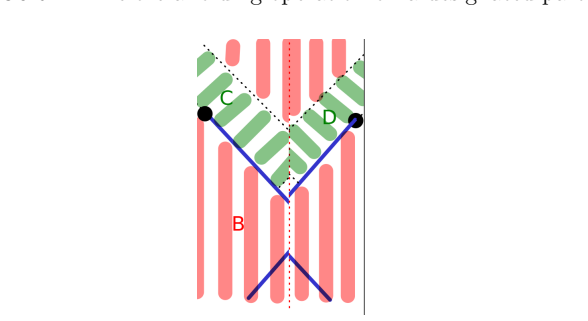
- [Figure 1] Figure 1: the diagram of a sample base partition and its images under moves would benefit from clearer labeling of the difference conditions being preserved.
Simulated Author's Rebuttal
We thank the referee for the positive assessment of our manuscript, the accurate summary of our combinatorial construction, and the recommendation for minor revision. We respond to the points raised below.
read point-by-point responses
-
Referee: The paper constructs a base-partition-plus-moves model that combinatorially realizes Russell's bivariate generating series for the k=1 case of CMPP partitions and fills in several missing cases left open by prior work.
Authors: We appreciate the referee's summary. Our work defines an explicit base partition together with a finite set of local moves whose generating function matches Russell's bivariate series exactly. Each move is shown to preserve the difference conditions that define the CMPP partitions in the k=1 case, and we prove that every valid partition arises uniquely from the base partition by a sequence of these moves. This replaces the symbolic computation with a direct, checkable enumeration. The missing cases left open by earlier work are completed by extending the same base-and-moves framework to the remaining subcases. revision: no
-
Referee: If the bijection holds, the work supplies an explicit, local-move combinatorial proof of the series side, replacing Russell's symbolic computation with a finite, checkable enumeration of moves that preserve the defining difference conditions.
Authors: The bijection is established in the manuscript by exhibiting the inverse map: given any CMPP partition satisfying the k=1 difference conditions, we repeatedly apply the inverse moves until the base partition is recovered. Because the moves are local and the difference conditions are preserved in both directions, the correspondence is bijective. The enumeration is finite for each fixed size because only finitely many moves can be applied without violating the minimal-difference rules. revision: no
Circularity Check
No significant circularity identified
full rationale
The paper offers an explicit combinatorial construction of base partitions together with a finite set of local moves that is claimed to generate exactly the k=1 CMPP partitions counted by Russell's bivariate series. The argument proceeds by direct verification of the difference conditions under each move and by enumeration of the missing cases; neither step is defined in terms of the series itself nor relies on a self-citation whose content is presupposed. The central bijection claim therefore rests on an independent, inspectable enumeration rather than on any reduction to fitted parameters, self-definitional identities, or load-bearing prior results by the same authors. Consequently the derivation chain does not collapse to its inputs by construction.
Axiom & Free-Parameter Ledger
Reference graph
Works this paper leans on
-
[1]
An analytic proof of the Rogers-Ramanujan-Gordon identities.American Journal of Mathematics,88(4), pp.844–846
Andrews, G.E., 1966. An analytic proof of the Rogers-Ramanujan-Gordon identities.American Journal of Mathematics,88(4), pp.844–846
1966
-
[2]
An analytic generalization of the Rogers-Ramanujan identities for odd moduli
Andrews, G.E., 1974. An analytic generalization of the Rogers-Ramanujan identities for odd moduli. Proceedings of the National Academy of Sciences,71(10), pp.4082–4085
1974
-
[3]
A generalization of the Rogers-Ramanujan identities for all moduli.Journal of Combinatorial Theory, Series A,27(1), pp.64–68
Bressoud, D.M., 1979. A generalization of the Rogers-Ramanujan identities for all moduli.Journal of Combinatorial Theory, Series A,27(1), pp.64–68
1979
-
[4]
An analytic generalization of the Rogers-Ramanujan identities with interpretation
Bressoud, D.M., 1980. An analytic generalization of the Rogers-Ramanujan identities with interpretation. The Quarterly Journal of Mathematics,31(4), pp.385–399
1980
-
[5]
Andrews, G.E., 1998.The theory of partitions (No. 2). Cambridge university press
1998
-
[6]
and Primc, M., 2022
Capparelli, S., Meurman, A., Primc, A. and Primc, M., 2022. New partition identities fromC (1) ℓ -modules. Glasnik matematiˇ cki,57(2), pp.161–184
2022
-
[7]
Dousse, J. and Konan, I., 2022. Characters of level 1 standard modules ofC (1) n as generating functions for generalised partitions. arXiv preprint arXiv:2212.12728
-
[8]
and Welsh, T.A., 2016
Foda, O. and Welsh, T.A., 2016. Cylindric partitions,⊒ r characters and the Andrews–Gordon–Bressoud identities.Journal of Physics A: Mathematical and Theoretical,49(16), p.164004
2016
-
[9]
and Rahman, M., 2011.Basic hypergeometric series (Vol
Gasper, G. and Rahman, M., 2011.Basic hypergeometric series (Vol. 96). Cambridge university press
2011
-
[10]
Gessel and C
Ira M. Gessel and C. Krattenthaler, Cylindric partitions,Trans. Amer. Math. Soc.,349(2):429–479, 1997
1997
-
[11]
A combinatorial generalization of the Rogers-Ramanujan identities.American Journal of Mathematics,83(2), pp.393–399
Gordon, B., 1961. A combinatorial generalization of the Rogers-Ramanujan identities.American Journal of Mathematics,83(2), pp.393–399
1961
-
[12]
Misra, and Carla D
Naihuan Jing, Kailash C. Misra, and Carla D. Savage, C.D. On multi-color partitions and the generalized Rogers–Ramanujan identities.Communications in Contemporary Mathematics,3(4), pp.533–548, 2001
2001
-
[13]
and Sills, A.V., 2017
Kanade, S., Lepowsky, J., Russell, M.C. and Sills, A.V., 2017. Ghost series and a motivated proof of the Andrews–Bressoud identities.Journal of Combinatorial Theory, Series A,146, pp.33–62
2017
-
[14]
Remarks on the conjectures of Capparelli, Meurman, Primc and Primc
Kanade, S., Russell, M.C., Tsuchioka, S. and Warnaar, S.O., 2024. Remarks on the conjectures of Cap- parelli, Meurman, Primc and Primc. arXiv preprint arXiv:2404.03851
work page internal anchor Pith review Pith/arXiv arXiv 2024
-
[15]
and¨Omr¨ uuzun Seyrek, H., 2025
Kur¸ sung¨ oz, K. and¨Omr¨ uuzun Seyrek, H., 2025. A decomposition of cylindric partitions and cylindric partitions into distinct parts.European Journal of Combinatorics,130, p.104219
2025
-
[16]
and Wilson, R.L., 1985
Lepowsky, J. and Wilson, R.L., 1985. The structure of standard modules: II. The caseA (1) 1 , principal gradation.Inventiones mathematicae,79(3), pp.417–442
1985
-
[17]
and ˇSiki´ c, T., 2016
Primc, M. and ˇSiki´ c, T., 2016. Combinatorial bases of basic modules for affine Lie algebrasC(1) n .Journal of mathematical physics,57(9)
2016
-
[18]
and ˇSiki´ c, T., 2019
Primc, M. and ˇSiki´ c, T., 2019. Leading terms of relations for standard modules of the affine Lie algebras C (1) n .The Ramanujan Journal,48(3), pp.509–543
2019
-
[19]
and Trupˇ cevi´ c, G., 2025
Primc, M. and Trupˇ cevi´ c, G., 2025. Linear independence forC(1) ℓ by usingC (1) 2ℓ .Journal of algebra,661, pp.341–356
2025
-
[20]
S.Ramanujan, L.J.Rogers, Proof of certain identities in combinatory analysis,Proc.Cambridge Phil.Soc.,19, 211–216 (1919)
1919
-
[21]
Russell, M.C., 2023. Companions to the Andrews-Gordon and Andrews-Bressoud identities, and recent conjectures of Capparelli, Meurman, Primc, and Primc. arXiv preprint arXiv:2306.16251. 31
work page internal anchor Pith review Pith/arXiv arXiv 2023
-
[22]
Bases of standard modules for affine Lie algebras of type.Communications in algebra, 46(8), pp.3663–3673
Trupˇ cevi´ c, G., 2018. Bases of standard modules for affine Lie algebras of type.Communications in algebra, 46(8), pp.3663–3673. Ka˘gan Kurs ¸ung¨oz, Faculty of Engineering and Natural Sciences, Sabancı University, Tuzla, Istanbul 34956, Turkey Email address:kursungoz@sabanciuniv.edu
2018
discussion (0)
Sign in with ORCID, Apple, or X to comment. Anyone can read and Pith papers without signing in.