Recognition: 2 theorem links
· Lean TheoremQCIVET: A Quantum--Classical Pipeline Integrity Framework with Contract-Based Subtype Verification and Hash-Chained Audit Traces
Pith reviewed 2026-05-14 18:58 UTC · model grok-4.3
The pith
QCIVET verifies integrity of hybrid quantum-classical pipelines through contract-based subtype checks on quantum observables and hash-chained audit traces.
A machine-rendered reading of the paper's core claim, the machinery that carries it, and where it could break.
Core claim
QCIVET models a hybrid pipeline as a sequence of stages with explicit specifications, audits syntactic integrity via hash-chained traces, and verifies semantic integrity at quantum stages with a calibrated observable-deviation test drawn from behavioural-subtyping rules; this test is sound under diamond-norm channel distance, conditionally complete for informationally complete observable families, compositional under inheritance, and distinguishes Z-only-sneaky overrides that single-Pauli contracts miss.
What carries the argument
The calibrated observable-deviation test based on Liskov-Wing behavioural subtyping, which measures whether quantum-channel outputs remain inside declared subtype contracts on chosen observables.
If this is right
- Soundness of integrity verification holds under the diamond-norm distance between quantum channels.
- Conditional completeness follows when the observable family is informationally complete.
- Compositionality of the contracts is preserved along inheritance chains.
- Multi-Pauli contracts expose Z-only-sneaky overrides that evade single-Pauli contracts.
Where Pith is reading between the lines
- The low per-stage latency makes the method suitable for continuous auditing of cloud QPUs during live customer workloads.
- Recalibrating the deviation thresholds for processors with different noise profiles would be a direct next measurement.
- The same subtype discipline could be applied to verify integrity of quantum-assisted optimization or simulation pipelines beyond the three examples tested.
Load-bearing premise
The calibrated observable-deviation test grounded in behavioural-subtyping discipline correctly captures semantic integrity violations at quantum stages under realistic noise.
What would settle it
An experiment on ibm_fez in which a Z-only-sneaky override passes the multi-Pauli contract test while violating the intended observable bounds would falsify the completeness claim.
Figures



read the original abstract
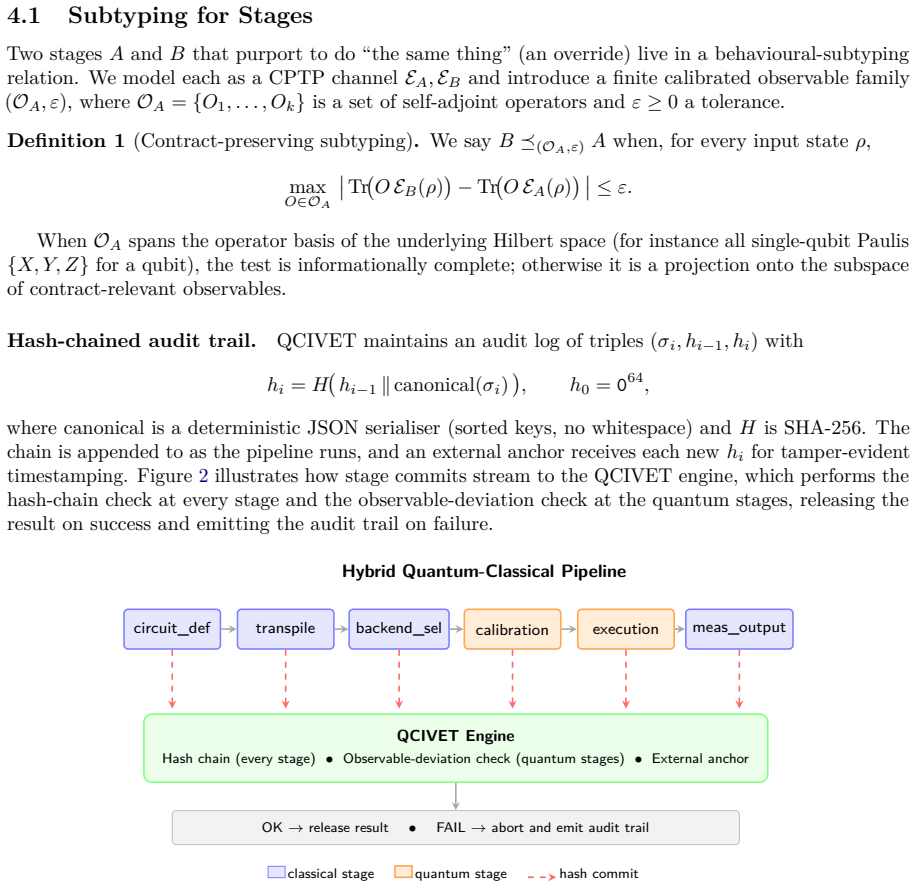
Hybrid quantum--classical pipelines increasingly support applications such as drug discovery, fraud detection, and cloud quantum processing unit (QPU) auditing, yet existing integrity-verification methods remain largely classical and fail to capture quantum-stage behaviour. We propose QCIVET, a contract-based integrity-verification framework that models a hybrid pipeline as a sequence of stages with explicit specifications and audits it at both syntactic and semantic levels. Syntactic integrity is enforced through a hash-chained audit trail with optional external anchoring, while semantic integrity at quantum stages is verified using a calibrated observable-deviation test grounded in the behavioural-subtyping discipline of Liskov and Wing. We prove soundness under the diamond-norm distance between quantum channels, conditional completeness for informationally complete observable families, and compositionality under inheritance chains. We further identify a class of Z-only-sneaky overrides that evade weak single-Pauli contracts but are exposed by multi-Pauli contracts. The framework is evaluated under calibration-derived noise models from IBM Quantum Eagle r3 and Heron r2 processors, and the subtype-separation protocol is validated end-to-end on a real ibm_fez (Heron r2) processor. QCIVET is instantiated on three representative applications: variational quantum eigensolver (VQE) for drug discovery, quantum-assisted fraud detection, and customer-side auditing of cloud QPU services. The reference implementation, including a real-time verification engine with sub-millisecond per-stage commit latency, is released as open source.
Editorial analysis
A structured set of objections, weighed in public.
Referee Report
Summary. The paper introduces QCIVET, a contract-based framework for verifying integrity in hybrid quantum-classical pipelines. It models pipelines as sequences of stages with specifications, enforces syntactic integrity via hash-chained audit trails, and semantic integrity at quantum stages via a calibrated observable-deviation test derived from Liskov-Wing behavioral subtyping. The authors claim proofs of soundness under diamond-norm distance between quantum channels, conditional completeness for informationally complete observable families, and compositionality under inheritance chains; they identify Z-only-sneaky overrides that evade single-Pauli but not multi-Pauli contracts. The framework is instantiated on VQE for drug discovery, quantum-assisted fraud detection, and QPU auditing, with evaluation under IBM Eagle/Heron noise models and end-to-end validation on ibm_fez hardware; an open-source reference implementation is provided.
Significance. If the claimed reduction from observable-deviation tests to diamond-norm soundness holds and the completeness condition is satisfied under realistic IBM noise, the work would provide a novel, auditable integrity layer for hybrid quantum pipelines that is currently absent from the literature. The combination of formal proofs, identification of a concrete evasion class (Z-only-sneaky overrides), real-hardware validation on Heron r2, and open-source release would strengthen reproducibility and practical impact for applications such as VQE and cloud QPU auditing.
major comments (2)
- [Abstract and §3] Abstract and §3 (Soundness and Completeness): the soundness claim is stated under diamond-norm distance between channels, yet the implemented quantum-stage check is a calibrated observable-deviation test grounded in classical behavioral subtyping. No explicit reduction is supplied showing that the chosen observable family remains informationally complete after calibration and under the specific noise channels of Eagle/Heron processors, so it is unclear whether the test bounds diamond-norm deviation for the contract signatures used in VQE or fraud-detection pipelines.
- [§4.2] §4.2 (Z-only-sneaky overrides): the identification of this evasion class is load-bearing for the claim that multi-Pauli contracts are strictly stronger than single-Pauli contracts. The manuscript should supply the explicit diamond-norm distance achieved by a concrete Z-only-sneaky override under the calibration-derived noise model, together with the observable-deviation values reported by both contract types, to confirm that the multi-Pauli test indeed exposes the violation while the single-Pauli test does not.
minor comments (3)
- [§2.1] §2.1: the notation for contract signatures and inheritance chains is introduced without a compact summary table; adding one would improve readability when the compositionality theorem is stated later.
- [Figure 5] Figure 5 (end-to-end ibm_fez trace): axis labels and error-bar definitions are missing; the caption should explicitly state whether the plotted deviations are raw or post-calibration and whether the shaded regions represent one or two standard deviations over the 1000-shot runs.
- [§5] §5 (open-source release): the repository link and commit hash used for the reported experiments should be stated in the main text rather than only in the supplementary material.
Simulated Author's Rebuttal
We are grateful to the referee for the thorough review and valuable feedback on QCIVET. We address each major comment in detail below and outline the revisions we will make to strengthen the manuscript.
read point-by-point responses
-
Referee: [Abstract and §3] Abstract and §3 (Soundness and Completeness): the soundness claim is stated under diamond-norm distance between channels, yet the implemented quantum-stage check is a calibrated observable-deviation test grounded in classical behavioral subtyping. No explicit reduction is supplied showing that the chosen observable family remains informationally complete after calibration and under the specific noise channels of Eagle/Heron processors, so it is unclear whether the test bounds diamond-norm deviation for the contract signatures used in VQE or fraud-detection pipelines.
Authors: The referee correctly identifies that the manuscript would benefit from a more explicit reduction. Section 3 establishes soundness by proving that for an informationally complete observable family, the maximum observable deviation bounds the diamond-norm distance between channels. The calibration procedure is designed to preserve informational completeness under the Eagle and Heron noise models by incorporating device-specific Pauli calibrations. However, to address the concern directly, we will add a lemma in the revised §3 that explicitly derives the diamond-norm bound from the observable-deviation test for the contract signatures in the VQE and fraud-detection examples, including the relevant constants and completeness verification under the noise channels. revision: yes
-
Referee: [§4.2] §4.2 (Z-only-sneaky overrides): the identification of this evasion class is load-bearing for the claim that multi-Pauli contracts are strictly stronger than single-Pauli contracts. The manuscript should supply the explicit diamond-norm distance achieved by a concrete Z-only-sneaky override under the calibration-derived noise model, together with the observable-deviation values reported by both contract types, to confirm that the multi-Pauli test indeed exposes the violation while the single-Pauli test does not.
Authors: We concur that providing explicit numerical values for a concrete instance would reinforce the practical significance of the Z-only-sneaky override class. The current text defines the class and proves its existence and evasion properties theoretically. In the revision, we will include a specific numerical example in §4.2, calculating the diamond-norm distance for a chosen Z-only-sneaky override using the Heron r2 calibration noise model, and tabulate the observable-deviation values under both single-Pauli and multi-Pauli contracts to demonstrate the detection difference. revision: yes
Circularity Check
No significant circularity; claims rest on external standards
full rationale
The derivation claims soundness under the standard diamond-norm distance between quantum channels, conditional completeness for informationally complete observable families, and compositionality under inheritance chains. The observable-deviation test is explicitly grounded in the external Liskov-Wing behavioral-subtyping discipline and evaluated on IBM calibration data from Eagle/Heron processors. No self-definitional reductions, fitted inputs renamed as predictions, or load-bearing self-citations appear in the stated proofs or framework. The central claims remain independent of the paper's own fitted values or prior author results.
Axiom & Free-Parameter Ledger
free parameters (1)
- calibration-derived noise models
axioms (1)
- domain assumption Behavioural-subtyping discipline of Liskov and Wing extends to quantum channels under diamond-norm distance
invented entities (1)
-
Z-only-sneaky overrides
no independent evidence
Lean theorems connected to this paper
-
IndisputableMonolith/Cost/FunctionalEquation.leanwashburn_uniqueness_aczel unclear?
unclearRelation between the paper passage and the cited Recognition theorem.
We prove soundness under the diamond-norm distance between quantum channels, conditional completeness for informationally complete observable families... (Thm 1–2, Prop 1)
-
IndisputableMonolith/Foundation/RealityFromDistinction.leanreality_from_one_distinction unclear?
unclearRelation between the paper passage and the cited Recognition theorem.
B⪯(OA,ε)A when max |Tr(O EB(ρ))−Tr(O EA(ρ))|≤ε for O in OA
What do these tags mean?
- matches
- The paper's claim is directly supported by a theorem in the formal canon.
- supports
- The theorem supports part of the paper's argument, but the paper may add assumptions or extra steps.
- extends
- The paper goes beyond the formal theorem; the theorem is a base layer rather than the whole result.
- uses
- The paper appears to rely on the theorem as machinery.
- contradicts
- The paper's claim conflicts with a theorem or certificate in the canon.
- unclear
- Pith found a possible connection, but the passage is too broad, indirect, or ambiguous to say the theorem truly supports the claim.
Reference graph
Works this paper leans on
-
[1]
Internet X.509 public key infrastructure time-stamp protocol (tsp)
Carlisle Adams, Pat Cain, Denis Pinkas, and Robert Zuccherato. Internet X.509 public key infrastructure time-stamp protocol (tsp). RFC 3161, Internet Engineering Task Force (IETF), 2001
work page 2001
-
[2]
Mst Shapna Akter, Hossain Shahriar, Sheikh Iqbal Ahamed, Kishor Datta Gupta, Muhammad Rahman, Atef Mohamed, Mohammad Rahman, Akond Rahman, and Fan Wu. Case study-based approach of quantum machine learning in cybersecurity: Quantum support vector machine for malware classification and protection. In2023 IEEE 47th Annual Computers, Software, and Application...
work page 2023
-
[3]
Vita Santa Barletta, Danilo Caivano, Mirko De Vincentiis, Anibrata Pal, and Michele Scalera. Hybrid quantum architecture for smart city security.Journal of Systems and Software, 217:112161, 2024
work page 2024
-
[4]
Samarth Bhadane, Disha Gupta, Priyanka V. Deshmukh, and Nivedita Mishra. A hybrid hash framework for post-quantum secure zero-knowledge identification.Scientific Reports, 15:42176, 2025
work page 2025
-
[5]
Robert Campbell. AI supply chain security: MBOM-PQC provenance, PQC attestation, and a maturity model for quantum-resistant assurance, 2026. Preprints.org
work page 2026
-
[6]
Grazia D’Onghia and Antonio Lioy. Towards quantum-resistant trusted computing: Architectures for post-quantum integrity verification techniques. In2025 IEEE Symposium on Computers and Communications (ISCC), Bologna, Italy, July 2025. IEEE
work page 2025
-
[7]
Kanishk Dwivedi, Majid Haghparast, and Tommi Mikkonen. Quantum software engineering and quantum software development lifecycle: A survey.Cluster Computing, 27(6):7127–7145, 2024
work page 2024
-
[8]
Fedorov, Bo Peng, Niranjan Govind, and Yuri Alexeev
Dmitry A. Fedorov, Bo Peng, Niranjan Govind, and Yuri Alexeev. VQE method: A short survey and recent developments.Materials Theory, 6(1):2, 2022
work page 2022
-
[9]
A monadic semantics for quantum computing in Featherweight Java
Samuel da Silva Feitosa, Juliana Kaizer Vizzotto, Eduardo Kessler Piveta, and Andre Rauber Du Bois. A monadic semantics for quantum computing in Featherweight Java. InBrazilian Symposium on Programming Languages (SBLP 2016), volume 9889 ofLecture Notes in Computer Science, pages 31–45. Springer, 2016
work page 2016
-
[10]
Yuan Feng, Runyao Duan, and Mingsheng Ying. Bisimulation for quantum processes.ACM Transactions on Programming Languages and Systems, 34(4):17:1–17:43, 2012
work page 2012
-
[11]
Refinement orders for quantum programs, 2025
Yuan Feng and Li Zhou. Refinement orders for quantum programs, 2025
work page 2025
-
[12]
Yuan Feng, Li Zhou, Yingte Xu, and Xiaoquan Xu. Refinement calculus of quantum programs with projective assertions.ACM Transactions on Software Engineering and Methodology, 2025
work page 2025
-
[13]
Doubling down on open-access quantum computing, March 2026
Leron Gil, Julianna Roberts, Sanskriti Deva, and Robert Davis. Doubling down on open-access quantum computing, March 2026. IBM Quantum Computing Blog. Accessed: May 2026
work page 2026
-
[14]
Taylor Harville, Rishu Khurana, Vitor F. Grizzi, and Cong Liu. Recent developments in VQE: Survey and benchmarking, 2026
work page 2026
-
[15]
Wood, Jake Lishman, Julien Gacon, Simon Martiel, Paul D
Ali Javadi-Abhari, Matthew Treinish, Kevin Krsulich, Christopher J. Wood, Jake Lishman, Julien Gacon, Simon Martiel, Paul D. Nation, Lev S. Bishop, Andrew W. Cross, Blake R. Johnson, and Jay M. Gambetta. Quantum computing with Qiskit, 2024
work page 2024
-
[16]
ScaffML: A quantum behavioral interface specification language for Scaffold, 2023
Tiancheng Jin and Jianjun Zhao. ScaffML: A quantum behavioral interface specification language for Scaffold, 2023
work page 2023
-
[17]
Zaki Khan, Mizanur Rahman, and Mashrur Chowdhury
Md. Zaki Khan, Mizanur Rahman, and Mashrur Chowdhury. Hybrid quantum-classical neural network for cloud-supported in-vehicle cyberattack detection, 2021
work page 2021
-
[18]
Sungbeen Kim and Dohoon Kim. Data-tracking in blockchain utilizing hash chain: A study of structured and adaptive process.Symmetry, 16(1):62, 2024. 27
work page 2024
-
[19]
Verifying BQP computations on noisy devices with minimal overhead.PRX Quantum, 2(4):040302, 2021
Dominik Leichtle, Luka Music, Elham Kashefi, and Harold Ollivier. Verifying BQP computations on noisy devices with minimal overhead.PRX Quantum, 2(4):040302, 2021
work page 2021
-
[20]
Gushu Li, Li Zhou, Nengkun Yu, Yufei Ding, Mingsheng Ying, and Yuan Xie. Projection-based runtime assertions for testing and debugging quantum programs.Proceedings of the ACM on Programming Languages, 4(OOPSLA):150:1–150:29, 2020
work page 2020
-
[21]
Barbara Liskov and Jeannette M. Wing. A behavioral notion of subtyping.ACM Transactions on Programming Languages and Systems, 16(6):1811–1841, 1994
work page 1994
-
[22]
Ang Liu, Xiu-Bo Chen, Shengwei Xu, Zhuo Wang, Zhengyang Li, Liwei Xu, Yanshuo Zhang, and Ying Chen. A secure scheme based on a hybrid of classical-quantum communications protocols for managing classical blockchains.Entropy, 25(5):811, 2023
work page 2023
-
[23]
Ralph C. Merkle. A digital signature based on a conventional encryption function. InAdvances in Cryptology — CRYPTO ’87, volume 293 ofLecture Notes in Computer Science, pages 369–378. Springer, 1988
work page 1988
-
[24]
Prentice Hall, 2nd edition, 1997
Bertrand Meyer.Object-Oriented Software Construction. Prentice Hall, 2nd edition, 1997
work page 1997
-
[25]
Hector E. Mozo. Quantum-classical hybrid encryption framework based on simulated BB84 and AES-256: Design and experimental evaluation, 2025
work page 2025
-
[26]
Juan M. Murillo, Jose Garcia-Alonso, Enrique Moguel, Johanna Barzen, Frank Leymann, Shaukat Ali, Tao Yue, Paolo Arcaini, Ricardo Pérez-Castillo, Ignacio García Rodríguez de Guzmán, Mario Piattini, Antonio Ruiz-Cortés, Antonio Brogi, Jianjun Zhao, Andriy Miranskyy, and Manuel Wimmer. Quantum software engineering: Roadmap and challenges ahead.ACM Transactio...
work page 2025
-
[27]
FIPS 203: Module-lattice-based key-encapsulation mechanism standard
National Institute of Standards and Technology. FIPS 203: Module-lattice-based key-encapsulation mechanism standard. Technical report, 2024
work page 2024
-
[28]
FIPS 204: Module-lattice-based digital signature standard
National Institute of Standards and Technology. FIPS 204: Module-lattice-based digital signature standard. Technical report, 2024
work page 2024
-
[29]
FIPS 205: Stateless hash-based digital signature standard
National Institute of Standards and Technology. FIPS 205: Stateless hash-based digital signature standard. Technical report, 2024
work page 2024
-
[30]
Post-quantum cryptography: Additional digital signature schemes
National Institute of Standards and Technology (NIST). Post-quantum cryptography: Additional digital signature schemes. https://csrc.nist.gov/projects/pqc-dig-sig, 2026. Accessed 19 April 2026
work page 2026
-
[31]
Post-quantum cryptography standardization process
National Institute of Standards and Technology (NIST). Post-quantum cryptography standardization process. https://csrc.nist.gov/projects/post-quantum-cryptography/ post-quantum-cryptography-standardization, 2026. Accessed 19 April 2026
work page 2026
-
[32]
Srikumar Nayak. HQFS: Hybrid quantum classical financial security with VQC forecasting, QUBO annealing, and audit-ready post-quantum signing, 2026
work page 2026
-
[33]
Sigstore: Software signing for everybody
Zachary Newman, John Speed Meyers, and Santiago Torres-Arias. Sigstore: Software signing for everybody. InProceedings of the 2022 ACM SIGSAC Conference on Computer and Communications Security (CCS ’22), pages 2353–2367. ACM, 2022
work page 2022
-
[34]
Michael A. Nielsen and Isaac L. Chuang.Quantum Computation and Quantum Information. Cambridge University Press, 10th anniversary edition, 2010
work page 2010
-
[35]
Chinenye Okafor, Trevor Schorlemmer, Santiago Torres-Arias, and James C. Davis. SoK: Analysis of software supply chain security by establishing secure design properties. InProceedings of the 2022 ACM Workshop on Software Supply Chain Offensive Research and Ecosystem Defenses (SCORED ’22), pages 15–24. ACM, 2022
work page 2022
-
[36]
Vern I. Paulsen.Completely Bounded Maps and Operator Algebras, volume 78 ofCambridge Studies in Advanced Mathematics. Cambridge University Press, 2002. 28
work page 2002
-
[37]
Koustubh Phalak, Abdullah Ash-Saki, Mahabubul Alam, Rasit Onur Topaloglu, and Swaroop Ghosh. Quantum PUF for security and trust in quantum computing.IEEE Journal on Emerging and Selected Topics in Circuits and Systems, 11(2):333–342, 2021
work page 2021
-
[38]
Lecture notes for physics 229: Quantum information and computation
John Preskill. Lecture notes for physics 229: Quantum information and computation. Caltech, 1998
work page 1998
-
[39]
Audit trail in pharma: A review.Asian Journal of Pharmaceutical Research, 12(4):359– 363, 2022
Amit Saxena. Audit trail in pharma: A review.Asian Journal of Pharmaceutical Research, 12(4):359– 363, 2022
work page 2022
-
[40]
Bruce Schneier and John Kelsey. Secure audit logs to support computer forensics.ACM Transactions on Information and System Security, 2(2):159–176, 1999
work page 1999
-
[41]
Samuel Sepúlveda, Ania Cravero, Guillermo Fonseca, and Leandro Antonelli. Systematic review on requirements engineering in quantum computing: Insights and future directions.Electronics, 13(15):2989, 2024
work page 2024
-
[42]
Yunong Shi, Runzhou Tao, Xupeng Li, Ali Javadi-Abhari, Andrew W. Cross, Frederic T. Chong, and Ronghui Gu. CertiQ: A mostly-automated verification tool for a realistic quantum compiler, 2019
work page 2019
-
[43]
Supply-chain levels for software artifacts (slsa)
SLSA Framework. Supply-chain levels for software artifacts (slsa). Project repository and specification, 2021.https://slsa.dev
work page 2021
-
[44]
Analyzing challenges in deployment of the SLSA framework for software supply chain security, 2024
Mahzabin Tamanna, Sascha Fahl, Sivana Hamer, Yasemin Acar, Mindy Tran, and Laurie Williams. Analyzing challenges in deployment of the SLSA framework for software supply chain security, 2024
work page 2024
-
[45]
Feature-oriented contract composition.Journal of Systems and Software, 152:83–107, 2019
Thomas Thüm, Alexander Knüppel, Stefan Krüger, Stefanie Bolle, and Ina Schaefer. Feature-oriented contract composition.Journal of Systems and Software, 152:83–107, 2019
work page 2019
-
[46]
Jules Tilly, Hongxiang Chen, Shuxiang Cao, Dario Picozzi, Kanav Setia, Ying Li, Edward Grant, Leonard Wossnig, Ivan Rungger, George H. Booth, and Jonathan Tennyson. The variational quantum eigensolver: A review of methods and best practices.Physics Reports, 986:1–128, 2022
work page 2022
-
[47]
in-toto: Providing farm-to-table guarantees for bits and bytes
Santiago Torres-Arias, Hammad Afzali, Trishank Karthik Kuppusamy, Reza Curtmola, and Justin Cappos. in-toto: Providing farm-to-table guarantees for bits and bytes. In28th USENIX Security Symposium (USENIX Security 19), pages 1393–1410. USENIX Association, 2019
work page 2019
-
[48]
Dominique Unruh. Quantum relational Hoare logic.Proceedings of the ACM on Programming Languages, 3(POPL):33:1–33:31, 2019
work page 2019
-
[49]
Robust and secure hybrid quantum-classical computation on untrusted cloud-based quantum hardware
Suryansh Upadhyay and Swaroop Ghosh. Robust and secure hybrid quantum-classical computation on untrusted cloud-based quantum hardware. InProceedings of the 11th International Workshop on Hardware and Architectural Support for Security and Privacy (HASP ’22), pages 45–52. ACM, 2022
work page 2022
-
[50]
Suryansh Upadhyay and Swaroop Ghosh. Trustworthy and reliable computing using untrusted and unreliable quantum hardware.Frontiers in Computer Science, 6:1431788, 2024
work page 2024
-
[51]
U.S. Food and Drug Administration. 21 CFR Part 11 – electronic records; electronic signatures. Code of Federal Regulations, Title 21, 1997. Last accessed: 2026
work page 1997
-
[52]
Cambridge University Press, 2018
John Watrous.The Theory of Quantum Information. Cambridge University Press, 2018
work page 2018
-
[53]
Detecting fraudulent services on quantum cloud platforms via dynamic fingerprinting
Jindi Wu, Tianjie Hu, and Qun Li. Detecting fraudulent services on quantum cloud platforms via dynamic fingerprinting. InProceedings of the 43rd IEEE/ACM International Conference on Computer-Aided Design (ICCAD ’24), pages 1–8. ACM, 2024
work page 2024
-
[54]
Jindi Wu, Tianjie Hu, and Qun Li. QuanGuard: Error evolution-based fingerprinting for fraud detection in quantum cloud services.IEEE Transactions on Computers, 75(3):1070–1081, 2026
work page 2026
-
[55]
Design by contract framework for quantum software
Masaomi Yamaguchi and Nobukazu Yoshioka. Design by contract framework for quantum software. In2023 IEEE/ACM 4th International Workshop on Quantum Software Engineering (Q-SE), pages 24–25. IEEE Computer Society, 2023. Also available as arXiv:2303.17750
-
[56]
Esra Yeniaras. Quantum resistance. In Roman Beck, editor,Elgar Encyclopedia of Cryptocurrencies, Blockchain and DLT, pages 178–184. Edward Elgar Publishing, 2026. 29
work page 2026
-
[57]
Esra Yeniaras and Murat Cenk. Faster characteristic three polynomial multiplication and its application to NTRU Prime decapsulation.Journal of Cryptographic Engineering, 12(3):329–348, 2022
work page 2022
-
[58]
Esra Yeniaras and Murat Cenk. Improved polynomial multiplication algorithms over characteristic three fields and applications to NTRU Prime. InInnovative Security Solutions for Information Technology and Communications, pages 125–144, Cham, 2022. Springer International Publishing
work page 2022
-
[59]
Mingsheng Ying. Floyd–Hoare logic for quantum programs.ACM Transactions on Programming Languages and Systems, 33(6):19:1–19:49, 2011
work page 2011
-
[60]
An applied quantum Hoare logic
Li Zhou, Nengkun Yu, and Mingsheng Ying. An applied quantum Hoare logic. InProceedings of the 40th ACM SIGPLAN Conference on Programming Language Design and Implementation (PLDI 2019), pages 1149–1162. ACM, 2019. 30
work page 2019
discussion (0)
Sign in with ORCID, Apple, or X to comment. Anyone can read and Pith papers without signing in.