Recognition: 2 theorem links
· Lean TheoremRecasting AI Data Centers as Engines for Carbon Removal
Pith reviewed 2026-05-14 18:08 UTC · model grok-4.3
The pith
Integrating AI data center waste heat with direct air capture can yield net carbon removal in many US regions.
A machine-rendered reading of the paper's core claim, the machinery that carries it, and where it could break.
Core claim
AIDC waste heat can substantially improve net CO2 removal and lower the levelized cost of capture. In carbon-intensive regions, integration can flip DAC from net-positive to net-negative. Under a 2030 scenario with more GPU-intensive AIDCs and cleaner grids, several states achieve removal ratios above 1, indicating that integrated systems can offset their own operational emissions and deliver additional carbon removal.
What carries the argument
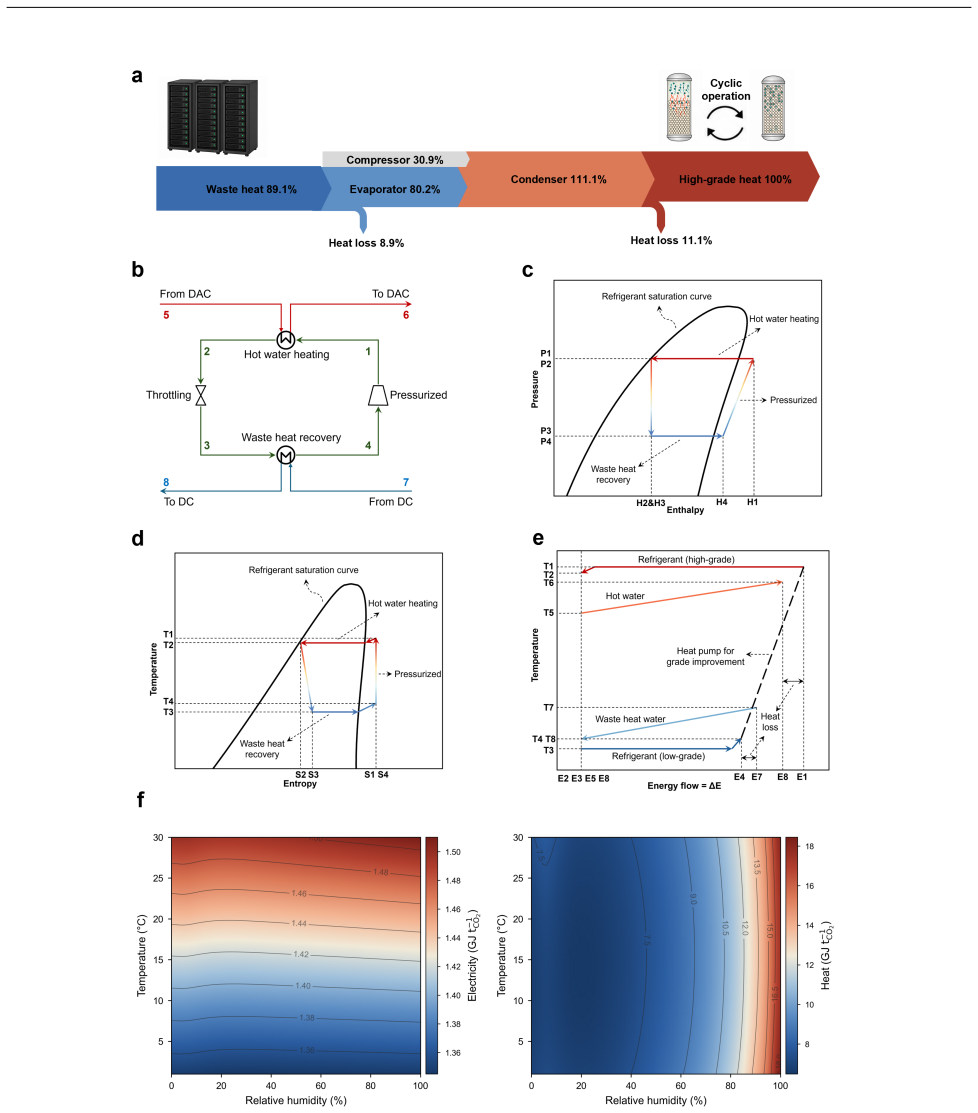
The thermodynamically integrated DAC-AIDC system that upgrades low-grade AIDC waste heat via heat pumps to drive direct air capture.
If this is right
- In carbon-intensive regions the integrated system achieves net-negative CO2 emissions overall.
- The levelized cost of CO2 capture falls when AIDC waste heat supplies the DAC process.
- Under 2030 conditions with GPU-intensive centers and cleaner grids, several states reach removal ratios above 1.
- Regional differences in grid carbon intensity and climate strongly determine whether the integration succeeds.
Where Pith is reading between the lines
- Future data center siting decisions could favor locations where grid carbon intensity is high enough to maximize the net removal benefit from heat integration.
- Policy incentives for waste-heat recovery could become part of strategies to manage the growing electricity demand of AI infrastructure.
- The same heat-upgrade approach might be tested on other continuous heat sources such as large conventional data centers or industrial processes.
Load-bearing premise
Heat pumps can efficiently raise the temperature and energy quality of AIDC waste heat to the levels required for effective DAC operation without adding prohibitive energy costs or losses.
What would settle it
A pilot installation in a high-carbon-intensity grid region that measures actual net CO2 removal and levelized costs for both the integrated system and standalone DAC to check against model predictions.
Figures



read the original abstract
AI data centers (AIDCs) are rapidly increasing electricity demand and associated CO2 emissions, yet they also generate continuous low-grade waste heat. Here, we assess whether this heat can be upgraded by heat pumps to drive direct air capture (DAC) and reduce the climate impact of AI infrastructure. We develop a thermodynamically integrated DAC-AIDC system and conduct a region-resolved assessment across the United States, accounting for AIDC capacity, server composition, local climate, electricity prices, and grid carbon intensity. We find that AIDC waste heat can substantially improve net CO2 removal and lower the levelized cost of capture. In carbon-intensive regions, integration can flip DAC from net-positive to net-negative. Under a 2030 scenario with more GPU-intensive AIDCs and cleaner grids, several states achieve removal ratios above 1, indicating that integrated systems can offset their own operational emissions and deliver additional carbon removal.
Editorial analysis
A structured set of objections, weighed in public.
Referee Report
Summary. The manuscript claims that integrating AI data center (AIDC) waste heat, upgraded via heat pumps, with direct air capture (DAC) can substantially improve net CO2 removal rates and lower the levelized cost of capture. Region-specific modeling across the US shows that in carbon-intensive areas, this integration can make DAC net-negative, and under a 2030 GPU-intensive scenario, several states achieve removal ratios exceeding 1.
Significance. If the modeling assumptions hold, this identifies a promising synergy between the growing energy demands of AI infrastructure and carbon removal technologies, potentially turning waste heat and emissions into an asset for net carbon reduction. It provides quantitative, spatially resolved insights that could inform policy and infrastructure planning for sustainable AI growth, with credit due for the region-resolved assessment incorporating AIDC capacity, local climate, and grid factors.
major comments (2)
- The thermodynamic integration model relies on heat pump COP values for lifting ~30-60°C AIDC waste heat to 80-150°C DAC regeneration temperatures; without explicit justification, sensitivity analysis, or bounds on realistic COP (typically 2-4 accounting for losses), the claimed net removal ratios >1 in the 2030 scenario are not robust, especially on carbon-intensive grids.
- Results section on removal ratios and net-negative DAC: the flip from net-positive to net-negative in carbon-intensive regions depends on unexamined auxiliary electricity demands and system boundaries; the central claim that integration offsets AIDC emissions requires explicit validation against grid carbon intensity variations and parameter ranges for DAC energy per ton CO2.
minor comments (2)
- Abstract and results: quantitative findings lack error bars, confidence intervals, or validation steps for modeling assumptions such as AIDC capacity projections and electricity prices.
- Notation and methods: clarify exact definition of 'removal ratio' and how server composition parameters are set for the 2030 GPU-intensive case.
Simulated Author's Rebuttal
We thank the referee for the constructive comments on our manuscript. These have prompted us to strengthen the justification and robustness checks in the thermodynamic model and results. We address each major comment below and indicate the revisions to be incorporated in the next version.
read point-by-point responses
-
Referee: The thermodynamic integration model relies on heat pump COP values for lifting ~30-60°C AIDC waste heat to 80-150°C DAC regeneration temperatures; without explicit justification, sensitivity analysis, or bounds on realistic COP (typically 2-4 accounting for losses), the claimed net removal ratios >1 in the 2030 scenario are not robust, especially on carbon-intensive grids.
Authors: We acknowledge the need for greater transparency on the heat pump COP assumptions. The model employs COP values consistent with established performance data for the relevant temperature lifts in industrial heat pump applications. To address this directly, we will revise the methods section to include explicit justification with supporting references and add a sensitivity analysis varying COP across the realistic range of 2–4 (incorporating losses). This analysis will demonstrate that the net removal ratios exceeding 1 in the 2030 scenario remain robust across the parameter space, including under carbon-intensive grid conditions. revision: yes
-
Referee: Results section on removal ratios and net-negative DAC: the flip from net-positive to net-negative in carbon-intensive regions depends on unexamined auxiliary electricity demands and system boundaries; the central claim that integration offsets AIDC emissions requires explicit validation against grid carbon intensity variations and parameter ranges for DAC energy per ton CO2.
Authors: We agree that clearer exposition of auxiliary demands and system boundaries will strengthen the presentation. The integrated model accounts for auxiliary electricity consumption of the heat pumps and DAC units, with net CO2 balances computed using region-specific grid carbon intensities. The shift to net-negative DAC in carbon-intensive regions follows from the substantial reduction in DAC energy input enabled by waste-heat recovery, which offsets AIDC operational emissions when grid intensity is sufficiently high. We will revise the results section to include explicit validation through sensitivity analyses on grid carbon intensity variations and DAC energy requirements per ton CO2, together with a clarified system boundary description, to confirm the robustness of the offset claim. revision: yes
Circularity Check
No significant circularity; results computed from external inputs and thermodynamic integration
full rationale
The paper develops a thermodynamically integrated DAC-AIDC system and performs a region-resolved assessment using external data on AIDC capacity, server composition, local climate, electricity prices, and grid carbon intensity. Net CO2 removal ratios and levelized costs are computed outputs from these inputs rather than defined into existence or fitted to the target metrics. No equations or steps reduce by construction to self-citations, self-defined parameters, or renamed empirical patterns. The derivation chain remains independent of the claimed outcomes.
Axiom & Free-Parameter Ledger
free parameters (2)
- Heat pump coefficient of performance
- DAC energy requirement per ton CO2
axioms (1)
- domain assumption Thermodynamic feasibility of heat pump integration with DAC using AIDC waste heat
Lean theorems connected to this paper
-
IndisputableMonolith/Cost/FunctionalEquation.leanwashburn_uniqueness_aczel unclearSupplying 1 kJ of useful regeneration heat requires ∼0.30 kJ of electricity, corresponding to COP = 3.51... The standard heat pump relation Q_hi = Q_lo · COP/(COP−1) is also applied.
-
IndisputableMonolith/Foundation/BranchSelection.leanbranch_selection unclearnet removal ratio φ_{s,c} = m_net / (μ_s α_s γ_c λ E_ser)
Reference graph
Works this paper leans on
-
[1]
Renewable and sustainable energy reviews , volume=
A review of data center cooling technology, operating conditions and the corresponding low-grade waste heat recovery opportunities , author=. Renewable and sustainable energy reviews , volume=. 2014 , publisher=
2014
-
[2]
2024 united states data center energy usage report , author=
2024
-
[3]
Electric Power Research Institute: Washington, DC, USA , year=
Analyzing Artificial Intelligence and Data Center Energy Consumption , author=. Electric Power Research Institute: Washington, DC, USA , year=
-
[4]
2025 , url =
Energy and AI , institution =. 2025 , url =
2025
-
[5]
Applied Thermal Engineering , volume=
Liquid cooling of data centers: A necessity facing challenges , author=. Applied Thermal Engineering , volume=. 2024 , publisher=
2024
-
[6]
AI Power: Expanding Data Center Capacity to Meet Growing Demand , year =
-
[7]
arXiv preprint arXiv:2411.09786 , year=
Environmental burden of United States data centers in the artificial intelligence era , author=. arXiv preprint arXiv:2411.09786 , year=
-
[8]
Nature Sustainability , pages=
Environmental impact and net-zero pathways for sustainable artificial intelligence servers in the USA , author=. Nature Sustainability , pages=. 2025 , publisher=
2025
-
[9]
2023 , month = jun, url =
Greenhouse Gas Emissions from a Typical Passenger Vehicle , institution =. 2023 , month = jun, url =
2023
-
[10]
Carbon Emissions and Large Neural Network Training
Carbon emissions and large neural network training , author=. arXiv preprint arXiv:2104.10350 , year=
work page internal anchor Pith review Pith/arXiv arXiv
-
[11]
IEEE Communications Surveys & Tutorials , volume=
Toward a systematic survey for carbon neutral data centers , author=. IEEE Communications Surveys & Tutorials , volume=. 2022 , publisher=
2022
-
[12]
Nature Reviews Clean Technology , volume=
Designing and regulating clean energy data centres , author=. Nature Reviews Clean Technology , volume=. 2025 , publisher=
2025
-
[13]
IEEE Transactions on Power Systems , volume=
Carbon-aware computing for datacenters , author=. IEEE Transactions on Power Systems , volume=. 2022 , publisher=
2022
-
[14]
Proceedings of the 28th ACM International Conference on Architectural Support for Programming Languages and Operating Systems, Volume 2 , pages=
Carbon explorer: A holistic framework for designing carbon aware datacenters , author=. Proceedings of the 28th ACM International Conference on Architectural Support for Programming Languages and Operating Systems, Volume 2 , pages=
-
[15]
2025 , note =
Carbon-free energy , howpublished =. 2025 , note =
2025
-
[16]
2025 , month = nov, note =
Leong, Jennifer , title =. 2025 , month = nov, note =
2025
-
[17]
2024 , month = sep, note =
Constellation to Launch Crane Clean Energy Center, Restoring Jobs and Carbon-Free Power to The Grid , howpublished =. 2024 , month = sep, note =
2024
-
[18]
2026 , month = mar, day = 17, note =
De Chant, Tim , title =. 2026 , month = mar, day = 17, note =
2026
-
[19]
The global energy impact of raising the space temperature for high-temperature data centers, Cell Rep , author=. Phys. Sci , volume=
-
[20]
Renewable and Sustainable Energy Reviews , volume=
Reducing district heating carbon dioxide emissions with data center waste heat--Region perspective , author=. Renewable and Sustainable Energy Reviews , volume=. 2025 , publisher=
2025
-
[21]
Google , year=
Our first offsite heat recovery project lands in Finland , author=. Google , year=
-
[22]
Clean Technologies and Environmental Policy , volume=
Feasibility limits of using low-grade industrial waste heat in symbiotic district heating and cooling networks , author=. Clean Technologies and Environmental Policy , volume=. 2020 , publisher=
2020
-
[23]
Energy , pages=
Large-scale Long-distance Data Center Waste Heat District Heating System: Exergy Analysis, System Performance, and Application , author=. Energy , pages=. 2026 , publisher=
2026
-
[24]
Joule , volume=
A process for capturing CO2 from the atmosphere , author=. Joule , volume=. 2018 , publisher=
2018
-
[25]
Progress in Energy , volume=
A review of direct air capture (DAC): scaling up commercial technologies and innovating for the future , author=. Progress in Energy , volume=. 2021 , publisher=
2021
-
[26]
2022 , publisher=
Direct Air Capture: A Key Technology for Net Zero , author=. 2022 , publisher=
2022
-
[27]
2021 , url =
Zhou, Xiaoliang and others , title =. 2021 , url =
2021
-
[28]
Joule , volume=
A comparative energy and costs assessment and optimization for direct air capture technologies , author=. Joule , volume=. 2021 , publisher=
2021
-
[29]
Joule , volume=
Considering technology characteristics to project future costs of direct air capture , author=. Joule , volume=. 2024 , publisher=
2024
-
[30]
Industrial & Engineering Chemistry Research , volume=
Optimal design and operation of solid sorbent direct air capture processes at varying ambient conditions , author=. Industrial & Engineering Chemistry Research , volume=. 2022 , publisher=
2022
-
[31]
Industrial & Engineering Chemistry Research , volume=
Innovative process integrating air source heat pumps and direct air capture processes , author=. Industrial & Engineering Chemistry Research , volume=. 2022 , publisher=
2022
-
[32]
Applied Energy , volume=
Innovative process integrating high temperature heat pump and direct air capture , author=. Applied Energy , volume=. 2024 , publisher=
2024
-
[33]
Carbon Capture Science & Technology , volume=
Techno-economic assessment of waste heat-powered direct air capture in the refinery and petrochemical sectors in Saudi Arabia , author=. Carbon Capture Science & Technology , volume=. 2025 , publisher=
2025
-
[34]
Speed to Power Initiative , year =
-
[35]
Journal of Environmental Chemical Engineering , volume=
Life cycle cost analysis of direct air capture integrated with HVAC systems: Utilization routes in formic acid production and agricultural greenhouses , author=. Journal of Environmental Chemical Engineering , volume=. 2025 , publisher=
2025
-
[36]
2021 , institution=
Cambium documentation: version 2021 , author=. 2021 , institution=
2021
-
[37]
Energy & Environmental Science , volume=
Flipping the switch: carbon-negative and water-positive data centers through waste heat utilization , author=. Energy & Environmental Science , volume=. 2025 , publisher=
2025
-
[38]
Science , volume=
Recalibrating global data center energy-use estimates , author=. Science , volume=. 2020 , publisher=
2020
-
[39]
2022 , institution=
Direct Air Capture Case Studies , author=. 2022 , institution=
2022
-
[40]
Proceedings of the 17th Greenhouse Gas Control Technologies Conference (GHGT-17) , pages=
Techno-economic analysis of sorbent-based direct air capture informed by EPC input and recent technological advancements , author=. Proceedings of the 17th Greenhouse Gas Control Technologies Conference (GHGT-17) , pages=
-
[41]
One Earth , volume=
Geospatial analysis of regional climate impacts to accelerate cost-efficient direct air capture deployment , author=. One Earth , volume=. 2022 , publisher=
2022
-
[42]
Journal of CO2 Utilization , volume=
Integrating direct air capture with algal biofuel production to reduce cost, energy, and GHG emissions , author=. Journal of CO2 Utilization , volume=. 2024 , publisher=
2024
-
[43]
Joule , volume=
The growing energy footprint of artificial intelligence , author=. Joule , volume=. 2023 , publisher=
2023
-
[44]
2025 , note =
NVIDIA DGX SuperPOD: Data Center Design Featuring NVIDIA DGX H100 Systems , author =. 2025 , note =
2025
-
[45]
IEEE access , volume=
A review of data centers energy consumption and reliability modeling , author=. IEEE access , volume=. 2021 , publisher=
2021
-
[46]
Cambium 2024 Scenario Descriptions and Documentation , author =
2024
-
[47]
Nature , volume=
Using life cycle assessment to drive innovation for sustainable cool clouds , author=. Nature , volume=. 2025 , publisher=
2025
-
[48]
2026 , month = jan, howpublished =
Data Center Liquid Cooling Market to Approach \ 7 Billion by 2029 as. 2026 , month = jan, howpublished =
2029
-
[49]
2024 , month = oct, howpublished =
Davis, Jacqueline , title =. 2024 , month = oct, howpublished =
2024
discussion (0)
Sign in with ORCID, Apple, or X to comment. Anyone can read and Pith papers without signing in.