Recognition: unknown
Security-Aware Planning and Control of Multi-Agent Systems with LTL Tasks
Pith reviewed 2026-05-14 18:53 UTC · model grok-4.3
The pith
A synthesis procedure builds secure transition system abstractions for multi-agent LTL tasks by removing paths that would let a partial observer infer secret executions or responsible agents.
A machine-rendered reading of the paper's core claim, the machinery that carries it, and where it could break.
Core claim
The central claim is that constructing a secure finite transition system by removing all paths violating the two security notions, then performing standard LTL synthesis on the resulting abstraction and refining the discrete plans to continuous trajectories, produces multi-agent behavior that satisfies the global LTL specification while preventing a passive intruder with known partial observations from inferring secret task executions or agent identities.
What carries the argument
The secure finite transition system, formed by excising all intruder-violating paths from the finite abstraction of the agents' continuous dynamics, which directly encodes the security constraints into the subsequent LTL synthesis step.
If this is right
- The synthesized multi-agent behavior satisfies both the global LTL specification and the security constraints with formal guarantees.
- Discrete plans obtained from the secure abstraction can be refined into dynamically feasible continuous trajectories.
- The same synthesis procedure applies to any multi-agent system whose continuous dynamics admit a finite transition system abstraction.
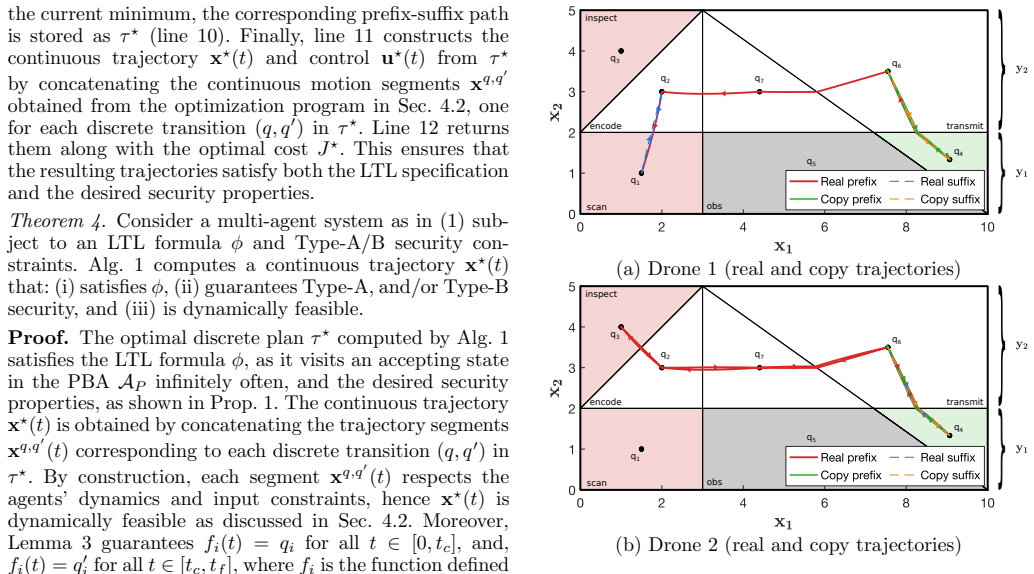
- The framework is illustrated by a two-drone case study in which both LTL compliance and security are achieved.
Where Pith is reading between the lines
- If intruder observations are not known in advance, the path-removal step would need to be replaced by a robust or online variant to retain the guarantees.
- The same path-removal technique could be applied to other temporal-logic specifications provided an appropriate finite abstraction exists.
Load-bearing premise
The two security notions can be enforced exactly by removing violating paths from a finite transition system abstraction of the agents' continuous dynamics when the intruder's partial observations are known in advance.
What would settle it
A recorded execution in which the intruder, given only the partial observations assumed known, correctly determines either that a secret task occurred or which agent performed it would falsify the claimed security guarantees.
Figures

read the original abstract
This paper presents a secure-by-construction planning and control framework for multi-agent systems subject to linear temporal logic (LTL) specifications. The framework protects sensitive information from a passive intruder with partial observations of the agents' motion. Security in multi-agent coordination is captured by two notions that prevent the intruder from inferring whether a secret task has been executed and from identifying the agent responsible for its execution. The proposed framework incorporates the security constraints directly into the LTL synthesis procedure by constructing a secure finite transition system that removes all paths violating these constraints. Standard LTL synthesis is then applied to this secure abstraction to generate discrete plans, which are then refined into dynamically feasible continuous trajectories. This synthesis procedure provides formal guarantees that the resulting behavior of the multi-agent system satisfies both the global LTL specification and the security constraints. The effectiveness of the proposed framework is demonstrated through a two-drone case study.
Editorial analysis
A structured set of objections, weighed in public.
Referee Report
Summary. The paper proposes a secure-by-construction planning and control framework for multi-agent systems subject to LTL specifications. Security against a passive intruder with partial observations is captured via two notions (preventing inference of secret task execution and identification of the responsible agent). These are enforced by constructing a secure finite transition system abstraction that removes violating paths, applying standard LTL synthesis to obtain discrete plans, and refining the plans into continuous trajectories. The central claim is that this procedure yields formal guarantees that the resulting multi-agent behavior satisfies both the global LTL specification and the security constraints, illustrated via a two-drone case study.
Significance. If the preservation of security properties under continuous refinement holds, the work offers a systematic method to embed information-security constraints directly into LTL synthesis for multi-agent systems. This could be useful for robotic coordination tasks where passive observation of motion must not reveal sensitive execution details. The approach builds on standard abstraction and synthesis techniques, and the two-drone demonstration provides a concrete illustration of the workflow.
major comments (2)
- [§4] §4 (secure abstraction and refinement): The manuscript asserts that removing violating paths from the finite transition system exactly enforces the two security notions even after refinement to continuous controllers. However, no explicit theorem or argument is given showing that the intruder’s partial observations of the continuous trajectories coincide exactly with the observable transitions of the discrete abstraction (accounting for controller dynamics, timing, and possible sensor effects). This preservation step is load-bearing for the formal-guarantee claim in the abstract.
- [§5] §5 (two-drone case study): The case study reports successful execution of the LTL task under the secure plan but supplies no verification (e.g., intruder simulation or reachability analysis) that the continuous trajectories prevent the intruder from inferring secret-task execution or agent identity. Without such evidence, it is impossible to confirm that the claimed security properties survive the continuous refinement.
minor comments (2)
- [§2] The definitions of the two security notions (non-inference and non-identification) are introduced in §2 but would benefit from an explicit tabular comparison of the intruder’s observation model versus the agents’ actual continuous outputs.
- Notation for the secure transition system (e.g., the operator that removes violating paths) is used without a compact symbolic definition; a single displayed equation would improve readability.
Simulated Author's Rebuttal
We thank the referee for the constructive and detailed feedback. We address each major comment below and will revise the manuscript to strengthen the formal arguments and empirical verification as outlined.
read point-by-point responses
-
Referee: [§4] §4 (secure abstraction and refinement): The manuscript asserts that removing violating paths from the finite transition system exactly enforces the two security notions even after refinement to continuous controllers. However, no explicit theorem or argument is given showing that the intruder’s partial observations of the continuous trajectories coincide exactly with the observable transitions of the discrete abstraction (accounting for controller dynamics, timing, and possible sensor effects). This preservation step is load-bearing for the formal-guarantee claim in the abstract.
Authors: We agree that an explicit theorem establishing preservation of the security notions under continuous refinement is required. The original manuscript relies on standard soundness properties of the finite transition system abstraction (i.e., that discrete transitions correspond to feasible continuous executions under the chosen controllers), but does not state this link formally for the security properties. In the revised version we will insert a new theorem in §4 proving that, under the assumed observation model and controller refinement, the intruder’s partial observations on continuous trajectories are identical to those on the secure discrete abstraction. The proof will explicitly address timing, sensor effects, and controller dynamics. revision: yes
-
Referee: [§5] §5 (two-drone case study): The case study reports successful execution of the LTL task under the secure plan but supplies no verification (e.g., intruder simulation or reachability analysis) that the continuous trajectories prevent the intruder from inferring secret-task execution or agent identity. Without such evidence, it is impossible to confirm that the claimed security properties survive the continuous refinement.
Authors: We acknowledge that the original case study demonstrates only task satisfaction and plan execution without explicit intruder-side verification. In the revised manuscript we will augment §5 with an intruder simulation: we will model the passive intruder’s partial observations on the generated continuous trajectories, perform reachability analysis to check distinguishability of secret executions, and confirm that neither security notion is violated. New figures and quantitative results will be added to substantiate that the security properties are preserved after refinement. revision: yes
Circularity Check
No significant circularity: standard LTL synthesis on independently-defined secure abstraction
full rationale
The paper defines the two security notions (non-inference of secret task execution and non-identification of responsible agent) independently of the synthesis procedure. It then constructs a secure finite transition system by removing violating paths, applies standard LTL synthesis to obtain discrete plans, and refines them to continuous trajectories. This chain relies on established formal methods techniques for abstraction-refinement and LTL synthesis rather than any self-definitional loop, fitted parameter renamed as prediction, or load-bearing self-citation that reduces the central guarantee to the paper's own inputs. The formal guarantees are stated to follow from the composition of these standard steps, with no equations or definitions that equate the output to the input by construction.
Axiom & Free-Parameter Ledger
axioms (2)
- domain assumption The continuous dynamics of the multi-agent system can be abstracted to a finite transition system while preserving relevant behaviors
- domain assumption Security against a passive intruder with partial observations can be enforced by removing all paths that violate the two stated security notions
Reference graph
Works this paper leans on
-
[1]
Sreenath, K., and Tabuada, P. (2019). Control barrier functions: theory and applications. InProc. 18th IEEE Eur. Conf. Control, 3420–3431
work page 2019
-
[2]
Baier, C. and Katoen, J. (2008).Principles of Model Checking. MIT Press
work page 2008
-
[3]
Fainekos, G.E., Girard, A., Kress-Gazit, H., and Pappas, G.J. (2009). Temporal logic motion planning for dy- namic robots.Automatica, 45(2), 343–352
work page 2009
-
[4]
Fukuda, K. (2025). cddlib: An efficient implementation of the double description method
work page 2025
- [5]
-
[6]
Guo, M. and Dimarogonas, D.V. (2014). Multi-agent plan reconfiguration under local ltl specifications.Int. J. Robot. Res., 34(2), 218–235
work page 2014
-
[7]
Hadjicostis, C.N. (2018). Trajectory planning under current-state opacity constraints.IFAC-PapersOnLine, 51, 337–342
work page 2018
-
[8]
Kloetzer, M. and Belta, C. (2007). Temporal logic plan- ning and control of robotic swarms by hierarchical ab- stractions.IEEE Trans. Robot., 23(2), 320–330
work page 2007
-
[9]
Kloetzer, M. and Belta, C. (2008). A fully automated framework for control of linear systems from temporal logic specifications.IEEE Trans. Autom. Control, 53(1), 287–297
work page 2008
-
[10]
LaValle, S.M. (2006).Planning Algorithms. Cambridge Univ. Press
work page 2006
-
[11]
Liu, S., Trivedi, A., Yin, X., and Zamani, M. (2022). Secure-by-construction synthesis of cyber-physical sys- tems.Annu. Rev. Control, 53, 30–50
work page 2022
-
[12]
Loizou, S.G. and Kyriakopoulos, K.J. (2004). Automatic synthesis of multi-agent motion tasks based on ltl spec- ifications. InProc. 43rd IEEE Conf. Decis. Control, volume 1, 153–158
work page 2004
-
[13]
Ma, Z. and Cai, K. (2021). Optimal secret protections in discrete-event systems.IEEE Trans. Autom. Control, 67(6), 2816–2828
work page 2021
-
[14]
Saboori, A. and Hadjicostis, C.N. (2007). Notions of security and opacity in discrete event systems. InProc. 46th IEEE Conf. Decis. Control, 5056–5061
work page 2007
-
[15]
Smith, S.L., Tumova, J., Belta, C., and Rus, D. (2011). Optimal path planning for surveillance with temporal- logic constraints.Int. J. Robot. Res., 30(14), 1695–1708
work page 2011
-
[16]
Wang, Y., Nalluri, S., and Pajic, M. (2020). Hyperprop- erties for robotics: Planning via hyperltl. InIEEE Int. Conf. Robot. Autom., 8462–8468
work page 2020
-
[17]
Wolper, P., Vardi, M.Y., and Sistla, A.P. (1983). Rea- soning about infinite computation paths. InProc. 24th Annu. Symp. Found. Comput. Sci., 185–194
work page 1983
-
[18]
Xie, Y., Yin, X., Li, S., and Zamani, M. (2021). Secure-by- construction controller synthesis for stochastic systems under linear temporal logic specifications. In60th IEEE Conf. Decis. Control, 7015–7021
work page 2021
-
[19]
Yang, S., Yin, X., Li, S., and Zamani, M. (2020). Secure- by-construction optimal path planning for linear tempo- ral logic tasks. InProc. 59th IEEE Conf. Decis. Control, 4460–4466
work page 2020
-
[20]
Yin, X., Zamani, M., and Liu, S. (2021). On approximate opacity of cyber-physical systems.IEEE Trans. Autom. Control, 66(4), 1630–1645
work page 2021
-
[21]
Yu, X., Yin, X., Li, S., and Li, Z. (2022). Security- preserving multi-agent coordination for complex tem- poral logic tasks.Control Eng. Pract., 123, 105130
work page 2022
-
[22]
Zhong, B., Liu, S., Caccamo, M., and Zamani, M. (2025). Secure-by-construction synthesis for control systems. IEEE Trans. Autom. Control, 70(6), 4170–4177
work page 2025
discussion (0)
Sign in with ORCID, Apple, or X to comment. Anyone can read and Pith papers without signing in.