Recognition: unknown
UIBenchKit: A unified toolkit for design-to-code model evaluation
Pith reviewed 2026-05-14 18:28 UTC · model grok-4.3
The pith
UIBenchKit gives researchers a single platform to run and compare design-to-code models under identical conditions.
A machine-rendered reading of the paper's core claim, the machinery that carries it, and where it could break.
Core claim
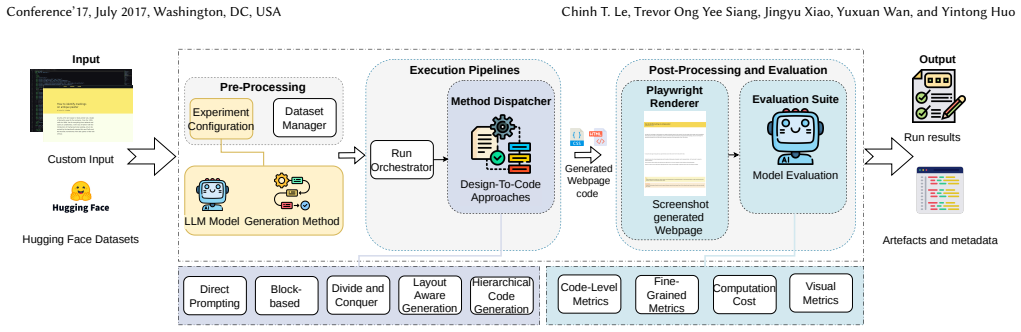
UIBenchKit is an open-source toolkit that unifies design-to-code evaluation by abstracting environment setup, model inference, and code rendering into a plug-and-play architecture, while also supplying an analytical interface that supports consistent comparison across multiple metrics.
What carries the argument
The plug-and-play architecture that abstracts environment setup, model inference, and code rendering so every method runs under the same settings.
If this is right
- Any new design-to-code method can be dropped in and evaluated against existing ones without rebuilding the test harness.
- Reported results across papers become directly comparable because they share the same rendering and metric pipeline.
- Benchmark runs can systematically expose which current methods fail on particular visual or structural aspects.
- Future improvements can be measured against a fixed baseline instead of ad-hoc test suites.
Where Pith is reading between the lines
- Widespread adoption could turn UIBenchKit into the default reference platform, similar to how other standardized benchmarks shaped their fields.
- The same abstraction layer could be extended to support additional output formats such as React or native mobile layouts.
- Over time the collected benchmark data might reveal which visual features are hardest for current models to reproduce.
Load-bearing premise
The metrics and comparison interface chosen for the toolkit actually reflect meaningful differences in the practical quality of the generated code.
What would settle it
Independent teams re-implement the same set of models outside UIBenchKit, run them with their own setups, and obtain substantially different performance rankings than those produced inside the toolkit.
Figures
read the original abstract
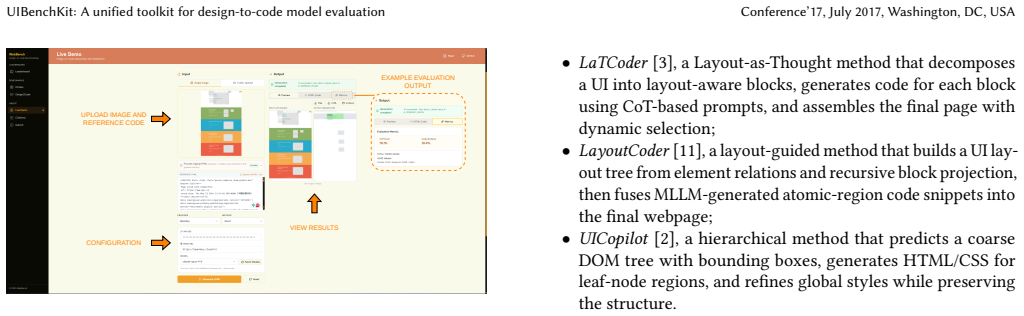
Recent years have seen substantial progress in automated design-to-code generation, with many methods proposed for generating HTML and CSS from webpage screenshots. However, the absence of a standardized evaluation platform makes it difficult to compare these methods fairly, limiting both practical adoption and systematic research progress. To bridge this gap, we introduce UIBenchKit, an open-source, integrated toolkit designed to unify the evaluation of design-to-code tasks. UIBenchKit abstracts the complexities of environment setup, model inference, and code rendering, offering researchers a plug-and-play architecture to compare various methods under consistent settings. In addition, it offers an analytical interface for comparison across multiple metrics. Using UIBenchKit, we conduct a benchmarking study of existing tools and derive several findings that highlight directions for future improvement. By providing a streamlined environment for both experimentation and evaluation, UIBenchKit aims to accelerate future benchmarking and innovations in web engineering. The evaluation platform and toolkit are available at the project page https://www.uibenchkit.com/.
Editorial analysis
A structured set of objections, weighed in public.
Referee Report
Summary. The paper introduces UIBenchKit, an open-source toolkit for unifying evaluation of design-to-code generation methods that produce HTML/CSS from screenshots. It abstracts environment setup, model inference, and code rendering to enable plug-and-play comparisons under consistent settings, supplies an analytical interface supporting multiple metrics, and reports a benchmarking study of existing tools along with derived findings for future improvements. The toolkit is released at https://www.uibenchkit.com/.
Significance. If the toolkit implementation is robust and the benchmarking study is reproducible with clear methodology, the work could meaningfully advance the field by establishing a shared evaluation platform. This would reduce setup overhead for researchers and support more systematic progress in automated UI generation. The open-source release itself is a concrete strength that aids adoption and verification.
major comments (2)
- Benchmarking study section: the manuscript states that a study was conducted and 'several findings' derived, yet provides no description of the evaluated methods, input datasets, exact metrics, quantitative results, or error analysis. Without these, the claim that UIBenchKit enables fair comparisons cannot be assessed and the findings remain unverifiable.
- Toolkit architecture description: the abstract asserts that the system abstracts 'environment setup, model inference, and code rendering' for consistency, but no concrete details (e.g., supported model interfaces, rendering pipeline, or handling of model-specific requirements) are supplied. This information is load-bearing for the central 'plug-and-play' claim.
minor comments (2)
- The abstract mentions an 'analytical interface for comparison across multiple metrics' but does not name or define the metrics; adding a brief enumeration would improve clarity.
- The project page URL is given but no usage examples, installation instructions, or API documentation are referenced in the text; consider adding a short 'Getting Started' subsection.
Simulated Author's Rebuttal
We thank the referee for the constructive comments on UIBenchKit. We agree that additional concrete details are needed in both the benchmarking study and architecture sections to allow verification of the claims. We will revise the manuscript accordingly.
read point-by-point responses
-
Referee: Benchmarking study section: the manuscript states that a study was conducted and 'several findings' derived, yet provides no description of the evaluated methods, input datasets, exact metrics, quantitative results, or error analysis. Without these, the claim that UIBenchKit enables fair comparisons cannot be assessed and the findings remain unverifiable.
Authors: We agree that the current benchmarking study section lacks the necessary specifics for verification. In the revised version, we will expand this section to describe the evaluated methods (including their sources and versions), the input datasets (e.g., screenshot collections and sizes), the exact metrics used (with formulas or references), quantitative results (tables and figures), and error analysis. This will substantiate how UIBenchKit supports fair comparisons under consistent settings. revision: yes
-
Referee: Toolkit architecture description: the abstract asserts that the system abstracts 'environment setup, model inference, and code rendering' for consistency, but no concrete details (e.g., supported model interfaces, rendering pipeline, or handling of model-specific requirements) are supplied. This information is load-bearing for the central 'plug-and-play' claim.
Authors: We acknowledge the need for more concrete architecture details. The revision will include specifics on supported model interfaces (e.g., API wrappers for common frameworks), the step-by-step rendering pipeline, and mechanisms for handling model-specific requirements such as dependency isolation and output normalization. These additions will directly support the plug-and-play claim. revision: yes
Circularity Check
No circularity: software toolkit release with no derivations
full rationale
The paper introduces UIBenchKit as an open-source evaluation toolkit for design-to-code tasks. It describes environment setup, inference, rendering, and metrics without any equations, fitted parameters, predictions, or derivations. Benchmarking results are presented as empirical observations from using the tool, not as outputs forced by construction from inputs. No self-citations are used to justify uniqueness theorems or ansatzes. The contribution is the artifact itself under consistent settings, making the derivation chain self-contained with no reductions to prior inputs.
Axiom & Free-Parameter Ledger
axioms (1)
- domain assumption Standard metrics for visual similarity and code quality are appropriate and sufficient for comparing design-to-code methods
invented entities (1)
-
UIBenchKit toolkit
no independent evidence
Reference graph
Works this paper leans on
-
[1]
Max Bachmann. 2026. Levenshtein Distance — RapidFuzz Documentation. https: //rapidfuzz.github.io/Levenshtein/levenshtein.html Accessed: 2026-02-26
work page 2026
-
[2]
Yi Gui, Zhen Li, Zhongyi Zhang, Yao Wan, Dongping Chen, Hongyu Zhang, Yi Su, Bohua Chen, Xing Zhou, Wenbin Jiang, and Xiangliang Zhang. 2025. UICopilot: Automating UI Synthesis via Hierarchical Code Generation from Webpage Designs. arXiv:2505.09904 [cs.SE] https://arxiv.org/abs/2505.09904
-
[3]
Yi Gui, Zhen Li, Zhongyi Zhang, Guohao Wang, Tianpeng Lv, Gaoyang Jiang, Yi Liu, Dongping Chen, Yao Wan, Hongyu Zhang, Wenbin Jiang, Xuanhua Shi, and Hai Jin. 2025. <scp>LaTCoder:</scp> Converting Webpage Design to Code with Layout-as-Thought. InProceedings of the 31st ACM SIGKDD Conference on Knowledge Discovery and Data Mining V.2 (KDD ’25). ACM, 721–73...
-
[4]
Jason Lemkin. 2025. How Vercel Hit $9.3B and Replit Hit $3B. . . After a Decade: The Long Paths to AI Overnight Success. https://www.saastr.com/how-vercel- hit-9-3b-and-replit-hit-3b-after-a-decade-the-long-paths-to-ai-overnight- success/. SaaStr. Reports v0 reaching 3.5 million users at the time of Vercel’s Series F in September 2025. Accessed: 2026-04-28
work page 2025
-
[5]
Meta Open Source. [n. d.]. React Documentation. https://react.dev/. Accessed: 2026-05-10
work page 2026
-
[6]
Microsoft. [n. d.]. TypeScript Documentation. https://www.typescriptlang.org/ docs/. Accessed: 2026-05-10
work page 2026
-
[7]
Pallets Projects. [n. d.]. Flask Documentation. https://flask.palletsprojects.com/. Accessed: 2026-05-10
work page 2026
-
[8]
Chenglei Si, Yanzhe Zhang, Ryan Li, Zhengyuan Yang, Ruibo Liu, and Diyi Yang
-
[9]
arXiv:2403.03163 [cs.CL] https://arxiv.org/abs/2403
Design2Code: Benchmarking Multimodal Code Generation for Automated Front-End Engineering. arXiv:2403.03163 [cs.CL] https://arxiv.org/abs/2403. 03163
-
[10]
Tailwind Labs. [n. d.]. Tailwind CSS Documentation. https://tailwindcss.com/docs. Accessed: 2026-05-10
work page 2026
-
[11]
Yuxuan Wan, Chaozheng Wang, Yi Dong, Wenxuan Wang, Shuqing Li, Yintong Huo, and Michael Lyu. 2025. Divide-and-Conquer: Generating UI Code from Screenshots.Proceedings of the ACM on Software Engineering2, FSE (June 2025), 2099–2122. doi:10.1145/3729364
-
[12]
Fan Wu, Cuiyun Gao, Shuqing Li, Xin-Cheng Wen, and Qing Liao. 2025. MLLM- Based UI2Code Automation Guided by UI Layout Information.Proceedings of the ACM on Software Engineering2, ISSTA (June 2025), 1123–1145. doi:10.1145/ 3728925
work page 2025
-
[13]
Jingyu Xiao, Yuxuan Wan, Yintong Huo, Zixin Wang, Xinyi Xu, Wenxuan Wang, Zhiyao Xu, Yuhang Wang, and Michael R Lyu. 2025. Interaction2code: Bench- marking mllm-based interactive webpage code generation from interactive pro- totyping. In2025 40th IEEE/ACM International Conference on Automated Software Engineering (ASE). IEEE, 241–253
work page 2025
-
[14]
Boqin Zhuang, Jiacheng Qiao, Mingqian Liu, Mingxing Yu, Ping Hong, Rui Li, Xiaoxia Song, Xiangjun Xu, Xu Chen, Yaoyao Ma, and Yujie Gao. 2025. Beyond UIBenchKit: A unified toolkit for design-to-code model evaluation Conference’17, July 2017, Washington, DC, USA Benchmarks: The Economics of AI Inference. arXiv:2510.26136 [cs.AI] https: //arxiv.org/abs/2510.26136
discussion (0)
Sign in with ORCID, Apple, or X to comment. Anyone can read and Pith papers without signing in.