Recognition: no theorem link
Strikingness-Aware Evaluation for Temporal Knowledge Graph Reasoning
Pith reviewed 2026-05-14 20:22 UTC · model grok-4.3
The pith
A strikingness measure shows that temporal knowledge graph models degrade on rare outstanding events and that ensemble gains often come from fitting trivial repetitions instead.
A machine-rendered reading of the paper's core claim, the machinery that carries it, and where it could break.
Core claim
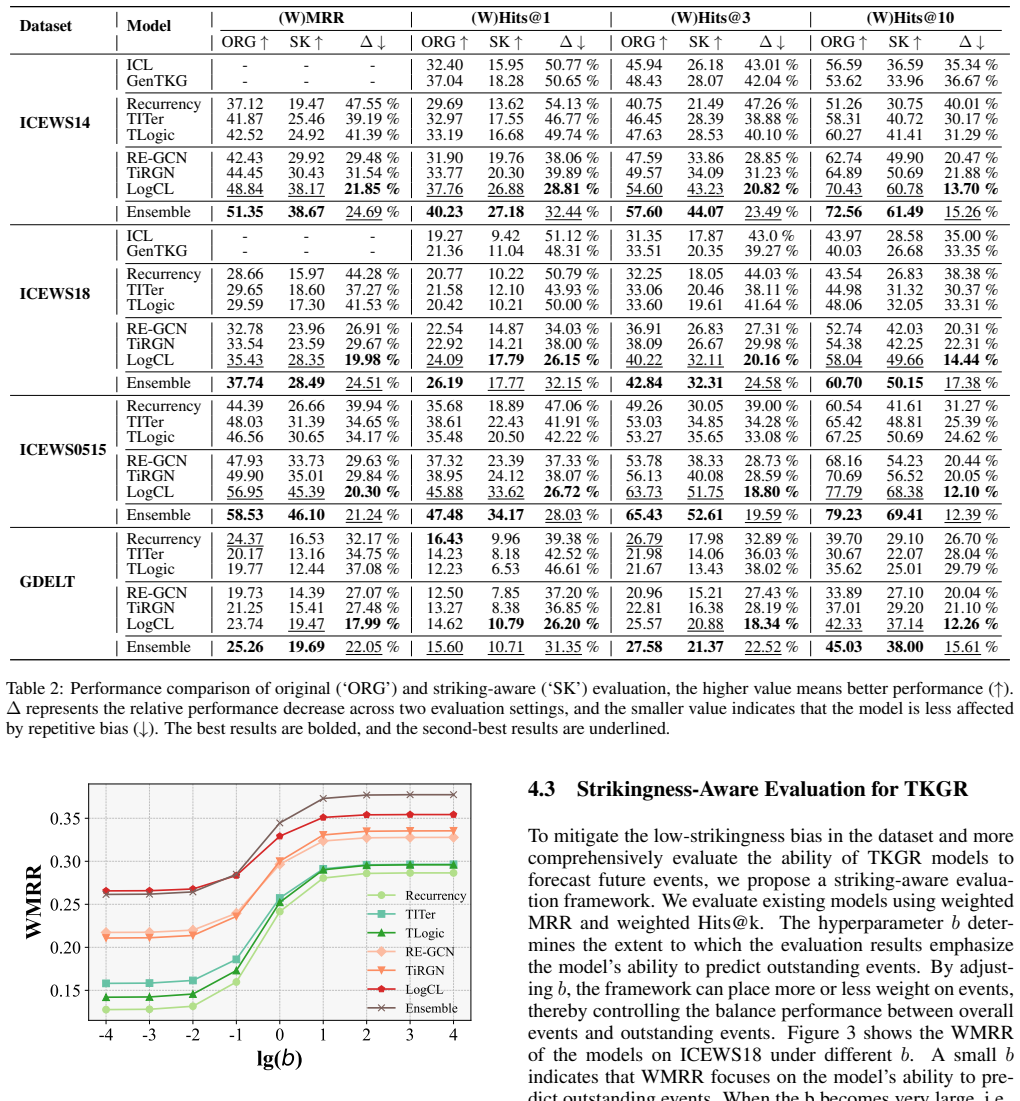
By weighting evaluation metrics according to event strikingness, the framework shows that representative temporal knowledge graph models all lose accuracy as events become more striking, that path-based and representation-based approaches have complementary strengths across strikingness levels, and that ensemble improvements largely reflect better handling of repetitive events rather than genuine advances in reasoning about unusual future events.
What carries the argument
The rule-based strikingness measuring framework (RSMF) that assigns a strikingness score to each event by comparing its observed occurrence against the expected frequency of peer events generated from temporal rules extracted from the training data.
If this is right
- All tested models lose accuracy on high-strikingness events, so uniform metrics have been overstating reasoning ability.
- Path-based methods are relatively stronger on low-strikingness repetitive events while representation-based methods are relatively stronger on high-strikingness ones.
- Ensemble performance gains under standard metrics largely disappear once trivial events are down-weighted, indicating the gains come from fitting common patterns.
- Future model comparisons should report both uniform and strikingness-weighted scores to separate frequency fitting from reasoning improvement.
Where Pith is reading between the lines
- Models could be trained with an auxiliary loss that explicitly rewards accurate prediction of high-strikingness events.
- The same strikingness idea could be applied to other temporal prediction tasks such as user-behavior forecasting or scientific event prediction.
- Re-evaluating previously published TKGR results with strikingness weighting might reorder the current leaderboard.
- The framework suggests that progress in the field has been measured more by memorizing frequent patterns than by learning to anticipate unusual ones.
Load-bearing premise
The rule-based method for calculating strikingness correctly identifies events whose correct prediction requires deeper reasoning rather than simple frequency matching.
What would settle it
Re-running the four benchmark experiments after replacing the rule-derived strikingness scores with random weights and checking whether the reported performance gaps between models and between strikingness levels disappear.
Figures




read the original abstract
Temporal Knowledge Graph Reasoning (TKGR) aims at inferring missing (especially future) events from historical data. Current evaluation in TKGR uniformly weights all events, ignoring that most are trivial repetitions, which overestimate the true reasoning ability. Therefore, the rare outstanding events, whose prediction demands deeper reasoning, should be distinguished and emphasized. To this end, we propose a strikingness-aware evaluation framework, which introduces a rule-based strikingness measuring framework (RSMF) to quantify event strikingness by comparing its expected occurrence with peer events derived from temporal rules. Strikingness is then integrated as a weighting factor into metrics like weighted MRR and Hits@k. Experiments on four TKG benchmarks reveal: 1) All representative models perform worse as event strikingness increases, 2) Path-based methods excel on low-strikingness events and representation-based ones on high-strikingness events, 3) We design an ensemble method whose gains stem from fitting trivial events rather than reasoning improvement. Our framework provides a more rigorous evaluation, refocusing the field on predicting outstanding events.
Editorial analysis
A structured set of objections, weighed in public.
Referee Report
Summary. The manuscript proposes a strikingness-aware evaluation framework for temporal knowledge graph reasoning (TKGR). It introduces the Rule-based Strikingness Measuring Framework (RSMF) to quantify the strikingness of events by comparing their expected occurrence against peer events derived from temporal rules extracted from the data. Strikingness scores are then used as weights in standard metrics such as MRR and Hits@k. Through experiments on four TKG benchmarks, the authors report three main findings: (1) all models perform worse as strikingness increases, (2) path-based methods excel on low-strikingness events while representation-based methods perform better on high-strikingness ones, and (3) gains from an ensemble method arise from better fitting of trivial (low-strikingness) events rather than improved reasoning.
Significance. If the strikingness measure is valid and free from data leakage, this framework could provide a more rigorous way to evaluate TKGR models by emphasizing events that require deeper reasoning rather than trivial repetitions. This has the potential to shift the field towards developing methods that handle outstanding events better, addressing a possible overestimation in current uniform-weight evaluations. The experimental trends across benchmarks are a positive step toward falsifiable claims about model behavior.
major comments (3)
- [Section 3] Section 3 (RSMF description): the rule extraction process is not specified as using only the training split; if temporal rules are mined from the full TKG (train+val+test), then strikingness scores for held-out test events incorporate patterns from those events, creating leakage that directly contaminates the weighted MRR/Hits@k and undermines the interpretation of performance drops on high-strikingness events as reflecting genuine reasoning difficulty.
- [Section 4] Section 4 (Experiments and findings): the three numbered claims rest on observed trends, but no statistical significance tests, confidence intervals, or exact weighting formulas (e.g., how expected occurrence is normalized against peers) are reported; without these, the support for 'all models perform worse as strikingness increases' and the path- vs. representation-based distinction remains moderate.
- [Section 4.3] Section 4.3 (ensemble analysis): the claim that ensemble gains stem from fitting trivial events rather than reasoning improvement is load-bearing for finding (3), yet lacks ablation results on high-strikingness subsets or comparison of per-strikingness performance before/after ensembling.
minor comments (2)
- [Abstract] The abstract and introduction should explicitly name the four TKG benchmarks used.
- [Section 3] The precise mathematical definition of the strikingness score (expected occurrence vs. peer events) should be given as a numbered equation for reference.
Simulated Author's Rebuttal
We thank the referee for the constructive and detailed comments. We address each major point below and will incorporate the suggested clarifications and additions into the revised manuscript.
read point-by-point responses
-
Referee: [Section 3] Section 3 (RSMF description): the rule extraction process is not specified as using only the training split; if temporal rules are mined from the full TKG (train+val+test), then strikingness scores for held-out test events incorporate patterns from those events, creating leakage that directly contaminates the weighted MRR/Hits@k and undermines the interpretation of performance drops on high-strikingness events as reflecting genuine reasoning difficulty.
Authors: We appreciate this important observation. In the RSMF implementation, temporal rules are extracted exclusively from the training split to avoid any leakage from validation or test data. We will revise Section 3 to explicitly state this restriction and provide the precise rule-mining procedure using only training data, thereby ensuring the strikingness scores for test events remain uncontaminated. revision: yes
-
Referee: [Section 4] Section 4 (Experiments and findings): the three numbered claims rest on observed trends, but no statistical significance tests, confidence intervals, or exact weighting formulas (e.g., how expected occurrence is normalized against peers) are reported; without these, the support for 'all models perform worse as strikingness increases' and the path- vs. representation-based distinction remains moderate.
Authors: We agree that greater statistical rigor is needed. In the revision we will add paired statistical significance tests (e.g., Wilcoxon signed-rank) for performance trends across strikingness bins, report 95% confidence intervals on all weighted metrics, and include the exact formulas for expected occurrence and peer normalization in an expanded Section 3. These additions will provide firmer quantitative support for the reported trends. revision: yes
-
Referee: [Section 4.3] Section 4.3 (ensemble analysis): the claim that ensemble gains stem from fitting trivial events rather than reasoning improvement is load-bearing for finding (3), yet lacks ablation results on high-strikingness subsets or comparison of per-strikingness performance before/after ensembling.
Authors: This is a fair critique of the current evidence. We will augment Section 4.3 with new ablation tables that isolate ensemble performance on high-strikingness subsets and directly compare per-strikingness MRR/Hits@k values before versus after ensembling. These results will substantiate that the gains derive predominantly from low-strikingness events. revision: yes
Circularity Check
No significant circularity detected in the strikingness-aware evaluation derivation
full rationale
The paper defines a rule-based strikingness measuring framework (RSMF) that computes event strikingness via comparison of expected occurrence against peer events from temporal rules, then applies these scores as weights to standard metrics such as weighted MRR and Hits@k. No equations, definitions, or self-citations in the abstract or described framework reduce the final weighted metrics to fitted parameters or inputs by construction; strikingness functions as an independent, externally derived weighting factor rather than a self-referential or tautological quantity. The reported experimental observations (performance degradation with increasing strikingness, differential method strengths, and ensemble analysis) remain empirical claims that do not collapse into the measurement process itself. The derivation chain is therefore self-contained against external benchmarks and does not exhibit any of the enumerated circularity patterns.
Axiom & Free-Parameter Ledger
axioms (1)
- domain assumption Temporal rules extracted from the data can define expected occurrences for peer events used to compute strikingness.
invented entities (1)
-
Strikingness score
no independent evidence
Reference graph
Works this paper leans on
-
[1]
ACM Computing Surveys , volume =
Liang Zhao , title =. ACM Computing Surveys , volume =. 2022 , url =. doi:10.1145/3450287 , timestamp =
-
[2]
International studies review , volume=
Crisis early warning and decision support: Contemporary approaches and thoughts on future research , author=. International studies review , volume=. 2010 , publisher=
2010
-
[3]
Mario Krenn and Lorenzo Buffoni and Bruno C. Coutinho and Sagi Eppel and Jacob Gates Foster and Andrew Gritsevskiy and Harlin Lee and Yichao Lu and Jo. Forecasting the future of artificial intelligence with machine learning-based link prediction in an exponentially growing knowledge network , journal =. 2023 , url =. doi:10.1038/S42256-023-00735-0 , timestamp =
-
[4]
ISA annual convention , volume=
Gdelt: Global data on events, location, and tone, 1979--2012 , author=. ISA annual convention , volume=. 2013 , organization=
1979
-
[5]
IEEE Transactions on Pattern Analysis and Machine Intelligence (TPAMI) , volume =
Ke Liang and Lingyuan Meng and Meng Liu and Yue Liu and Wenxuan Tu and Siwei Wang and Sihang Zhou and Xinwang Liu and Fuchun Sun and Kunlun He , title =. IEEE Transactions on Pattern Analysis and Machine Intelligence (TPAMI) , volume =. 2024 , url =. doi:10.1109/TPAMI.2024.3417451 , timestamp =
-
[6]
2024 , booktitle=
Impact4Cast: Forecasting high-impact research topics via machine learning on evolving knowledge graphs , author=. 2024 , booktitle=
2024
-
[7]
Proceedings of the 2018 International Conference on Management of Data (SIGMOD) , pages =
Gensheng Zhang and Damian Jimenez and Chengkai Li , title =. Proceedings of the 2018 International Conference on Management of Data (SIGMOD) , pages =. 2018 , url =. doi:10.1145/3183713.3183730 , timestamp =
-
[8]
Yueji Yang and Yuchen Li and Panagiotis Karras and Anthony K. H. Tung , title =. The 27th. 2021 , url =. doi:10.1145/3447548.3467272 , timestamp =
-
[9]
Hanhua Xiao and Yuchen Li and Yanhao Wang and Panagiotis Karras and Kyriakos Mouratidis and Natalia Rozalia Avlona , title =. Proceedings of the 30th. 2024 , url =. doi:10.1145/3637528.3671763 , timestamp =
-
[10]
2010 , publisher=
Black swan , author=. 2010 , publisher=
2010
-
[11]
Safety science , volume=
On the meaning of a black swan in a risk context , author=. Safety science , volume=. 2013 , publisher=
2013
-
[12]
Journal of Business Continuity & Emergency Planning , volume=
Planning for grey rhino risks: How to prepare for the ‘unforeseeable’ , author=. Journal of Business Continuity & Emergency Planning , volume=. 2024 , publisher=
2024
-
[13]
Woojeong Jin and Meng Qu and Xisen Jin and Xiang Ren , title =. Proceedings of the 2020 Conference on Empirical Methods in Natural Language Processing (EMNLP) , year =. doi:10.18653/V1/2020.EMNLP-MAIN.541 , timestamp =
-
[14]
Zixuan Li and Xiaolong Jin and Wei Li and Saiping Guan and Jiafeng Guo and Huawei Shen and Yuanzhuo Wang and Xueqi Cheng , title =. The 44th International ACM SIGIR Conference on Research and Development in Information Retrieval (SIGIR) , year =. doi:10.1145/3404835.3462963 , timestamp =
-
[15]
Rikui Huang and Wei Wei and Xiaoye Qu and Shengzhe Zhang and Dangyang Chen and Yu Cheng , title =. Proceedings of the 62nd Annual Meeting of the Association for Computational Linguistics (ACL) , year =. doi:10.18653/V1/2024.ACL-LONG.580 , timestamp =
-
[16]
Findings of the Association for Computational Linguistics (NAACL) , year =
Ruotong Liao and Xu Jia and Yangzhe Li and Yunpu Ma and Volker Tresp , title =. Findings of the Association for Computational Linguistics (NAACL) , year =. doi:10.18653/V1/2024.FINDINGS-NAACL.268 , timestamp =
-
[17]
Julia Gastinger and Timo Sztyler and Lokesh Sharma and Anett Schuelke and Heiner Stuckenschmidt , title =. Machine Learning and Knowledge Discovery in Databases: Research Track - European Conference (ECML-PKDD) , series =. 2023 , url =. doi:10.1007/978-3-031-43418-1\_32 , timestamp =
-
[18]
36th Conference on Artificial Intelligence (AAAI) , year =
Yushan Liu and Yunpu Ma and Marcel Hildebrandt and Mitchell Joblin and Volker Tresp , title =. 36th Conference on Artificial Intelligence (AAAI) , year =. doi:10.1609/AAAI.V36I4.20330 , timestamp =
-
[19]
ACM Transactions on Database Systems , volume =
Fabrizio Angiulli and Fabio Fassetti and Luigi Palopoli , title =. ACM Transactions on Database Systems , volume =. 2009 , url =. doi:10.1145/1508857.1508864 , timestamp =
-
[20]
Temporal Knowledge Graph Forecasting Without Knowledge Using In-Context Learning , booktitle =
Dong. Temporal Knowledge Graph Forecasting Without Knowledge Using In-Context Learning , booktitle =. 2023 , url =. doi:10.18653/V1/2023.EMNLP-MAIN.36 , timestamp =
-
[21]
History Repeats Itself:
Julia Gastinger and Christian Meilicke and Federico Errica and Timo Sztyler and Anett Sch. History Repeats Itself:. Proceedings of the 33rd International Joint Conference on Artificial Intelligence (IJCAI) , year =
-
[22]
Proceedings of the 31st International Joint Conference on Artificial Intelligence (IJCAI) , year =
Yujia Li and Shiliang Sun and Jing Zhao , title =. Proceedings of the 31st International Joint Conference on Artificial Intelligence (IJCAI) , year =. doi:10.24963/IJCAI.2022/299 , timestamp =
-
[23]
Haohai Sun and Jialun Zhong and Yunpu Ma and Zhen Han and Kun He , title =. Proceedings of the 2021 Conference on Empirical Methods in Natural Language Processing (EMNLP) , year =. doi:10.18653/V1/2021.EMNLP-MAIN.655 , timestamp =
-
[24]
Wei Chen and Huaiyu Wan and Yuting Wu and Shuyuan Zhao and Jiayaqi Cheng and Yuxin Li and Youfang Lin , title =. 40th. 2024 , url =. doi:10.1109/ICDE60146.2024.00062 , timestamp =
-
[25]
Translating Embeddings for Modeling Multi-relational Data , booktitle =
Antoine Bordes and Nicolas Usunier and Alberto Garc. Translating Embeddings for Modeling Multi-relational Data , booktitle =. 2013 , url =
2013
-
[26]
Saiping Guan and Xueqi Cheng and Long Bai and Fujun Zhang and Zixuan Li and Yutao Zeng and Xiaolong Jin and Jiafeng Guo , title =. 2023 , url =. doi:10.1109/TKDE.2022.3180362 , timestamp =
-
[27]
Guansong Pang and Chunhua Shen and Longbing Cao and Anton van den Hengel , title =. 2022 , url =. doi:10.1145/3439950 , timestamp =
-
[28]
Ali Bou Nassif and Manar Abu Talib and Qassim Nasir and Fatima Mohamad Dakalbab , title =. 2021 , url =. doi:10.1109/ACCESS.2021.3083060 , timestamp =
-
[29]
Annals of Data Science , volume=
A comprehensive survey of anomaly detection algorithms , author=. Annals of Data Science , volume=. 2023 , publisher=
2023
-
[30]
Enchang Zhu and Zhengtao Yu and Yuxin Huang and Shengxiang Gao and Yantuan Xian , title =. Neurocomputing , volume =. 2025 , url =. doi:10.1016/J.NEUCOM.2024.128639 , timestamp =
-
[31]
Findings of the Association for Computational Linguistics:
Yincen Qu and Ningyu Zhang and Hui Chen and Zelin Dai and Chengming Wang and Xiaoyu Wang and Qiang Chen and Huajun Chen , title =. Findings of the Association for Computational Linguistics:. 2022 , url =. doi:10.18653/V1/2022.FINDINGS-EMNLP.2 , timestamp =
-
[32]
Human-Centric Cyber Social Computing Model for Hot-Event Detection and Propagation , journal =
Lei. Human-Centric Cyber Social Computing Model for Hot-Event Detection and Propagation , journal =. 2019 , url =. doi:10.1109/TCSS.2019.2913783 , timestamp =
-
[33]
Zuowu Zheng and Xiaofeng Gao and Xiao Ma and Guihai Chen , title =. 2022 , url =. doi:10.1109/TKDE.2020.2994946 , timestamp =
-
[34]
Jiacheng Luo and Wenyi Xu and Xiaofeng Gao and Guihai Chen , title =. Knowl. Inf. Syst. , volume =. 2022 , url =. doi:10.1007/S10115-022-01733-1 , timestamp =
-
[35]
9th International Conference on Learning Representations (ICLR) , year =
Zhen Han and Peng Chen and Yunpu Ma and Volker Tresp , title =. 9th International Conference on Learning Representations (ICLR) , year =
-
[36]
Talukdar and Yiming Yang , title =
Zhiqing Sun and Shikhar Vashishth and Soumya Sanyal and Partha P. Talukdar and Yiming Yang , title =. Proceedings of the 58th Annual Meeting of the Association for Computational Linguistics (ACL) , year =. doi:10.18653/V1/2020.ACL-MAIN.489 , timestamp =
-
[37]
Yuyue Zhao and Xiang Wang and Jiawei Chen and Yashen Wang and Wei Tang and Xiangnan He and Haiyong Xie , title =. 2023 , url =. doi:10.1145/3531267 , timestamp =
-
[38]
Proceedings of the 34th International Conference on Machine Learning,
Rakshit Trivedi and Hanjun Dai and Yichen Wang and Le Song , title =. Proceedings of the 34th International Conference on Machine Learning,. 2017 , url =
2017
-
[39]
Mengqi Zhang and Yuwei Xia and Qiang Liu and Shu Wu and Liang Wang , title =. Proceedings of the 61st Annual Meeting of the Association for Computational Linguistics (ACL) , pages =. 2023 , url =. doi:10.18653/V1/2023.ACL-LONG.705 , timestamp =
-
[40]
Context-aware Event Forecasting via Graph Disentanglement , booktitle =
Yunshan Ma and Chenchen Ye and Zijian Wu and Xiang Wang and Yixin Cao and Tat. Context-aware Event Forecasting via Graph Disentanglement , booktitle =. 2023 , url =. doi:10.1145/3580305.3599285 , timestamp =
-
[41]
Haoxuan Li and Zhengmao Yang and Yunshan Ma and Yi Bin and Yang Yang and Tat. MM-Forecast:. Proceedings of the 32nd. 2024 , url =. doi:10.1145/3664647.3681593 , timestamp =
-
[42]
In Proceedings of 38th Conferenceon Neural Information Processing Systems (NeurIPS) , year =
Julia Gastinger and Shenyang Huang and Michael Galkin and Erfan Loghmani and Ali Parviz and Farimah Poursafaei and Jacob Danovitch and Emanuele Rossi and Ioannis Koutis and Heiner Stuckenschmidt and Reihaneh Rabbany and Guillaume Rabusseau , title =. In Proceedings of 38th Conferenceon Neural Information Processing Systems (NeurIPS) , year =
-
[43]
Proceedings of the 32nd Conference on Artificial Intelligence, (AAAI) , year =
Tim Dettmers and Pasquale Minervini and Pontus Stenetorp and Sebastian Riedel , title =. Proceedings of the 32nd Conference on Artificial Intelligence, (AAAI) , year =. doi:10.1609/AAAI.V32I1.11573 , timestamp =
-
[44]
Findings of the Association for Computational Linguistics,
Yuxiang Cai and Qiao Liu and Yanglei Gan and Changlin Li and Xueyi Liu and Run Lin and Da Luo and JiayeYang JiayeYang , title =. Findings of the Association for Computational Linguistics,. 2024 , url =. doi:10.18653/V1/2024.FINDINGS-ACL.343 , timestamp =
-
[45]
Qika Lin and Jun Liu and Rui Mao and Fangzhi Xu and Erik Cambria , title =. Proceedings of the 61st Annual Meeting of the Association for Computational Linguistics (Volume 1: Long Papers),. 2023 , url =. doi:10.18653/V1/2023.ACL-LONG.71 , timestamp =
-
[46]
Zixuan Li and Xiaolong Jin and Saiping Guan and Wei Li and Jiafeng Guo and Yuanzhuo Wang and Xueqi Cheng , title =. Proceedings of the 59th Annual Meeting of the Association for Computational Linguistics and the 11th International Joint Conference on Natural Language Processing, (ACL/IJCNLP) , year =. doi:10.18653/V1/2021.ACL-LONG.365 , timestamp =
-
[47]
Proceedings of the 46th International
Shangfei Zheng and Hongzhi Yin and Tong Chen and Quoc Viet Hung Nguyen and Wei Chen and Lei Zhao , title =. Proceedings of the 46th International. 2023 , url =. doi:10.1145/3539618.3591671 , timestamp =
-
[48]
Findings of the Association for Computational Linguistics,
Yuwei Xia and Ding Wang and Qiang Liu and Liang Wang and Shu Wu and Xiaoyu Zhang , title =. Findings of the Association for Computational Linguistics,. 2024 , url =. doi:10.18653/V1/2024.FINDINGS-ACL.955 , timestamp =
-
[49]
8th International Conference on Learning Representations (ICLR) , year =
Daniel Ruffinelli and Samuel Broscheit and Rainer Gemulla , title =. 8th International Conference on Learning Representations (ICLR) , year =
-
[50]
Prachi Jain and Sushant Rathi and Mausam and Soumen Chakrabarti , title =. Proceedings of the 2020 Conference on Empirical Methods in Natural Language Processing (EMNLP) , year =. doi:10.18653/V1/2020.EMNLP-MAIN.305 , timestamp =
-
[51]
Proceedings of the VLDB Endowment , volume =
Naeemul Hassan and Afroza Sultana and You Wu and Gensheng Zhang and Chengkai Li and Jun Yang and Cong Yu , title =. Proceedings of the VLDB Endowment , volume =. 2014 , url =. doi:10.14778/2733004.2733029 , timestamp =
-
[52]
Agarwal and Chengkai Li and Jun Yang and Cong Yu , title =
You Wu and Pankaj K. Agarwal and Chengkai Li and Jun Yang and Cong Yu , title =. The 18th. 2012 , url =. doi:10.1145/2339530.2339762 , timestamp =
-
[53]
RNNLogic: Learning Logic Rules for Reasoning on Knowledge Graphs , booktitle =
Meng Qu and Jun. RNNLogic: Learning Logic Rules for Reasoning on Knowledge Graphs , booktitle =. 2021 , url =
2021
-
[54]
Findings of the Association for Computational Linguistics (EMNLP) , year =
Zhengtao Liu and Lei Tan and Mengfan Li and Yao Wan and Hai Jin and Xuanhua Shi , title =. Findings of the Association for Computational Linguistics (EMNLP) , year =. doi:10.18653/V1/2023.FINDINGS-EMNLP.249 , timestamp =
-
[55]
Large Language Models-guided Dynamic Adaptation for Temporal Knowledge Graph Reasoning , booktitle =
Jiapu Wang and Kai Sun and Linhao Luo and Wei Wei and Yongli Hu and Alan Wee. Large Language Models-guided Dynamic Adaptation for Temporal Knowledge Graph Reasoning , booktitle =. 2024 , url =
2024
-
[56]
3rd Conference on Automated Knowledge Base Construction (AKBC) , year =
Christian Meilicke and Patrick Betz and Heiner Stuckenschmidt , title =. 3rd Conference on Automated Knowledge Base Construction (AKBC) , year =. doi:10.24432/C5PK5V , timestamp =
-
[57]
Simon Ott and Patrick Betz and Daria Stepanova and Mohamed H. Gad. Rule-based Knowledge Graph Completion with Canonical Models , booktitle =. 2023 , url =. doi:10.1145/3583780.3615042 , timestamp =
-
[58]
Learning Sequence Encoders for Temporal Knowledge Graph Completion , booktitle =
Alberto Garc. Learning Sequence Encoders for Temporal Knowledge Graph Completion , booktitle =. 2018 , url =
2018
-
[59]
Kangzheng Liu and Feng Zhao and Guandong Xu and Xianzhi Wang and Hai Jin , title =. 39th. 2023 , url =. doi:10.1109/ICDE55515.2023.00138 , timestamp =
-
[60]
Corentin Kervadec and Grigory Antipov and Moez Baccouche and Christian Wolf , title =. 2021 , url =. doi:10.1109/CVPR46437.2021.00280 , timestamp =
-
[61]
Kristina Toutanova and Danqi Chen , title =. Proceedings of the 3rd Workshop on Continuous Vector Space Models and their Compositionality , pages =. 2015 , url =. doi:10.18653/V1/W15-4007 , timestamp =
-
[62]
35th Conference on Artificial Intelligence (AAAI) , year =
Cunchao Zhu and Muhao Chen and Changjun Fan and Guangquan Cheng and Yan Zhang , title =. 35th Conference on Artificial Intelligence (AAAI) , year =. doi:10.1609/AAAI.V35I5.16604 , timestamp =
-
[63]
Kangzheng Liu and Feng Zhao and Hai Jin , title =. Int. J. Softw. Informatics , volume =. 2023 , url =. doi:10.21655/IJSI.1673-7288.00308 , timestamp =
-
[64]
Proceedings of the 32nd International Joint Conference on Artificial Intelligence (IJCAI) , year =
Hao Dong and Zhiyuan Ning and Pengyang Wang and Ziyue Qiao and Pengfei Wang and Yuanchun Zhou and Yanjie Fu , title =. Proceedings of the 32nd International Joint Conference on Artificial Intelligence (IJCAI) , year =. doi:10.24963/IJCAI.2023/232 , timestamp =
-
[65]
37th Conference on Artificial Intelligence (AAAI) , year =
Yi Xu and Junjie Ou and Hui Xu and Luoyi Fu , title =. 37th Conference on Artificial Intelligence (AAAI) , year =. doi:10.1609/AAAI.V37I4.25601 , timestamp =
-
[66]
Structure and Interpretation of Computer Programs
Harold Abelson and Gerald Jay Sussman and Julie Sussman. Structure and Interpretation of Computer Programs. 1985
1985
-
[67]
Visual Information Extraction with Lixto
Robert Baumgartner and Georg Gottlob and Sergio Flesca. Visual Information Extraction with Lixto. Proceedings of the 27th International Conference on Very Large Databases. 2001
2001
-
[68]
Brachman and James G
Ronald J. Brachman and James G. Schmolze. An overview of the KL-ONE knowledge representation system. Cognitive Science. 1985
1985
-
[69]
Complexity results for nonmonotonic logics
Georg Gottlob. Complexity results for nonmonotonic logics. Journal of Logic and Computation. 1992
1992
-
[70]
Hypertree Decompositions and Tractable Queries
Georg Gottlob and Nicola Leone and Francesco Scarcello. Hypertree Decompositions and Tractable Queries. Journal of Computer and System Sciences. 2002
2002
-
[71]
Levesque
Hector J. Levesque. Foundations of a functional approach to knowledge representation. Artificial Intelligence. 1984
1984
-
[72]
Levesque
Hector J. Levesque. A logic of implicit and explicit belief. Proceedings of the Fourth National Conference on Artificial Intelligence. 1984
1984
-
[73]
On the compilability and expressive power of propositional planning formalisms
Bernhard Nebel. On the compilability and expressive power of propositional planning formalisms. Journal of Artificial Intelligence Research. 2000
2000
discussion (0)
Sign in with ORCID, Apple, or X to comment. Anyone can read and Pith papers without signing in.