Recognition: 2 theorem links
· Lean TheoremNeural Networks, Dispersion Relations and the Thermal Bootstrap
Pith reviewed 2026-05-14 18:46 UTC · model grok-4.3
The pith
Dispersion relations and neural networks enable a positivity-free conformal bootstrap for thermal correlators.
A machine-rendered reading of the paper's core claim, the machinery that carries it, and where it could break.
Core claim
The central claim is that dispersion relations can resum the infinite sum of high-dimension operator contributions in the OPE, reformulating the bootstrap as a non-convex optimization problem that neural networks can solve numerically, with the framework tested on thermal two-point functions for generalized free fields and holographic CFTs.
What carries the argument
Dispersion relations that resum high-dimension OPE contributions, paired with neural-network optimization of the bootstrap functional equations.
If this is right
- The method computes thermal two-point functions in CFTs without requiring positivity bounds on the spectrum.
- Numerical access becomes possible for cases where traditional bootstrap techniques are limited by lack of positivity.
- Stability of the non-convex scheme supports reliable use for thermal correlators on S^1 x R^{d-1}.
- The approach connects to discussions of smoothness properties in CFT correlators.
Where Pith is reading between the lines
- The framework could extend to higher-point correlators or other geometries beyond thermal setups.
- Neural networks may offer advantages over linear programming in handling nonlinear bootstrap constraints.
- Further tests in higher dimensions could reveal how the method scales with spacetime dimension.
Load-bearing premise
The stability properties of the non-convex optimisation scheme hold for the relevant thermal two-point functions on S^1 x R^{d-1}.
What would settle it
A demonstration that the neural-network optimization fails to converge to known results or becomes unstable for the generalized free field thermal two-point function would falsify practical applicability of the framework.
Figures


read the original abstract
We review a framework for the conformal bootstrap that does not rely on positivity and treats the infinite tower of high-dimension OPE contributions to conformal correlators through dispersion relations and neural networks. We apply it to scalar thermal two-point functions on $S^1\times \mathbb R^{d-1}$. We discuss the stability properties of the relevant non-convex optimisation scheme and potential relations to recent discussions of smoothness properties in CFT correlators. We illustrate the numerical application of the method to Generalized Free Fields and 4d holographic CFTs. This is a proceedings contribution to the ``Athens Workshop in Theoretical Physics: 10th Anniversary", held at the National and Kapodistrian University of Athens on December 17-19 2025.
Editorial analysis
A structured set of objections, weighed in public.
Referee Report
Summary. The manuscript reviews a framework for the conformal bootstrap that dispenses with positivity assumptions by using dispersion relations to resum the infinite tower of high-dimension OPE contributions to conformal correlators, with neural networks serving as the ansatz. It applies the method to scalar thermal two-point functions on S¹ × ℝ^{d-1}, discusses stability properties of the non-convex optimization, and provides numerical illustrations for Generalized Free Fields and 4d holographic CFTs. This is presented as a proceedings contribution.
Significance. If the stability of the optimization can be placed on firmer footing, the approach would offer a useful positivity-independent route to the thermal bootstrap, allowing control over the high-dimension tower in settings where standard positivity-based methods are limited. The numerical illustrations for GFF and holographic cases demonstrate feasibility, and the link to smoothness properties in CFT correlators merits further exploration.
major comments (2)
- [Stability discussion] The discussion of stability properties of the non-convex optimization (in the section addressing the relevant scheme) relies on illustrations for Generalized Free Fields, where the spectrum is known a priori, and 4d holographic CFTs. No analytic bounds, systematic scans over random seeds or network architectures, or tests for generic interacting CFTs are provided. The non-positive kernel and S¹ periodicity constraints are noted but not shown to preserve convergence in broader cases; this is load-bearing for the claim that the method reliably resums the OPE tower.
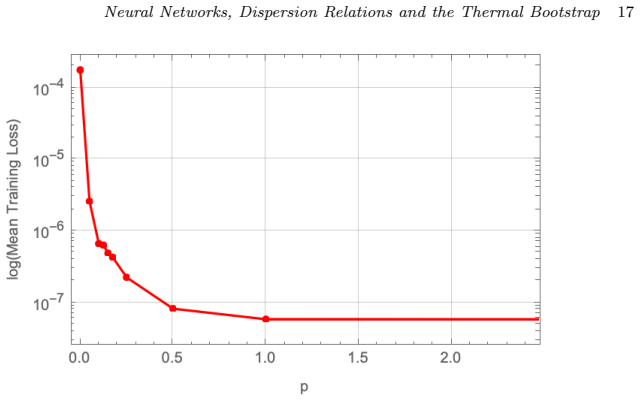
- [Numerical illustrations] In the numerical applications section, the GFF and holographic illustrations lack error analysis, convergence diagnostics (e.g., loss curves across seeds), or quantitative comparisons to independent results beyond the exactly solvable GFF limit. This weakens the assessment of accuracy for cases where the spectrum is unknown.
minor comments (1)
- [Abstract] The abstract refers to 'potential relations to recent discussions of smoothness properties in CFT correlators,' but the main text provides only a brief mention without explicit connections or citations to the relevant literature.
Simulated Author's Rebuttal
We thank the referee for the careful reading and constructive comments on our proceedings contribution. We address each major point below, taking into account the limited scope and length of the manuscript.
read point-by-point responses
-
Referee: The discussion of stability properties of the non-convex optimization (in the section addressing the relevant scheme) relies on illustrations for Generalized Free Fields, where the spectrum is known a priori, and 4d holographic CFTs. No analytic bounds, systematic scans over random seeds or network architectures, or tests for generic interacting CFTs are provided. The non-positive kernel and S¹ periodicity constraints are noted but not shown to preserve convergence in broader cases; this is load-bearing for the claim that the method reliably resums the OPE tower.
Authors: We agree that the stability discussion is based on numerical illustrations for GFF and holographic cases rather than analytic bounds or exhaustive scans. As a short proceedings contribution, a comprehensive analysis of convergence for generic interacting CFTs lies beyond the present scope. The examples demonstrate practical stability under the non-positive kernel and periodicity constraints, but we will add a clarifying sentence noting the illustrative character of these results and the desirability of further tests in future work. revision: partial
-
Referee: In the numerical applications section, the GFF and holographic illustrations lack error analysis, convergence diagnostics (e.g., loss curves across seeds), or quantitative comparisons to independent results beyond the exactly solvable GFF limit. This weakens the assessment of accuracy for cases where the spectrum is unknown.
Authors: We acknowledge that the current numerical section provides limited diagnostics and error estimates. For the GFF case we recover the exact result, while the holographic example is presented as a feasibility check. Within proceedings length constraints we can add a brief note on observed loss behavior and basic stability across a few seeds, but quantitative comparisons for unknown spectra are not feasible without independent methods. We will incorporate a short convergence remark in the revision. revision: partial
- Analytic bounds on optimization stability or systematic architecture scans over generic CFTs, which would require a full-length research article rather than a proceedings contribution.
Circularity Check
No circularity: review of dispersion+NN framework with external illustrations on known spectra
full rationale
The paper is explicitly a review/proceedings contribution that applies an existing dispersion-relation + neural-network framework to thermal two-point functions. Illustrations are performed on Generalized Free Fields and 4d holographic CFTs where the OPE data are known independently; the stability discussion is presented as numerical evidence rather than a derivation that reduces to a fitted parameter or self-citation chain defined inside the manuscript. No load-bearing step equates a claimed prediction to its own input by construction, and the central claim remains independent of any internal tautology.
Axiom & Free-Parameter Ledger
axioms (1)
- domain assumption Dispersion relations hold for conformal correlators on the thermal circle
Lean theorems connected to this paper
-
IndisputableMonolith/Cost/FunctionalEquation.leanwashburn_uniqueness_aczel unclearWe review a framework for the conformal bootstrap that does not rely on positivity and treats the infinite tower of high-dimension OPE contributions to conformal correlators through dispersion relations and neural networks.
-
IndisputableMonolith/Foundation/AlphaCoordinateFixation.leanJ_uniquely_calibrated_via_higher_derivative unclearthe non-convex optimisation converges accurately to the physical solution
Reference graph
Works this paper leans on
-
[1]
The Conformal Bootstrap: Theory, Numerical Techniques, and Applications
D. Poland, S. Rychkov and A. Vichi,Rev. Mod. Phys.91(2019) 015002, arXiv:1805.04405 [hep-th]
work page internal anchor Pith review Pith/arXiv arXiv 2019
-
[2]
S. Rychkov and N. Su,Rev. Mod. Phys.96(2024) 045004,arXiv:2311.15844 [hep-th]
-
[3]
D. Poland and D. Simmons-Duffin, Snowmass White Paper: The Numerical Confor- mal Bootstrap, inSnowmass 2021, (3 2022),arXiv:2203.08117 [hep-th]
-
[4]
T. Hartman, D. Mazac, D. Simmons-Duffin and A. Zhiboedov, Snowmass White Paper: The Analytic Conformal Bootstrap, inSnowmass 2021, (2 2022), arXiv:2202.11012 [hep-th]
-
[5]
More constraining conformal bootstrap
F. Gliozzi,Phys. Rev. Lett.111(2013) 161602,arXiv:1307.3111 [hep-th]
work page internal anchor Pith review Pith/arXiv arXiv 2013
-
[6]
Critical exponents of the 3d Ising and related models from Conformal Bootstrap
F. Gliozzi and A. Rago,JHEP10(2014) 042,arXiv:1403.6003 [hep-th]
work page internal anchor Pith review Pith/arXiv arXiv 2014
-
[7]
F. Gliozzi, P. Liendo, M. Meineri and A. Rago,JHEP05(2015) 036, arXiv:1502.07217 [hep-th], [Erratum: JHEP 12, 093 (2021)]
-
[8]
Truncatable bootstrap equations in algebraic form and critical surface exponents
F. Gliozzi,JHEP10(2016) 037,arXiv:1605.04175 [hep-th]
work page internal anchor Pith review Pith/arXiv arXiv 2016
-
[9]
Closure of the Operator Product Expansion in the Non-Unitary Bootstrap
I. Esterlis, A. L. Fitzpatrick and D. Ramirez,JHEP11(2016) 030,arXiv:1606.07458 [hep-th]
work page internal anchor Pith review Pith/arXiv arXiv 2016
-
[10]
New method for the conformal bootstrap with OPE truncations
W. Li (11 2017)arXiv:1711.09075 [hep-th]
work page internal anchor Pith review Pith/arXiv arXiv 2017
-
[11]
Inverse Bootstrapping Conformal Field Theories
W. Li,JHEP01(2018) 077,arXiv:1706.04054 [hep-th]
work page internal anchor Pith review Pith/arXiv arXiv 2018
-
[12]
Conformal bootstrap for percolation and polymers
A. Leclair and J. Squires,J. Stat. Mech.1812(2018) 123105,arXiv:1802.08911 [hep-th]
work page internal anchor Pith review Pith/arXiv arXiv 2018
-
[13]
G. K´ antor, V. Niarchos and C. Papageorgakis,Phys. Rev. D105(2022) 025018, arXiv:2108.09330 [hep-th]
-
[14]
V. Niarchos, C. Papageorgakis, P. Richmond, A. G. Stapleton and M. Woolley,Phys. Rev. D108(2023) 105027,arXiv:2306.15730 [hep-th]
-
[15]
V. Niarchos, C. Papageorgakis, A. Stratoudakis and M. Woolley,Phys. Rev. D112 (2025) 126012,arXiv:2508.08560 [hep-th]
-
[16]
G. K´ antor, V. Niarchos and C. Papageorgakis,Phys. Rev. Lett.128(2022) 041601, arXiv:2108.08859 [hep-th]
-
[17]
G. K´ antor, V. Niarchos, C. Papageorgakis and P. Richmond,Phys. Rev. D107(2023) 025005,arXiv:2209.02801 [hep-th]
-
[18]
Neural Networks Reveal a Universal Bias in Conformal Correlators
K. Ghosh, S. Kumar, V. Niarchos and A. Stergiou (4 2026)arXiv:2604.18673 [hep-th]
work page internal anchor Pith review Pith/arXiv arXiv 2026
-
[19]
Neural Spectral Bias and Conformal Correlators I: Introduction and Applications
K. Ghosh, S. Kumar, V. Niarchos and A. Stergiou (4 2026)arXiv:2604.18686 [hep-th]
work page internal anchor Pith review Pith/arXiv arXiv 2026
- [20]
-
[21]
B. Bajc and K. Trailovi´ c,JHEP11(2025) 133,arXiv:2509.02226 [hep-th]
- [22]
- [23]
-
[24]
N. ˇCeplak, H. Liu, A. Parnachev and S. Valach (11 2025)arXiv:2511.09638 [hep-th]
-
[25]
Chakravarty (12 2025)arXiv:2512.10912 [hep-th]
J. Chakravarty (12 2025)arXiv:2512.10912 [hep-th]
- [26]
-
[27]
Bouncing singularities and thermal correlators on line defects
S. Giombi, Y.-Z. Li and J. Shan (3 2026)arXiv:2603.11012 [hep-th]
work page internal anchor Pith review Pith/arXiv arXiv 2026
-
[28]
The Conformal Bootstrap at Finite Temperature
L. Iliesiu, M. Kolo˘ glu, R. Mahajan, E. Perlmutter and D. Simmons-Duffin,JHEP10 Neural Networks, Dispersion Relations and the Thermal Bootstrap21 (2018) 070,arXiv:1802.10266 [hep-th]
work page internal anchor Pith review Pith/arXiv arXiv 2018
-
[29]
Emergent Spacetime and Holographic CFTs
S. El-Showk and K. Papadodimas,JHEP10(2012) 106,arXiv:1101.4163 [hep-th]
work page internal anchor Pith review Pith/arXiv arXiv 2012
-
[30]
E. Katz, S. Sachdev, E. S. Sørensen and W. Witczak-Krempa,Phys. Rev. B90(2014) 245109,arXiv:1409.3841 [cond-mat.str-el]
work page internal anchor Pith review Pith/arXiv arXiv 2014
-
[31]
Constraining quantum critical dynamics: 2+1D Ising model and beyond
W. Witczak-Krempa,Phys. Rev. Lett.114(2015) 177201,arXiv:1501.03495 [cond-mat.str-el]
work page internal anchor Pith review Pith/arXiv arXiv 2015
- [32]
-
[33]
Stratoudakis,University of Crete Institutional Repository(2024) 35
A. Stratoudakis,University of Crete Institutional Repository(2024) 35
2024
-
[34]
A. C. Petkou and A. Stergiou,Phys. Rev. Lett.121(2018) 071602,arXiv:1806.02340 [hep-th]
work page internal anchor Pith review Pith/arXiv arXiv 2018
-
[35]
L. F. Alday and S. Caron-Huot,JHEP12(2018) 017,arXiv:1711.02031 [hep-th]
work page internal anchor Pith review Pith/arXiv arXiv 2018
-
[36]
L. F. Alday, J. Henriksson and M. van Loon,JHEP07(2018) 131,arXiv:1712.02314 [hep-th]
work page internal anchor Pith review Pith/arXiv arXiv 2018
-
[37]
Universality at large transverse spin in defect CFT
M. Lemos, P. Liendo, M. Meineri and S. Sarkar,JHEP09(2018) 091, arXiv:1712.08185 [hep-th]
work page internal anchor Pith review Pith/arXiv arXiv 2018
-
[38]
J. Liu, E. Perlmutter, V. Rosenhaus and D. Simmons-Duffin,JHEP03(2019) 052, arXiv:1808.00612 [hep-th]
work page internal anchor Pith review Pith/arXiv arXiv 2019
-
[39]
S. Caron-Huot and A.-K. Trinh,JHEP01(2019) 196,arXiv:1809.09173 [hep-th]
work page internal anchor Pith review Pith/arXiv arXiv 2019
-
[40]
Resummation at finite conformal spin
C. Cardona, S. Guha, S. K. Kanumilli and K. Sen,JHEP01(2019) 077, arXiv:1811.00213 [hep-th]
work page internal anchor Pith review Pith/arXiv arXiv 2019
-
[41]
Li,JHEP01(2020) 055,arXiv:1906.00707 [hep-th]
W. Li,JHEP01(2020) 055,arXiv:1906.00707 [hep-th]
-
[42]
S. Albayrak, D. Meltzer and D. Poland,JHEP08(2019) 040,arXiv:1904.00032 [hep-th]
-
[43]
D. Carmi and S. Caron-Huot,JHEP09(2020) 009,arXiv:1910.12123 [hep-th]
- [44]
- [45]
-
[46]
E. Marchetto, A. Miscioscia and E. Pomoni,JHEP09(2024) 044,arXiv:2312.13030 [hep-th]
-
[47]
I. Buri´ c, I. Gusev and A. Parnachev,JHEP09(2025) 053,arXiv:2505.10277 [hep-th]
- [48]
- [49]
-
[50]
E. Parisini, K. Skenderis and B. Withers (12 2023)arXiv:2312.03820 [hep-th]
-
[51]
I. Buri´ c, I. Gusev and A. Parnachev (8 2025)arXiv:2508.08373 [hep-th]
-
[52]
Neural tangent kernel: Convergence and generalization in neural networks
A. Jacot, F. Gabriel and C. Hongler (6 2018)arXiv:1806.07572 [cs.LG]
-
[53]
John Xu, Y
Z.-Q. John Xu, Y. Zhang, T. Luo, Y. Xiao and Z. Ma,Communications in Computa- tional Physics28(2020) 1746–1767
2020
-
[54]
Rahaman, A
N. Rahaman, A. Baratin, D. Arpit, F. Draxler, M. Lin, F. A. Hamprecht, Y. Bengio and A. Courville, On the spectral bias of neural networks (2019)
2019
-
[55]
Bietti and J
A. Bietti and J. Mairal, On the inductive bias of neural tangent kernels (2019)
2019
- [56]
discussion (0)
Sign in with ORCID, Apple, or X to comment. Anyone can read and Pith papers without signing in.