Recognition: 2 theorem links
· Lean TheoremExtended Scenario Bundle Analysis: A Formal Framework for Strategic Scenario Modeling
Pith reviewed 2026-05-14 01:12 UTC · model grok-4.3
The pith
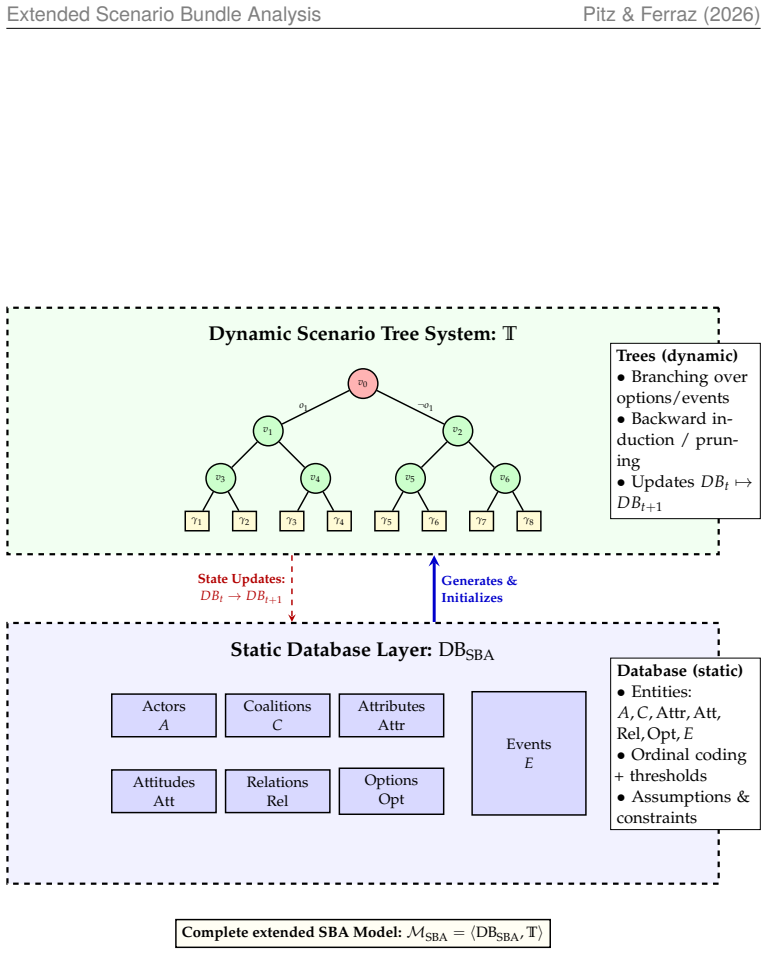
An extended Scenario Bundle Analysis framework adds a two-layer architecture and richer attitude vocabulary to model strategic scenarios without full payoffs or probabilities.
A machine-rendered reading of the paper's core claim, the machinery that carries it, and where it could break.
Core claim
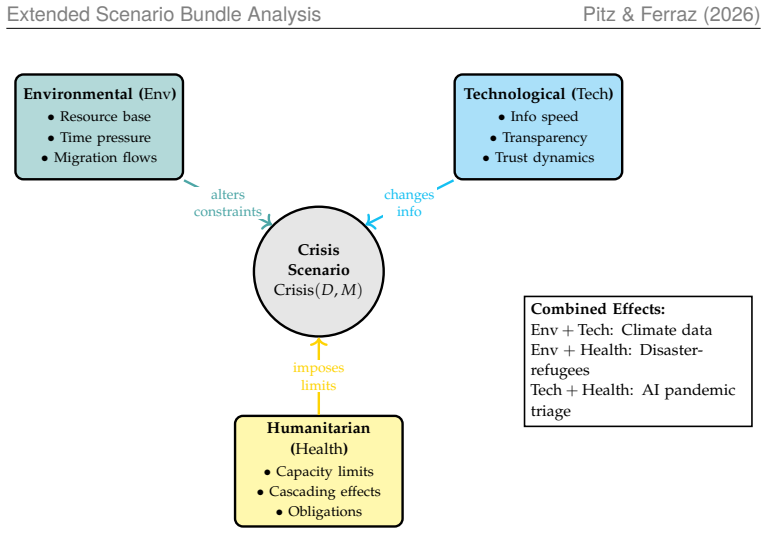
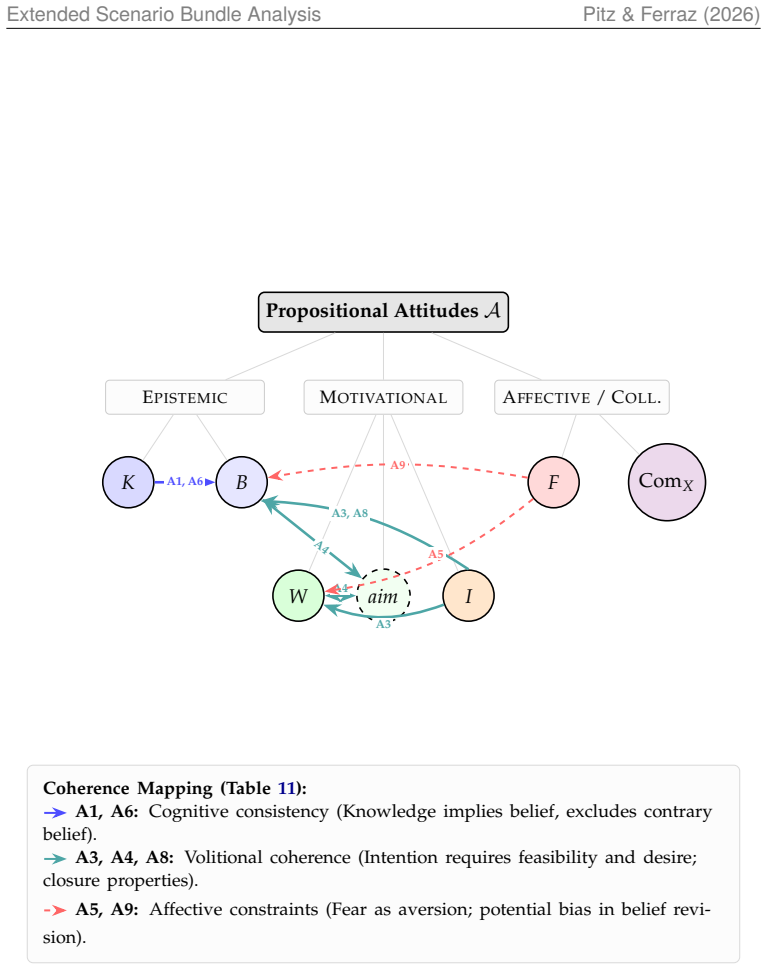
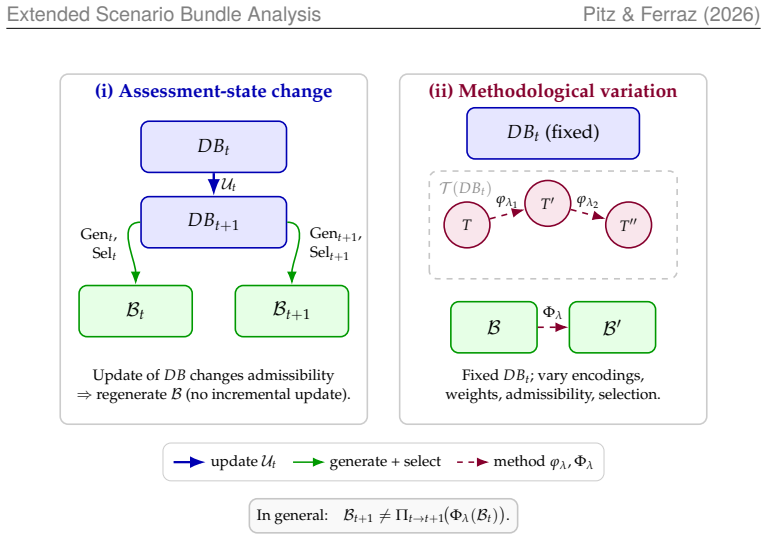
The paper claims that the original SBA framework can be extended by introducing a two-layer architecture that separates a static scenario database from a dynamic scenario tree system, along with a richer attitude vocabulary including beliefs, desires, intentions, fears, and coalitional commitments (with expectations as doxastic attitudes), a domain/modifier layer for contextual framing, a topology on admissible scenario spaces, typed assessment-state updates, and multi-criteria evaluation, all stated with sufficient mathematical precision to support computational implementation while preserving the ability to combine qualitative judgment and interdependence without fully specified payoffs or
What carries the argument
The two-layer architecture separating a static scenario database from a dynamic scenario tree system, augmented by an extended attitude vocabulary and typed update rules.
If this is right
- Enables auditable update rules for scenario assessments in strategic crises.
- Supports multi-criteria evaluation of interdependent scenarios using qualitative inputs.
- Allows precise mathematical definitions suitable for computational tools.
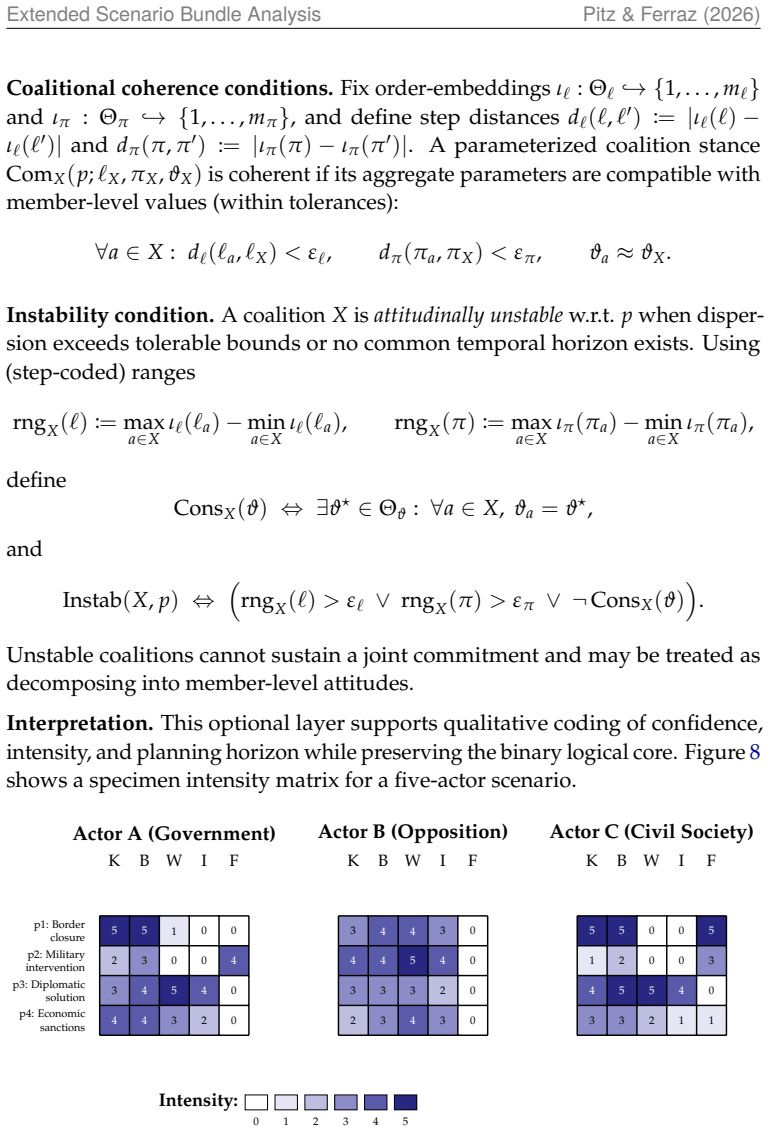
- Incorporates coalitional commitments and fears alongside beliefs and desires.
- Provides a topology for comparing admissible scenario spaces.
Where Pith is reading between the lines
- The topology on scenario spaces could support new similarity metrics for comparing strategic options across different crises.
- Typed updates might integrate directly with automated monitoring systems for real-time attitude tracking.
- The separation of static and dynamic layers suggests easier maintenance of large scenario databases in practice.
- This structure could extend to domains like policy planning where full probabilistic models remain unavailable.
Load-bearing premise
The original SBA framework can be extended with these specific mathematical interfaces and attitude layers while preserving its core ability to combine qualitative judgment and interdependence without requiring fully specified payoffs or probabilities.
What would settle it
An implementation of the extended framework that requires full payoff matrices or probability distributions to perform any update or evaluation would falsify the claim that the extensions preserve the original qualitative capabilities.
Figures







read the original abstract
Strategic crisis analysis needs representations that combine qualitative expert judgement, explicit interdependence, and auditable update rules without requiring fully specified payoffs or probabilities. Scenario Bundle Analysis (SBA), developed by Amos Perlmutter and Reinhard Selten, provides such a starting point, but the original formulation leaves several database, topology, and update interfaces implicit. This paper presents a formal refinement and extension of the original SBA framework, introducing a two-layer architecture that separates a static scenario database from a dynamic scenario tree system. The extended framework incorporates a richer attitude vocabulary: beliefs, desires, intentions, fears, and coalitional commitments, with expectations treated as doxastic attitudes. It also adds a domain/modifier layer for contextual framing, a topology on admissible scenario spaces\index{Scenario space}, typed assessment-state updates, and multi-criteria evaluation. Mathematical definitions are stated with sufficient precision to support computational implementation.
Editorial analysis
A structured set of objections, weighed in public.
Referee Report
Summary. The paper claims to provide a formal refinement and extension of the original Scenario Bundle Analysis (SBA) framework by Perlmutter and Selten. It introduces a two-layer architecture separating a static scenario database from a dynamic scenario tree system, incorporates a richer attitude vocabulary (beliefs, desires, intentions, fears, coalitional commitments, with expectations as doxastic attitudes), adds a domain/modifier layer for contextual framing, a topology on admissible scenario spaces, typed assessment-state updates, and multi-criteria evaluation. The mathematical definitions are stated with precision sufficient to support computational implementation, enabling representations that combine qualitative expert judgment, explicit interdependence, and auditable update rules without requiring fully specified payoffs or probabilities.
Significance. If the mathematical definitions hold with the claimed precision for implementation, this extension would represent a meaningful advance in formal strategic modeling for crisis analysis and economic theory. It directly addresses implicit interfaces in the original SBA regarding databases, topologies, and updates while preserving the core strength of handling qualitative judgment alongside interdependence. The provision of implementation-ready definitions and the expanded attitude vocabulary (including coalitional commitments) are particular strengths that could facilitate reproducible applications in decision support systems.
minor comments (3)
- [Abstract] Abstract: The phrase 'a topology on admissible scenario spaces' is introduced without indicating the specific topological structure (e.g., discrete, metric, or order-based); a single clarifying clause would improve readability for readers unfamiliar with the original SBA.
- [Throughout] The manuscript contains a LaTeX artifact 'scenario spacesindex{Scenario space}' that should be corrected to ensure clean typesetting in the final version.
- [Section 3 or 4] Consider adding one short worked example (perhaps in §3 or §4) showing how a typed assessment-state update operates on a minimal scenario bundle; this would make the claimed computational implementability more concrete without lengthening the paper substantially.
Simulated Author's Rebuttal
We thank the referee for the positive and constructive assessment of our manuscript on the extended Scenario Bundle Analysis framework. The recommendation for minor revision is noted, and we appreciate the recognition of the framework's potential contributions to formal strategic modeling. Since no specific major comments were raised, we have no point-by-point rebuttals to provide at this stage. We will proceed with minor revisions to improve clarity, notation consistency, and implementation details as appropriate.
Circularity Check
No significant circularity detected
full rationale
The paper is explicitly framed as a formal refinement and extension of the original SBA framework by Perlmutter and Selten (distinct external authors). It introduces new components including a two-layer architecture, richer attitude vocabulary (beliefs, desires, intentions, fears, coalitional commitments), domain/modifier layer, topology on scenario spaces, typed assessment-state updates, and multi-criteria evaluation, with mathematical definitions stated for computational implementation. No load-bearing steps reduce by construction to fitted parameters, self-definitions, or self-citation chains; the central claims rest on independent formalization of interfaces left implicit in the cited prior work rather than on renaming or smuggling in unverified assumptions from the authors' own prior results.
Axiom & Free-Parameter Ledger
axioms (1)
- standard math Standard mathematical definitions suffice for topology on scenario spaces and typed assessment-state updates
Lean theorems connected to this paper
-
IndisputableMonolith/Cost/FunctionalEquation.leanwashburn_uniqueness_aczel unclearThis paper presents a formal refinement and extension of the original SBA framework, introducing a two-layer architecture that separates a static scenario database from a dynamic scenario tree system. The extended framework incorporates a richer attitude vocabulary: beliefs, desires, intentions, fears, and coalitional commitments...
-
IndisputableMonolith/Foundation/RealityFromDistinction.leanreality_from_one_distinction unclearSBA occupies a semiformal position between these paradigms by combining qualitative content with checkable structural constraints.
Reference graph
Works this paper leans on
-
[1]
Armed Conflict Location & Event Data Project (ACLED) , author =. 2024 , url =
work page 2024
-
[2]
Consensus Problems on Networks with Antagonistic Interactions , author =. 2013 , journal =
work page 2013
- [3]
-
[4]
Social Choice and Individual Values , author =. 1951 , publisher =
work page 1951
- [5]
- [6]
- [7]
-
[8]
Speech Act Classification: A Study in the Lexical Analysis of English Speech Activity Verbs , author =. 1981 , publisher =
work page 1981
-
[9]
The Logic of Public Announcements, Common Knowledge, and Private Suspicions , author =. 2008 , booktitle =
work page 2008
-
[10]
An Architectonic for Science: The Structuralist Program , author =. 1987 , publisher =
work page 1987
-
[11]
Networks beyond Pairwise Interactions: Structure and Dynamics of Higher-Order Systems , author =. 2020 , journal =
work page 2020
-
[12]
Risk Society: Towards a New Modernity , author =. 1992 , publisher =
work page 1992
-
[13]
Bellman, Richard , title =
-
[14]
Multiple Criteria Decision Analysis: An Integrated Approach , author =. 2002 , publisher =
work page 2002
-
[15]
Higher-Order Organization of Complex Networks , author =. 2016 , journal =
work page 2016
-
[16]
Social Conflicts and Third Parties: Strategies of Conflict Resolution , author =. 1992 , publisher =
work page 1992
- [17]
-
[18]
The Structure and Dynamics of Multilayer Networks , author =. 2014 , journal =
work page 2014
-
[19]
Intention, Plans, and Practical Reason , author =. 1987 , publisher =
work page 1987
- [20]
-
[21]
Security: A New Framework for Analysis , author =. 1998 , publisher =
work page 1998
-
[22]
Meaning and Necessity: A Study in Semantics and Modal Logic , author =. 1947 , publisher =
work page 1947
-
[23]
Structural Balance: A Generalization of Heider's Theory , author =. 1956 , journal =
work page 1956
- [24]
- [25]
-
[26]
The Cognitive Structure of Emotions , author =. 1988 , publisher =
work page 1988
- [27]
- [28]
- [29]
- [30]
-
[31]
The Logical Form of Action Sentences , author =. 1967 , booktitle =
work page 1967
- [32]
-
[33]
Networks, Crowds, and Markets: Reasoning About a Highly Connected World , author =. 2010 , publisher =
work page 2010
- [34]
- [35]
- [36]
- [37]
- [38]
-
[39]
SARS, Governance and the Globalization of Disease , author =. 2004 , publisher =
work page 2004
-
[40]
The Logic of Information: A Theory of Philosophy as Conceptual Design , author =. 2019 , publisher =
work page 2019
- [41]
-
[42]
Social Influence Network Theory: A Sociological Examination of Small Group Dynamics , author =. 2011 , publisher =
work page 2011
- [43]
-
[44]
Peace by Peaceful Means: Peace and Conflict, Development and Civilization , author =. 1996 , publisher =
work page 1996
-
[45]
Global Database of Events, Language, and Tone , author =. 2023 , howpublished =
work page 2023
- [46]
-
[47]
Journal of Mathematical Economics , year =
Gilboa, Itzhak and Schmeidler, David , title =. Journal of Mathematical Economics , year =
- [48]
-
[49]
Stable Coalition Structures with a Unidimensional Set of Alternatives , author =. 1993 , journal =
work page 1993
- [50]
- [51]
-
[52]
Cardinal Welfare, Individualistic Ethics, and Interpersonal Comparisons of Utility , author =. 1955 , journal =
work page 1955
- [53]
-
[54]
Globally Networked Risks and How to Respond , author =. 2013 , journal =
work page 2013
-
[55]
Psychology of Intelligence Analysis , author =. 1999 , publisher =
work page 1999
-
[56]
Structured Analytic Techniques for Intelligence Analysis , author =. 2010 , publisher =
work page 2010
-
[57]
Knowledge and Belief: An Introduction to the Logic of the Two Notions , author =. 1962 , publisher =
work page 1962
-
[58]
Adaptation in Natural and Artificial Systems , author =. 1992 , publisher =
work page 1992
-
[59]
Resilience and stability of ecological systems , author =. 1973 , journal =
work page 1973
-
[60]
Environment, Scarcity, and Violence , author =. 1999 , publisher =
work page 1999
-
[61]
Integrated Crisis Early Warning System Event Data , author =. 2024 , url =
work page 2024
- [62]
- [63]
- [64]
- [65]
-
[66]
Bayesian Networks and Decision Graphs , author =. 2007 , publisher =
work page 2007
-
[67]
The Year 2000: A Framework for Speculation on the Next Thirty-Three Years , author =. 1967 , publisher =
work page 2000
- [68]
- [69]
-
[70]
Reassembling the Social: An Introduction to Actor--Network Theory , author =. 2005 , publisher =
work page 2005
-
[71]
Alliance Reliability in Times of War: Explaining State Decisions to Violate Treaties , author =. 2003 , journal =
work page 2003
-
[72]
Group Agency: The Possibility, Design, and Status of Corporate Agents , author =. 2011 , publisher =
work page 2011
-
[73]
The New Institutionalism: Organizational Factors in Political Life , author =. 1984 , journal =
work page 1984
- [74]
-
[75]
Quantal Response Equilibria for Normal Form Games , author =. 1995 , journal =
work page 1995
-
[76]
Epistemic Logic for AI and Computer Science , author =. 1999 , publisher =
work page 1999
- [77]
-
[78]
Game Theory for Political Scientists , author =. 1994 , publisher =
work page 1994
- [79]
- [80]
discussion (0)
Sign in with ORCID, Apple, or X to comment. Anyone can read and Pith papers without signing in.