Recognition: unknown
Survival of Molecular Complexity under Recent Supernova Feedback: Detection of Hot Cores in RX J1713.7-3946
Pith reviewed 2026-05-14 20:12 UTC · model grok-4.3
The pith
Hot cores inside a supernova remnant retain the same molecular ratios as those in ordinary star-forming regions.
A machine-rendered reading of the paper's core claim, the machinery that carries it, and where it could break.
Core claim
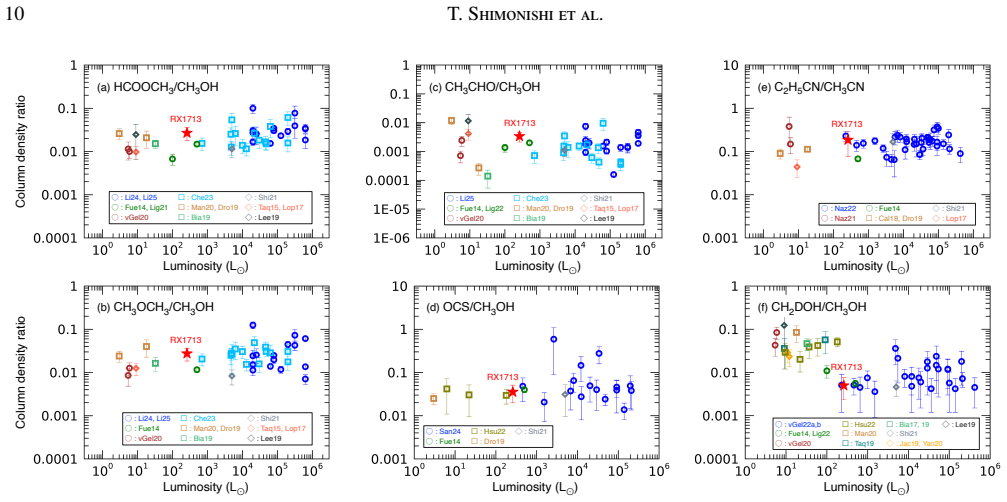
Hot cores HC1 and HC2 inside RX J1713.7-3946 exhibit excitation conditions of roughly 10^7 cm^{-3} density, less than 500 au size, and temperatures above 100 K. Their chemical abundance ratios remain indistinguishable from those in isolated star-forming regions, indicating that supernova feedback has not yet measurably altered the molecular inventory.
What carries the argument
Column density ratios of complex organic molecules (HCOOCH3/CH3OH, CH3OCH3/CH3OH, CH3CHO/CH3OH), deuterated species (CH2DOH/CH3OH), and sulfur- and nitrogen-bearing molecules (OCS/CH3OH, C2H5CN/CH3CN) measured in HC1.
If this is right
- Protostellar cores near supernova remnants can preserve typical hot-core chemistry during early exposure phases.
- Chemical evolution of complex molecules proceeds similarly whether or not the region is inside a young supernova shell.
- Solar-system analogues may form in supernova-influenced environments without immediate chemical disruption.
- Magnetic amplification by supernova shocks can limit cosmic-ray penetration into dense cores.
Where Pith is reading between the lines
- If magnetic shielding operates, similar protection could allow molecular complexity to survive in other high-energy environments such as galactic centers.
- The result implies that the window for chemical alteration by supernova feedback may be narrow, testable by mapping age gradients across multiple remnants.
- Future observations of older exposed cores could directly measure the timescale on which supernova radiation begins to destroy or alter complex organics.
Load-bearing premise
The time since the hot core began exposure to supernova particles and photons has been too short for chemistry to change, or magnetic fields shield the core from enhanced cosmic rays.
What would settle it
Detection of significantly altered molecular ratios in hot cores that have experienced supernova feedback for a longer, well-measured time interval.
Figures


read the original abstract
Protostellar cores located near supernova remnants are considered potential analogues of the birth environment of the solar system. However, the extent to which supernovae influence their chemical evolution remains unclear. We report the first detection of hot molecular cores in a supernova remnant using the Atacama Large Millimeter/submillimeter Array. The detected hot cores (HC1 and HC2) are located inside the X-ray shell of the young supernova remnant RX J1713.7-3946, and both sources are associated with Class I intermediate-mass protostars. This paper focuses on a detailed chemical analysis of HC1, in which a variety of carbon-, oxygen-, nitrogen-, sulfur-, and silicon-bearing species are detected. Excitation analyses indicate that HC1 harbors dense (~10^7 cm-3), compact (<500 au), and high-temperature (>100K) molecular gas. Despite being located within a supernova-feedback region, the column density ratios of complex organic molecules (HCOOCH3/CH3OH, CH3OCH3/CH3OH, and CH3CHO/CH3OH), a deuterated molecule (CH2DOH/CH3OH), and sulfur- and nitrogen-bearing species (OCS/CH3OH and C2H5CN/CH3CN) in HC1 are indistinguishable from those observed in hot cores/corinos in more typical star-forming environments. HC1 is located near the outer edge of the supernova shell, and the surrounding region has likely begun to be exposed to such a harsh environment only recently. The elapsed time since the onset of exposure to high-energy particles and photons may be too short for the chemical composition of the hot core to be significantly altered, and/or the hot-core region may be shielded by magnetic fields amplified by supernova feedback, which could suppress the penetration of enhanced cosmic rays.
Editorial analysis
A structured set of objections, weighed in public.
Referee Report
Summary. The paper reports the first detection of hot molecular cores (HC1 and HC2) inside the X-ray shell of the young supernova remnant RX J1713.7-3946 using ALMA. Both sources are associated with Class I intermediate-mass protostars. For HC1, excitation analysis indicates dense (~10^7 cm^{-3}), compact (<500 au), T>100 K molecular gas. Column density ratios of complex organics (HCOOCH3/CH3OH, CH3OCH3/CH3OH, CH3CHO/CH3OH), the deuterated species CH2DOH/CH3OH, and S/N-bearing species (OCS/CH3OH, C2H5CN/CH3CN) are found to be indistinguishable from literature values in typical hot cores and corinos. The authors attribute this to the core's location near the outer edge of the shell, implying recent exposure to supernova feedback and/or magnetic shielding.
Significance. If the reported ratios hold after full verification of the excitation modeling, the result is significant: it supplies direct observational evidence that molecular complexity can survive in protostellar cores exposed to supernova environments, constraining chemical models of supernova feedback and supporting the viability of supernova-influenced regions as solar-system analogs. The use of standard ALMA excitation analysis and explicit ratio comparisons to established hot-core samples strengthens the empirical basis.
major comments (1)
- [Excitation Analysis] Excitation Analysis section: the column-density ratios central to the indistinguishability claim depend on the adopted source size (<500 au) and any optical-depth corrections; without explicit quantification of how these assumptions propagate into the reported ratios (e.g., HCOOCH3/CH3OH), the precision of the match to literature values cannot be evaluated.
minor comments (2)
- [Abstract] The abstract states that 'a variety of carbon-, oxygen-, nitrogen-, sulfur-, and silicon-bearing species are detected' but provides no explicit list or reference to a table; adding such a summary would improve readability.
- [Discussion] Discussion: the magnetic-shielding scenario is invoked without a quantitative estimate of field strength or cosmic-ray suppression factor, leaving the interpretation qualitative.
Simulated Author's Rebuttal
We thank the referee for their constructive review and recommendation for minor revision. We address the major comment on the excitation analysis below.
read point-by-point responses
-
Referee: Excitation Analysis section: the column-density ratios central to the indistinguishability claim depend on the adopted source size (<500 au) and any optical-depth corrections; without explicit quantification of how these assumptions propagate into the reported ratios (e.g., HCOOCH3/CH3OH), the precision of the match to literature values cannot be evaluated.
Authors: We agree that a quantitative assessment of how the assumed source size and optical-depth corrections affect the derived ratios would strengthen the manuscript. In the revised version we will add a short subsection to the Excitation Analysis that (i) tests the effect of source sizes between 200–500 au on the column densities of the key species and (ii) reports optical-depth estimates for the strongest transitions used in the ratio calculations. These tests show that the reported ratios (HCOOCH3/CH3OH, CH3OCH3/CH3OH, CH3CHO/CH3OH, CH2DOH/CH3OH, OCS/CH3OH, C2H5CN/CH3CN) vary by at most 25 % across the plausible size range and remain statistically indistinguishable from the literature values once the uncertainties are included. We will also state explicitly that the majority of the lines employed are optically thin (τ < 0.3). revision: yes
Circularity Check
No circularity: ratios are direct observational measurements compared to external literature
full rationale
The paper's central result is an empirical comparison: column density ratios (HCOOCH3/CH3OH, CH3OCH3/CH3OH, CH3CHO/CH3OH, CH2DOH/CH3OH, OCS/CH3OH, C2H5CN/CH3CN) measured in HC1 via ALMA excitation analysis are reported as matching values from unrelated hot-core studies. No equations derive these ratios from supernova parameters, no parameters are fitted to the target data and then re-predicted, and no self-citation chain supplies the uniqueness or ansatz for the similarity claim. The time-shielding interpretations are post-hoc and do not enter the ratio calculation. The derivation chain is therefore self-contained against external benchmarks.
Axiom & Free-Parameter Ledger
axioms (2)
- domain assumption LTE excitation conditions apply to the detected lines
- ad hoc to paper The supernova shell has only recently begun to affect the core region
Reference graph
Works this paper leans on
-
[1]
Adams , F. C. 2010, , 48, 47, 10.1146/annurev-astro-081309-130830
-
[2]
1999, , 526, 314, 10.1086/307973
Aikawa , Y., & Herbst , E. 1999, , 526, 314, 10.1086/307973
-
[3]
Arumainayagam , C. R., Garrod , R. T., Boyer , M. C., et al. 2019, Chemical Society Reviews, 48, 2293, 10.1039/C7CS00443E
-
[4]
Bennett , C. J., & Kaiser , R. I. 2007, , 661, 899, 10.1086/516745
-
[5]
Bethell , T. J., & Bergin , E. A. 2011, , 740, 7, 10.1088/0004-637X/740/1/7
-
[6]
2017, , 467, 3011, 10.1093/mnras/stx252
Bianchi , E., Codella , C., Ceccarelli , C., et al. 2017, , 467, 3011, 10.1093/mnras/stx252
-
[7]
2019, , 483, 1850, 10.1093/mnras/sty2915
---. 2019, , 483, 1850, 10.1093/mnras/sty2915
-
[8]
Bisschop , S. E., J rgensen , J. K., van Dishoeck , E. F., & de Wachter , E. B. M. 2007, , 465, 913, 10.1051/0004-6361:20065963
-
[9]
Observations of the Icy Universe
Boogert , A., Gerakines , P., & Whittet , D. 2015, ArXiv e-prints. 1501.05317
work page internal anchor Pith review Pith/arXiv arXiv 2015
-
[10]
Boogert , A. C. A., Brewer , K., Brittain , A., & Emerson , K. S. 2022, , 941, 32, 10.3847/1538-4357/ac9b4a
-
[11]
Boss , A. P. 2012, Annual Review of Earth and Planetary Sciences, 40, 23, 10.1146/annurev-earth-042711-105552
-
[12]
Calcutt , H., J rgensen , J. K., M \"u ller , H. S. P., et al. 2018, , 616, A90, 10.1051/0004-6361/201732289
-
[13]
2022, , 134, 114501, 10.1088/1538-3873/ac9642
CASA Team , Bean , B., Bhatnagar , S., et al. 2022, , 134, 114501, 10.1088/1538-3873/ac9642
-
[14]
2012, , 20, 56, 10.1007/s00159-012-0056-x
Caselli , P., & Ceccarelli , C. 2012, , 20, 56, 10.1007/s00159-012-0056-x
-
[15]
2004, in Astronomical Society of the Pacific Conference Series, Vol
Ceccarelli , C. 2004, in Astronomical Society of the Pacific Conference Series, Vol. 323, Star Formation in the Interstellar Medium: In Honor of David Hollenbach, ed. D. Johnstone , F. C. Adams , D. N. C. Lin , D. A. Neufeeld , & E. C. Ostriker , 195
2004
-
[16]
2014, in Protostars and Planets VI, ed
Ceccarelli , C., Caselli , P., Bockel \'e e-Morvan , D., et al. 2014, in Protostars and Planets VI, ed. H. Beuther , R. S. Klessen , C. P. Dullemond , & T. Henning , 859, 10.2458/azu\_uapress\_9780816531240-ch037
work page doi:10.2458/azu 2014
-
[17]
2011, , 740, L4, 10.1088/2041-8205/740/1/L4
Ceccarelli , C., Hily-Blant , P., Montmerle , T., et al. 2011, , 740, L4, 10.1088/2041-8205/740/1/L4
-
[18]
2023, in Astronomical Society of the Pacific Conference Series, Vol
Ceccarelli , C., Codella , C., Balucani , N., et al. 2023, in Astronomical Society of the Pacific Conference Series, Vol. 534, Protostars and Planets VII, ed. S. Inutsuka , Y. Aikawa , T. Muto , K. Tomida , & M. Tamura , 379
2023
-
[19]
Celli , S., Morlino , G., Gabici , S., & Aharonian , F. A. 2019, , 487, 3199, 10.1093/mnras/stz1425
-
[20]
Chen , Y., van Gelder , M. L., Nazari , P., et al. 2023, , 678, A137, 10.1051/0004-6361/202346491
-
[21]
2026, , 707, A95, 10.1051/0004-6361/202557900
Cosentino , G., Jim \'e nez-Serra , I., Fontani , F., et al. 2026, , 707, A95, 10.1051/0004-6361/202557900
-
[22]
Cox , A. N. 2000, Allen's astrophysical quantities (Springer)
2000
-
[23]
Drozdovskaya , M. N., van Dishoeck , E. F., Rubin , M., J rgensen , J. K., & Altwegg , K. 2019, , 490, 50, 10.1093/mnras/stz2430
-
[24]
2014, , 568, A65, 10.1051/0004-6361/201323074
Fuente , A., Cernicharo , J., Caselli , P., et al. 2014, , 568, A65, 10.1051/0004-6361/201323074
-
[25]
2021, , 915, 84, 10.3847/1538-4357/abff4a
Fukui , Y., Sano , H., Yamane , Y., et al. 2021, , 915, 84, 10.3847/1538-4357/abff4a
-
[26]
2012, , 746, 82, 10.1088/0004-637X/746/1/82
Fukui , Y., Sano , H., Sato , J., et al. 2012, , 746, 82, 10.1088/0004-637X/746/1/82
-
[27]
2015, , 584, A124, 10.1051/0004-6361/201527050
Furuya , K., Aikawa , Y., Hincelin , U., et al. 2015, , 584, A124, 10.1051/0004-6361/201527050
-
[28]
Furuya , K., van Dishoeck , E. F., & Aikawa , Y. 2016, , 586, A127, 10.1051/0004-6361/201527579
-
[29]
Gaches , B. A. L., & Viti , S. 2025, arXiv e-prints, arXiv:2512.10060, 10.48550/arXiv.2512.10060
-
[30]
Garrod , R. T. 2013, , 765, 60, 10.1088/0004-637X/765/1/60
-
[31]
doi:10.1051/0004-6361:20065560 , eprint =
Garrod , R. T., & Herbst , E. 2006, , 457, 927, 10.1051/0004-6361:20065560
-
[32]
2023, Faraday Discussions, 245, 541, 10.1039/D3FD00014A
---. 2023, Faraday Discussions, 245, 541, 10.1039/D3FD00014A
-
[33]
Geppert , W. D., Hamberg , M., Thomas , R. D., et al. 2006, Faraday Discussions, 133, 177, 10.1039/B516010C
-
[34]
Hamberg , M., \"O sterdahl , F., Thomas , R. D., et al. 2010, , 514, A83, 10.1051/0004-6361/200913891
-
[35]
Herbst , E., & van Dishoeck , E. F. 2009, , 47, 427, 10.1146/annurev-astro-082708-101654
-
[36]
2009, , 702, 291, 10.1088/0004-637X/702/1/291
Hidaka , H., Watanabe , M., Kouchi , A., & Watanabe , N. 2009, , 702, 291, 10.1088/0004-637X/702/1/291
-
[37]
2022, , 927, 218, 10.3847/1538-4357/ac49e0
Hsu , S.-Y., Liu , S.-Y., Liu , T., et al. 2022, , 927, 218, 10.3847/1538-4357/ac49e0
-
[38]
Hudson , R. L., & Moore , M. H. 1999, , 140, 451, 10.1006/icar.1999.6144
-
[39]
Indriolo , N., Blake , G. A., Goto , M., et al. 2010, , 724, 1357, 10.1088/0004-637X/724/2/1357
-
[40]
2012, , 744, 71, 10.1088/0004-637X/744/1/71
Inoue , T., Yamazaki , R., Inutsuka , S.-i., & Fukui , Y. 2012, , 744, 71, 10.1088/0004-637X/744/1/71
-
[41]
Jacobsen , S. K., J rgensen , J. K., Di Francesco , J., et al. 2019, , 629, A29, 10.1051/0004-6361/201833214
-
[42]
2025, arXiv e-prints, arXiv:2501.01782, 10.48550/arXiv.2501.01782
Jimenez-Serra , I. 2025, arXiv e-prints, arXiv:2501.01782, 10.48550/arXiv.2501.01782
-
[43]
Kaiser , R. I., & Roessler , K. 1998, , 503, 959, 10.1086/306001
-
[44]
Koo , B.-C., Lee , Y.-H., Moon , D.-S., Yoon , S.-C., & Raymond , J. C. 2013, Science, 342, 1346, 10.1126/science.1243823
-
[45]
Kurtz , S., Cesaroni , R., Churchwell , E., Hofner , P., & Walmsley , C. M. 2000, Protostars and Planets IV, 299
2000
-
[46]
Lazendic , J. S., Slane , P. O., Gaensler , B. M., et al. 2003, , 593, L27, 10.1086/378183
-
[47]
2019, , 876, 63, 10.3847/1538-4357/ab15db
Lee , C.-F., Codella , C., Li , Z.-Y., & Liu , S.-Y. 2019, , 876, 63, 10.3847/1538-4357/ab15db
-
[48]
Lee , T., Papanastassiou , D. A., & Wasserburg , G. J. 1976, , 3, 41, 10.1029/GL003i001p00041
-
[49]
2021, Nature Astronomy, 5, 832, 10.1038/s41550-021-01344-w
Leike , R., Celli , S., Krone-Martins , A., et al. 2021, Nature Astronomy, 5, 832, 10.1038/s41550-021-01344-w
-
[50]
2024, , 533, 1583, 10.1093/mnras/stae1934
Li , C., Qin , S.-L., Liu , T., et al. 2024, , 533, 1583, 10.1093/mnras/stae1934
-
[51]
2025, , 696, A7, 10.1051/0004-6361/202452810
---. 2025, , 696, A7, 10.1051/0004-6361/202452810
-
[52]
Ligterink , N. F. W., Ahmadi , A., Coutens , A., et al. 2021, , 647, A87, 10.1051/0004-6361/202039619
-
[53]
Ligterink , N. F. W., Ahmadi , A., Luitel , B., et al. 2022, ACS Earth and Space Chemistry, 6, 455, 10.1021/acsearthspacechem.1c00330
-
[54]
Linsky , J. L., Draine , B. T., Moos , H. W., et al. 2006, , 647, 1106, 10.1086/505556
-
[55]
2017, , 606, A121, 10.1051/0004-6361/201630334
L \'o pez-Sepulcre , A., Sakai , N., Neri , R., et al. 2017, , 606, A121, 10.1051/0004-6361/201630334
-
[56]
Manigand , S., J rgensen , J. K., Calcutt , H., et al. 2020, , 635, A48, 10.1051/0004-6361/201936299
-
[57]
Maxted , N. I., Rowell , G. P., Dawson , B. R., et al. 2012, , 422, 2230, 10.1111/j.1365-2966.2012.20766.x
-
[58]
P., Waters , B., Schiebel , D., Young , W., & Golap , K
McMullin , J. P., Waters , B., Schiebel , D., Young , W., & Golap , K. 2007, in Astronomical Society of the Pacific Conference Series, Vol. 376, Astronomical Data Analysis Software and Systems XVI, ed. R. A. Shaw , F. Hill , & D. J. Bell , 127
2007
-
[59]
2016, , 591, A149, 10.1051/0004-6361/201526380
Molinari , S., Schisano , E., Elia , D., et al. 2016, , 591, A149, 10.1051/0004-6361/201526380
-
[60]
1980, , 237, 1, 10.1086/157837
Morris , M., Palmer , P., & Zuckerman , B. 1980, , 237, 1, 10.1086/157837
-
[61]
M \"u ller , H. S. P., Schl \"o der , F., Stutzki , J., & Winnewisser , G. 2005, Journal of Molecular Structure, 742, 215, 10.1016/j.molstruc.2005.01.027
-
[62]
Nazari , P., van Gelder , M. L., van Dishoeck , E. F., et al. 2021, , 650, A150, 10.1051/0004-6361/202039996
-
[63]
Nazari , P., Meijerhof , J. D., van Gelder , M. L., et al. 2022, , 668, A109, 10.1051/0004-6361/202243788
-
[64]
Nomura , H., & Millar , T. J. 2004, , 414, 409, 10.1051/0004-6361:20031646
-
[65]
1994, , 291, 943
Ossenkopf , V., & Henning , T. 1994, , 291, 943
1994
-
[66]
2016, , 824, 88, 10.3847/0004-637X/824/2/88
Oya , Y., Sakai , N., L \'o pez-Sepulcre , A., et al. 2016, , 824, 88, 10.3847/0004-637X/824/2/88
-
[67]
Padovani , M., Ivlev , A. V., Galli , D., & Caselli , P. 2018, , 614, A111, 10.1051/0004-6361/201732202
-
[68]
Pickett , H. M., Poynter , R. L., Cohen , E. A., et al. 1998, , 60, 883, 10.1016/S0022-4073(98)00091-0
-
[69]
Pilbratt , G. L., Riedinger , J. R., Passvogel , T., et al. 2010, , 518, L1, 10.1051/0004-6361/201014759
-
[70]
2023, , 680, A87, 10.1051/0004-6361/202245367
Riedel , W., Sipil \"a , O., Redaelli , E., et al. 2023, , 680, A87, 10.1051/0004-6361/202245367
-
[71]
Roberts , H., Herbst , E., & Millar , T. J. 2003, , 591, L41, 10.1086/376962
-
[72]
2021, , 366, 58, 10.1007/s10509-021-03960-4
Sano , H., & Fukui , Y. 2021, , 366, 58, 10.1007/s10509-021-03960-4
-
[73]
2010, , 724, 59, 10.1088/0004-637X/724/1/59
Sano , H., Sato , J., Horachi , H., et al. 2010, , 724, 59, 10.1088/0004-637X/724/1/59
-
[74]
2013, , 778, 59, 10.1088/0004-637X/778/1/59
Sano , H., Tanaka , T., Torii , K., et al. 2013, , 778, 59, 10.1088/0004-637X/778/1/59
-
[75]
2020, , 904, L24, 10.3847/2041-8213/abc884
Sano , H., Inoue , T., Tokuda , K., et al. 2020, , 904, L24, 10.3847/2041-8213/abc884
-
[76]
Santos , J. C., van Gelder , M. L., Nazari , P., Ahmadi , A., & van Dishoeck , E. F. 2024, , 689, A248, 10.1051/0004-6361/202450736
-
[77]
2025, Science Advances, 11, 24.7892, 10.1126/sciadv.adx7892
Sawada , R., Kurokawa , H., Suwa , Y., et al. 2025, Science Advances, 11, 24.7892, 10.1126/sciadv.adx7892
-
[78]
Sch \"o ier , F. L., J rgensen , J. K., van Dishoeck , E. F., & Blake , G. A. 2002, , 390, 1001, 10.1051/0004-6361:20020756
-
[79]
Scott , E. R. D. 2007, Annual Review of Earth and Planetary Sciences, 35, 577, 10.1146/annurev.earth.35.031306.140100
-
[80]
2021, , 922, 206, 10.3847/1538-4357/ac289b
Shimonishi , T., Izumi , N., Furuya , K., & Yasui , C. 2021, , 922, 206, 10.3847/1538-4357/ac289b
discussion (0)
Sign in with ORCID, Apple, or X to comment. Anyone can read and Pith papers without signing in.