Recognition: 2 theorem links
· Lean TheoremDoppler Prompting for Stable mmWave-based Human Pose Estimation
Pith reviewed 2026-05-14 18:45 UTC · model grok-4.3
The pith
PULSE converts Doppler signatures into screened motion prompts that stabilize mmWave human pose estimates by suppressing spurious cues.
A machine-rendered reading of the paper's core claim, the machinery that carries it, and where it could break.
Core claim
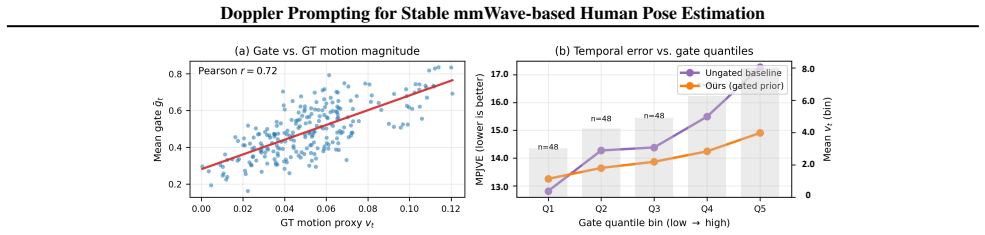
PULSE converts Doppler signatures into confidence-aware motion prompts and injects them into spatial magnitude reasoning through constrained interactions. By screening Doppler prompts before they influence prediction, PULSE first suppresses spurious spectral motion cues and then uses the screened prompts to stabilize prediction. Across three datasets spanning single- and multi-person settings, PULSE consistently improves pose accuracy and temporal stability.
What carries the argument
The constrained interaction mechanism that screens Doppler-derived motion prompts for confidence before injecting them into spatial magnitude-based pose reasoning.
If this is right
- Pose accuracy improves consistently across single- and multi-person datasets.
- Temporal stability increases by reducing jittery trajectories.
- Controlled Doppler prompting proves practical for stable mmWave human pose estimation.
Where Pith is reading between the lines
- The screening step might generalize to other radar-based tasks that combine spatial and velocity data.
- Explicit confidence filtering could benefit multimodal fusion in related estimation problems.
- Performance in heavily interfered environments would test the robustness of the prompt screening.
Load-bearing premise
That Doppler signatures contain separable human versus non-human motion cues that can be reliably screened via confidence-aware prompts without discarding useful information or introducing new errors in the constrained interaction process.
What would settle it
A test showing no improvement or degradation in pose accuracy when Doppler prompts are screened on a dataset with mixed human and environmental motions would falsify the claim.
Figures




read the original abstract
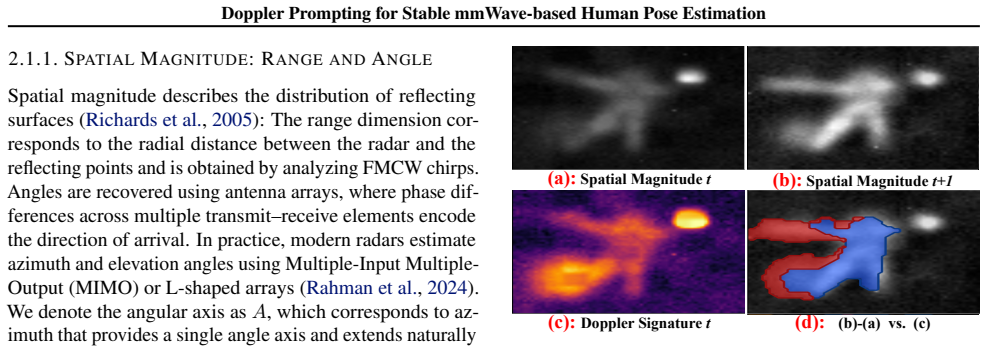
Millimeter-wave (mmWave) enables privacy-preserving, illumination-robust human pose estimation (HPE), with each mmWave frame represented as a range-angle-Doppler tensor, providing spatial magnitude for localization and Doppler signatures for motion-related cues. However, existing mmWave-based HPE methods either underutilize or na\"ively fuse Doppler signatures with spatial magnitude, disregarding their distinct physical semantics. As a result, non-human Doppler signatures can be misinterpreted as human motion cues, leading to jittery trajectories. We propose PULSE, which converts Doppler signatures into confidence-aware motion prompts and injects them into spatial magnitude reasoning through constrained interactions. By screening Doppler prompts before they influence prediction, PULSE first suppresses spurious spectral motion cues and then uses the screened prompts to stabilize prediction. Across three datasets spanning single- and multi-person settings, PULSE consistently improves pose accuracy and temporal stability, indicating that controlled Doppler prompting is a practical direction for stable mmWave HPE.
Editorial analysis
A structured set of objections, weighed in public.
Referee Report
Summary. The manuscript proposes PULSE, a technique for mmWave-based human pose estimation that transforms Doppler signatures into confidence-aware motion prompts. These prompts are injected into spatial magnitude reasoning through constrained interactions to first screen out spurious non-human motion cues and then stabilize the pose predictions. The authors report consistent improvements in both pose accuracy and temporal stability on three datasets covering single- and multi-person scenarios.
Significance. If the empirical results and the underlying separability assumption hold, this work could meaningfully advance stable, privacy-preserving human pose estimation using mmWave radar by providing a principled way to leverage Doppler information without introducing jitter from environmental clutter. It highlights the importance of respecting the distinct physical semantics of range-angle-Doppler tensors rather than naive fusion.
major comments (3)
- Abstract: The abstract asserts that PULSE 'consistently improves pose accuracy and temporal stability' across three datasets, but provides no quantitative results, error analysis, ablation studies, or implementation details. This absence is load-bearing for the central claim that the screening mechanism delivers measurable stability gains.
- Method (constrained interactions): The description of converting Doppler signatures into confidence-aware prompts and screening them via constrained interactions lacks any equations, pseudocode, or formal definition of the confidence estimation or interaction constraints. Without these, it is impossible to verify that the process reliably separates human motion from clutter without introducing false negatives or retained jitter.
- Evaluation section: No details are supplied on the three datasets, the precise metrics used for pose accuracy (e.g., MPJPE) or temporal stability (e.g., jerk or frame-to-frame variance), or the baselines against which improvements are measured. This prevents assessment of whether the reported gains are statistically meaningful or reproducible.
minor comments (1)
- Abstract: The phrase 'naïvely fuse' contains a LaTeX escaping artifact ('naïvely') that should be rendered cleanly as 'naively'.
Simulated Author's Rebuttal
We thank the referee for the constructive and detailed review. The comments highlight important areas for improving clarity and completeness. We address each major comment below and will revise the manuscript to incorporate the suggested additions.
read point-by-point responses
-
Referee: Abstract: The abstract asserts that PULSE 'consistently improves pose accuracy and temporal stability' across three datasets, but provides no quantitative results, error analysis, ablation studies, or implementation details. This absence is load-bearing for the central claim that the screening mechanism delivers measurable stability gains.
Authors: We agree that the abstract would benefit from explicit quantitative support for the claimed improvements. In the revised version, we will expand the abstract to include key numerical results (e.g., average MPJPE reduction and stability metric gains across the three datasets) while remaining within length constraints. The full error analysis, ablation studies, and implementation details are already present in Sections 3 and 4; we will add a direct reference in the abstract to these sections. revision: yes
-
Referee: Method (constrained interactions): The description of converting Doppler signatures into confidence-aware prompts and screening them via constrained interactions lacks any equations, pseudocode, or formal definition of the confidence estimation or interaction constraints. Without these, it is impossible to verify that the process reliably separates human motion from clutter without introducing false negatives or retained jitter.
Authors: We acknowledge that the current textual description of the constrained interactions is high-level. In the revision, we will add formal equations defining the Doppler signature to prompt conversion, the confidence estimation function, and the interaction constraints. We will also include pseudocode for the screening procedure to make the separation of human motion from clutter explicit and verifiable. revision: yes
-
Referee: Evaluation section: No details are supplied on the three datasets, the precise metrics used for pose accuracy (e.g., MPJPE) or temporal stability (e.g., jerk or frame-to-frame variance), or the baselines against which improvements are measured. This prevents assessment of whether the reported gains are statistically meaningful or reproducible.
Authors: We agree that additional specification is required for reproducibility. The revised evaluation section will fully describe the three datasets (sizes, single-/multi-person scenarios, collection protocols), precisely define the metrics (MPJPE for accuracy; jerk and frame-to-frame variance for stability), list all baselines with implementation details, and report statistical significance tests on the observed gains. revision: yes
Circularity Check
No circularity: empirical method evaluated on external data
full rationale
The paper proposes PULSE as an empirical technique that converts Doppler signatures into confidence-aware prompts, screens them via constrained interactions, and injects the results into spatial magnitude reasoning for mmWave HPE. Improvements in accuracy and stability are asserted based on evaluations across three external datasets in single- and multi-person settings. No equations, derivations, or self-referential definitions are presented that would reduce the claimed stabilization to a fitted parameter or input by construction. The load-bearing steps rely on experimental outcomes rather than any of the enumerated circular patterns.
Axiom & Free-Parameter Ledger
Lean theorems connected to this paper
-
IndisputableMonolith/Cost/FunctionalEquation.leanwashburn_uniqueness_aczel unclear?
unclearRelation between the paper passage and the cited Recognition theorem.
PULSE converts Doppler signatures into confidence-aware motion prompts and injects them into spatial magnitude reasoning through constrained interactions
-
IndisputableMonolith/Foundation/AlexanderDuality.leanalexander_duality_circle_linking unclear?
unclearRelation between the paper passage and the cited Recognition theorem.
locality-constrained interaction neighborhood on the shared lattice
What do these tags mean?
- matches
- The paper's claim is directly supported by a theorem in the formal canon.
- supports
- The theorem supports part of the paper's argument, but the paper may add assumptions or extra steps.
- extends
- The paper goes beyond the formal theorem; the theorem is a base layer rather than the whole result.
- uses
- The paper appears to rely on the theorem as machinery.
- contradicts
- The paper's claim conflicts with a theorem or certificate in the canon.
- unclear
- Pith found a possible connection, but the passage is too broad, indirect, or ambiguous to say the theorem truly supports the claim.
Reference graph
Works this paper leans on
-
[1]
P. Langley , title =. Proceedings of the 17th International Conference on Machine Learning (ICML 2000) , address =. 2000 , pages =
work page 2000
-
[2]
IEEE Internet of Things Journal , volume=
A joint global--local network for human pose estimation with millimeter wave radar , author=. IEEE Internet of Things Journal , volume=. 2022 , publisher=
work page 2022
-
[3]
arXiv preprint arXiv:2512.20128 , year=
milliMamba: Specular-Aware Human Pose Estimation via Dual mmWave Radar with Multi-Frame Mamba Fusion , author=. arXiv preprint arXiv:2512.20128 , year=
-
[4]
Proceedings of the 59th ACM/IEEE Design Automation Conference , pages=
Fast and scalable human pose estimation using mmwave point cloud , author=. Proceedings of the 59th ACM/IEEE Design Automation Conference , pages=
-
[5]
arXiv preprint arXiv:2503.09537 , year=
GenHPE: Generative Counterfactuals for 3D Human Pose Estimation with Radio Frequency Signals , author=. arXiv preprint arXiv:2503.09537 , year=
-
[6]
mmHSE: A Two-Stage Framework for Human Skeleton Estimation Using mmWave FMCW Radar Signals , author=. Applied Sciences , volume=. 2025 , publisher=
work page 2025
-
[7]
Proceedings of the 21st ACM Conference on Embedded Networked Sensor Systems , pages=
Egocentric human pose estimation using head-mounted mmwave radar , author=. Proceedings of the 21st ACM Conference on Embedded Networked Sensor Systems , pages=
-
[8]
Optimum array processing: Part IV of detection, estimation, and modulation theory , author=. 2002 , publisher=
work page 2002
-
[9]
IEEE Internet of Things Journal , volume=
Cubelearn: End-to-end learning for human motion recognition from raw mmwave radar signals , author=. IEEE Internet of Things Journal , volume=. 2023 , publisher=
work page 2023
-
[10]
Michael Downes and Barbara Beeton , organization =. The
-
[11]
Emmett Brown , title =
-
[12]
Human3. 6m: Large scale datasets and predictive methods for 3d human sensing in natural environments , author=. IEEE transactions on pattern analysis and machine intelligence , volume=. 2013 , publisher=
work page 2013
-
[13]
Proceedings of the IEEE conference on computer vision and pattern recognition , pages=
Pose-conditioned joint angle limits for 3D human pose reconstruction , author=. Proceedings of the IEEE conference on computer vision and pattern recognition , pages=
-
[14]
European Conference on Computer Vision , pages=
Neuman: Neural human radiance field from a single video , author=. European Conference on Computer Vision , pages=. 2022 , organization=
work page 2022
-
[15]
Fundamentals of radar signal processing , author=. 2005 , publisher=
work page 2005
-
[16]
Journal of computational and applied mathematics , volume=
The ubiquitous Kronecker product , author=. Journal of computational and applied mathematics , volume=. 2000 , publisher=
work page 2000
-
[17]
IEEE Transactions on Image Processing , volume=
Kronecker compressive sensing , author=. IEEE Transactions on Image Processing , volume=. 2011 , publisher=
work page 2011
-
[18]
2012 IEEE International Conference on Communications (ICC) , pages=
Millimeter waves channel measurements and path loss models , author=. 2012 IEEE International Conference on Communications (ICC) , pages=. 2012 , organization=
work page 2012
-
[19]
Quaternion kinematics for the error-state Kalman filter
Quaternion kinematics for the error-state Kalman filter , author=. arXiv preprint arXiv:1711.02508 , year=
work page internal anchor Pith review Pith/arXiv arXiv
-
[20]
Computer vision and image understanding , volume=
Estimating optical flow: A comprehensive review of the state of the art , author=. Computer vision and image understanding , volume=. 2024 , publisher=
work page 2024
-
[21]
IEEE Transactions on Aerospace and Electronic Systems , year=
ProbRadarM3F: mmWave Radar-based Human Skeletal Pose Estimation with Probability Map Guided Multi-Format Feature Fusion , author=. IEEE Transactions on Aerospace and Electronic Systems , year=
-
[22]
Proceedings of the Computer Vision and Pattern Recognition Conference , pages=
MVDoppler-Pose: Multi-Modal Multi-View mmWave Sensing for Long-Distance Self-Occluded Human Walking Pose Estimation , author=. Proceedings of the Computer Vision and Pattern Recognition Conference , pages=
-
[23]
Proceedings of the ACM on Interactive, Mobile, Wearable and Ubiquitous Technologies , volume=
Breaking the Resolution Barriers of mmWave Arrays via Null Steering for Sleep Monitoring in Multi-Person Scenarios , author=. Proceedings of the ACM on Interactive, Mobile, Wearable and Ubiquitous Technologies , volume=. 2025 , publisher=
work page 2025
-
[24]
IEEE INFOCOM 2025-IEEE Conference on Computer Communications , pages=
iRadar: Synthesizing Millimeter-Waves from Wearable Inertial Inputs for Human Gesture Sensing , author=. IEEE INFOCOM 2025-IEEE Conference on Computer Communications , pages=. 2025 , organization=
work page 2025
-
[25]
Proceedings of the ACM on Interactive, Mobile, Wearable and Ubiquitous Technologies , volume=
3D Bounding Box Estimation Based on COTS mmWave Radar via Moving Scanning , author=. Proceedings of the ACM on Interactive, Mobile, Wearable and Ubiquitous Technologies , volume=. 2024 , publisher=
work page 2024
-
[26]
Proceedings of the ACM on interactive, mobile, wearable and ubiquitous technologies , volume=
Pantomime: Mid-air gesture recognition with sparse millimeter-wave radar point clouds , author=. Proceedings of the ACM on interactive, mobile, wearable and ubiquitous technologies , volume=. 2021 , publisher=
work page 2021
-
[27]
Proceedings of the ACM on Interactive, Mobile, Wearable and Ubiquitous Technologies , volume=
mmSpyVR: Exploiting mmWave radar for penetrating obstacles to uncover privacy vulnerability of virtual reality , author=. Proceedings of the ACM on Interactive, Mobile, Wearable and Ubiquitous Technologies , volume=. 2024 , publisher=
work page 2024
-
[28]
Proceedings of the ACM on Interactive, Mobile, Wearable and Ubiquitous Technologies , volume=
3D point cloud generation with millimeter-wave radar , author=. Proceedings of the ACM on Interactive, Mobile, Wearable and Ubiquitous Technologies , volume=. 2020 , publisher=
work page 2020
-
[29]
Proceedings of the ACM on Interactive, Mobile, Wearable and Ubiquitous Technologies , volume=
View-agnostic Human Exercise Cataloging with Single MmWave Radar , author=. Proceedings of the ACM on Interactive, Mobile, Wearable and Ubiquitous Technologies , volume=. 2024 , publisher=
work page 2024
-
[30]
Proceedings of the ACM on Interactive, Mobile, Wearable and Ubiquitous Technologies , volume=
Millipcd: Beyond traditional vision indoor point cloud generation via handheld millimeter-wave devices , author=. Proceedings of the ACM on Interactive, Mobile, Wearable and Ubiquitous Technologies , volume=. 2023 , publisher=
work page 2023
-
[31]
Proceedings of the 30th ACM International Conference on Multimedia , pages=
mmbody benchmark: 3d body reconstruction dataset and analysis for millimeter wave radar , author=. Proceedings of the 30th ACM International Conference on Multimedia , pages=
-
[32]
Proceedings of the ACM on Interactive, Mobile, Wearable and Ubiquitous Technologies , volume=
Human parsing with joint learning for dynamic mmwave radar point cloud , author=. Proceedings of the ACM on Interactive, Mobile, Wearable and Ubiquitous Technologies , volume=. 2023 , publisher=
work page 2023
-
[33]
IEEE Transactions on Microwave Theory and Techniques , year=
Noncontact Multipoint Vital Sign Monitoring With mmWave MIMO Radar , author=. IEEE Transactions on Microwave Theory and Techniques , year=
-
[34]
arXiv preprint arXiv:2306.04242 , year=
4d millimeter-wave radar in autonomous driving: A survey , author=. arXiv preprint arXiv:2306.04242 , year=
-
[35]
Stabilizing Skeletal Pose Estimation using mmWave Radar via Dynamic Model and Filtering , year=
Hu, Shuting and Sengupta, Arindam and Cao, Siyang , booktitle=. Stabilizing Skeletal Pose Estimation using mmWave Radar via Dynamic Model and Filtering , year=
-
[36]
Proceedings of the AAAI Conference on Artificial Intelligence , volume=
Wavelet-Assisted Multi-Frequency Attention Network for Pansharpening , author=. Proceedings of the AAAI Conference on Artificial Intelligence , volume=
-
[37]
Proceedings of the IEEE/CVF conference on computer vision and pattern recognition , pages=
Densefusion: 6d object pose estimation by iterative dense fusion , author=. Proceedings of the IEEE/CVF conference on computer vision and pattern recognition , pages=
-
[38]
Seminal Graphics Papers: Pushing the Boundaries, Volume 2 , pages=
SMPL: A skinned multi-person linear model , author=. Seminal Graphics Papers: Pushing the Boundaries, Volume 2 , pages=
-
[39]
PoseCNN: A Convolutional Neural Network for 6D Object Pose Estimation in Cluttered Scenes
Posecnn: A convolutional neural network for 6d object pose estimation in cluttered scenes , author=. arXiv preprint arXiv:1711.00199 , year=
work page internal anchor Pith review Pith/arXiv arXiv
-
[40]
arXiv preprint arXiv:2509.21396 , year=
mmHSense: Multi-Modal and Distributed mmWave ISAC Datasets for Human Sensing , author=. arXiv preprint arXiv:2509.21396 , year=
-
[41]
Proceedings of the IEEE/CVF conference on computer vision and pattern recognition , pages=
Lite-hrnet: A lightweight high-resolution network , author=. Proceedings of the IEEE/CVF conference on computer vision and pattern recognition , pages=
-
[42]
Real-time human gesture grading based on OpenPose , author=. 2017 10th International Congress on Image and Signal Processing, BioMedical Engineering and Informatics (CISP-BMEI) , pages=. 2017 , organization=
work page 2017
-
[43]
Proceedings of the IEEE conference on computer vision and pattern recognition , pages=
Through-wall human pose estimation using radio signals , author=. Proceedings of the IEEE conference on computer vision and pattern recognition , pages=
-
[44]
Pattern Recognition Letters , volume=
Weighted Intersection over Union (wIoU) for evaluating image segmentation , author=. Pattern Recognition Letters , volume=. 2024 , publisher=
work page 2024
-
[45]
Proceedings of the IEEE/CVF conference on computer vision and pattern recognition , pages=
Boundary IoU: Improving object-centric image segmentation evaluation , author=. Proceedings of the IEEE/CVF conference on computer vision and pattern recognition , pages=
-
[46]
An introduction to domain adaptation and transfer learning
An introduction to domain adaptation and transfer learning , author=. arXiv preprint arXiv:1812.11806 , year=
work page internal anchor Pith review Pith/arXiv arXiv
-
[47]
arXiv preprint arXiv:2508.03578 , year=
RadProPoser: A Framework for Human Pose Estimation with Uncertainty Quantification from Raw Radar Data , author=. arXiv preprint arXiv:2508.03578 , year=
-
[48]
arXiv preprint arXiv:2509.07995 , year=
BodyWave: Egocentric Body Tracking using mmWave Radars on an MR Headset , author=. arXiv preprint arXiv:2509.07995 , year=
-
[49]
European Conference on Computer Vision , pages=
Rt-pose: A 4d radar tensor-based 3d human pose estimation and localization benchmark , author=. European Conference on Computer Vision , pages=. 2024 , organization=
work page 2024
-
[50]
Non-Line-of-Sight 3D Object Reconstruction via mmWave Surface Normal Estimation , author=. Proceedings of the 23rd Annual International Conference on Mobile Systems, Applications and Services , pages=
-
[51]
Real-time human pose estimation and tracking on monocular videos: A systematic literature review , author=. Neurocomputing , pages=. 2025 , publisher=
work page 2025
-
[52]
ACM Transactions on Embedded Computing Systems (TECS) , volume=
Mars: mmwave-based assistive rehabilitation system for smart healthcare , author=. ACM Transactions on Embedded Computing Systems (TECS) , volume=. 2021 , publisher=
work page 2021
-
[53]
Proceedings of the IEEE/CVF conference on computer vision and pattern recognition , pages=
3d human pose estimation in video with temporal convolutions and semi-supervised training , author=. Proceedings of the IEEE/CVF conference on computer vision and pattern recognition , pages=
-
[54]
European Conference on Computer Vision , pages=
Grm: Large gaussian reconstruction model for efficient 3d reconstruction and generation , author=. European Conference on Computer Vision , pages=. 2024 , organization=
work page 2024
-
[55]
Proceedings of the IEEE/CVF International Conference on Computer Vision , pages=
Go-slam: Global optimization for consistent 3d instant reconstruction , author=. Proceedings of the IEEE/CVF International Conference on Computer Vision , pages=
-
[56]
Proceedings of the IEEE international conference on computer vision , pages=
Flowing convnets for human pose estimation in videos , author=. Proceedings of the IEEE international conference on computer vision , pages=
-
[57]
Image and Vision Computing , volume=
Human skeleton tracking from depth data using geodesic distances and optical flow , author=. Image and Vision Computing , volume=. 2012 , publisher=
work page 2012
-
[58]
Model-based Deep Hand Pose Estimation
Model-based deep hand pose estimation , author=. arXiv preprint arXiv:1606.06854 , year=
work page internal anchor Pith review Pith/arXiv arXiv
-
[59]
Proceedings of the ieee conference on computer vision and pattern recognition , pages=
Structural-rnn: Deep learning on spatio-temporal graphs , author=. Proceedings of the ieee conference on computer vision and pattern recognition , pages=
-
[60]
IEEE Transactions on Neural Networks and Learning Systems , volume=
Transfer adaptation learning: A decade survey , author=. IEEE Transactions on Neural Networks and Learning Systems , volume=. 2022 , publisher=
work page 2022
-
[61]
2008 International Conference on Microwave and Millimeter Wave Technology , volume=
Research on the transmissivity of some clothing materials at millimeter-wave band , author=. 2008 International Conference on Microwave and Millimeter Wave Technology , volume=. 2008 , organization=
work page 2008
-
[62]
Usability of a wearable device for home-based upper limb telerehabilitation in persons with stroke: a mixed-methods study , author=. Digital Health , volume=. 2023 , publisher=
work page 2023
-
[63]
ACM Computing Surveys , volume=
Wearable activity trackers: A survey on utility, privacy, and security , author=. ACM Computing Surveys , volume=. 2024 , publisher=
work page 2024
-
[64]
Proceedings on Privacy Enhancing Technologies , year=
Exploring the privacy concerns of bystanders in smart homes from the perspectives of both owners and bystanders , author=. Proceedings on Privacy Enhancing Technologies , year=
-
[65]
Privacy concerns in the smart home context , author=. SN Applied Sciences , volume=. 2020 , publisher=
work page 2020
-
[66]
Proceedings of the ACM on Interactive, Mobile, Wearable and Ubiquitous Technologies , volume=
Pmtrack: Enabling personalized mmwave-based human tracking , author=. Proceedings of the ACM on Interactive, Mobile, Wearable and Ubiquitous Technologies , volume=. 2024 , publisher=
work page 2024
-
[67]
Proceedings of the IEEE/CVF conference on computer vision and pattern Recognition , pages=
Humannerf: Free-viewpoint rendering of moving people from monocular video , author=. Proceedings of the IEEE/CVF conference on computer vision and pattern Recognition , pages=
-
[68]
Proceedings of the Computer Vision and Pattern Recognition Conference , pages=
ODHSR: Online Dense 3D Reconstruction of Humans and Scenes from Monocular Videos , author=. Proceedings of the Computer Vision and Pattern Recognition Conference , pages=
-
[69]
Proceedings of the ACM on Interactive, Mobile, Wearable and Ubiquitous Technologies , volume=
From Spatial Domain to Temporal Domain: Unleashing the Capability of CFAR for mmWave Point Cloud Generation , author=. Proceedings of the ACM on Interactive, Mobile, Wearable and Ubiquitous Technologies , volume=. 2025 , publisher=
work page 2025
-
[70]
Proceedings of the Computer Vision and Pattern Recognition Conference , pages=
UMotion: Uncertainty-driven Human Motion Estimation from Inertial and Ultra-wideband Units , author=. Proceedings of the Computer Vision and Pattern Recognition Conference , pages=
-
[71]
Proceedings of the 29th Annual International Conference on Mobile Computing and Networking , pages=
Towards generalized mmwave-based human pose estimation through signal augmentation , author=. Proceedings of the 29th Annual International Conference on Mobile Computing and Networking , pages=
-
[72]
Computer vision, graphics, and image processing , volume=
Adaptive histogram equalization and its variations , author=. Computer vision, graphics, and image processing , volume=. 1987 , publisher=
work page 1987
-
[73]
IEEE Transactions on Microwave Theory and Techniques , year=
Multiperson localization and vital signs estimation using mmwave mimo radar , author=. IEEE Transactions on Microwave Theory and Techniques , year=
-
[74]
IEEE INFOCOM 2020-IEEE Conference on Computer Communications , pages=
mmTrack: Passive multi-person localization using commodity millimeter wave radio , author=. IEEE INFOCOM 2020-IEEE Conference on Computer Communications , pages=. 2020 , organization=
work page 2020
-
[75]
Proceedings of the IEEE/CVF Winter Conference on Applications of Computer Vision , pages=
Dualsanet: Dual spatial attention network for iris recognition , author=. Proceedings of the IEEE/CVF Winter Conference on Applications of Computer Vision , pages=
-
[76]
arXiv preprint arXiv:2308.04268 , year=
Teacher-student architecture for knowledge distillation: A survey , author=. arXiv preprint arXiv:2308.04268 , year=
-
[77]
IEEE Transactions on Signal Processing , volume=
Meridian filtering for robust signal processing , author=. IEEE Transactions on Signal Processing , volume=. 2007 , publisher=
work page 2007
-
[78]
Digital signal processing: principles, algorithms, and applications, 4/E , author=. 2007 , publisher=
work page 2007
-
[79]
Proceedings of the 3rd ACM Workshop on Millimeter-wave Networks and Sensing Systems , pages=
Radhar: Human activity recognition from point clouds generated through a millimeter-wave radar , author=. Proceedings of the 3rd ACM Workshop on Millimeter-wave Networks and Sensing Systems , pages=
-
[80]
Clancey, William J. Communication, Simulation, and Intelligent Agents: Implications of Personal Intelligent Machines for Medical Education. Proceedings of the Eighth International Joint Conference on Artificial Intelligence (IJCAI-83)
discussion (0)
Sign in with ORCID, Apple, or X to comment. Anyone can read and Pith papers without signing in.