Recognition: unknown
A Hybrid Framework for Natural Language Querying of IFC Models with Relational and Graph Representations
Pith reviewed 2026-05-14 19:10 UTC · model grok-4.3
The pith
Transforming IFC models into relational tables and graphs lets an LLM answer natural language queries about building data with over 93 percent first-attempt accuracy.
A machine-rendered reading of the paper's core claim, the machinery that carries it, and where it could break.
Core claim
IfcLLM transforms IFC models into complementary relational and graph representations and integrates them via iterative retry-and-refine LLM reasoning to support accurate natural language queries on BIM data.
What carries the argument
Hybrid transformation of IFC data into a relational representation for structured properties and geometry together with a graph representation for topology, processed by iterative retry-and-refine LLM reasoning.
If this is right
- Routine BIM analysis tasks become answerable through natural language without IFC expertise.
- Open-weight models can be used for reproducible deployment in AEC workflows.
- All query failures are recoverable through a simple fallback LLM step.
- Complementary representations raise first-attempt success rates above 93 percent on standard scenarios.
Where Pith is reading between the lines
- The same hybrid conversion plus iteration pattern could be tested on other structured engineering data such as infrastructure or product models.
- If the iterative correction works reliably, the approach might reduce training requirements for non-specialist staff who need occasional access to BIM repositories.
- Extending the framework to handle incremental model updates would allow live querying of evolving construction projects.
Load-bearing premise
The conversions to relational and graph forms retain every detail required for correct answers, and the LLM can spot and fix its mistakes iteratively without creating fresh errors.
What would settle it
A query on one of the three test IFC models where critical information is missing from both representations and iteration still yields an incorrect answer.
Figures






read the original abstract
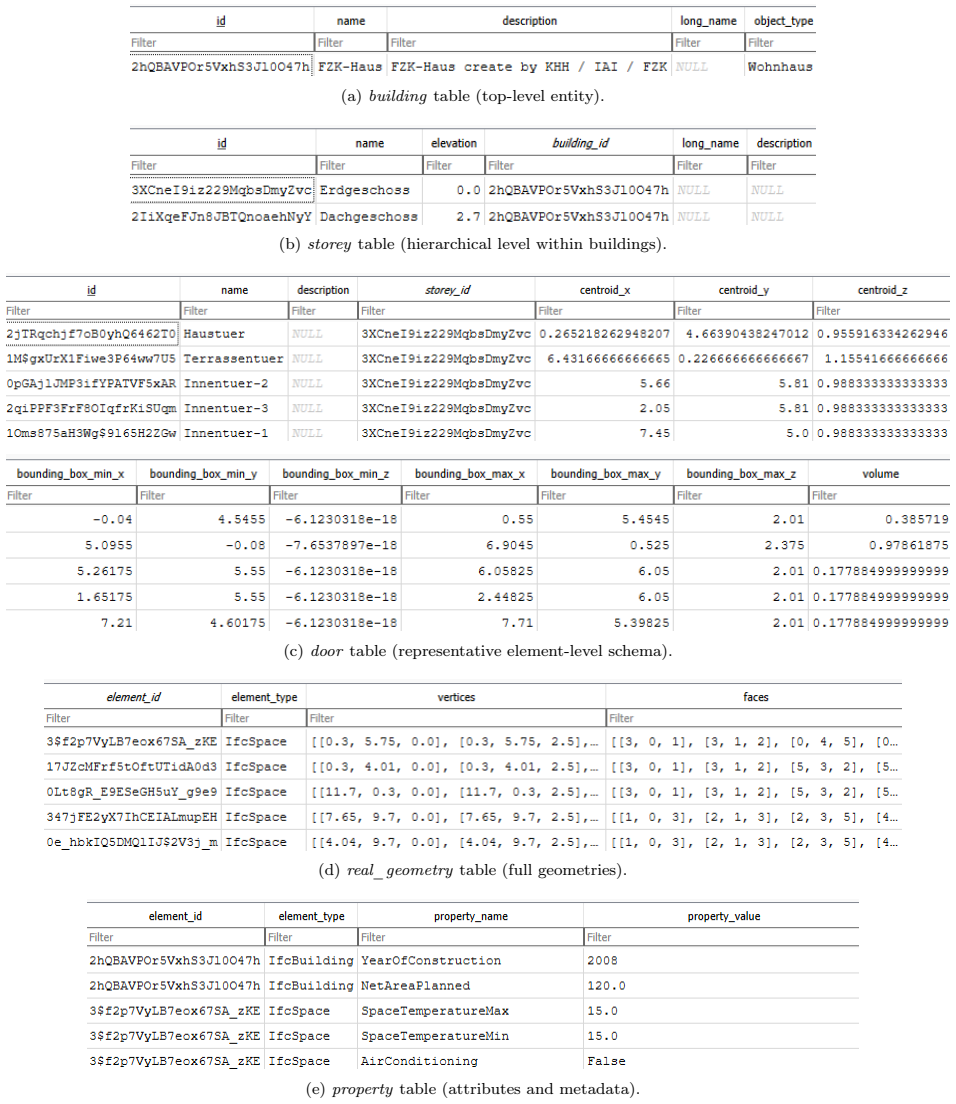
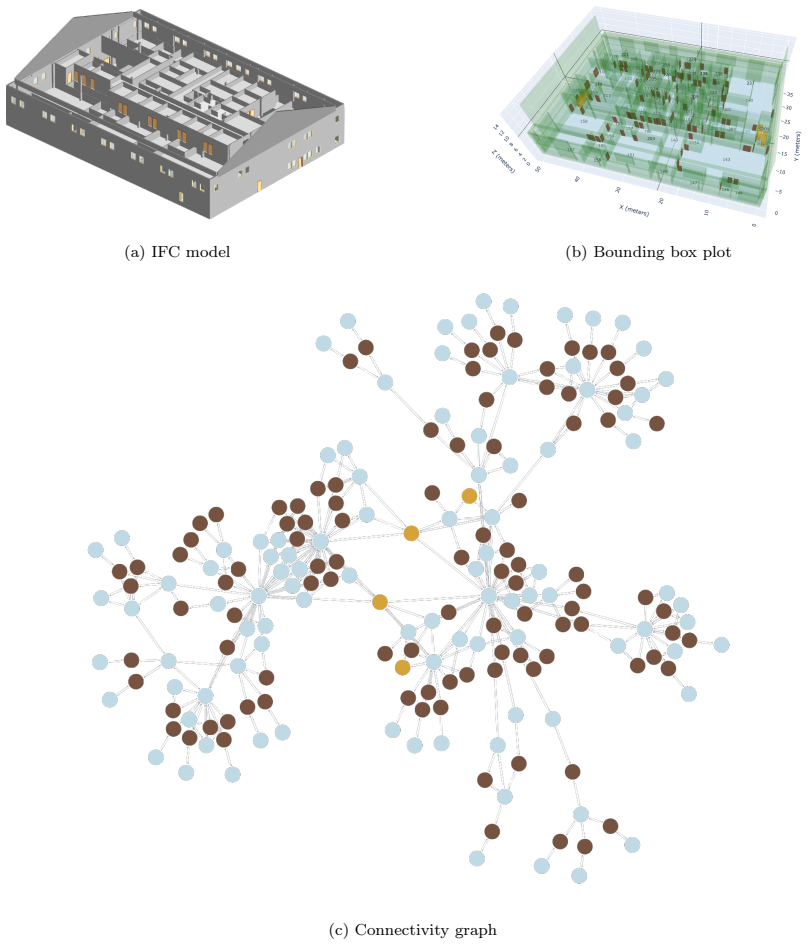
Building Information Modeling (BIM) is widely used in the Architecture, Engineering, and Construction (AEC) industry, but the complexity of Industry Foundation Classes (IFC) limits accessibility for non-expert users. To address this, we introduce IfcLLM, a hybrid framework for natural language interaction with IFC-based BIM models. It transforms IFC models into complementary representations: a relational representation for structured element properties and geometry, and a graph representation for topological relationships. These representations are integrated through iterative retry-and-refine LLM reasoning. We implement the framework using an open-weight LLM (GPT OSS 120B), supporting reproducible and deployment-oriented workflows. Evaluation on three IFC models with queries derived from 30 scenarios shows first-attempt accuracy of 93.3%-100%, with all failures recovered using a fallback LLM. The results show that combining complementary representations with iterative reasoning enables more accessible natural language querying of IFC data while supporting routine BIM analysis tasks.
Editorial analysis
A structured set of objections, weighed in public.
Circularity Check
No circularity: empirical framework with external evaluation
full rationale
The paper describes IfcLLM as a hybrid framework that converts IFC models to relational and graph representations then integrates them via iterative LLM reasoning. Evaluation uses three external IFC models and 30 query scenarios, reporting first-attempt accuracies of 93.3-100% with fallback recovery. No equations, fitted parameters, self-referential definitions, or load-bearing self-citations appear in the derivation. The claim that representations are complementary and preserve needed information is an empirical assumption tested on held-out models rather than derived by construction from the inputs. The work is therefore self-contained against external benchmarks with no reduction of predictions to fitted values or prior self-citations.
Axiom & Free-Parameter Ledger
axioms (1)
- domain assumption Large language models can perform reliable iterative retry-and-refine reasoning over structured relational and graph representations derived from IFC models
invented entities (1)
-
IfcLLM
no independent evidence
Reference graph
Works this paper leans on
-
[1]
C. M. Eastman, BIM handbook: A guide to building information modeling for owners, managers, designers, engineers and contractors, John Wiley & Sons,
-
[2]
doi:10.1002/9781119287568
-
[3]
H. Wang, Y. Pan, X. Luo, Integration of bim and gis in sustainable built environment: A review and bibliometric analysis, Automation in construction 103 (2019) 41–52. doi:10.1016/j.autcon.2019.03.005
-
[4]
A. Alattas, E. Kalogianni, T. Alzahrani, S. Zlatanova, P. van Oosterom, Map- ping private, common, and exclusive common spaces in buildings from bim/ifc to ladm. a case study from saudi arabia, Land Use Policy 104 (2021) 105355. doi:10.1016/j.landusepol.2021.105355
-
[5]
L. Liu, B. Li, S. Zlatanova, P. van Oosterom, Indoor navigation supported by the industry foundation classes (ifc): A survey, Automation in Construction 121 (2021) 103436. doi:10.1016/j.autcon.2020.103436
-
[6]
M. Aleksandrov, S. Zlatanova, D. J. Heslop, A. Diakite, Bim-based connectivity graph and voxels classification for pedestrian-hazard interaction, Journal of Spatial Science 69 (2024) 699–719. doi:10.1080/14498596.2023.2281923
-
[7]
H. Xu, F. Omitaomu, S. Sabri, S. Zlatanova, X. Li, Y. Song, Leveraging genera- tive ai for urban digital twins: a scoping review on the autonomous generation of urban data, scenarios, designs, and 3d city models for smart city advancement, Urban Informatics 3 (2024) 29. doi:10.1007/s44212-024-00060-w
-
[8]
J. Irizarry, E. P. Karan, F. Jalaei, Integrating bim and gis to improve the 43 visual monitoring of construction supply chain management, Automation in construction 31 (2013) 241–254. doi:10.1016/j.autcon.2012.12.005
-
[9]
J. B. Kim, W. Jeong, M. J. Clayton, J. S. Haberl, W. Yan, Developing a physical bim library for building thermal energy simulation, Automation in construction 50 (2015) 16–28. doi:10.1016/j.autcon.2014.10.011
-
[10]
J. Won, J. C. Cheng, Identifying potential opportunities of building information modeling for construction and demolition waste management and minimization, Automation in Construction 79 (2017) 3–18. doi:10.1016/j.autcon.2017.02. 002
-
[11]
A. A. Diakité, S. Zlatanova, Spatial subdivision of complex indoor environments for 3d indoor navigation, International Journal of Geographical Information Science 32 (2018) 213–235. doi:10.1080/13658816.2017.1376066
-
[12]
doi:10.1016/j.autcon.2019.04.022
A.M.Hasan, A.A.Torky, Y.F.Rashed, Geometricallyaccuratestructuralanal- ysis models in bim-centered software, Automation in construction 104 (2019) 299–321. doi:10.1016/j.autcon.2019.04.022
-
[13]
buildingSMART International, Industry foundation classes (ifc),https:// technical.buildingsmart.org/standards/ifc/, 2025
2025
-
[14]
U. Isikdag, S. Zlatanova, J. Underwood, A bim-oriented model for supporting indoor navigation requirements, Computers, Environment and Urban Systems 41 (2013) 112–123. doi:10.1016/j.compenvurbsys.2013.05.001
-
[15]
Z. Ma, Z. Liu, Ontology-and freeware-based platform for rapid development of bim applications with reasoning support, Automation in Construction 90 (2018) 1–8. doi:10.1016/j.autcon.2018.02.004. 44
-
[16]
J.-R. Lin, Z.-Z. Hu, J.-P. Zhang, F.-Q. Yu, A natural-language-based approach to intelligent data retrieval and representation for cloud bim, Computer-Aided Civil and Infrastructure Engineering 31 (2016) 18–33. doi:10.1111/mice.12151
-
[17]
S. Shin, R. R. Issa, Bimasr: Framework for voice-based bim information retrieval, Journal of Construction Engineering and Management 147 (2021) 04021124. doi:10.1061/(ASCE)CO.1943-7862.0002138
-
[18]
M. Yin, L. Tang, C. Webster, S. Xu, X. Li, H. Ying, An ontology-aided, natural language-based approach for multi-constraint bim model querying, Journal of Building Engineering 76 (2023) 107066. doi:10.1016/j.jobe.2023.107066
-
[20]
W. X. Zhao, K. Zhou, J. Li, T. Tang, X. Wang, Y. Hou, Y. Min, B. Zhang, J. Zhang, Z. Dong, et al., A survey of large language models, arXiv preprint arXiv:2303.18223 1 (2023). doi:10.48550/arXiv.2303.18223
work page internal anchor Pith review Pith/arXiv arXiv doi:10.48550/arxiv.2303.18223 2023
-
[21]
J. Achiam, S. Adler, S. Agarwal, L. Ahmad, I. Akkaya, F. L. Aleman, D. Almeida, J. Altenschmidt, S. Altman, S. Anadkat, et al., Gpt-4 techni- cal report, arXiv preprint arXiv:2303.08774 (2023). doi:10.48550/arXiv.2303. 08774
work page internal anchor Pith review Pith/arXiv arXiv doi:10.48550/arxiv.2303 2023
-
[22]
URL:https://ai.meta.com/blog/ llama-4-multimodal-intelligence/
Meta, The llama 4 herd: The beginning of a new era of natively multi- modal ai innovation, AI at Meta (2025). URL:https://ai.meta.com/blog/ llama-4-multimodal-intelligence/. 45
2025
-
[23]
X. Shi, Y.-S. Liu, G. Gao, M. Gu, H. Li, Ifcdiff: A content-based automatic comparison approach for ifc files, Automation in Construction 86 (2018) 53–68. doi:10.1016/j.autcon.2017.10.013
-
[24]
S. Iranmanesh, H. Saadany, E. Vakaj, Llm-assisted graph-rag information ex- traction from ifc data, arXiv preprint arXiv:2504.16813 (2025). doi:10.48550/ arXiv.2504.16813
-
[25]
Pacheco, C
L. Pacheco, C. Berkmiller, Bimconverse – graphrag for ifc nat- ural language queries, 2024. URL:https://blog.iaac.net/ bimconverse-graphrag-for-ifc-natural-language-queries/
2024
-
[26]
J. Lin, K. Chen, P. Pan, D. Wu, J. Zhang, Chatbim: Interactive data retrieval andvisualizationfrombim, in: Proceedingsofthe10thInternationalConference on Innovative Production and Construction (IPC 2024), Perth, Australia, 2024, pp. 265–266. doi:10.13140/RG.2.2.31563.20006
- [27]
-
[28]
Retrieval-Augmented Generation for Knowledge-Intensive NLP Tasks
P. Lewis, E. Perez, A. Piktus, F. Petroni, V. Karpukhin, N. Goyal, H. Küttler, M. Lewis, W.-t. Yih, T. Rocktäschel, et al., Retrieval-augmented generation for knowledge-intensive nlp tasks, Advances in neural information processing systems 33 (2020) 9459–9474. doi:10.48550/arXiv.2005.11401
work page internal anchor Pith review Pith/arXiv arXiv doi:10.48550/arxiv.2005.11401 2020
-
[29]
Noardo, K
F. Noardo, K. Arroyo Ohori, T. Krijnen, J. Stoter, An inspection of ifc models from practice, Applied Sciences 11 (2021) 2232. 46
2021
-
[30]
URL:https://ifcopenshell.org/
IfcOpenShell contributors, IfcOpenShell: The open source IFC toolkit and ge- ometry engine, 2025. URL:https://ifcopenshell.org/
2025
-
[31]
com/ifcquery/ifcplusplus, 2025
ifcquery contributors, Ifcplusplus: Ifc reader/writer for c++,https://github. com/ifcquery/ifcplusplus, 2025
2025
-
[32]
xBIM contributors, xBIM Toolkit Documentation,https://docs.xbim.net/, 2025
2025
-
[33]
Ara 3D contributors, Ara 3D IFC Toolkit,https://github.com/ara3d/ IFC-toolkit, 2025
2025
-
[34]
ThatOpen contributors, Web IFC,https://github.com/ThatOpen/engine\ _web-ifc, 2025
2025
-
[35]
ifcopenshell.org/autoapi/ifcpatch/recipes/Ifc2Sql/index.html, 2025
IfcOpenShell contributors, Ifc2Sql Documentation,https://docs. ifcopenshell.org/autoapi/ifcpatch/recipes/Ifc2Sql/index.html, 2025
2025
-
[36]
Adachi, Outline of ifc model server development project,
Y. Adachi, Outline of ifc model server development project,
- [37]
-
[38]
S.-J. You, D. Yang, C. M. Eastman, Relational db implementation of step based product model, in: CIB World Building Congress 2004, Citeseer, 2004, pp. 2–7. URL:https://www.irbnet.de/daten/iconda/CIB9696.pdf
2004
-
[39]
W. Solihin, C. Eastman, Y.-C. Lee, D.-H. Yang, A simplified relational database schema for transformation of bim data into a query-efficient and spatially enabled database, Automation in Construction 84 (2017) 367–383. doi:10.1016/j.autcon.2017.10.002. 47
-
[40]
H. Alzraiee, Cost estimate system using structured query language in bim, In- ternational Journal of Construction Management 22 (2022) 2731–2743. doi:10. 1080/15623599.2020.1823061
-
[41]
G. Demirdöğen, Z. Işık, Y. Arayici, Bim-based big data analytic system for healthcare facility management, Journal of Building Engineering 64 (2023) 105713. doi:10.1016/j.jobe.2022.105713
-
[42]
H. Li, H. Liu, Y. Liu, Y. Wang, An object-relational ifc storage model based on oracle database, The International Archives of the Photogram- metry, Remote Sensing and Spatial Information Sciences 41 (2016) 625–631. doi:10.5194/isprs-archives-XLI-B2-625-2016
-
[43]
Beetz, L
J. Beetz, L. van Berlo, R. de Laat, P. van den Helm, Bimserver.org–an open source ifc model server, in: Proceedings of the CIP W78 confer- ence, volume 8, 2010. URL:https://research.tue.nl/en/publications/ bimserverorg-an-open-source-ifc-model-server/
2010
-
[44]
I. Hijazi, M. Ehlers, S. Zlatanova, T. Becker, L. van Berlo, Initial investigations for modeling interior utilities within 3d geo context: Transforming ifc-interior utility to citygml/utilitynetworkade, in: Advances in 3D Geo-information sci- ences, Springer, 2010, pp. 95–113. doi:10.1007/978-3-642-12670-3_6
-
[45]
R. Stouffs, H. Tauscher, F. Biljecki, Achieving complete and near-lossless con- version from ifc to citygml, ISPRS International Journal of Geo-Information 7 (2018) 355. doi:10.3390/ijgi7090355
-
[46]
F.Biljecki, J.Lim, J.Crawford, D.Moraru, H.Tauscher, A.Konde, K.Adouane, S. Lawrence, P. Janssen, R. Stouffs, Extending citygml for ifc-sourced 3d 48 city models, Automation in Construction 121 (2021) 103440. doi:10.1016/j. autcon.2020.103440
work page doi:10.1016/j 2021
-
[47]
Gröger, L
G. Gröger, L. Plümer, Citygml–interoperable semantic 3d city models, ISPRS Journal of Photogrammetry and Remote Sensing 71 (2012) 12–33. doi:10.1016/ j.isprsjprs.2012.04.004
2012
-
[48]
A. A. Diakite, L. Díaz-Vilariño, F. Biljecki, Ü. Isikdag, S. Simmons, K. Li, S. Zlatanova, Ifc2indoorgml: An open-source tool for generating indoorgml from ifc, The International Archives of the Photogrammetry, Remote Sensing and Spatial Information Sciences 43 (2022) 295–301
2022
-
[49]
J. Zhu, M. O. Wong, N. Nisbet, J. Xu, T. Kelly, S. Zlatanova, I. Brilakis, Semantics-basedconnectivitygraphforindoorpathfindingpoweredbyifc-graph, Automation in Construction 171 (2025) 106019. doi:10.1016/j.autcon.2025. 106019
- [50]
-
[51]
A. K. Avgoren, Enhancing IFC Model Interpretability Using Knowledge Graphs and Large Language Models with Integrated Visual Support, Master’s thesis, Technical University of Munich, 2025. URL:https://mediatum.ub.tum.de/ node?id=1782062
2025
-
[52]
BIM Dictionary, buildingSMART Data Dictionary (bSDD),https:// bimdictionary.com/en/buildingsmart-data-dictionary/1, 2025. 49
2025
-
[53]
N. Wang, R. Issa, C. J. Anumba, A framework for intelligent building information spoken dialogue system (ibisds), in: EG-ICE 2021 workshop on intelligent computing in engineering, Universitätsverlag der TU Berlin, 2021, p. 228. URL:https://www.researchgate.net/publication/353742039_A_ Framework_for_Intelligent_Building_Information_Spoken_Dialogue_ System_iBISDS
-
[54]
N. Wang, R. R. Issa, C. J. Anumba, Nlp-based query-answering system for information extraction from building information models, Journal of comput- ing in civil engineering 36 (2022) 04022004. doi:10.1061/(ASCE)CP.1943-5487. 0001019
-
[55]
N. Wang, R. R. Issa, C. J. Anumba, Transfer learning-based query classification for intelligent building information spoken dialogue, Automation in Construc- tion 141 (2022) 104403. doi:10.1016/j.autcon.2022.104403
-
[56]
T. Krijnen, J. Beetz, A sparql query engine for binary-formatted ifc building models, Automation in Construction 95 (2018) 46–63. doi:10.1016/j.autcon. 2018.07.014
-
[57]
B.Liu, H.Chen, Bimcoder: Acomprehensivelargelanguagemodelfusionframe- work for natural language-based bim information retrieval, Applied Sciences 15 (2025) 7647. doi:10.3390/app15147647
-
[58]
J. Wang, Q. Yang, Y. Chen, A large language model–based approach for au- tomatically optimizing bim, in: 2024 43rd Chinese Control Conference (CCC), IEEE, 2024, pp. 8518–8523. doi:10.23919/CCC63176.2024.10661504. 50
-
[59]
S. Fuchs, A. Borrmann, Towards semantic enrichment of ifc models through language modeling (2025). doi:10.17868/strath.00093271
-
[60]
S. Du, Y. Gao, W. Tong, Y. Weng, Towards agent: Llm-based framework for robotic construction by leveraging ifc, in: ISARC. Proceedings of the Inter- national Symposium on Automation and Robotics in Construction, volume 42, IAARC Publications, 2025, pp. 358–365. doi:10.22260/ISARC2025/0048
- [61]
-
[62]
C. Du, S. Esser, S. Nousias, A. Borrmann, Text2bim: Generating building mod- els using a large language model-based multi-agent framework, arXiv preprint arXiv:2408.08054 (2024). doi:10.1061/JCCEE5.CPENG-6386
-
[63]
Y. Gao, Y. Xiong, X. Gao, K. Jia, J. Pan, Y. Bi, Y. Dai, J. Sun, H. Wang, H. Wang, Retrieval-augmented generation for large language models: A survey, arXiv preprint arXiv:2312.10997 2 (2023). doi:10.48550/arXiv.2312.10997
work page internal anchor Pith review Pith/arXiv arXiv doi:10.48550/arxiv.2312.10997 2023
-
[64]
J. Webber, A programmatic introduction to neo4j, in: Proceedings of the 3rd annual conference on Systems, programming, and applications: software for humanity, 2012, pp. 217–218. doi:10.1145/2384716.2384777
-
[65]
URL:https://langchain-ai.github.io/ langgraph/
LangChain, Langgraph, 2025. URL:https://langchain-ai.github.io/ langgraph/
2025
-
[66]
gpt-oss-120b & gpt-oss-20b Model Card
S. Agarwal, L. Ahmad, J. Ai, S. Altman, A. Applebaum, E. Arbus, R. K. Arora, 51 Y. Bai, B. Baker, H. Bao, et al., gpt-oss-120b & gpt-oss-20b model card, arXiv preprint arXiv:2508.10925 (2025). doi:10.48550/arXiv.2508.10925
work page internal anchor Pith review Pith/arXiv arXiv doi:10.48550/arxiv.2508.10925 2025
-
[67]
Groq, Groq.com,https://groq.com, 2025
2025
-
[68]
Groq, Compound,https://console.groq.com/docs/compound/systems/ compound, 2025
2025
-
[69]
S. Donkers, H. Ledoux, J. Zhao, J. Stoter, Automatic conversion of ifc datasets to geometrically and semantically correct citygml lod3 buildings, Transactions in GIS 20 (2016) 547–569. doi:10.1111/tgis.12162
-
[70]
W. Shang, X. Huang, A survey of large language models on generative graph analytics: Query, learning, and applications, IEEE Transactions on Knowledge and Data Engineering (2025). doi:10.1109/TKDE.2025.3609877
-
[71]
Z. Hong, Z. Yuan, Q. Zhang, H. Chen, J. Dong, F. Huang, X. Huang, Next- generation database interfaces: A survey of llm-based text-to-sql, IEEE Trans- actions on Knowledge and Data Engineering (2025). doi:10.1109/TKDE.2025. 3609486
-
[72]
Q. Zhang, J. Dong, H. Chen, D. Zha, Z. Yu, X. Huang, Knowgpt: Knowledge graph based prompting for large language models, Advances in Neural Infor- mation Processing Systems 37 (2024) 6052–6080. doi:10.48550/arXiv.2312. 06185
-
[73]
Y. Choi, J. Baek, S. J. Hwang, System prompt optimization with meta-learning, arXiv preprint arXiv:2505.09666 (2025). doi:10.48550/arXiv.2505.09666. 52
-
[74]
Lamsal, M
R. Lamsal, M. R. Read, S. Karunasekera, Crisistransformers: Pre-trained language models and sentence encoders for crisis-related social media texts, Knowledge-Based Systems 296 (2024) 111916
2024
- [75]
-
[76]
G. N. Lilis, G. I. Giannakis, D. V. Rovas, Detection and semi-automatic cor- rection of geometric inaccuracies in ifc files, in: 14th International Conference of IBPSA-Building Simulation 2015, BS 2015, Conference Proceedings, IBPSA, 2015, pp. 2182–2189. doi:10.26868/25222708.2015.2581. 53 Appendix A. System Prompt Template You are an expert assistant for...
-
[77]
Use SQLite for element hierarchy, properties, and counts
-
[78]
Use Neo4j for spatial navigation, adjacency, shortest paths, and connectivity among rooms/doors/stairs
-
[79]
Neo4j has no labels; always match nodes by properties, e.g., (n {type:‘room’})
-
[80]
Relationships are CONNECTS with properties distance and type
-
[81]
Treat all names as strings; use case-insensitive matching when necessary
discussion (0)
Sign in with ORCID, Apple, or X to comment. Anyone can read and Pith papers without signing in.