Recognition: 2 theorem links
· Lean TheoremIn-situ tunable superconducting diode: towards field-free operation with infinite nonreciprocity
Pith reviewed 2026-05-14 18:48 UTC · model grok-4.3
The pith
Four-terminal Josephson junctions enable magnetic-field-free superconducting diodes with unlimited in-situ tunability and infinite nonreciprocity.
A machine-rendered reading of the paper's core claim, the machinery that carries it, and where it could break.
Core claim
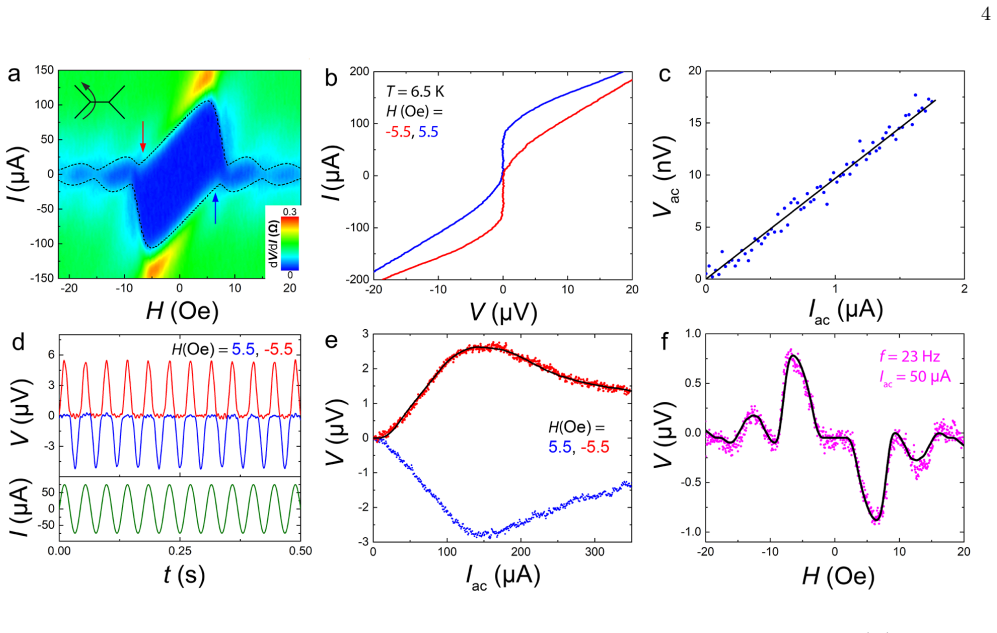
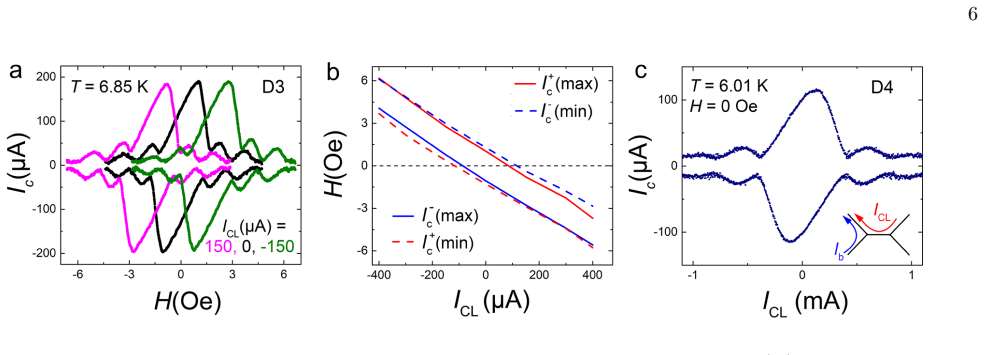
In four-terminal niobium planar Josephson junctions, the multiterminal structure eliminates the need for an external magnetic field and enables essentially unrestricted in-situ tunability, along with reconfigurability of the diode polarity. This leads to new functionality, including operation as Gauss neurons via reentrant superconductivity. Deliberate tuning of junction parameters yields effectively infinite nonreciprocity within experimental resolution, enabling threshold-free ac-current rectification.
What carries the argument
Four-terminal geometry of planar niobium Josephson junctions that inherently provides the asymmetry needed for nonreciprocal supercurrent transport.
Load-bearing premise
The four-terminal structure alone generates enough asymmetry to produce a diode effect without external magnetic fields or extra engineering.
What would settle it
Observation of symmetric critical currents in both directions for a four-terminal niobium Josephson junction at zero applied magnetic field would disprove the field-free diode operation.
Figures


read the original abstract
Efficient, scalable, and magnetic-field-free superconducting diodes are essential for future superconducting electronics; yet, despite significant efforts, such practical devices remain unrealized. The main challenge lies in achieving broad-range in-situ tunability, both for optimization and for achieving transistor-like operation. Here, we study diodes based on four-terminal niobium planar Josephson junctions. We show that the multiterminal structure eliminates the need for an external magnetic field and enables essentially unrestricted in-situ tunability, along with reconfigurability of the diode polarity, leading to new functionality. For example, we demonstrate that such diodes can operate as Gauss neurons via reentrant superconductivity. By deliberately tuning the junction parameters, we obtain effectively infinite nonreciprocity (within experimental resolution) leading to threshold-free ac-current rectification. Such technologically simple, reconfigurable, and broadly tunable diodes could be instrumental for future digital and neuromorphic computing.
Editorial analysis
A structured set of objections, weighed in public.
Referee Report
Summary. The manuscript reports an experimental study of four-terminal planar niobium Josephson junctions demonstrating field-free superconducting diode operation. Key claims include elimination of external magnetic field via the multiterminal geometry, broad in-situ tunability and polarity reconfigurability, reentrant superconductivity enabling Gauss-neuron functionality, and effectively infinite nonreciprocity (within resolution) for threshold-free ac rectification.
Significance. If the experimental results hold under scrutiny, the work offers a technologically simple platform for scalable, field-free superconducting diodes with reconfigurability, which could advance superconducting electronics and neuromorphic computing. The absence of external-field requirements and the reported threshold-free rectification are potentially high-impact strengths.
major comments (2)
- [Discussion] The central claim that the four-terminal cross geometry inherently supplies inversion-symmetry breaking for finite diode efficiency without external flux or engineered junction asymmetry lacks a supporting microscopic derivation. Standard multiterminal JJ theory predicts an odd CPR for symmetric geometries unless flux or asymmetry is introduced; no Usadel or GL calculation is provided to derive a non-reciprocal term from the topology alone (see Discussion or Theory section).
- [Results] Claims of 'effectively infinite nonreciprocity (within experimental resolution)' and reentrant superconductivity are load-bearing for the headline results, yet the provided abstract contains no I-V data, error bars, sample statistics, or detailed protocols. Full-text figures must be checked for quantitative support of these statements.
minor comments (1)
- [Abstract] The term 'Gauss neurons' is introduced in the abstract without definition or reference, which may hinder readability for a broad applied-physics audience.
Simulated Author's Rebuttal
We thank the referee for their thorough review and constructive feedback on our manuscript. We address each major comment below with detailed responses and indicate revisions where appropriate. Our goal is to strengthen the presentation of the experimental results while maintaining scientific accuracy.
read point-by-point responses
-
Referee: [Discussion] The central claim that the four-terminal cross geometry inherently supplies inversion-symmetry breaking for finite diode efficiency without external flux or engineered junction asymmetry lacks a supporting microscopic derivation. Standard multiterminal JJ theory predicts an odd CPR for symmetric geometries unless flux or asymmetry is introduced; no Usadel or GL calculation is provided to derive a non-reciprocal term from the topology alone (see Discussion or Theory section).
Authors: We agree that a microscopic derivation would strengthen the interpretation. Our manuscript is primarily experimental and relies on the observed field-free diode effect in symmetric four-terminal devices, which we attribute to the multiterminal topology based on prior literature on non-reciprocal Josephson effects. We will add a dedicated paragraph in the Discussion section referencing existing multiterminal JJ models (e.g., those predicting effective asymmetry from current distribution in cross geometries) and explicitly note the absence of a full Usadel/GL calculation in this work. Quantitative modeling is planned as follow-up but is outside the current scope. revision: partial
-
Referee: [Results] Claims of 'effectively infinite nonreciprocity (within experimental resolution)' and reentrant superconductivity are load-bearing for the headline results, yet the provided abstract contains no I-V data, error bars, sample statistics, or detailed protocols. Full-text figures must be checked for quantitative support of these statements.
Authors: Abstracts are summaries and conventionally omit raw data, error bars, and protocols; these are provided in the full text. Figures 2–4 present the I-V curves supporting the nonreciprocity claims (with the 'infinite' value defined relative to the noise floor of ~10 nA), reentrant superconductivity data, and device statistics from multiple junctions. Detailed measurement protocols and error analysis appear in the Methods and Supplementary Information. We have cross-checked all figures for quantitative consistency and added a brief clarification in the Results section on the resolution limit for nonreciprocity. revision: no
Circularity Check
No circularity: experimental demonstration with no derivation chain
full rationale
The paper is an experimental study of four-terminal Nb planar Josephson junctions. All central claims (field-free diode operation, in-situ tunability, infinite nonreciprocity within resolution, reconfigurability) rest on measured I-V curves and device behavior under applied currents and gates. No first-principles derivation, CPR model, or prediction is advanced that reduces by construction to fitted parameters, self-citations, or ansatzes. The four-terminal geometry is presented as supplying the observed asymmetry through fabrication and measurement, without any equation that equates the result to its own input. The work is therefore self-contained against external benchmarks.
Axiom & Free-Parameter Ledger
Lean theorems connected to this paper
-
IndisputableMonolith/Cost/FunctionalEquation.leanwashburn_uniqueness_aczel unclear?
unclearRelation between the paper passage and the cited Recognition theorem.
Nonreciprocity in our JJs is induced by the self-field effect... via the second London equation... sine-Gordon model (Eq. 7)
-
IndisputableMonolith/Foundation/RealityFromDistinction.leanreality_from_one_distinction unclear?
unclearRelation between the paper passage and the cited Recognition theorem.
The condition for achieving maximum nonreciprocity is Φ_sf = L_sf I_c0 = Φ_0... short-junction limit W_x < 4 λ_J
What do these tags mean?
- matches
- The paper's claim is directly supported by a theorem in the formal canon.
- supports
- The theorem supports part of the paper's argument, but the paper may add assumptions or extra steps.
- extends
- The paper goes beyond the formal theorem; the theorem is a base layer rather than the whole result.
- uses
- The paper appears to rely on the theorem as machinery.
- contradicts
- The paper's claim conflicts with a theorem or certificate in the canon.
- unclear
- Pith found a possible connection, but the passage is too broad, indirect, or ambiguous to say the theorem truly supports the claim.
Reference graph
Works this paper leans on
-
[1]
https://www.iea.org/reports/electricity-2024/executive- summary
work page 2024
-
[2]
Likharev, K.K. and Semenov, V.K. RSFQ logic/memory family: A new Josephson-junction technology for sub- terahertz-clock-frequency digital systems.IEEE Trans. Appl. Supercond.,1(1), 3-28 (1991)
work page 1991
-
[3]
Holmes, D. S., Ripple, A. L., & Manheimer, M. A. Energy-efficient superconducting computing—Power budgets and requirements.IEEE Trans. Appl. Supercond. 23, 1701610 (2013)
work page 2013
-
[4]
Ortlepp, T. & Van Duzer, T. Access time and power dissipation of a model 256-bit single flux quantum RAM. IEEE Trans. Appl. Supercond.24, 1300307 (2014)
work page 2014
-
[5]
Golod, T., Iovan, A. & Krasnov, V.M. Single Abrikosov vortices as quantized information bits.Nat. Commun.6, 8628 (2015)
work page 2015
-
[6]
Soloviev, I. I. et al. Beyond Moore’s technologies: opera- tion principles of a superconductor alternative.Beilstein J. Nanotechnol.8, 2689 (2017)
work page 2017
-
[7]
Tolpygo, S. K. et. al. Advanced fabrication processes for 8 superconductor electronics: current status and new de- velopments.IEEE Trans. Appl. Supercond.29, 1102513 (2019)
work page 2019
-
[8]
Kirichenko, A. F., Vernik, I. V., Kamkar, M. Y., Walter, J., Miller, M., Albu, L. R. & Mukhanov, O. A. ERSFQ 8-Bit Parallel Arithmetic Logic Unit.IEEE Trans. Appl. Supercond.,29, 1302407 (2019)
work page 2019
-
[9]
Krasnov, V.M., Oboznov, V.A. and Pedersen, N.F. Fluxon dynamics in long Josephson junctions in the pres- ence of a temperature gradient or spatial nonuniformity. Phys. Rev. B,55, 14486 1997
work page 1997
-
[10]
Weiss, S., Koelle, D., M¨ uller, J., Gross, R., & Barthel, K, Ratchet effect in dc SQUIDs.Europhys. Lett.51, 499 (2000)
work page 2000
-
[11]
Villegas, J. E. et al. A superconducting reversible rectifier that controls the motion of magnetic flux quanta.Science 302, 1188 (2003)
work page 2003
-
[12]
Beck, M. et al. High-efficiency deterministic Josephson vortex ratchet.Phys. Rev. Lett.95, 090603 (2005)
work page 2005
-
[13]
C., Van de Vondel, J., Morelle, M
de Souza Silva, C. C., Van de Vondel, J., Morelle, M. & Moshchalkov, V. V. Controlled multiple reversals of a ratchet effect.Nature440, 651 (2006)
work page 2006
-
[14]
Lustikova, J. et al. Vortex rectenna powered by environ- mental fluctuations.Nat. Commun.10, 1038 (2018)
work page 2018
-
[15]
Ando, F. et al. Observation of superconducting diode ef- fect.Nature584, 373 (2020)
work page 2020
-
[16]
Wu, H. et al. The field-free Josephson diode in a van der Waals heterostructure.Nature604, 653 (2022)
work page 2022
-
[17]
Lin, J.-X. et al. Zero-field superconducting diode effect in small-twist-angle trilayer graphene.Nat. Phys.18, 1221- 1227 (2022)
work page 2022
-
[18]
Baumgartner, C. et al. Supercurrent rectification and magnetochiral effects in symmetric Josephson junctions. Nat. Nanotechn..17, 39 (2022)
work page 2022
-
[19]
Narita, H., Ishizuka, J., Kawarazaki, R., Kan, D., Sh- iota, Y., Moriyama, T., Shimakawa, Y., Ognev, A.V., Samardak, A.S., Yanase, Y. & Ono, T. Field-free super- conducting diode effect in noncentrosymmetric supercon- ductor/ferromagnet multilayers.Nat. Nanotechn.17(8), 823-828 (2022)
work page 2022
-
[20]
Golod, T. and Krasnov, V.M. Demonstration of a su- perconducting diode-with-memory, operational at zero magnetic field with switchable nonreciprocity.Nat. Com- mun.,13, 3658 (2022)
work page 2022
-
[21]
The supercon- ducting diode effect.Nat
Nadeem, M., Fuhrer, M.S., & Wang, X.L. The supercon- ducting diode effect.Nat. Rev. Phys.5, 558-577 (2023)
work page 2023
-
[22]
Gupta, M., Graziano, G.V., Pendharkar, M., Dong, J.T., Dempsey, C.P., Palmstrom, C. & Pribiag, V.S. Gate- tunable superconducting diode effect in a three-terminal Josephson device.Nat. Com.14, 3078 (2023)
work page 2023
-
[23]
Chiles, J. et. al. Nonreciprocal Supercurrents in a Field- Free Graphene Josephson Triode.Nano Lett.23, 5257 (2023)
work page 2023
-
[24]
Diamagnetic mechanism of critical cur- rent non-reciprocity in multilayered superconductors
Sundaresh, A., V¨ ayrynen, J., Lyanda-Geller, Y., & Rokhinson, L.P. Diamagnetic mechanism of critical cur- rent non-reciprocity in multilayered superconductors. Nat. Com.14, 1628 (2023)
work page 2023
-
[25]
Margineda, D. et. al. Sign reversal diode effect in su- perconducting Dayem nanobridges.Com. Phys.6, 343 (2023)
work page 2023
-
[26]
Direct observa- tion of a superconducting vortex diode.Nat
Gutfreund, A., Matsuki, H., Plastovets, V., Noah A., Gorzawski, L., Fridman, N., Yang, G., Buzdin, A., Millo, O., Robinson, J.W.A., and Anahory, Y. Direct observa- tion of a superconducting vortex diode.Nat. Com.14, 1630 (2023)
work page 2023
-
[27]
Nagaosa, N. & Yanase, Y. Nonreciprocal Transport and Optical Phenomena in Quantum Materials.Ann. Rev. Cond. Mat. Phys.15, 63-83 (2024)
work page 2024
-
[28]
Banerjee, S., & Scheurer, M.S., Altermagnetic supercon- ducting diode effect.Phys. Rev. B.110, 024503 (2024)
work page 2024
-
[29]
Efficiency of diode effect in asymmetric inline long Josephson junc- tions.Appl
Guarcello, C., Pagano, S., & Filatrella, G. Efficiency of diode effect in asymmetric inline long Josephson junc- tions.Appl. Phys. Lett.124, 162601 (2024)
work page 2024
-
[30]
Ghosh, S. et. al. High-temperature Josephson diode.Nat. Mat.23, 612 (2024)
work page 2024
- [31]
-
[32]
Margineda, D. et. al. Back-action supercurrent rectifiers. Com. Phys.8, 16 (2025)
work page 2025
-
[33]
A., Colangelo, M., Berggren, K
Castellani, M., Medeiros, O., Buzzi, A., Foster, R. A., Colangelo, M., Berggren, K. K. A superconducting full- wave bridge rectifier.Nat. Electr.8, 417 (2025)
work page 2025
-
[34]
Vasenko, S. A., Likharev, K. K., Semenov, V. K. Static properties of distributed inhomogeneous Josephson junc- tions.Sov. Phys. JETP54, 766-771 (1981)
work page 1981
-
[35]
Monaco, R., Mygind, J., Koshelets, V. P. Long Josephson tunnel junctions with doubly connected electrodes.Phys. Rev. B85, 094514 (2012)
work page 2012
-
[36]
Krasnov, V.M., Josephson junctions in a local inhomoge- neous magnetic field.Phys. Rev. B,101, 144507 (2020)
work page 2020
-
[37]
Golod, T., Kapran, O. M. & Krasnov, V. M. Planar superconductor-ferromagnet- superconductor Josephson junctions as scanning-probe sensors.Phys. Rev. Appl.11, 014062 (2019)
work page 2019
-
[38]
Knebel, G., Knafo, W., Pourret, A., Niu, Q., Valiˇ ska, M., Braithwaite, D., Lapertot, G., Nardone, M., Zitouni, A., Mishra, S. and Sheikin, I. Field-reentrant superconduc- tivity close to a metamagnetic transition in the heavy- fermion superconductor UTe2.Journal of the Physical Society of Japan,88(6), 063707 (2019)
work page 2019
-
[39]
I., et al., Reentrant superconductivity in superconductor/ferromagnetic-alloy bilayers.Phys
Zdravkov, V. I., et al., Reentrant superconductivity in superconductor/ferromagnetic-alloy bilayers.Phys. Rev. B.82, 054517 (2010)
work page 2010
- [40]
-
[41]
Hovhannisyan, R., Golod, T. , Krasnov, V. M. Control- lable Manipulation of Semifluxon States in Phase-Shifted Josephson Junctions.Phys. Rev. Lett.132227001 (2024)
work page 2024
-
[42]
Krasnov, V. M., Oboznov, V. A., Ryazanov, V. V., Mros, N., Yurgens, A., Winkler, D. Comparison of Josephson fluxon modes in high- and low-temperature supercon- ducting stacked Josephson junctions.Phys. Rev. B61, 766 (2000)
work page 2000
-
[43]
Grebenchuk, S. Yu., Cattaneo, R., Krasnov, V. M. Non- local Long-Range Synchronization of Planar Josephson- Junction Arrays.Phys. Rev. Appl.17, 064032 (2022)
work page 2022
-
[44]
Schegolev, A. E., Klenov, N. V., Soloviev, I. I., Tereshonok, M. V. Adiabatic superconducting cells for ultra-low-power artificial neural networks.Beilstein J. Nanotechn.7, 1397–1403 (2016)
work page 2016
-
[45]
Beck, M.E., Shylendra, A., Sangwan, V.K. et al. Spiking neurons from tunable Gaussian heterojunction transis- tors.Nat. Commun.11, 1565 (2020)
work page 2020
-
[46]
Razorenov, F. A., Ionin, A. S., Shuravin, N. S., Karelina, 9 L. N., Sidel’nikov, M. S., Egorov, S. V., Bol’ginov, V. V. Transfer function of an asymmetric superconducting Gauss neuron.Beilstein J. Nanotechnol.16, 1160–1170 (2025). METHODS Device fabrication. The diodes were fabricated from a single thin (70 nm) niobium film, deposited by DC magnetron sput...
work page 2025
discussion (0)
Sign in with ORCID, Apple, or X to comment. Anyone can read and Pith papers without signing in.