Recognition: unknown
Reentrant behavior and possible 2/3 magnetization plateau on the double-trillium langbeinite K₂Ni₂(SO₄)₃
Pith reviewed 2026-05-14 18:22 UTC · model grok-4.3
The pith
K2Ni2(SO4)3 shows a reentrant 2/3 magnetization plateau from a 1/3 state on the strong trillium lattice plus full polarization on the weak one.
A machine-rendered reading of the paper's core claim, the machinery that carries it, and where it could break.
Core claim
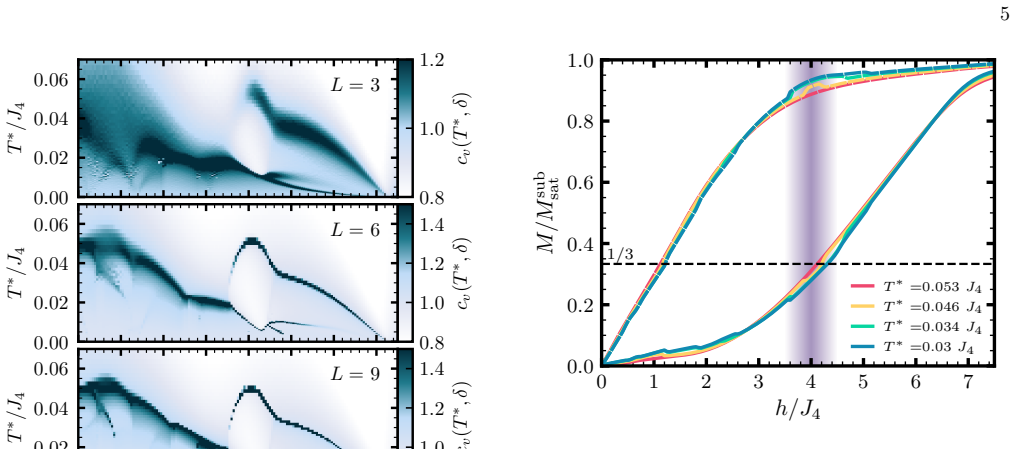
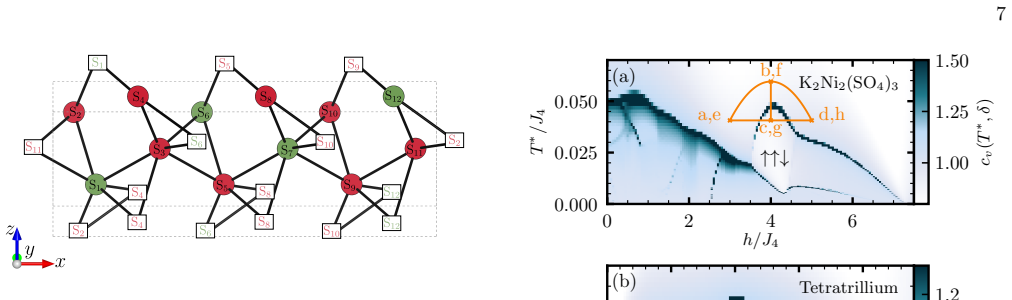
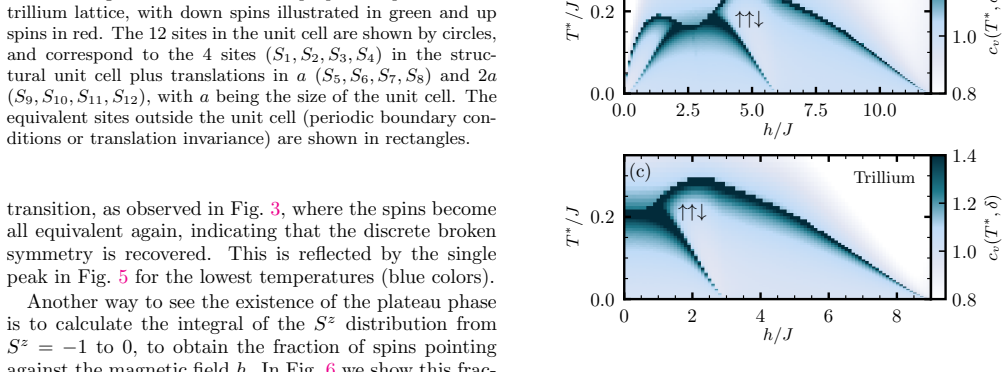
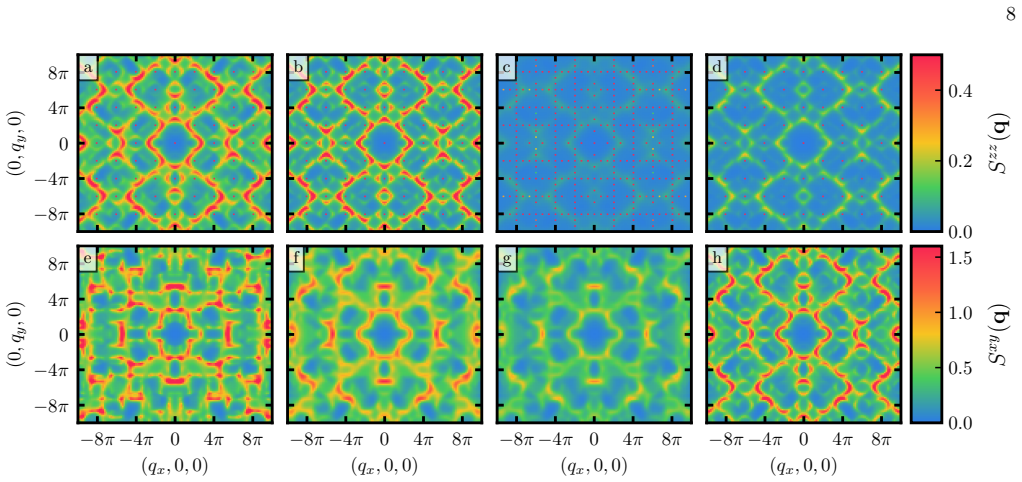
K2Ni2(SO4)3 exhibits a signature of the 2/3 magnetization plateau consisting of a 1/3 phase on the strong-TL and a fully polarized phase on the weak-TL. Although the classical limit does not produce a plateau, a prominent dome structure reflects the system's tendency to stabilize this spin configuration, leading to reentrant recovery of Hamiltonian symmetries at higher fields. The same plateau-like phase appears in the classical Heisenberg model on both the single trillium and tetratrillium lattices.
What carries the argument
The double-trillium lattice geometry with strong and weak couplings under a highly frustrated Heisenberg Hamiltonian, which supports the mixed 1/3-plus-full-polarization spin arrangement.
If this is right
- Multiple phase transitions occur at both low and intermediate magnetic fields.
- The system recovers the full Hamiltonian symmetries upon increasing the field through the dome region.
- A similar plateau-like feature is expected across the wider family of double-trillium langbeinite compounds.
- The dome persists in classical treatments of the isolated strong trillium and tetratrillium lattices.
Where Pith is reading between the lines
- Quantum effects in the S=1 system may enlarge or stabilize the dome beyond the classical prediction.
- Search for analogous mixed plateaus in other materials built from intertwined frustrated lattices.
- Quantum Monte Carlo or tensor-network calculations could test whether the plateau survives when quantum fluctuations are included.
Load-bearing premise
The magnetization feature is produced by the specific 1/3 phase on the strong trillium lattice together with full polarization on the weak lattice, and classical Monte Carlo captures the essential physics for this S=1 system near a spin-liquid regime.
What would settle it
Neutron diffraction or specific-heat data taken inside the dome field range would confirm or rule out the proposed 1/3-plus-full-polarization spin arrangement.
Figures




read the original abstract
K$_2$Ni$_2$(SO$_4$)$_3$ is a member of the langbeinite family, consisting of two intertwined $S=1$ trillium lattices, out of which one is strongly coupled (strong-TL) and the other is weakly coupled (weak-TL). Further inter-trillium interactions give rise to a highly-frustrated Heisenberg Hamiltonian. Despite ordering at low temperatures, K$_2$Ni$_2$(SO$_4$)$_3$ lies close in parameter space to a spin-liquid region that surrounds the tetratrillium limit, where each triangle belonging to strong-TL turns into a tetrahedron by connecting to a single spin from weak-TL. Here, we compare the experimentally determined magnetization process using pulsed magnetic fields up to $40$ T with classical Monte Carlo calculations, uncovering a series of phase transitions at both low and intermediate fields. Furthermore, we reveal a signature of a $2/3$ magnetization plateau consisting of a $1/3$ phase on strong-TL and a fully polarized phase on weak-TL. Although in the classical limit no plateau is expected, we find a very prominent dome structure reflecting the tendency of the system to stabilize this particular spin configuration. The presence of a dome leads to a reentrant phenomenon in which the system recovers the Hamiltonian symmetries when increasing the magnetic field. Finally, we show that this plateau-like phase is also present in the classical Heisenberg model on the single trillium and tetratrillium lattices, indicating its possible presence in the large family of double-trillium langbeinite compounds. Our findings motivate future studies on the presence of the plateau phase in the quantum limit of both trillium and double-trillium materials within the langbeinite family.
Editorial analysis
A structured set of objections, weighed in public.
Referee Report
Summary. The manuscript examines the magnetization process of the double-trillium langbeinite K₂Ni₂(SO₄)₃, consisting of strongly and weakly coupled S=1 trillium lattices forming a frustrated Heisenberg model near a spin-liquid regime. Pulsed-field experiments up to 40 T are compared with classical Monte Carlo simulations, revealing multiple phase transitions and a prominent dome in the magnetization curve interpreted as a signature of a 2/3 plateau (1/3 ordering on the strong-TL plus full polarization on the weak-TL). The work also reports reentrant symmetry recovery with increasing field and shows analogous dome features in the classical models on single-trillium and tetratrillium lattices, motivating quantum studies in the langbeinite family.
Significance. If the dome-to-plateau mapping and its microscopic assignment hold, the result identifies a robust classical tendency toward a specific 2/3 configuration in trillium-based frustrated magnets, even without a true plateau. This extends to the broader langbeinite family and supplies concrete motivation for quantum calculations near the spin-liquid boundary. The experimental data up to 40 T and the lattice-specific comparisons are solid contributions, though the classical approximation for S=1 limits immediate applicability to the quantum regime.
major comments (3)
- [Results (magnetization curves)] Magnetization and Monte Carlo comparison section: the experimental curves are stated to match the classical dome without reported error bars, fitting details, or quantitative metrics (e.g., R² or residual values), weakening the claim that the observed feature directly corresponds to the proposed 1/3-plus-full-polarization state.
- [Monte Carlo results and discussion] Classical Monte Carlo analysis: the text explicitly notes that no true plateau exists in the classical limit, yet the dome is presented as reflecting stabilization of the 1/3 (strong-TL) + polarized (weak-TL) configuration; this interpretation requires explicit sublattice-resolved magnetization or structure-factor data to confirm the microscopic assignment rather than relying on the dome shape alone.
- [Discussion and conclusions] Quantum regime discussion: given the material's proximity to the spin-liquid region and S=1 spins, the absence of any quantum calculations (DMRG, QMC, or exact diagonalization) to test survival of the dome or the specific 2/3 configuration constitutes a load-bearing gap; classical results alone cannot establish the plateau signature for the physical system.
minor comments (2)
- [Abstract] Abstract: the reentrant phenomenon is mentioned but its precise field range and symmetry restoration are not quantified, leaving the claim somewhat vague for readers.
- [Model Hamiltonian] Notation: the distinction between strong-TL and weak-TL couplings is clear in the text but would benefit from an explicit table of fitted J values with uncertainties.
Simulated Author's Rebuttal
We thank the referee for the careful reading and constructive comments on our manuscript. We address each major comment below, indicating where revisions have been made to strengthen the presentation and analysis.
read point-by-point responses
-
Referee: Magnetization and Monte Carlo comparison section: the experimental curves are stated to match the classical dome without reported error bars, fitting details, or quantitative metrics (e.g., R² or residual values), weakening the claim that the observed feature directly corresponds to the proposed 1/3-plus-full-polarization state.
Authors: We agree that error bars and quantitative metrics improve the comparison. In the revised manuscript we have added error bars to the experimental data in the relevant figure and included a quantitative measure of agreement (normalized root-mean-square deviation between experiment and simulation) in the figure caption. revision: yes
-
Referee: Classical Monte Carlo analysis: the text explicitly notes that no true plateau exists in the classical limit, yet the dome is presented as reflecting stabilization of the 1/3 (strong-TL) + polarized (weak-TL) configuration; this interpretation requires explicit sublattice-resolved magnetization or structure-factor data to confirm the microscopic assignment rather than relying on the dome shape alone.
Authors: We accept that the microscopic assignment needs direct support. We have added sublattice-resolved magnetization versus field plots (new panel in the main text and supplementary information) showing the strong trillium lattice approaching 1/3 magnetization while the weak lattice approaches full polarization precisely in the dome region, thereby confirming the configuration beyond the dome shape. revision: yes
-
Referee: Quantum regime discussion: given the material's proximity to the spin-liquid region and S=1 spins, the absence of any quantum calculations (DMRG, QMC, or exact diagonalization) to test survival of the dome or the specific 2/3 configuration constitutes a load-bearing gap; classical results alone cannot establish the plateau signature for the physical system.
Authors: We acknowledge the importance of quantum effects for S=1 spins near the spin-liquid regime. The present work is confined to the classical limit to identify the underlying tendency; performing DMRG or QMC on this frustrated lattice is computationally demanding and lies outside the current scope. We have expanded the discussion to state these limitations explicitly and to position the classical results as motivation for future quantum studies. revision: partial
- Performing quantum many-body calculations (DMRG, QMC or exact diagonalization) to verify survival of the 2/3 plateau for the physical S=1 system.
Circularity Check
No significant circularity; derivation uses independent experiment and standard classical Monte Carlo
full rationale
The paper compares experimental pulsed-field magnetization data (up to 40 T) directly with classical Monte Carlo simulations of the Heisenberg model on the double-trillium lattice. The reported dome structure and reentrant behavior are simulation outputs, not quantities fitted from the same data and then relabeled as predictions. No self-citations, uniqueness theorems, or ansatzes are invoked to close any derivation loop in the abstract or context. The mapping to the proposed 1/3-plus-full configuration is an interpretive step based on external benchmarks (experiment plus standard classical methods), not a reduction to the paper's own inputs by construction.
Axiom & Free-Parameter Ledger
free parameters (1)
- strong and weak exchange couplings
axioms (1)
- domain assumption Classical limit of the Heisenberg Hamiltonian suffices to capture the high-field magnetization features
Reference graph
Works this paper leans on
-
[1]
We see in Fig. 2 that the cMC calculations agree quite well with the experimental results, even though there are 4 0 50 100 150 200M (a.u.) K2Ni2(SO4)3 T = 1.50 K T = 0.80 K T = 0.57 K 0 5 10 15 20 25 30 35 B (T) 0 5 10 15dM/dB 0 1 2 3 4 B (T) 8 10 12dM/dB 10 13 16 19 22 B (T) 7.5 8.0 8.5 9.0 0.0 0.2 0.4 0.6 0.8 1.0 M/Msat cMC T ∗ = 0.053 J4 cMC T ∗ = 0.0...
-
[2]
Chillal, Y
S. Chillal, Y. Iqbal, H. O. Jeschke, J. A. Rodriguez- Rivera, R. Bewley, P. Manuel, D. Khalyavin, P. Steffens, R. Thomale, A. T. M. N. Islam, J. Reuther, and B. Lake, Evidence for a three-dimensional quantum spin liquid in PbCuTe2O6, Nature Communications11, 2348 (2020)
2020
-
[3]
L. E. Chern and Y. B. Kim, Theoretical study of quan- tum spin liquids inS= 1 2 hyper-hyperkagome magnets: Classification, heat capacity, and dynamical spin struc- ture factor, Phys. Rev. B104, 094413 (2021)
2021
-
[4]
Fancelli, J
A. Fancelli, J. Reuther, and B. Lake, Classical spin models of the windmill lattice and their relevance for PbCuTe2O6, Phys. Rev. B108, 184415 (2023)
2023
-
[5]
Ranaut, S
D. Ranaut, S. S. Shastri, S. K. Pandey, and K. Mukher- jee, Possible realization of three-dimensional quantum spin liquid behavior in HoVO4, Journal of Physics: Con- densed Matter34, 485803 (2022)
2022
-
[6]
Alexanian, R
Y. Alexanian, R. Kumar, H. Zeroual, B. Bernu, L. Mangin-Thro, J. R. Stewart, J. M. Wilkinson, S. Bhat- tacharya, P. L. Paulose, F. Bert, P. Mendels, B. F˚ ak, and E. Kermarrec, Evidence for spin liquid behavior in the frustrated three-dimensionalS= 1/2 Heisenberg garnet NaCa2Cu2(VO4)3, Phys. Rev. Mater.9, 074411 (2025)
2025
-
[7]
ˇZivkovi´ c, V
I. ˇZivkovi´ c, V. Favre, C. Salazar Mejia, H. O. Jeschke, A. Magrez, B. Dabholkar, V. Noculak, R. S. Freitas, M. Jeong, N. G. Hegde, L. Testa, P. Babkevich, Y. Su, P. Manuel, H. Luetkens, C. Baines, P. J. Baker, J. Wos- nitza, O. Zaharko, Y. Iqbal, J. Reuther, and H. M. Rønnow, Magnetic Field Induced Quantum Spin Liquid in the Two Coupled Trillium Lattic...
2021
-
[8]
W. Yao, Q. Huang, T. Xie, A. Podlesnyak, A. Brassing- ton, C. Xing, R. S. D. Mudiyanselage, H. Wang, W. Xie, S. Zhang, M. Lee, V. S. Zapf, X. Bai, D. A. Tennant, J. Liu, and H. Zhou, Continuous Spin Excitations in the Three-Dimensional Frustrated Magnet K2Ni2(SO4)3, Phys. Rev. Lett.131, 146701 (2023)
2023
-
[9]
M. G. Gonzalez, V. Noculak, A. Sharma, V. Favre, J.-R. Soh, A. Magrez, R. Bewley, H. O. Jeschke, J. Reuther, H. M. Rønnow, Y. Iqbal, and I. ˇZivkovi´ c, Dynamics of K2Ni2(SO4)3 governed by proximity to a 3D spin liquid model, Nature Communications15, 7191 (2024)
2024
-
[10]
K. Boya, K. Nam, K. Kargeti, A. Jain, R. Kumar, S. K. Panda, S. M. Yusuf, P. L. Paulose, U. K. Voma, E. Ker- marrec, K. H. Kim, and B. Koteswararao, Signatures of spin-liquid state in a 3D frustrated lattice compound KSrFe2(PO4)3 with S = 5/2, APL Materials10, 101103 (2022)
2022
-
[11]
S. J. Sebastian, Q.-P. Ding, A. A. Tsirlin, R. Nath, and Y. Furukawa, Short-range spin freezing in the double tril- lium lattice spin-liquid candidate KSrFe2(PO4)3 revealed via 31P NMR, Phys. Rev. B112, L220406 (2025)
2025
-
[12]
Khatua, S
J. Khatua, S. Krishnamoorthi, C. Koo, G. Ban, T. Kim, S. Kim, Y. Oshima, J. A. Krieger, T. J. Hicken, H. Luetkens, M. Uhlarz, E. Mun, K. J. Lee, S. H. Chang, R. Sankar, and K.-Y. Choi, Coexistence of anomalous spin dynamics and weak magnetic order in the chiral tril- lium lattice K 2FeSn(PO4)3, Phys. Rev. B112, 064430 (2025)
2025
-
[13]
Kub´ ıˇ ckov´ a, A
L. Kub´ ıˇ ckov´ a, A. K. Weber, M. Panth¨ ofer, S. Calder, and A. M¨ oller, Cs2Fe2(MoO4)3-A Strongly Frustrated Mag- net with Orbital Degrees of Freedom and Magnetocaloric Properties, Chemistry of Materials36, 7016 (2024)
2024
-
[14]
Khatua, S
J. Khatua, S. Lee, G. Ban, M. Uhlarz, G. S. Murugan, R. Sankar, K.-Y. Choi, and P. Khuntia, Magnetism and spin dynamics of theS= 3 2 frustrated trillium lattice com- pound K2CrTi(PO4)3, Phys. Rev. B109, 184432 (2024)
2024
-
[15]
Kolay, Q.-P
R. Kolay, Q.-P. Ding, Y. Furukawa, A. A. Tsirlin, and R. Nath, Magnetic properties of the double trillium lat- tice antiferromagnet KBaCr 2(PO4)3, Phys. Rev. B110, 224405 (2024)
2024
-
[16]
Magar, K
A. Magar, K. Somesh, M. P. Saravanan, J. Sichelschmidt, Y. Skourski, M. T. F. Telling, V. A. Ginga, A. A. Tsirlin, and R. Nath, Proximate spin-liquid behavior in the dou- ble trillium lattice antiferromagnet K 2Co2(SO4)3, Phys. Rev. B113, L020409 (2026)
2026
-
[17]
Khatua and K.-Y
J. Khatua and K.-Y. Choi, Frustration and chirality in three-dimensional trillium lattices: insights and perspec- tives, Journal of Physics: Condensed Matter37, 483001 (2025)
2025
-
[18]
J. M. Hopkinson and H.-Y. Kee, Geometric frustration inherent to the trillium lattice, a sublattice of the B20 structure, Phys. Rev. B74, 224441 (2006)
2006
-
[19]
S. V. Isakov, J. M. Hopkinson, and H.-Y. Kee, Fate of partial order on trillium and distorted windmill lattices, Phys. Rev. B78, 014404 (2008)
2008
-
[20]
M. G. Gonzalez and J. Reuther, Spin liquids on the tetra- trillium lattice, Phys. Rev. B113, 054430 (2026)
2026
-
[21]
Takigawa and F
M. Takigawa and F. Mila, Magnetization plateaus, inIn- troduction to Frustrated Magnetism: Materials, Experi- ments, Theory, edited by C. Lacroix, P. Mendels, and F. Mila (Springer Berlin Heidelberg, Berlin, Heidelberg,
-
[22]
Honecker, A comparative study of the magnetization process of two-dimensional antiferromagnets, Journal of Physics: Condensed Matter11, 4697 (1999)
A. Honecker, A comparative study of the magnetization process of two-dimensional antiferromagnets, Journal of Physics: Condensed Matter11, 4697 (1999)
1999
-
[23]
K. Penc, N. Shannon, and H. Shiba, Half-Magnetization Plateau Stabilized by Structural Distortion in the Anti- ferromagnetic Heisenberg Model on a Pyrochlore Lattice, Phys. Rev. Lett.93, 197203 (2004)
2004
-
[24]
Sakai and H
T. Sakai and H. Nakano, Critical magnetization behavior of the triangular- and kagome-lattice quantum antiferro- magnets, Phys. Rev. B83, 100405 (2011)
2011
-
[25]
Nakano and T
H. Nakano and T. Sakai, Magnetization Process of the Spin-1/2 Triangular-Lattice Heisenberg Antiferromagnet with Next-Nearest-Neighbor Interactions — Plateau or Nonplateau —, Journal of the Physical Society of Japan 86, 114705 (2017)
2017
-
[26]
Schnack, J
J. Schnack, J. Schulenburg, and J. Richter, Magnetism of theN= 42 kagome lattice antiferromagnet, Phys. Rev. B98, 094423 (2018)
2018
-
[27]
Misawa, Y
T. Misawa, Y. Motoyama, and Y. Yamaji, Asymmetric melting of a one-third plateau in kagome quantum anti- ferromagnets, Phys. Rev. B102, 094419 (2020)
2020
-
[28]
Schl¨ uter, J
H. Schl¨ uter, J. Richter, and J. Schnack, Melting of Mag- netization Plateaus for Kagom´ e and Square-Kagom´ e Lat- tice Antiferromagnets, Journal of the Physical Society of Japan91, 094711 (2022)
2022
-
[29]
Hagym´ asi, R
I. Hagym´ asi, R. Sch¨ afer, R. Moessner, and D. J. Luitz, Magnetization process and ordering of theS= 1 2 py- rochlore Heisenberg antiferromagnet in a magnetic field, Phys. Rev. B106, L060411 (2022)
2022
-
[30]
Morita, Stability of the 1 3 magnetization plateau of theJ 1 −J 2 kagome Heisenberg model, Phys
K. Morita, Stability of the 1 3 magnetization plateau of theJ 1 −J 2 kagome Heisenberg model, Phys. Rev. B108, 184405 (2023)
2023
-
[31]
He, S.-L
L.-W. He, S.-L. Yu, and J.-X. Li, Variational Monte Carlo Study of the 1/9-Magnetization Plateau in Kagome An- tiferromagnets, Phys. Rev. Lett.133, 096501 (2024)
2024
-
[32]
Seabra, T
L. Seabra, T. Momoi, P. Sindzingre, and N. Shannon, Phase diagram of the classical Heisenberg antiferromag- net on a triangular lattice in an applied magnetic field, Phys. Rev. B84, 214418 (2011)
2011
-
[33]
Skourski, M
Y. Skourski, M. D. Kuz’min, K. P. Skokov, A. V. Andreev, and J. Wosnitza, High-field magnetization of Ho2Fe17, Phys. Rev. B83, 214420 (2011)
2011
-
[34]
J. D. Alzate-Cardona, D. Sabogal-Su´ arez, R. F. L. Evans, and E. Restrepo-Parra, Optimal phase space sampling for Monte Carlo simulations of Heisenberg spin systems, Journal of Physics: Condensed Matter31, 095802 (2019)
2019
discussion (0)
Sign in with ORCID, Apple, or X to comment. Anyone can read and Pith papers without signing in.