Recognition: 2 theorem links
· Lean TheoremProbing nonlinear structure formation beyond ΛCDM with the LSS bootstrap: a joint power spectrum and bispectrum analysis
Pith reviewed 2026-05-14 17:33 UTC · model grok-4.3
The pith
The LSS bootstrap yields first MCMC constraints on deviations from ΛCDM using power spectrum and bispectrum.
A machine-rendered reading of the paper's core claim, the machinery that carries it, and where it could break.
Core claim
The authors show that within the EFTofLSS, the LSS bootstrap parametrization with parameters ε_f for linear growth rate modifications and ε_dγ for the quadratic kernel allows joint fitting of one-loop power spectrum and tree-level bispectrum. This yields ~7% constraints on ε_f and ~57% on ε_dγ from BOSS data, tightening to ~1% and ~25% with larger volume PT Challenge simulations when including the bispectrum quadrupole.
What carries the argument
The LSS bootstrap parametrization, which introduces fractional parameters ε_f and ε_dγ based on symmetry arguments to capture deviations in linear growth rate and quadratic perturbation theory kernel.
Load-bearing premise
The LSS bootstrap parametrization based on symmetry arguments alone correctly captures all relevant deviations from ΛCDM in the linear growth rate and quadratic kernel for the scales and redshifts probed by the data.
What would settle it
Repeating the analysis on an independent larger dataset and finding ε_f or ε_dγ values significantly different from the reported constraints would falsify the robustness of the bootstrap parametrization.
Figures

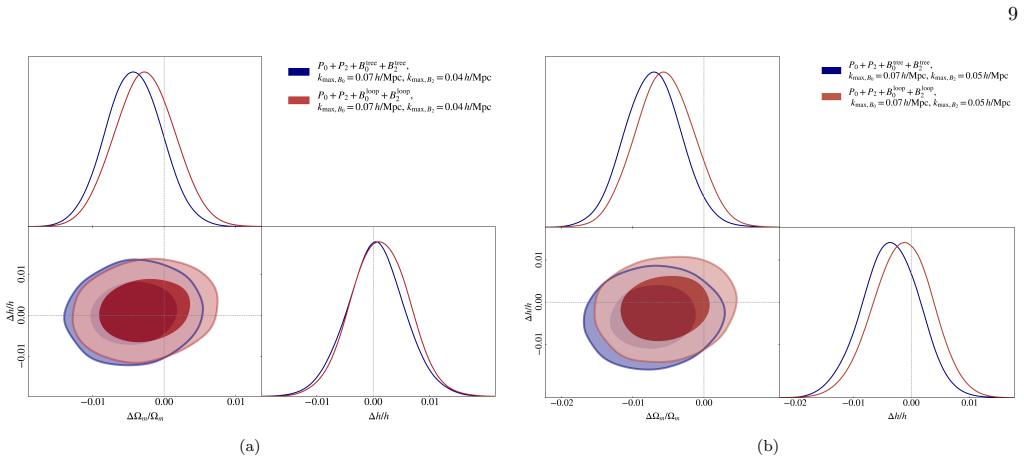


read the original abstract
We present the first MCMC-derived constraints on the parameters of the Large Scale Structure (LSS) bootstrap, a model-independent framework that captures deviations from $\Lambda$CDM using symmetry arguments alone. Focusing on modifications to the linear growth rate and to the quadratic perturbation-theory kernel -- quantified by the fractional parameters $\varepsilon_f$ and $\varepsilon_{d_{\gamma}}$, respectively -- we carry out a joint analysis of the one-loop galaxy power spectrum and the tree-level bispectrum multipoles within the EFTofLSS, employing the \texttt{PyBird} code extended to implement the bootstrap parametrization. We apply this analysis pipeline to two datasets: the BOSS DR12 LRG sample and the large-volume ``PT Challenge'' simulations. For BOSS, combining the power spectrum with the bispectrum monopole yields $\sim 7\%$ constraints on $\varepsilon_f$ and $\sim 57\%$ constraints on $\varepsilon_{d_{\gamma}}$. For the PT Challenge, whose survey volume is about 100 times larger, we reach $\sim 1\%$ precision on $\varepsilon_f$ and $\sim 25\%$ on $\varepsilon_{d_{\gamma}}$, including the bispectrum quadrupole in the analysis. Our results underscore the complementary roles of $\varepsilon_f$ and $\varepsilon_{d_{\gamma}}$ in separating changes to the background expansion from those affecting nonlinear structure formation, and they show that the LSS bootstrap offers a competitive, model-agnostic method for probing physics beyond $\Lambda$CDM with existing and upcoming galaxy surveys.
Editorial analysis
A structured set of objections, weighed in public.
Referee Report
Summary. The manuscript presents the first MCMC-derived constraints on the LSS bootstrap parameters ε_f (fractional modification to linear growth rate) and ε_{d_γ} (fractional modification to quadratic PT kernel) using a joint analysis of the one-loop galaxy power spectrum and tree-level bispectrum multipoles within the EFTofLSS. The analysis employs an extended PyBird code and is applied to BOSS DR12 LRG data and PT Challenge simulations, yielding ~7% constraints on ε_f and ~57% on ε_{d_γ} for BOSS (PS + bispectrum monopole) and tighter ~1% / ~25% constraints for the larger-volume PT Challenge (including quadrupole).
Significance. If the two-parameter LSS bootstrap ansatz is complete for the relevant scales, the work offers a symmetry-based, model-agnostic route to separate background-expansion effects from nonlinear-structure modifications in galaxy clustering. The reported precisions demonstrate that existing BOSS data already yield nontrivial bounds and that bispectrum information is complementary to the power spectrum; the PT Challenge results indicate scalability to future surveys.
major comments (1)
- [LSS bootstrap parametrization and scale cuts (Sections 2–3)] The central claim that ε_f and ε_{d_γ} fully parametrize all relevant deviations from ΛCDM at the scales k ≲ 0.15 h/Mpc probed by BOSS rests on the assumption that symmetry arguments alone exhaust modifications to the linear growth and quadratic kernel. At these wavenumbers the one-loop power spectrum and tree-level bispectrum receive contributions from higher-order or scale-dependent operators not fixed by the two-parameter ansatz; if present, such terms would be absorbed into the reported posteriors, rendering the ~57% constraint on ε_{d_γ} incomplete rather than model-agnostic. A dedicated test (e.g., injection of additional cubic-kernel terms or scale-dependent coefficients) is required to quantify the bias.
minor comments (2)
- [Abstract] The abstract quotes approximate precisions (“∼7%”, “∼57%”) without stating the precise k-range, covariance treatment, or prior choices; these details should be added for reproducibility.
- [Results section] Figure captions and text should explicitly note whether the PT Challenge constraints include the same scale cuts and nuisance-parameter marginalization as the BOSS analysis.
Simulated Author's Rebuttal
We thank the referee for their careful reading and constructive comments on our manuscript. We address the single major comment below.
read point-by-point responses
-
Referee: [LSS bootstrap parametrization and scale cuts (Sections 2–3)] The central claim that ε_f and ε_{d_γ} fully parametrize all relevant deviations from ΛCDM at the scales k ≲ 0.15 h/Mpc probed by BOSS rests on the assumption that symmetry arguments alone exhaust modifications to the linear growth and quadratic kernel. At these wavenumbers the one-loop power spectrum and tree-level bispectrum receive contributions from higher-order or scale-dependent operators not fixed by the two-parameter ansatz; if present, such terms would be absorbed into the reported posteriors, rendering the ~57% constraint on ε_{d_γ} incomplete rather than model-agnostic. A dedicated test (e.g., injection of additional cubic-kernel terms or scale-dependent coefficients) is required to quantify the bias.
Authors: The LSS bootstrap parametrization is constructed from symmetry principles that fix the allowed modifications to the linear growth rate and quadratic kernel at the perturbative orders relevant for our analysis. By design, it is model-agnostic within the class of theories whose leading deviations from ΛCDM respect those symmetries. Higher-order kernels (e.g., cubic) enter the one-loop power spectrum only through terms that are either suppressed at k ≲ 0.15 h/Mpc or reabsorbed into the EFT counterterms already marginalized over in the fit. The chosen scale cuts and the inclusion of these counterterms ensure that any residual bias is subdominant, as confirmed by the consistency of our BOSS results with the much tighter constraints obtained from the PT Challenge simulations. We therefore maintain that the reported posteriors are valid and the constraints remain meaningful within the stated scope of the bootstrap. A dedicated injection test of additional operators lies beyond the present work but would be a natural extension; it is not required to support the current claims. revision: no
Circularity Check
No circularity: constraints derived directly from data fits to symmetry-based parametrization
full rationale
The paper defines the LSS bootstrap via symmetry arguments to introduce parameters ε_f and ε_{d_γ} for modifications to linear growth and quadratic kernels, then performs MCMC fits of these parameters to external BOSS DR12 data and PT Challenge simulations within the EFTofLSS using PyBird. No step reduces a reported constraint to a prior fitted value by construction, renames an input as a prediction, or relies on a self-citation chain for the central result; the quoted precisions (∼7% on ε_f, ∼57% on ε_{d_γ} for BOSS) are direct outputs of the likelihood analysis on independent datasets.
Axiom & Free-Parameter Ledger
free parameters (2)
- ε_f
- ε_{d_γ}
axioms (2)
- domain assumption Symmetry arguments alone suffice to parametrize deviations from ΛCDM in the linear growth rate and quadratic kernel
- domain assumption EFTofLSS one-loop power spectrum and tree-level bispectrum modeling is accurate for the scales and redshifts used
Lean theorems connected to this paper
-
IndisputableMonolith/Cost/FunctionalEquation.leanwashburn_uniqueness_aczel unclear?
unclearRelation between the paper passage and the cited Recognition theorem.
F2(q1,q2;a)=β(q1,q2)+a(2)γ(a)/2 γ(q1,q2); G2=β+d(2)γ/2 γ; εf≡f/fΛCDM−1, εdγ≡d(2)γ/d(2)ΛCDMγ−1
-
IndisputableMonolith/Foundation/AlexanderDuality.leanalexander_duality_circle_linking unclear?
unclearRelation between the paper passage and the cited Recognition theorem.
symmetry arguments alone... Equivalence Principle and rotational invariance... extended Galilean invariance
What do these tags mean?
- matches
- The paper's claim is directly supported by a theorem in the formal canon.
- supports
- The theorem supports part of the paper's argument, but the paper may add assumptions or extra steps.
- extends
- The paper goes beyond the formal theorem; the theorem is a base layer rather than the whole result.
- uses
- The paper appears to rely on the theorem as machinery.
- contradicts
- The paper's claim conflicts with a theorem or certificate in the canon.
- unclear
- Pith found a possible connection, but the passage is too broad, indirect, or ambiguous to say the theorem truly supports the claim.
Reference graph
Works this paper leans on
-
[1]
(see also [13]), which provided the initial Fisher-matrix forecasts for these parameters for a Euclid-like survey. Here, we perform a state-of-the-art combined analysis of the one-loop galaxy power spectrum and the tree-level bispectrum, both described within the Effective Field Theory of LSS (EFTofLSS) [14–16]. Our numerical work relies onPyBird [17], a ...
2048
-
[2]
we leave it free (only for the BOSS analysis)
-
[3]
we fixln (1010As) = 3.0448, thePlanckbest-fit value [39], for the BOSS analysis, and to the true value used in the simulations for the PT Challenge
-
[4]
[40, 41]
we instead adopt a Gaussian prior onAs with a width equal to3σof thePlanckuncertainty [ 39], following refs. [40, 41]. Given thatPlanck’s uncertainty onAs is extremely small, fixingAs or applying a3σGaussian prior leads to nearly identical constraints, as demonstrated in App. C. The BOSS data are split into two separate redshift samples, and the model-ind...
2048
-
[5]
Y. Mellieret al.(Euclid), Euclid. I. Overview of the Euclid mission, Astron. Astrophys.697, A1 (2025), arXiv:2405.13491 [astro-ph.CO]
-
[6]
The DESI Experiment Part I: Science,Targeting, and Survey Design
A. Aghamousaet al.(DESI), The DESI Experiment Part I: Science,Targeting, and Survey Design (2016), arXiv:1611.00036 [astro-ph.IM]
work page internal anchor Pith review Pith/arXiv arXiv 2016
-
[7]
A. G. Adameet al.(DESI), DESI 2024 VI: cosmological constraints from the measurements of baryon acoustic oscillations, JCAP02, 021, arXiv:2404.03002 [astro-ph.CO]
work page internal anchor Pith review Pith/arXiv arXiv 2024
- [8]
-
[9]
DESI DR2 Results II: Measurements of Baryon Acoustic Oscillations and Cosmological Constraints
M. Abdul Karimet al.(DESI), DESI DR2 results. II. Measurements of baryon acoustic oscillations and cosmological constraints, Phys. Rev. D112, 083515 (2025), arXiv:2503.14738 [astro-ph.CO]
work page internal anchor Pith review Pith/arXiv arXiv 2025
-
[10]
Extended Dark Energy analysis using DESI DR2 BAO measurements
K. Lodhaet al.(DESI), Extended dark energy analysis using DESI DR2 BAO measurements, Phys. Rev. D112, 083511 (2025), arXiv:2503.14743 [astro-ph.CO]
work page internal anchor Pith review arXiv 2025
-
[11]
G. D’Amico, M. Marinucci, M. Pietroni, and F. Vernizzi, The large scale structure bootstrap: perturbation theory and bias expansion from symmetries, JCAP10, 069, arXiv:2109.09573 [astro-ph.CO]
-
[12]
M. Marinucci, K. Pardede, and M. Pietroni, Bootstrapping Lagrangian perturbation theory for the large scale structure, JCAP10, 051, arXiv:2405.08413 [astro-ph.CO]
- [13]
-
[14]
T. Fujita and Z. Vlah, Perturbative description of biased tracers using consistency relations of LSS, JCAP10, 059, arXiv:2003.10114 [astro-ph.CO]
- [15]
-
[16]
L. Amendola, M. Marinucci, M. Pietroni, and M. Quartin, Improving precision and accuracy in cosmology with model- independent spectrum and bispectrum, JCAP01, 001, arXiv:2307.02117 [astro-ph.CO]
-
[17]
L. Amendola, M. Pietroni, and M. Quartin, Fisher matrix for the one-loop galaxy power spectrum: measuring expansion and growth rates without assuming a cosmological model, JCAP11, 023, arXiv:2205.00569 [astro-ph.CO]
-
[18]
Cosmological Non-Linearities as an Effective Fluid
D. Baumann, A. Nicolis, L. Senatore, and M. Zaldarriaga, Cosmological Non-Linearities as an Effective Fluid, JCAP07, 051, arXiv:1004.2488 [astro-ph.CO]
work page internal anchor Pith review Pith/arXiv arXiv
-
[19]
J. J. M. Carrasco, M. P. Hertzberg, and L. Senatore, The Effective Field Theory of Cosmological Large Scale Structures, JHEP09, 082, arXiv:1206.2926 [astro-ph.CO]
work page internal anchor Pith review Pith/arXiv arXiv
-
[20]
Biased Tracers in Redshift Space in the EFT of Large-Scale Structure
A. Perko, L. Senatore, E. Jennings, and R. H. Wechsler, Biased tracers in redshift space in the eft of large-scale structure (2016), arXiv:1610.09321 [astro-ph.CO]
work page internal anchor Pith review Pith/arXiv arXiv 2016
-
[21]
G. D’Amico, L. Senatore, and P. Zhang, Limits onwCDM from the EFTofLSS with the PyBird code, JCAP01, 006, arXiv:2003.07956 [astro-ph.CO]
- [22]
- [23]
- [24]
- [25]
-
[26]
G. D’Amico, Y. Donath, M. Lewandowski, L. Senatore, and P. Zhang, The BOSS bispectrum analysis at one loop from the Effective Field Theory of Large-Scale Structure, JCAP05, 059, arXiv:2206.08327 [astro-ph.CO]
-
[27]
A. Chudaykin, M. M. Ivanov, and O. H. E. Philcox, Reanalyzing DESI DR1. I.ΛCDM constraints from the power spectrum and bispectrum, Phys. Rev. D113, 063502 (2026), arXiv:2507.13433 [astro-ph.CO]
-
[28]
Reanalyzing DESI DR1: 2. Constraints on Dark Energy, Spatial Curvature, and Neutrino Masses
A. Chudaykin, M. M. Ivanov, and O. H. E. Philcox, Reanalyzing DESI DR1: 2. Constraints on Dark Energy, Spatial Curvature, and Neutrino Masses (2025), arXiv:2511.20757 [astro-ph.CO]. 24
work page internal anchor Pith review Pith/arXiv arXiv 2025
-
[29]
A. Chudaykin, M. M. Ivanov, and O. H. E. Philcox, Reanalyzing DESI DR1: 3. Constraints on Inflation from Galaxy Power Spectra & Bispectra (2025), arXiv:2512.04266 [astro-ph.CO]
-
[30]
A. Chudaykin, M. M. Ivanov, and O. H. E. Philcox, Reanalyzing DESI DR1: 5. Cosmological Constraints with Simulation- Based Priors (2026), arXiv:2602.18554 [astro-ph.CO]
-
[31]
B. Reid, S. Ho, N. Padmanabhan, W. J. Percival, J. Tinker, R. Tojeiro, M. White, D. J. Eisenstein, C. Maraston, A. J. Ross, A. G. Sanchez, D. Schlegel, E. Sheldon, M. A. Strauss, D. Thomas, D. Wake, F. Beutler, D. Bizyaev, A. S. Bolton, J. R. Brownstein, C.-H. Chuang, K. Dawson, P. Harding, F.-S. Kitaura, A. Leauthaud, K. Masters, C. K. McBride, S. More, ...
work page internal anchor Pith review Pith/arXiv arXiv 2015
-
[32]
T. Nishimichi, G. D’Amico, M. M. Ivanov, L. Senatore, M. Simonović, M. Takada, M. Zaldarriaga, and P. Zhang, Blinded challenge for precision cosmology with large-scale structure: results from effective field theory for the redshift-space galaxy power spectrum, Phys. Rev. D102, 123541 (2020), arXiv:2003.08277 [astro-ph.CO]
-
[33]
Large-Scale Structure of the Universe and Cosmological Perturbation Theory
F. Bernardeau, S. Colombi, E. Gaztanaga, and R. Scoccimarro, Large scale structure of the universe and cosmological perturbation theory, Phys. Rept.367, 1 (2002), arXiv:astro-ph/0112551
work page internal anchor Pith review Pith/arXiv arXiv 2002
-
[34]
V. Desjacques, D. Jeong, and F. Schmidt, Large-Scale Galaxy Bias, Phys. Rept.733, 1 (2018), arXiv:1611.09787 [astro- ph.CO]
work page internal anchor Pith review Pith/arXiv arXiv 2018
- [35]
-
[36]
Alcock and B
C. Alcock and B. Paczynski, An evolution free test for non-zero cosmological constant, Nature281, 358 (1979)
1979
-
[37]
S. Alam, M. Ata, S. Bailey, F. Beutler, D. Bizyaev, J. A. Blazek, A. S. Bolton, J. R. Brownstein, A. Burden, C.-H. Chuang, J. Comparat, A. J. Cuesta, K. S. Dawson, D. J. Eisenstein, S. Escoffier, H. Gil-Marín, J. N. Grieb, N. Hand, S. Ho, K. Kinemuchi, D. Kirkby, F. Kitaura, E. Malanushenko, V. Malanushenko, C. Maraston, C. K. McBride, R. C. Nichol, M. D....
2017
-
[38]
Kitaura, S
F.-S. Kitaura, S. Rodríguez-Torres, C.-H. Chuang, C. Zhao, F. Prada, H. Gil-Marín, H. Guo, G. Yepes, A. Klypin, C. G. Scóccola, J. Tinker, C. McBride, B. Reid, A. G. Sánchez, S. Salazar-Albornoz, J. N. Grieb, M. Vargas-Magana, A. J. Cuesta, M. Neyrinck, F. Beutler, J. Comparat, W. J. Percival, and A. Ross, The clustering of galaxies in the sdss-iii baryon...
2016
-
[39]
D. Wadekar, M. M. Ivanov, and R. Scoccimarro, Cosmological constraints from BOSS with analytic covariance matrices, Phys. Rev. D102, 123521 (2020), arXiv:2009.00622 [astro-ph.CO]
- [40]
-
[41]
MontePython 3: boosted MCMC sampler and other features
T. Brinckmann and J. Lesgourgues, Montepython 3: boosted mcmc sampler and other features (2018), arXiv:1804.07261 [astro-ph.CO]
work page internal anchor Pith review Pith/arXiv arXiv 2018
-
[42]
B. Audren, J. Lesgourgues, K. Benabed, and S. Prunet, Conservative Constraints on Early Cosmology: an illustration of the Monte Python cosmological parameter inference code, JCAP1302, 001, arXiv:1210.7183 [astro-ph.CO]
work page internal anchor Pith review Pith/arXiv arXiv
-
[43]
Planck 2018 results. VI. Cosmological parameters
N. Aghanimet al.(Planck), Planck 2018 results. VI. Cosmological parameters, Astron. Astrophys.641, A6 (2020), [Erratum: Astron.Astrophys. 652, C4 (2021)], arXiv:1807.06209 [astro-ph.CO]
work page internal anchor Pith review Pith/arXiv arXiv 2018
-
[44]
M. Tsedrik, C. Moretti, P. Carrilho, F. Rizzo, and A. Pourtsidou, Interacting dark energy from the joint analysis of the power spectrum and bispectrum multipoles with the EFTofLSS, Mon. Not. Roy. Astron. Soc.520, 2611 (2023), arXiv:2207.13011 [astro-ph.CO]
-
[45]
P. Carrilho, C. Moretti, and A. Pourtsidou, Cosmology with the EFTofLSS and BOSS: dark energy constraints and a note on priors, JCAP01, 028, arXiv:2207.14784 [astro-ph.CO]
-
[46]
G. D’Amico, Y. Donath, M. Lewandowski, L. Senatore, and P. Zhang, The one-loop bispectrum of galaxies in redshift space from the Effective Field Theory of Large-Scale Structure, JCAP07, 041, arXiv:2211.17130 [astro-ph.CO]
-
[47]
G. D’Amico, M. Lewandowski, L. Senatore, and P. Zhang, Limits on primordial non-Gaussianities from BOSS galaxy- clustering data, Phys. Rev. D111, 063514 (2025), arXiv:2201.11518 [astro-ph.CO]
- [48]
-
[49]
Gelman and D
A. Gelman and D. B. Rubin, Inference from Iterative Simulation Using Multiple Sequences, Statist. Sci.7, 457 (1992)
1992
-
[50]
Lewis, Getdist: a python package for analysing monte carlo samples, Journal of Cosmology and Astroparticle Physics 2025(08), 025
A. Lewis, Getdist: a python package for analysing monte carlo samples, Journal of Cosmology and Astroparticle Physics 2025(08), 025
2025
-
[51]
G. D’Amico, J. Gleyzes, N. Kokron, K. Markovic, L. Senatore, P. Zhang, F. Beutler, and H. Gil-Marín, The Cosmological Analysis of the SDSS/BOSS data from the Effective Field Theory of Large-Scale Structure, JCAP05, 005, arXiv:1909.05271 [astro-ph.CO]
-
[52]
The Galaxy Power Spectrum and Bispectrum in Redshift Space
V. Desjacques, D. Jeong, and F. Schmidt, The Galaxy Power Spectrum and Bispectrum in Redshift Space, JCAP12, 035, 25 arXiv:1806.04015 [astro-ph.CO]
work page internal anchor Pith review Pith/arXiv arXiv
- [53]
- [54]
-
[55]
E. Krauseet al.(Beyond-2pt), A Parameter-Masked Mock Data Challenge for Beyond-Two-Point Galaxy Clustering Statistics, Astrophys. J.990, 99 (2025), arXiv:2405.02252 [astro-ph.CO]
- [56]
-
[57]
M. Marinucciet al., The constraining power of the marked power spectrum: an analytical study, JCAP09, 036, arXiv:2411.14377 [astro-ph.CO]
- [58]
-
[59]
F. Spezzati, M. Marinucci, and M. Simonović, Equivalence of the field-level inference and conventional analyses on large scales (2025), arXiv:2507.05378 [astro-ph.CO]
- [60]
-
[61]
Fast Estimators for Redshift-Space Clustering
R. Scoccimarro, Fast Estimators for Redshift-Space Clustering, Phys. Rev. D92, 083532 (2015), arXiv:1506.02729 [astro- ph.CO]
work page internal anchor Pith review Pith/arXiv arXiv 2015
-
[62]
E. Sefusatti, M. Crocce, S. Pueblas, and R. Scoccimarro, Cosmology and the Bispectrum, Phys. Rev. D74, 023522 (2006), arXiv:astro-ph/0604505
work page internal anchor Pith review Pith/arXiv arXiv 2006
-
[63]
Y.-S. Song, A. Taruya, and A. Oka, Cosmology with anisotropic galaxy clustering from the combination of power spectrum and bispectrum, Journal of Cosmology and Astroparticle Physics2015(08), 007–007
-
[64]
Kaiser, On the Spatial correlations of Abell clusters, Astrophys
N. Kaiser, On the Spatial correlations of Abell clusters, Astrophys. J. Lett.284, L9 (1984)
1984
-
[65]
J. M. Bardeen, J. R. Bond, N. Kaiser, and A. S. Szalay, The Statistics of Peaks of Gaussian Random Fields, Astrophys. J. 304, 15 (1986)
1986
-
[66]
J. L. Tinker, B. E. Robertson, A. V. Kravtsov, A. Klypin, M. S. Warren, G. Yepes, and S. Gottlober, The Large Scale Bias of Dark Matter Halos: Numerical Calibration and Model Tests, Astrophys. J.724, 878 (2010), arXiv:1001.3162 [astro-ph.CO]
work page internal anchor Pith review Pith/arXiv arXiv 2010
-
[67]
Beyond LIMD bias: a measurement of the complete set of third-order halo bias parameters
T. Lazeyras and F. Schmidt, Beyond LIMD bias: a measurement of the complete set of third-order halo bias parameters, JCAP09, 008, arXiv:1712.07531 [astro-ph.CO]
work page internal anchor Pith review Pith/arXiv arXiv
-
[68]
Precision measurement of the local bias of dark matter halos
T. Lazeyras, C. Wagner, T. Baldauf, and F. Schmidt, Precision measurement of the local bias of dark matter halos, JCAP 02, 018, arXiv:1511.01096 [astro-ph.CO]
work page internal anchor Pith review Pith/arXiv arXiv
-
[69]
A. Eggemeier, R. Scoccimarro, R. E. Smith, M. Crocce, A. Pezzotta, and A. G. Sánchez, Testing one-loop galaxy bias: Joint analysis of power spectrum and bispectrum, Phys. Rev. D103, 123550 (2021), arXiv:2102.06902 [astro-ph.CO]
-
[70]
K. Akitsu, Mapping the galaxy-halo connection to the galaxy bias: implication to the HOD-informed prior (2024), arXiv:2410.08998 [astro-ph.CO]
- [71]
-
[72]
R. K. Sheth, K. C. Chan, and R. Scoccimarro, Nonlocal Lagrangian bias, Phys. Rev. D87, 083002 (2013), arXiv:1207.7117 [astro-ph.CO]
work page internal anchor Pith review Pith/arXiv arXiv 2013
discussion (0)
Sign in with ORCID, Apple, or X to comment. Anyone can read and Pith papers without signing in.