Recognition: 2 theorem links
· Lean TheoremThreefold Efficiency Enhancement and Narrowed Nanoparticle Size Distribution in Laser Ablation of Gold in Water by GHz-Burst Irradiation
Pith reviewed 2026-05-14 18:35 UTC · model grok-4.3
The pith
GHz-burst irradiation triples ablation efficiency for gold in water by delivering energy before cavitation bubble shielding begins.
A machine-rendered reading of the paper's core claim, the machinery that carries it, and where it could break.
Core claim
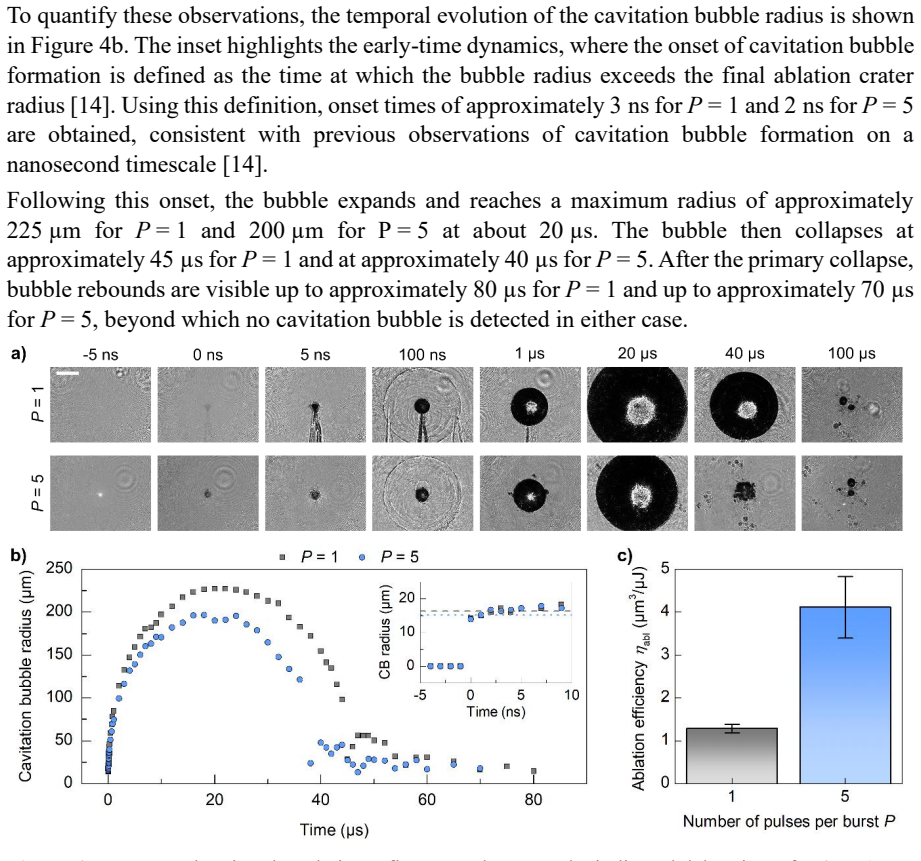
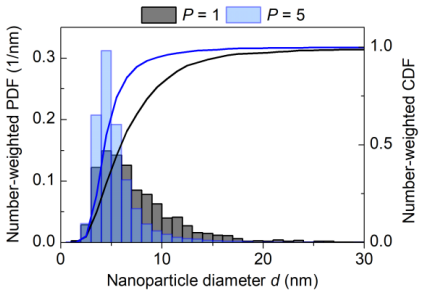
By distributing the pulse energy into a sequence of picosecond sub-pulses arriving within the nanosecond time window preceding cavitation bubble formation, GHz-burst irradiation enables energy delivery before the onset of bubble-induced shielding. This increases the threshold fluence for nonlinear losses and yields an ablation efficiency enhancement of up to a factor of three compared to single-pulse ablation. Importantly, this efficiency gain is not accompanied by an increase in cavitation bubble size or lifetime. In addition, burst irradiation yields a twofold narrower nanoparticle size distribution.
What carries the argument
GHz-burst irradiation timing that places picosecond sub-pulses inside the nanosecond window before cavitation bubble formation, thereby bypassing shielding.
If this is right
- Ablation efficiency rises by a factor of up to three relative to single-pulse irradiation.
- Nanoparticle size distribution narrows by a factor of two.
- Cavitation bubble size and lifetime stay unchanged despite higher energy delivery.
- The threshold fluence for nonlinear optical losses increases.
- Productivity of surfactant-free nanoparticle synthesis improves while particle quality rises.
Where Pith is reading between the lines
- The same timing strategy could be tested on other metals or liquids where bubble shielding now limits throughput.
- Higher average laser power may become usable without proportional growth in bubble effects.
- Narrower size distributions could reduce the need for post-synthesis sorting in catalysis or biomedical uses.
- Optimizing sub-pulse count and spacing might yield still larger gains without new hardware.
Load-bearing premise
The sub-pulses reach the target before shielding starts without new loss channels such as cumulative heating offsetting the gain.
What would settle it
An experiment that finds no efficiency increase or that measures larger and longer-lived cavitation bubbles under GHz-burst conditions than under single-pulse conditions would falsify the claim.
Figures

read the original abstract
Laser ablation in liquids enables the synthesis of surfactant-free nanoparticles but remains limited in productivity due to intrinsic constraints imposed by the liquid environment. These constraints include nonlinear optical losses, material redeposition, and cavitation bubble-induced shielding. Temporal intensity shaping of the incident laser pulse offers a potential route to mitigate these limitations. Here, ultrashort GHz-burst ablation is applied to laser ablation of gold in water. By distributing the pulse energy into a sequence of picosecond sub-pulses arriving within the nanosecond time window preceding cavitation bubble formation, GHz-burst irradiation enables energy delivery before the onset of bubble-induced shielding. This increases the threshold fluence for nonlinear losses and yields an ablation efficiency enhancement of up to a factor of three compared to single-pulse ablation. Importantly, this efficiency gain is not accompanied by an increase in cavitation bubble size or lifetime. In addition to enhanced efficiency, burst irradiation yields a twofold narrower nanoparticle size distribution. These results demonstrate that GHz-burst ablation is a promising approach to increase productivity while simultaneously improving nanoparticle quality.
Editorial analysis
A structured set of objections, weighed in public.
Referee Report
Summary. The manuscript reports experimental results on laser ablation of gold in water using GHz-burst irradiation. By splitting pulse energy into a train of picosecond sub-pulses spaced ~1 ns apart within the nanosecond window before cavitation bubble formation, the approach claims to avoid bubble-induced shielding and nonlinear losses. This yields up to threefold higher ablation efficiency than single-pulse ablation at the same total fluence, with no increase in bubble size or lifetime, plus a twofold narrower nanoparticle size distribution.
Significance. If the efficiency gain and mechanism hold, the work offers a practical route to higher productivity in surfactant-free nanoparticle synthesis while improving size uniformity. The observation that bubble dynamics remain unchanged is a notable experimental strength, as it suggests the gain is not offset by new hydrodynamic losses.
major comments (2)
- [Abstract / Results] Abstract and Results: The central mechanistic claim—that sub-pulses arrive before shielding onset—is load-bearing for the threefold efficiency attribution, yet the manuscript provides no pump-probe shadowgraphy, plasma emission timing, or fluence-dependent onset data to confirm shielding is absent during the burst train. The reported higher ablation rates and unchanged bubble lifetime could instead arise from reduced redeposition or cumulative heating.
- [Results] Results section: The quantitative threefold efficiency enhancement and twofold narrower size distribution are stated without error bars, number of independent runs, or explicit fluence values at which the maximum gain occurs. This makes it impossible to judge whether the reported factors are statistically robust or fluence-specific.
minor comments (1)
- [Abstract] Abstract: The phrase 'up to a factor of three' should be accompanied by the specific fluence or burst parameter at which the maximum is observed.
Simulated Author's Rebuttal
We thank the referee for the constructive comments and positive assessment of the significance of our work. We address each major comment point by point below, providing the strongest honest defense of the manuscript while making revisions where the points are valid.
read point-by-point responses
-
Referee: [Abstract / Results] Abstract and Results: The central mechanistic claim—that sub-pulses arrive before shielding onset—is load-bearing for the threefold efficiency attribution, yet the manuscript provides no pump-probe shadowgraphy, plasma emission timing, or fluence-dependent onset data to confirm shielding is absent during the burst train. The reported higher ablation rates and unchanged bubble lifetime could instead arise from reduced redeposition or cumulative heating.
Authors: We acknowledge that direct pump-probe shadowgraphy or plasma emission timing data would provide stronger confirmation of the absence of shielding during the burst train. Our mechanistic claim rests on established literature timing for cavitation bubble onset (typically >10 ns post-pulse) combined with the ~1 ns sub-pulse spacing in the GHz burst, ensuring all energy delivery occurs prior to bubble formation. The key supporting observation in our data is that bubble size and lifetime remain unchanged relative to single-pulse ablation at the same total fluence, which would be inconsistent with additional shielding or new hydrodynamic losses. To address the suggested alternatives, we have added a dedicated paragraph in the revised Results section arguing that reduced redeposition cannot explain the simultaneously observed narrowing of the nanoparticle size distribution, while cumulative heating effects would be expected to increase rather than maintain bubble lifetime. We have also added an explicit limitations statement noting the absence of direct timing diagnostics and recommending such measurements for future work. This is a partial revision focused on clarification and discussion rather than new experiments. revision: partial
-
Referee: [Results] Results section: The quantitative threefold efficiency enhancement and twofold narrower size distribution are stated without error bars, number of independent runs, or explicit fluence values at which the maximum gain occurs. This makes it impossible to judge whether the reported factors are statistically robust or fluence-specific.
Authors: We apologize for these omissions in the original submission. The revised manuscript now reports all efficiency and size-distribution data with error bars corresponding to the standard deviation across five independent experimental runs. We explicitly state that the maximum threefold efficiency enhancement is observed at a total fluence of 1.5 J/cm² and remains above a factor of two across the tested range of 0.5–3 J/cm². The twofold narrowing of the nanoparticle size distribution is quantified as a reduction in full width at half maximum, with mean diameters and standard deviations provided for both burst and single-pulse cases. These statistical details and fluence values have been incorporated into the Results text, figure captions, and a new supplementary table summarizing the run statistics. revision: yes
Circularity Check
No circularity: purely experimental comparison
full rationale
The paper reports direct experimental measurements of ablation efficiency, nanoparticle size distributions, and cavitation bubble size/lifetime for single-pulse versus GHz-burst irradiation of gold in water. No equations, derivations, fitted parameters, or predictions are presented that reduce to self-definitions or self-citations by construction. The efficiency gain and narrower size distribution are stated as observed outcomes, not derived quantities. The timing hypothesis for pre-shielding energy delivery is supported by the unchanged bubble metrics but remains an empirical interpretation without circular reduction.
Axiom & Free-Parameter Ledger
axioms (1)
- domain assumption Cavitation bubble formation and shielding occur on a nanosecond timescale after pulse arrival
Lean theorems connected to this paper
-
IndisputableMonolith/Foundation/RealityFromDistinction.leanreality_from_one_distinction unclearBy distributing the pulse energy into a sequence of picosecond sub-pulses arriving within the nanosecond time window preceding cavitation bubble formation, GHz-burst irradiation enables energy delivery before the onset of bubble-induced shielding.
-
IndisputableMonolith/Cost/FunctionalEquation.leanwashburn_uniqueness_aczel unclearThis increases the threshold fluence for nonlinear losses and yields an ablation efficiency enhancement of up to a factor of three compared to single-pulse ablation.
Reference graph
Works this paper leans on
-
[1]
V. Amendola, M. Meneghetti, Laser ablation synthesis in solution and size manipulation of noble metal nanoparticles, Phys. Chem. Chem. Phys. 11 (2009) 3805. https://doi.org/10.1039/b900654k
-
[2]
D. Zhang, B. Gökce, S. Barcikowski, Laser Synthesis and Processing of Colloids: Fundamentals and Applications, Chem. Rev. 117 (2017) 3990–4103. https://doi.org/10.1021/acs.chemrev.6b00468
-
[3]
R.C. Forsythe, C.P. Cox, M.K. Wilsey, A.M. Müller, Pulsed Laser in Liquids Made Nanomaterials for Catalysis, Chem. Rev. 121 (2021) 7568–7637. https://doi.org/10.1021/acs.chemrev.0c01069
-
[4]
P. Gabriel, V. Nallathambi, J. Liu, F. Staab, T.D. Oyedeji, Y. Yang, N. Hantke, E. Adabifiroozjaei, O. Recalde‐Benitez, L. Molina‐Luna, Z. Rao, B. Gault, J.T. Sehrt, F. Scheibel, K. Skokov, B. Xu, K. Durst, O. Gutfleisch, S. Barcikowski, A.R. Ziefuss, Boosting Coercivity of 3D Printed Hard Magnets through Nano‐Modification of the Powder Feedstock, Adv. Sc...
-
[5]
S. Jendrzej, B. Gökce, M. Epple, S. Barcikowski, How Size Determines the Value of Gold: Economic Aspects of Wet Chemical and Laser-Based Metal Colloid Synthesis, ChemPhysChem. 18 (2017) 1012–1019. https://doi.org/10.1002/cphc.201601139
-
[6]
R. Miao, C. Reffatto, M. Cattelan, R. Torres-Mendieta, L. Menilli, V. Amendola, Machine Learning Optimization of Laser Ablation in Liquid for the Green and Low- Cost Synthesis of Clean Gold Nanoparticles, J. Am. Chem. Soc. (2026). https://doi.org/10.1021/jacs.6c02047
-
[7]
F. Waag, R. Streubel, B. Gökce, S. Barcikowski, Synthesis of gold, platinum, and gold- platinum alloy nanoparticle colloids with high-power megahertz-repetition-rate lasers: the importance of the beam guidance method, Appl. Nanosci. 11 (2021) 1303–1312. https://doi.org/10.1007/s13204-021-01693-y
-
[8]
M. Spellauge, D. Redka, A. Podhrazsky, K. Eckmann, C. Eulenkamp, O. Koepp, C. Doñate‐Buendia, B. Gökce, S. Barcikowski, H.P. Huber, Mechanisms of Laser Ablation in Liquids and Their Impact on the Efficiency of Nanoparticle Generation, Laser Photon. Rev. (2025) 1–13. https://doi.org/10.1002/lpor.202501348
-
[9]
I.Y. Khairani, G. Mínguez-Vega, C. Doñate-Buendía, B. Gökce, Green nanoparticle synthesis at scale: a perspective on overcoming the limits of pulsed laser ablation in liquids for high-throughput production, Phys. Chem. Chem. Phys. 25 (2023) 19380– 19408. https://doi.org/10.1039/D3CP01214J
-
[10]
W. Liu, O. Kosareva, I.S. Golubtsov, A. Iwasaki, A. Becker, V.P. Kandidov, S.L. Chin, Femtosecond laser pulse filamentation versus optical breakdown in H 2 O, Appl. Phys. B Lasers Opt. 76 (2003) 215–229. https://doi.org/10.1007/s00340-002-1087-1
-
[11]
S. Dittrich, S. Barcikowski, B. Gökce, Plasma and nanoparticle shielding during pulsed laser ablation in liquids cause ablation efficiency decrease, Opto-Electronic Adv. 4 (2021) 20007201–20007215. https://doi.org/10.29026/oea.2021.200072
-
[12]
M.E. Povarnitsyn, T.E. Itina, Hydrodynamic modeling of femtosecond laser ablation of metals in vacuum and in liquid, Appl. Phys. A. 117 (2014) 175–178. https://doi.org/10.1007/s00339-014-8319-1
-
[13]
C. Chen, L. V Zhigilei, Atomistic modeling of pulsed laser ablation in liquid: spatially and time-resolved maps of transient nonequilibrium states and channels of nanoparticle formation, Appl. Phys. A. 129 (2023) 288. https://doi.org/10.1007/s00339-023-06525- 0
-
[14]
S. Dittrich, M. Spellauge, S. Barcikowski, H.P. Huber, B. Gökce, Time resolved studies reveal the origin of the unparalleled high efficiency of one nanosecond laser ablation in liquids, Opto-Electronic Adv. 5 (2022) 210053–210053. https://doi.org/10.29026/oea.2022.210053
-
[15]
M. Spellauge, C. Doñate-Buendía, S. Barcikowski, B. Gökce, H.P. Huber, Comparison of ultrashort pulse ablation of gold in air and water by time-resolved experiments, Light Sci. Appl. 11 (2022) 68. https://doi.org/10.1038/s41377-022-00751-6
-
[16]
Tomko, S.M
J. Tomko, S.M. O’Malley, C. Trout, J.J. Naddeo, R. Jimenez, J.C. Griepenburg, W. Soliman, D.M. Bubb, Cavitation bubble dynamics and nanoparticle size distributions in laser ablation in liquids, Colloids Surfaces A Physicochem. Eng. Asp. 522 (2017) 368–
2017
-
[17]
https://doi.org/10.1016/j.colsurfa.2017.03.030
-
[18]
S. Ibrahimkutty, P. Wagener, T.D.S. Rolo, D. Karpov, A. Menzel, T. Baumbach, S. Barcikowski, A. Plech, A hierarchical view on material formation during pulsed-laser synthesis of nanoparticles in liquid, Sci. Rep. 5 (2015) 16313. https://doi.org/10.1038/srep16313
-
[19]
Y. Arita, M. Ploschner, M. Antkowiak, F. Gunn-Moore, K. Dholakia, Laser-induced breakdown of an optically trapped gold nanoparticle for single cell transfection, Opt. Lett. 38 (2013) 3402. https://doi.org/10.1364/OL.38.003402
-
[20]
M. Ćwikła, M. Kempa, R. Dziedzic, K. Marciniak, J. Reiner, A. Zakrzewski, Comparison of ablation rate and surface quality of in-air and underwater picosecond laser processing of tungsten carbide cobalt, Appl. Phys. A. 132 (2026) 454. https://doi.org/10.1007/s00339-026-09614-y
-
[21]
C. Doñate-Buendia, M. Spellauge, R. Streubel, F. Riahi, S. Barcikowski, H.P. Huber, B. Gökce, Double-pulse laser ablation in liquids: nanoparticle bimodality reduction by sub-nanosecond interpulse delay optimization, J. Phys. D. Appl. Phys. 56 (2023) 104001. https://doi.org/10.1088/1361-6463/acbaaa
-
[22]
P.L. Maack, C. Esen, A. Ostendorf, Single- and Multi-Beam Drilling of Thin Titanium Foils by Femtosecond Laser Ablation in Liquids, J. Laser Micro/Nanoengineering. 19 (2024) 193–203. https://doi.org/10.2961/jlmn.2024.03.2004
-
[23]
Simple Technique for Measurements of Pulsed Gaussian-Beam Spot Sizes
J.M. Liu, Simple technique for measurements of pulsed Gaussian-beam spot sizes, Opt. Lett. 7 (1982) 196. https://doi.org/10.1364/OL.7.000196
-
[24]
J. Car, D. Blažeka, N. Krstulović, Advanced quantitative analysis of colloidal solution of metal nanoparticles produced by laser ablation in liquids, J. Quant. Spectrosc. Radiat. Transf. 290 (2022) 108318. https://doi.org/10.1016/j.jqsrt.2022.108318
-
[25]
M.E. Povarnitsyn, T.E. Itina, P.R. Levashov, K. V. Khishchenko, Mechanisms of nanoparticle formation by ultra-short laser ablation of metals in liquid environment, Phys. Chem. Chem. Phys. 15 (2013) 3108. https://doi.org/10.1039/c2cp42650a
-
[26]
A. Vogel, J. Noack, K. Nahen, D. Theisen, S. Busch, U. Parlitz, D.X.X. Hammer, G.D.D. Noojin, B.A.A. Rockwell, R. Birngruber, Energy balance of optical breakdown in water at nanosecond to femtosecond time scales, Appl. Phys. B. 68 (1999) 271–280. https://doi.org/10.1007/s003400050617
-
[27]
P.K.P.K. Kennedy, A first-order model for computation of laser-induced breakdown thresholds in ocular and aqueous media. I. Theory, IEEE J. Quantum Electron. 31 (1995) 2241–2249. https://doi.org/10.1109/3.477753
-
[28]
J.M. Wiesenfeld, E.P. Ippen, Dynamics of electron solvation in liquid water, Chem. Phys. Lett. 73 (1980) 47–50. https://doi.org/10.1016/0009-2614(80)85199-2
-
[29]
A. Semerok, C. Dutouquet, Ultrashort double pulse laser ablation of metals, Thin Solid Films. 453–454 (2004) 501–505. https://doi.org/10.1016/j.tsf.2003.11.115
-
[30]
M. Spellauge, J. Winter, S. Rapp, C. McDonnell, F. Sotier, M. Schmidt, H.P. Huber, Influence of stress confinement, particle shielding and re-deposition on the ultrashort pulse laser ablation of metals revealed by ultrafast time-resolved experiments, Appl. Surf. Sci. 545 (2021) 148930. https://doi.org/10.1016/j.apsusc.2021.148930
-
[31]
M.E. Povarnitsyn, P.R. Levashov, D. V. Knyazev, Simulation of ultrafast bursts of subpicosecond pulses: In pursuit of efficiency, Appl. Phys. Lett. 112 (2018) 051603. https://doi.org/10.1063/1.5012758
-
[32]
D.J. Förster, B. Jäggi, A. Michalowski, B. Neuenschwander, Review on Experimental and Theoretical Investigations of Ultra-Short Pulsed Laser Ablation of Metals with Burst Pulses, Materials (Basel). 14 (2021) 3331. https://doi.org/10.3390/ma14123331
-
[33]
S. Dittrich, R. Streubel, C. McDonnell, H.P. Huber, S. Barcikowski, B. Gökce, Comparison of the productivity and ablation efficiency of different laser classes for laser ablation of gold in water and air, Appl. Phys. A. 125 (2019) 432. https://doi.org/10.1007/s00339-019-2704-8
-
[34]
J. Mildner, C. Sarpe, N. Götte, M. Wollenhaupt, T. Baumert, Emission signal enhancement of laser ablation of metals (aluminum and titanium) by time delayed femtosecond double pulses from femtoseconds to nanoseconds, Appl. Surf. Sci. 302 (2014) 291–298. https://doi.org/10.1016/j.apsusc.2013.09.137
-
[35]
E. Boulais, R. Lachaine, A. Hatef, M. Meunier, Plasmonics for pulsed-laser cell nanosurgery: Fundamentals and applications, J. Photochem. Photobiol. C Photochem. Rev. 17 (2013) 26–49. https://doi.org/10.1016/j.jphotochemrev.2013.06.001
-
[36]
F. Di Niso, C. Gaudiuso, T. Sibillano, F.P. Mezzapesa, A. Ancona, P.M. Lugarà, Role of heat accumulation on the incubation effect in multi-shot laser ablation of stainless steel at high repetition rates., Opt. Express. 22 (2014) 12200–10. https://doi.org/10.1364/OE.22.012200
-
[37]
R. Weber, T. Graf, P. Berger, V. Onuseit, M. Wiedenmann, C. Freitag, A. Feuer, Heat accumulation during pulsed laser materials processing, Opt. Express. 22 (2014) 11312. https://doi.org/10.1364/OE.22.011312
-
[38]
A.Y. Vorobyev, C. Guo, Enhanced absorptance of gold following multipulse femtosecond laser ablation, Phys. Rev. B. 72 (2005) 195422. https://doi.org/10.1103/PhysRevB.72.195422
-
[39]
A.Y. Vorobyev, C. Guo, Reflection of femtosecond laser light in multipulse ablation of metals, J. Appl. Phys. 110 (2011) 043102. https://doi.org/10.1063/1.3620898
-
[40]
Z. Sun, M. Lenzner, W. Rudolph, Generic incubation law for laser damage and ablation thresholds, J. Appl. Phys. 117 (2015). https://doi.org/10.1063/1.4913282
-
[41]
N.A. Inogamov, V. V. Zhakhovskii, V.A. Khokhlov, Dynamics of Gold Ablation into Water, J. Exp. Theor. Phys. 127 (2018) 79–106. https://doi.org/10.1134/S1063776118070075
-
[42]
C.-Y. Shih, M. V. Shugaev, C. Wu, L. V. Zhigilei, Generation of Subsurface Voids, Incubation Effect, and Formation of Nanoparticles in Short Pulse Laser Interactions with Bulk Metal Targets in Liquid: Molecular Dynamics Study, J. Phys. Chem. C. 121 (2017) 16549–16567. https://doi.org/10.1021/acs.jpcc.7b02301
-
[43]
V.K. Pustovalov, Laser melting, evaporation, and fragmentation of nanoparticles: Experiments, modeling, and applications, Nanotechnol. Precis. Eng. 8 (2025). https://doi.org/10.1063/10.0034539
discussion (0)
Sign in with ORCID, Apple, or X to comment. Anyone can read and Pith papers without signing in.