Recognition: no theorem link
FIND: Toward Multimodal Financial Reasoning and Question Answering for Indic Languages
Pith reviewed 2026-05-14 20:21 UTC · model grok-4.3
The pith
FinVQA benchmark and FIND framework support accurate financial reasoning across six Indic languages and multiple modalities.
A machine-rendered reading of the paper's core claim, the machinery that carries it, and where it could break.
Core claim
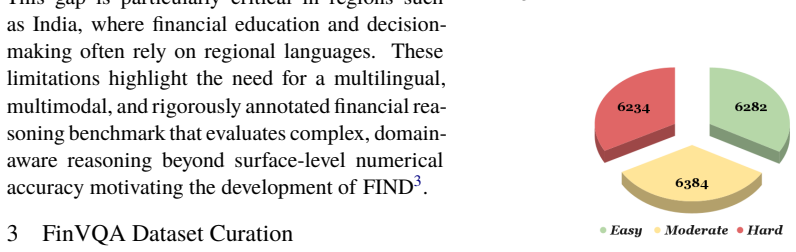
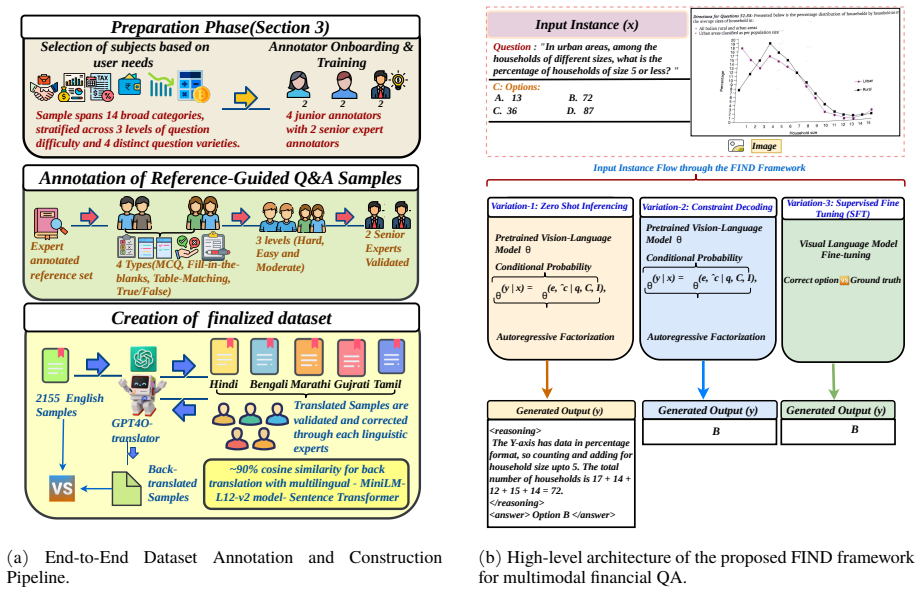
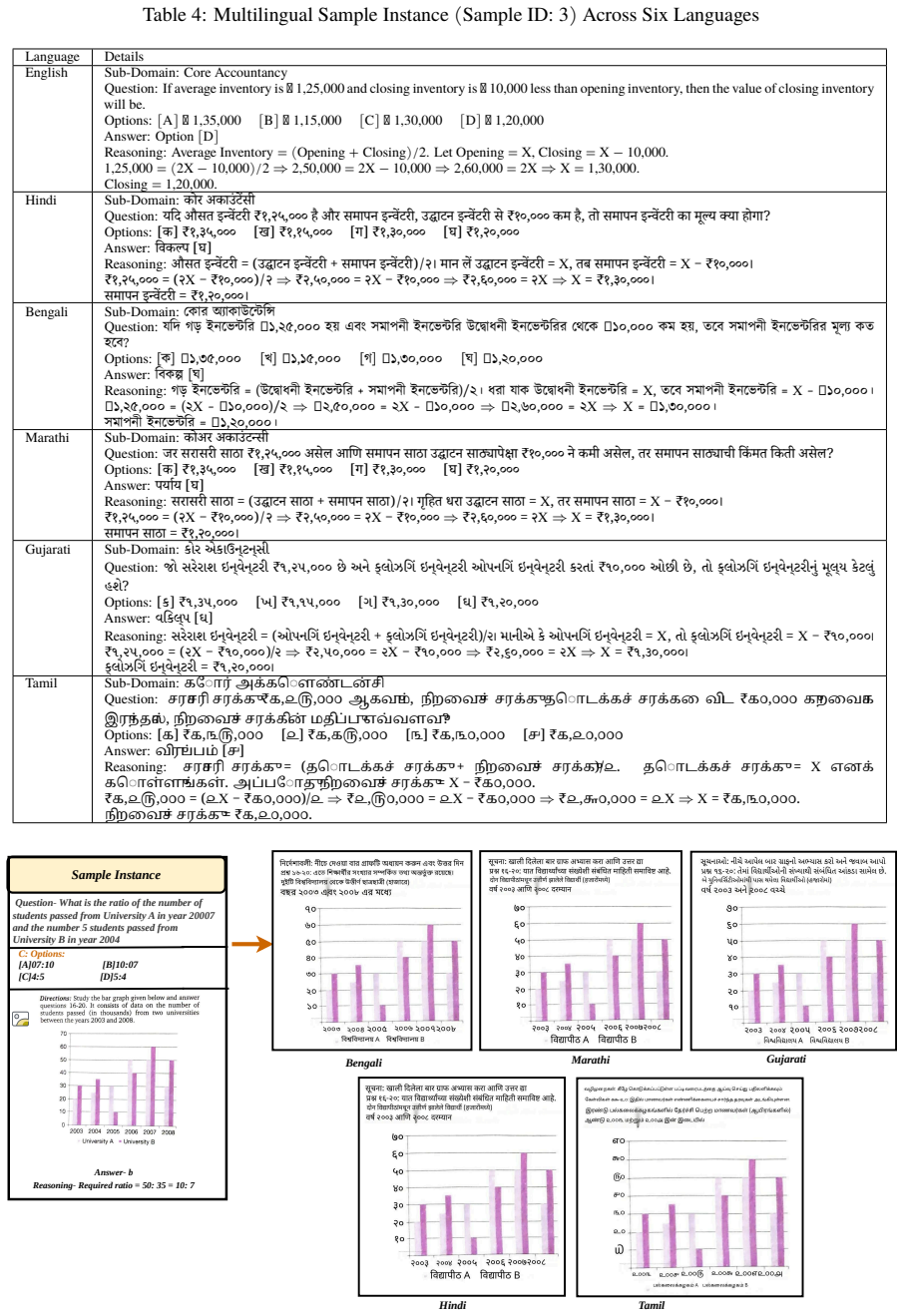
FinVQA spans English, Hindi, Bengali, Marathi, Gujarati, and Tamil with 18,900 samples across 14 financial domains, three difficulty levels, and four question formats. FIND combines supervised fine-tuning with constraint-aware decoding to promote faithful numerical reasoning, robust multimodal grounding, and structured decision-making.
What carries the argument
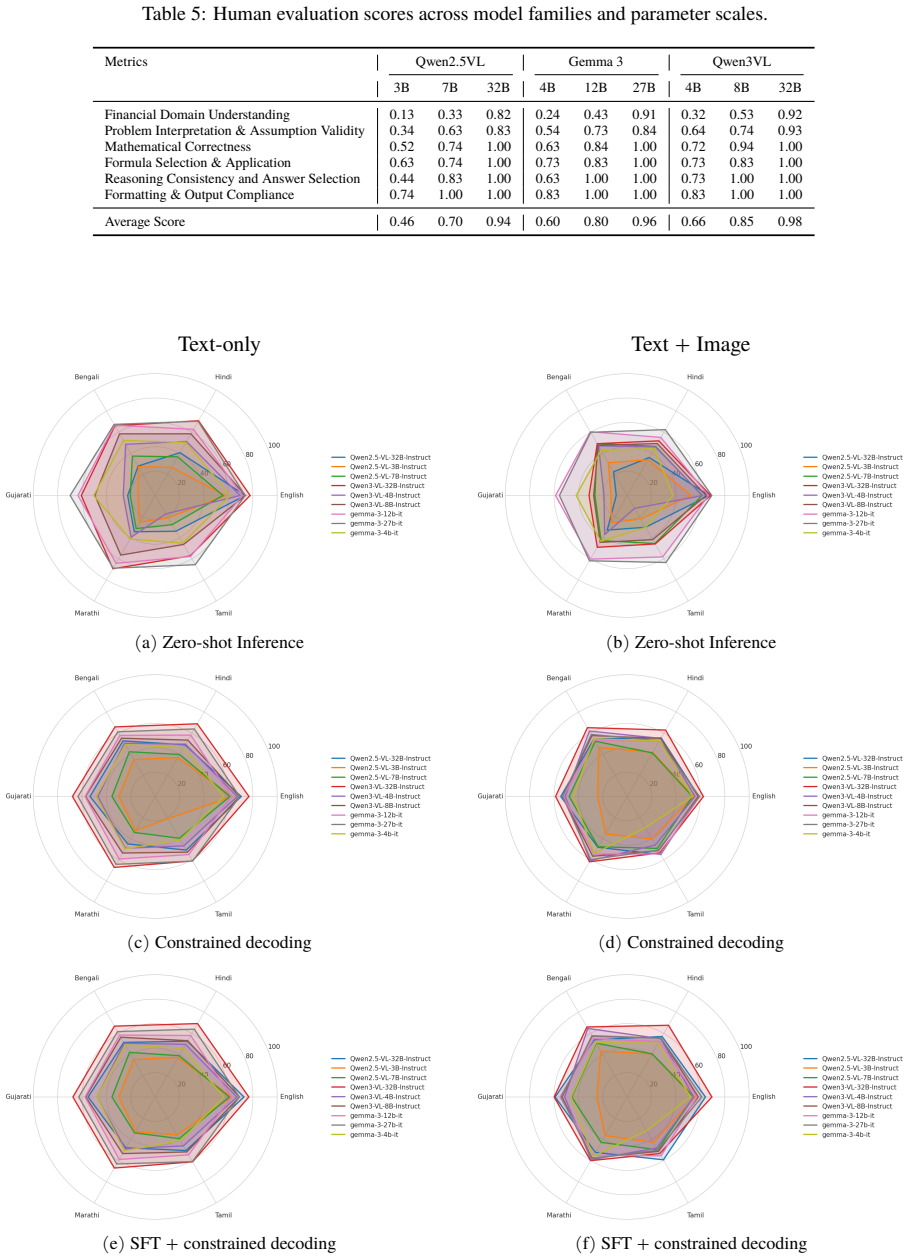
The FIND framework, which pairs supervised fine-tuning of models with constraint-aware decoding that restricts outputs to remain consistent with provided numbers and tables.
If this is right
- Models can be tested for numerical fidelity on realistic financial questions that mix text, tables, and calculations.
- Constraint-aware decoding can reduce invented numbers in answers across four question formats.
- Evaluation now exists for financial reasoning in six languages rather than English alone.
- Structured decision-making becomes measurable through the dataset's difficulty tiers and format variety.
Where Pith is reading between the lines
- The same fine-tuning plus decoding pattern could be applied to other high-stakes domains such as legal contract review in Indic languages.
- Real-world financial chat tools might adopt FIND-style constraints to lower error rates when users ask in Hindi or Marathi.
- Scaling the benchmark to additional Indic languages would test whether the current six-language coverage generalizes.
Load-bearing premise
The assumption that the FinVQA dataset captures diverse reasoning paradigms under realistic constraints across 14 financial domains, three difficulty levels, and four question formats in Indic languages.
What would settle it
If models using FIND still produce numerical contradictions on hard table-matching items in Tamil or Gujarati at rates no lower than standard fine-tuning, the benefit of constraint-aware decoding would be refuted.
Figures




read the original abstract
Financial decision-making in multilingual settings demands accurate numerical reasoning grounded in diverse modalities, yet existing benchmarks largely overlook this high-stakes, real-world challenge, especially for Indic languages. We introduce FinVQA, a benchmark for evaluating financial numerical and multimodal reasoning in multilingual Indic contexts. FinVQA spans English, Hindi, Bengali, Marathi, Gujarati, and Tamil, and comprises 18,900 samples across 14 financial domains. The dataset captures diverse reasoning paradigms under realistic constraints, and is structured across three difficulty levels (easy, moderate, hard) and four question formats: multiple choice, fill-in-the-blank, table matching, and true/false. To address these challenges, we propose FIND, a framework that combines supervised fine-tuning with constraint-aware decoding to promote faithful numerical reasoning, robust multimodal grounding, and structured decision-making. Together, FinVQA and FIND establish a rigorous evaluation and modeling paradigm for high-stakes multilingual multimodal financial reasoning.
Editorial analysis
A structured set of objections, weighed in public.
Referee Report
Summary. The paper introduces FinVQA, a benchmark comprising 18,900 samples for financial numerical and multimodal reasoning across six languages (English, Hindi, Bengali, Marathi, Gujarati, Tamil), 14 financial domains, three difficulty levels, and four question formats. It also proposes the FIND framework, which combines supervised fine-tuning with constraint-aware decoding to promote faithful numerical reasoning and robust multimodal grounding. The central claim is that FinVQA and FIND together establish a rigorous evaluation and modeling paradigm for high-stakes multilingual multimodal financial reasoning.
Significance. If the dataset construction and framework are properly validated with quantitative evidence, this work could fill a notable gap in multilingual financial QA benchmarks for Indic languages and support development of more grounded models in high-stakes domains. The scale and multilingual coverage are strengths, but the absence of any reported experiments, baselines, or validation metrics means the significance remains prospective rather than demonstrated.
major comments (3)
- [§3] §3 (FinVQA Construction and Validation): The manuscript details the 14 domains, three difficulty levels, and four formats but supplies no inter-annotator agreement scores, source-document fidelity checks, or native-speaker validation rates for the Indic-language instances. This is load-bearing for the claim that the benchmark captures diverse realistic reasoning paradigms under authentic constraints rather than synthetic artifacts.
- [§4] §4 (FIND Framework): The description of constraint-aware decoding lacks concrete implementation details, pseudocode, or ablation studies showing how it enforces numerical faithfulness and multimodal grounding. Without these, it is difficult to assess whether the framework delivers the promised improvements over standard fine-tuning.
- [§5] §5 (Experiments and Evaluation): No baseline results, error analysis, or performance metrics on FinVQA are reported. This undermines the assertion that FinVQA and FIND establish a rigorous evaluation paradigm, as there is no evidence the framework improves over existing approaches on the new benchmark.
minor comments (2)
- [Abstract] The abstract and introduction use the term 'parameter-free' in describing aspects of FIND; clarify whether this refers to the decoding constraints or another component, and ensure consistent usage throughout.
- [Table 1] Table 1 (dataset statistics) should include a breakdown by language and difficulty level to allow readers to assess balance across the 18,900 samples.
Simulated Author's Rebuttal
We thank the referee for the constructive feedback. We agree that the manuscript requires additional quantitative validation for FinVQA, concrete implementation details for FIND, and experimental results to substantiate our claims. We will incorporate these elements in the revised version.
read point-by-point responses
-
Referee: [§3] §3 (FinVQA Construction and Validation): The manuscript details the 14 domains, three difficulty levels, and four formats but supplies no inter-annotator agreement scores, source-document fidelity checks, or native-speaker validation rates for the Indic-language instances. This is load-bearing for the claim that the benchmark captures diverse realistic reasoning paradigms under authentic constraints rather than synthetic artifacts.
Authors: We agree that explicit reporting of inter-annotator agreement, fidelity checks, and native-speaker validation is necessary to support the benchmark's authenticity. The current manuscript omitted these quantitative details to prioritize the overall dataset description. In the revised version, we will expand §3 with a dedicated validation subsection that reports inter-annotator agreement scores (Fleiss' kappa) per language and difficulty level, source-document fidelity metrics, and native-speaker validation rates for all Indic instances. These additions will directly address the concern and strengthen the claim that FinVQA reflects realistic financial reasoning. revision: yes
-
Referee: [§4] §4 (FIND Framework): The description of constraint-aware decoding lacks concrete implementation details, pseudocode, or ablation studies showing how it enforces numerical faithfulness and multimodal grounding. Without these, it is difficult to assess whether the framework delivers the promised improvements over standard fine-tuning.
Authors: We concur that the FIND framework description would benefit from greater specificity. The initial submission provided a high-level overview of the supervised fine-tuning plus constraint-aware decoding approach. In the revised manuscript, we will augment §4 with pseudocode for the decoding procedure, explicit definitions of the numerical and multimodal constraints employed, and ablation studies that isolate the contribution of each constraint type relative to standard fine-tuning. This will enable readers to evaluate the framework's mechanisms and improvements. revision: yes
-
Referee: [§5] §5 (Experiments and Evaluation): No baseline results, error analysis, or performance metrics on FinVQA are reported. This undermines the assertion that FinVQA and FIND establish a rigorous evaluation paradigm, as there is no evidence the framework improves over existing approaches on the new benchmark.
Authors: We acknowledge that the absence of reported experiments in the submitted manuscript limits the immediate demonstration of FIND's advantages on FinVQA. The work was initially structured to introduce the benchmark and framework, with empirical evaluation reserved for subsequent development. To resolve this, the revised manuscript will include a new experimental section presenting baseline results (e.g., standard multimodal models versus FIND), performance metrics across difficulty levels and languages, and error analysis. These results will provide initial evidence supporting the proposed paradigm. revision: yes
Circularity Check
No circularity: dataset creation and framework proposal are self-contained introductions.
full rationale
The paper introduces FinVQA as a new benchmark dataset spanning languages, domains, difficulties, and formats, plus the FIND framework combining fine-tuning and decoding. No equations, fitted parameters, predictions, or self-citations appear in the provided text. The central claims rest on the construction and description of these new resources rather than any derivation that reduces to its own inputs by definition or fit. This matches the expected non-circular outcome for resource-creation papers.
Axiom & Free-Parameter Ledger
axioms (2)
- domain assumption Existing benchmarks largely overlook multilingual financial numerical reasoning in Indic languages
- domain assumption Supervised fine-tuning combined with constraint-aware decoding promotes faithful numerical reasoning and robust multimodal grounding
invented entities (2)
-
FinVQA
no independent evidence
-
FIND
no independent evidence
Reference graph
Works this paper leans on
-
[1]
Theoremqa: A theorem-driven question an- swering dataset. arXiv preprint arXiv:2305.12524. Zhiyu Chen, Wenhu Chen, Charese Smiley, Sameena Shah, Iana Borova, Dylan Langdon, Reema Moussa, Matt Beane, Ting-Hao Huang, Bryan R Routledge, and 1 others. 2021. Finqa: A dataset of numerical reasoning over financial data. In Proceedings of the 2021 Conference on E...
-
[2]
arXiv preprint arXiv:2506.06282
Understanding financial reasoning in ai: A multimodal benchmark and error learning approach. arXiv preprint arXiv:2506.06282. Team Gemma Team. 2025. Gemma 3. Akash Ghosh, Debayan Datta, Sriparna Saha, and Chirag Agarwal. 2025. A survey of multilingual reasoning in language models. arXiv preprint arXiv:2502.09457. Sohom Ghosh, Arnab Maji, Aswartha Narayana...
-
[3]
Kimi k1.5: Scaling Reinforcement Learning with LLMs
Kimi k1. 5: Scaling reinforcement learning with llms. arXiv preprint arXiv:2501.12599. Mateusz Klimaszewski, Pinzhen Chen, Liane Guillou, Ioannis Papaioannou, Barry Haddow, and Alexandra Birch. 2025. Avenibench: Accessible and versatile evaluation of finance intelligence. In Proceedings of the Joint Workshop of the 9th Financial Technology and Natural Lan...
work page internal anchor Pith review Pith/arXiv arXiv 2025
-
[4]
Let’s verify step by step. In The T welfth Inter- national Conference on Learning Representations. Aixin Liu, Bei Feng, Bing Xue, Bingxuan Wang, Bochao Wu, Chengda Lu, Chenggang Zhao, Chengqi Deng, Chenyu Zhang, Chong Ruan, and 1 others. 2024. Deepseek-v3 technical report. arXiv preprint arXiv:2412.19437. Pan Lu, Hritik Bansal, Tony Xia, Jiacheng Liu, Chu...
work page internal anchor Pith review Pith/arXiv arXiv 2024
-
[5]
arXiv preprint arXiv:2307.10635
Scibench: Evaluating college-level scientific problem-solving abilities of large language models. arXiv preprint arXiv:2307.10635. Yuqing Wang and Yun Zhao. 2024. Metacognitive prompting improves understanding in large language models. In Proceedings of the 2024 Conference of the North American Chapter of the Association for Computational Linguistics: Hum...
-
[6]
Mmmu: A massive multi-discipline multi- modal understanding and reasoning benchmark for expert agi. In Proceedings of the IEEE/CVF Confer- ence on Computer Vision and Pattern Recognition, pages 9556–9567. Yilun Zhao, Hongjun Liu, Yitao Long, Rui Zhang, Chen Zhao, and Arman Cohan. 2024. Financemath: Knowledge-intensive math reasoning in finance do- mains. ...
-
[7]
Semantic Faithfulness: Text annotations must accurately reflect the intended meaning of the input question or content, without introducing unsupported assumptions or hallucinated in- formation
-
[8]
Conceptual Correctness: Ensure that all domain-specific concepts (e.g., financial, eco- nomic, statistical) are used correctly and con- sistently, adhering to standard definitions and conventions
-
[9]
Clarity and Precision: Textual explanations should be concise, unambiguous, and log- ically structured, avoiding unnecessary ver- bosity while preserving essential reasoning steps
-
[10]
Reasoning Transparency: When explanations are required, intermediate reasoning must align coherently with the final answer, ensur- ing traceability between assumptions, compu- tations, and conclusions
-
[11]
Irrelevant or speculative details should be excluded
Context Appropriateness: Incorporate only the contextual information necessary to inter- pret or solve the task. Irrelevant or speculative details should be excluded
-
[12]
Consistency and Formatting: Maintain a uni- form annotation style across all samples, in- cluding consistent terminology, notation, and response structure
-
[13]
All annotations should remain neutral and task-focused
Bias and Neutrality Check: Avoid subjec- tive, cultural, or demographic bias in textual descriptions and reasoning. All annotations should remain neutral and task-focused. B.2 Image Annotation and Validation Rules The following rules govern the annotation and vali- dation of visual inputs to ensure alignment, quality, and reliability in multimodal settings:
-
[14]
Visual content should support, not contradict, the intended reasoning task
Rule 1: Text–Image Semantic Alignment The image must provide visual evidence that is directly relevant to the associated text or question. Visual content should support, not contradict, the intended reasoning task
-
[15]
Im- ages that are ambiguous, misleading, or in- sufficient to support reasoning should be ex- cluded
Rule 2: Visual Evidence Sufficiency Annotate only those images where the neces- sary information is visually discernible. Im- ages that are ambiguous, misleading, or in- sufficient to support reasoning should be ex- cluded
-
[16]
Rule 3: No Embedded or Overlay Text Images must not contain embedded text, la- bels, watermarks, or annotations, as these can introduce unintended shortcuts or textual bias
-
[17]
Low-resolution, blurred, or cluttered visuals that hinder interpretation are not permitted
Rule 4: Visual Quality and Readability Images should be clear, properly cropped, and well-illuminated. Low-resolution, blurred, or cluttered visuals that hinder interpretation are not permitted
-
[18]
Rule 5: Numerical and Structural Integrity For charts, tables, or financial visuals, ensure that axes, symbols, and numerical values are visually intact and correctly rendered, without distortion or truncation
-
[19]
Images exhibiting anatomical inconsistencies or AI-induced ar- tifacts should be rejected
Rule 6: Human and Object Realism Any depicted humans or objects must appear natural and undistorted. Images exhibiting anatomical inconsistencies or AI-induced ar- tifacts should be rejected. These guidelines ensure that textual and visual annotations remain semantically aligned, logically coherent, and visually reliable, thereby enabling ro- bust multimo...
2004
discussion (0)
Sign in with ORCID, Apple, or X to comment. Anyone can read and Pith papers without signing in.