Recognition: 2 theorem links
· Lean TheoremImpedance-Based VSC Unit Commitment with STATCOM Support under High IBG Penetration
Pith reviewed 2026-05-14 18:35 UTC · model grok-4.3
The pith
A mixed-integer second-order cone program for unit commitment embeds voltage stability boundaries and synthetic inertia to maintain security and lower costs with high inverter-based generation, with STATCOM adding dispatch gains.
A machine-rendered reading of the paper's core claim, the machinery that carries it, and where it could break.
Core claim
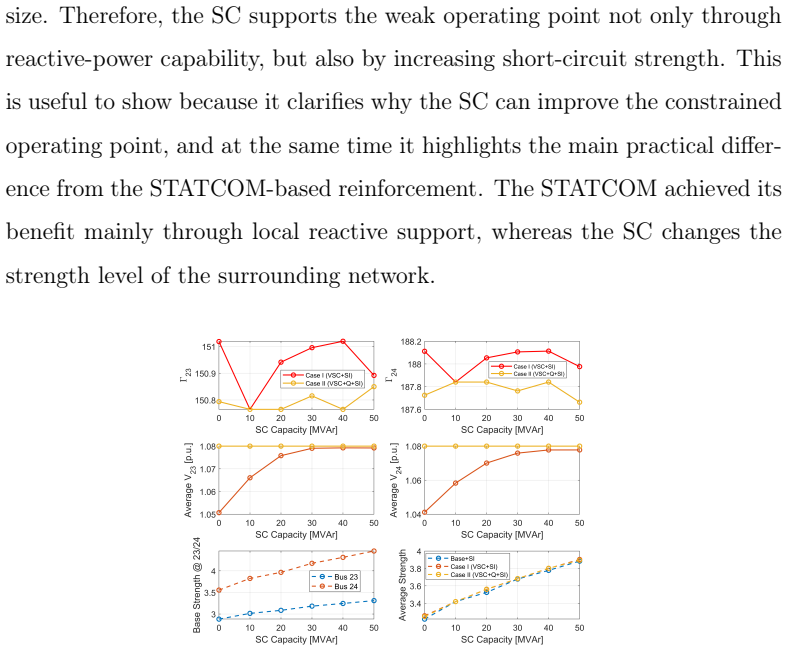
Embedding an SOC voltage stability boundary into the MISOCP unit commitment formulation together with synthetic inertia constraints produces secure and lower-cost schedules that respect both voltage and frequency limits, and treating a 30 MVAr STATCOM as an additional reactive power decision variable expands the feasible operating region under high IBG penetration.
What carries the argument
The MISOCP unit commitment model that co-optimizes synthetic inertia dispatch for frequency-nadir compliance with an SOC-relaxed voltage stability boundary at IBG buses and models STATCOM reactive power as a decision variable.
Load-bearing premise
The second-order cone relaxation remains tight and accurately represents the voltage stability boundary for the chosen high-IBG scenarios on the modified IEEE 30-bus system, and the 30 MVAr STATCOM placement is representative of practical weak-grid conditions.
What would settle it
If the SOC relaxation produces a noticeable gap from the exact voltage stability boundary or if actual voltage collapse occurs in the modified IEEE 30-bus simulations despite the constraints under the tested high-IBG cases, the model's security guarantees would be shown to be unreliable.
Figures





read the original abstract
The large-scale replacement of synchronous machines with inverter-based generation (IBG) introduces critical challenges to both voltage and frequency stability. This work builds on a mixed-integer second-order cone programming (MISOCP) framework that co-optimizes unit commitment (UC) model which embeds frequency-nadir constraints through synthetic inertia (SI) dispatch and an SOC voltage stability boundary for IBG buses. The formulation extends by modeling a STATCOM as a reactive-power decision variable in the same MISOCP model. A modified IEEE 30-bus system is used to assess three scheduling strategies: (i) baseline UC with SI only, (ii) voltage-stability-constrained (VSC) UC with SI, and (iii) the joint UC with SI and reactive power support from IBGs. The impact of incorporating a 30~MVAr STATCOM at a weak grid location near the IBG buses is investigated. Simulation results show that the proposed framework enhances voltage security, maintains frequency-nadir compliance, and reduces operating cost, while STATCOM integration further improves dispatch feasibility under high IBG.
Editorial analysis
A structured set of objections, weighed in public.
Referee Report
Summary. The paper develops a mixed-integer second-order cone programming (MISOCP) model for unit commitment that co-optimizes synthetic inertia dispatch for frequency-nadir constraints and SOC-relaxed voltage stability constraints for IBG buses, extended to include STATCOM reactive power support as a decision variable. Evaluated on a modified IEEE 30-bus system under high IBG penetration, it compares three strategies (baseline UC with SI, VSC-UC with SI, and joint UC with SI plus STATCOM) and claims that the framework enhances voltage security, maintains frequency-nadir compliance, reduces operating costs, and improves dispatch feasibility with STATCOM integration.
Significance. If the SOC relaxations remain tight and the simulation results are robust, the work offers a computationally tractable MISOCP framework for jointly addressing voltage and frequency stability in unit commitment under high inverter-based generation. The use of standard test systems and the extension to STATCOM support provide practical value for weak-grid operation; the approach could support more secure and economic scheduling if the relaxation accuracy is confirmed.
major comments (2)
- [Numerical Results] The central claim that the framework enhances voltage security depends on the SOC relaxation of the voltage stability boundary remaining tight. The manuscript reports simulation outcomes on the modified IEEE 30-bus system but provides no post-hoc verification (e.g., AC power-flow recovery at the obtained points or explicit relaxation-gap computation) that the SOC solutions satisfy the original nonlinear voltage-stability limits under the chosen high-IBG scenarios. This verification is load-bearing and absent from the numerical results section.
- [Formulation] The formulation embeds the voltage stability boundary as SOC constraints on IBG buses without reporting conditions for tightness or sensitivity of the relaxation gap to IBG penetration levels and network modifications. If the gap is nonzero, the reported feasible dispatches may be either insecure or overly conservative, directly affecting the claims of improved security and feasibility.
minor comments (2)
- [Abstract] The abstract contains the LaTeX artifact '30~MVAr'; this should be rendered as '30 MVAr' for readability.
- [Introduction] The description of the three scheduling strategies would benefit from explicit cross-references to the objective function and constraint sets in the formulation section to improve clarity.
Simulated Author's Rebuttal
We thank the referee for the detailed and constructive review. The comments highlight the need for explicit verification of the SOC relaxation tightness, which is critical to substantiate the voltage security claims. We will revise the manuscript to address both major points by adding post-hoc verification and sensitivity analysis in the numerical results section.
read point-by-point responses
-
Referee: [Numerical Results] The central claim that the framework enhances voltage security depends on the SOC relaxation of the voltage stability boundary remaining tight. The manuscript reports simulation outcomes on the modified IEEE 30-bus system but provides no post-hoc verification (e.g., AC power-flow recovery at the obtained points or explicit relaxation-gap computation) that the SOC solutions satisfy the original nonlinear voltage-stability limits under the chosen high-IBG scenarios. This verification is load-bearing and absent from the numerical results section.
Authors: We agree that explicit post-hoc verification is necessary to confirm the tightness of the SOC relaxation and validate the voltage security improvements. In the revised manuscript, we will add AC power-flow recovery checks at the obtained UC solutions for the high-IBG scenarios and report the maximum relaxation gaps (e.g., via the difference between SOC-relaxed and recovered nonlinear voltage stability margins). This will demonstrate that the solutions remain feasible under the original nonlinear constraints within numerical tolerances. revision: yes
-
Referee: [Formulation] The formulation embeds the voltage stability boundary as SOC constraints on IBG buses without reporting conditions for tightness or sensitivity of the relaxation gap to IBG penetration levels and network modifications. If the gap is nonzero, the reported feasible dispatches may be either insecure or overly conservative, directly affecting the claims of improved security and feasibility.
Authors: We acknowledge the value of reporting tightness conditions and sensitivity. The revised version will include a new subsection in the numerical results that analyzes the relaxation gap as a function of IBG penetration (from 40% to 80%) and key network modifications (e.g., line outages or STATCOM placement). We will also state the theoretical conditions under which the SOC relaxation for the voltage stability boundary is known to be tight (based on the underlying convex relaxation literature) and confirm empirically that gaps remain below 1% in our test cases. revision: yes
Circularity Check
No circularity: standard MISOCP formulation evaluated on external test system
full rationale
The paper formulates a MISOCP unit-commitment model that embeds frequency-nadir constraints via synthetic inertia and SOC voltage-stability constraints, then solves it on a modified IEEE 30-bus network with a fixed 30 MVAr STATCOM. All reported improvements (voltage security, nadir compliance, cost reduction) are direct outputs of the optimization on this fixed test case; no parameters are fitted to the same simulation results, no self-referential definitions appear in the equations, and the SOC relaxation is a standard modeling choice whose tightness is an external assumption rather than a quantity defined by the claimed outcomes. The derivation chain therefore remains self-contained against the external benchmark data.
Axiom & Free-Parameter Ledger
free parameters (1)
- STATCOM rating =
30 MVAr
axioms (1)
- domain assumption Second-order cone relaxation accurately captures the voltage stability boundary for the IBG buses
Lean theorems connected to this paper
-
IndisputableMonolith/Cost/FunctionalEquation.leanwashburn_uniqueness_aczel unclearThe nonlinear voltage stability condition in (3) can be reformulated as a second-order cone (SOC) constraint... ˆP²_c + ˆQ²_c ≤ (ˆQ_c + Γ_c)²
-
IndisputableMonolith/Foundation/AlexanderDuality.leanalexander_duality_circle_linking unclearZ = Y^{-1}, regression-based linearization of impedance ratios z_c' = |Z_Φ(c)Φ(c')| / |Z_Φ(c)Φ(c)|
Reference graph
Works this paper leans on
- [1]
-
[2]
J. Modarresi, E. Gholipour, A. Khodabakhshian, A comprehensive re- view of the voltage stability indices, Renewable and Sustainable En- ergy Reviews 63 (2016) 1–12.doi:https://doi.org/10.1016/j.rser. 2016.05.010. 46
-
[3]
D. Wu, G. Li, M. Javadi, A. M. Malyscheff, M. Hong, J. N. Jiang, As- sessing impact of renewable energy integration on system strength using site-dependent short circuit ratio, IEEE Transactions on Sustainable Energy 9 (3) (2018) 1072–1080.doi:10.1109/TSTE.2017.2764871
-
[4]
Z. Chu, U. Markovic, G. Hug, F. Teng, Towards optimal system schedul- ing with synthetic inertia provision from wind turbines, IEEE Transac- tions on Power Systems 35 (5) (2020) 4056–4066.doi:10.1109/TPWRS. 2020.2985843
-
[5]
G. E. Mejia-Ruiz, M. R. A. Paternina, Z. Qu, S. Ahmed, C. Konstanti- nou, Multiple ancillary services provision by optimal control of aggre- gated inverter-based resources, International Journal of Electrical Power &EnergySystems171(2025)110953.doi:https://doi.org/10.1016/ j.ijepes.2025.110953
-
[6]
Z. Chu, F. Teng, Short circuit current constrained uc in high ibg- penetrated power systems, IEEE Transactions on Power Systems 36 (4) (2021) 3776–3785.doi:10.1109/TPWRS.2021.3053074
-
[7]
Z. Chu, F. Teng, Impact of ibr modeling on scc calculation and scc- constrained system operation, in: 2025 IEEE Kiel PowerTech, 2025, pp. 1–6.doi:10.1109/PowerTech59965.2025.11180470
- [8]
-
[9]
B. H. Alajrash, M. Salem, M. Swadi, T. Senjyu, M. Kamarol, S. Mo- tahhir, A comprehensive review of facts devices in modern power sys- tems: Addressing power quality, optimal placement, and stability with renewable energy penetration, Energy Reports 11 (2024) 5350–5371. doi:https://doi.org/10.1016/j.egyr.2024.05.011
-
[10]
S. Sreejith, S. P. Simon, M. Selvan, Analysis of facts devices on se- curity constrained unit commitment problem, International Journal of Electrical Power & Energy Systems 66 (2015) 280–293.doi:https: //doi.org/10.1016/j.ijepes.2014.10.049
-
[11]
X. Liu, X. Fang, N. Gao, H. Yuan, A. Hoke, H. Wu, J. Tan, Frequency nadir constrained unit commitment for high renewable penetration is- land power systems, IEEE Open Access Journal of Power and Energy 11 (2024) 141–153.doi:10.1109/OAJPE.2024.3370504
-
[12]
ISO New England, Dynamic reactive device technologies stake- holder feedback,https://www.iso-ne.com/static-assets/ documents/2021/04/a6_dynamic_reactive_device_technologies_ stakeholder_feedback.pdf(2021)
2021
-
[13]
B. Kocuk, S. S. Dey, X. A. Sun, Strong socp relaxations for the optimal power flow problem, Operations Research 64 (6) (2016) 1177–1196.doi: 10.1287/opre.2016.1489
-
[14]
F. Teng, V. Trovato, G. Strbac, Stochastic scheduling with inertia- dependent fast frequency response requirements, IEEE Transactions on 48 Power Systems 31 (2) (2016) 1557–1566.doi:10.1109/TPWRS.2015. 2434837
-
[15]
D. Wu, A. M. Aldaoudeyeh, M. Javadi, F. Ma, J. Tan, J. N. Jiang, A method to identify weak points of interconnection of renewable energy resources, International Journal of Electrical Power & Energy Systems 110 (2019) 72–82.doi:https://doi.org/10.1016/j.ijepes.2019. 03.003
-
[16]
Australian Energy Regulator, Aer approves electranet spending on south australia system strength,https://tinyurl.com/3brr5452(2019)
2019
-
[17]
Neutz, Power quality: Voltage stabilisation for industrial grids and wind farms with statcom,https://tinyurl.com/ybr5a596(2013)
M. Neutz, Power quality: Voltage stabilisation for industrial grids and wind farms with statcom,https://tinyurl.com/ybr5a596(2013)
2013
-
[18]
com/54ud9837(2015)
ABB, Synchronous condensers in mining projects,https://tinyurl. com/54ud9837(2015)
2015
-
[19]
com/3t95nyvb(2025)
Australian Energy Market Operator (AEMO), Victorian system strength requirement rit-t padr webinar slide pack,https://tinyurl. com/3t95nyvb(2025). 49
2025
discussion (0)
Sign in with ORCID, Apple, or X to comment. Anyone can read and Pith papers without signing in.