Recognition: 3 theorem links
· Lean TheoremStrategic PAC Learnability via Geometric Definability
Pith reviewed 2026-05-15 05:18 UTC · model grok-4.3
The pith
A geometric definability assumption ensures strategic classification remains PAC learnable with sample complexity governed by formula complexity.
A machine-rendered reading of the paper's core claim, the machinery that carries it, and where it could break.
Core claim
Both the hypothesis class and the cost-induced neighborhood relation can be defined by first-order formulas over R_exp. Under this assumption learnability is preserved: if the base class is PAC learnable then so is the induced strategic class, and the sample complexity is controlled by the definability parameters of the formulas.
What carries the argument
Geometric definability: the requirement that hypotheses and cost-induced neighborhoods are expressible by first-order formulas over the reals with exponentiation, which bounds the combinatorial complexity of the induced strategic class.
If this is right
- The result applies to linear classifiers paired with ell_p costs and to Wasserstein or divergence-based costs.
- Sample complexity scales with the quantifier depth and formula size in the definitions rather than with unrestricted strategic modifications.
- Strategic behavior cannot inflate VC dimension to infinity when the definability condition holds.
- Many information-theoretic and geometric cost structures fall inside the covered regime.
Where Pith is reading between the lines
- System designers could deliberately select or approximate cost functions to satisfy the definability condition and thereby retain learnability.
- The same definability lens might apply to other tame structures in real geometry beyond R_exp.
- Efficient learning algorithms could exploit the explicit first-order definitions to compute optimal responses or sample bounds directly.
Load-bearing premise
Both the hypothesis class and the cost-induced neighborhood relation can be defined by first-order formulas over the reals with exponentiation.
What would settle it
An explicit hypothesis class and cost function, both first-order definable over R_exp, for which the induced strategic class has infinite VC dimension would falsify the preservation claim.
Figures
read the original abstract
Strategic classification studies learning settings in which individuals can modify their features, at a cost, in order to influence the classifier's decision. A central question is how the sample complexity of the induced (strategic) hypothesis class depends on the complexities of the underlying hypothesis class and the cost structure governing feasible manipulations. Prior work has shown that in several natural settings, such as linear classifiers with norm costs, the induced complexity can be controlled. We begin by showing that such guarantees fail in general - even in simple cases: there exist hypothesis classes of VC dimension $1$ on the real line such that, even under the simplest interval neighborhoods, the induced class has infinite VC dimension. Thus, strategic behavior can turn an easy learning problem into a non-learnable one. To overcome this, we introduce structure via a geometric definability assumption: both the hypothesis class and the cost-induced neighborhood relation can be defined by first-order formulas over $\mathbb{R}_{\mathtt{exp}}$. Intuitively, this means that hypotheses and costs can be described using arithmetic operations, exponentiation, logarithms, and comparisons. This captures a broad range of natural classes and cost functions, including $\ell_p$ distances, Wasserstein distance, and information-theoretic divergences. Under this assumption, we prove that learnability is preserved, with sample complexity controlled by the complexity of the defining formulas.
Editorial analysis
A structured set of objections, weighed in public.
Referee Report
Summary. The paper shows that strategic classification can turn a VC-dimension 1 hypothesis class into one with infinite VC-dimension, even with simple interval neighborhoods on the real line. It then introduces a geometric definability assumption: both the hypothesis class and the cost-induced neighborhood relation are first-order definable over the real exponential field R_exp. Under this assumption, the induced strategic hypothesis class remains PAC-learnable, with sample complexity controlled by the syntactic complexity of the defining formulas.
Significance. If the results hold, this supplies a broad, model-theoretic sufficient condition for preserving PAC learnability under strategic manipulation. By invoking o-minimality of R_exp, any first-order definable family has finite VC-dimension, and the strategic induction step preserves definability via existential quantification over the neighborhood relation; the resulting sample-complexity bound is then governed by formula complexity rather than case-by-case analysis. The counterexample demonstrates that the assumption is necessary in general. The approach covers natural families such as ell_p balls, Wasserstein distances, and information-theoretic divergences.
minor comments (3)
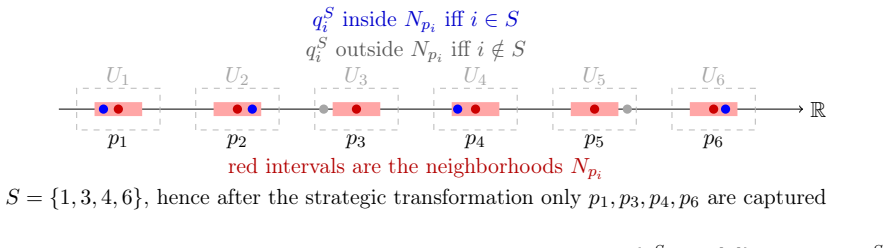
- [§3] §3 (counterexample construction): the explicit hypothesis class and interval neighborhood relation that produce infinite VC-dimension should be stated with a concrete formula or diagram so that the infinite shattering argument can be verified directly.
- [Theorem 4.2] Theorem 4.2 (preservation): the sample-complexity bound is stated in terms of formula complexity, but the precise dependence (e.g., via the number of quantifier alternations or the degree of the defining polynomials) is not displayed; adding an explicit corollary relating syntactic size to the Sauer-Shelah bound would strengthen the result.
- [§2] Notation: the symbol R_exp is introduced without a reference to the standard definition of the real exponential field; a brief parenthetical or footnote citing van den Dries or Marker would aid readers unfamiliar with o-minimality.
Simulated Author's Rebuttal
We thank the referee for their positive and accurate summary of our results on strategic PAC learnability under geometric definability, as well as for recommending minor revision. No specific major comments were raised in the report.
Circularity Check
No significant circularity identified
full rationale
The derivation relies on the external fact that the structure R_exp is o-minimal, which is a known model-theoretic property implying finite VC-dimension for any first-order definable family of sets. The paper shows that the strategic hypothesis class remains first-order definable over R_exp by closing under existential quantification over the definable neighborhood relation, thereby inheriting finite VC-dimension and a sample-complexity bound governed by formula complexity. This is a direct application of standard results on o-minimal structures and definability preservation; it does not reduce any claim to a fitted parameter, self-referential definition, or load-bearing self-citation. The counterexample for general failure is constructed explicitly without reference to the positive result, keeping the positive theorem self-contained against external benchmarks.
Axiom & Free-Parameter Ledger
axioms (1)
- domain assumption Both the hypothesis class and the cost-induced neighborhood relation can be defined by first-order formulas over R_exp.
Lean theorems connected to this paper
-
IndisputableMonolith/Foundation/AbsoluteFloorClosure.leanreality_from_one_distinction unclear?
unclearRelation between the paper passage and the cited Recognition theorem.
Main Theorem 2: if both H and N are definable in R_exp then HN is PAC-learnable with growth function bounded by C m^k (Johnson-Laskowski [JL10])
-
IndisputableMonolith/Foundation/AlexanderDuality.leanalexander_duality_circle_linking unclear?
unclearRelation between the paper passage and the cited Recognition theorem.
Main Theorem 4: existential R_exp formulas of format F and degree D yield VC(HN)=O(F log D) via restricted Pfaffian cell decomposition [BV20, BNZ22]
-
IndisputableMonolith/Cost/FunctionalEquation.leanwashburn_uniqueness_aczel unclear?
unclearRelation between the paper passage and the cited Recognition theorem.
Strategic hypothesis defined by ∃y (Φ_N(x,y) ∧ Φ_H(y,a))
What do these tags mean?
- matches
- The paper's claim is directly supported by a theorem in the formal canon.
- supports
- The theorem supports part of the paper's argument, but the paper may add assumptions or extra steps.
- extends
- The paper goes beyond the formal theorem; the theorem is a base layer rather than the whole result.
- uses
- The paper appears to rely on the theorem as machinery.
- contradicts
- The paper's claim conflicts with a theorem or certificate in the canon.
- unclear
- Pith found a possible connection, but the passage is too broad, indirect, or ambiguous to say the theorem truly supports the claim.
Reference graph
Works this paper leans on
-
[1]
Honest Compressions and Their Application to Compression Schemes , booktitle =
Roi Livni and Pierre Simon , editor =. Honest Compressions and Their Application to Compression Schemes , booktitle =. 2013 , url =
work page 2013
-
[2]
Noga Alon and Dmitrii Avdiukhin and Dor Elboim and Orr Fischer and Grigory Yaroslavtsev , title =. CoRR , volume =. 2023 , url =. doi:10.48550/ARXIV.2312.00379 , eprinttype =. 2312.00379 , timestamp =
-
[3]
Noga Alon and Shay Moran and Amir Yehudayoff , editor =. Sign rank versus. Proceedings of the 29th Conference on Learning Theory,. 2016 , url =
work page 2016
-
[4]
Limitations of Learning Via Embeddings in Euclidean Half Spaces , journal =
Shai Ben. Limitations of Learning Via Embeddings in Euclidean Half Spaces , journal =. 2002 , url =
work page 2002
- [5]
-
[6]
A. W. van der Vaart and J. A. Wellner , Date-Added =
-
[7]
Journal of the ACM (JACM) , volume=
Learnability and the Vapnik-Chervonenkis dimension , author=. Journal of the ACM (JACM) , volume=. 1989 , publisher=
work page 1989
-
[8]
Steve Hanneke , title =. J. Mach. Learn. Res. , volume =. 2016 , url =
work page 2016
- [9]
-
[10]
Journal of Machine Learning Research , volume=
The optimal sample complexity of PAC learning , author=. Journal of Machine Learning Research , volume=
-
[11]
Proper Learning, Helly Number, and an Optimal
Olivier Bousquet and Steve Hanneke and Shay Moran and Nikita Zhivotovskiy , editor =. Proper Learning, Helly Number, and an Optimal. Conference on Learning Theory,. 2020 , url =
work page 2020
-
[12]
Vapnik-Chervonenkis density in some theories without the independence property, I , author=. 2011 , url=
work page 2011
-
[13]
Transactions of the American Mathematical Society , volume=
Lower bounds for approximation by nonlinear manifolds , author=. Transactions of the American Mathematical Society , volume=. 1968 , publisher=
work page 1968
-
[14]
Basu, Saugata and Pollack, Richard and Roy, Marie-Fran. 2006 , KEYWORDS =
work page 2006
-
[15]
Goldberg, Paul W. and Jerrum, Mark R. , date =. Bounding the Vapnik-Chervonenkis dimension of concept classes parameterized by real numbers , url =. Machine Learning , number =. 1995 , bdsk-url-1 =. doi:10.1007/BF00993408 , id =
-
[16]
Handbook of combinatorics , volume=
Tools from higher algebra , author=. Handbook of combinatorics , volume=. 1995 , publisher=
work page 1995
-
[17]
Journal of Machine Learning Research , year =
Ravi Sundaram and Anil Vullikanti and Haifeng Xu and Fan Yao , title =. Journal of Machine Learning Research , year =
-
[18]
Johnson, H. R. and Laskowski, M. C. , date =. Compression Schemes, Stable Definable Families, and o-Minimal Structures , url =. Discrete & Computational Geometry , number =. 2010 , bdsk-url-1 =. doi:10.1007/s00454-009-9201-3 , id =
-
[19]
Proceedings of the 2019 ACM Conference on Economics and Computation (EC) , pages =
Jon Kleinberg and Manish Raghavan , title =. Proceedings of the 2019 ACM Conference on Economics and Computation (EC) , pages =
work page 2019
-
[20]
Edelman and Brian Axelrod , title =
Yonadav Shavit and Benjamin L. Edelman and Brian Axelrod , title =. Proceedings of the 37th International Conference on Machine Learning (ICML) , pages =
-
[21]
Advances in Neural Information Processing Systems (NeurIPS) , year =
Benyamin Trachtenberg and Nir Rosenfeld , title =. Advances in Neural Information Processing Systems (NeurIPS) , year =
-
[22]
Journal of Computer and System Sciences , volume =
Karpinski, Marek and Macintyre, Angus , title =. Journal of Computer and System Sciences , volume =. 1997 , doi =
work page 1997
-
[23]
arXiv preprint arXiv:2209.10972 , year =
Binyamini, Gal and Novikov, Dmitri and Zak, Benny , title =. arXiv preprint arXiv:2209.10972 , year =
- [24]
-
[25]
Effective Cylindrical Cell Decompositions for Restricted Sub-Pfaffian Sets , volume =
Binyamini, Gal and Vorobjov, Nicolai , year =. Effective Cylindrical Cell Decompositions for Restricted Sub-Pfaffian Sets , volume =. International Mathematics Research Notices , doi =
-
[26]
Proceedings of the 2016 ACM conference on innovations in theoretical computer science , pages=
Strategic classification , author=. Proceedings of the 2016 ACM conference on innovations in theoretical computer science , pages=
work page 2016
-
[27]
The Journal of Machine Learning Research , volume=
Static prediction games for adversarial learning problems , author=. The Journal of Machine Learning Research , volume=. 2012 , publisher=
work page 2012
-
[28]
Annals of Mathematics , number =
Gal Binyamini and Dmitry Novikov and Benny Zak , title =. Annals of Mathematics , number =. 2024 , doi =
work page 2024
- [29]
-
[30]
The Thirty Seventh Annual Conference on Learning Theory , pages=
Learnability gaps of strategic classification , author=. The Thirty Seventh Annual Conference on Learning Theory , pages=. 2024 , organization=
work page 2024
- [31]
-
[32]
Alex J. Wilkie , journal =. Model Completeness Results for Expansions of the Ordered Field of Real Numbers by Restricted Pfaffian Functions and the Exponential Function , urldate =
-
[33]
identification of semi-algebraic sets , author=
Localization vs. identification of semi-algebraic sets , author=. Proceedings of the sixth annual conference on Computational learning theory , pages=
-
[34]
Tarski, Alfred , title =
-
[35]
International Conference on Machine Learning , pages=
Strategic classification is causal modeling in disguise , author=. International Conference on Machine Learning , pages=. 2020 , organization=
work page 2020
-
[36]
International Conference on Machine Learning , pages=
Causal strategic classification: A tale of two shifts , author=. International Conference on Machine Learning , pages=. 2023 , organization=
work page 2023
-
[37]
International Conference on Machine Learning , pages=
Generalized strategic classification and the case of aligned incentives , author=. International Conference on Machine Learning , pages=. 2022 , organization=
work page 2022
-
[38]
International Conference on Machine Learning , pages=
Strategic classification in the dark , author=. International Conference on Machine Learning , pages=. 2021 , organization=
work page 2021
-
[39]
Proceedings of the 39th International Conference on Machine Learning , pages =
Information Discrepancy in Strategic Learning , author =. Proceedings of the 39th International Conference on Machine Learning , pages =. 2022 , volume =
work page 2022
-
[40]
Advances in Neural Information Processing Systems , volume=
Strategic Classification under Unknown Personalized Manipulation , author=. Advances in Neural Information Processing Systems , volume=
-
[41]
International Conference on Machine Learning , year=
Strategic Classification with Unknown User Manipulations , author=. International Conference on Machine Learning , year=
-
[42]
Forty-first International Conference on Machine Learning , year=
One-Shot Strategic Classification Under Unknown Costs , author=. Forty-first International Conference on Machine Learning , year=
-
[43]
Basu, Saugata , title =. 1999 , issue_date =. doi:10.1145/320211.320240 , journal =
-
[44]
On the Combinatorial and Algebraic Complexity of Quantifier Elimination , journal =
Basu, Saugata and Pollack, Richard and Roy, Marie-Fran. On the Combinatorial and Algebraic Complexity of Quantifier Elimination , journal =. 1996 , doi =
work page 1996
-
[45]
Journal of Symbolic Computation , volume =
Renegar, James , title =. Journal of Symbolic Computation , volume =. 1992 , doi =
work page 1992
- [46]
-
[47]
Annals of Mathematics , volume =
Seidenberg, Abraham , title =. Annals of Mathematics , volume =. 1954 , doi =
work page 1954
- [48]
-
[49]
Normal Forms, Bifurcations and Finiteness Problems in Differential Equations , editor =
Gabrielov, Andrei and Vorobjov, Nicolai , title =. Normal Forms, Bifurcations and Finiteness Problems in Differential Equations , editor =
-
[50]
Journal of the London Mathematical Society , series =
Gabrielov, Andrei and Vorobjov, Nicolai , title =. Journal of the London Mathematical Society , series =. 2009 , doi =
work page 2009
-
[51]
Exponential families on resource-constrained systems , author=. 2019 , publisher=
work page 2019
-
[52]
van den Dries, Lou , TITLE =. 1998 , PAGES =. doi:10.1017/CBO9780511525919 , URL =
- [53]
-
[54]
On the speed of algebraically defined graph classes , journal =
Lisa Sauermann , keywords =. On the speed of algebraically defined graph classes , journal =. 2021 , issn =. doi:https://doi.org/10.1016/j.aim.2021.107593 , url =
-
[55]
Bartlett and Nick Harvey and Christopher Liaw and Abbas Mehrabian , title =
Peter L. Bartlett and Nick Harvey and Christopher Liaw and Abbas Mehrabian , title =. Journal of Machine Learning Research , year =
-
[56]
Almost Linear VC Dimension Bounds for Piecewise Polynomial Networks , url =
Bartlett, Peter and Maiorov, Vitaly and Meir, Ron , booktitle =. Almost Linear VC Dimension Bounds for Piecewise Polynomial Networks , url =
-
[57]
Proceedings of the 36th AAAI Conference on Artificial Intelligence , pages=
Learning Losses for Strategic Classification , author=. Proceedings of the 36th AAAI Conference on Artificial Intelligence , pages=
-
[58]
Proceedings of the Thirty-Second Conference on Learning Theory , pages =
VC Classes are Adversarially Robustly Learnable, but Only Improperly , author =. Proceedings of the Thirty-Second Conference on Learning Theory , pages =. 2019 , editor =
work page 2019
discussion (0)
Sign in with ORCID, Apple, or X to comment. Anyone can read and Pith papers without signing in.