Recognition: 2 theorem links
· Lean TheoremMagnetar-powered long gamma-ray bursts and connection to superluminous supernovae and fast radio bursts
Pith reviewed 2026-05-15 02:38 UTC · model grok-4.3
The pith
Long gamma-ray bursts powered by magnetars exhibit a correlation where stronger magnetic fields correspond to shorter initial spin periods.
A machine-rendered reading of the paper's core claim, the machinery that carries it, and where it could break.
Core claim
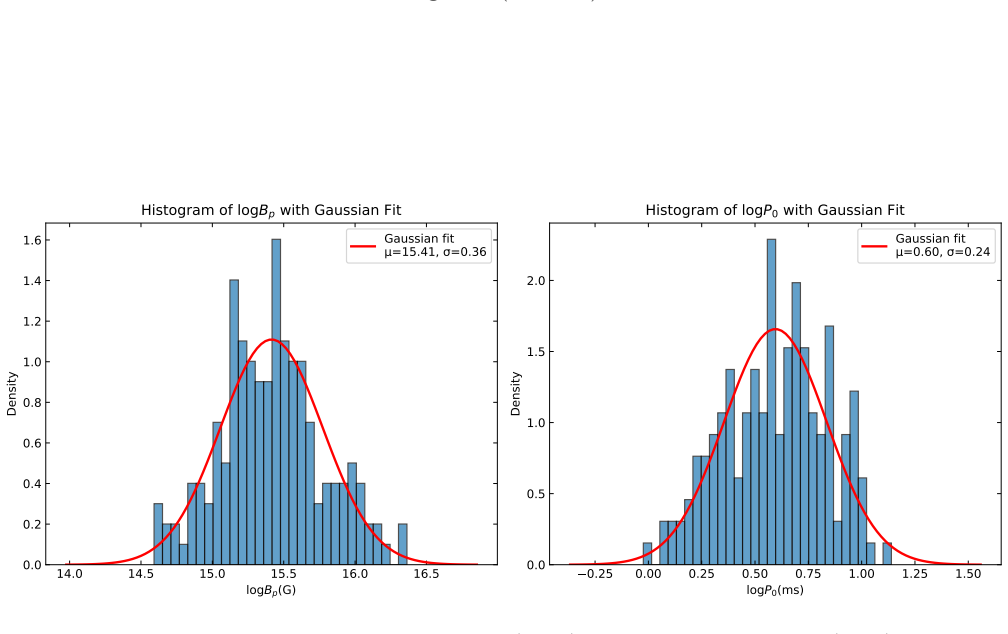
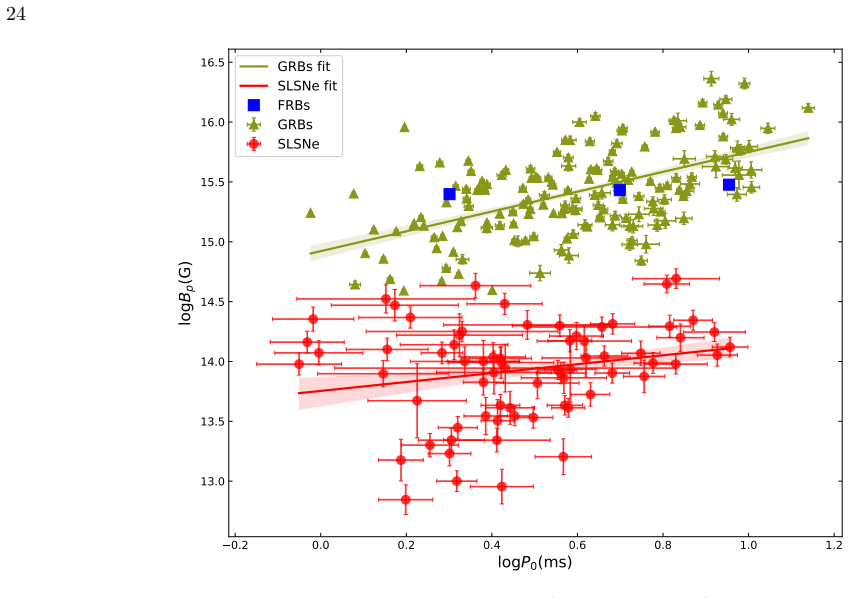
In a sample of 169 long gamma-ray bursts selected for canonical magnetar plateau signatures, the derived magnetar parameters satisfy B_p proportional to P_0 to the power 0.83 plus or minus 0.09 for the full set and 0.80 plus or minus 0.16 for the known-redshift subset. These GRB magnetars possess systematically stronger surface magnetic fields than those powering superluminous supernovae while showing no significant difference from those associated with fast radio bursts, implying distinct progenitor conditions for the former comparison and a possible shared evolutionary channel for the latter.
What carries the argument
Magnetar spin-down energy injection into the external shock, which produces the observed X-ray plateau luminosity L_0 and break time t_b used to solve for surface polar field B_p and initial period P_0.
If this is right
- GRB magnetars arise under collapse conditions that produce stronger magnetic fields than those operating in superluminous-supernova progenitors.
- The absence of a field-strength difference with fast-radio-burst magnetars supports the possibility of a common evolutionary sequence or progenitor channel between the two classes.
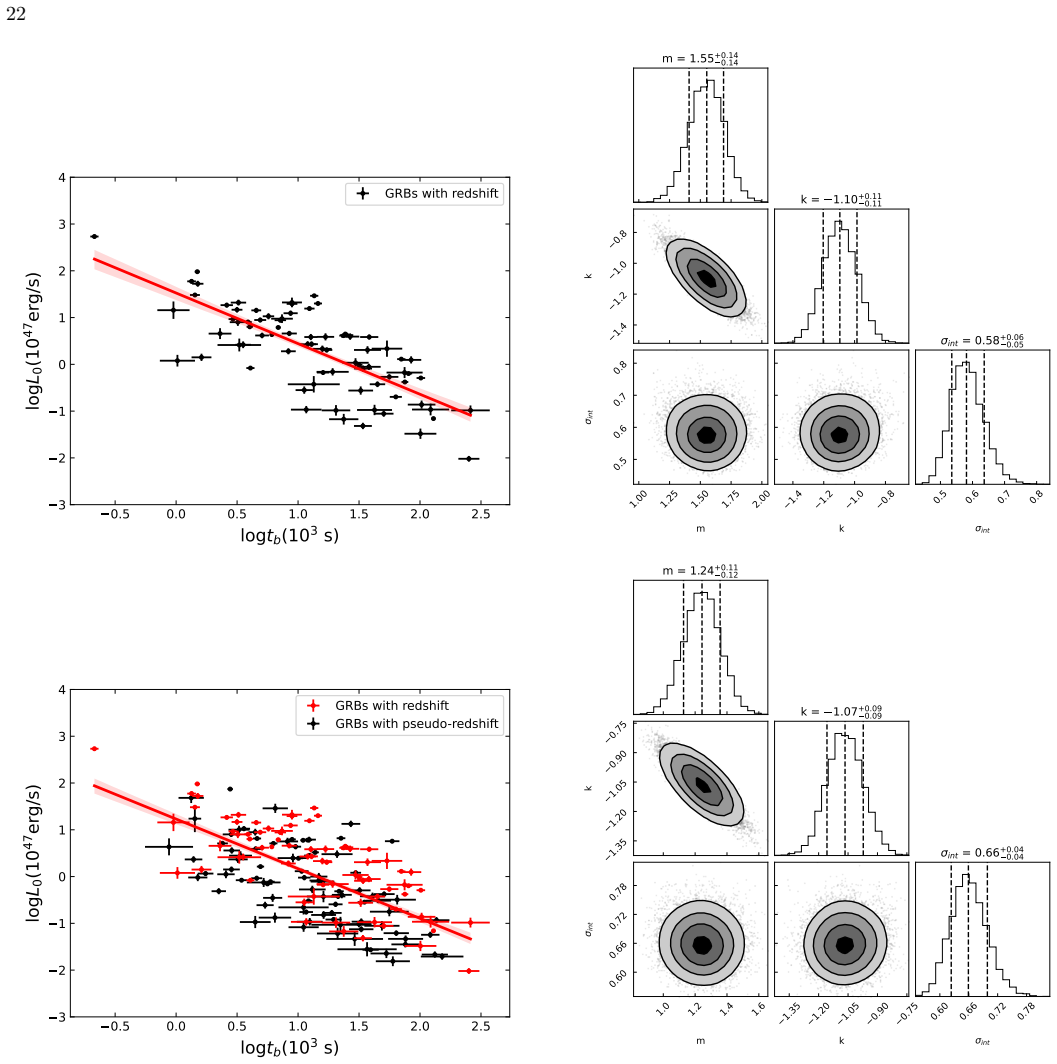
- The Dainotti correlation holding with slope near minus one confirms that the plateau phase reflects a roughly constant rate of energy injection from the central engine.
- The derived parameter distributions supply a uniform, model-consistent catalog for statistical studies of neutron-star birth properties.
Where Pith is reading between the lines
- Different amplification mechanisms during core collapse may operate in gamma-ray-burst progenitors compared with those producing superluminous supernovae.
- A shared magnetar population could connect some gamma-ray bursts and fast radio bursts through orientation or evolutionary stage differences.
- Models of magnetic-field generation in newly formed neutron stars must reproduce a B_p-P_0 scaling close to 0.8 if the observed correlation is physical.
- Joint searches for fast radio bursts accompanying X-ray plateaus could test whether the same objects occupy both populations.
Load-bearing premise
The X-ray plateau must arise from magnetar spin-down rather than alternative energy sources, and the Amati relation must supply pseudo-redshifts accurate enough to yield reliable B_p and P_0 values.
What would settle it
A sample of long gamma-ray bursts with spectroscopically confirmed redshifts that shows either no B_p-P_0 correlation or magnetic fields matching those of superluminous-supernova magnetars instead of being stronger.
Figures



read the original abstract
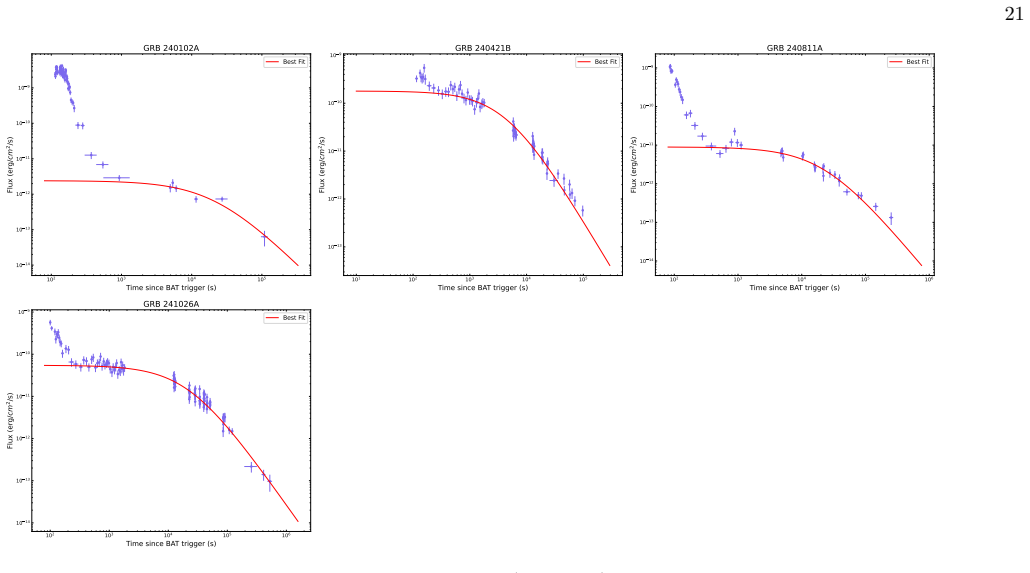
Based on X-ray afterglow observations from the Swift satellite, we construct a sample of 169 long gamma-ray bursts (LGRBs) exhibiting the canonical magnetar plateau signature, i.e., a plateau followed by a $t^{-2}$ decay. We derive the plateau luminosity $L_0$ and break time $t_b$ for each burst by performing Markov Chain Monte Carlo (MCMC) fits to the light curves, and estimate pseudo-redshifts for bursts lacking known redshifts via the Amati relation. The fundamental magnetar parameters are subsequently inferred: the surface polar magnetic field strength $B_p \in [0.39,\ 23.08] \times 10^{15}$G and the initial spin period $P_0 \in [0.95,\ 13.79]$ms. Statistical analysis shows that both the known-redshift subsample and the full sample follow the Dainotti correlation between $L_0$ and $t_b$ with a slope close to $-1$, supporting a constant energy injection rate during the plateau phase. Furthermore, we identify a significant correlation between $B_p$ and $P_0$: $B_p \propto P_0^{0.83 \pm 0.09}$ for the full sample and $B_p \propto P_0^{0.80 \pm 0.16}$ for the known-redshift subsample, with both slopes consistent within uncertainties. Compared to magnetars powering superluminous supernovae (SLSNe), GRB magnetars possess systematically stronger magnetic fields (by approximately one order of magnitude), suggesting fundamental differences in their progenitor systems or collapse conditions; while their magnetic field strengths show no significant difference from those powering fast radio bursts (FRBs), suggesting a possible common evolutionary pathway. This study provides a physics-motivated, model-consistent sample of magnetar-candidate GRBs, offering a robust foundation for statistical investigations within the magnetar central engine model and placing new observational constraints on the birth properties of these extreme compact objects.
Editorial analysis
A structured set of objections, weighed in public.
Referee Report
Summary. The manuscript constructs a sample of 169 long gamma-ray bursts exhibiting X-ray plateaus, performs MCMC fits to extract plateau luminosity L_0 and break time t_b, estimates pseudo-redshifts via the Amati relation for bursts without spectroscopic redshifts, and derives magnetar parameters B_p and P_0. It reports that both the full sample and known-redshift subsample obey the Dainotti relation with slope near -1, identifies a correlation B_p ∝ P_0^{0.83 ± 0.09} (full sample) and B_p ∝ P_0^{0.80 ± 0.16} (known-z subsample), and finds GRB magnetars have systematically stronger fields than SLSN magnetars but comparable to FRB magnetars.
Significance. If the B_p–P_0 correlation is shown to be physical rather than an algebraic consequence of the L_0–t_b mapping under the Dainotti relation, the large sample and MCMC-derived parameters would provide useful observational constraints on the initial spin periods and magnetic fields of GRB central engines, including quantitative differences from SLSN progenitors and a possible evolutionary link to FRBs.
major comments (2)
- [statistical analysis of B_p and P_0] The reported B_p ∝ P_0^{0.83 ± 0.09} correlation is likely induced by the Dainotti relation (slope ≈ −1) through the standard magnetar spin-down mappings L_0 ∝ B_p² P_0^{-4} and t_b ∝ P_0² B_p^{-2}. Inverting these gives B_p ∝ (L_0 t_b²)^{-1/2} and P_0 ∝ (L_0 t_b)^{-1/2}. When L_0 t_b is approximately constant (plus scatter), the derived parameters are no longer independent; the observed index is the expected outcome of propagating the measured L_0–t_b joint distribution. The manuscript does not test whether the slope and significance exceed the null distribution obtained from the L_0–t_b scatter alone (e.g., via Monte Carlo resampling).
- [pseudo-redshift estimation and full-sample results] Pseudo-redshifts derived from the Amati relation carry substantial systematic uncertainty that directly affects the inferred B_p and P_0 values. The paper should propagate these uncertainties explicitly into the reported correlations and demonstrate that the B_p–P_0 slope remains significant when only the known-redshift subsample is used or when Amati scatter is included in the error budget.
minor comments (2)
- [Abstract] The abstract states the B_p range but omits explicit units for P_0 (ms is implied later); add units for consistency.
- [Methods] The conversion formulas from L_0 and t_b to B_p and P_0 should list the exact numerical constants adopted for neutron-star radius and moment of inertia.
Simulated Author's Rebuttal
We thank the referee for their thorough review and constructive feedback on our manuscript. We address each major comment in detail below and have revised the analysis to strengthen the statistical robustness of our results.
read point-by-point responses
-
Referee: [statistical analysis of B_p and P_0] The reported B_p ∝ P_0^{0.83 ± 0.09} correlation is likely induced by the Dainotti relation (slope ≈ −1) through the standard magnetar spin-down mappings L_0 ∝ B_p² P_0^{-4} and t_b ∝ P_0² B_p^{-2}. Inverting these gives B_p ∝ (L_0 t_b²)^{-1/2} and P_0 ∝ (L_0 t_b)^{-1/2}. When L_0 t_b is approximately constant (plus scatter), the derived parameters are no longer independent; the observed index is the expected outcome of propagating the measured L_0–t_b joint distribution. The manuscript does not test whether the slope and significance exceed the null distribution obtained from the L_0–t_b scatter alone (e.g., via Monte Carlo resampling).
Authors: We agree that this is a critical point and that the observed B_p–P_0 correlation could partly arise from the scatter around the Dainotti relation via the algebraic mappings. To address this rigorously, we will add a Monte Carlo test in the revised manuscript: we will generate large numbers of synthetic L_0–t_b pairs drawn from the observed joint distribution (including the measured Dainotti slope and intrinsic scatter), compute the corresponding B_p and P_0 values, and derive the null distribution of the fitted power-law index α in B_p ∝ P_0^α. We will then compare our measured slopes (0.83 ± 0.09 for the full sample and 0.80 ± 0.16 for the known-z subsample) against this null distribution to quantify the significance of any excess correlation. This will clarify whether the relation contains a physical component beyond the induced effect. revision: yes
-
Referee: [pseudo-redshift estimation and full-sample results] Pseudo-redshifts derived from the Amati relation carry substantial systematic uncertainty that directly affects the inferred B_p and P_0 values. The paper should propagate these uncertainties explicitly into the reported correlations and demonstrate that the B_p–P_0 slope remains significant when only the known-redshift subsample is used or when Amati scatter is included in the error budget.
Authors: We acknowledge the importance of propagating the Amati-relation scatter. In the revised manuscript we will explicitly include the typical Amati scatter (≈0.3–0.4 dex) when estimating pseudo-redshifts and will propagate the resulting uncertainties on luminosity distance, L_0, and t_b into the derived B_p and P_0 values for the full sample. As already reported, the known-redshift subsample (which bypasses pseudo-redshifts entirely) yields a fully consistent slope of 0.80 ± 0.16 that remains statistically significant; we will highlight this comparison more prominently and show the effect of adding Amati scatter on the full-sample fit to demonstrate robustness. revision: yes
Circularity Check
No significant circularity; correlations are empirical outputs from data-driven parameter derivation
full rationale
The paper obtains L0 and tb directly from MCMC fits to observed Swift X-ray light curves, applies standard (non-self-referential) magnetar spin-down formulas to compute Bp and P0, confirms the Dainotti relation in the fitted L0-tb plane, and reports the Bp-P0 power-law as a statistical property of the resulting sample. No step reduces the reported correlation to an algebraic identity of the inputs, a fitted parameter renamed as a prediction, or a self-citation chain; the derivation chain remains self-contained against the external light-curve data.
Axiom & Free-Parameter Ledger
free parameters (1)
- Amati relation parameters
axioms (1)
- domain assumption X-ray plateau followed by t^{-2} decay is produced by magnetar spin-down energy injection
Lean theorems connected to this paper
-
IndisputableMonolith/Cost/FunctionalEquation.leanwashburn_uniqueness_aczel unclear?
unclearRelation between the paper passage and the cited Recognition theorem.
L_EM(t) = L_EM,0 / (1 + t/t_b)^2 with L_EM,0 = B_p² R^6 Ω_0^4 / (6 c^3) and t_b = 3 c^3 I / (B_p² R^6 Ω_0²); inversion yields B_p,15 ∝ (L_EM,49 t_3)^{-1/2} and P_0,-3 ∝ (L_EM,49 t_3)^{-1/2}
What do these tags mean?
- matches
- The paper's claim is directly supported by a theorem in the formal canon.
- supports
- The theorem supports part of the paper's argument, but the paper may add assumptions or extra steps.
- extends
- The paper goes beyond the formal theorem; the theorem is a base layer rather than the whole result.
- uses
- The paper appears to rely on the theorem as machinery.
- contradicts
- The paper's claim conflicts with a theorem or certificate in the canon.
- unclear
- Pith found a possible connection, but the passage is too broad, indirect, or ambiguous to say the theorem truly supports the claim.
Reference graph
Works this paper leans on
-
[1]
Abbott, B. P., Abbott, R., Abbott, T. D., et al. 2017, ApJL, 848, 2, L12. Amati, L., Frontera, F., Tavani, M., et al. 2002, A&A, 390,
work page 2017
- [2]
-
[3]
Amati, L., D’Agostino, R., Luongo, O., et al. 2019, MNRAS, 486, 1, L46. Ascenzi, S., Oganesyan, G., Salafia, O. S., et al. 2020, A&A, 641, A61. Atteia, J.-L. 2003, A&A, 407, L1. Band, D., Matteson, J., Ford, L., et al. 1993, ApJ, 413,
work page 2019
-
[4]
Bargiacchi, G, Dainotti, M & Capozziello, S., 2025, New Astronomy Reviews, 100, 101712 Berger, E., Fong, W., & Chornock, R. 2013, ApJL, 774, 2, L23. Bhattacharya, M., Murase, K., & Kashiyama, K. 2025, MNRAS. Blandford, R. D. & Znajek, R. L. 1977, MNRAS, 179,
work page 2025
- [5]
- [6]
-
[7]
Bochenek, C. D., Ravi, V., Belov, K. V., et al. 2020, Nature, 587, 7832,
work page 2020
- [8]
- [9]
-
[10]
H., Yan, L., Kangas, T., et al
Chen, Z. H., Yan, L., Kangas, T., et al. 2023, ApJ, 943, 1,
work page 2023
-
[11]
CHIME/FRB Collaboration, Andersen, B. C., Bandura, K. M., et al. 2020, Nature, 587, 7832,
work page 2020
- [12]
- [13]
- [14]
-
[15]
D’Avanzo, P., Perri, M., Fugazza, D., et al. 2010, A&A, 522, A20. Dai, Z. G. & Lu, T. 1998, PhRvL, 81, 20,
work page 2010
-
[16]
Dai, Z. G. & Lu, T. 1998, A&A, 333, L87. Dainotti, M. G., Cardone, V. F., Piedipalumbo, E., et al. 2013, MNRAS, 436, 1,
work page 1998
-
[17]
Dainotti, M. G., Cardone, V. F., & Capozziello, S. 2008, MNRAS, 391, 1, L79. Dainotti, M. G., Hernandez, X., Postnikov, S., et al. 2017, ApJ, 848, 2,
work page 2008
-
[18]
Dainotti, M. G., Lenart, A. L., Sarracino, G., et al. 2020, ApJ, 904, 2,
work page 2020
-
[19]
G., Willingale, R., Capozziello, S., et al
Dainotti, M. G., Willingale, R., Capozziello, S., et al. 2010, ApJL, 722, 2, L215. Dainotti, M. G., Nielson, V., Sarracino, G., et al. 2022, MNRAS, 514, 2,
work page 2010
-
[20]
G., Bargiacchi, G., Bogdan, M., et al
Dainotti, M. G., Bargiacchi, G., Bogdan, M., et al. 2023, ApJ, 951, 1,
work page 2023
-
[21]
Dainotti, M. G., Lenart, A. L., Chraya, A., et al. 2023, MNRAS, 518, 2,
work page 2023
-
[22]
G., Narendra, A., Pollo, A., et al
Dainotti, M. G., Narendra, A., Pollo, A., et al. 2024, ApJL, 967, 2, L30. Dainotti, M. G., Taira, E., Wang, E., et al. 2024, ApJS, 271, 1,
work page 2024
-
[23]
Gamma-Ray Bursts as an Independent High-Redshift Probe of Dark Energy
Dainotti, M. G., Lukasz Lenart, A., De Simone, B., et al. 2026, arXiv:2603.18223. Dall’Osso, S., Stratta, G., Guetta, D., et al. 2011, A&A, 526, A121. Dereli-B´ egu´ e, H., Pe’er, A., Ryde, F., et al. 2022, Nature Communications, 13,
work page internal anchor Pith review Pith/arXiv arXiv 2026
- [24]
-
[25]
Eichler, D., Livio, M., Piran, T., et al. 1989, Nature, 340, 6229,
work page 1989
-
[26]
Evans, P. A., Beardmore, A. P., Page, K. L., et al. 2007, A&A, 469, 1,
work page 2007
-
[27]
10 Evans, P. A., Beardmore, A. P., Page, K. L., et al. 2009, MNRAS, 397, 3,
work page 2009
-
[28]
A., Willingale, R., Osborne, J
Evans, P. A., Willingale, R., Osborne, J. P., et al. 2010, A&A, 519, A102. Favale, A., Dainotti, M. G., G´ omez-Valent, A., et al. 2024, Journal of High Energy Astrophysics, 44,
work page 2010
-
[29]
Foreman-Mackey, D., Hogg, D. W., Lang, D., et al. 2013, PASP, 125, 925,
work page 2013
- [30]
-
[31]
Gao, H., Zhang, B., & L¨ u, H.-J. 2016, PhRvD, 93, 4, 044065. Gehrels, N., Ramirez-Ruiz, E., & Fox, D. B. 2009, ARA&A, 47, 1,
work page 2016
- [32]
-
[33]
Hjorth, J., Sollerman, J., Møller, P., et al. 2003, Nature, 423, 6942,
work page 2003
-
[34]
& Bildsten, L., 2010, ApJ, 717, 245 Khadka, N., Luongo, O., Muccino, M., et al
Kasen, D. & Bildsten, L., 2010, ApJ, 717, 245 Khadka, N., Luongo, O., Muccino, M., et al. 2021, JCAP, 2021, 9,
work page 2010
-
[35]
Kouveliotou, C., Meegan, C. A., Fishman, G. J., et al. 1993, ApJL, 413, L101. Kumar, P. & Zhang, B. 2015, PhR, 561,
work page 1993
- [36]
-
[37]
Lan, L., Gao, H., Zhao, L., et al. 2025, , arXiv:2511.22149. Lasky, P. D., Leris, C., Rowlinson, A., et al. 2017, ApJL, 843, 1, L1. Lattimer, J. M. & Prakash, M. 2001, ApJ, 550, 1,
- [38]
- [39]
-
[40]
Lenart, A. L., Dainotti, M. G., Khatiya, N., et al. 2025, Journal of High Energy Astrophysics, 47, 100384. Levine, D., Dainotti, M., Zvonarek, K. J., et al. 2022, ApJ, 925, 1,
work page 2025
- [41]
-
[42]
Li, X.-Y., Liu, T., Huang, B.-Q., et al. 2026, , arXiv:2601.01586. Liu, T., Gu, W.-M., & Zhang, B. 2017, NewAR, 79,
-
[43]
Lyons, N., O’Brien, P. T., Zhang, B., et al. 2010, MNRAS, 402, 2,
work page 2010
- [44]
- [45]
- [46]
- [47]
-
[48]
MacFadyen, A. I. & Woosley, S. E. 1999, ApJ, 524, 1,
work page 1999
-
[49]
Margalit, B. & Metzger, B. D. 2018, ApJL, 868, 1, L4. Metzger, B. D., Giannios, D., Thompson, T. A., et al. 2011, MNRAS, 413, 3,
work page 2018
-
[50]
D., Quataert, E., & Thompson, T
Metzger, B. D., Quataert, E., & Thompson, T. A. 2008, MNRAS, 385, 3,
work page 2008
-
[51]
Metzger, B. D. & Piro, A. L. 2014, MNRAS, 439, 4,
work page 2014
-
[52]
& Meszaros, P., 2016, MNRAS, 461, 1498 Narayan, R., Paczynski, B., & Piran, T
Murase, K., Kashiyama, K. & Meszaros, P., 2016, MNRAS, 461, 1498 Narayan, R., Paczynski, B., & Piran, T. 1992, ApJL, 395, L83. Narendra, A., Dainotti, M. G., Sarkar, M., et al. 2025, A&A, 698, A92. Nicholl, M., Williams, P. K. G., Berger, E., et al. 2017, ApJ, 843, 2,
work page 2016
-
[53]
A., Kouveliotou, C., Grupe, D., et al
Nousek, J. A., Kouveliotou, C., Grupe, D., et al. 2006, ApJ, 642, 1,
work page 2006
-
[54]
2023, Science Advances, 9, 23, eadi1405
O’Connor, B., Troja, E., Ryan, G., et al. 2023, Science Advances, 9, 23, eadi1405. Oganesyan, G., Ascenzi, S., Branchesi, M., et al. 2020, ApJ, 893, 2,
work page 2023
-
[55]
2004, Reviews of Modern Physics, 76, 4,
Piran, T. 2004, Reviews of Modern Physics, 76, 4,
work page 2004
-
[56]
Planck Collaboration, Aghanim, N., Akrami, Y., et al. 2020, A&A, 641, A6. Platts, E., Weltman, A., Walters, A., et al. 2019, PhR, 821,
work page 2020
- [57]
- [58]
-
[59]
Rahaman, S. M., Acharya, S. K., Beniamini, P., et al. 2025, ApJ, 988, 2,
work page 2025
- [60]
-
[61]
Rowlinson, A., O’Brien, P. T., Tanvir, N. R., et al. 2010, MNRAS, 409, 2,
work page 2010
-
[62]
Rowlinson, A., Gompertz, B. P., Dainotti, M., et al. 2014, MNRAS, 443, 2,
work page 2014
-
[63]
Rowlinson, A., O’Brien, P. T., Metzger, B. D., et al. 2013, MNRAS, 430, 2,
work page 2013
- [64]
- [65]
-
[66]
Schaefer, B. E. 2007, ApJ, 660, 1,
work page 2007
- [67]
-
[68]
Stratta, G., Dainotti, M. G., Dall’Osso, S., et al. 2018, ApJ, 869, 2,
work page 2018
-
[69]
Tang, C.-H., Huang, Y.-F., Geng, J.-J., et al. 2019, ApJS, 245, 1,
work page 2019
- [70]
- [71]
- [72]
-
[73]
Usov, V. V. 1992, Nature, 357, 6378,
work page 1992
-
[74]
Wang, F. Y. & Dai, Z. G., 2013, Nature Physics, 9, 463 Wang, F. Y., Dai, Z. G., & Liang, E. W. 2015, NewAR, 67,
work page 2013
- [75]
-
[76]
Wang, F. Y., Zhang, G. Q., Dai, Z. G. & Cheng, K. S., 2022, Nature Communications, 13, 4382 Wang, F. Y., Qi, S. & Dai, Z. G., 2011, MNRAS, 415, 3423 Wang, J. S., Wang, F. Y., Cheng, K. S. & Dai, Z. G., 2016, A&A, 585, A68 Wei, J., et al., 2016, arXiv: 1610.06892 Willingale, R., O’Brien, P. T., Osborne, J. P., et al. 2007, ApJ, 662, 2,
work page internal anchor Pith review Pith/arXiv arXiv 2022
-
[77]
Woosley, S. E. & Bloom, J. S. 2006, ARA&A, 44, 1,
work page 2006
-
[78]
Woosley, S. E. 1993, ApJ, 405,
work page 1993
-
[79]
E., 2010, ApJL, 719, L204 Xiao, D
Woosley, S. E., 2010, ApJL, 719, L204 Xiao, D. & Dai, Z.-G. 2019, ApJ, 878, 1,
work page 2010
- [80]
discussion (0)
Sign in with ORCID, Apple, or X to comment. Anyone can read and Pith papers without signing in.