Recognition: 1 theorem link
· Lean TheoremMagnetic fields in monoclinic α-RuCl₃ reveal rhombohedral inclusions underlying apparent oscillations
Pith reviewed 2026-05-14 18:08 UTC · model grok-4.3
The pith
Transitions beyond antiferromagnetic order in α-RuCl₃ arise from multiple shifted phase boundaries caused by rhombohedral inclusions.
A machine-rendered reading of the paper's core claim, the machinery that carries it, and where it could break.
Core claim
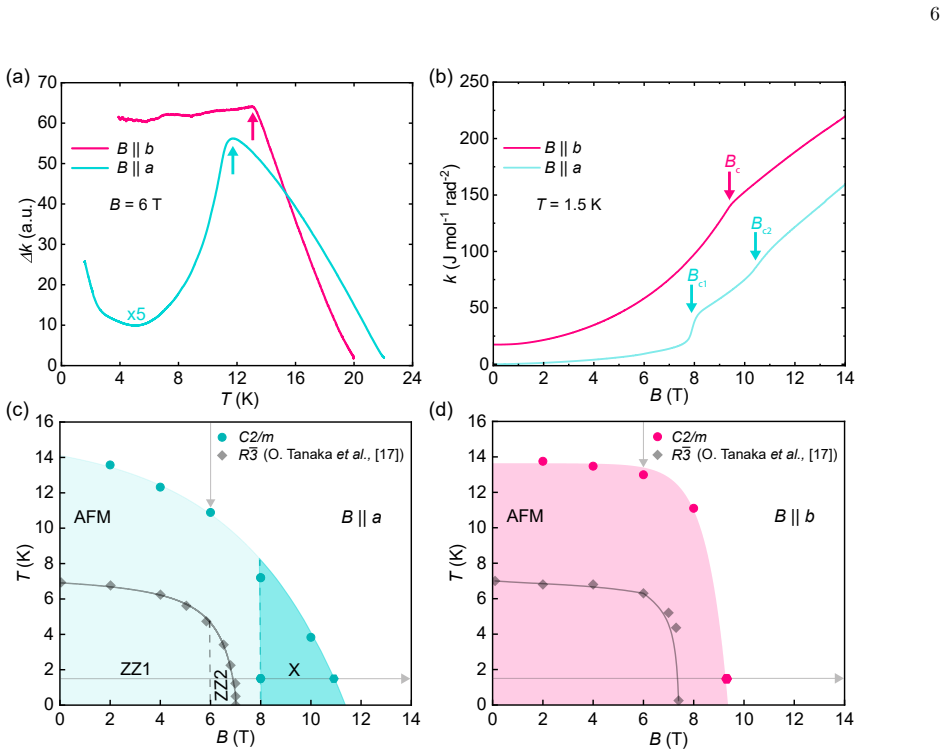
By studying structurally well-defined monoclinic α-RuCl₃ at low temperature, the antiferromagnetic phase diagram is found to closely resemble that of rhombohedral crystals yet is systematically shifted to higher transition temperatures and critical fields. For B parallel to a, a two-step suppression of order appears, indicating an intermediate ordered phase. The transitions observed beyond the antiferromagnetic regime under in-plane fields are therefore produced by multiple shifted antiferromagnetic boundaries associated with monoclinic inclusions rather than by non-magnetic phases.
What carries the argument
High-resolution magnetotropic susceptibility measurements that map the antiferromagnetic phase boundary versus temperature, field strength, and crystal orientation in nanogram-scale monoclinic crystals.
If this is right
- The monoclinic antiferromagnetic boundary lies at higher fields and temperatures than the rhombohedral one.
- An intermediate ordered phase exists under in-plane fields in the monoclinic structure.
- Apparent non-magnetic phases are reinterpreted as incomplete structural conversion to the rhombohedral stacking.
- Structural symmetry and sample homogeneity control the interpretation of field-induced states in α-RuCl₃.
Where Pith is reading between the lines
- Engineering the low-temperature stacking transition could stabilize a single phase and allow cleaner searches for a quantum spin liquid.
- Analogous inclusion effects may appear in other layered quantum magnets whose stacking changes with temperature.
- Strain or sample-size tuning could be used to test whether the phase boundaries move continuously between the two structures.
Load-bearing premise
The magnetotropic susceptibility data cleanly isolate contributions from the monoclinic matrix versus rhombohedral inclusions without undetected strain or defects shifting the observed boundaries.
What would settle it
The same extra transitions appear in a low-temperature crystal confirmed to be purely rhombohedral, or they are absent in a crystal confirmed to remain purely monoclinic with no inclusions.
Figures



read the original abstract
The majority of research on $\alpha$-RuCl$_3$ has focused on applying in-plane magnetic fields to suppress antiferromagnetic order and induce a quantum spin liquid (QSL). However, this effort has been complicated by the materials temperature-dependent crystal structure and sensitivity to strain-induced stacking disorder, making interpretation of field-induced phenomena contentious. The crystal structure of $\alpha$-RuCl$_3$ has recently been clarified as a function of temperature and sample size, motivating a reassessment of its magnetic properties and connection to proposed spin-liquid signatures. Here, we show that the monoclinic structure can be isolated in nanogram-scale crystals, enabling the study of Kitaev physics in a new regime. We focus on a structurally well-defined monoclinic crystal at low temperature and perform high-resolution magnetotropic susceptibility measurements in several crystal planes. Mapping the AFM phase boundary versus temperature, field, and orientation, we find the monoclinic phase diagram closely resembles rhombohedral crystals but is systematically shifted to higher transition temperatures and critical fields. For $B \parallel a$, we observe a two-step suppression of AFM order, indicating an intermediate ordered phase analogous to the ZZ2 phase reported in rhombohedral samples. Our results show that transitions previously observed beyond the AFM regime under in-plane fields arise from multiple shifted AFM phase boundaries associated with monoclinic inclusions, rather than non-magnetic phases. These findings indicate that features attributed to a QSL are instead due to an incomplete transition from the high-temperature monoclinic to the low-temperature rhombohedral structure. They also highlight the role of structural symmetry and sample homogeneity in interpreting field-induced phenomena in $\alpha$-RuCl$_3$ and related two-dimensional quantum magnets.
Editorial analysis
A structured set of objections, weighed in public.
Referee Report
Summary. The paper reports high-resolution magnetotropic susceptibility measurements on nanogram-scale monoclinic α-RuCl₃ crystals, mapping the antiferromagnetic (AFM) phase boundaries versus temperature, field strength, and orientation. It finds that the monoclinic phase diagram closely resembles that of rhombohedral crystals but is shifted to higher transition temperatures and critical fields, with a two-step suppression of AFM order observed for B ∥ a. The central claim is that transitions previously interpreted as beyond the AFM regime under in-plane fields arise from multiple shifted AFM phase boundaries due to rhombohedral inclusions, rather than non-magnetic phases or quantum spin liquid signatures, attributing apparent QSL features to incomplete structural transitions.
Significance. If the interpretation holds, the work provides a structural resolution to contentious interpretations of field-induced phenomena in α-RuCl₃, linking them to sample inhomogeneity from the temperature-dependent monoclinic-to-rhombohedral transition. It underscores the importance of structural characterization and sample homogeneity in Kitaev materials research. The high-resolution data on well-defined small crystals and consistency with cited structural studies represent strengths in supporting the inclusion model over exotic-phase interpretations.
major comments (1)
- The two-step AFM suppression for B ∥ a is presented as evidence for an intermediate ordered phase analogous to the ZZ2 phase in rhombohedral samples; however, the manuscript should explicitly address how this feature is distinguished from possible undetected strain or defect effects that could alter apparent boundaries, as this separation is load-bearing for the inclusion interpretation over alternative explanations.
minor comments (2)
- The methods section would benefit from additional detail on the criteria used to select and verify nanogram-scale crystals as purely monoclinic, including any diffraction or other structural probes employed.
- Figure captions and axis labels in the susceptibility maps should explicitly indicate which features are attributed to the monoclinic matrix versus rhombohedral inclusions to improve clarity for readers.
Simulated Author's Rebuttal
We thank the referee for the positive assessment and recommendation for minor revision. The single major comment is addressed point-by-point below, and we will incorporate the requested clarification into the revised manuscript.
read point-by-point responses
-
Referee: The two-step AFM suppression for B ∥ a is presented as evidence for an intermediate ordered phase analogous to the ZZ2 phase in rhombohedral samples; however, the manuscript should explicitly address how this feature is distinguished from possible undetected strain or defect effects that could alter apparent boundaries, as this separation is load-bearing for the inclusion interpretation over alternative explanations.
Authors: We agree that an explicit discussion of this distinction is needed to reinforce the inclusion model. In the revised manuscript we will add a dedicated paragraph in the discussion section. The two-step feature is distinguished from strain or defect effects by the following: (i) measurements are performed on nanogram-scale crystals whose monoclinic structure and low defect density are confirmed by high-resolution XRD and the extreme sharpness of the susceptibility transitions (widths < 0.1 T); (ii) the field values of both steps coincide, within experimental resolution, with the ZZ1–ZZ2 and ZZ2–paramagnetic boundaries reported for rhombohedral crystals once the known structural shift in critical fields is accounted for; (iii) strain-induced broadening would smear rather than produce two distinct, equally sharp steps at precisely offset locations. We will cite the structural literature showing that nanogram crystals minimize stacking faults and residual strain compared with larger samples. These additions will make the argument against undetected inhomogeneity explicit. revision: yes
Circularity Check
No significant circularity
full rationale
This is a purely experimental paper with no derivation chain, equations, or model-based predictions. Central claims rest on direct high-resolution magnetotropic susceptibility measurements that map AFM phase boundaries in monoclinic crystals and compare them to rhombohedral samples. No fitted parameters are relabeled as predictions, no self-definitional loops exist, and cited structural clarifications are external references rather than self-citations that bear the load of the argument. The analysis is self-contained against the reported data.
Axiom & Free-Parameter Ledger
axioms (1)
- domain assumption Magnetotropic susceptibility accurately maps magnetic phase boundaries and anisotropy in layered magnets.
Reference graph
Works this paper leans on
-
[1]
Anyons in an exactly solved model and beyond
A. Kitaev, Annals of Physics 10.1016/j.aop.2005.10.005 (2006), cond-mat/0506438
work page internal anchor Pith review Pith/arXiv arXiv doi:10.1016/j.aop.2005.10.005 2005
-
[2]
G. Jackeli and G. Khaliullin 10.1103/physrevlett.102.017205 (2009)
-
[3]
S. Kim, B. Yuan, and Y.-J. Kim, APL Materials10, 080903 (2022)
2022
-
[4]
Loidl, P
A. Loidl, P. Lunkenheimer, and V. Tsurkan, Journal of Physics: Condensed Matter33, 443004
-
[5]
C. Ojeda-Aristizabal, X. Zheng, C. Xu, Z. Nussinov, Y. Motome, A. Banerjee, A. W. Tsen, M. Knap, R.-R. Du, G. Joshi, et al., arXiv preprint arXiv:2511.13838 (2025). 12
-
[6]
R. D. Johnson, S. Williams, A. Haghighirad, J. Singleton, V. Zapf, P. Manuel, I. Mazin, Y. Li, H. O. Jeschke, R. Valent´ ı, et al., Physical Review B92, 235119 (2015)
2015
-
[7]
H. B. Cao, A. Banerjee, J.-Q. Yan, C. A. Bridges, M. D. Lumsden, D. G. Mandrus, D. A. Tennant, B. C. Chakoumakos, and S. E. Nagler, PHYSICAL REVIEW B93, 134423 (2016)
2016
-
[8]
Banerjee, J
A. Banerjee, J. Yan, J. Knolle, C. A. Bridges, M. B. Stone, M. D. Lumsden, D. G. Mandrus, D. A. Tennant, R. Moessner, and S. E. Nagler,Neutron scattering in the proximate quantum spin liquidα-RuCl3, Tech. Rep. (2017)
2017
- [9]
-
[10]
Banerjee, P
A. Banerjee, P. Lampen-Kelley, J. Knolle, C. Balz, A. A. Aczel, B. Winn, Y. Liu, D. Pajerowski, J. Yan, C. A. Bridges, et al., npj Quantum Materials3, 8 (2018)
2018
-
[11]
Field-induced quantum criticality in the Kitaev system $\alpha$-RuCl$_3$
A. Wolter, L. Corredor, L. Janssen, K. Nenkov, S. Sch¨ onecker, S.-H. Do, K.-Y. Choi, R. Albrecht, J. Hunger, T. Doert, et al., arXiv preprint arXiv:1704.03475 (2017)
work page internal anchor Pith review Pith/arXiv arXiv 2017
-
[12]
Li, H.-K
H. Li, H.-K. Zhang, J. Wang, H.-Q. Wu, Y. Gao, D.-W. Qu, Z.-X. Liu, S.-S. Gong, and W. Li, Nature Communications 12, 4007 (2021)
2021
-
[13]
Jiang, T
Y.-F. Jiang, T. P. Devereaux, and H.-C. Jiang, Physical Review B100, 165123 (2019)
2019
- [14]
-
[15]
Bachus, D
S. Bachus, D. A. Kaib, Y. Tokiwa, A. Jesche, V. Tsurkan, A. Loidl, S. M. Winter, A. A. Tsirlin, R. Valent´ ı, and P. Gegen- wart, Physical Review Letters125, 097203 (2020)
2020
-
[16]
Bachus, D
S. Bachus, D. A. Kaib, A. Jesche, V. Tsurkan, A. Loidl, S. M. Winter, A. A. Tsirlin, R. Valenti, and P. Gegenwart, Physical Review B103, 054440 (2021)
2021
- [17]
-
[18]
Y. Kasahara, K. Sugii, T. Ohnishi, M. Shimozawa, M. Yamashita, N. Kurita, H. Tanaka, J. Nasu, Y. Motome, T. Shibauchi, and Y. Matsuda, Physical Review Letters120, 10.1103/physrevlett.120.217205 (2018)
- [19]
-
[20]
J. S. Gordon, A. Catuneanu, E. S. Sørensen, and H.-Y. Kee, Nature Communications 2019 10:110, 1 (2019)
2019
- [21]
-
[22]
Kubota, H
Y. Kubota, H. Tanaka, T. Ono, Y. Narumi, and K. Kindo, PHYSICAL REVIEW B91, 94422 (2015)
2015
-
[23]
S. Kim, . E. H. P. C. Ruff, . B. D. Moreno, and Kim, 3 and Young-June, Physical Review B 10.1103/physrevb.109.l140101
- [24]
- [25]
- [26]
-
[27]
Kee, Nature Materials22, 6 (2023), 2301.03526
H.-Y. Kee, Nature Materials22, 6 (2023), 2301.03526
- [28]
-
[29]
S. Kim, E. Horsley, C. S. Nelson, J. P. C. Ruff, and Y.-J. Kim, Journal of Physics: Condensed Matter37, 215601 (2025)
2025
- [30]
-
[31]
K. A. Modic, M. D. Bachmann, B. J. Ramshaw, F. Arnold, K. R. Shirer, A. Estry, J. B. Betts, N. J. Ghimire, E. D. Bauer, M. Schmidt, M. Baenitz, E. Svanidze, R. D. McDonald, A. Shekhter, and P. J. Moll, Nature Communications 2018 9:19, 1 (2018), 1802.08211
work page internal anchor Pith review Pith/arXiv arXiv 2018
-
[32]
A. Shekhter, R. D. McDonald, B. J. Ramshaw, and K. A. Modic, Physical Review B108, 035111 (2023), 2208.10038
-
[33]
K. A. Modic, R. D. McDonald, J. P. Ruff, M. D. Bachmann, Y. Lai, J. C. Palmstrom, D. Graf, M. K. Chan, F. F. Balakirev, J. B. Betts, G. S. Boebinger, M. Schmidt, M. J. Lawler, D. A. Sokolov, P. J. Moll, B. J. Ramshaw, and A. Shekhter, Nature Physics 2020 17:217, 240 (2020), 2005.04228
-
[34]
J. A. Sears, Y. Zhao, Z. Xu, J. W. Lynn, and Y.-J. Kim,Phase Diagram ofα-RuCl 3 in an in-plane Magnetic Field, Tech. Rep. (2017). 13
2017
-
[35]
Wagner, A
J. Wagner, A. Sahasrabudhe, R. B. Versteeg, L. Wysocki, Z. Wang, V. Tsurkan, A. Loidl, D. I. Khomskii, H. Hedayat, and P. H. M. v. Loosdrecht, npj Quantum Materials7, 28 (2022)
2022
-
[36]
Lefran¸ cois, J
E. Lefran¸ cois, J. Baglo, Q. Barth´ elemy, S. Kim, Y.-J. Kim, and L. Taillefer, Phys. Rev. B107, 064408 (2023)
2023
-
[37]
T. Akiyama, N. F. D. Rooij, U. Staufer, M. Detterbeck, D. Braendlin, S. Waldmeier, and M. Scheidiger, Citation: Review of Scientific Instruments81, 10.1063/1.3455219 (2010), http://aip.scitation.org/toc/rsi/81/6
-
[38]
P. Harford, E. Horsley, S. Kim, and Y.-J. Kim, arXiv preprint arXiv:2601.00210 (2026)
-
[39]
Evidence for a Field-induced Quantum Spin Liquid in $\alpha$-RuCl$_3$
S.-H. Baek, S.-H. Do, K.-Y. Choi, Y. S. Kwon, A. U. B. Wolter, S. Nishimoto, J. V. D. Brink, and B. B¨ uchner, , 1 (2017), 1702.01671
work page internal anchor Pith review Pith/arXiv arXiv 2017
-
[40]
A. U. B. Wolter, L. T. Corredor, L. Janssen, K. Nenkov, S. Sch¨ onecker, S.-H. Do, K.-Y. Choi, R. Albrecht, J. Hunger, T. Doert, M. Vojta, and B. B¨ uchner, (2017)
2017
-
[41]
Y. Kasahara, Y. Mizukami, O. tanaka, S. Ma, K. Sugii, N. Kurita, H. tanaka, J. Nasu, Y. Motome, and Y. Matsuda, Nature 10.1038/s41586-018-0274-0 (2018)
-
[42]
Majumder, M
M. Majumder, M. Schmidt, H. Rosner, A. Tsirlin, H. Yasuoka, and M. Baenitz, Physical Review B91, 180401 (2015)
2015
-
[43]
I. A. Leahy, C. A. Pocs, P. E. Siegfried, D. Graf, S.-H. Do, K.-Y. Choi, B. Normand, and M. Lee, Physical review letters 118, 187203 (2017)
2017
-
[44]
Zheng, K
J. Zheng, K. Ran, T. Li, J. Wang, P. Wang, B. Liu, Z.-X. Liu, B. Normand, J. Wen, and W. Yu, Physical review letters 119, 227208 (2017)
2017
-
[45]
Do, S.-Y
S.-H. Do, S.-Y. Park, J. Yoshitake, J. Nasu, Y. Motome, Y. S. Kwon, D. T. Adroja, D. J. Voneshen, K. Kim, T.-H. Jang, J.-H. Park, K.-Y. Choi, and S. Ji, Nature Physics13, 1079 (2017)
2017
-
[46]
J. Cen and H.-Y. Kee, Physical Review B112, 024419 (2025), 2504.11458
- [47]
-
[48]
Bruin, R
J. Bruin, R. Claus, Y. Matsumoto, J. Nuss, S. Laha, B. Lotsch, N. Kurita, H. Tanaka, and H. Takagi, APL Materials10 (2022)
2022
-
[49]
Suetsugu, Y
S. Suetsugu, Y. Ukai, M. Shimomura, M. Kamimura, T. Asaba, Y. Kasahara, N. Kurita, H. Tanaka, T. Shibauchi, J. Nasu, et al., Journal of the Physical Society of Japan91, 124703 (2022)
2022
-
[50]
Riedl, Y
K. Riedl, Y. Li, S. M. Winter, and R. Valent´ ı, Physical Review Letters122, 197202 (2019)
2019
-
[51]
J. Wang, B. Normand, and Z.-X. Liu, Physical review letters123, 197201 (2019)
2019
- [52]
-
[53]
Chaloupka, G
J. Chaloupka, G. Jackeli, and G. Khaliullin, Physical review letters110, 097204 (2013)
2013
-
[54]
G. Bastien, G. Garbarino, R. Yadav, F. J. Martinez-Casado, R. B. Rodr´ ıguez, Q. Stahl, M. Kusch, S. P. Limandri, R. Ray, P. Lampen-Kelley, D. G. Mandrus, S. E. Nagler, M. Roslova, A. Isaeva, T. Doert, L. Hozoi, A. U. B. Wolter, B. B¨ uchner, J. Geck, and J. v. d. Brink, Physical Review B97, 241108 (2018), 1802.09861
work page internal anchor Pith review Pith/arXiv arXiv 2018
-
[55]
Magnetic fields in monoclinicα-RuCl 3 reveal rhombohedral inclusions underlying apparent oscillations
H. Li, W. Li, and G. Su, Physical Review B107, 115124 (2023). 1 Supplementary information for “Magnetic fields in monoclinicα-RuCl 3 reveal rhombohedral inclusions underlying apparent oscillations” I. Structural analysis I.1. Reciprocal space mapping Reciprocal-space maps (RSMs) for sample S2 were analyzed using an orthorhombic (rectilinear) coordinate sy...
2023
discussion (0)
Sign in with ORCID, Apple, or X to comment. Anyone can read and Pith papers without signing in.