Recognition: unknown
Liquid Tree Automata
Pith reviewed 2026-05-14 18:26 UTC · model grok-4.3
The pith
Liquid Tree Automata merge semantically similar states using subtyping from refinement types to speed up component-based synthesis.
A machine-rendered reading of the paper's core claim, the machinery that carries it, and where it could break.
Core claim
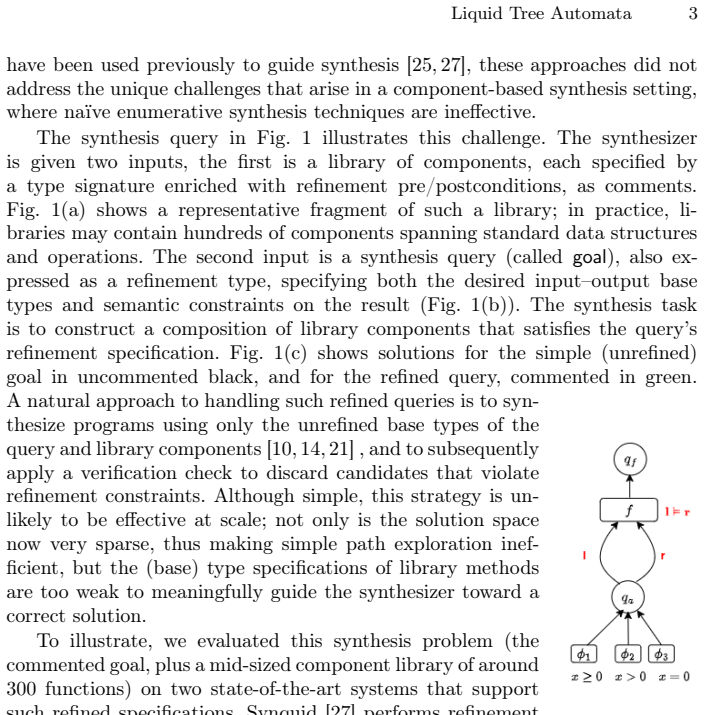
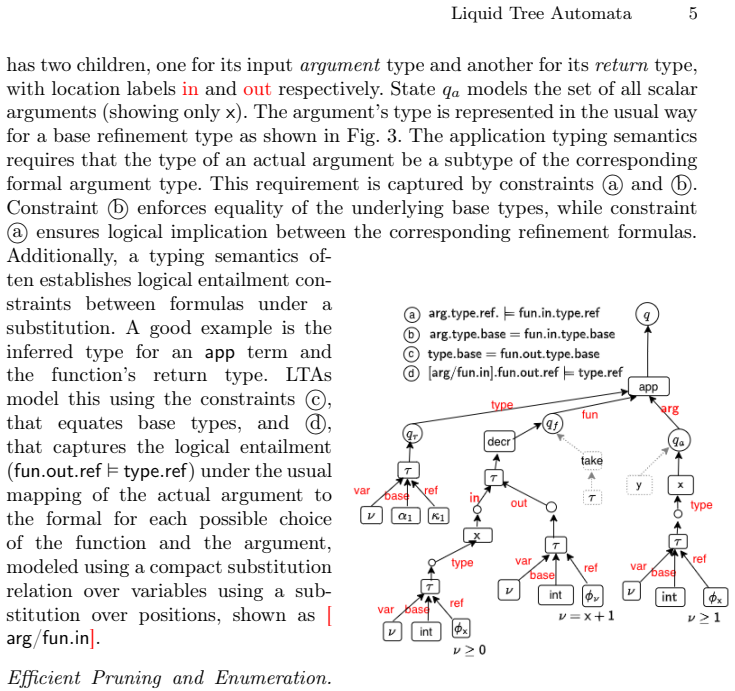
Liquid Tree Automata are constructed according to refinement typing rules for library components and use subtyping constraints to eagerly merge states that label semantically equivalent exploration paths, thereby pruning the search without losing valid solutions.
What carries the argument
Liquid Tree Automata, a tree-automata variant whose state merging is driven directly by subtyping judgments on refinement types.
If this is right
- The effective size of the search space shrinks as more paths are recognized as identical.
- Synthesis remains sound because only provably equivalent states are merged.
- Precise specifications become practical rather than prohibitive for component libraries.
- The same merging discipline can be applied to any synthesis procedure that already reasons with refinement types.
Where Pith is reading between the lines
- The state-merging idea could be adapted to other automata constructions that operate over logical specifications.
- Approximate or dynamic variants of the subtyping check might trade a small amount of precision for further scalability gains.
- The technique suggests a general pattern for using type-based equivalences to compress search spaces in program synthesis.
Load-bearing premise
Subtyping constraints derived from refinement types accurately capture semantic equivalence of exploration paths without missing valid solutions or incorrectly merging distinct paths.
What would settle it
A synthesis query on which the LTA-based procedure either returns an incorrect program because two non-equivalent paths were merged or fails to find a known solution that a non-merging search would locate.
Figures








read the original abstract
Component-based synthesis (CBS) generates loop-free programs from library components to satisfy logical queries. While expressive specifications and precise queries simplify the solution space, they make finding feasible execution paths significantly more difficult for traditional CBS procedures. As constraints become more exact, the search must navigate an increasingly sparse space of valid paths. We address this challenge by reasoning about \emph{logical similarities} between exploration paths. We consider library methods equipped with refinement-type specifications, which enrich base types with logical qualifiers to precisely constrain the value space. To efficiently explore this space, we introduce Liquid Tree Automata (LTA), a novel tree automata variant whose construction is driven by refinement typing rules. LTAs leverage subtyping constraints to identify and eagerly merge semantically similar states during search. This merging avoids redundant exploration of equivalent paths, significantly improving synthesis efficiency. We implement this approach in a tool called Hegel. Our evaluation demonstrates that Hegel synthesizes solutions to complex queries that are beyond the reach of existing state-of-the-art tools.
Editorial analysis
A structured set of objections, weighed in public.
Referee Report
Summary. The manuscript introduces Liquid Tree Automata (LTAs), a tree-automaton variant for component-based synthesis of loop-free programs from library components equipped with refinement-type specifications. LTAs are constructed using refinement typing rules and leverage subtyping constraints to identify and eagerly merge semantically similar states during search, with the goal of avoiding redundant exploration of equivalent paths and thereby improving synthesis efficiency. The approach is implemented in the Hegel tool, whose evaluation is claimed to synthesize solutions to complex queries beyond the reach of existing state-of-the-art tools.
Significance. If the soundness of the subtyping-driven merge operation holds, the work could meaningfully advance component-based synthesis by supporting more precise refinement-type specifications without incurring prohibitive search costs. The direct use of existing refinement typing rules for automata construction is a positive aspect that may facilitate integration with type-based synthesis frameworks.
major comments (1)
- [§3] §3: The LTA construction uses subtyping judgments on refinement types to decide state equivalence and perform eager merging during tree-automaton search. No lemma is supplied establishing that the subtyping relation is a congruence with respect to the synthesis semantics (i.e., that whenever two states are related by subtyping they remain semantically interchangeable in every context of component composition). Without such a result, it is unclear whether merging preserves the set of accepted programs; an over-approximation could silently drop valid solutions or introduce spurious ones, which directly undermines the central efficiency-without-loss claim.
minor comments (1)
- [Abstract] Abstract: The claim of 'significantly improving synthesis efficiency' is stated without any quantitative summary of runtime or success-rate improvements; a single sentence reporting key experimental deltas would strengthen the abstract.
Simulated Author's Rebuttal
We thank the referee for the careful reading and for highlighting the need for an explicit congruence result. We agree that the soundness of the eager merge operation requires a formal guarantee that subtyping preserves semantic interchangeability under component composition. We will add the requested lemma in the revised manuscript.
read point-by-point responses
-
Referee: [§3] §3: The LTA construction uses subtyping judgments on refinement types to decide state equivalence and perform eager merging during tree-automaton search. No lemma is supplied establishing that the subtyping relation is a congruence with respect to the synthesis semantics (i.e., that whenever two states are related by subtyping they remain semantically interchangeable in every context of component composition). Without such a result, it is unclear whether merging preserves the set of accepted programs; an over-approximation could silently drop valid solutions or introduce spurious ones, which directly undermines the central efficiency-without-loss claim.
Authors: We agree that an explicit lemma is required. In the revised version we will insert a new lemma (placed after the definition of LTA construction in §3) proving that the subtyping relation is a congruence with respect to the synthesis semantics: if two states q1 and q2 satisfy q1 <: q2 then, for any context of component composition, the sets of programs accepted from q1 and from q2 coincide. The proof proceeds by induction on the structure of the component composition tree, using the fact that the refinement typing rules already enforce semantic inclusion and that subtyping is transitive and compatible with the tree-automaton transition relation. This establishes that the eager merge operation neither drops valid solutions nor introduces spurious ones, thereby preserving the completeness claim while still delivering the reported efficiency gains. revision: yes
Circularity Check
No significant circularity; LTA construction directly applies existing refinement typing rules
full rationale
The paper introduces Liquid Tree Automata as a novel variant whose construction is driven by standard refinement typing rules and subtyping constraints from the literature. No equations, fitted parameters, or self-referential definitions appear; state merging is presented as a direct application of existing subtyping judgments rather than a result that reduces to the paper's own inputs by construction. No load-bearing self-citations, uniqueness theorems imported from the authors, or ansatzes smuggled via prior work are invoked in the provided text. The central efficiency claim rests on the semantics of refinement types, which are treated as external and independent.
Axiom & Free-Parameter Ledger
axioms (1)
- domain assumption Refinement typing rules soundly identify logical similarities between program paths.
invented entities (1)
-
Liquid Tree Automata
no independent evidence
Reference graph
Works this paper leans on
-
[1]
Recursive Program Syn- thesis
Aws Albarghouthi, Sumit Gulwani, and Zachary Kincaid. Recursive Program Syn- thesis. In Natasha Sharygina and Helmut Veith, editors,Computer Aided Verifi- cation, pages 934–950, Berlin, Heidelberg, 2013. Springer Berlin Heidelberg. Liquid Tree Automata 21
2013
-
[2]
Olausson, Lionel Wong, Gabriel Grand, Joshua B
Matthew Bowers, Theo X. Olausson, Lionel Wong, Gabriel Grand, Joshua B. Tenenbaum, Kevin Ellis, and Armando Solar-Lezama. Top-Down Synthesis for Library Learning. Proc. ACM Program. Lang., 7(POPL), jan 2023
2023
-
[3]
Babble: Learning Better Abstractions with E-Graphs and Anti- Unification
David Cao, Rose Kunkel, Chandrakana Nandi, Max Willsey, Zachary Tatlock, and Nadia Polikarpova. Babble: Learning Better Abstractions with E-Graphs and Anti- Unification. Proc. ACM Program. Lang., 7(POPL), jan 2023
2023
-
[4]
VOCAL – A Verified OCaml Library
Arthur Charguéraud, Jean-Christophe Filliâtre, Mário Pereira, and François Pot- tier. VOCAL – A Verified OCaml Library. ML Family Workshop, September 2017
2017
-
[5]
Tree Automata Techniques and Applications
Hubert Comon. Tree Automata Techniques and Applications. 1997
1997
-
[6]
Extended symbolic finite automata and trans- ducers
Loris D’antoni and Margus Veanes. Extended symbolic finite automata and trans- ducers. Form. Methods Syst. Des., 47(1):93–119, August 2015
2015
-
[7]
AutomataforReduction Properties Solving
MaxDauchet,Anne-CécileCaron,andJean-LucCoquidé. AutomataforReduction Properties Solving. Journal of Symbolic Computation, 20(2):215–233, 1995
1995
-
[8]
Program Synthesis Using Conflict-Driven Learning
Yu Feng, Ruben Martins, Osbert Bastani, and Isil Dillig. Program Synthesis Using Conflict-Driven Learning. InProceedings of the 39th ACM SIGPLAN Conference on Programming Language Design and Implementation, PLDI 2018, page 420–435, New York, NY, USA, 2018. Association for Computing Machinery
2018
-
[9]
Component-Based Synthesis of Table Consolidation and Transformation Tasks from Examples
Yu Feng, Ruben Martins, Jacob Van Geffen, Isil Dillig, and Swarat Chaudhuri. Component-Based Synthesis of Table Consolidation and Transformation Tasks from Examples. In Proceedings of the 38th ACM SIGPLAN Conference on Pro- gramming Language Design and Implementation, PLDI 2017, page 422–436, New York, NY, USA, 2017. Association for Computing Machinery
2017
-
[10]
Yu Feng, Ruben Martins, Yuepeng Wang, Isil Dillig, and Thomas W. Reps. Component-Based Synthesis for Complex APIs. InProceedings of the 44th ACM SIGPLAN Symposium on Principles of Programming Languages, POPL 2017, page 599–612, New York, NY, USA, 2017. Association for Computing Machinery
2017
-
[11]
Inductive Program Synthesis Guided by Observational Program Similarity.Proc
Jack Feser, Işıl Dillig, and Armando Solar-Lezama. Inductive Program Synthesis Guided by Observational Program Similarity.Proc. ACM Program. Lang., 7(OOP- SLA2), oct 2023
2023
-
[12]
Synthesizing Functional Reactive Programs
Bernd Finkbeiner, Felix Klein, Ruzica Piskac, and Mark Santolucito. Synthesizing Functional Reactive Programs. InProceedings of the 12th ACM SIGPLAN Inter- national Symposium on Haskell, Haskell 2019, page 162–175, New York, NY, USA,
2019
-
[14]
TheEssence of Compiling with Continuations
CormacFlanagan,AmrSabry,BruceF.Duba,andMatthiasFelleisen. TheEssence of Compiling with Continuations. In Proceedings of the ACM SIGPLAN 1993 Conference on Programming Language Design and Implementation, PLDI ’93, page 237–247, New York, NY, USA, 1993. Association for Computing Machinery
1993
-
[15]
Program Synthesis by Type-Guided Abstraction Refine- ment
Zheng Guo, Michael James, David Justo, Jiaxiao Zhou, Ziteng Wang, Ranjit Jhala, and Nadia Polikarpova. Program Synthesis by Type-Guided Abstraction Refine- ment. Proc. ACM Program. Lang., 4(POPL), December 2019
2019
-
[16]
Foster, and David Van Horn
Sankha Narayan Guria, Jeffrey S. Foster, and David Van Horn. RbSyn: Type- and Effect-Guided Program Synthesis. In Proceedings of the 42nd ACM SIGPLAN International Conference on Programming Language Design and Implementation, PLDI 2021, page 344–358, New York, NY, USA, 2021. Association for Computing Machinery
2021
-
[17]
On the Automated Verification of Web Applications with Embedded SQL
Shachar Itzhaky, Tomer Kotek, Noam Rinetzky, Mooly Sagiv, Orr Tamir, Helmut Veith, and Florian Zuleger. On the Automated Verification of Web Applications with Embedded SQL. In Michael Benedikt and Giorgio Orsi, editors,20th Inter- national Conference on Database Theory, ICDT 2017, March 21-24, 2017, Venice, 22 A. Mishra and S. Jagannathan Italy, volume 68...
2017
-
[18]
James, Zheng Guo, Ziteng Wang, Shivani Doshi, Hila Peleg, Ranjit Jhala, and Nadia Polikarpova
Michael B. James, Zheng Guo, Ziteng Wang, Shivani Doshi, Hila Peleg, Ranjit Jhala, and Nadia Polikarpova. Digging for Fold: Synthesis-Aided API Discovery for Haskell.Proc. ACM Program. Lang., 4(OOPSLA), nov 2020
2020
-
[19]
Seshia, and Ashish Tiwari
Susmit Jha, Sumit Gulwani, Sanjit A. Seshia, and Ashish Tiwari. Oracle-Guided Component-Based Program Synthesis. In Proceedings of the 32nd ACM/IEEE International Conference on Software Engineering - Volume 1, ICSE ’10, page 215–224, New York, NY, USA, 2010. Association for Computing Machinery
2010
-
[20]
Refinement Types: A Tutorial
Ranjit Jhala and Niki Vazou. Refinement Types: A Tutorial. Found. Trends Program. Lang., 6(3-4):159–317, 2021
2021
-
[21]
A relational framework for higher-order shape analysis
Gowtham Kaki and Suresh Jagannathan. A relational framework for higher-order shape analysis. InProceedings of the 19th ACM SIGPLAN International Confer- ence on Functional Programming, ICFP ’14, pages 311–324, New York, NY, USA,
-
[22]
Association for Computing Machinery
-
[23]
Searching Entangled Program Spaces.Proc
James Koppel, Zheng Guo, Edsko de Vries, Armando Solar-Lezama, and Nadia Polikarpova. Searching Entangled Program Spaces.Proc. ACM Program. Lang., 6(ICFP), aug 2022
2022
-
[24]
Lau, Pedro Domingos, and Daniel S
Tessa A. Lau, Pedro Domingos, and Daniel S. Weld. Version Space Algebra and Its Application to Programming by Demonstration. InProceedings of the Seven- teenth International Conference on Machine Learning, ICML ’00, page 527–534, San Francisco, CA, USA, 2000. Morgan Kaufmann Publishers Inc
2000
-
[25]
Bottom-up Synthesis of Recursive Functional Programs Using Angelic Exe- cution
Anders Miltner, Adrian Trejo Nuñez, Ana Brendel, Swarat Chaudhuri, and Işıl Dilig. Bottom-up Synthesis of Recursive Functional Programs Using Angelic Exe- cution. Proc. ACM Program. Lang., 6(POPL), jan 2022
2022
-
[26]
Relational Syn- thesis of Recursive Programs via Constraint Annotated Tree Automata
Anders Miltner, Ziteng Wang, Swarat Chaudhuri, and Isil Dillig. Relational Syn- thesis of Recursive Programs via Constraint Annotated Tree Automata. InCom- puter Aided Verification: 36th International Conference, CAV 2024, Montreal, QC, Canada, July 24–27, 2024, Proceedings, Part III, page 41–63, Berlin, Heidelberg,
2024
-
[27]
Specification-Guided Component-Based Synthesis from Effectful Libraries.Proc
Ashish Mishra and Suresh Jagannathan. Specification-Guided Component-Based Synthesis from Effectful Libraries.Proc. ACM Program. Lang., 6(OOPSLA2), oct 2022
2022
-
[28]
Springer Berlin Heidelberg, Berlin, Heidelberg, 1999
Flemming Nielson, Hanne Riis Nielson, and Chris Hankin.Abstract Interpretation, pages 211–282. Springer Berlin Heidelberg, Berlin, Heidelberg, 1999
1999
-
[29]
Program Synthesis from Polymorphic Refinement Types
Nadia Polikarpova, Ivan Kuraj, and Armando Solar-Lezama. Program Synthesis from Polymorphic Refinement Types. InProceedings of the 37th ACM SIGPLAN Conference on Programming Language Design and Implementation, PLDI ’16, page 522–538, New York, NY, USA, 2016. Association for Computing Machinery
2016
-
[30]
FrAngel: Component-Based Syn- thesis with Control Structures.Proc
Kensen Shi, Jacob Steinhardt, and Percy Liang. FrAngel: Component-Based Syn- thesis with Control Structures.Proc. ACM Program. Lang., 3(POPL), jan 2019
2019
-
[31]
Program Synthesis with Equivalence Reduc- tion
Calvin Smith and Aws Albarghouthi. Program Synthesis with Equivalence Reduc- tion. In Constantin Enea and Ruzica Piskac, editors,Verification, Model Checking, and Abstract Interpretation, pages 24–47, Cham, 2019. Springer International Pub- lishing
2019
-
[32]
Verifying Higher-Order Programs with the Dijkstra Monad
Nikhil Swamy, Joel Weinberger, Cole Schlesinger, Juan Chen, and Benjamin Livshits. Verifying Higher-Order Programs with the Dijkstra Monad. InProceed- ings of the 34th ACM SIGPLAN Conference on Programming Language Design and Implementation, PLDI ’13, page 387–398, New York, NY, USA, 2013. Associ- ation for Computing Machinery. Liquid Tree Automata 23
2013
-
[33]
Bounded refinement types
Niki Vazou, Alexander Bakst, and Ranjit Jhala. Bounded refinement types. In Proceedings of the 20th ACM SIGPLAN International Conference on Functional Programming, ICFP 2015, pages 48–61, New York, NY, USA, 2015. Association for Computing Machinery
2015
-
[34]
Rondon, and Ranjit Jhala
Niki Vazou, Patrick M. Rondon, and Ranjit Jhala. Abstract Refinement Types. In Matthias Felleisen and Philippa Gardner, editors,Programming Languages and Systems, pages 209–228, Berlin, Heidelberg, 2013. Springer Berlin Heidelberg
2013
-
[35]
Visu- alization by Example.Proc
Chenglong Wang, Yu Feng, Rastislav Bodik, Alvin Cheung, and Isil Dillig. Visu- alization by Example.Proc. ACM Program. Lang., 4(POPL), dec 2019
2019
-
[36]
Program Synthesis using Abstraction Refinement
Xinyu Wang, Isil Dillig, and Rishabh Singh. Program Synthesis using Abstraction Refinement. Proc. ACM Program. Lang., 2(POPL), dec 2017
2017
-
[37]
Synthesis of Data Completion Scripts Using Finite Tree Automata.Proc
Xinyu Wang, Işıl Dillig, and Rishabh Singh. Synthesis of Data Completion Scripts Using Finite Tree Automata.Proc. ACM Program. Lang., 1(OOPSLA), oct 2017
2017
-
[38]
Egg: Fast and Extensible Equality Saturation.Proc
Max Willsey, Chandrakana Nandi, Yisu Remy Wang, Oliver Flatt, Zachary Tat- lock, and Pavel Panchekha. Egg: Fast and Extensible Equality Saturation.Proc. ACM Program. Lang., 5(POPL), jan 2021
2021
-
[39]
query":
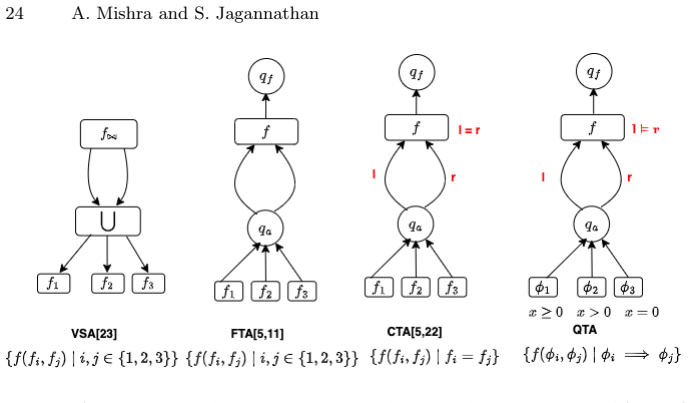
Yihong Zhang, Yisu Remy Wang, Oliver Flatt, David Cao, Philip Zucker, Eli Rosenthal, Zachary Tatlock, and Max Willsey. Better Together: Unifying Datalog and Equality Saturation.Proc. ACM Program. Lang., 7(PLDI), jun 2023. 10 Appendix/Supplemental Material for the Main Paper 24 A. Mishra and S. Jagannathan Fig.12: A comparison for representation of space o...
2023
discussion (0)
Sign in with ORCID, Apple, or X to comment. Anyone can read and Pith papers without signing in.