Recognition: 2 theorem links
· Lean TheoremCollective amplification and anisotropic narrowing of alignment signals in cesium vapor under strong spin exchange near zero magnetic field
Pith reviewed 2026-05-14 18:02 UTC · model grok-4.3
The pith
Ultra-narrow alignment resonances in cesium vapor arise predominantly from quadrupole anisotropy due to spontaneous transverse orientation under strong spin exchange.
A machine-rendered reading of the paper's core claim, the machinery that carries it, and where it could break.
Core claim
The experimentally observed ultra-narrow alignment resonances may originate predominantly from quadrupole anisotropy associated with spontaneous transverse orientation projected onto the detection axis. A demonstration theoretical model that incorporates spontaneous polarization effects arising under strong spin exchange qualitatively reproduces the anisotropy of the Hanle resonances, their ultra-small widths, and the magnetic-field-controlled bistability with memory.
What carries the argument
Spontaneous polarization effects under strong spin exchange, which produce quadrupole anisotropy from spontaneous transverse orientation projected on the detection axis.
If this is right
- Resonance widths are set by classical spin exchange along one axis and by the SERF effect along the orthogonal axis.
- Normalized signal amplitude rises with increasing vapor concentration.
- Nonlinear effects appear, including an effective magnetic field, bistability, hysteresis, and memory.
- The ultra-small width and magnetic-field-controlled memory make the resonances suitable for quantum sensing and information applications.
Where Pith is reading between the lines
- The same spontaneous-polarization mechanism may appear in other dense alkali vapors when spin exchange dominates near zero field.
- Magnetic-field control of the bistable state could allow construction of atomic switches or memories whose state persists after the field is removed.
- A parameter-free version of the model could be tested against earlier data sets to see whether it accounts for all reported features without adjustment.
Load-bearing premise
Spontaneous polarization effects arising under strong spin exchange are sufficient to produce the observed anisotropy, bistability, and memory without requiring additional fitted parameters.
What would settle it
Suppress spontaneous orientation by changing the optical pumping geometry or vapor conditions and check whether the ultra-narrow anisotropic resonances and bistability disappear.
Figures



read the original abstract
We present the results of an experimental study of the anomalous anisotropy of alignment signals in cesium vapors under strong spin exchange conditions in zero magnetic fields under linearly polarized optical pumping. We show that the anisotropy of the Hanle resonances in the plane perpendicular to the pump beam increases sharply with increasing concentration. In one direction, the resonance widths are determined by classical spin exchange, while in the other, by the SERF (Spin-Exchange Relaxation Free) effect. With further concentration increases, additional nonlinear effects arise, such as an increase of the normalized signal amplitude, effective magnetic field, bistability, hysteresis, and memory. To explain these observations, as well as the results presented in our previous studies, we construct a demonstration theoretical model incorporating spontaneous polarization effects arising under strong spin exchange. The model qualitatively shows that the experimentally observed ultra-narrow alignment resonances may originate predominantly from quadrupole anisotropy associated with spontaneous transverse orientation projected onto the detection axis.The unique properties of these resonances, such as their ultra-small width and magnetic field-controlled bistability with a long-term memory effect, make them promising for use in quantum sensing and information.
Editorial analysis
A structured set of objections, weighed in public.
Referee Report
Summary. The paper reports experimental observations of anisotropic narrowing and collective amplification of alignment signals in cesium vapor under strong spin exchange near zero magnetic field with linearly polarized pumping. Hanle resonance widths become directionally dependent with rising concentration (one axis limited by classical spin exchange, the other by SERF), accompanied by nonlinear effects including rising normalized amplitude, effective internal field, bistability, hysteresis, and long-term memory. A demonstration theoretical model incorporating spontaneous polarization is introduced to attribute the ultra-narrow resonances predominantly to quadrupole anisotropy arising from spontaneous transverse orientation projected onto the detection axis.
Significance. If the attribution holds under quantitative scrutiny, the work would establish a new regime of spin-exchange-driven collective effects that produce magnetically controllable ultra-narrow resonances with memory, offering potential advantages for quantum sensing and information storage beyond conventional SERF magnetometry.
major comments (1)
- [Demonstration theoretical model] Demonstration theoretical model (abstract and main text): the model is stated to 'qualitatively show' that the observed ultra-narrow resonances originate from quadrupole anisotropy tied to spontaneous transverse orientation, yet no explicit rate equations, parameter values (including the effective internal magnetic field), or direct comparison to measured Hanle curves (width versus concentration, normalized amplitude, or hysteresis loops) are supplied. This absence leaves the central claim that the spontaneous-polarization term is predominant unverifiable and prevents assessment of whether additional mechanisms are required.
minor comments (1)
- [Abstract] The abstract refers to 'our previous studies' without specific citations; adding the relevant references would clarify the relation to prior work on alignment signals.
Simulated Author's Rebuttal
We thank the referee for the careful reading and constructive feedback. The single major comment concerns the level of detail in our demonstration theoretical model. We address it directly below and will revise the manuscript to incorporate the requested elements.
read point-by-point responses
-
Referee: [Demonstration theoretical model] Demonstration theoretical model (abstract and main text): the model is stated to 'qualitatively show' that the observed ultra-narrow resonances originate from quadrupole anisotropy tied to spontaneous transverse orientation, yet no explicit rate equations, parameter values (including the effective internal magnetic field), or direct comparison to measured Hanle curves (width versus concentration, normalized amplitude, or hysteresis loops) are supplied. This absence leaves the central claim that the spontaneous-polarization term is predominant unverifiable and prevents assessment of whether additional mechanisms are required.
Authors: We agree that the current presentation of the demonstration model is insufficient for quantitative scrutiny. Although the model was constructed to illustrate qualitatively how spontaneous transverse orientation can generate the observed quadrupole anisotropy and ultra-narrow resonances, we acknowledge that explicit rate equations, parameter values, and direct data comparisons are needed to substantiate the claim that this mechanism is predominant. In the revised manuscript we will add the full set of rate equations, the numerical values of all parameters (including the effective internal magnetic field), and side-by-side comparisons of the model output with the measured Hanle curves for resonance width versus concentration, normalized amplitude, and hysteresis loops. These additions will allow readers to evaluate the model’s explanatory power and to determine whether supplementary mechanisms are required. revision: yes
Circularity Check
No significant circularity; qualitative demonstration model does not reduce claims to inputs by construction
full rationale
The paper reports independent experimental observations of anisotropic Hanle resonances, bistability, and memory effects in cesium vapor. It then introduces a qualitative demonstration model incorporating spontaneous polarization under strong spin exchange to suggest a possible origin for the ultra-narrow features. No explicit equations, fitted parameters, or quantitative comparisons are shown that would make any prediction equivalent to the inputs by construction. The model is presented as explanatory rather than predictive, and the experimental data stand separately. No self-citation chain or ansatz is invoked as a load-bearing uniqueness theorem. The derivation chain therefore remains self-contained against external benchmarks.
Axiom & Free-Parameter Ledger
free parameters (1)
- effective internal magnetic field
axioms (1)
- domain assumption Standard spin-exchange relaxation rates apply in the classical regime and are suppressed in the SERF regime
invented entities (1)
-
spontaneous transverse orientation
no independent evidence
Lean theorems connected to this paper
-
IndisputableMonolith/Cost/FunctionalEquation.leanwashburn_uniqueness_aczel unclear?
unclearRelation between the paper passage and the cited Recognition theorem.
We construct a demonstration theoretical model incorporating spontaneous polarization effects... The model qualitatively shows that the experimentally observed ultra-narrow alignment resonances may originate predominantly from quadrupole anisotropy associated with spontaneous transverse orientation
-
IndisputableMonolith/Foundation/RealityFromDistinction.leanreality_from_one_distinction unclear?
unclearRelation between the paper passage and the cited Recognition theorem.
The condition for spontaneous polarization follows from the instability... χ > Γ(1). In the nonlinear regime the cubic saturation term stabilizes the dynamics... two stable stationary solutions exist
What do these tags mean?
- matches
- The paper's claim is directly supported by a theorem in the formal canon.
- supports
- The theorem supports part of the paper's argument, but the paper may add assumptions or extra steps.
- extends
- The paper goes beyond the formal theorem; the theorem is a base layer rather than the whole result.
- uses
- The paper appears to rely on the theorem as machinery.
- contradicts
- The paper's claim conflicts with a theorem or certificate in the canon.
- unclear
- Pith found a possible connection, but the passage is too broad, indirect, or ambiguous to say the theorem truly supports the claim.
Reference graph
Works this paper leans on
-
[1]
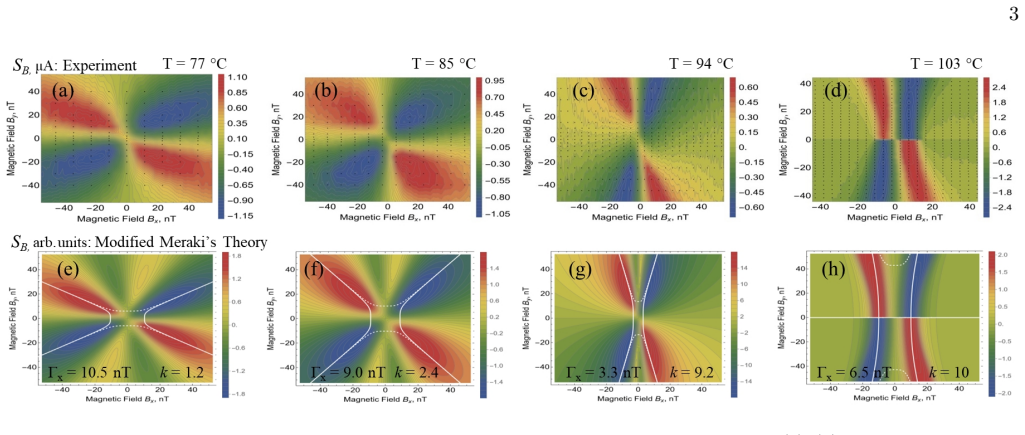
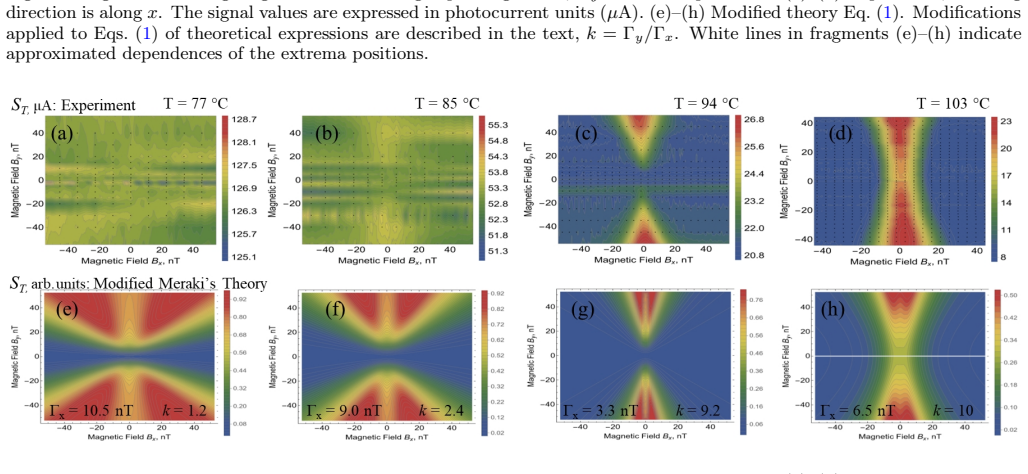
In processing these, we relied on the theory of [25], which fully and reliably describes the alignment signals in the classical case. The upper rows of Figs. 2, 3 show the maps obtained by scanning the field along thex-axis, as described above. The lower rows show the theoreti- cal maps constructed using Eqs. (1), (2) with modifi- cations that will be des...
-
[2]
Linearly polarized pumping (E∥x) emptiesF= 3 manifold and creates negative alignment along the xaxis in theF= 4manifold, and therefore positive alignment in the transverse0yzplane
-
[3]
Under strong SE conditions, this transverse anisotropy serves as a seed for spontaneous polar- ization (SP) inside local spin-exchange domains
-
[4]
A pos- sible reason is the ellipticity introduced into the beam by the rotating alignment components
The direction of SP is selected by weak transverse to the propagation vectorkmagnetic fields. A pos- sible reason is the ellipticity introduced into the beam by the rotating alignment components
-
[5]
The spontaneous orientation initially appears as the componentP z, while the experimentally rel- evant componentP y is subsequently generated through ordinary Larmor precession in the fieldBx
-
[6]
The transverse orientationP y possesses the same symmetrywithrespecttoω x andω y astheordinary alignment signal
-
[7]
When observed along the detection axis parallel toE, the transverse orientation is perceived as a quadrupole anisotropy,A p ∝P y
-
[8]
Therefore, no dy- namical reverse conversionP→Ais required
Thisprojectedcontributionisnotanindependently evolving alignment component. Therefore, no dy- namical reverse conversionP→Ais required
-
[9]
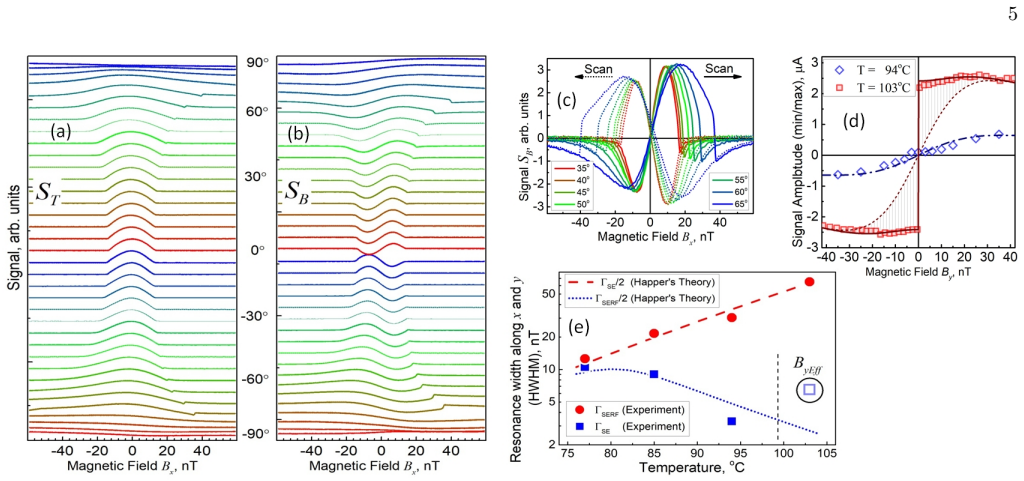
The nonlinearity is localized in the orientation subsystem. Starting from a certain concentration value, polarization in the SERF regime maintains itself even when the sign of the seed changes, which leads to hysteresis, bistability and memory effects
-
[10]
The experimentally observed signal is determined by the superpositionS B ∝A c +A p, whereA c is the ordinary rapidly relaxing alignment contribu- tion.A p inherits the slow relaxation rate of orien- tation, therefore it dominates in the SERF regime and produces ultra-narrow resonances
-
[11]
Linear dichroism signals are detected due to the overlap of the optical contours of Cs, and also, possibly, due to the transfer of negative alignment (sublevelm F = 0is the most populated) from the F= 4level to theF= 3level via spin exchange. Finally, we emphasize that the proposed model re- mains intentionally minimal. It includes only the lowest relevan...
work page 2024
- [12]
-
[13]
Kitching, Applied Physics Reviews5, 10.1063/1.5026238 (2018)
J. Kitching, Applied Physics Reviews5, 10.1063/1.5026238 (2018)
- [14]
-
[15]
M. Petrenko, A. Pazgalev, and A. Vershovskii, Physical Review Applied15, 064072 (2021)
work page 2021
-
[16]
M. Petrenko, A. Pazgalev, and A. Vershovskii, Physical Review Applied20, 024001 (2023)
work page 2023
- [17]
-
[18]
A. K. Vershovskii, Y. A. Litmanovich, A. S. Pazgalev, and V. G. Peshekhonov, Gyroscopy and Navigation9, 162–176 (2018)
work page 2018
-
[19]
Franzen, Physical Review115, 850–856 (1959)
W. Franzen, Physical Review115, 850–856 (1959)
work page 1959
- [20]
- [21]
- [22]
-
[23]
I. K. Kominis, T. W. Kornack, J. C. Allred, and M. V. Romalis, Nature422, 596–599 (2003)
work page 2003
-
[24]
M. P. Ledbetter, I. M. Savukov, V. M. Acosta, D. Bud- ker, and M. V. Romalis, Physical Review A77, 033408 (2008)
work page 2008
-
[25]
T. Scholtes, V. Schultze, R. IJsselsteijn, S. Woetzel, and H.-G. Meyer, Physical Review A84, 043416 (2011)
work page 2011
-
[26]
V. Schultze, B. Schillig, R. IJsselsteijn, T. Scholtes, S. Woetzel, and R. Stolz, Sensors17, 561 (2017)
work page 2017
-
[27]
A. Ben-Kish and M. V. Romalis, Physical Review Letters 105, 193601 (2010)
work page 2010
-
[28]
H. Wang, T. Wu, W. Xiao, H. Wang, X. Peng, and H. Guo, Phys. Rev. Applied15, 024033 (2021)
work page 2021
- [29]
- [30]
- [31]
-
[32]
K. Blum, Irreducible components of the density matrix, inDensity Matrix Theory and Applications, edited by K. Blum (Springer, Berlin, Heidelberg, 2012) p. 115–163
work page 2012
-
[33]
Omont, Progress in Quantum Electronics5, 69–138 (1977)
A. Omont, Progress in Quantum Electronics5, 69–138 (1977). 11
work page 1977
-
[34]
A. Weis, G. Bison, and A. S. Pazgalev, Physical Review A74, 033401 (2006)
work page 2006
- [35]
- [36]
- [37]
- [38]
-
[39]
M. V. Petrenko and A. K. Vershovskii, Phys. Rev. A112, 013123 (2025)
work page 2025
-
[40]
M. V. Petrenko and A. K. Vershovskii, Phys. Rev. A113, 043104 (2026)
work page 2026
-
[41]
S. Rochester, M. Ledbetter, T. Zigdon, A. Wilson- Gordon, and D. Budker, Physical Review A—Atomic, Molecular, and Optical Physics85, 022125 (2012)
work page 2012
- [42]
discussion (0)
Sign in with ORCID, Apple, or X to comment. Anyone can read and Pith papers without signing in.