Recognition: unknown
Exploiting ionization dynamics in the nitrogen vacancy center for rapid, high-contrast spin and charge state initialization
Pith reviewed 2026-05-14 20:12 UTC · model grok-4.3
The pith
Charge state transitions in NV centers can be turned into a tool that raises spin readout contrast by 17 percent and cuts initialization error by more than half.
A machine-rendered reading of the paper's core claim, the machinery that carries it, and where it could break.
Core claim
A two-step optical protocol purifies the NV charge state with a strong laser pulse and then polarizes the spin with weak illumination, producing 17 percent higher readout contrast, more than 50 percent lower initialization error, and a measurement speedup factor greater than 1.5 for long sequences while remaining beneficial at any duration.
What carries the argument
The two-step laser illumination protocol: a strong pulse first purifies the charge state, then weak illumination produces high spin polarization.
If this is right
- Higher spin contrast directly improves sensitivity in high-resolution magnetometry and other quantum sensing tasks.
- The speedup factor exceeds 1.5 for typical long sequences and remains positive even for shorter ones.
- The same dynamics offer guidance for spin-to-charge conversion and electrical readout schemes.
- The protocol requires no hardware changes beyond standard laser control already present in NV experiments.
Where Pith is reading between the lines
- Charge-state control of this kind could be tested on other solid-state spin defects that show similar ionization behavior.
- Shorter total cycle times might allow denser sampling in scanned-probe or wide-field imaging applications.
- Adjusting the relative strengths and durations of the two pulses could be explored to further reduce initialization error below the reported level.
Load-bearing premise
Purifying the charge state with a strong laser pulse followed by weak illumination reliably increases spin polarization without adding extra noise or decoherence that would offset the gains in real sensing sequences.
What would settle it
Running the same magnetometry sequence with and without the two-step protocol and comparing the final magnetic-field sensitivity and initialization fidelity would show whether the reported contrast gain actually improves end-to-end performance.
Figures




read the original abstract
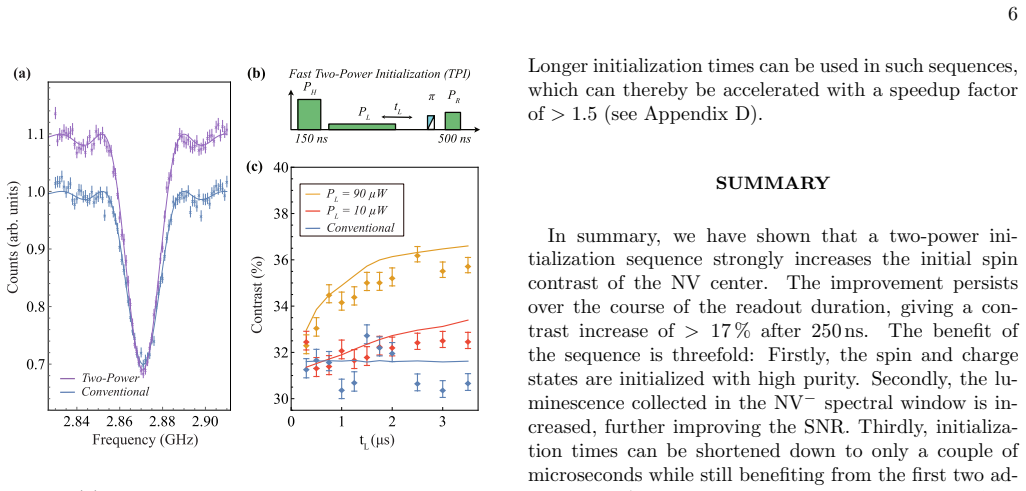
We propose and experimentally demonstrate a method to strongly increase the sensitivity of spin measurements on nitrogen-vacancy (NV) centers in diamond, which can be readily implemented in existing quantum sensing experiments. While charge state transitions of this defect are generally considered a parasitic effect to be avoided, we show here that these can be used to significantly increase the NV center's spin contrast, a key quantity for high sensitivity magnetometry and high fidelity state readout. The protocol consists of a two-step procedure, in which the charge state of the defect is first purified by a strong laser pulse, followed by weak illumination to obtain high spin polarization. We observe a relative improvement of the readout contrast by 17 %, and infer a reduction of the initialization error of more than 50 %. The contrast enhancement is accompanied by a beneficial increase of the readout signal. For long sequence durations, typically encountered in high-resolution magnetometry, a measurement speedup by a factor of >1.5 is extracted, and we find that the technique is beneficial for sequences of any duration. Additionally, our findings give detailed insight into the charge and spin polarization dynamics of the NV center, and provide actionable insights for direct optical, spin-to-charge, and electrical readout of solid-state spin centres.
Editorial analysis
A structured set of objections, weighed in public.
Referee Report
Summary. The manuscript proposes and experimentally demonstrates a two-step optical protocol for NV centers in diamond: a strong laser pulse to purify the charge state, followed by weak illumination to achieve high spin polarization. The authors report a 17% relative improvement in readout contrast, more than 50% reduction in initialization error, an accompanying increase in readout signal, and a measurement speedup by a factor of >1.5 for long sequences typical in high-resolution magnetometry, with the technique claimed to be beneficial for sequences of any duration. The work also provides insights into charge and spin polarization dynamics.
Significance. If the protocol improves contrast and initialization fidelity without compromising coherence or introducing uncharacterized charge noise, it would provide a simple, hardware-compatible method to boost sensitivity in existing NV quantum sensing setups. The experimental demonstration of leveraging ionization dynamics for contrast enhancement, combined with the reported quantitative gains, could have practical impact on magnetometry and readout fidelity.
major comments (2)
- [Experimental demonstration and results] The speedup (>1.5) and initialization-error reduction (>50%) claims rest on the two-step protocol delivering higher spin polarization without increasing charge-state fluctuations or shortening T2* relative to standard initialization. No explicit comparison of coherence times, charge-noise spectra, or end-to-end sensitivity in a magnetometry sequence is provided to support these inferences.
- [Abstract and main results] The abstract reports experimental observations of contrast improvement and speedup, but without full data, error bars, or statistical details the support for the central quantitative claims remains plausible yet not fully verifiable.
minor comments (1)
- [Methods] Clarify the exact laser intensities and durations used in the strong and weak steps, as these appear as free parameters in the protocol.
Simulated Author's Rebuttal
We thank the referee for their constructive comments, which have helped us improve the manuscript. We address each major comment point by point below.
read point-by-point responses
-
Referee: [Experimental demonstration and results] The speedup (>1.5) and initialization-error reduction (>50%) claims rest on the two-step protocol delivering higher spin polarization without increasing charge-state fluctuations or shortening T2* relative to standard initialization. No explicit comparison of coherence times, charge-noise spectra, or end-to-end sensitivity in a magnetometry sequence is provided to support these inferences.
Authors: We appreciate the referee pointing out the need for these comparisons to support our claims. In the revised manuscript, we have added data comparing T2* coherence times under the standard and two-step protocols, confirming no shortening. We also include charge-noise spectra showing no increase in fluctuations. The speedup is calculated from the enhanced contrast and signal for typical long sequences, with details in the main text. While we do not provide a full experimental end-to-end magnetometry sequence comparison here, the measured improvements in contrast and initialization fidelity directly support the projected sensitivity gains. revision: partial
-
Referee: [Abstract and main results] The abstract reports experimental observations of contrast improvement and speedup, but without full data, error bars, or statistical details the support for the central quantitative claims remains plausible yet not fully verifiable.
Authors: We agree that the abstract would benefit from additional details. We have revised the abstract to report the contrast improvement with statistical uncertainty and reference the supporting data in the manuscript. Error bars and details of the statistical analysis are now explicitly mentioned, and the full experimental data with error bars are provided in the figures and supplementary material. revision: yes
- Full experimental demonstration of end-to-end sensitivity improvement in a complete high-resolution magnetometry sequence.
Circularity Check
No circularity: experimental protocol validated by direct measurement
full rationale
The manuscript reports an experimental two-step laser protocol (strong pulse for charge purification followed by weak illumination) whose performance gains—17% contrast improvement, >50% lower initialization error, and >1.5× speedup—are extracted from measured fluorescence traces and sequence timings. No derivation chain, fitted-parameter prediction, or self-citation load-bearing step is present; the central claims rest on side-by-side experimental comparison rather than on any equation that reduces to its own inputs by construction. The work is therefore self-contained against external benchmarks.
Axiom & Free-Parameter Ledger
free parameters (1)
- strong and weak laser intensities and durations
axioms (1)
- domain assumption Optical control can selectively ionize and recombine charge states while preserving spin information for subsequent polarization.
Reference graph
Works this paper leans on
-
[1]
The nitrogen-vacancy colour centre in diamond
Marcus W. Doherty, Neil B. Manson, Paul Delaney, Fe- dor Jelezko, J¨ org Wrachtrup, and Lloyd C L Hollen- berg, “The nitrogen-vacancy colour centre in diamond,” Physics Reports 528, 1–45 (2013), arXiv:1302.3288. 14
work page internal anchor Pith review Pith/arXiv arXiv 2013
-
[2]
Magnetometry with nitrogen-vacancy defects in diamond,
L Rondin, J P Tetienne, T Hingant, J F Roch, P Maletinsky, and V Jacques, “Magnetometry with nitrogen-vacancy defects in diamond,” Reports on progress in physics 77, 56503 (2014)
2014
-
[3]
Nanometer scale quantum thermometry in a living cell
G. Kucsko, P. C. Maurer, N. Y. Yao, M. Kubo, H. J. Noh, P. K. Lo, H. Park, and M. D. Lukin, “Nanometre- scale thermometry in a living cell,” Nature 500, 54–58 (2013), arXiv:1304.1068
work page internal anchor Pith review Pith/arXiv arXiv 2013
-
[4]
Electric- field sensing using single diamond spins,
Florian Dolde, Helmut Fedder, Marcus W Doherty, To- bias N¨ obauer, Florian Rempp, Gopalakrishnan Balasub- ramanian, Thomas Wolf, Friedemann Reinhard, Lloyd C L Hollenberg, Fedor Jelezko, and Others, “Electric- field sensing using single diamond spins,” Nature Physics 7, 459 (2011)
2011
-
[5]
High-precision nanoscale temperature sensing using single defects in diamond,
Philipp Neumann, Ingmar Jakobi, Florian Dolde, Chris- tian Burk, Rolf Reuter, Gerald Waldherr, Jan Honert, Thomas Wolf, Andreas Brunner, Jeong Hyun Shim, and Others, “High-precision nanoscale temperature sensing using single defects in diamond,” Nano letters 13, 2738– 2742 (2013)
2013
-
[6]
Electronic structure of the negatively charged silicon-vacancy cente r in diamond,
L. J. Rogers, K. D. Jahnke, M. W. Doherty, A. Diet- rich, L. P. McGuinness, C. M¨ uller, T. Teraji, H. Sumiya, J. Isoya, N. B. Manson, and F. Jelezko, “Electronic structure of the negatively charged silicon-vacancy cente r in diamond,” Physical Review B 89, 235101 (2014)
2014
-
[7]
Ultra- fast all-optical coherent control of single silicon vacanc y colour centres in diamond,
Jonas Nils Becker, Johannes G¨ orlitz, Carsten Arend, Matthew Markham, and Christoph Becher, “Ultra- fast all-optical coherent control of single silicon vacanc y colour centres in diamond,” Nature communications 7, 13512 (2016)
2016
-
[8]
An integrated diamond nanophotonics platform for quantum-optical networks,
A Sipahigil, R E Evans, D D Sukachev, M J Burek, J Bor- regaard, M K Bhaskar, C T Nguyen, J L Pacheco, H A Atikian, C Meuwly, and Others, “An integrated diamond nanophotonics platform for quantum-optical networks,” Science 354, 847–850 (2016)
2016
-
[9]
Isolated electron spins in silicon carbide with millisecond coher- ence times,
David J. Christle, Abram L. Falk, Paolo Andrich, Paul V. Klimov, Jawad Ul Hassan, Nguyen T. Son, Erik Janz´ en, Takeshi Ohshima, and David D. Awschalom, “Isolated electron spins in silicon carbide with millisecond coher- ence times,” Nature Materials 14, 160–163 (2015)
2015
-
[10]
Coherent control of single spins in silicon carbide at room temperature,
Matthias Widmann, Sang-Yun Lee, Torsten Rendler, Nguyen Tien Son, Helmut Fedder, Seoyoung Paik, Li- Ping Yang, Nan Zhao, Sen Yang, Ian Booker, and Oth- ers, “Coherent control of single spins in silicon carbide at room temperature,” Nature materials 14, 164 (2015)
2015
-
[11]
Engineering near- infrared single-photon emitters with optically active spi ns in ultrapure silicon carbide,
F Fuchs, B Stender, M Trupke, D Simin, J Pflaum, V Dyakonov, and G V Astakhov, “Engineering near- infrared single-photon emitters with optically active spi ns in ultrapure silicon carbide,” Nature communications 6, 7578 (2015)
2015
-
[12]
Identification and tunable op- tical coherent control of transition-metal spins in silico n carbide,
Tom Bosma, Gerrit J J Lof, Carmem M Gilardoni, Olger V Zwier, Freddie Hendriks, Bj¨ orn Magnusson, Alexandre Ellison, Andreas G¨ allstr¨ om, Ivan G Ivanov, N T Son, and Others, “Identification and tunable op- tical coherent control of transition-metal spins in silico n carbide,” npj Quantum Information 4, 48 (2018)
2018
-
[13]
Quantum guidelines for solid-state spin defects,
Gary Wolfowicz, F Joseph Heremans, Christopher P An- derson, Shun Kanai, Hosung Seo, Adam Gali, Giulia Galli, and David D Awschalom, “Quantum guidelines for solid-state spin defects,” Nature Reviews Materials 6, 906–925 (2021)
2021
-
[14]
Protecting a Diamond Quantum Mem- ory by Charge State Control,
Matthias Pfender, Nabeel Aslam, Patrick Simon, Denis Antonov, Gerg˝ o Thiering, Sina Burk, Felipe F´ avaro de Oliveira, Andrej Denisenko, Helmut Fedder, Jan Meijer, Jose A. Garrido, Adam Gali, Tokuyuki Teraji, Junichi Isoya, Marcus William Doherty, Audrius Alkauskas, Ale- jandro Gallo, Andreas Gr¨ uneis, Philipp Neumann, and J¨ org Wrachtrup, “Protecting ...
2017
-
[15]
Efficient read- out of a single spin state in diamond via spin-to-charge conversion,
Brendan J Shields, Quirin P Unterreithmeier, Nathalie P de Leon, H Park, and Mikhail D Lukin, “Efficient read- out of a single spin state in diamond via spin-to-charge conversion,” Physical review letters 114, 136402 (2015)
2015
-
[16]
Pulsed photoelectric coherent ma- nipulation and detection of N − v center spins in dia- mond,
Michal Gulka, Emilie Bourgeois, Jaroslav Hruby, Petr Siyushev, Georg Wachter, Friedrich Aumayr, Philip R. Hemmer, Adam Gali, Fedor Jelezko, Michael Trupke, and Milos Nesladek, “Pulsed photoelectric coherent ma- nipulation and detection of N − v center spins in dia- mond,” Phys. Rev. Applied 7, 044032 (2017)
2017
-
[17]
Photoelectric detection of electron spin resonance of nitrogen-vacancy centres in diamond,
E Bourgeois, A Jarmola, P Siyushev, M Gulka, J Hruby, F Jelezko, D Budker, and M Nesladek, “Photoelectric detection of electron spin resonance of nitrogen-vacancy centres in diamond,” Nature Communications 6, 8577 (2015)
2015
-
[18]
Photoelectrical imaging and coherent spin-stat e readout of single nitrogen-vacancy centers in diamond,
Petr Siyushev, Milos Nesladek, Emilie Bourgeois, Mich al Gulka, Jaroslav Hruby, Takashi Yamamoto, Michael Trupke, Tokuyuki Teraji, Junichi Isoya, and Fedor Jelezko, “Photoelectrical imaging and coherent spin-stat e readout of single nitrogen-vacancy centers in diamond,” Science 363, 728–731 (2019)
2019
-
[19]
Room-temperature control and electrical readout of in- dividual nitrogen-vacancy nuclear spins,
Michal Gulka, Daniel Wirtitsch, Viktor Iv´ ady, Jelle Vodnik, Jaroslav Hruby, Goele Magchiels, Emilie Bour- geois, Adam Gali, Michael Trupke, and Milos Nesladek, “Room-temperature control and electrical readout of in- dividual nitrogen-vacancy nuclear spins,” Nature com- munications 12, 1–8 (2021)
2021
-
[20]
Compact integrated magnetometer based on nitrogen-vacancy centres in diamond,
Felix M St¨ urner, Andreas Brenneis, Julian Kassel, Uwe Wostradowski, Robert Roelver, Tino Fuchs, Kazuo Naka- mura, Hitoshi Sumiya, Shinobu Onoda, Junichi Isoya, et al., “Compact integrated magnetometer based on nitrogen-vacancy centres in diamond,” Diamond and Re- lated Materials 93, 59–65 (2019)
2019
-
[21]
A cmos-integrated quantum sensor based on nitrogen–vacancy centres,
Donggyu Kim, Mohamed I Ibrahim, Christopher Foy, Matthew E Trusheim, Ruonan Han, and Dirk R En- glund, “A cmos-integrated quantum sensor based on nitrogen–vacancy centres,” Nature Electronics 2, 284– 289 (2019)
2019
-
[22]
Nanotesla sensitivity magnetic field sensing using a compact diamond nitrogen-vacancy mag- netometer,
James L Webb, Joshua D Clement, Luca Troise, Sepehr Ahmadi, Gustav Juhl Johansen, Alexander Huck, and Ulrik L Andersen, “Nanotesla sensitivity magnetic field sensing using a compact diamond nitrogen-vacancy mag- netometer,” Applied Physics Letters 114, 231103 (2019)
2019
-
[23]
Sensitivity optimization for nv- diamond magnetometry,
John F. Barry, Jennifer M. Schloss, Erik Bauch, Matthew J. Turner, Connor A. Hart, Linh M. Pham, and Ronald L. Walsworth, “Sensitivity optimization for nv- diamond magnetometry,” Rev. Mod. Phys. 92, 015004 (2020)
2020
-
[24]
Pulse-width-induced polarization en- hancement of optically pumped n-v electron spin in dia- mond,
Yumeng Song, Yu Tian, Zhiyi Hu, Feifei Zhou, Tengteng Xing, Dawei Lu, Bing Chen, Ya Wang, Nanyang Xu, and Jiangfeng Du, “Pulse-width-induced polarization en- hancement of optically pumped n-v electron spin in dia- mond,” Photon. Res. 8, 1289–1295 (2020)
2020
-
[25]
Real-time charge initialization of di- amond nitrogen-vacancy centers for enhanced spin read- out,
David A Hopper, Joseph D Lauigan, Tzu-Yung Huang, and Lee C Bassett, “Real-time charge initialization of di- amond nitrogen-vacancy centers for enhanced spin read- out,” Physical Review Applied 13, 024016 (2020). 15
2020
-
[26]
Zhao Mu, Soroush Abbasi Zargaleh, Hans J¨ urgen von Bardeleben, Johannes E. Fr¨ och, Milad Nonahal, Hong- bing Cai, Xinge Yang, Jianqun Yang, Xingji Li, Igor Aharonovich, and Weibo Gao, “Coherent manipula- tion with resonant excitation and single emitter cre- ation of nitrogen vacancy centers in 4h silicon carbide,” Nano Letters 20, 6142–6147 (2020), pMID...
-
[27]
Co- herent control of nitrogen-vacancy center spins in sili- con carbide at room temperature,
Jun-Feng Wang, Fei-Fei Yan, Qiang Li, Zheng-Hao Liu, He Liu, Guo-Ping Guo, Li-Ping Guo, Xiong Zhou, Jin- Ming Cui, Jian Wang, Zong-Quan Zhou, Xiao-Ye Xu, Jin-Shi Xu, Chuan-Feng Li, and Guang-Can Guo, “Co- herent control of nitrogen-vacancy center spins in sili- con carbide at room temperature,” Phys. Rev. Lett. 124, 223601 (2020)
2020
-
[28]
Electron paramagnetic resonance studies of the neutral nitrogen vacancy in diamond,
Solveig Felton, A.M. Edmonds, Mark E. Newton, P.M. Martineau, D. Fisher, and D.J. Twitchen, “Electron paramagnetic resonance studies of the neutral nitrogen vacancy in diamond,” Physical Review B 77, 081201(R) (2008)
2008
-
[29]
Pho- toionization of negatively charged nv centers in diamond: Theory and ab initio calculations,
Lukas Razinkovas, Marek Maciaszek, Friedemann Rein- hard, Marcus W Doherty, and Audrius Alkauskas, “Pho- toionization of negatively charged nv centers in diamond: Theory and ab initio calculations,” Physical Review B 104, 235301 (2021)
2021
-
[30]
N. Aslam, G. Waldherr, P. Neumann, F. Jelezko, and J. Wrachtrup, “Photo-induced ionization dynamics of the nitrogen vacancy defect in diamond investigated by single-shot charge state detection,” New Journal of Physics 15 (2013), 10.1088/1367-2630/15/1/013064, arXiv:1209.0268
work page internal anchor Pith review Pith/arXiv arXiv doi:10.1088/1367-2630/15/1/013064 2013
-
[31]
Orbital and spin dy- namics of single neutrally-charged nitrogen-vacancy cen- ters in diamond,
S. Baier, C.E. Bradley, T. Middelburg, V.V. Dobrovitsk i, T.H. Taminiau, and R. Hanson, “Orbital and spin dy- namics of single neutrally-charged nitrogen-vacancy cen- ters in diamond,” Physical Review Letters 125, 193601 (2020)
2020
-
[32]
Spin-dependent charge state interconversion of nitrogen vacancy centers in nanodiamonds,
Reece P Roberts, Mathieu L Juan, and Gabriel Molina- Terriza, “Spin-dependent charge state interconversion of nitrogen vacancy centers in nanodiamonds,” Physical Re- view B 99, 174307 (2019)
2019
-
[33]
Dark state photophysics of nitrogen–vacancy centres in di- amond,
KY Han, D Wildanger, E Rittweger, J Meijer, S Pezzagna, SW Hell, and C Eggeling, “Dark state photophysics of nitrogen–vacancy centres in di- amond,” New Journal of Physics 14, 123002 (2012), https://doi.org/10.1088/1367-2630/14/12/123002
-
[34]
Anomalous saturation effects due to optical spin depolarization in nitrogen-vacancy centers in diamond nanocrystals,
Robert Chapman and Taras Plakhotnik, “Anomalous saturation effects due to optical spin depolarization in nitrogen-vacancy centers in diamond nanocrystals,” Phys. Rev. B 86, 045204 (2012)
2012
-
[35]
Ab initio description of highly correlated states in defects for realizing quantum bits,
Michel Bockstedte, Felix Sch¨ utz, Thomas Garratt, Vik - tor Iv´ ady, and Adam Gali, “Ab initio description of highly correlated states in defects for realizing quantum bits,” npj Quantum Materials 3, 31 (2018)
2018
-
[36]
Spin depolarization effect induced by charge state conversion of nitrogen vacancy center in diamond,
Xiang-Dong Chen, Lei-Ming Zhou, Chang-Ling Zou, Cong-Cong Li, Yang Dong, Fang-Wen Sun, and Guang- Can Guo, “Spin depolarization effect induced by charge state conversion of nitrogen vacancy center in diamond,” Phys. Rev. B 92, 104301 (2015)
2015
-
[37]
Quantum error correction in a solid-state hybrid spin register
G. Waldherr, Y. Wang, S. Zaiser, M. Jamali, T. Schulte- Herbr¨ uggen, H. Abe, T. Ohshima, J. Isoya, J. F. Du, P. Neumann, and J. Wrachtrup, “Quantum error cor- rection in a solid-state hybrid spin register,” Nature 506, 204–207 (2014), arXiv:1309.6424
work page internal anchor Pith review Pith/arXiv arXiv 2014
-
[38]
Supplementary Information
-
[39]
Dynamic polarization of single nuclear spins by optical pumping of nitrogen- vacancy color centers in diamond at room temperature,
V. Jacques, P. Neumann, J. Beck, M. Markham, D. Twitchen, J. Meijer, F. Kaiser, G. Balasubramanian, F. Jelezko, and J. Wrachtrup, “Dynamic polarization of single nuclear spins by optical pumping of nitrogen- vacancy color centers in diamond at room temperature,” Phys. Rev. Lett. 102, 057403 (2009)
2009
-
[40]
Submillihertz magnetic spectroscopy performed with a nanoscale quantum sensor,
Simon Schmitt, Tuvia Gefen, Felix M St¨ urner, Thomas Unden, Gerhard Wolff, Christoph M¨ uller, Jochen Scheuer, Boris Naydenov, Matthew Markham, Sebastien Pezzagna, et al., “Submillihertz magnetic spectroscopy performed with a nanoscale quantum sensor,” Science 356, 832–837 (2017)
2017
-
[41]
Nuclear magnetic res- onance detection and spectroscopy of single proteins using quantum logic,
I. Lovchinsky, A. O. Sushkov, E. Urbach, N. P. de Leon, S. Choi, K. De Greve, R. Evans, R. Gertner, E. Bersin, C. M¨ uller, L. McGuinness, F. Jelezko, R. L. Walsworth, H. Park, and M. D. Lukin, “Nuclear magnetic res- onance detection and spectroscopy of single proteins using quantum logic,” Science 351, 836–841 (2016), https://dx.doi.org/10.1126/science.aad8022
-
[42]
Micron-scale nv-nmr spectroscopy with signal amplification by reversible exchange,
Nithya Arunkumar, Dominik B Bucher, Matthew J Turner, Patrick TomHon, David Glenn, S¨ oren Lehmkuhl, Mikhail D Lukin, Hongkun Park, Matthew S Rosen, Thomas Theis, et al., “Micron-scale nv-nmr spectroscopy with signal amplification by reversible exchange,” PRX quantum 2, 010305 (2021)
2021
-
[43]
Origins of diamond surface noise probed by correlat- ing single-spin measurements with surface spectroscopy,
Sorawis Sangtawesin, Bo L. Dwyer, Srikanth Srinivasan , J. J. Allred, L. V. H. Rodgers, Kristiaan De Greve, Alas- tair Stacey, N. Dontschuk, K. M. O’Donnell, D. Hu, D. A. Evans, C. Jaye, D. A. Fischer, M. L. Markham, D. J. Twitchen, H. Park, M. D. Lukin, and N. P. de Leon, “Origins of diamond surface noise probed by correlat- ing single-spin measurements ...
2019
-
[44]
Experimental fault-tolerant univer- sal quantum gates with solid-state spins under ambient conditions,
Xing Rong, Jianpei Geng, Fazhan Shi, Ying Liu, Ke- biao Xu, Wenchao Ma, Fei Kong, Zhen Jiang, Yang Wu, and Jiangfeng Du, “Experimental fault-tolerant univer- sal quantum gates with solid-state spins under ambient conditions,” Nature communications 6, 1–7 (2015)
2015
-
[45]
A compact, diode laser based excitation system for mi- croscopy of nv centers,
Thomas Oeckinghaus, Rainer St¨ ohr, Roman Kolesov, Ju- lia Tisler, Friedemann Reinhard, and J¨ org Wrachtrup, “A compact, diode laser based excitation system for mi- croscopy of nv centers,” Review of Scientific Instruments 85, 073101 (2014), https://doi.org/10.1063/1.4885469
-
[46]
High-fidelity projective read-out of a solid-state spin quantum register,
Lucio Robledo, Lilian Childress, Hannes Bernien, Bas Hensen, Paul F. A. Alkemade, and Ronald Han- son, “High-fidelity projective read-out of a solid-state spin quantum register,” Nature 477 (2011), 10.1038/na- ture10401
work page doi:10.1038/na- 2011
-
[47]
Scalable spin– photon entanglement by time-to-polarization conver- sion,
Rui Vasconcelos, Sarah Reisenbauer, Cameron Salter, Georg Wachter, Daniel Wirtitsch, J¨ org Schmiedmayer, Philip Walther, and Michael Trupke, “Scalable spin– photon entanglement by time-to-polarization conver- sion,” npj Quantum Information 6, 1–5 (2020)
2020
-
[48]
Lifetime investigation of sin- gle nitrogen vacancy centres in nanodiamonds,
Jelle Storteboom, Philip Dolan, Stefania Castelletto , Xi- angping Li, and Min Gu, “Lifetime investigation of sin- gle nitrogen vacancy centres in nanodiamonds,” Opt. Ex- press 23, 11327–11333 (2015)
2015
-
[49]
Negative charge enhancement of near-surface nitrogen vacancy centers by multicolor excitation
I Meirzada, Y Hovav, S. A. Wolf, and N. Bar-Gill, “Nega- tive charge enhancement of near-surface nitrogen vacancy centers by multicolor excitation,” Physical Review B 98, 245411 (2018), arXiv:1709.04776
work page internal anchor Pith review Pith/arXiv arXiv 2018
-
[50]
Photochromism 16 in single nitrogen-vacancy defect in diamond,
T. Gaebel, M. Domhan, C. Wittmann, I. Popa, F. Jelezko, J. Rabeau, A. Greentree, S. Prawer, E. Tra- jkov, P. R. Hemmer, and J. Wrachtrup, “Photochromism 16 in single nitrogen-vacancy defect in diamond,” Applied Physics B: Lasers and Optics 82, 243–246 (2006)
2006
-
[51]
Optically Controlled Switching of the Charge State of a Single Nitrogen-Vacancy Center in Diamond at Cryogenic Temperatures,
P. Siyushev, H. Pinto, M. V¨ or¨ os, A. Gali, F. Jelezko, and J. Wrachtrup, “Optically Controlled Switching of the Charge State of a Single Nitrogen-Vacancy Center in Diamond at Cryogenic Temperatures,” Physical Review Letters 110, 167402 (2013)
2013
-
[52]
The Theory of Complex Spectra,
J. C. Slater, “The Theory of Complex Spectra,” Phys- ical Review 34, 1293–1322 (1929), publisher: American Physical Society
1929
-
[53]
The Theory of Complex Spectra,
E. U. Condon, “The Theory of Complex Spectra,” Phys- ical Review 36, 1121–1133 (1930), publisher: American Physical Society
1930
-
[54]
Excited-state life - time of the n v- infrared transition in diamond,
Ronald Ulbricht and Zhi-Heng Loh, “Excited-state life - time of the n v- infrared transition in diamond,” Physical Review B 98, 094309 (2018)
2018
-
[55]
Accurate defect levels ob- tained from the HSE06 range-separated hybrid func- tional,
Peter De´ ak, B´ alint Aradi, Thomas Frauenheim, Erik Janz´ en, and Adam Gali, “Accurate defect levels ob- tained from the HSE06 range-separated hybrid func- tional,” Physical Review B 81, 153203 (2010)
2010
-
[56]
Identification of nickel-vacancy defects by combining ex- perimental and ab initio simulated photocurrent spec- tra,
E. Londero, E. Bourgeois, M. Nesladek, and A. Gali, “Identification of nickel-vacancy defects by combining ex- perimental and ab initio simulated photocurrent spec- tra,” Physical Review B 97, 241202(R) (2018)
2018
-
[57]
Ab initio theory of the nitrogen-vacancy center in diamond,
´Ad´ am Gali, “Ab initio theory of the nitrogen-vacancy center in diamond,” Nanophotonics 8, 1907 – 1943 (01 Nov. 2019)
1907
-
[58]
Optically detected magnetic resonance in neutral silicon vacancy centers in diamond via bound exciton states,
Zi-Huai Zhang, Paul Stevenson, Gerg ˝ o Thiering, Bren- don C. Rose, Ding Huang, Andrew M. Edmonds, Matthew L. Markham, Stephen A. Lyon, Adam Gali, and Nathalie P. de Leon, “Optically detected magnetic resonance in neutral silicon vacancy centers in diamond via bound exciton states,” Phys. Rev. Lett. 125, 237402 (2020)
2020
-
[59]
Electri- cally driven single-photon source at room temperature in diamond,
N. Mizuochi, T. Makino, H. Kato, D. Takeuchi, M. Ogura, H. Okushi, M. Nothaft, P. Neumann, A. Gali, F. Jelezko, J. Wrachtrup, and S. Yamasaki, “Electri- cally driven single-photon source at room temperature in diamond,” Nature Photonics 6, 299–303 (2012)
2012
-
[60]
Optical activa- tion and detection of charge transport between individual colour centres in diamond,
Artur Lozovoi, Harishankar Jayakumar, Damon Daw, Gyorgy Vizkelethy, Edward Bielejec, Marcus W Doherty, Johannes Flick, and Carlos A Meriles, “Optical activa- tion and detection of charge transport between individual colour centres in diamond,” Nature Electronics 4, 717– 724 (2021)
2021
-
[61]
Properties of nitrogen-vacancy centers in diamond: the group theoretic approach,
J R Maze, A Gali, E Togan, Y Chu, A Trifonov, E Kaxi- ras, and M D Lukin, “Properties of nitrogen-vacancy centers in diamond: the group theoretic approach,” New Journal of Physics 13, 025025 (2011)
2011
-
[62]
Room-temperature quantum bit memory exceeding one second
P C Maurer, G Kucsko, C Latta, L Jiang, N Y Yao, S D Bennett, F Pastawski, D Hunger, N Chisholm, M Markham, D J Twitchen, J I Cirac, and M D Lukin, “Room-temperature quantum bit memory exceeding one second.” Science (New York, N.Y.) 336, 1283–6 (2012)
2012
-
[63]
Magnetic-field- dependent photodynamics of single NV defects in dia- mond: an application to qualitative all-optical magnetic imaging,
J-P Tetienne, L Rondin, P Spinicelli, M Chipaux, T De- buisschert, J-F Roch, and V Jacques, “Magnetic-field- dependent photodynamics of single NV defects in dia- mond: an application to qualitative all-optical magnetic imaging,” New Journal of Physics 14, 103033 (2012)
2012
-
[64]
Efficient signal processing for time-resolved fluorescence detectio n of nitrogen-vacancy spins in diamond,
A. Gupta, L. Hacquebard, and L. Childress, “Efficient signal processing for time-resolved fluorescence detectio n of nitrogen-vacancy spins in diamond,” J. Opt. Soc. Am. B 33, B28–B34 (2016)
2016
-
[65]
Dephasing mechanisms of diamond-based nuclear- spin memories for quantum networks,
N. Kalb, P. C. Humphreys, J. J. Slim, and R. Han- son, “Dephasing mechanisms of diamond-based nuclear- spin memories for quantum networks,” Phys. Rev. A 97, 062330 (2018)
2018
-
[66]
The (eg ⊗ eu)⊗ eg product jahn–teller effect in the neutral group-iv vacancy quantum bits in diamond,
Gerg˝ o Thiering and Adam Gali, “The (eg ⊗ eu)⊗ eg product jahn–teller effect in the neutral group-iv vacancy quantum bits in diamond,” npj Computational Materials 5, 1–6 (2019)
2019
discussion (0)
Sign in with ORCID, Apple, or X to comment. Anyone can read and Pith papers without signing in.