Recognition: unknown
Sustainable Graph Analytics Workload Scheduling with Evolutionary Reinforcement Learning in Edge-Cloud Systems
Pith reviewed 2026-05-14 19:25 UTC · model grok-4.3
The pith
A hybrid evolutionary reinforcement learning scheduler reduces SLA violations by up to 45 percent and carbon emissions by up to 12 percent for graph analytics in edge-cloud systems.
A machine-rendered reading of the paper's core claim, the machinery that carries it, and where it could break.
Core claim
MERSEM integrates evolutionary search with reinforcement learning to solve the problem of graph workload allocation and scheduling. The evolutionary component explores diverse global solutions, while the RL agent refines decisions through adaptive local optimization. The framework is designed to jointly minimize service-level agreement violations and carbon emissions by considering dynamic carbon intensity, resource heterogeneity, and workload characteristics.
What carries the argument
MERSEM, a multi-objective evolutionary reinforcement learning framework that pairs global exploration from evolutionary search with local policy refinement from reinforcement learning to produce workload allocations.
If this is right
- Graph analytics workloads in edge-cloud environments can meet stricter service-level targets while lowering overall carbon output.
- Hybrid evolutionary-RL schedulers achieve better joint optimization of delay and emission objectives than single-technique baselines.
- Scheduling policies that incorporate real-time carbon intensity data produce measurable emission reductions under heterogeneous resource conditions.
- The same allocation mechanism extends to dynamic workloads with varying graph sizes and arrival patterns typical of IoT and infrastructure monitoring.
Where Pith is reading between the lines
- The same hybrid search-plus-learning structure could be tested on non-graph workloads such as model training or stream processing jobs.
- If the simulation matches real conditions, the method may lower total operating costs in carbon-priced computing markets.
- Physical deployment on hardware with live renewable energy signals would test whether the reported improvements survive outside controlled traces.
- Coupling the framework with short-term carbon intensity forecasts could further reduce emissions by anticipating grid changes.
Load-bearing premise
The simulation environment used for experiments accurately captures real-world dynamics of carbon intensity, resource heterogeneity, and workload arrival patterns in edge-cloud systems.
What would settle it
Running MERSEM on a live edge-cloud testbed with measured carbon intensity traces and comparing actual SLA violation rates and emission totals against a baseline scheduler.
Figures


read the original abstract
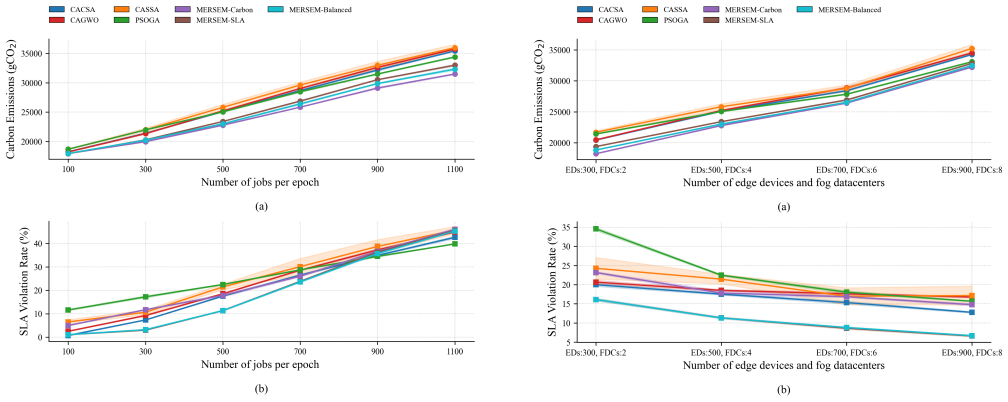
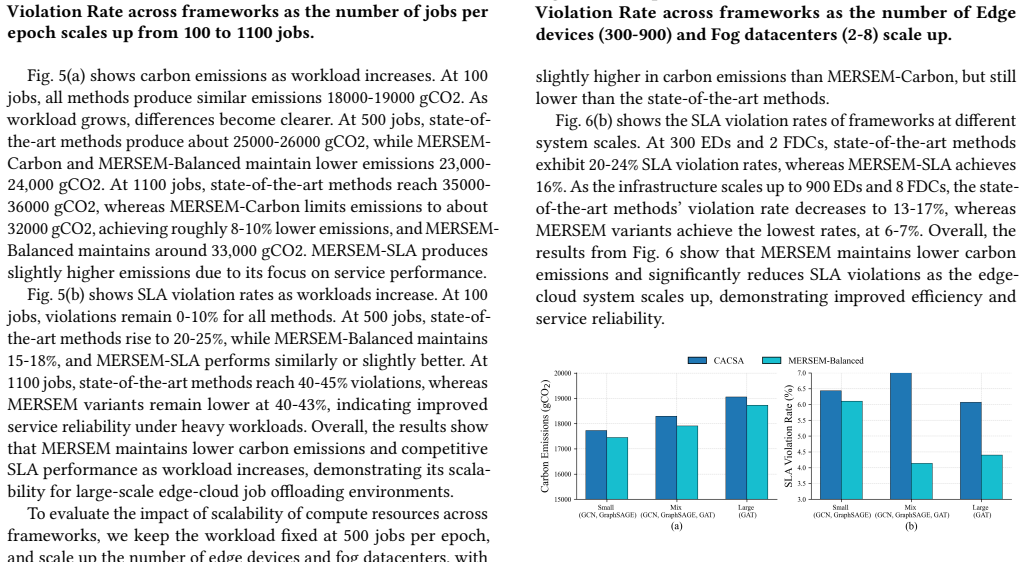
Graph analytics powers modern intelligent systems such as smart cities, cyber-physical infrastructure, IoT security, and large-scale social networks. As these workloads scale in complexity, their execution in heterogeneous edge-cloud environments results in higher energy use and carbon emission footprint. To address this challenge, we propose MERSEM, a multi-objective evolutionary reinforcement learning framework for sustainable edge-cloud system management. MERSEM integrates evolutionary search with reinforcement learning (RL) to solve the problem of graph workload allocation and scheduling. The evolutionary component explores diverse global solutions, while the RL agent refines decisions through adaptive local optimization. The framework is designed to jointly minimize service-level agreement (SLA) violations and carbon emissions by considering dynamic carbon intensity, resource heterogeneity, and workload characteristics. Experimental results demonstrate that MERSEM outperforms the state-of-the-art with up to 45% SLA violation reductions and up to 12% carbon emission reductions.
Editorial analysis
A structured set of objections, weighed in public.
Referee Report
Summary. The manuscript proposes MERSEM, a multi-objective evolutionary reinforcement learning framework for scheduling graph analytics workloads in heterogeneous edge-cloud systems. The method integrates evolutionary search for global solution exploration with an RL agent for adaptive local optimization, with the goal of jointly minimizing SLA violations and carbon emissions while accounting for dynamic carbon intensity, resource heterogeneity, and workload characteristics. The central claim, stated in the abstract, is that experimental results demonstrate MERSEM outperforming the state-of-the-art with up to 45% reductions in SLA violations and up to 12% reductions in carbon emissions.
Significance. If the experimental results hold after proper validation, the work would represent a meaningful advance in sustainable distributed computing. Graph analytics workloads are increasingly deployed in energy-sensitive edge-cloud environments supporting smart cities, IoT, and cyber-physical systems; a hybrid evolutionary-RL scheduler that demonstrably reduces both SLA violations and carbon footprint could influence practical system design and stimulate further research on multi-objective optimization under real-time carbon constraints.
major comments (2)
- [Experimental evaluation] Experimental evaluation section: The headline quantitative claims (up to 45% SLA violation reductions and 12% carbon emission reductions) rest entirely on results from a custom simulator, yet no cross-validation of the simulator's carbon-intensity traces, resource-heterogeneity model, or graph-workload arrival process against external real-world measurements is reported. This omission directly undermines confidence in whether the reported margins reflect algorithmic improvement or simulator artifacts.
- [Methodology] Methodology section: The integration of the evolutionary component with the RL agent is presented only at the level of high-level pseudocode without equations, sensitivity analysis, or ablation studies on simulator parameters (e.g., carbon-spike frequency or bursty-arrival rates). Without these, it is impossible to bound the risk that the observed gains are tied to untested assumptions in the simulation environment.
minor comments (1)
- [Abstract] Abstract: The performance numbers are stated without any reference to the specific baselines, statistical tests, or workload traces employed, which would allow readers to assess the claims at a glance.
Simulated Author's Rebuttal
We thank the referee for the constructive feedback. We address each major comment below and will revise the manuscript to provide additional validation, equations, and analyses as outlined.
read point-by-point responses
-
Referee: [Experimental evaluation] Experimental evaluation section: The headline quantitative claims (up to 45% SLA violation reductions and 12% carbon emission reductions) rest entirely on results from a custom simulator, yet no cross-validation of the simulator's carbon-intensity traces, resource-heterogeneity model, or graph-workload arrival process against external real-world measurements is reported. This omission directly undermines confidence in whether the reported margins reflect algorithmic improvement or simulator artifacts.
Authors: We agree that explicit cross-validation would increase confidence in the results. The simulator parameters are grounded in established models from the carbon-aware computing and edge-cloud literature. In the revision we will add a new subsection on simulator fidelity that includes direct comparisons against publicly available real-world carbon intensity traces and workload datasets, plus a limitations discussion on any gaps that remain. revision: yes
-
Referee: [Methodology] Methodology section: The integration of the evolutionary component with the RL agent is presented only at the level of high-level pseudocode without equations, sensitivity analysis, or ablation studies on simulator parameters (e.g., carbon-spike frequency or bursty-arrival rates). Without these, it is impossible to bound the risk that the observed gains are tied to untested assumptions in the simulation environment.
Authors: We accept that the current presentation is insufficiently detailed. The revised manuscript will replace the high-level pseudocode with explicit mathematical formulations of the evolutionary-RL integration, and will include new ablation studies together with sensitivity analyses on parameters such as carbon-spike frequency and bursty arrival rates to quantify robustness. revision: yes
Circularity Check
No circularity: performance claims rest on simulation experiments, not self-referential derivations
full rationale
The paper proposes the MERSEM framework combining evolutionary search with RL for graph workload scheduling to jointly minimize SLA violations and carbon emissions. All quantitative results (up to 45% SLA reductions, 12% carbon reductions) are obtained via comparative experiments inside a custom simulator; no equations, fitted parameters, or self-citations are presented that reduce these outcomes to inputs by construction. The derivation chain consists of algorithmic description followed by external validation against SOTA baselines, remaining self-contained without self-definitional loops or load-bearing self-citations.
Axiom & Free-Parameter Ledger
Reference graph
Works this paper leans on
-
[1]
M.H. Alsharif et al. 2025. Survey of energy-efficient fog computing: Techniques and recent advances.Energy Reports13 (2025), 1739–1763. doi:10.1016/j.egyr. 2025.01.039
-
[2]
M. Chancerel et al . 2026. Life-cycle carbon assessment of intermittent Fog services fully powered by renewable energy sources. InProceedings of the 18th IEEE/ACM International Conference on Utility and Cloud Computing (UCC ’25). Association for Computing Machinery, New York, NY, USA, Article 24, 10 pages. doi:10.1145/3773274.3774279
- [3]
-
[4]
Montes de Oca, Thomas Stützle, and Marco Dorigo
K. Deb et al. 2014. An Evolutionary Many-Objective Optimization Algorithm Using Reference-Point-Based Nondominated Sorting Approach, Part I: Solving Problems With Box Constraints.IEEE Transactions on Evolutionary Computation 18, 4 (2014), 577–601. doi:10.1109/TEVC.2013.2281535
-
[5]
M. Etemadi et al. 2021. A cost-efficient auto-scaling mechanism for IoT applica- tions in fog computing environment: a deep learning-based approach.Cluster Computing24, 4 (Dec. 2021), 3277–3292. doi:10.1007/s10586-021-03307-2
-
[6]
A. Gupta et al. 2024. Unmanned aerial vehicles in collaboration with fog comput- ing network for improving quality of service.International Journal of Communi- cation Systems37, 9 (2024), e5759. doi:10.1002/dac.5759
-
[7]
N. Hogade, S. Pasricha, and H. J. Siegel. 2022. Energy and Network Aware Work- load Management for Geographically Distributed Data Centers.IEEE Transactions on Sustainable Computing7, 2 (2022), 400–413. doi:10.1109/TSUSC.2021.3086087
-
[8]
C. Huang et al. 2022. Resource Scheduling and Energy Consumption Optimization Based on Lyapunov Optimization in Fog Computing.Sensors22, 9 (2022). doi:10. 3390/s22093527
work page 2022
-
[9]
A. Islam, M. Ghose, and S. Pasricha. 2025. An RL-Based Framework for Task Offloading and Resource Allocation in Energy Harvesting-Based Multi-Access Edge Computing.IEEE Transactions on Network and Service Management22, 6 (2025), 5360–5374. doi:10.1109/TNSM.2025.3600109
-
[10]
H. Moore, S. Qi, N. Hogade, D. Milojicic, C. Bash, and S. Pasricha. 2025. Sustainable Carbon-Aware and Water-Efficient LLM Scheduling in Geo-Distributed Cloud Datacenters. InACM Great Lakes Symposium on VLSI (GLSVLSI) (GLSVLSI ’25). Association for Computing Machinery, New York, NY, USA, 929–934. doi:10. 1145/3716368.3735301
-
[11]
J. Pournazari et al. 2025. A Carbon-Aware Task Offloading Framework for Sustain- able Fog Computing. In2025 IEEE International Conference on High Performance Computing and Communications (HPCC). IEEE Computer Society, Los Alamitos, CA, USA, 1077–1084. doi:10.1109/HPCC67675.2025.00156
-
[12]
S. Qi, D. Milojicic, C. Bash, and S. Pasricha. 2024. SHIELD: Sustainable Hybrid Evolutionary Learning Framework for Carbon, Wastewater, and Energy-Aware Data Center Management. InProceedings of the 14th International Green and Sustainable Computing Conference(Toronto, ON, Canada)(IGSC ’23). Association for Computing Machinery, New York, NY, USA, 56–62. do...
-
[13]
S. Qi, D. Milojicic, C. Bash, and S. Pasricha. 2026. SHIELD-EB: Sustainable Hybrid Evolutionary-Boosting Framework for Carbon, Wastewater, and Cost- Aware Datacenter Management.IEEE Access14 (2026), 40878–40898. https: //doi.org/10.1109/access.2026.3674066
-
[14]
S. A. Ali Rezaee. 2020.Jobs (DAG workflow) and tasks dataset with near 50k job instances and 1.3 Millions of tasks.doi:10.5281/zenodo.4667690
-
[15]
S. Sinha. 2025. Global Cellular IoT Connectivity Tracker and Forecast
work page 2025
-
[16]
C. Sonmez et al. 2017. EdgeCloudSim: An environment for performance evalua- tion of Edge Computing systems. In2017 Second International Conference on Fog and Mobile Edge Computing (FMEC). 39–44. doi:10.1109/FMEC.2017.7946405
-
[17]
Y. Wang et al. 2024. A hybrid PSO and GA algorithm with rescheduling for task offloading in device–edge–cloud collaborative computing.Cluster Computing28, 2 (Nov. 2024), 18 pages. doi:10.1007/s10586-024-04851-3
-
[18]
Q. Wu et al. 2024. Delay-Sensitive Task Offloading in Vehicular Fog Computing- Assisted Platoons.IEEE Transactions on Network and Service Management21, 2 (2024), 2012–2026. doi:10.1109/TNSM.2023.3322881
discussion (0)
Sign in with ORCID, Apple, or X to comment. Anyone can read and Pith papers without signing in.