Recognition: unknown
Task-Aware Automated User Profile Generation for Recommendation Simulation Using Large Language Models
Pith reviewed 2026-05-14 18:18 UTC · model grok-4.3
The pith
APG4RecSim automatically generates realistic user profiles for LLM-based recommender simulations with minimal supervision.
A machine-rendered reading of the paper's core claim, the machinery that carries it, and where it could break.
Core claim
APG4RecSim constructs realistic, coherent, and robust user profiles with minimal supervision. Extensive experiments on three benchmark datasets demonstrate that it achieves the best overall performance on discrimination, ranking, and rating tasks, improving ranking quality by up to 7% in nDCG@10 and reducing rating distribution divergence by 8% in JSD compared to existing profile-generation baselines. The profiles are resilient to popularity- and position-induced biases and maintain stable performance across datasets and different LLMs.
What carries the argument
Task-aware automated profile generation framework (APG4RecSim) that leverages LLMs to create user profiles driving simulated agent interactions in recommender systems.
If this is right
- Recommender evaluations can achieve higher accuracy in ranking and rating predictions through simulated interactions.
- Scalability of simulation frameworks increases by reducing reliance on manual profile creation.
- Simulated behaviors become more robust against common data biases like item popularity.
- Consistency across datasets and LLMs supports broader application in different recommendation scenarios.
Where Pith is reading between the lines
- Adopting this could allow faster iteration on recommender algorithms using only simulated data.
- Extensions might include generating profiles for multi-turn interactions or incorporating user feedback loops.
- The results imply that task-awareness in prompting is critical for aligning LLM outputs with real user patterns.
- Testing on non-standard domains like news or music recommendations could validate broader utility.
Load-bearing premise
Minimally supervised LLM outputs can accurately capture and replicate the underlying preferences and decision patterns of real users.
What would settle it
A controlled experiment where simulated interactions using APG4RecSim profiles show equal or higher divergence from real user logs than those from manual baselines on the same metrics.
Figures

read the original abstract
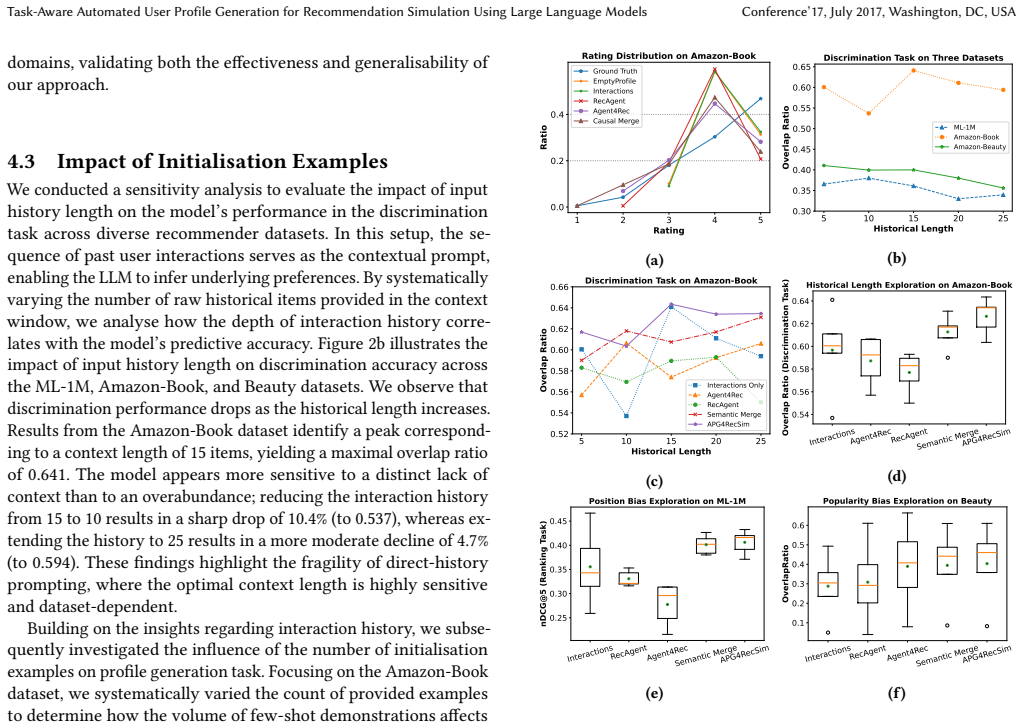
Large Language Model (LLM)-based agent simulation has emerged as a promising approach to meet the increasing demand for real-time and rigorous evaluation in modern recommender systems. A typical LLM-driven simulation framework comprises three essential components: the profile module, memory module, and action module. However, existing studies have primarily concentrated on enhancing the memory and action modules, with limited attention to profile generation, which plays a pivotal role in ensuring realistic agent behaviours and aligning simulated interactions with real user dynamics. Moreover, the scarcity of datasets specifically designed for recommendation simulations has led to heavy reliance on manually crafted profiles, significantly limiting the scalability and generalisability of simulation frameworks across different datasets. To address these challenges, this work proposes an Automated Profile Generation Framework for Recommendation Simulation, APG4RecSim, that constructs realistic, coherent, and robust user profiles with minimal supervision. Extensive experiments on three benchmark datasets demonstrate that APG4RecSim achieves the best overall performance on discrimination, ranking, and rating tasks, improving ranking quality by up to 7% in nDCG@10 and reducing rating distribution divergence by 8% in JSD compared to existing profile-generation baselines. Beyond overall performance gains, our results show that profiles generated by APG4RecSim are resilient to popularity- and position-induced biases and maintain stable performance across datasets and different LLMs.
Editorial analysis
A structured set of objections, weighed in public.
Circularity Check
No significant circularity
full rationale
The paper presents an empirical framework APG4RecSim for automated user profile generation via LLMs, evaluated on three public benchmark datasets using standard metrics (nDCG@10, JSD) against external baselines. No mathematical derivation, equations, or load-bearing steps are described that reduce by construction to fitted inputs, self-citations, or renamed ansatzes. Performance gains are reported as measured outcomes on held-out tasks, with the method relying on minimal supervision and LLM prompting rather than any self-referential fitting or uniqueness theorem imported from prior author work. The derivation chain is therefore self-contained against external benchmarks.
Axiom & Free-Parameter Ledger
axioms (1)
- domain assumption LLM-generated profiles can produce simulated user behaviors that align with real user dynamics
Reference graph
Works this paper leans on
-
[1]
Himan Abdollahpouri, Masoud Mansoury, Robin Burke, Bamshad Mobasher, and Edward Malthouse. 2021. User-centered Evaluation of Popularity Bias in Recom- mender Systems. InProceedings of the 29th ACM Conference on User Modeling, Adaptation and Personalization(Utrecht, Netherlands)(UMAP ’21). Association for Computing Machinery, New York, NY, USA, 119–129. do...
-
[2]
Mohammad Yahya H. Al-Shamri. 2016. User profiling approaches for demo- graphic recommender systems.Know.-Based Syst.100, C (May 2016), 175–187. doi:10.1016/j.knosys.2016.03.006
-
[3]
Ananya Bhattacharjee, Yuchen Zeng, Sarah Yi Xu, Dana Kulzhabayeva, Minyi Ma, Rachel Kornfield, Syed Ishtiaque Ahmed, Alex Mariakakis, Mary P Czerwinski, Anastasia Kuzminykh, Michael Liut, and Joseph Jay Williams. 2024. Under- standing the Role of Large Language Models in Personalizing and Scaffolding Strategies to Combat Academic Procrastination. InProcee...
-
[4]
Nicolas Bougie and Narimawa Watanabe. 2025. SimUSER: Simulating User Be- havior with Large Language Models for Recommender System Evaluation. In Proceedings of the 63rd Annual Meeting of the Association for Computational Lin- guistics (Volume 6: Industry Track), Georg Rehm and Yunyao Li (Eds.). Association for Computational Linguistics, Vienna, Austria, 4...
-
[6]
Nicholas Carlini, Daphne Ippolito, Matthew Jagielski, Katherine Lee, Florian Tramèr, and Chiyuan Zhang. 2023. Quantifying Memorization Across Neu- ral Language Models. InThe Eleventh International Conference on Learning Representations, ICLR 2023, Kigali, Rwanda, May 1-5, 2023. OpenReview.net. https://openreview.net/forum?id=TatRHT_1cK
work page 2023
-
[7]
Abhijnan Chakraborty, Johnnatan Messias, Fabricio Benevenuto, Saptarshi Ghosh, Niloy Ganguly, and Krishna Gummadi. 2017. Who makes trends? understanding demographic biases in crowdsourced recommendations. InProceedings of the International AAAI Conference on Web and Social Media, Vol. 11. 22–31
work page 2017
-
[8]
Jiawei Chen, Hande Dong, Xiang Wang, Fuli Feng, Meng Wang, and Xiangnan He
-
[9]
Bias and Debias in Recommender System: A Survey and Future Directions. ACM Trans. Inf. Syst.41, 3, Article 67 (Feb. 2023), 39 pages. doi:10.1145/3564284
-
[10]
Luyu Chen, Quanyu Dai, Zeyu Zhang, Xueyang Feng, Mingyu Zhang, Pengcheng Tang, Xu Chen, Yue Zhu, and Zhenhua Dong. 2025. RecUserSim: A Realistic and Diverse User Simulator for Evaluating Conversational Recommender Systems. InCompanion Proceedings of the ACM on Web Conference 2025(Sydney NSW, Australia)(WWW ’25). Association for Computing Machinery, New Yo...
-
[11]
Xinshi Chen, Shuang Li, Hui Li, Shaohua Jiang, Yuan Qi, and Le Song. 2019. Gen- erative adversarial user model for reinforcement learning based recommendation system. InInternational conference on machine learning. PMLR, 1052–1061
work page 2019
-
[12]
Andrew Collins, Dominika Tkaczyk, Akiko Aizawa, and Joeran Beel. 2018. Posi- tion bias in recommender systems for digital libraries. InInternational Conference on Information. Springer, 335–344
work page 2018
-
[13]
Yashar Deldjoo, Zhankui He, Julian McAuley, Anton Korikov, Scott Sanner, Arnau Ramisa, René Vidal, Maheswaran Sathiamoorthy, Atoosa Kasirzadeh, and Silvia Milano. 2024. A review of modern recommender systems using generative models (gen-recsys). InProceedings of the 30th ACM SIGKDD conference on Knowledge Discovery and Data Mining. 6448–6458
work page 2024
-
[14]
Dario Di Palma, Felice Antonio Merra, Maurizio Sfilio, Vito Walter Anelli, Fedelu- cio Narducci, and Tommaso Di Noia. 2025. Do LLMs Memorize Recommendation Datasets? A Preliminary Study on MovieLens-1M. InProceedings of the 48th International ACM SIGIR Conference on Research and Development in Information Retrieval(Padua, Italy)(SIGIR ’25). Association fo...
-
[15]
Chongming Gao, Shijun Li, Wenqiang Lei, Jiawei Chen, Biao Li, Peng Jiang, Xiangnan He, Jiaxin Mao, and Tat-Seng Chua. 2022. KuaiRec: A fully-observed dataset and insights for evaluating recommender systems. InProceedings of the 31st ACM International Conference on Information & Knowledge Management. 540–550
work page 2022
-
[16]
F. Maxwell Harper and Joseph A. Konstan. 2015. The MovieLens Datasets: History and Context.ACM Trans. Interact. Intell. Syst.5, 4, Article 19 (Dec. 2015), 19 pages. doi:10.1145/2827872
-
[17]
Katja Hofmann, Anne Schuth, Alejandro Bellogin, and Maarten De Rijke. 2014. Effects of position bias on click-based recommender evaluation. InEuropean Conference on Information Retrieval. Springer, 624–630
work page 2014
-
[18]
Yupeng Hou, Jiacheng Li, Zhankui He, An Yan, Xiusi Chen, and Julian McAuley
-
[19]
Bridging language and items for retrieval and recommendation.arXiv preprint arXiv:2403.03952(2024)
work page internal anchor Pith review Pith/arXiv arXiv 2024
-
[20]
Yupeng Hou, Shanlei Mu, Wayne Xin Zhao, Yaliang Li, Bolin Ding, and Ji-Rong Wen. 2022. Towards Universal Sequence Representation Learning for Recom- mender Systems. InProceedings of the 28th ACM SIGKDD Conference on Knowl- edge Discovery and Data Mining(Washington DC, USA)(KDD ’22). Association for Computing Machinery, New York, NY, USA, 585–593. doi:10.1...
- [21]
-
[22]
Song Jin, Juntian Zhang, Yuhan Liu, Xun Zhang, Yufei Zhang, Guojun Yin, Fei Jiang, Wei Lin, and Rui Yan. 2025. Beyond Static Testbeds: An Interaction-Centric Agent Simulation Platform for Dynamic Recommender Systems. InProceedings of the 2025 Conference on Empirical Methods in Natural Language Processing, Christos Christodoulopoulos, Tanmoy Chakraborty, C...
-
[23]
Thorsten Krause, Lorena Göritz, and Robin Gratz. 2025. The Effect of Gender De-biased Recommendations — A User Study on Gender-specific Preferences. In Proceedings of the 2025 CHI Conference on Human Factors in Computing Systems (CHI ’25). Association for Computing Machinery, New York, NY, USA, Article 1000, 16 pages. doi:10.1145/3706598.3713155
-
[24]
J. Lin. 1991. Divergence measures based on the Shannon entropy.IEEE Transac- tions on Information Theory37, 1 (1991), 145–151. doi:10.1109/18.61115
-
[25]
Yusheng Lu, Zhaocheng Du, Xiangyang Li, Pengyue Jia, Yejing Wang, Weiwen Liu, Yichao Wang, Huifeng Guo, Ruiming Tang, Zhenhua Dong, Yongrui Duan, and Xiangyu Zhao. 2025. Prompt Tuning as User Inherent Profile Inference Machine. InProceedings of the 34th ACM International Conference on Information and Knowledge Management(Seoul, Republic of Korea)(CIKM ’25...
-
[26]
Chenglong Ma, Ziqi Xu, Yongli Ren, Danula Hettiachchi, and Jeffrey Chan. 2025. PUB: An LLM-Enhanced Personality-Driven User Behaviour Simulator for Rec- ommender System Evaluation. InProceedings of the 48th International ACM SIGIR Conference on Research and Development in Information Retrieval, SIGIR. 2690– 2694
work page 2025
-
[27]
Stuart E. Middleton, Nigel R. Shadbolt, and David C. De Roure. 2004. Ontological user profiling in recommender systems.ACM Trans. Inf. Syst.22, 1 (Jan. 2004), 54–88. doi:10.1145/963770.963773
-
[28]
Joon Sung Park, Joseph O’Brien, Carrie Jun Cai, Meredith Ringel Morris, Percy Liang, and Michael S. Bernstein. 2023. Generative Agents: Interactive Simulacra of Human Behavior. InProceedings of the 36th Annual ACM Symposium on User Task-Aware Automated User Profile Generation for Recommendation Simulation Using Large Language Models Conference’17, July 20...
-
[29]
Alec Radford, Jeffrey Wu, Rewon Child, David Luan, Dario Amodei, Ilya Sutskever, et al. 2019. Language models are unsupervised multitask learners.OpenAI blog 1, 8 (2019), 9
work page 2019
-
[30]
Robin Ungruh, Alejandro Bellogín, and Maria Soledad Pera. 2025. From Monolith to Mosaic: Uncovering Behavioral Differences for Choice Models in Recom- mender Systems Simulations. InProceedings of the 48th International ACM SIGIR Conference on Research and Development in Information Retrieval(Padua, Italy)(SI- GIR ’25). Association for Computing Machinery,...
-
[31]
Hanpeng Wang and Zijiang Yang. 2025. A Multi-Agent Approach to Investor Profiling Using Large Language Models. In2025 International Conference on Control, Automation and Diagnosis (ICCAD). 1–6. doi:10.1109/ICCAD64771.2025. 11099326
-
[32]
Lu Wang, Di Zhang, Fangkai Yang, Pu Zhao, Jianfeng Liu, Yuefeng Zhan, Hao Sun, Qingwei Lin, Weiwei Deng, Dongmei Zhang, Feng Sun, and Qi Zhang
-
[33]
LettinGo: Explore User Profile Generation for Recommendation System. InProceedings of the 31st ACM SIGKDD Conference on Knowledge Discovery and Data Mining V.2(Toronto ON, Canada)(KDD ’25). Association for Computing Machinery, New York, NY, USA, 2985–2995. doi:10.1145/3711896.3737024
-
[34]
Lei Wang, Jingsen Zhang, Hao Yang, Zhi-Yuan Chen, Jiakai Tang, Zeyu Zhang, Xu Chen, Yankai Lin, Hao Sun, Ruihua Song, et al. 2025. User behavior simulation with large language model-based agents.ACM Transactions on Information Systems43, 2 (2025), 1–37
work page 2025
-
[35]
Xinyi Wang, Antonis Antoniades, Yanai Elazar, Alfonso Amayuelas, Alon Albalak, Kexun Zhang, and William Yang Wang. 2025. Generalization v.s. Memorization: Tracing Language Models’ Capabilities Back to Pretraining Data. InThe Thirteenth International Conference on Learning Representations. https://openreview.net/ forum?id=IQxBDLmVpT
work page 2025
-
[36]
Xinye Wanyan, Danula Hettiachchi, Chenglong Ma, Ziqi Xu, and Jeffrey Chan
-
[37]
Temporal-Aware User Behaviour Simulation with Large Language Mod- els for Recommender Systems. InProceedings of the 34th ACM International Conference on Information and Knowledge Management(Seoul, Republic of Ko- rea)(CIKM ’25). Association for Computing Machinery, New York, NY, USA, 5335–5339. doi:10.1145/3746252.3760878
-
[38]
Tianxin Wei, Fuli Feng, Jiawei Chen, Ziwei Wu, Jinfeng Yi, and Xiangnan He
-
[39]
Model-Agnostic Counterfactual Reasoning for Eliminating Popularity Bias in Recommender System. InProceedings of the 27th ACM SIGKDD Conference on Knowledge Discovery & Data Mining(Virtual Event, Singapore)(KDD ’21). Association for Computing Machinery, New York, NY, USA, 1791–1800. doi:10. 1145/3447548.3467289
-
[40]
Ziqi Xu, Chenglong Ma, Yongli Ren, Jeffrey Chan, Wei Shao, and Feng Xia. 2025. Towards Better Evaluation of Recommendation Algorithms with Bi-directional Item Response Theory. InCompanion Proceedings of the ACM on Web Conference 2025(Sydney NSW, Australia)(WWW ’25). Association for Computing Machinery, New York, NY, USA, 1455–1459. doi:10.1145/3701716.3715540
-
[41]
An Zhang, Yuxin Chen, Leheng Sheng, Xiang Wang, and Tat-Seng Chua. 2024. On Generative Agents in Recommendation. InProceedings of the 47th International ACM SIGIR Conference on Research and Development in Information Retrieval (Washington DC, USA)(SIGIR ’24). Association for Computing Machinery, New York, NY, USA, 1807–1817. doi:10.1145/3626772.3657844
-
[42]
Erhan Zhang, Xingzhu Wang, Peiyuan Gong, Zixuan Yang, and Jiaxin Mao. 2025. Exploring Human-Like Thinking in Search Simulations with Large Language Models. InProceedings of the 48th International ACM SIGIR Conference on Research and Development in Information Retrieval(Padua, Italy)(SIGIR ’25). Association for Computing Machinery, New York, NY, USA, 2669–...
-
[43]
Jiarui Zhang. 2024. Guided Profile Generation Improves Personalization with Large Language Models. InFindings of the Association for Computational Lin- guistics: EMNLP 2024, Yaser Al-Onaizan, Mohit Bansal, and Yun-Nung Chen (Eds.). Association for Computational Linguistics, Miami, Florida, USA, 4005–
work page 2024
-
[44]
doi:10.18653/v1/2024.findings-emnlp.231
-
[45]
McAuley, Wayne Xin Zhao, Leyu Lin, and Ji-Rong Wen
Junjie Zhang, Yupeng Hou, Ruobing Xie, Wenqi Sun, Julian J. McAuley, Wayne Xin Zhao, Leyu Lin, and Ji-Rong Wen. 2024. AgentCF: Collaborative Learning with Autonomous Language Agents for Recommender Systems. InProceedings of the ACM on Web Conference 2024, WWW. 3679–3689
work page 2024
-
[46]
Shuo Zhang and Krisztian Balog. 2020. Evaluating conversational recommender systems via user simulation. InProceedings of the 26th acm sigkdd international conference on knowledge discovery & data mining. 1512–1520
work page 2020
-
[47]
Yu Zhang, Shutong Qiao, Jiaqi Zhang, Tzu-Heng Lin, Chen Gao, and Yong Li
- [48]
-
[49]
Zeyu Zhang, Quanyu Dai, Xiaohe Bo, Chen Ma, Rui Li, Xu Chen, Jieming Zhu, Zhenhua Dong, and Ji-Rong Wen. 2025. A Survey on the Memory Mechanism of Large Language Model-based Agents.ACM Trans. Inf. Syst.43, 6, Article 155 (Sept. 2025), 47 pages. doi:10.1145/3748302
-
[50]
Zijian Zhang, Shuchang Liu, Ziru Liu, Rui Zhong, Qingpeng Cai, Xiangyu Zhao, Chunxu Zhang, Qidong Liu, and Peng Jiang. 2025. LLM-powered user simulator for recommender system. InProceedings of the Thirty-Ninth AAAI Conference on Artificial Intelligence and Thirty-Seventh Conference on Innovative Applications of Artificial Intelligence and Fifteenth Sympos...
-
[51]
Zihuai Zhao, Wenqi Fan, Jiatong Li, Yunqing Liu, Xiaowei Mei, Yiqi Wang, Zhen Wen, Fei Wang, Xiangyu Zhao, Jiliang Tang, et al. 2024. Recommender systems in the era of large language models (llms).IEEE Transactions on Knowledge and Data Engineering36, 11 (2024), 6889–6907
work page 2024
-
[52]
Kun Zhou, Hui Wang, Wayne Xin Zhao, Yutao Zhu, Sirui Wang, Fuzheng Zhang, Zhongyuan Wang, and Ji-Rong Wen. 2020. S3-Rec: Self-Supervised Learning for Sequential Recommendation with Mutual Information Maximization. InCIKM ’20: The 29th ACM International Conference on Information and Knowledge Man- agement. 1893–1902
work page 2020
discussion (0)
Sign in with ORCID, Apple, or X to comment. Anyone can read and Pith papers without signing in.