Perfect simulation for interacting Hawkes processes with reset-induced variable length memory
Pith reviewed 2026-05-14 18:09 UTC · model grok-4.3
The pith
If the sure-event rate exceeds the candidate-event rate in interacting Hawkes processes, their clans of ancestors are finite almost surely.
A machine-rendered reading of the paper's core claim, the machinery that carries it, and where it could break.
Core claim
The main result is a constructive subcriticality criterion: if β_*/(β^* − β_*) > 1, then the clan of ancestors is almost surely finite. The proof relies on an explicit dominating branching process associated with the genealogical structure of the exploration. The finiteness yields a measurable local construction of the stationary regime, existence and uniqueness by coupling, and an exact perfect simulation algorithm.
What carries the argument
The clan of ancestors, defined as the finite or infinite backward exploration of all events whose acceptance decisions may influence a target space-time point, dominated by a branching process from the dominating Poisson environment.
If this is right
- The stationary solution exists and is unique.
- An exact backward-forward perfect simulation algorithm is obtained.
- The algorithm terminates almost surely in the subcritical regime.
- Exact samples from the stationary law are returned.
Where Pith is reading between the lines
- This approach could extend to other interacting point processes with memory resets on higher-dimensional graphs.
- Computational efficiency near the threshold might be improved by optimizing the dominating Poisson intensities.
- Similar clan constructions may apply to non-stationary or time-inhomogeneous versions of these processes.
Load-bearing premise
The intensities are bounded uniformly by a dominating Poisson environment so that the associated branching process dominates the clan size.
What would settle it
A numerical simulation where for parameters satisfying β_*/(β^*-β_*) <=1 the backward exploration continues indefinitely with positive probability, or fails to produce finite clans.
Figures


read the original abstract
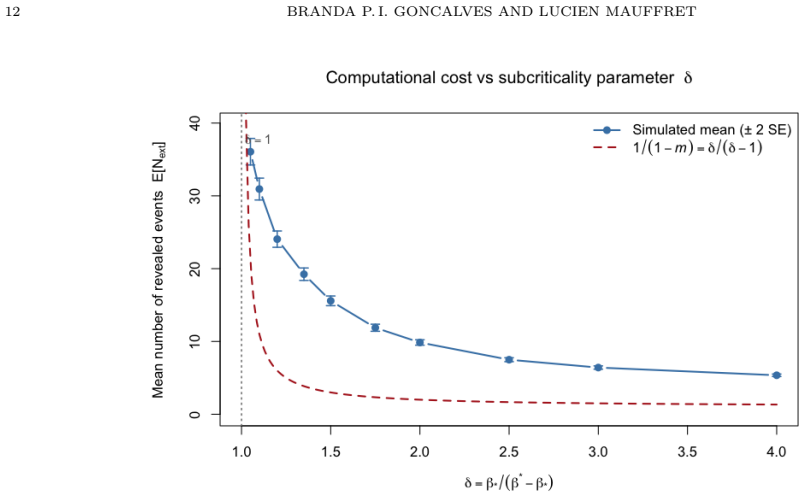
We study a class of interacting nonlinear Hawkes point processes on the integer lattice in which each component is reset after its own jumps. The intensity of a component depends on the post-reset activity of its nearest neighbours, which produces a variable-length memory structure. We develop a graphical construction based on a dominating Poisson environment and introduce the clan of ancestors of a space-time point. The clan is the finite or infinite backward exploration of all events whose acceptance decisions may influence the target value. Our main result is a constructive subcriticality criterion: if the sure-event rate exceeds the candidate-event rate, equivalently if $\beta_*/(\beta^*-\beta_*)>1$, then the clan is almost surely finite. The proof is based on an explicit dominating branching process associated with the genealogical structure of the exploration. The finiteness of the clan yields a measurable local construction of the stationary regime. We prove existence and uniqueness of the stationary solution by a coupling argument and obtain an exact backward--forward perfect simulation algorithm. The algorithm terminates almost surely in the subcritical regime and returns exact samples from the stationary law. Numerical experiments, together with reproducibility details and R code, illustrate the finite-clan mechanism and the computational behaviour near the theoretical threshold.
Editorial analysis
A structured set of objections, weighed in public.
Referee Report
Summary. The manuscript develops a graphical construction for interacting nonlinear Hawkes point processes on the integer lattice with reset after each jump, inducing variable-length memory via nearest-neighbor post-reset activity. It defines the clan of ancestors of a space-time point as the backward exploration of influencing events and proves that under the subcriticality condition β_*/(β^* - β_*) > 1 the clan is almost surely finite, via explicit domination by a branching process built from the Poisson environment. This finiteness yields a measurable local construction of the stationary regime, proved via coupling for existence and uniqueness, together with an exact backward-forward perfect simulation algorithm that terminates a.s. Numerical illustrations and R code are included.
Significance. If the central claim holds, the paper supplies a constructive, rate-based criterion for perfect simulation of a nontrivial class of interacting point processes with memory truncation, which is a concrete advance for exact sampling in stochastic simulation. The explicit branching-process domination, the coupling argument for stationarity, and the provision of reproducible R code are particular strengths that support verifiability and potential extensions.
major comments (1)
- [§3] §3 (graphical construction): the uniform upper bound on the nonlinear Hawkes intensity that justifies the dominating Poisson environment is stated but its derivation from the reset rule and nearest-neighbor dependence is only sketched; an explicit verification that the bound remains β^* independently of the history length would make the branching-process comparison fully rigorous.
minor comments (3)
- [§2] The definition of the candidate-event rate β^* and sure-event rate β_* appears first in the abstract and should be restated with the intensity functions in §2 to improve readability.
- [Figure 1] Figure 1 caption could explicitly note the lattice spacing and the reset time scale used in the simulation to match the theoretical parameters.
- [Introduction] A brief comparison paragraph with existing perfect-simulation methods for Hawkes processes (e.g., those based on thinning or coupling from the past) would clarify the novelty of the reset-induced truncation.
Simulated Author's Rebuttal
We thank the referee for the positive report and the recommendation to accept. The single major comment is addressed point-by-point below.
read point-by-point responses
-
Referee: [§3] §3 (graphical construction): the uniform upper bound on the nonlinear Hawkes intensity that justifies the dominating Poisson environment is stated but its derivation from the reset rule and nearest-neighbor dependence is only sketched; an explicit verification that the bound remains β^* independently of the history length would make the branching-process comparison fully rigorous.
Authors: We agree that an explicit verification strengthens rigor. In the revised version we insert a short paragraph immediately after the definition of the intensity in §3. Because each component is reset after its own jump, the intensity at any time depends only on the post-reset activity of nearest neighbors. The nonlinear rate function is bounded above by β^* by assumption, and the reset mechanism truncates all earlier history, so the instantaneous intensity is at most β^* irrespective of the length of the post-reset interval. Consequently the dominating Poisson environment with intensity β^* is valid uniformly in time and space. This explicit bound justifies the branching-process comparison without changing the subsequent arguments. revision: yes
Circularity Check
No significant circularity; derivation self-contained
full rationale
The central result constructs a graphical representation of the Hawkes process directly from the model primitives, then builds an explicit dominating branching process whose offspring distribution is controlled by the sure-event and candidate-event rates β_* and β^*. The subcriticality threshold β_*/(β^*−β_*)>1 is obtained as a sufficient condition for almost-sure finiteness of the clan by standard branching-process comparison; this comparison is internal to the paper and does not rely on fitting parameters to output data or on self-citations for its justification. The stationary construction and perfect-simulation algorithm follow immediately from clan finiteness without any definitional loop or renaming of known results.
Axiom & Free-Parameter Ledger
free parameters (1)
- β_* and β^*
axioms (2)
- standard math Existence of a dominating Poisson point process whose intensity bounds the Hawkes intensities
- domain assumption The nonlinear intensity functions admit uniform domination compatible with the nearest-neighbor reset rule
invented entities (1)
-
Clan of ancestors
no independent evidence
Lean theorems connected to this paper
-
IndisputableMonolith/Cost/FunctionalEquation.leanwashburn_uniqueness_aczel unclear?
unclearRelation between the paper passage and the cited Recognition theorem.
Lemma 4.1 (Discrete offspring domination) … Galton-Watson process (Zm) with offspring P(ξ=k)=p0(1−p0)^k … total progeny … stochastically dominated
-
IndisputableMonolith/Foundation/BranchSelection.leanbranch_selection unclear?
unclearRelation between the paper passage and the cited Recognition theorem.
Theorem 4.3 (Extinction of the clan) … E[ξ]<1 … subcritical … Next<∞ a.s.
What do these tags mean?
- matches
- The paper's claim is directly supported by a theorem in the formal canon.
- supports
- The theorem supports part of the paper's argument, but the paper may add assumptions or extra steps.
- extends
- The paper goes beyond the formal theorem; the theorem is a base layer rather than the whole result.
- uses
- The paper appears to rely on the theorem as machinery.
- contradicts
- The paper's claim conflicts with a theorem or certificate in the canon.
- unclear
- Pith found a possible connection, but the passage is too broad, indirect, or ambiguous to say the theorem truly supports the claim.
Reference graph
Works this paper leans on
-
[1]
Athreya, K.B. and Ney, P.E. (1972).Branching Processes. Springer, Berlin
work page 1972
-
[2]
P. Brémaud and L. Massoulié. Stability of nonlinear Hawkes processes.Ann. Probab.24(1996), 1563–1588
work page 1996
- [3]
-
[4]
S. Delattre, N. Fournier and M. Hoffmann. Hawkes processes on large networks.Ann. Appl. Probab.26(2016), 216–261
work page 2016
-
[5]
P. A. Ferrari, A. Galves, I. Grigorescu and E. Löcherbach. Phase transition for infinite systems of spiking neurons.J. Stat. Phys. 172(2018), 1564–1575
work page 2018
-
[6]
A. Galves and E. Löcherbach. Infinite systems of interacting chains with memory of variable length.J. Stat. Phys.151(2013), 896–921
work page 2013
- [7]
-
[8]
Goncalves, B.P.I. (2023). An interacting neuronal network with inhibition: theoretical analysis and perfect simulation.Mathe- maticS In Action, Maths Bio,12(1), 3–22.doi:10.5802/msia.29
-
[9]
A. G. Hawkes. Point spectra of some mutually exciting point processes.J. Roy. Statist. Soc. Ser. B33(1971), 438–443
work page 1971
-
[10]
P. Hodara and E. Löcherbach. Hawkes processes with variable length memory and an infinite number of components.Adv. in Appl. Probab.49(2017), 84–107
work page 2017
- [11]
-
[12]
J. G. Propp and D. B. Wilson. Exact sampling with coupled Markov chains and applications to statistical mechanics.Random Structures Algorithms9(1996), 223–252. B. P. I. Goncal ves: Université Paris Est Créteil, 61 a venue du Général de Gaulle, Créteil, France Email address:branda.goncalves@u-pec.fr L. Mauffret: Université Paris 1 Panthéon-Sorbonne, 90 rue...
work page 1996
discussion (0)
Sign in with ORCID, Apple, or X to comment. Anyone can read and Pith papers without signing in.