Recognition: no theorem link
Decoupled and Divergence-Conditioned Prompt for Multi-domain Dynamic Graph Foundation Models
Pith reviewed 2026-05-14 20:18 UTC · model grok-4.3
The pith
DyGFM decouples semantic and temporal patterns in dynamic graphs and uses divergence-conditioned prompts to enable effective multi-domain pre-training without negative transfer.
A machine-rendered reading of the paper's core claim, the machinery that carries it, and where it could break.
Core claim
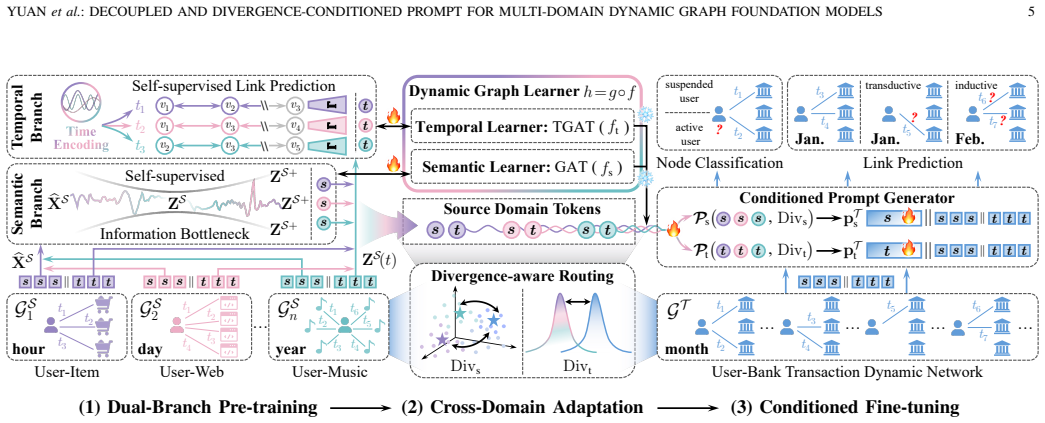
DyGFM is a Dynamic Graph Foundation Model over multiple domains based on decoupled and divergence-conditioned prompting. It disentangles transferable semantics from the domain-specific dynamics through a dual-branch pre-training strategy, alleviates negative transfer during domain adaptation via a cross-domain routing mechanism with divergence-aware expert selection, and enables efficient downstream fine-tuning with a divergence-conditioned prompt generator that injects lightweight learnable graph prompts tailored to semantic and temporal traits.
What carries the argument
Dual-branch pre-training for semantic-temporal decoupling together with divergence-aware expert selection in cross-domain routing and a divergence-conditioned prompt generator.
If this is right
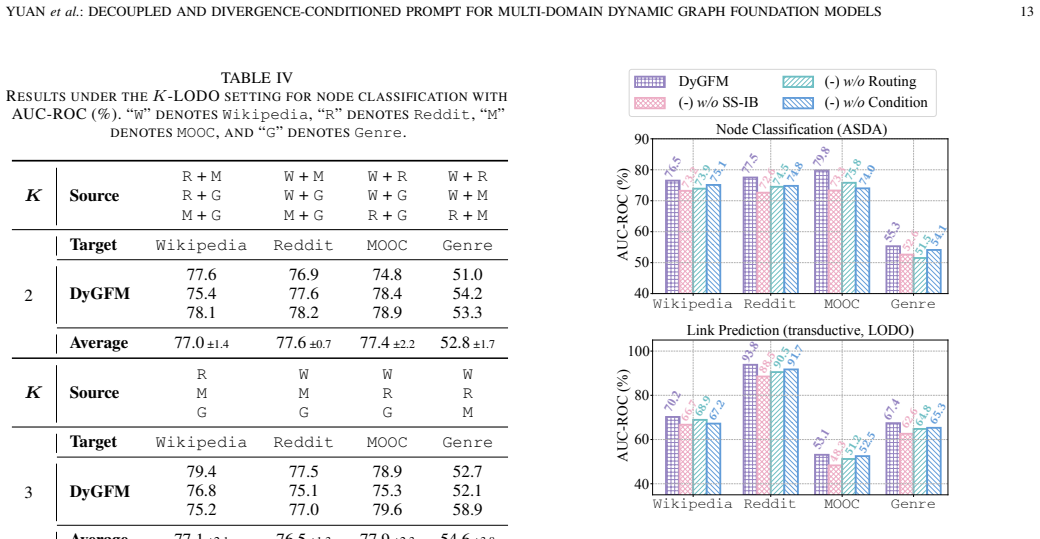
- DyGFM outperforms 12 state-of-the-art baselines on node classification and link prediction across continuous dynamic graph benchmarks.
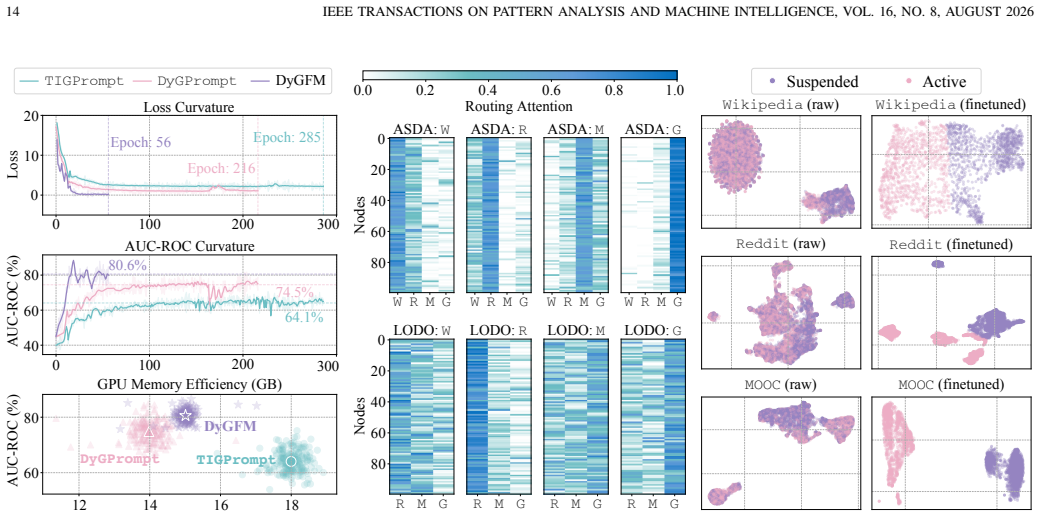
- The model achieves higher effectiveness and efficiency than prior multi-domain or single-domain approaches.
- Unified modeling becomes feasible for dynamic graphs whose semantic and temporal traits differ across domains.
- Lightweight divergence-conditioned prompts allow fast adaptation to new domains without full retraining.
Where Pith is reading between the lines
- The same decoupling idea could be tested on static graphs or other sequential data where domain shifts cause negative transfer.
- If divergence metrics prove stable, they might serve as a general diagnostic for choosing which pre-trained components to reuse in new settings.
- Success on continuous benchmarks suggests the method could scale to streaming scenarios with evolving domains.
- The approach implies that foundation models for graphs may need explicit mechanisms for separating universal from domain-specific structure.
Load-bearing premise
Semantic and temporal patterns can be cleanly separated and divergence metrics will reliably guide expert selection to prevent negative transfer across arbitrary domains without new biases or per-domain tuning.
What would settle it
If a single-domain model trained only on the target domain outperforms DyGFM on held-out test sets from new domain combinations, the claim that the decoupling and routing reliably avoid negative transfer would be falsified.
Figures


read the original abstract
Dynamic graphs are ubiquitous in real-world systems, and building generalizable dynamic Graph Foundation Models has become a frontier in graph learning. However, dynamic graphs from different domains pose fundamental challenges to unified modeling, as their semantic and temporal patterns are inherently inconsistent, making the multi-domain pre-training difficult. Consequently, the widely used "pretrain-then-finetune" paradigm often suffers from severe negative knowledge transfer. To the best of our knowledge, there exists no multi-domain dynamic GFM. In this work, we propose DyGFM, a Dynamic Graph Foundation Model over multiple domains based on decoupled and divergence-conditioned prompting. To disentangle transferable semantics from the domain-specific dynamics, we introduce a dual-branch pre-training strategy with semantic-temporal decoupling. To alleviate negative transfer during domain adaptation, we further develop a cross-domain routing mechanism with divergence-aware expert selection. To enable efficient downstream fine-tuning, we design a divergence-conditioned prompt generator that injects lightweight, learnable graph prompts tailored to semantic and temporal traits. Extensive experiments on continuous dynamic graph benchmarks demonstrate that DyGFM consistently outperforms 12 state-of-the-art baselines on both node classification and link prediction tasks, achieving superior effectiveness and efficiency.
Editorial analysis
A structured set of objections, weighed in public.
Referee Report
Summary. The paper proposes DyGFM, a multi-domain dynamic graph foundation model that employs a dual-branch pre-training strategy with semantic-temporal decoupling to separate transferable semantics from domain-specific dynamics, a cross-domain routing mechanism with divergence-aware expert selection to mitigate negative transfer, and a divergence-conditioned prompt generator for lightweight, tailored fine-tuning. It claims consistent outperformance over 12 state-of-the-art baselines on node classification and link prediction tasks in continuous dynamic graph benchmarks, with gains in both effectiveness and efficiency.
Significance. If the empirical gains hold under rigorous controls, the work would represent a meaningful step toward generalizable dynamic graph foundation models by directly addressing domain heterogeneity through decoupling and routing, potentially reducing reliance on per-domain retraining and offering a practical path for multi-domain pre-training in graph learning.
major comments (1)
- [Experiments] Experimental section: the headline claim of consistent outperformance over 12 baselines requires explicit confirmation that data splits, hyperparameter search protocols, and statistical significance tests (e.g., multiple random seeds with reported p-values) were fixed in advance rather than selected post-hoc, as this directly affects whether the reported gains are load-bearing for the central multi-domain claim.
minor comments (2)
- [Method] Method section: the precise formulation of the divergence threshold and its interaction with the expert selection routing should be stated with an equation or pseudocode to support reproducibility.
- [Preliminaries] Notation: ensure consistent use of symbols for semantic and temporal branches across the dual-branch pre-training description and the prompt generator.
Simulated Author's Rebuttal
We thank the referee for the constructive feedback and positive recommendation for minor revision. We address the single major comment below by clarifying our experimental protocols and committing to explicit documentation in the revised manuscript.
read point-by-point responses
-
Referee: [Experiments] Experimental section: the headline claim of consistent outperformance over 12 baselines requires explicit confirmation that data splits, hyperparameter search protocols, and statistical significance tests (e.g., multiple random seeds with reported p-values) were fixed in advance rather than selected post-hoc, as this directly affects whether the reported gains are load-bearing for the central multi-domain claim.
Authors: We agree that explicit confirmation of pre-fixed protocols is essential for the credibility of the multi-domain claims. In the original experiments, all data splits were determined in advance using temporal ordering (earliest 70% for training, next 15% for validation, latest 15% for testing) to respect the continuous dynamic nature of the graphs; no post-hoc adjustments were made. Hyperparameter search followed a fixed grid-search protocol over a predefined range on the validation set only, with the same search space applied uniformly across all baselines and domains. All reported results are means and standard deviations over five independent random seeds (with seed values fixed in advance), and we computed paired t-test p-values between DyGFM and each baseline to assess statistical significance. To address the referee's concern directly, we will add a new subsection titled 'Experimental Protocol and Reproducibility' that explicitly states these fixed procedures, lists the seed values, and includes the p-values in the main result tables. revision: yes
Circularity Check
No significant circularity; empirical validation of engineering choices
full rationale
The paper introduces DyGFM as an architectural proposal relying on dual-branch pre-training for semantic-temporal decoupling, divergence-aware expert routing, and a conditioned prompt generator. These components are framed as design decisions to address negative transfer, not as quantities derived from equations that reduce to the inputs by construction. Central claims rest on empirical outperformance versus 12 baselines on node classification and link prediction tasks across continuous dynamic graph benchmarks. No load-bearing self-citations, fitted parameters renamed as predictions, or ansatzes smuggled via prior work appear in the derivation chain. The model is self-contained as an engineering contribution whose validity is assessed externally through experiments rather than internal tautology.
Axiom & Free-Parameter Ledger
free parameters (2)
- divergence threshold for expert selection
- prompt generator hidden size
axioms (1)
- domain assumption Semantic and temporal patterns in dynamic graphs can be disentangled without loss of critical information
Reference graph
Works this paper leans on
-
[1]
Random graph models of social networks,
M. E. Newman, D. J. Watts, and S. H. Strogatz, “Random graph models of social networks,”Proceedings of the National Academy of Sciences, vol. 99, no. suppl 1, pp. 2566–2572, 2002
2002
-
[2]
Graph neural networks for social recommendation,
W. Fan, Y . Ma, Q. Li, Y . He, E. Zhao, J. Tang, and D. Yin, “Graph neural networks for social recommendation,” inWWW, 2019, pp. 417–426
2019
-
[3]
Graph neural networks for friend ranking in large-scale social platforms,
A. Sankar, Y . Liu, J. Yu, and N. Shah, “Graph neural networks for friend ranking in large-scale social platforms,” inWWW, 2021, pp. 2535–2546
2021
-
[4]
Graph convolutional neural networks for web-scale recommender systems,
R. Ying, R. He, K. Chen, P. Eksombatchai, W. L. Hamilton, and J. Leskovec, “Graph convolutional neural networks for web-scale recommender systems,” inKDD, 2018, pp. 974–983
2018
-
[5]
Session-based recommendation with graph neural networks,
S. Wu, Y . Tang, Y . Zhu, L. Wang, X. Xie, and T. Tan, “Session-based recommendation with graph neural networks,”AAAI, vol. 33, no. 01, pp. 346–353, 2019
2019
-
[6]
Knowledge-aware graph neural networks with label smoothness regularization for recommender systems,
H. Wang, F. Zhang, M. Zhang, J. Leskovec, M. Zhao, W. Li, and Z. Wang, “Knowledge-aware graph neural networks with label smoothness regularization for recommender systems,” inKDD, 2019, pp. 968–977
2019
-
[7]
Knowledge graph embedding by translating on hyperplanes,
Z. Wang, J. Zhang, J. Feng, and Z. Chen, “Knowledge graph embedding by translating on hyperplanes,” inAAAI, vol. 28, no. 1, 2014
2014
-
[8]
Knowledge graph embedding: A survey of approaches and applications,
Q. Wang, Z. Mao, B. Wang, and L. Guo, “Knowledge graph embedding: A survey of approaches and applications,”IEEE TKDE, vol. 29, no. 12, pp. 2724–2743, 2017
2017
-
[9]
Knowledge graph reasoning with relational digraph,
Y . Zhang and Q. Yao, “Knowledge graph reasoning with relational digraph,” inWWW, 2022, pp. 912–924
2022
-
[10]
KGNN: Knowledge graph neural network for drug-drug interaction prediction,
X. Lin, Z. Quan, Z.-J. Wang, T. Ma, and X. Zeng, “KGNN: Knowledge graph neural network for drug-drug interaction prediction,” inIJCAI, 2021, pp. 2739–2745
2021
-
[11]
Structure-based protein function prediction using graph convolutional networks,
V . Gligorijevi´c, P. D. Renfrew, T. Kosciolek, J. K. Leman, D. Berenberg, T. Vatanen, C. Chandler, B. C. Taylor, I. M. Fisk, H. Vlamakiset al., “Structure-based protein function prediction using graph convolutional networks,”Nature Communications, vol. 12, no. 1, p. 3168, 2021
2021
-
[12]
Prediction of protein-protein interaction using graph neural networks,
K. Jha, S. Saha, and H. Singh, “Prediction of protein-protein interaction using graph neural networks,”Scientific Reports, vol. 12, no. 1, p. 8360, 2022
work page 2022
-
[13]
Towards event prediction in temporal graphs,
W. Fan, R. Jin, P. Lu, C. Tian, and R. Xu, “Towards event prediction in temporal graphs,”VLDB, vol. 15, no. 9, pp. 1861–1874, 2022
work page 2022
-
[14]
TREND: Temporal event and node dynamics for graph representation learning,
Z. Wen and Y . Fang, “TREND: Temporal event and node dynamics for graph representation learning,” inWWW, 2022, pp. 1159–1169
work page 2022
-
[15]
TMac: Temporal multi-modal graph learning for acoustic event classification,
M. Liu, K. Liang, D. Hu, H. Yu, Y . Liu, L. Meng, W. Tu, S. Zhou, and X. Liu, “TMac: Temporal multi-modal graph learning for acoustic event classification,” inACM MM, 2023, pp. 3365–3374
work page 2023
-
[16]
Spatio-temporal attentive RNN for node classification in temporal attributed graphs,
D. Xu, W. Cheng, D. Luo, X. Liu, and X. Zhang, “Spatio-temporal attentive RNN for node classification in temporal attributed graphs,” in IJCAI, 2019, pp. 3947–3953
work page 2019
-
[17]
Node embedding over temporal graphs,
U. Singer, I. Guy, and K. Radinsky, “Node embedding over temporal graphs,” inIJCAI, 2019, pp. 4605–4612
work page 2019
-
[18]
Temporal graph benchmark for machine learning on temporal graphs,
S. Huang, F. Poursafaei, J. Danovitch, M. Fey, W. Hu, E. Rossi, J. Leskovec, M. Bronstein, G. Rabusseau, and R. Rabbany, “Temporal graph benchmark for machine learning on temporal graphs,”NeurIPS, vol. 36, pp. 2056–2073, 2023
work page 2056
-
[19]
Spatio-temporal graph structure learning for traffic forecasting,
Q. Zhang, J. Chang, G. Meng, S. Xiang, and C. Pan, “Spatio-temporal graph structure learning for traffic forecasting,” inAAAI, vol. 34, no. 01, 2020, pp. 1177–1185
work page 2020
-
[20]
Neural temporal walks: Motif-aware representation learning on continuous-time dynamic graphs,
M. Jin, Y .-F. Li, and S. Pan, “Neural temporal walks: Motif-aware representation learning on continuous-time dynamic graphs,”NeurIPS, vol. 35, pp. 19 874–19 886, 2022
work page 2022
-
[21]
Time-aware dynamic graph embedding for asynchronous structural evolution,
Y . Yang, H. Yin, J. Cao, T. Chen, Q. V . H. Nguyen, X. Zhou, and L. Chen, “Time-aware dynamic graph embedding for asynchronous structural evolution,”IEEE TKDE, vol. 35, no. 9, pp. 9656–9670, 2023
work page 2023
-
[22]
Continuous graph neural networks,
L.-P. A. Xhonneux, M. Qu, and J. Tang, “Continuous graph neural networks,” inICML, 2020, pp. 10 432–10 441
2020
-
[23]
Foundations and modeling of dynamic networks using dynamic graph neural networks: A survey,
J. Skarding, B. Gabrys, and K. Musial, “Foundations and modeling of dynamic networks using dynamic graph neural networks: A survey,” IEEE Access, vol. 9, pp. 79 143–79 168, 2021
2021
-
[24]
Dynamic graph neural networks for sequential recommendation,
M. Zhang, S. Wu, X. Yu, Q. Liu, and L. Wang, “Dynamic graph neural networks for sequential recommendation,”IEEE TKDE, vol. 35, no. 5, pp. 4741–4753, 2022
2022
-
[25]
Calendar graph neural networks for modeling time structures in spatiotemporal user behaviors,
D. Wang, M. Jiang, M. Syed, O. Conway, V . Juneja, S. Subramanian, and N. V . Chawla, “Calendar graph neural networks for modeling time structures in spatiotemporal user behaviors,” inKDD, 2020, pp. 2581–2589
2020
-
[26]
TP-GNN: Continuous dynamic graph neural network for graph classification,
J. Liu, J. Liu, K. Zhao, Y . Tang, and W. Chen, “TP-GNN: Continuous dynamic graph neural network for graph classification,” inIEEE ICDE, 2024, pp. 2848–2861
2024
-
[27]
Boosting GNN- based link prediction via pu-auc optimization,
Y . Mao, Y . Hao, X. Cao, Y . Gao, C. Yao, and X. Lin, “Boosting GNN- based link prediction via pu-auc optimization,”IEEE TKDE, 2025
2025
-
[28]
BRIGHT-graph neural networks in real-time fraud detection,
M. Lu, Z. Han, S. X. Rao, Z. Zhang, Y . Zhao, Y . Shan, R. Raghunathan, C. Zhang, and J. Jiang, “BRIGHT-graph neural networks in real-time fraud detection,” inCIKM, 2022, pp. 3342–3351
2022
-
[29]
DGA- GNN: Dynamic grouping aggregation GNN for fraud detection,
M. Duan, T. Zheng, Y . Gao, G. Wang, Z. Feng, and X. Wang, “DGA- GNN: Dynamic grouping aggregation GNN for fraud detection,” in AAAI, vol. 38, no. 10, 2024, pp. 11 820–11 828
2024
-
[30]
Dynamic fraud detection: Integrating reinforcement learning into graph neural networks,
Y . Dong, J. Yao, J. Wang, Y . Liang, S. Liao, and M. Xiao, “Dynamic fraud detection: Integrating reinforcement learning into graph neural networks,” in6th International Conference on Data-driven Optimization of Complex Systems. IEEE, 2024, pp. 818–823
work page 2024
-
[31]
Predicting drug-protein interaction using quasi-visual question answering system,
S. Zheng, Y . Li, S. Chen, J. Xu, and Y . Yang, “Predicting drug-protein interaction using quasi-visual question answering system,”Nature Machine Intelligence, vol. 2, no. 2, pp. 134–140, 2020
work page 2020
-
[32]
Graph neural networks accelerated molecular dynamics,
Z. Li, K. Meidani, P. Yadav, and A. Barati Farimani, “Graph neural networks accelerated molecular dynamics,”The Journal of Chemical Physics, vol. 156, no. 14, 2022
work page 2022
-
[33]
G. Li, Y . Yuan, and R. Zhang, “A spatial-temporal graph attention network for protein-ligand binding affinity prediction based on molecular geometry,”Multimedia Systems, vol. 31, no. 2, p. 94, 2025
work page 2025
-
[34]
Prompt learning on temporal interaction graphs,
X. Chen, S. Zhang, Y . Xiong, X. Wu, J. Zhang, X. Sun, Y . Zhang, F. Zhao, and Y . Kang, “Prompt learning on temporal interaction graphs,” arXiv preprint arXiv:2402.06326, 2024
-
[35]
Node-time conditional prompt learning in dynamic graphs,
X. Yu, Z. Liu, X. Zhang, and Y . Fang, “Node-time conditional prompt learning in dynamic graphs,” inICLR, 2025
2025
-
[36]
A survey on evaluation of large language models,
Y . Chang, X. Wang, J. Wang, Y . Wu, L. Yang, K. Zhu, H. Chen, X. Yi, C. Wang, Y . Wanget al., “A survey on evaluation of large language models,”ACM TIST, vol. 15, no. 3, pp. 1–45, 2024
work page 2024
-
[37]
Vision-language models for vision tasks: A survey,
J. Zhang, J. Huang, S. Jin, and S. Lu, “Vision-language models for vision tasks: A survey,”IEEE TPAMI, 2024
work page 2024
-
[38]
J. Achiam, S. Adler, S. Agarwal, L. Ahmad, I. Akkaya, F. L. Aleman, D. Almeida, J. Altenschmidt, S. Altman, S. Anadkatet al., “GPT-4 technical report,”arXiv preprint arXiv:2303.08774, 2023
work page internal anchor Pith review Pith/arXiv arXiv 2023
-
[39]
Transformers in vision: A survey,
S. Khan, M. Naseer, M. Hayat, S. W. Zamir, F. S. Khan, and M. Shah, “Transformers in vision: A survey,”ACM Computing Surveys, vol. 54, no. 10s, pp. 1–41, 2022
2022
-
[40]
Position: Graph foundation models are already here,
H. Mao, Z. Chen, W. Tang, J. Zhao, Y . Ma, T. Zhao, N. Shah, M. Galkin, and J. Tang, “Position: Graph foundation models are already here,” in ICML, 2024
work page 2024
-
[41]
C. Shi, J. Chen, J. Liu, and C. Yang, “Graph foundation model,” Frontiers of Computer Science, vol. 18, no. 6, 2024
work page 2024
-
[42]
ProG: A graph prompt learning benchmark,
C. Zi, H. Zhao, X. Sun, Y . Lin, H. Cheng, and J. Li, “ProG: A graph prompt learning benchmark,”NeurIPS, vol. 37, pp. 95 406–95 437, 2024
work page 2024
-
[43]
Lecture-style tutorial: Towards graph foundation models,
C. Shi, C. Yang, Y . Fang, L. Sun, and P. S. Yu, “Lecture-style tutorial: Towards graph foundation models,” inWWW, 2024, pp. 1264–1267
work page 2024
-
[44]
On the Opportunities and Risks of Foundation Models
R. Bommasani, D. A. Hudson, E. Adeli, R. Altman, S. Arora, S. von Arx, M. S. Bernstein, J. Bohg, A. Bosselut, E. Brunskillet al., “On the opportunities and risks of foundation models,”arXiv preprint arXiv:2108.07258, 2021
work page internal anchor Pith review Pith/arXiv arXiv 2021
-
[45]
GraphGPT: Graph instruction tuning for large language models,
J. Tang, Y . Yang, W. Wei, L. Shi, L. Su, S. Cheng, D. Yin, and C. Huang, “GraphGPT: Graph instruction tuning for large language models,” in SIGIR, 2024, pp. 491–500
work page 2024
-
[46]
UniGraph: Learning a unified cross-domain foundation model for text-attributed graphs,
Y . He, Y . Sui, X. He, and B. Hooi, “UniGraph: Learning a unified cross-domain foundation model for text-attributed graphs,” inKDD, 2025, pp. 448–459
work page 2025
-
[47]
GraphFM: A scalable framework for multi-graph pretraining,
D. Lachi, M. Azabou, V . Arora, and E. Dyer, “GraphFM: A scalable framework for multi-graph pretraining,”arXiv preprint arXiv:2407.11907, 2024
-
[48]
Continuous-time dynamic network embeddings,
G. H. Nguyen, J. B. Lee, R. A. Rossi, N. K. Ahmed, E. Koh, and S. Kim, “Continuous-time dynamic network embeddings,” inWWW, 2018, pp. 969–976
work page 2018
-
[49]
Inductive representation learning in temporal networks via causal anonymous walks,
Y . Wang, Y .-Y . Chang, Y . Liu, J. Leskovec, and P. Li, “Inductive representation learning in temporal networks via causal anonymous walks,” inICLR, 2021
work page 2021
-
[50]
Provably expressive temporal graph networks,
A. Souza, D. Mesquita, S. Kaski, and V . Garg, “Provably expressive temporal graph networks,”NeurIPS, vol. 35, pp. 32 257–32 269, 2022
work page 2022
-
[51]
Improving temporal link prediction via temporal walk matrix projection,
X. Lu, L. Sun, T. Zhu, and W. Lv, “Improving temporal link prediction via temporal walk matrix projection,”NeurIPS, vol. 37, pp. 141 153– 141 182, 2024
work page 2024
-
[52]
Inductive representation learning on temporal graphs,
D. Xu, C. Ruan, E. Korpeoglu, S. Kumar, and K. Achan, “Inductive representation learning on temporal graphs,” inICLR, 2020
work page 2020
-
[53]
Do we really need complicated model architectures for temporal networks?
W. Cong, S. Zhang, J. Kang, B. Yuan, H. Wu, X. Zhou, H. Tong, and M. Mahdavi, “Do we really need complicated model architectures for temporal networks?” inICLR, 2023. YUANet al.: DECOUPLED AND DIVERGENCE-CONDITIONED PROMPT FOR MULTI-DOMAIN DYNAMIC GRAPH FOUNDATION MODELS 17
work page 2023
-
[54]
Towards better dynamic graph learning: New architecture and unified library,
L. Yu, L. Sun, B. Du, and W. Lv, “Towards better dynamic graph learning: New architecture and unified library,” inNeurIPS, 2023, pp. 67 686–67 700
work page 2023
-
[55]
Co-neighbor encoding schema: A light-cost structure encoding method for dynamic link prediction,
K. Cheng, P. Linzhi, J. Ye, L. Sun, and B. Du, “Co-neighbor encoding schema: A light-cost structure encoding method for dynamic link prediction,” inKDD, 2024, pp. 421–432
work page 2024
-
[56]
Towards adaptive neighborhood for advancing temporal interaction graph modeling,
S. Zhang, X. Chen, Y . Xiong, X. Wu, Y . Zhang, Y . Fu, Y . Zhao, and J. Zhang, “Towards adaptive neighborhood for advancing temporal interaction graph modeling,” inKDD, 2024, pp. 4290–4301
work page 2024
-
[57]
Repeat-aware neighbor sampling for dynamic graph learning,
T. Zou, Y . Mao, J. Ye, and B. Du, “Repeat-aware neighbor sampling for dynamic graph learning,” inKDD, 2024, pp. 4722–4733
work page 2024
-
[58]
Predicting path failure in time-evolving graphs,
J. Li, Z. Han, H. Cheng, J. Su, P. Wang, J. Zhang, and L. Pan, “Predicting path failure in time-evolving graphs,” inKDD, 2019, pp. 1279–1289
work page 2019
-
[59]
Streaming graph neural networks,
Y . Ma, Z. Guo, Z. Ren, J. Tang, and D. Yin, “Streaming graph neural networks,” inSIGIR, 2020, pp. 719–728
work page 2020
-
[60]
Recurrent temporal revision graph networks,
Y . Chen, A. Zeng, Q. Yu, K. Zhang, C. Yuanpeng, K. Wu, G. Huzhang, H. Yu, and Z. Zhou, “Recurrent temporal revision graph networks,” NeurIPS, vol. 36, pp. 69 348–69 360, 2023
work page 2023
-
[61]
Embedding temporal network via neighborhood formation,
Y . Zuo, G. Liu, H. Lin, J. Guo, X. Hu, and J. Wu, “Embedding temporal network via neighborhood formation,” inKDD, 2018, pp. 2857–2866
work page 2018
-
[62]
DyRep: Learning representations over dynamic graphs,
R. Trivedi, M. Farajtabar, P. Biswal, and H. Zha, “DyRep: Learning representations over dynamic graphs,” inICLR, 2019
work page 2019
-
[63]
Temporal network embedding with micro-and macro-dynamics,
Y . Lu, X. Wang, C. Shi, P. S. Yu, and Y . Ye, “Temporal network embedding with micro-and macro-dynamics,” inCIKM, 2019, pp. 469– 478
work page 2019
-
[64]
EasyDGL: Encode, train and interpret for continuous-time dynamic graph learning,
C. Chen, H. Geng, N. Yang, X. Yang, and J. Yan, “EasyDGL: Encode, train and interpret for continuous-time dynamic graph learning,”TPAMI, vol. 46, no. 12, pp. 10 845–10 862, 2024
work page 2024
-
[65]
Temporal graph networks for deep learning on dynamic graphs,
E. Rossi, B. Chamberlain, F. Frasca, D. Eynard, F. Monti, and M. Bronstein, “Temporal graph networks for deep learning on dynamic graphs,”arXiv preprint arXiv:2006.10637, 2020
-
[66]
Neighborhood-aware scalable temporal network representation learning,
Y . Luo and P. Li, “Neighborhood-aware scalable temporal network representation learning,” inLOG. PMLR, 2022, pp. 1–1
work page 2022
-
[67]
TIGER: Temporal interaction graph embedding with restarts,
Y . Zhang, Y . Xiong, Y . Liao, Y . Sun, Y . Jin, X. Zheng, and Y . Zhu, “TIGER: Temporal interaction graph embedding with restarts,” inWWW, 2023, pp. 478–488
work page 2023
-
[68]
PRES: Toward scalable memory-based dynamic graph neural networks,
J. Su, D. Zou, and C. Wu, “PRES: Toward scalable memory-based dynamic graph neural networks,” inICLR, 2020
work page 2020
-
[69]
MemMap: An adaptive and latent memory structure for dynamic graph learning,
S. Ji, M. Liu, L. Sun, C. Liu, and T. Zhu, “MemMap: An adaptive and latent memory structure for dynamic graph learning,” inKDD, 2024, pp. 1257–1268
work page 2024
-
[70]
MSPipe: Efficient temporal GNN training via staleness-aware pipeline,
G. Sheng, J. Su, C. Huang, and C. Wu, “MSPipe: Efficient temporal GNN training via staleness-aware pipeline,” inKDD, 2024, pp. 2651– 2662
work page 2024
-
[71]
FreeDyG: Frequency enhanced continuous- time dynamic graph model for link prediction,
Y . Tian, Y . Qi, and F. Guo, “FreeDyG: Frequency enhanced continuous- time dynamic graph model for link prediction,” inICLR, 2024
work page 2024
-
[72]
Ranking on dynamic graphs: An effective and robust band-pass disentangled approach,
Y . Li, Y . Xu, X. Lin, W. Zhang, and Y . Zhang, “Ranking on dynamic graphs: An effective and robust band-pass disentangled approach,” in WWW, 2025, pp. 3918–3929
work page 2025
-
[73]
Continuous- time sequential recommendation with temporal graph collaborative transformer,
Z. Fan, Z. Liu, J. Zhang, Y . Xiong, L. Zheng, and P. S. Yu, “Continuous- time sequential recommendation with temporal graph collaborative transformer,” inCIKM, 2021, pp. 433–442
work page 2021
-
[74]
Position- enhanced and time-aware graph convolutional network for sequential recommendations,
L. Huang, Y . Ma, Y . Liu, B. Danny Du, S. Wang, and D. Li, “Position- enhanced and time-aware graph convolutional network for sequential recommendations,”ACM TOIS, vol. 41, no. 1, pp. 1–32, 2023
work page 2023
-
[75]
TCGC: Temporal collaboration-aware graph co-evolution learning for dynamic recommendation,
H. Tang, S. Wu, X. Sun, J. Zeng, G. Xu, and Q. Li, “TCGC: Temporal collaboration-aware graph co-evolution learning for dynamic recommendation,”ACM TOIS, vol. 43, no. 1, pp. 1–27, 2025
work page 2025
-
[76]
Neural Kalman filtering for robust temporal recommendation,
J. Xia, D. Li, H. Gu, T. Lu, P. Zhang, L. Shang, and N. Gu, “Neural Kalman filtering for robust temporal recommendation,” inWSDM, 2024, pp. 836–845
work page 2024
-
[77]
Temporal graph contrastive learning for sequential recommendation,
S. Zhang, L. Chen, C. Wang, S. Li, and H. Xiong, “Temporal graph contrastive learning for sequential recommendation,” inAAAI, vol. 38, no. 8, 2024, pp. 9359–9367
work page 2024
-
[78]
A data-driven graph generative model for temporal interaction networks,
D. Zhou, L. Zheng, J. Han, and J. He, “A data-driven graph generative model for temporal interaction networks,” inKDD, 2020, pp. 401–411
work page 2020
-
[79]
SAD: semi-supervised anomaly detection on dynamic graphs,
S. Tian, J. Dong, J. Li, W. Zhao, X. Xu, B. Wang, B. Song, C. Meng, T. Zhang, and L. Chen, “SAD: semi-supervised anomaly detection on dynamic graphs,” inIJCAI, 2023, pp. 2306–2314
work page 2023
-
[80]
A generalizable anomaly detection method in dynamic graphs,
X. Yang, X. Zhao, and Z. Shen, “A generalizable anomaly detection method in dynamic graphs,” inAAAI, vol. 39, no. 20, 2025, pp. 22 001– 22 009
work page 2025
discussion (0)
Sign in with ORCID, Apple, or X to comment. Anyone can read and Pith papers without signing in.