Recognition: 2 theorem links
· Lean TheoremUNIONS-3500 Weak Lensing: III. 2D Cosmological Constraints in Configuration Space
Pith reviewed 2026-05-14 18:12 UTC · model grok-4.3
The pith
Cosmic shear from the UNIONS-3500 catalogue yields S_8 = 0.831^{+0.067}_{-0.078} in a flat LCDM model, consistent with Planck within 1 sigma.
A machine-rendered reading of the paper's core claim, the machinery that carries it, and where it could break.
Core claim
Assuming a flat LCDM model, the 2D cosmic shear analysis of the UNIONS-3500 catalogue yields S_8 = 0.831^{+0.067}_{-0.078}, which is consistent with constraints from Planck CMB measurements and precedent cosmic shear results within 1 sigma. The analysis uses the two-point correlation function statistic together with methodologies for source redshift distribution estimation, shear calibration, and covariance construction while mitigating residual PSF systematics and B-modes.
What carries the argument
The two-point correlation function statistic applied to cosmic shear measurements in a single tomographic bin, with explicit steps for redshift distribution estimation, shear calibration, covariance estimation, and mitigation of PSF systematics and B-modes.
If this is right
- The S_8 constraint supports the flat LCDM model because it lies within 1 sigma of independent Planck CMB results.
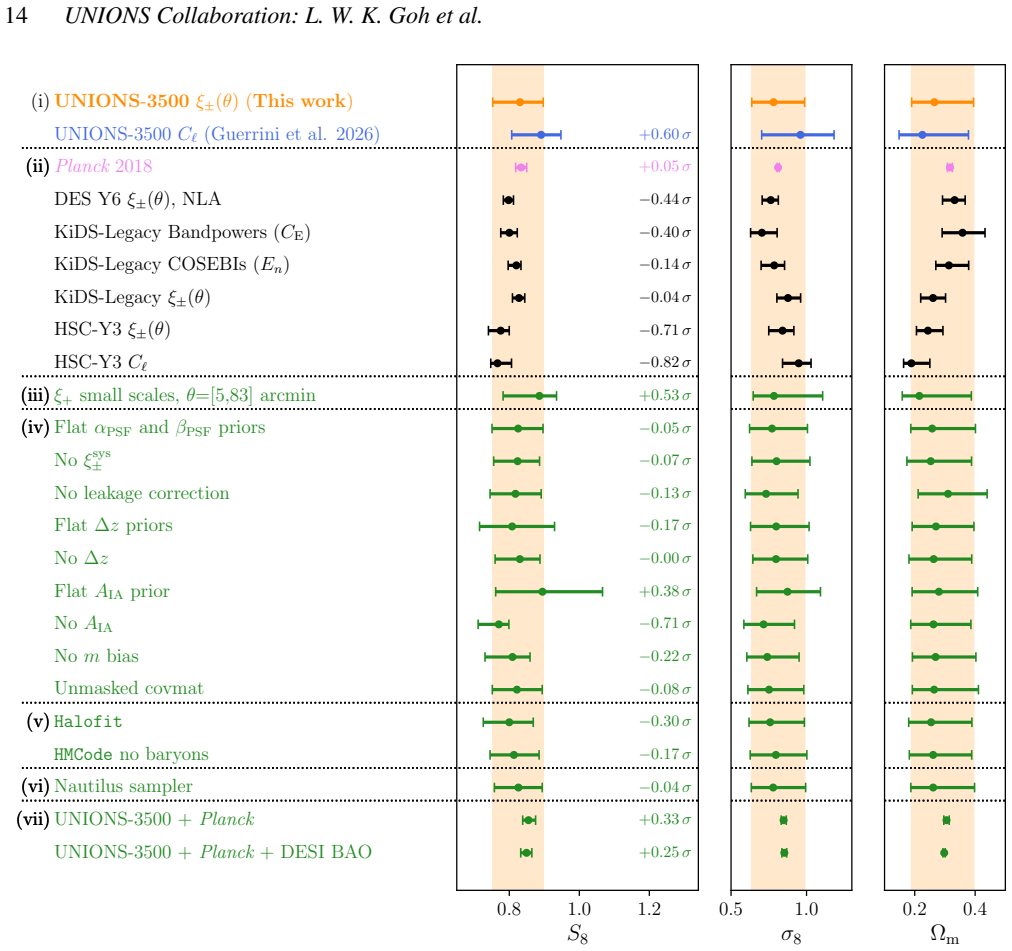
- The pipeline's stability under varied scale cuts, prior ranges, and nonlinear modelling choices indicates reliable error control.
- The coordinated data release positions the UNIONS survey as ready to contribute competitive results ahead of Stage IV weak lensing experiments.
- The single-bin configuration-space measurement provides a baseline that future multi-bin analyses can build upon directly.
Where Pith is reading between the lines
- Adding multiple tomographic bins to the same catalogue would likely tighten constraints on the dark energy equation of state parameter.
- Cross-correlating the UNIONS shear catalogue with spectroscopic galaxy samples could test whether the reported S_8 value changes under different tracer selections.
- Repeating the identical analysis in Fourier space on the same data would allow a direct internal consistency check between configuration-space and power-spectrum approaches.
Load-bearing premise
The analysis assumes that the source redshift distribution, shear calibration, and covariance matrix are accurately estimated and that residual PSF systematics and B-modes have been sufficiently mitigated.
What would settle it
A new cosmic shear measurement on the same or larger area that returns an S_8 value lying well outside the reported 1-sigma interval while using an otherwise identical flat LCDM setup would falsify the claimed consistency.
Figures





read the original abstract
We present the first cosmological constraints from the cosmic shear analysis of the UNIONS-3500 weak lensing galaxy catalogue in configuration space. The Ultraviolet Near Infrared Optical Northern Survey (UNIONS) is the largest and deepest photometric survey of the northern hemisphere to date, with the UNIONS-3500 catalogue using high-quality $r$-band imaging across 3500 deg2 of the sky. We perform a 2D cosmic shear analysis with a single tomographic bin, using the two-point correlation function (2PCF) statistic. Assuming a flat LCDM model, we obtain constraints on the clustering amplitude of S_8 = 0.831^{+0.067}_{-0.078}, which is consistent with constraints from Planck CMB measurements and precedent cosmic shear results within 1sigma. We outline the construction of our cosmological inference pipeline, including the estimation of the source redshift distribution, shear calibration, and covariance matrix, and describe methodologies for the mitigation of systematic effects arising from PSF systematics and B-modes. We demonstrate that our results are robust to variations in analysis choices, including scale cuts, prior ranges, and nonlinear modelling. This paper is part of a coordinated release which collectively demonstrates the maturity and readiness of UNIONS to deliver competitive cosmological results, positioning it as a key stepping stone towards the forthcoming era of Stage IV weak lensing experiments.
Editorial analysis
A structured set of objections, weighed in public.
Referee Report
Summary. The manuscript presents the first cosmological constraints from a 2D cosmic shear analysis of the UNIONS-3500 weak lensing catalogue in configuration space. Using the two-point correlation function in a single tomographic bin under a flat ΛCDM model, the authors derive S_8 = 0.831^{+0.067}_{-0.078}. The result is reported to be consistent with Planck CMB measurements and prior cosmic shear constraints within 1σ. The paper outlines the full inference pipeline, including source n(z) estimation, shear calibration, covariance construction, PSF mitigation, and B-mode null tests, along with explicit robustness checks against scale cuts, prior ranges, and nonlinear modeling choices.
Significance. If the central result holds, this work delivers an independent northern-hemisphere constraint on the clustering amplitude S_8 from one of the largest photometric surveys to date. The explicit demonstration of robustness to analysis choices and the detailed treatment of systematics (PSF, B-modes) strengthen the reliability of the measurement and position UNIONS as a mature precursor to Stage-IV weak-lensing experiments. The consistency with Planck within 1σ and the reproducibility-oriented pipeline description are notable strengths.
minor comments (3)
- The abstract states that results are robust to scale cuts, priors, and nonlinear modeling; a concise summary table listing the S_8 shifts under each variation would improve readability and allow readers to assess the impact at a glance.
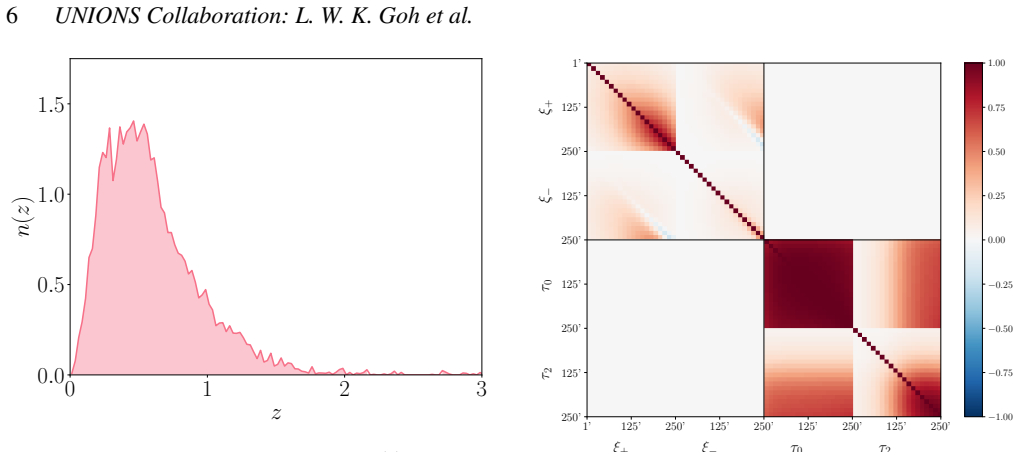
- In the description of the covariance matrix construction, the treatment of the survey mask and shape noise should be cross-referenced to the specific equations or appendices where the analytic or simulation-based form is defined.
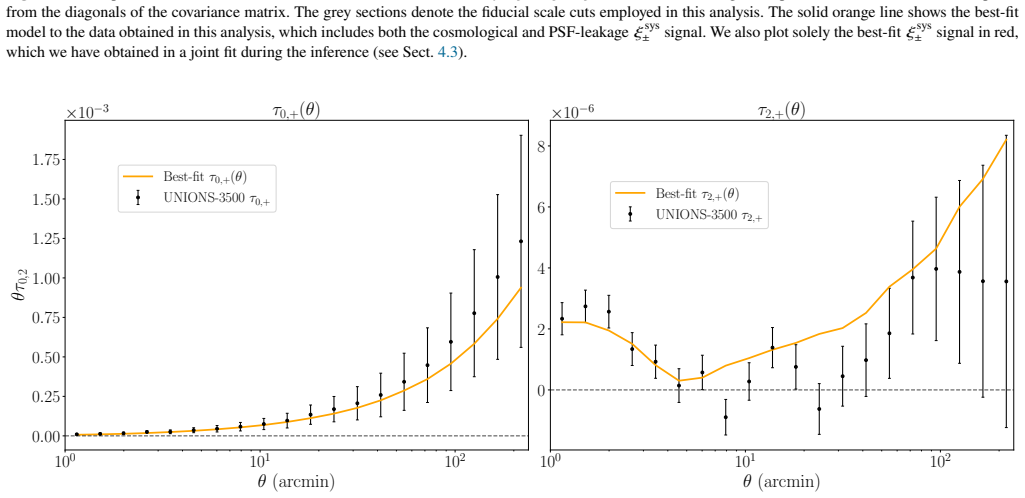
- Figure captions for the 2PCF measurements and model fits should explicitly state the scale range used and whether the plotted error bars include the full covariance or only diagonal elements.
Simulated Author's Rebuttal
We thank the referee for their positive assessment of our manuscript and for recommending acceptance. We are pleased that the work is recognized for its robust pipeline, detailed systematics treatment, and value as an independent northern-hemisphere S_8 constraint from UNIONS-3500. No major comments were raised in the report.
Circularity Check
No significant circularity; standard parameter fit from data
full rationale
The paper's central result is the posterior on S_8 obtained by fitting the measured 2PCF under flat LCDM. This is a direct likelihood evaluation against observed correlation functions, with n(z), shear calibration, covariance, and systematics mitigation serving as external inputs rather than outputs derived from the same equations. No self-definitional loops, fitted inputs renamed as predictions, or load-bearing self-citations appear in the derivation chain. The analysis is self-contained against external benchmarks (Planck consistency is a post-hoc comparison, not an input).
Axiom & Free-Parameter Ledger
free parameters (1)
- S_8
axioms (1)
- domain assumption flat LCDM cosmology
Lean theorems connected to this paper
-
IndisputableMonolith/Cost/FunctionalEquation.leanwashburn_uniqueness_aczel unclear?
unclearRelation between the paper passage and the cited Recognition theorem.
Assuming a flat LCDM model, we obtain constraints on the clustering amplitude of S_8 = 0.831^{+0.067}_{-0.078}
-
IndisputableMonolith/Foundation/RealityFromDistinction.leanreality_from_one_distinction unclear?
unclearRelation between the paper passage and the cited Recognition theorem.
We use the Einstein-Boltzmann solver CAMB ... HMCode2020 ... nonlinear matter power spectrum
What do these tags mean?
- matches
- The paper's claim is directly supported by a theorem in the formal canon.
- supports
- The theorem supports part of the paper's argument, but the paper may add assumptions or extra steps.
- extends
- The paper goes beyond the formal theorem; the theorem is a base layer rather than the whole result.
- uses
- The paper appears to rely on the theorem as machinery.
- contradicts
- The paper's claim conflicts with a theorem or certificate in the canon.
- unclear
- Pith found a possible connection, but the passage is too broad, indirect, or ambiguous to say the theorem truly supports the claim.
Reference graph
Works this paper leans on
-
[1]
Dark Energy Survey Y3 results: blending shear and redshift biases in image simulations
N MacCrann and M R Becker and J McCullough and A Amon and D Gruen and M Jarvis and A Choi and M A Troxel and E Sheldon and B Yanny and K Herner and S Dodelson and J Zuntz and K Eckert and R P Rollins and T N Varga and G M Bernstein and R A Gruendl and I Harrison and W G Hartley and I Sevilla-Noarbe and A Pieres and S L Bridle and J Myles and A Alarcon and...
-
[2]
Li, Shun-Sheng and Kuijken, Konrad and Hoekstra, Henk and Miller, Lance and Heymans, Catherine and Hildebrandt, Hendrik and. 2023 , month = feb, journal =. doi:10.1051/0004-6361/202245210 , urldate =
-
[3]
Report of the Dark Energy Task Force
Report of the Dark Energy Task Force. arXiv e-prints , keywords =. doi:10.48550/arXiv.astro-ph/0609591 , archivePrefix =. astro-ph/0609591 , primaryClass =
work page internal anchor Pith review Pith/arXiv arXiv doi:10.48550/arxiv.astro-ph/0609591
-
[4]
Large-Scale Cosmic Shear Measurements
Large-Scale Cosmic Shear Measurements. arXiv e-prints , keywords =. doi:10.48550/arXiv.astro-ph/0003338 , archivePrefix =. astro-ph/0003338 , primaryClass =
work page internal anchor Pith review Pith/arXiv arXiv doi:10.48550/arxiv.astro-ph/0003338
-
[5]
Survey geometry and the internal consistency of recent cosmic shear measurements
Survey geometry and the internal consistency of recent cosmic shear measurements. , keywords =. doi:10.1093/mnras/sty1889 , archivePrefix =. 1804.10663 , primaryClass =
work page internal anchor Pith review Pith/arXiv arXiv doi:10.1093/mnras/sty1889
-
[6]
doi:10.48550/arXiv.2601.14559 , archiveprefix =
Dark Energy Survey Year 6 Results: Cosmological Constraints from Galaxy Clustering and Weak Lensing. arXiv e-prints , keywords =. doi:10.48550/arXiv.2601.14559 , archivePrefix =. 2601.14559 , primaryClass =
-
[7]
Dark Energy Survey year 3 results: covariance modelling and its impact on parameter estimation and quality of fit. , keywords =. doi:10.1093/mnras/stab2384 , archivePrefix =. 2012.08568 , primaryClass =
-
[8]
Astrophysics Source Code Library , pages =
Sheldon, Erin , year =. Astrophysics Source Code Library , pages =
-
[9]
Metacalibration: Direct Self-Calibration of Biases in Shear Measurement
Huff, Eric and Mandelbaum, Rachel , year =. Metacalibration:. arXiv e-prints , eid =. arXiv , keywords =:1702.02600 , primaryclass =
work page internal anchor Pith review Pith/arXiv arXiv
-
[10]
Sheldon, Erin S. and Huff, Eric M. , year =. Practical. , volume =. doi:10.3847/1538-4357/aa704b , urldate =
-
[11]
Astronomical Data Analysis Software and Systems XX , year = 2011, editor =
Automated Morphometry with SExtractor and PSFEx. Astronomical Data Analysis Software and Systems XX , year = 2011, editor =
work page 2011
-
[12]
Farrens, S. and Guinot, A. and Kilbinger, M. and Liaudat, T. and Baumont, L. and Jimenez, X. and Peel, A. and Pujol, A. and Schmitz, M. and Starck, J.-L. and Vitorelli, A. Z. , year =. , volume =. doi:10.1051/0004-6361/202243970 , urldate =
-
[13]
and Cuillandre, Jean-Charles and Chambers, Kenneth C
UNIONS: The Ultraviolet Near-infrared Optical Northern Survey. , keywords =. doi:10.3847/1538-3881/ae03ab , archivePrefix =. 2503.13783 , primaryClass =
-
[14]
and Hildebrandt, Hendrik and Holwerda, Benne W
The dependence of intrinsic alignment of galaxies on wavelength using. A&A , author =. 2019 , pages =. doi:10.1051/0004-6361/201834219 , abstract =
-
[15]
Intrinsic alignments of. MNRAS , author =. 2016 , note =. doi:10.1093/mnras/stw144 , abstract =
-
[16]
The impact of intrinsic alignment on current and future cosmic shear surveys
Krause, Elisabeth and Eifler, Tim and Blazek, Jonathan. The impact of intrinsic alignment on current and future cosmic shear surveys. 2016. doi:10.1093/mnras/stv2615. arXiv:1506.08730
work page internal anchor Pith review Pith/arXiv arXiv doi:10.1093/mnras/stv2615 2016
-
[17]
Dark energy constraints from cosmic shear power spectra: impact of intrinsic alignments on photometric redshift requirements , volume =. New Journal of Physics , author =. 2007 , note =. doi:10.1088/1367-2630/9/12/444 , abstract =
-
[18]
Revising the Halofit Model for the Nonlinear Matter Power Spectrum
Takahashi, Ryuichi and Sato, Masanori and Nishimichi, Takahiro and Taruya, Atsushi and Oguri, Masamune. Revising the Halofit Model for the Nonlinear Matter Power Spectrum. 2012. doi:10.1088/0004-637X/761/2/152. arXiv:1208.2701
work page internal anchor Pith review Pith/arXiv arXiv doi:10.1088/0004-637x/761/2/152 2012
-
[19]
Intrinsic alignment-lensing interference as a contaminant of cosmic shear , volume =. Phys. Rev. D , author =. 2004 , pages =. doi:10.1103/PhysRevD.70.063526 , language =
-
[20]
Bayesian photometric redshift estimation
Bayesian Photometric Redshift Estimation. , keywords =. doi:10.1086/308947 , archivePrefix =. astro-ph/9811189 , primaryClass =
work page internal anchor Pith review Pith/arXiv arXiv doi:10.1086/308947
-
[21]
LePHARE: Photometric Analysis for Redshift Estimate
-
[22]
The halo model as a versatile tool to predict intrinsic alignments , volume =. MNRAS , author =. 2021 , pages =. doi:10.1093/mnras/staa3802 , abstract =
-
[23]
doi:10.1088/1475-7516/2025/08/025 , urldate =
Lewis, Antony. GetDist: a Python package for analysing Monte Carlo samples. JCAP. 2025. doi:10.1088/1475-7516/2025/08/025. arXiv:1910.13970
-
[24]
COSEBIs: Extracting the full E-/B-mode information from cosmic shear correlation functions
COSEBIs: Extracting the full E-/B-mode information from cosmic shear correlation functions. , keywords =. doi:10.1051/0004-6361/201014235 , archivePrefix =. 1002.2136 , primaryClass =
work page internal anchor Pith review Pith/arXiv arXiv doi:10.1051/0004-6361/201014235
-
[25]
Cosmic Shear Tomography and Efficient Data Compression using COSEBIs
Cosmic shear tomography and efficient data compression using COSEBIs. , keywords =. doi:10.1051/0004-6361/201218828 , archivePrefix =. 1201.2669 , primaryClass =
work page internal anchor Pith review Pith/arXiv arXiv doi:10.1051/0004-6361/201218828
-
[26]
doi:10.48550/arXiv.2602.10065 , archiveprefix =
Dark Energy Survey Year 6 Results: Cosmological Constraints from Cosmic Shear. arXiv e-prints , keywords =. doi:10.48550/arXiv.2602.10065 , archivePrefix =. 2602.10065 , primaryClass =
-
[27]
Blinding multiprobe cosmological experiments. , keywords =. doi:10.1093/mnras/staa965 , archivePrefix =. 1911.05929 , primaryClass =
-
[28]
and Kannawadi, Arun and Reischke, Robert and Shan, HuanYuan , year = 2023, month = nov, journal =
KiDS-1000: Cosmology with improved cosmic shear measurements. , keywords =. doi:10.1051/0004-6361/202347236 , archivePrefix =. 2306.11124 , primaryClass =
-
[29]
The fifth data release of the Kilo Degree Survey: Multi-epoch optical/NIR imaging covering wide and legacy-calibration fields. , keywords =. doi:10.1051/0004-6361/202346730 , archivePrefix =. 2503.19439 , primaryClass =
-
[30]
KiDS-Legacy: Cosmological constraints from cosmic shear with the complete Kilo-Degree Survey. arXiv e-prints , keywords =. doi:10.48550/arXiv.2503.19441 , archivePrefix =. 2503.19441 , primaryClass =
-
[31]
Beyond linear galaxy alignments , volume =. Phys. Rev. D , author =. 2019 , pages =. doi:10.1103/PhysRevD.100.103506 , language =
-
[32]
UNIONS: A direct measurement of intrinsic alignment with BOSS/eBOSS spectroscopy. , keywords =. doi:10.1051/0004-6361/202453442 , archivePrefix =. 2412.01790 , primaryClass =
-
[33]
The PAU Survey: Measuring intrinsic galaxy alignments in deep wide fields as a function of colour, luminosity, stellar mass and redshift. , keywords =. doi:10.1093/mnras/staf1630 , archivePrefix =. 2505.15470 , primaryClass =
-
[34]
Dark Energy Survey Year 6 Results: Photometric Data Set for Cosmology. arXiv e-prints , keywords =. doi:10.48550/arXiv.2501.05739 , archivePrefix =. 2501.05739 , primaryClass =
-
[35]
The. MNRAS , author =. 2023 , urldate =. doi:10.1093/mnras/stad2013 , abstract =
-
[36]
The. MNRAS , author =. 2011 , pages =. doi:10.1111/j.1365-2966.2010.17485.x , language =
-
[37]
A&A , author =. 2021 , note =. doi:10.1051/0004-6361/202140706 , abstract =
-
[38]
doi:10.1051/0004-6361/201834714 , urldate =
, author =. 2019 , pages =. doi:10.1051/0004-6361/201834714 , language =
-
[39]
Intrinsic alignments of. MNRAS , author =. 2015 , note =. doi:10.1093/mnras/stv778 , abstract =
-
[40]
Constraints on intrinsic alignment contamination of weak lensing surveys using the. A&A , author =. 2011 , note =. doi:10.1051/0004-6361/201015621 , abstract =
-
[41]
Dark Energy Survey Year 3 results: Cosmology from cosmic shear and robustness to modeling uncertainty. , keywords =. doi:10.1103/PhysRevD.105.023515 , archivePrefix =. 2105.13544 , primaryClass =
-
[42]
Cosmic Shear constraints from HSC Year 3 with clustering calibration of the tomographic redshift distributions from DESI. arXiv e-prints , keywords =. doi:10.48550/arXiv.2511.18134 , archivePrefix =. 2511.18134 , primaryClass =
work page internal anchor Pith review Pith/arXiv arXiv doi:10.48550/arxiv.2511.18134
-
[43]
A&A , author =. 2021 , note =. doi:10.1051/0004-6361/202039070 , abstract =
-
[44]
Controlling intrinsic alignments in weak lensing statistics: The nulling and boosting techniques
Controlling intrinsic alignments in weak lensing statistics: The nulling and boosting techniques. arXiv e-prints , keywords =. doi:10.48550/arXiv.1009.2024 , archivePrefix =. 1009.2024 , primaryClass =
work page internal anchor Pith review Pith/arXiv arXiv doi:10.48550/arxiv.1009.2024 2024
-
[45]
Bartelmann, M. and Schneider, P. Weak gravitational lensing. Phys. Rept. 2001. doi:10.1016/S0370-1573(00)00082-X. arXiv:astro-ph/9912508
work page internal anchor Pith review Pith/arXiv arXiv doi:10.1016/s0370-1573(00)00082-x 2001
-
[46]
Cosmology with cosmic shear observations: a review
Kilbinger, M. Cosmology with cosmic shear observations: a review. Rept. Prog. Phys. 2015. doi:10.1088/0034-4885/78/8/086901. arXiv:1411.0115
work page internal anchor Pith review Pith/arXiv arXiv doi:10.1088/0034-4885/78/8/086901 2015
-
[47]
Analysis of two-point statistics of cosmic shear: I. Estimators and covariances
Schneider, Peter and van Waerbeke, Ludovic and Kilbinger, Martin and Mellier, Yannick. Analysis of two-point statistics of cosmic shear: I. estimators and covariances. 2002. doi:10.1051/0004-6361:20021341. arXiv:astro-ph/0206182
work page internal anchor Pith review Pith/arXiv arXiv doi:10.1051/0004-6361:20021341 2002
-
[48]
Weak Gravitational Lensing of Distant Galaxies. , keywords =. doi:10.1086/171151 , adsurl =
-
[49]
Sch\"oneberg, Nils and Verde, Licia and Gil-Mar\'. BAO+BBN revisited growing the Hubble tension with a 0.7 km/s/Mpc constraint. JCAP. 2022. doi:10.1088/1475-7516/2022/11/039. arXiv:2209.14330
-
[50]
Sch\"oneberg, Nils , title = ". JCAP. 2024. doi:10.1088/1475-7516/2024/06/006. arXiv:2401.15054
-
[51]
HMCODE-2020: improved modelling of non-linear cosmological power spectra with baryonic feedback. , keywords =. doi:10.1093/mnras/stab082 , archivePrefix =. 2009.01858 , primaryClass =
-
[52]
One percent determination of the primordial deuterium abundance
One Percent Determination of the Primordial Deuterium Abundance. , keywords =. doi:10.3847/1538-4357/aaab53 , archivePrefix =. 1710.11129 , primaryClass =
work page internal anchor Pith review Pith/arXiv arXiv doi:10.3847/1538-4357/aaab53
-
[53]
The DECADE cosmic shear project IV: cosmological constraints from 107 million galaxies across 5,400 deg ^2 of the sky. Open J. Astrophys. 2025. doi:10.33232/001c.146161. arXiv:2502.17677
-
[54]
Planck 2018 results. I. Overview and the cosmological legacy of Planck. , keywords =. doi:10.1051/0004-6361/201833880 , archivePrefix =. 1807.06205 , primaryClass =
-
[55]
Data compression in cosmology: A compressed likelihood for Planck data. , keywords =. doi:10.1103/PhysRevD.100.083502 , archivePrefix =. 1909.05869 , primaryClass =
-
[56]
DESI DR2 results. I. Baryon acoustic oscillations from the Lyman alpha forest. , keywords =. doi:10.1103/2wwn-xjm5 , archivePrefix =. 2503.14739 , primaryClass =
-
[57]
DESI DR2 results. II. Measurements of baryon acoustic oscillations and cosmological constraints. , keywords =. doi:10.1103/tr6y-kpc6 , archivePrefix =. 2503.14738 , primaryClass =
work page internal anchor Pith review Pith/arXiv arXiv doi:10.1103/tr6y-kpc6
-
[58]
The Pantheon+ Analysis: Cosmological Constraints
The Pantheon+ Analysis: Cosmological Constraints. , keywords =. doi:10.3847/1538-4357/ac8e04 , archivePrefix =. 2202.04077 , primaryClass =
work page internal anchor Pith review Pith/arXiv arXiv doi:10.3847/1538-4357/ac8e04
-
[59]
Classical and Quantum Gravity , keywords =
In the realm of the Hubble tension-a review of solutions. Classical and Quantum Gravity , keywords =. doi:10.1088/1361-6382/ac086d , archivePrefix =. 2103.01183 , primaryClass =
-
[60]
A general framework for removing point-spread function additive systematics in cosmological weak lensing analysis. , keywords =. doi:10.1093/mnras/stad1801 , archivePrefix =. 2212.03257 , primaryClass =
-
[61]
and Mandelbaum, Rachel and Takada, Masahiro and More, Surhud and Strauss, Michael A
Hyper Suprime-Cam Year 3 results: Cosmology from cosmic shear two-point correlation functions. , keywords =. doi:10.1103/PhysRevD.108.123518 , archivePrefix =. 2304.00702 , primaryClass =
-
[62]
doi:10.1103/PhysRevD.108.123519 , archiveprefix =
Hyper Suprime-Cam Year 3 results: Cosmology from cosmic shear power spectra. , keywords =. doi:10.1103/PhysRevD.108.123519 , archivePrefix =. 2304.00701 , primaryClass =
-
[63]
Cosmology from cosmic shear power spectra with Subaru Hyper Suprime-Cam first-year data
Cosmology from cosmic shear power spectra with Subaru Hyper Suprime-Cam first-year data. , keywords =. doi:10.1093/pasj/psz010 , archivePrefix =. 1809.09148 , primaryClass =
work page internal anchor Pith review Pith/arXiv arXiv doi:10.1093/pasj/psz010
-
[64]
The skewness of the aperture mass statistic. , keywords =. doi:10.1111/j.1365-2966.2004.07926.x , archivePrefix =. astro-ph/0307393 , primaryClass =
-
[65]
Joint galaxy-lensing observables and the dark energy , author =. Phys. Rev. D , volume =. 2004 , month = Aug, publisher =. doi:10.1103/PhysRevD.70.043009 , url =
-
[66]
Takada, Masahiro and Jain, Bhuvnesh , title =. , volume =. 2009 , month =. doi:10.1111/j.1365-2966.2009.14504.x , url =
-
[67]
Halo Models of Large Scale Structure
Cooray, Asantha and Sheth, Ravi K. Halo Models of Large Scale Structure. Phys. Rept. 2002. doi:10.1016/S0370-1573(02)00276-4. arXiv:astro-ph/0206508
work page internal anchor Pith review Pith/arXiv arXiv doi:10.1016/s0370-1573(02)00276-4 2002
-
[68]
Lacasa, F. and Rosenfeld, R. , year=. Combining cluster number counts and galaxy clustering , volume=. JCAP , publisher=. doi:10.1088/1475-7516/2016/08/005 , number=
-
[69]
Power spectrum super-sample covariance. Phys. Rev. D , keywords =. doi:10.1103/PhysRevD.87.123504 , archivePrefix =. 1302.6994 , primaryClass =
work page internal anchor Pith review Pith/arXiv arXiv doi:10.1103/physrevd.87.123504
-
[70]
CosmoLike - Cosmological Likelihood Analyses for Photometric Galaxy Surveys
cosmolike - cosmological likelihood analyses for photometric galaxy surveys. , keywords =. doi:10.1093/mnras/stx1261 , archivePrefix =. 1601.05779 , primaryClass =
work page internal anchor Pith review Pith/arXiv arXiv doi:10.1093/mnras/stx1261
-
[71]
KiDS-Legacy: Covariance validation and the unified ONECOVARIANCE framework for projected large-scale structure observables. , keywords =. doi:10.1051/0004-6361/202452592 , archivePrefix =. 2410.06962 , primaryClass =
-
[72]
Kaiser, Nick. Weak lensing and cosmology. 1998. doi:10.1086/305515. arXiv:astro-ph/9610120
work page internal anchor Pith review Pith/arXiv arXiv doi:10.1086/305515 1998
-
[73]
Doux, C. and others. Consistency of cosmic shear analyses in harmonic and real space. 2021. doi:10.1093/mnras/stab661. arXiv:2011.06469
-
[74]
Dark Energy Survey Year 3 results: Cosmological constraints from galaxy clustering and weak lensing , author =. Phys. Rev. D , volume =. 2022 , month =. doi:10.1103/PhysRevD.105.023520 , url =
-
[75]
Euclid preparation. Cosmology Likelihood for Observables in Euclid (CLOE). 3. Inference and Forecasts. arXiv e-prints , keywords =. doi:10.48550/arXiv.2510.09153 , archivePrefix =. 2510.09153 , primaryClass =
work page internal anchor Pith review Pith/arXiv arXiv doi:10.48550/arxiv.2510.09153
-
[76]
Fang, X. and Eifler, T. and Krause, E. , year=. 2D-FFTLog: efficient computation of real-space covariance matrices for galaxy clustering and weak lensing , volume=. , publisher=. doi:10.1093/mnras/staa1726 , number=
-
[77]
Abbott, T. M. C. and others. DES Y3 + KiDS-1000: Consistent cosmology combining cosmic shear surveys. Open J. Astrophys. 2023. doi:10.21105/astro.2305.17173. arXiv:2305.17173
-
[78]
GLASS: Generator for Large Scale Structure. Open J. Astrophys. , keywords =. doi:10.21105/astro.2302.01942 , archivePrefix =. 2302.01942 , primaryClass =
-
[79]
Efficient Computation of CMB anisotropies in closed FRW models
Lewis, Antony and Challinor, Anthony and Lasenby, Anthony. Efficient computation of CMB anisotropies in closed FRW models. 2000. doi:10.1086/309179. arXiv:astro-ph/9911177
work page internal anchor Pith review Pith/arXiv arXiv doi:10.1086/309179 2000
-
[80]
CosmoSIS: modular cosmological parameter estimation
Zuntz, Joe and Paterno, Marc and Jennings, Elise and Rudd, Douglas and Manzotti, Alessandro and Dodelson, Scott and Bridle, Sarah and Sehrish, Saba and Kowalkowski, James. CosmoSIS: modular cosmological parameter estimation. Astron. Comput. 2015. doi:10.1016/j.ascom.2015.05.005. arXiv:1409.3409
work page internal anchor Pith review Pith/arXiv arXiv doi:10.1016/j.ascom.2015.05.005 2015
discussion (0)
Sign in with ORCID, Apple, or X to comment. Anyone can read and Pith papers without signing in.