Recognition: 2 theorem links
· Lean TheoremCausal Discovery via Statistical Power (CDSP)
Pith reviewed 2026-05-14 17:44 UTC · model grok-4.3
The pith
Effect-size asymmetry lets statistical power identify causal direction with uncertainty from bivariate observations.
A machine-rendered reading of the paper's core claim, the machinery that carries it, and where it could break.
Core claim
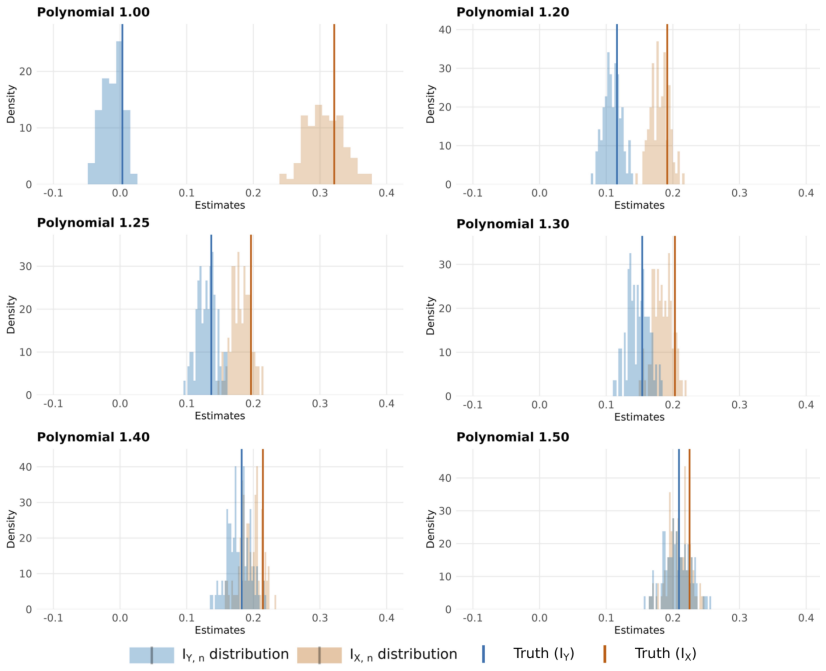
Considering the foundational setting of bivariate observational data, we show how quantities analogous to statistical power and effect size can be used in causal discovery to determine when data contain sufficient information to favor one direction over the other. We introduce the effect-size asymmetry assumption that characterizes when the probability of correctly detecting the causal direction exceeds that of incorrectly favoring the reverse direction. We show that the effect-size asymmetry assumption can be used for causal direction estimation with uncertainty quantification. Simulations show that CDSP direction estimation is robust to mild and moderate model misspecifications.
What carries the argument
The effect-size asymmetry assumption, which states that the power to detect the correct causal direction exceeds the power to detect the incorrect reverse direction.
If this is right
- Direction can be estimated only when the observed data supply enough information for one direction to have strictly higher power.
- Uncertainty about the chosen direction can be reported directly from the power calculations.
- The procedure remains reliable under mild and moderate departures from the assumed functional form.
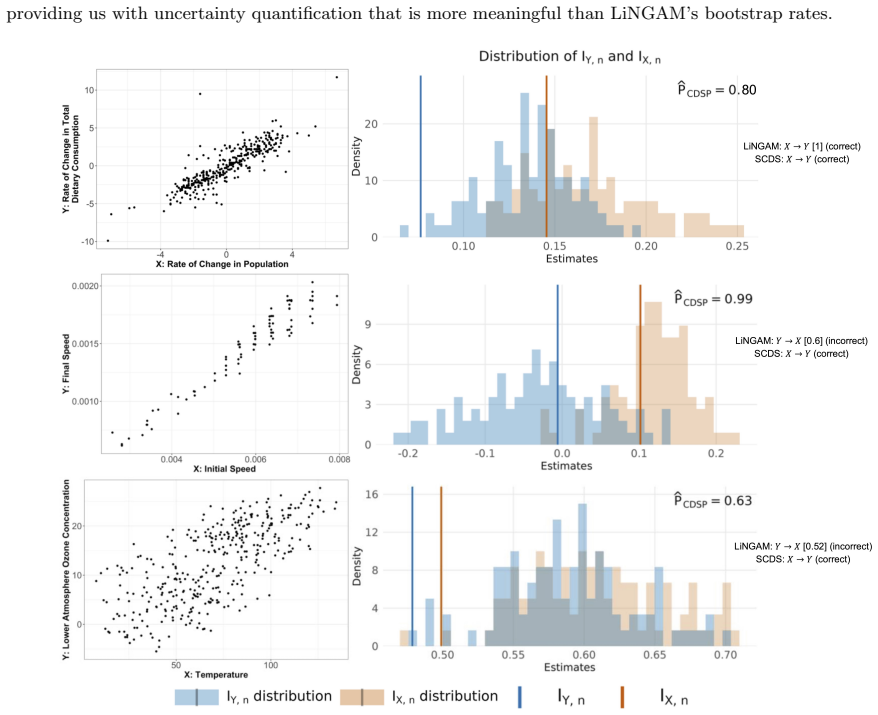
- False discovery rates drop by approximately 18 percent relative to a common existing method on standard cause-effect benchmarks.
Where Pith is reading between the lines
- The same power-comparison logic could be adapted to decide when to stop collecting more observations in a causal study.
- Domain-specific data such as gene-expression pairs could be used to test how often the asymmetry assumption holds in practice.
- Combining CDSP with existing functional causal methods might produce hybrid procedures that inherit both statistical guarantees and flexibility.
- Exact sample-size formulas derived from the asymmetry condition would let experimenters plan studies that reach a target power level for direction recovery.
Load-bearing premise
An effect-size asymmetry must exist such that the probability of correctly detecting the causal direction exceeds the probability of incorrectly favoring the reverse direction.
What would settle it
On pairs whose true direction is known independently, the estimated power for the correct direction is not higher than for the reverse, or the method fails to show an 18 percent reduction in false discoveries on the 100 benchmark pairs.
Figures


read the original abstract
Causal discovery methods aim to infer causal direction from observational data. Functional causal discovery approaches use structural asymmetries to identify causal directionality but rely on strong modeling assumptions and provide limited tools for uncertainty quantification. We introduce Causal Discovery via Statistical Power (CDSP), a statistical inference framework that connects causal direction estimation with statistical power and enables uncertainty quantification. Considering the foundational setting of bivariate observational data, we show how quantities analogous to statistical power and effect size can be used in causal discovery to determine when data contain sufficient information to favor one direction over the other. We introduce the effect-size asymmetry assumption that characterizes when the probability of correctly detecting the causal direction (i.e., the power of causal discovery) exceeds that of incorrectly favoring the reverse direction. We show that the effect-size asymmetry assumption can be used for causal direction estimation with uncertainty quantification. Simulations show that CDSP direction estimation is robust to mild and moderate model misspecifications. Real data analyses on 100 cause-effect benchmark pairs further demonstrate that CDSP reduces false discovery rates by approximately 18% relative to a commonly used existing method.
Editorial analysis
A structured set of objections, weighed in public.
Referee Report
Summary. The paper introduces Causal Discovery via Statistical Power (CDSP), a framework for bivariate causal discovery that analogizes statistical power and effect size to determine when observational data suffice to favor one causal direction over the reverse. It posits an effect-size asymmetry assumption under which the probability of correctly detecting the true direction exceeds that of favoring the reverse, and uses this to perform direction estimation together with uncertainty quantification. Simulations are reported to show robustness under mild-to-moderate misspecification, and an analysis of 100 cause-effect benchmark pairs is claimed to yield an approximately 18% FDR reduction relative to a standard existing method.
Significance. If the central assumption can be placed on a rigorous footing, CDSP would supply a statistically grounded route to uncertainty quantification in causal discovery, a feature largely absent from existing functional approaches. The reported empirical gains on benchmarks and the explicit link to power analysis constitute a potentially useful contribution, provided the mapping from observed statistics to calibrated inferences is shown to be valid rather than merely observed.
major comments (2)
- [effect-size asymmetry assumption and surrounding derivation] The effect-size asymmetry assumption (introduced after the abstract and developed in the main theoretical section) asserts that P(correct direction | data) > P(reverse | data) under the assumption, yet no theorem supplies the regularity conditions (e.g., on the class of structural functions, noise moments, or identifiability of the effect-size measure) that guarantee the inequality rather than merely illustrate it in simulations. Without such conditions the subsequent uncertainty quantification and FDR claims rest on an unverified premise.
- [real data analyses] Section on real-data experiments: the reported 18% FDR reduction on the 100 benchmark pairs is presented without an explicit statement of the data-exclusion rules, the precise definition of the power-analog statistics, or the baseline method's implementation details, making it impossible to verify that the gain is attributable to the new framework rather than to preprocessing choices.
minor comments (2)
- [abstract and introduction] The abstract refers to 'quantities analogous to statistical power and effect size' without a concise one-sentence definition; a short clarifying sentence in the introduction would improve readability.
- [simulation results] Simulation figures lack error bars or explicit sample-size annotations in several panels, which obscures the precision of the reported robustness claims.
Simulated Author's Rebuttal
We thank the referee for the constructive comments on our manuscript. We address each major comment below, indicating the revisions we will make to provide greater rigor and reproducibility.
read point-by-point responses
-
Referee: The effect-size asymmetry assumption asserts that P(correct direction | data) > P(reverse | data) under the assumption, yet no theorem supplies the regularity conditions (e.g., on the class of structural functions, noise moments, or identifiability of the effect-size measure) that guarantee the inequality rather than merely illustrate it in simulations. Without such conditions the subsequent uncertainty quantification and FDR claims rest on an unverified premise.
Authors: We appreciate the referee's point on the need for explicit regularity conditions. The manuscript introduces the effect-size asymmetry assumption via power analogies and supports it with derivations and simulations, but we acknowledge that a formal theorem stating the precise conditions was omitted. In the revised manuscript we will add a theorem that specifies the required conditions, including Lipschitz continuity and monotonicity of the structural functions, finite second moments of the noise terms, and identifiability of the effect-size measure. Under these conditions we will prove that the probability of correctly identifying the true direction exceeds that of the reverse, thereby placing the uncertainty quantification on a rigorous footing. revision: yes
-
Referee: the reported 18% FDR reduction on the 100 benchmark pairs is presented without an explicit statement of the data-exclusion rules, the precise definition of the power-analog statistics, or the baseline method's implementation details, making it impossible to verify that the gain is attributable to the new framework rather than to preprocessing choices.
Authors: We agree that the real-data section requires additional detail to ensure reproducibility and to confirm that the reported gain is attributable to CDSP. In the revised manuscript we will add an explicit description of the data-exclusion rules applied to the 100 benchmark pairs, the precise mathematical definitions of the power-analog statistics, and the full implementation details of the baseline method together with all preprocessing steps. These additions will allow independent verification of the 18% FDR reduction. revision: yes
Circularity Check
No significant circularity in CDSP derivation
full rationale
The paper introduces the effect-size asymmetry assumption explicitly as a new domain premise characterizing when power for correct causal direction exceeds that for the reverse. This premise is not derived from or reduced to fitted parameters, self-citations, or prior results by the same authors; it is posited directly and then used to motivate direction estimation and uncertainty quantification. Empirical claims (simulation robustness and 18% FDR reduction on benchmarks) are presented as independent validations rather than tautological consequences of the assumption. No load-bearing step in the abstract or described framework equates a prediction or result to its own inputs by construction, so the derivation chain remains self-contained.
Axiom & Free-Parameter Ledger
axioms (1)
- domain assumption Effect-size asymmetry assumption
Lean theorems connected to this paper
-
IndisputableMonolith/Cost/FunctionalEquation.leanwashburn_uniqueness_aczel unclear?
unclearRelation between the paper passage and the cited Recognition theorem.
We introduce the effect-size asymmetry assumption that characterizes when the probability of correctly detecting the causal direction exceeds that of incorrectly favoring the reverse direction.
-
IndisputableMonolith/Foundation/AbsoluteFloorClosure.leanreality_from_one_distinction unclear?
unclearRelation between the paper passage and the cited Recognition theorem.
Directional power is the probability that the causal discovery method correctly favors X→Y
What do these tags mean?
- matches
- The paper's claim is directly supported by a theorem in the formal canon.
- supports
- The theorem supports part of the paper's argument, but the paper may add assumptions or extra steps.
- extends
- The paper goes beyond the formal theorem; the theorem is a base layer rather than the whole result.
- uses
- The paper appears to rely on the theorem as machinery.
- contradicts
- The paper's claim conflicts with a theorem or certificate in the canon.
- unclear
- Pith found a possible connection, but the passage is too broad, indirect, or ambiguous to say the theorem truly supports the claim.
Reference graph
Works this paper leans on
-
[1]
Behavior Research Methods , volume=
Direction dependence analysis: A framework to test the direction of effects in linear models with an implementation in SPSS , author=. Behavior Research Methods , volume=. 2018 , publisher=
2018
-
[2]
Nature , volume=
Reproducibility crisis , author=. Nature , volume=
-
[3]
Science , volume=
Estimating the reproducibility of psychological science , author=. Science , volume=. 2015 , publisher=
2015
-
[4]
American Society of Clinical Oncology Educational Book , volume=
An unappreciated challenge to oncology drug discovery: pitfalls in preclinical research , author=. American Society of Clinical Oncology Educational Book , volume=. 2013 , publisher=
2013
-
[5]
Science translational medicine , volume=
What does research reproducibility mean? , author=. Science translational medicine , volume=. 2016 , publisher=
2016
-
[6]
Journal of adolescence , volume=
The effects of violent video game habits on adolescent hostility, aggressive behaviors, and school performance , author=. Journal of adolescence , volume=. 2004 , publisher=
2004
-
[7]
Journal of Causal Inference , volume=
Approximate kernel-based conditional independence tests for fast non-parametric causal discovery , author=. Journal of Causal Inference , volume=. 2019 , publisher=
2019
-
[8]
2011 , publisher=
Principles of applied statistics , author=. 2011 , publisher=
2011
-
[9]
, author=
Perceived crisis and reforms: Issues, explanations, and remedies. , author=. Psychological bulletin , volume=. 2018 , publisher=
2018
-
[10]
Psychophysiology , volume=
Methodological reporting behavior, sample sizes, and statistical power in studies of event-related potentials: Barriers to reproducibility and replicability , author=. Psychophysiology , volume=. 2019 , publisher=
2019
-
[11]
Nature reviews neuroscience , volume=
Power failure: why small sample size undermines the reliability of neuroscience , author=. Nature reviews neuroscience , volume=. 2013 , publisher=
2013
-
[12]
JAMA psychiatry , volume=
Leveraging statistical methods to improve validity and reproducibility of research findings , author=. JAMA psychiatry , volume=. 2017 , publisher=
2017
-
[13]
PloS one , volume=
Pairwise measures of causal direction in the epidemiology of sleep problems and depression , author=. PloS one , volume=. 2012 , publisher=
2012
-
[14]
Physics Today , year=
Doling out Hubble time with dual-anonymous evaluation , author=. Physics Today , year=
-
[15]
Nature , volume=
NASA changes how it divvies up telescope time to reduce gender bias , author=. Nature , volume=. 2019 , publisher=
2019
-
[16]
Journal of Machine Learning Research , year =
Ricardo Silva and Zoubin Ghahramani , title =. Journal of Machine Learning Research , year =
-
[17]
Mooij , title =
Tineke Blom and Anna Klimovskaia and Sara Magliacane and Joris M. Mooij , title =. UAI 2018 , volume =. 2018 , url =
2018
-
[18]
Probability Theory and Related Fields , volume=
Algebraic factor analysis: tetrads, pentads and beyond , author=. Probability Theory and Related Fields , volume=. 2007 , publisher=
2007
-
[19]
, author=
A tetrad test for causal indicators. , author=. Psychological methods , volume=. 2000 , publisher=
2000
-
[20]
TREK SEPARATION FOR GAUSSIAN GRAPHICAL MODELS , volume =
Seth Sullivant and Kelli Talaska and Jan Draisma , journal =. TREK SEPARATION FOR GAUSSIAN GRAPHICAL MODELS , volume =
-
[21]
Littman, Michael L. , title =. Commun. ACM , month = may, pages =. 2021 , issue_date =. doi:10.1145/3429776 , abstract =
-
[22]
Samuel and Matsueda, Ross L
Wang, Y. Samuel and Matsueda, Ross L. and Erosheva, Elena A. , journal=. A variational. 2017 , publisher=
2017
-
[23]
and McGhee, Debbie E
Greenwald, Anthony G. and McGhee, Debbie E. and Schwartz, Jordan L. K. , ISSN =. Measuring individual differences in implicit cognition: The implicit association test. , Volume =. Journal of Personality and Social Psychology , Keywords =
-
[24]
Journal of the Royal Statistical Society: Series B (Statistical Methodology) , volume=
Bootstrapping clustered data , author=. Journal of the Royal Statistical Society: Series B (Statistical Methodology) , volume=. 2007 , publisher=
2007
-
[25]
Biometrika , volume=
Restricted unbiased iterative generalized least-squares estimation , author=. Biometrika , volume=. 1989 , publisher=
1989
-
[26]
2002 , publisher=
Generalized estimating equations , author=. 2002 , publisher=
2002
-
[27]
and Song, Le and Schölkopf, Bernhard and Smola, Alex J
Gretton, Arthur and Fukumizu, Kenji and Teo, Choon H. and Song, Le and Schölkopf, Bernhard and Smola, Alex J. , editor =. A. Advances in. 2008 , pages =
2008
-
[28]
Testing independence and goodness-of-fit in linear models , volume =. Biometrika , author =. 2014 , note =. doi:10.1093/biomet/asu026 , abstract =
-
[29]
Proceedings of the 27th International Joint Conference on Artificial Intelligence (IJCAI) , pages=
Mixed causal structure discovery with application to prescriptive pricing , author=. Proceedings of the 27th International Joint Conference on Artificial Intelligence (IJCAI) , pages=
-
[30]
, author=
Learning Quadratic Variance Function (QVF) DAG Models via OverDispersion Scoring (ODS). , author=. J. Mach. Learn. Res. , volume=
-
[31]
A pooling-
Xu, Lele and Fan, Tingting and Wu, Xia and Chen, KeWei and Guo, Xiaojuan and Zhang, Jiacai and Yao, Li , journal=. A pooling-. 2014 , publisher=
2014
-
[32]
International Journal of Data Science and Analytics , volume=
Tell cause from effect: models and evaluation , author=. International Journal of Data Science and Analytics , volume=. 2017 , publisher=
2017
-
[33]
Direction dependence in statistical modeling: Methods of analysis , pages=
Distribution-Based Causal Inference , author=. Direction dependence in statistical modeling: Methods of analysis , pages=. 2020 , publisher=
2020
-
[34]
2000 , publisher=
Constructing Bayesian network models of gene expression networks from microarray data , author=. 2000 , publisher=
2000
-
[35]
and Scheines, Richard and Heckerman, David , year =
Spirtes, Peter and Glymour, Clark N. and Scheines, Richard and Heckerman, David , year =. Causation,
-
[36]
International Conference on Neural Information Processing , pages=
Discovery of linear non-gaussian acyclic models in the presence of latent classes , author=. International Conference on Neural Information Processing , pages=. 2007 , organization=
2007
-
[37]
Causal Inference and Mechanism Clustering of A Mixture of Additive Noise Models
Causal inference and mechanism clustering of a mixture of additive noise models , author=. arXiv preprint arXiv:1809.08568 , year=
work page internal anchor Pith review Pith/arXiv arXiv
-
[38]
Frontiers in Human Dynamics , volume=
Impacts of population growth and economic development on food security in low-income and middle-income countries , author=. Frontiers in Human Dynamics , volume=. 2023 , publisher=
2023
-
[39]
Do employers discriminate by gender? A field experiment in female-dominated occupations
Alison Booth and Andrew Leigh. Do employers discriminate by gender? A field experiment in female-dominated occupations. Economics Letters. 2010. doi:https://doi.org/10.1016/j.econlet.2010.01.034
-
[40]
A Report of the Surgeon General
The health consequences of smoking: cancer , author=. A Report of the Surgeon General. Rockville, MD: US Department of Health and Human Services , year=
-
[41]
2020 , url =
Microsoft Corporation , title =. 2020 , url =
2020
-
[42]
Open Scholarship and Peer Review: a Time for Experimentation , author=
-
[43]
The Toronto paper matching system: an automated paper-reviewer assignment system , author=
-
[44]
Causality: Models, Reasoning, and Inference , Year =
Judea Pearl , Isbn =. Causality: Models, Reasoning, and Inference , Year =
-
[45]
Proceedings of the 3rd innovations in theoretical computer science conference , pages=
Fairness through awareness , author=. Proceedings of the 3rd innovations in theoretical computer science conference , pages=
-
[46]
International Conference on Machine Learning , pages=
Learning fair representations , author=. International Conference on Machine Learning , pages=
-
[47]
Advances in Neural Information Processing Systems , pages=
On fairness and calibration , author=. Advances in Neural Information Processing Systems , pages=
-
[48]
Exploring. PLoS ONE , author =. 2014 , pages =. doi:10.1371/journal.pone.0101860 , language =
-
[49]
Advances in neural information processing systems , pages=
Equality of opportunity in supervised learning , author=. Advances in neural information processing systems , pages=
-
[50]
A statistical framework for fair predictive algorithms
A statistical framework for fair predictive algorithms , author=. arXiv preprint arXiv:1610.08077 , year=
work page internal anchor Pith review Pith/arXiv arXiv
-
[51]
Biometrika , month =
On Testing Marginal versus Conditional Independence , author=. Biometrika , month =
-
[52]
The R Journal , volume=
Gender prediction methods based on first names with genderizeR , author=. The R Journal , volume=
-
[53]
arXiv preprint arXiv:1909.01284 , year=
Gender-based homophily in collaborations across a heterogeneous scholarly landscape , author=. arXiv preprint arXiv:1909.01284 , year=
-
[54]
Scientific data , volume=
Demographic aspects of first names , author=. Scientific data , volume=. 2018 , publisher=
2018
-
[55]
Journal of Statistical Planning and Inference , volume=
Use of non-normality in structural equation modeling: Application to direction of causation , author=. Journal of Statistical Planning and Inference , volume=. 2008 , publisher=
2008
-
[56]
Structural Equations with Latent Variables , author=
-
[57]
New York University Law Review Online, Forthcoming , year=
Dirty data, bad predictions: How civil rights violations impact police data, predictive policing systems, and justice , author=. New York University Law Review Online, Forthcoming , year=
-
[58]
PloS one , volume=
Dose-response analysis using R , author=. PloS one , volume=. 2015 , publisher=
2015
-
[59]
The Annals of Statistics , pages=
Geometry of the faithfulness assumption in causal inference , author=. The Annals of Statistics , pages=. 2013 , publisher=
2013
-
[60]
Estimation of linear, non-gaussian causal models in the presence of confounding latent variables
Estimation of linear, non-gaussian causal models in the presence of confounding latent variables , author=. arXiv preprint cs/0603038 , year=
work page internal anchor Pith review Pith/arXiv arXiv
-
[61]
Journal of the American Statistical Association , pages=
Deep knockoffs , author=. Journal of the American Statistical Association , pages=. 2019 , publisher=
2019
-
[62]
arXiv preprint arXiv:1908.05428 , year=
With Malice Towards None: Assessing Uncertainty via Equalized Coverage , author=. arXiv preprint arXiv:1908.05428 , year=
-
[63]
Advances in Neural Information Processing Systems , pages=
Counterfactual fairness , author=. Advances in Neural Information Processing Systems , pages=
-
[64]
Journal of Machine Learning Research , volume=
A linear non-Gaussian acyclic model for causal discovery , author=. Journal of Machine Learning Research , volume=
-
[65]
proceedings of the 21th ACM SIGKDD international conference on knowledge discovery and data mining , pages=
Certifying and removing disparate impact , author=. proceedings of the 21th ACM SIGKDD international conference on knowledge discovery and data mining , pages=
-
[66]
The Annals of Applied Statistics , volume=
An algorithm for removing sensitive information: application to race-independent recidivism prediction , author=. The Annals of Applied Statistics , volume=. 2019 , publisher=
2019
-
[67]
Big data , volume=
Fair prediction with disparate impact: A study of bias in recidivism prediction instruments , author=. Big data , volume=. 2017 , publisher=
2017
-
[68]
Abstracts of the 2018 ACM International Conference on Measurement and Modeling of Computer Systems , pages=
Inherent trade-offs in algorithmic fairness , author=. Abstracts of the 2018 ACM International Conference on Measurement and Modeling of Computer Systems , pages=
2018
-
[69]
Neuroimage , volume=
Network modelling methods for FMRI , author=. Neuroimage , volume=. 2011 , publisher=
2011
-
[70]
Water Resources Research , volume=
Observational evidence that agricultural intensification and land use change may be reducing the Indian summer monsoon rainfall , author=. Water Resources Research , volume=. 2010 , publisher=
2010
-
[71]
Statistics in Medicine , author =
Analysis of clustered matched-pair data , volume =. Statistics in Medicine , author =. 2003 , keywords =. doi:10.1002/sim.1438 , abstract =
-
[72]
The central role of the propensity score in observational studies for causal effects , volume =. Biometrika , author =. 1983 , pages =. doi:10.1093/biomet/70.1.41 , number =
-
[73]
Pair-. Biometrics , author =. 1977 , pages =. doi:10.2307/2529471 , abstract =
-
[74]
Statistics in medicine , author =
Improving propensity score weighting using machine learning , volume =. Statistics in medicine , author =. 2010 , pmid =. doi:10.1002/sim.3782 , abstract =
-
[75]
The Journal of Machine Learning Research , volume=
The randomized causation coefficient , author=. The Journal of Machine Learning Research , volume=. 2015 , publisher=
2015
-
[76]
and Janzing, Dominik and Mooij, Joris M and Peters, Jonas and Schölkopf, Bernhard , editor =
Hoyer, Patrik O. and Janzing, Dominik and Mooij, Joris M and Peters, Jonas and Schölkopf, Bernhard , editor =. Nonlinear causal discovery with additive noise models , url =. Advances in. 2009 , pages =
2009
-
[77]
Crime & Delinquency , author =
Investigating the. Crime & Delinquency , author =. 2015 , pages =. doi:10.1177/0011128712466007 , abstract =
-
[78]
Cause or. Political Analysis , author =. 2016 , pages =. doi:10.1093/pan/mpw013 , abstract =
-
[79]
Proceedings of the National Academy of Sciences , author =
High-dimensional regression adjustments in randomized experiments , volume =. Proceedings of the National Academy of Sciences , author =. 2016 , pmid =. doi:10.1073/pnas.1614732113 , abstract =
-
[80]
King, Gary and Nielsen, Richard , file =. Why
discussion (0)
Sign in with ORCID, Apple, or X to comment. Anyone can read and Pith papers without signing in.