Recognition: unknown
HIR-ALIGN: Enhancing Hyperspectral Image Restoration via Diffusion-Based Data Generation
Pith reviewed 2026-05-14 19:42 UTC · model grok-4.3
The pith
Diffusion-generated synthetic HSIs allow finetuning of restoration models to match target domains without clean references
A machine-rendered reading of the paper's core claim, the machinery that carries it, and where it could break.
Core claim
Augmentation-based finetuning using diffusion-generated target-aligned HSIs achieves lower target-domain restoration risk by jointly improving target distribution coverage and controlling spectral bias.
What carries the argument
The warp-based spectral transfer module, which estimates soft patch-wise transport weights from aligned RGBs and applies learnable local interpolation kernels to transfer spectra from proxy HSIs.
If this is right
- Pretrained restoration networks show consistent gains on both simulated and real target datasets for denoising and super-resolution after aligned finetuning.
- The combined proxy and synthetic training set improves target distribution coverage while limiting spectral bias relative to source-only training.
- The framework remains plug-and-play and requires no extra real data beyond the degraded target observations.
Where Pith is reading between the lines
- The same proxy-plus-diffusion pipeline could be tested on other multi-channel imaging modalities that suffer domain shifts without paired clean data.
- Iterating the proxy generation step with the newly finetuned model might further reduce approximation error in subsequent rounds.
- The method's performance on real-world HSIs could be probed by varying the diffusion model's conditioning strength to isolate bias-control effects.
Load-bearing premise
Proxy HSIs from off-the-shelf restorers are semantics-preserving approximations of clean target images, and diffusion-generated RGBs can be aligned to them without introducing new biases.
What would settle it
Measuring whether finetuned restoration accuracy on real target HSIs drops to source-only levels when proxies are replaced by noisy or semantically altered versions.
Figures



read the original abstract
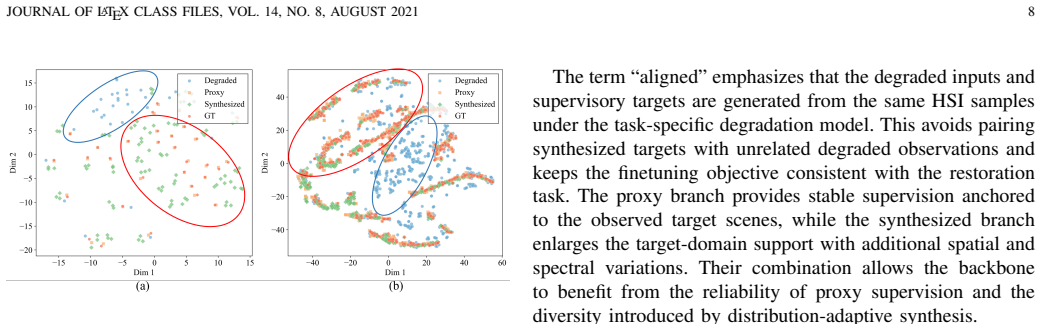
Hyperspectral image (HSI) restoration is crucial for reliable analysis, as real HSIs suffer from degradations like noise, blur, and resolution loss. However, existing models trained on source data often fail on target domains lacking clean references, a common occurrence in practice. To address this issue, we present HIR-ALIGN, a plug-and-play target-adaptive augmentation framework that enhances hyperspectral image restoration by augmenting limited training images with synthetic data that closely matches the target distribution using no extra data. It consists of three stages: (i) proxy generation, where off-the-shelf restoration models restore degraded target observations to produce semantics-preserving proxy HSIs that approximate target-domain clean images; (ii) distribution-adaptive synthesis, where a blur-robust unCLIP diffusion model generates target-aligned RGBs from proxy RGBs, with prompt conditioning and embedding-space noise initialization. Then, a warp-based spectral transfer module synthesizes HSIs by aligning each generated RGB with the proxy RGB, estimating soft patch-wise transport weights, and applying these weights and learnable local interpolation kernels to the proxy HSI; and (iii) aligned supervised finetuning, where restoration networks pretrained on the source distribution are finetuned using both the proxy HSIs and synthesized target-aligned HSIs, and are then deployed on degraded target images. We further provide theoretical analysis showing that augmentation-based finetuning can achieve lower target-domain restoration risk by jointly improving target distribution coverage and controlling spectral bias. Extensive experiments on simulated and real datasets across denoising and super-resolution tasks demonstrate that HIR-ALIGN consistently improves source-only supervised baselines, outperforming both source-only counterparts and representative unsupervised methods.
Editorial analysis
A structured set of objections, weighed in public.
Referee Report
Summary. The manuscript introduces HIR-ALIGN, a plug-and-play target-adaptive augmentation framework for hyperspectral image restoration. It proceeds in three stages: (i) proxy generation via off-the-shelf restorers to approximate clean target HSIs, (ii) distribution-adaptive synthesis using a blur-robust unCLIP diffusion model to generate target-aligned RGBs followed by warp-based spectral transfer (soft patch-wise transport weights and learnable local interpolation kernels) to produce aligned HSIs, and (iii) aligned supervised finetuning of source-pretrained restoration networks on the combined proxy and synthesized data. A theoretical analysis claims that this augmentation reduces target-domain restoration risk by jointly improving distribution coverage and controlling spectral bias. Experiments on simulated and real datasets report consistent gains over source-only baselines and unsupervised methods for denoising and super-resolution tasks.
Significance. If the proxy and alignment assumptions hold, the framework provides a practical route to domain adaptation for HSI restoration without requiring clean target references, which is a frequent practical constraint. The explicit theoretical link between augmentation, coverage, and bias control, together with the diffusion-based synthesis pipeline, could inform similar data-generation strategies in other imaging domains where source-target mismatch is severe.
major comments (3)
- [Abstract and §3.1 (proxy generation)] The central claim that augmentation-based finetuning lowers target-domain risk via improved coverage and bias control rests on the proxy HSIs being semantics-preserving approximations of clean target images. The manuscript does not isolate proxy fidelity (e.g., by direct comparison to any available target ground truth or by ablating proxy quality), leaving open whether observed gains arise from genuine distribution coverage or from incidental regularization effects of the finetuning procedure.
- [§3.2 (distribution-adaptive synthesis)] The warp-based spectral transfer module (soft patch-wise transport weights plus learnable local interpolation kernels) is asserted to produce unbiased aligned HSIs. Because the diffusion stage conditions on RGBs derived from potentially source-biased proxies, any semantic deviation between generated and proxy RGBs can misalign spectra; the paper provides no quantitative check (e.g., spectral angle or reconstruction error on held-out target patches) that new biases are not introduced.
- [Theoretical analysis section] The theoretical risk bound is presented as following from improved coverage and spectral-bias control, yet the derivation appears to rely on the proxy approximation assumption without an explicit sensitivity analysis. If the proxies retain source spectral biases or reconstruction artifacts, the coverage term in the bound may not improve as claimed.
minor comments (3)
- [Abstract] The abstract states that the method uses 'no extra data,' but the diffusion model is pretrained; clarify whether any target-domain images are used for prompt conditioning or embedding initialization.
- [§3.2] Implementation details for the learnable local interpolation kernels (e.g., kernel size, initialization, and optimization schedule) are not fully specified, making reproduction difficult.
- [Experiments section] Figure captions and experimental tables should report standard deviations across multiple random seeds or cross-validation folds to support the claim of 'consistent' improvement.
Simulated Author's Rebuttal
We thank the referee for the constructive and detailed comments, which help clarify the validation of our proxy and alignment steps as well as the theoretical claims. We address each major comment below and describe the revisions planned for the manuscript.
read point-by-point responses
-
Referee: [Abstract and §3.1 (proxy generation)] The central claim that augmentation-based finetuning lowers target-domain risk via improved coverage and bias control rests on the proxy HSIs being semantics-preserving approximations of clean target images. The manuscript does not isolate proxy fidelity (e.g., by direct comparison to any available target ground truth or by ablating proxy quality), leaving open whether observed gains arise from genuine distribution coverage or from incidental regularization effects of the finetuning procedure.
Authors: We agree that an explicit isolation of proxy fidelity would strengthen the empirical support for our claims. In the revised manuscript we will add an ablation study on the simulated datasets (where ground truth is available) that compares restoration performance obtained with proxies from different off-the-shelf restorers against the same models trained with ground-truth clean images. We will also report proxy fidelity metrics (PSNR, SAM) on held-out simulated patches to quantify how closely the proxies approximate clean target images. These additions will help separate the contribution of improved coverage from possible regularization effects of finetuning. revision: yes
-
Referee: [§3.2 (distribution-adaptive synthesis)] The warp-based spectral transfer module (soft patch-wise transport weights plus learnable local interpolation kernels) is asserted to produce unbiased aligned HSIs. Because the diffusion stage conditions on RGBs derived from potentially source-biased proxies, any semantic deviation between generated and proxy RGBs can misalign spectra; the paper provides no quantitative check (e.g., spectral angle or reconstruction error on held-out target patches) that new biases are not introduced.
Authors: We acknowledge the need for quantitative verification that the warp-based transfer does not introduce additional spectral bias. In the revision we will include new experiments that compute spectral angle mapper (SAM) and per-band reconstruction error between the synthesized HSIs and the corresponding proxy HSIs on held-out target patches. We will also compare these errors against a baseline that directly uses source-biased RGBs, thereby confirming that the proposed soft transport weights and local kernels preserve spectral fidelity. revision: yes
-
Referee: [Theoretical analysis section] The theoretical risk bound is presented as following from improved coverage and spectral-bias control, yet the derivation appears to rely on the proxy approximation assumption without an explicit sensitivity analysis. If the proxies retain source spectral biases or reconstruction artifacts, the coverage term in the bound may not improve as claimed.
Authors: The bound is derived under the explicit modeling assumption that proxies are reasonable approximations of clean target images, as stated in the manuscript. To address the referee’s concern we will augment the theoretical section with a sensitivity analysis that quantifies how the coverage term and overall risk bound degrade under controlled levels of proxy error (e.g., additive spectral bias or reconstruction artifacts). The analysis will be accompanied by a discussion of the conditions under which the claimed improvement still holds, supported by the empirical results already showing gains across varying proxy qualities. revision: partial
Circularity Check
No circularity detected in derivation chain
full rationale
The paper describes a three-stage plug-and-play augmentation pipeline (proxy generation via off-the-shelf restorers, diffusion-based RGB synthesis with warp-based spectral transfer, and supervised finetuning) plus a separate theoretical analysis claiming lower target risk through coverage and bias control. No equations or steps in the provided text reduce a claimed prediction or first-principles result to its own fitted inputs by construction, nor do any load-bearing premises collapse to self-citations, imported uniqueness theorems, or ansatzes smuggled via prior author work. The central claims rest on stated assumptions about proxy semantics preservation rather than self-referential definitions, so the derivation chain remains independent of its outputs.
Axiom & Free-Parameter Ledger
free parameters (1)
- learnable local interpolation kernels
axioms (1)
- domain assumption Off-the-shelf restoration models produce semantics-preserving proxy HSIs that approximate clean target-domain images.
Reference graph
Works this paper leans on
-
[1]
Coupled segmentation and denoising/deblurring models for hyperspectral material identification,
F. Li, M. K. Ng, and R. J. Plemmons, “Coupled segmentation and denoising/deblurring models for hyperspectral material identification,” Numerical Linear Algebra with Applications, vol. 19, no. 1, pp. 153– 173, 2012
work page 2012
-
[2]
G. Healey and D. Slater, “Models and methods for automated material identification in hyperspectral imagery acquired under unknown illumi- nation and atmospheric conditions,”IEEE Transactions on Geoscience and Remote Sensing, vol. 37, no. 6, pp. 2706–2717, 1999
work page 1999
-
[3]
Hyperspectral image dataset for benchmarking on salient object detection,
N. Imamoglu, Y . Oishi, X. Zhang, G. Ding, Y . Fang, T. Kouyama, and R. Nakamura, “Hyperspectral image dataset for benchmarking on salient object detection,” in2018 Tenth International Conference on Quality of Multimedia Experience (QoMEX). IEEE, 2018, pp. 1–3
work page 2018
-
[4]
Material based salient object detection from hyperspectral images,
J. Liang, J. Zhou, L. Tong, X. Bai, and B. Wang, “Material based salient object detection from hyperspectral images,”Pattern Recognition, vol. 76, pp. 476–490, 2018
work page 2018
-
[5]
Object detection in hyperspectral images,
L. Yan, M. Zhao, X. Wang, Y . Zhang, and J. Chen, “Object detection in hyperspectral images,”IEEE Signal Processing Letters, vol. 28, pp. 508–512, 2021
work page 2021
-
[6]
Hyperspectral imaging for clinical applications,
J. Yoon, “Hyperspectral imaging for clinical applications,”BioChip Journal, vol. 16, no. 1, pp. 1–12, 2022
work page 2022
-
[7]
Detection of preinvasive cancer cells,
V . Backman, M. B. Wallace, L. Perelman, J. Arendt, R. Gurjar, M. M ¨uller, Q. Zhang, G. Zonios, E. Kline, T. McGillicanet al., “Detection of preinvasive cancer cells,”Nature, vol. 406, no. 6791, pp. 35–36, 2000
work page 2000
-
[8]
M. Borengasser, W. Hungate, and R. Watkins,Hyperspectral Remote Sensing: Principles and Applications, 12 2007
work page 2007
-
[9]
Overview of hyperspectral imaging remote sensing from satellites,
S.-E. Qian, “Overview of hyperspectral imaging remote sensing from satellites,”Advances in Hyperspectral Image Processing Techniques, pp. 41–66, 2022
work page 2022
-
[10]
Sparse recovery of hyperspectral signal from natural rgb images,
B. Arad and O. Ben-Shahar, “Sparse recovery of hyperspectral signal from natural rgb images,” inComputer Vision–ECCV 2016: 14th Eu- ropean Conference, Amsterdam, the Netherlands, October 11–14, 2016, Proceedings, Part VII 14. Springer, 2016, pp. 19–34. TABLE XI UPPER-BOUND COMPARISON ONCAVEANDKAISTUSINGICVL-ONLY TRAINING, HIR-ALIGN,AND CLEAN-TARGET FINETU...
work page 2016
-
[11]
Generalized assorted pixel camera: Postcapture control of resolution, dynamic range, and spectrum,
F. Yasuma, T. Mitsunaga, D. Iso, and S. K. Nayar, “Generalized assorted pixel camera: Postcapture control of resolution, dynamic range, and spectrum,”IEEE Transactions on Image Processing, vol. 19, no. 9, pp. 2241–2253, 2010
work page 2010
-
[12]
Hyperspectral image restoration using low-rank matrix recovery,
H. Zhang, W. He, L. Zhang, H. Shen, and Q. Yuan, “Hyperspectral image restoration using low-rank matrix recovery,”IEEE Transactions on Geoscience and Remote Sensing, vol. 52, no. 8, pp. 4729–4743, 2014
work page 2014
-
[13]
Y . Chen, W. He, N. Yokoya, and T.-Z. Huang, “Hyperspectral image restoration using weighted group sparsity-regularized low-rank tensor decomposition,”IEEE Transactions on Cybernetics, vol. 50, no. 8, pp. 3556–3570, 2020
work page 2020
-
[14]
Y . Chen, W. Cao, L. Pang, and X. Cao, “Hyperspectral image denoising with weighted nonlocal low-rank model and adaptive total variation regularization,”IEEE Transactions on Geoscience and Remote Sensing, vol. 60, pp. 1–15, 2022
work page 2022
-
[15]
Hyperspectral image denoising via texture-preserved total variation regularizer,
Y . Chen, W. Cao, L. Pang, J. Peng, and X. Cao, “Hyperspectral image denoising via texture-preserved total variation regularizer,”IEEE Transactions on Geoscience and Remote Sensing, vol. 61, pp. 1–14, 2023
work page 2023
-
[16]
Image restoration for remote sensing: Overview and toolbox,
B. Rasti, Y . Chang, E. Dalsasso, L. Denis, and P. Ghamisi, “Image restoration for remote sensing: Overview and toolbox,”IEEE Geoscience and Remote Sensing Magazine, vol. 10, no. 2, pp. 201–230, 2021
work page 2021
-
[17]
Trq3dnet: A 3d quasi-recurrent and transformer based network for hyperspectral image denoising,
L. Pang, W. Gu, and X. Cao, “Trq3dnet: A 3d quasi-recurrent and transformer based network for hyperspectral image denoising,”Remote Sensing, vol. 14, no. 18, p. 4598, 2022
work page 2022
-
[18]
Progressive hyperspectral image destriping with an adaptive frequencial focus,
E. Pan, Y . Ma, X. Mei, F. Fan, J. Huang, and J. Ma, “Progressive hyperspectral image destriping with an adaptive frequencial focus,”IEEE Transactions on Geoscience and Remote Sensing, vol. 61, pp. 1–12, 2023
work page 2023
-
[19]
Spectral enhanced rectangle transformer for hyperspectral image denoising,
M. Li, J. Liu, Y . Fu, Y . Zhang, and D. Dou, “Spectral enhanced rectangle transformer for hyperspectral image denoising,” inProceedings of the IEEE/CVF Conference on Computer Vision and Pattern Recognition, 2023, pp. 5805–5814
work page 2023
-
[20]
Ssumamba: Spatial-spectral selective state space model for hyperspectral image denoising,
G. Fu, F. Xiong, J. Lu, and J. Zhou, “Ssumamba: Spatial-spectral selective state space model for hyperspectral image denoising,”IEEE Transactions on Geoscience and Remote Sensing, vol. 62, p. 3446812,
-
[21]
Available: https://ui.adsabs.harvard.edu/abs/2024ITGRS
[Online]. Available: https://ui.adsabs.harvard.edu/abs/2024ITGRS. .6246812F
-
[22]
Mp-hsir: A multi-prompt framework for universal hyperspectral image restoration,
Z. Wu, Y . Chen, N. Yokoya, and W. He, “Mp-hsir: A multi-prompt framework for universal hyperspectral image restoration,”arXiv preprint arXiv:2503.09131, 2025
-
[23]
Denoising hyper- spectral image with non-i.i.d. noise structure,
Y . Chen, X. Cao, Q. Zhao, D. Meng, and Z. Xu, “Denoising hyper- spectral image with non-i.i.d. noise structure,”IEEE Transactions on Cybernetics, vol. 48, no. 3, pp. 1054–1066, 2018
work page 2018
-
[24]
Hyperspectral image restoration under complex multi-band noises,
Z. Yue, D. Meng, Y . Sun, and Q. Zhao, “Hyperspectral image restoration under complex multi-band noises,”Remote Sensing, vol. 10, no. 10, p. 1631, 2018
work page 2018
-
[25]
T.-H. Ma, Z. Xu, D. Meng, and X.-L. Zhao, “Hyperspectral image restoration combining intrinsic image characterization with robust noise modeling,”IEEE Journal of Selected Topics in Applied Earth Observa- tions and Remote Sensing, vol. 14, pp. 1628–1644, 2021
work page 2021
-
[26]
Hyperspectral image denoising by asymmetric noise modeling,
S. Xu, X. Cao, J. Peng, Q. Ke, C. Ma, and D. Meng, “Hyperspectral image denoising by asymmetric noise modeling,”IEEE Transactions on Geoscience and Remote Sensing, vol. 60, pp. 1–14, 2022
work page 2022
-
[27]
Adaptive hyperspectral mixed noise removal,
T.-X. Jiang, L. Zhuang, T.-Z. Huang, and J. M. Bioucas-Dias, “Adaptive hyperspectral mixed noise removal,” inProceedings of the IEEE Inter- national Geoscience and Remote Sensing Symposium (IGARSS), 2018, pp. 4035–4038
work page 2018
-
[28]
Fasthymix: Fast and parameter-free hy- perspectral image mixed noise removal,
L. Zhuang and M. K. Ng, “Fasthymix: Fast and parameter-free hy- perspectral image mixed noise removal,”IEEE Transactions on Neural Networks and Learning Systems, vol. 34, no. 8, pp. 4702–4716, 2023
work page 2023
-
[29]
Denoising diffusion probabilistic models,
J. Ho, A. Jain, and P. Abbeel, “Denoising diffusion probabilistic models,” Advances in Neural Information Processing Systems, vol. 33, pp. 6840– 6851, 2020
work page 2020
-
[30]
Denoising Diffusion Implicit Models
J. Song, C. Meng, and S. Ermon, “Denoising diffusion implicit models,” p. arXiv:2010.02502, October 01, 2020 2020, iCLR 2021; updated connections with ODEs at page 6, fixed some typos in the proof. [Online]. Available: https://ui.adsabs.harvard.edu/abs/ 2020arXiv201002502S JOURNAL OF LATEX CLASS FILES, VOL. 14, NO. 8, AUGUST 2021 15
work page internal anchor Pith review Pith/arXiv arXiv 2010
-
[31]
Generative modeling by estimating gradients of the data distribution,
Y . Song and S. Ermon, “Generative modeling by estimating gradients of the data distribution,”Advances in Neural Information Processing Systems, vol. 32, 2019
work page 2019
-
[32]
Score-Based Generative Modeling through Stochastic Differential Equations
Y . Song, J. Sohl-Dickstein, D. P. Kingma, A. Kumar, S. Ermon, and B. Poole, “Score-based generative modeling through stochastic differential equations,” p. arXiv:2011.13456, November 01, 2020 2020, iCLR 2021 (Oral). [Online]. Available: https://ui.adsabs.harvard.edu/ abs/2020arXiv201113456S
work page internal anchor Pith review Pith/arXiv arXiv 2011
-
[33]
Diffusion models beat gans on image synthesis,
P. Dhariwal and A. Nichol, “Diffusion models beat gans on image synthesis,”Advances in Neural Information Processing Systems, vol. 34, pp. 8780–8794, 2021
work page 2021
-
[34]
GLIDE: Towards Photorealistic Image Generation and Editing with Text-Guided Diffusion Models
A. Nichol, P. Dhariwal, A. Ramesh, P. Shyam, P. Mishkin, B. McGrew, I. Sutskever, and M. Chen, “Glide: Towards photorealistic image gen- eration and editing with text-guided diffusion models,”arXiv preprint arXiv:2112.10741, 2021
work page internal anchor Pith review Pith/arXiv arXiv 2021
-
[35]
High- resolution image synthesis with latent diffusion models,
R. Rombach, A. Blattmann, D. Lorenz, P. Esser, and B. Ommer, “High- resolution image synthesis with latent diffusion models,” inProceedings of the IEEE/CVF Conference on Computer Vision and Pattern Recogni- tion, 2022, pp. 10 684–10 695
work page 2022
-
[36]
Hierarchical Text-Conditional Image Generation with CLIP Latents
A. Ramesh, P. Dhariwal, A. Nichol, C. Chu, and M. Chen, “Hierarchical text-conditional image generation with clip latents,” p. arXiv:2204.06125, April 01, 2022 2022. [Online]. Available: https://ui.adsabs.harvard.edu/abs/2022arXiv220406125R
work page internal anchor Pith review Pith/arXiv arXiv 2022
-
[37]
Photorealistic text-to- image diffusion models with deep language understanding,
C. Saharia, W. Chan, S. Saxena, L. Li, J. Whang, E. L. Denton, S. K. S. Ghasemipour, B. K. Ayan, S. S. Mahdavi, R. G. Lopes, T. Salimans, J. Ho, D. J. Fleet, and M. Norouzi, “Photorealistic text-to- image diffusion models with deep language understanding,” inAdvances in Neural Information Processing Systems, vol. 35, 2022, pp. 36 479– 36 494
work page 2022
-
[38]
Scalable diffusion models with transformers,
W. Peebles and S. Xie, “Scalable diffusion models with transformers,” inProceedings of the IEEE/CVF International Conference on Computer Vision, 2023, pp. 4195–4205
work page 2023
-
[39]
Crs-diff: Controllable remote sensing image generation with diffusion model,
D. Tang, X. Cao, X. Hou, Z. Jiang, J. Liu, and D. Meng, “Crs-diff: Controllable remote sensing image generation with diffusion model,” IEEE Transactions on Geoscience and Remote Sensing, 2024
work page 2024
-
[40]
Aerogen: enhancing remote sensing object detection with diffusion-driven data generation,
D. Tang, X. Cao, X. Wu, J. Li, J. Yao, X. Bai, D. Jiang, Y . Li, and D. Meng, “Aerogen: enhancing remote sensing object detection with diffusion-driven data generation,” inProceedings of the IEEE/CVF Conference on Computer Vision and Pattern Recognition, 2025, pp. 3614–3624
work page 2025
-
[41]
Terragen: A unified multi-task layout generation framework for remote sensing data augmentation,
D. Tang, H. Wang, Y . Xin, H. Qiao, D. Jiang, Y . Li, Z. Yu, and X. Cao, “Terragen: A unified multi-task layout generation framework for remote sensing data augmentation,”arXiv preprint arXiv:2510.21391, 2025
-
[42]
Hsigene: A foundation model for hyperspectral image generation,
L. Pang, X. Cao, D. Tang, S. Xu, X. Bai, F. Zhou, and D. Meng, “Hsigene: A foundation model for hyperspectral image generation,” arXiv preprint arXiv:2409.12470, 2024
-
[43]
Total-variation-regularized low-rank matrix factorization for hyperspectral image restoration,
W. He, H. Zhang, L. Zhang, and H. Shen, “Total-variation-regularized low-rank matrix factorization for hyperspectral image restoration,”IEEE Transactions on Geoscience and Remote Sensing, vol. 54, no. 1, pp. 178–188, 2016
work page 2016
-
[44]
Hyperspectral restoration vial 0 gradient regularized low-rank tensor factorization,
F. Xiong, J. Zhou, and Y . Qian, “Hyperspectral restoration vial 0 gradient regularized low-rank tensor factorization,”IEEE Transactions on Geoscience and Remote Sensing, vol. 57, no. 12, pp. 10 410–10 425, 2019
work page 2019
-
[45]
Enhanced 3dtv regularization and its applications on hsi denoising and compressed sensing,
J. Peng, Q. Xie, Q. Zhao, Y . Wang, L. Yee, and D. Meng, “Enhanced 3dtv regularization and its applications on hsi denoising and compressed sensing,”IEEE Transactions on Image Processing, vol. 29, pp. 7889– 7903, 2020
work page 2020
-
[46]
Fast noise removal in hyperspectral images via representative coefficient total variation,
J. Peng, H. Wang, X. Cao, X. Liu, X. Rui, and D. Meng, “Fast noise removal in hyperspectral images via representative coefficient total variation,”IEEE Transactions on Geoscience and Remote Sensing, vol. 60, pp. 1–17, 2022
work page 2022
-
[47]
Deep spatial-spectral global rea- soning network for hyperspectral image denoising,
X. Cao, X. Fu, C. Xu, and D. Meng, “Deep spatial-spectral global rea- soning network for hyperspectral image denoising,”IEEE Transactions on Geoscience and Remote Sensing, vol. 60, pp. 1–14, 2022
work page 2022
-
[48]
Single hyperspectral image super-resolution with grouped deep recursive residual network,
Y . Li, L. Zhang, C. Dingl, W. Wei, and Y . Zhang, “Single hyperspectral image super-resolution with grouped deep recursive residual network,” in2018 IEEE Fourth International Conference on Multimedia Big Data (BigMM). IEEE, 2018, pp. 1–4
work page 2018
-
[49]
Hyperspectral image superresolution using spectrum and feature context,
Q. Wang, Q. Li, and X. Li, “Hyperspectral image superresolution using spectrum and feature context,”IEEE Transactions on Industrial Electronics, vol. 68, no. 11, pp. 11 276–11 285, 2021
work page 2021
-
[50]
Essaformer: Efficient transformer for hyperspectral image super- resolution,
M. Zhang, C. Zhang, Q. Zhang, J. Guo, X. Gao, and J. Zhang, “Essaformer: Efficient transformer for hyperspectral image super- resolution,” in2023 IEEE/CVF International Conference on Computer Vision (ICCV), 2023, pp. 23 016–23 027
work page 2023
-
[51]
Hsr-diff: Hyperspectral image super-resolution via conditional diffusion models,
C. Wu, D. Wang, Y . Bai, H. Mao, Y . Li, and Q. Shen, “Hsr-diff: Hyperspectral image super-resolution via conditional diffusion models,” inProceedings of the IEEE/CVF International Conference on Computer Vision (ICCV), October 2023, pp. 7083–7093
work page 2023
-
[52]
Ispdiff: Interpretable scale- propelled diffusion model for hyperspectral image super-resolution,
W. Dong, S. Liu, S. Xiao, J. Qu, and Y . Li, “Ispdiff: Interpretable scale- propelled diffusion model for hyperspectral image super-resolution,” IEEE Transactions on Geoscience and Remote Sensing, vol. 62, pp. 1–14, 2024
work page 2024
-
[53]
Promptir: Prompting for all-in-one image restoration,
V . Potlapalli, S. W. Zamir, S. Khan, and F. Khan, “Promptir: Prompting for all-in-one image restoration,” inThirty-seventh Conference on Neural Information Processing Systems, 2023
work page 2023
-
[54]
Classifier-Free Diffusion Guidance
J. Ho and T. Salimans, “Classifier-free diffusion guidance,”arXiv preprint arXiv:2207.12598, 2022
work page internal anchor Pith review Pith/arXiv arXiv 2022
-
[55]
Hir-diff: Unsupervised hyperspectral image restoration via improved diffusion models,
L. Pang, X. Rui, L. Cui, H. Wang, D. Meng, and X. Cao, “Hir-diff: Unsupervised hyperspectral image restoration via improved diffusion models,” inProceedings of the IEEE/CVF Conference on Computer Vision and Pattern Recognition, 2024, pp. 3005–3014
work page 2024
-
[56]
Sdedit: guided image synthesis and editing with stochastic differential equations,
C. Meng, Y . He, Y . Song, J. Song, J. Wu, J.-Y . Zhu, and S. Ermon, “Sdedit: guided image synthesis and editing with stochastic differential equations,” 2022
work page 2022
-
[57]
Billion-scale similarity search with gpus,
J. Johnson, M. Douze, and H. J ´egou, “Billion-scale similarity search with gpus,”IEEE Transactions on Big Data, vol. 7, no. 3, pp. 535–547, 2019
work page 2019
-
[58]
High-quality hyperspectral reconstruction using a spectral prior,
I. Choi, D. S. Jeon, G. Nam, D. Gutierrez, and M. H. Kim, “High-quality hyperspectral reconstruction using a spectral prior,”ACM Transactions on Graphics (Proc. SIGGRAPH Asia 2017), vol. 36, no. 6, pp. 218:1–13,
work page 2017
-
[59]
Available: http://dx.doi.org/10.1145/3130800.3130810
[Online]. Available: http://dx.doi.org/10.1145/3130800.3130810
-
[60]
Hyperspectral image denoising with realistic data,
T. Zhang, Y . Fu, and C. Li, “Hyperspectral image denoising with realistic data,” inProceedings of the IEEE/CVF International Conference on Computer Vision, 2021, pp. 2248–2257
work page 2021
-
[61]
A trainable spectral-spatial sparse coding model for hyperspectral image restora- tion,
T. Bodrito, A. Zouaoui, J. Chanussot, and J. Mairal, “A trainable spectral-spatial sparse coding model for hyperspectral image restora- tion,”Advances in Neural Information Processing Systems (NeurIPS), 2021
work page 2021
-
[62]
Bidirectional 3d quasi-recurrent neural network for hyperspectral image super-resolution,
Y . Fu, Z. Liang, and S. You, “Bidirectional 3d quasi-recurrent neural network for hyperspectral image super-resolution,”IEEE Journal of Selected Topics in Applied Earth Observations and Remote Sensing, vol. 14, pp. 2674–2688, 2021
work page 2021
-
[63]
Mixed 2d/3d convolutional network for hyperspectral image super-resolution,
Q. Li, Q. Wang, and X. Li, “Mixed 2d/3d convolutional network for hyperspectral image super-resolution,”Remote Sensing, vol. 12, no. 10, 2020
work page 2020
-
[64]
Hyperspectral image restoration via total variation regularized low-rank tensor decomposition,
Y . Wang, J. Peng, Q. Zhao, Y . Leung, X.-L. Zhao, and D. Meng, “Hyperspectral image restoration via total variation regularized low-rank tensor decomposition,”IEEE Journal of Selected Topics in Applied Earth Observations and Remote Sensing, vol. 11, no. 4, pp. 1227–1243, 2018
work page 2018
-
[65]
Microsoft coco: Common objects in con- text,
T.-Y . Lin, M. Maire, S. Belongie, J. Hays, P. Perona, D. Ramanan, P. Doll´ar, and C. L. Zitnick, “Microsoft coco: Common objects in con- text,” inComputer Vision – ECCV 2014, D. Fleet, T. Pajdla, B. Schiele, and T. Tuytelaars, Eds. Cham: Springer International Publishing, 2014, pp. 740–755. JOURNAL OF LATEX CLASS FILES, VOL. 14, NO. 8, AUGUST 2021 16 Sup...
work page 2014
-
[66]
On the uniform convergence of relative frequencies of events to their probabilities,
V . N. Vapnik and A. Y . Chervonenkis, “On the uniform convergence of relative frequencies of events to their probabilities,” inMeasures of complexity: festschrift for alexey chervonenkis. Springer, 2015, pp. 11– 30
work page 2015
-
[67]
S. Shalev-Shwartz and S. Ben-David,Understanding machine learning: From theory to algorithms. Cambridge university press, 2014
work page 2014
- [68]
-
[69]
V . Koltchinskii,Oracle inequalities in empirical risk minimization and sparse recovery problems: Ecole D’Et ´e de Probabilit ´es de Saint-Flour XXXVIII-2008. Springer, 2011, vol. 2033
work page 2008
discussion (0)
Sign in with ORCID, Apple, or X to comment. Anyone can read and Pith papers without signing in.