Recognition: unknown
SINAPSE: A lightweight deep learning framework for accurate and explainable neutron-γ discrimination
Pith reviewed 2026-05-14 17:47 UTC · model grok-4.3
The pith
A lightweight dual-branch neural network denoises low-charge waveforms and classifies neutrons versus gammas with calibrated probabilities.
A machine-rendered reading of the paper's core claim, the machinery that carries it, and where it could break.
Core claim
SINAPSE uses a dual-branch architecture with a 1-dimensional convolutional autoencoder for waveform denoising and a classifier for particle identification. Random augmentations applied to high-SNR waveforms simulate low-charge conditions, enabling training where conventional PSD labels are unreliable. The framework shows superior denoising performance over conventional digital signal processing, outputs well-calibrated probabilities consistent with traditional graphical cuts, and relies on physically meaningful pulse-shape features according to SHAP analysis.
What carries the argument
Dual-branch architecture of a 1D convolutional autoencoder for denoising paired with a particle classifier, trained via random augmentations on high-SNR waveforms and interpreted with SHAP values.
Load-bearing premise
Random augmentations applied to high-SNR waveforms must faithfully reproduce the noise statistics and pulse-shape distortions present in real low-charge experimental data.
What would settle it
Direct test of classification accuracy and probability calibration on real low-charge experimental waveforms labeled independently by time-of-flight or equivalent ground truth, compared against conventional DSP performance; significant underperformance would falsify the superiority claim.
Figures






read the original abstract
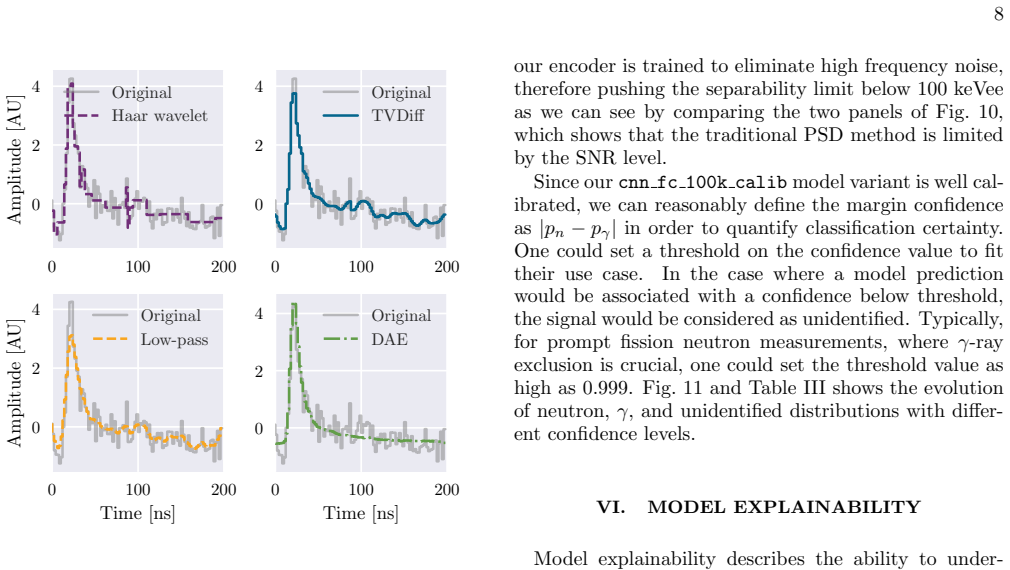
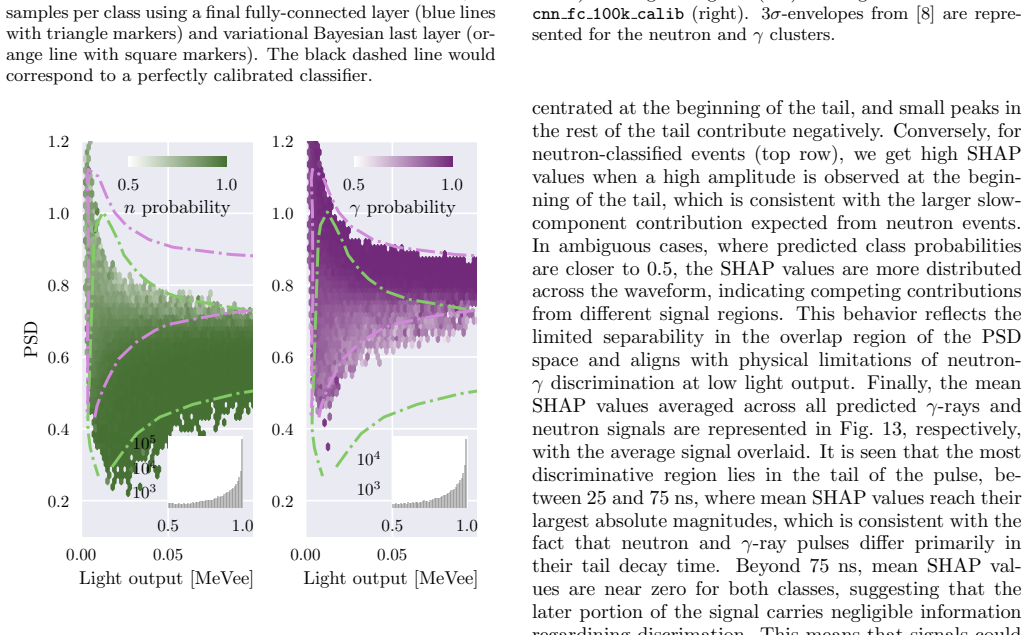
Traditionally, neutron-$\gamma$ discrimination in organic scintillators relies on techniques such as time-of-flight (ToF) selection and pulse-shape discrimination (PSD). However, particle identification through graphical cuts remains challenging in the low-charge regime due to poor signal-to-noise ratios (SNR). In this work, we propose SINAPSE, a lightweight deep learning framework for accurate and explainable neutron-$\gamma$ discrimination in the low-charge regime. The framework employs a dual-branch architecture that combines a 1-dimensional convolutional autoencoder for waveform denoising with a classifier for particle identification. Random augmentations are applied to high-SNR waveforms to simulate low-charge conditions, enabling robust extrapolation into regimes where conventional PSD labels are unreliable. We show that SINAPSE achieves superior denoising performance compared to conventional digital signal processing techniques, and outputs well-calibrated probabilities, consistent with traditional graphical cuts. Finally, we apply SHAP (SHapley Additive exPlanations) values to show that model decisions are driven by physically meaningful pulse-shape features, confirming consistency with established PSD principles.
Editorial analysis
A structured set of objections, weighed in public.
Referee Report
Summary. The manuscript proposes SINAPSE, a lightweight dual-branch deep learning framework for neutron-gamma discrimination in organic scintillators. It combines a 1D convolutional autoencoder for denoising waveforms with a classifier for particle identification, trained via random augmentations applied to high-SNR data to extrapolate into the low-charge regime where conventional PSD labels are unreliable. The paper claims superior denoising performance relative to digital signal processing techniques, well-calibrated output probabilities consistent with traditional graphical cuts, and explainability via SHAP values that align model decisions with established pulse-shape features.
Significance. If the central claims hold after addressing validation gaps, the work could offer a practical, lightweight, and interpretable tool for improving particle identification in low-SNR scintillator data, where traditional methods struggle. The emphasis on physical consistency via SHAP and the dual-branch design for denoising-plus-classification represent potential strengths for applications in nuclear instrumentation and radiation detection experiments.
major comments (2)
- [Methods] Methods (augmentation procedure): The central extrapolation claim relies on random augmentations of high-SNR waveforms to simulate low-charge conditions, yet no specific augmentation parameters, noise power spectra, or quantitative fidelity metrics (e.g., Kolmogorov-Smirnov tests on baseline fluctuations or pulse-shape distortions) are provided to demonstrate that the simulated data match real low-SNR experimental statistics. This directly affects both the denoising superiority and calibration claims.
- [Results] Results (performance evaluation): The abstract asserts superior denoising and well-calibrated probabilities relative to DSP and graphical cuts, but the manuscript supplies no quantitative metrics, baseline comparisons, error bars, or held-out real low-SNR validation set details. Without these, the load-bearing performance claims cannot be assessed for statistical significance or robustness.
minor comments (1)
- [Abstract] Abstract: Key quantitative results (e.g., denoising MSE or AUC values) should be included to allow readers to immediately gauge the magnitude of the reported improvements.
Simulated Author's Rebuttal
We thank the referee for their constructive comments, which help strengthen the manuscript. We address each major point below and will incorporate revisions to improve methodological transparency and quantitative rigor.
read point-by-point responses
-
Referee: [Methods] Methods (augmentation procedure): The central extrapolation claim relies on random augmentations of high-SNR waveforms to simulate low-charge conditions, yet no specific augmentation parameters, noise power spectra, or quantitative fidelity metrics (e.g., Kolmogorov-Smirnov tests on baseline fluctuations or pulse-shape distortions) are provided to demonstrate that the simulated data match real low-SNR experimental statistics. This directly affects both the denoising superiority and calibration claims.
Authors: We agree that the augmentation procedure requires fuller specification to support the extrapolation claims. In the revised manuscript we will add the exact augmentation parameters (including noise amplitude ranges, frequency content, and application order), describe the noise power spectra employed, and report quantitative fidelity metrics such as Kolmogorov-Smirnov tests comparing baseline fluctuations and pulse-shape statistics between simulated and real low-SNR data. These additions will allow readers to evaluate the realism of the simulated low-charge regime. revision: yes
-
Referee: [Results] Results (performance evaluation): The abstract asserts superior denoising and well-calibrated probabilities relative to DSP and graphical cuts, but the manuscript supplies no quantitative metrics, baseline comparisons, error bars, or held-out real low-SNR validation set details. Without these, the load-bearing performance claims cannot be assessed for statistical significance or robustness.
Authors: We acknowledge that the current results section would benefit from expanded quantitative reporting. The revised manuscript will include explicit denoising metrics (e.g., SNR gain, MSE, and waveform fidelity scores) with error bars from multiple runs, direct numerical comparisons against DSP baselines, and a clearer description of the validation strategy. Because conventional PSD labels become unreliable at low charge, our primary validation relies on consistency with graphical cuts on higher-SNR data plus SHAP-based physical interpretability; we will expand this discussion to address robustness. revision: yes
Circularity Check
No circularity; claims rest on independent validation against traditional PSD cuts
full rationale
The paper trains a dual-branch autoencoder+classifier on randomly augmented high-SNR waveforms and evaluates denoising and probability calibration against separate traditional graphical PSD cuts. No equations, fitted parameters, or self-citations are shown that reduce the performance claims to tautological inputs by construction. Augmentation is presented as an empirical modeling choice whose fidelity is an external assumption, not a definitional loop. The derivation chain is therefore self-contained against external benchmarks.
Axiom & Free-Parameter Ledger
axioms (1)
- domain assumption Random augmentations on high-SNR waveforms accurately simulate the noise and pulse-shape distortions of real low-charge data
Reference graph
Works this paper leans on
-
[1]
R. C. Haight, H. Y. Lee, T. N. Taddeucci, J. M. O’Donnell, B. A. Perdue, N. Fotiades, M. Devlin, J. L. Ullmann, A. Laptev, T. Bredeweg,et al., Two detector arrays for fast neutrons at lansce, Journal of Instrumen- tation7(03), C03028
-
[2]
Mart´ ınez, D
T. Mart´ ınez, D. Cano-Ott, J. Castilla, A. Garcia, J. Marin, G. Martinez, E. Mendoza, C. Santos, F. Tera, D. Villamarin,et al., Monster: a tof spectrometer forβ- delayed neutron spectroscopy, Nuclear Data Sheets120, 78 (2014)
2014
-
[3]
Talou and R
P. Talou and R. Vogt,Nuclear fission: theories, experi- ments and applications(Springer Nature, 2023)
2023
-
[4]
Brooks, Development of organic scintillators, Nuclear Instruments and Methods162, 477 (1979)
F. Brooks, Development of organic scintillators, Nuclear Instruments and Methods162, 477 (1979)
1979
-
[5]
Fabian, G
X. Fabian, G. Baulieu, L. Ducroux, O. St´ ezowski, A. Boujrad, E. Cl´ ement, S. Coudert, G. de France, N. Er- duran, S. Ert¨ urk,et al., Artificial neural networks for neutron/γdiscrimination in the neutron detectors of neda, Nuclear Instruments and Methods in Physics Re- search Section A: Accelerators, Spectrometers, Detectors and Associated Equipment986...
2021
-
[6]
R. L. Garnett and S. H. Byun, Neutralnet: Develop- ment and testing of a machine learning solution for pulse shape discrimination, Applied Radiation and Isotopes 211, 111384 (2024)
2024
- [7]
-
[8]
Syrett, C
O. Syrett, C. Lenain, B. Mauss, J. Taieb, P. Morfouace, A. Chatillon, and D. Etasse, Vendeta: Versatile neu- tron detector array, a new high-resolution neutron time- of-flight measurement array, Nuclear Instruments and 13 Methods in Physics Research Section A: Accelerators, Spectrometers, Detectors and Associated Equipment , 170824 (2025)
2025
-
[9]
Laurent, J
B. Laurent, J. Taieb, G. B´ elier, P. Marini, and P. Mor- fouace, New developments of a fission chamber for very high radioactivity samples, Nuclear Instruments and Methods in Physics Research Section A: Acceler- ators, Spectrometers, Detectors and Associated Equip- ment990, 164966 (2021)
2021
-
[10]
FASTER, Faster,https://faster.in2p3.fr/
-
[11]
G. F. Knoll,Radiation detection and measurement(John Wiley & Sons, 2010)
2010
-
[12]
Harrison, J
J. Harrison, J. Willes, and J. Snoek, Variational bayesian last layers, inInternational Conference on Learning Rep- resentations (ICLR)(2024)
2024
-
[13]
Watson, J
J. Watson, J. A. Lin, P. Klink, J. Pajarinen, and J. Pe- ters, Latent derivative bayesian last layer networks, in International Conference on Artificial Intelligence and Statistics(PMLR, 2021) pp. 1198–1206
2021
-
[14]
GRIT, Grit,https://grit.in2p3.fr/
-
[15]
Paszke, S
A. Paszke, S. Gross, F. Massa, A. Lerer, J. Bradbury, G. Chanan, T. Killeen, Z. Lin, N. Gimelshein, L. Antiga, et al., Pytorch: An imperative style, high-performance deep learning library, Advances in neural information processing systems32(2019)
2019
-
[16]
Haar, Zur theorie der orthogonalen funktionensys- teme, Mathematische Annalen71, 38 (1911)
A. Haar, Zur theorie der orthogonalen funktionensys- teme, Mathematische Annalen71, 38 (1911)
1911
-
[17]
L. I. Rudin, S. Osher, and E. Fatemi, Nonlinear total vari- ation based noise removal algorithms, Physica D: nonlin- ear phenomena60, 259 (1992)
1992
- [18]
-
[19]
ONNX, Open neural network exchange,https://onnx. ai/
-
[20]
J. Y. Araz, A. Buckley, G. Kasieczka, J. Kieseler, S. Kraml, A. Kvellestad, A. Lessa, T. Procter, A. Raklev, H. Reyes-Gonzalez,et al., Les houches guide to reusable ml models in lhc analyses, SciPost Physics Community Reports , 003 (2024)
2024
-
[21]
C. Wang, Calibration in deep learning: A survey of the state-of-the-art, arXiv preprint arXiv:2308.01222 (2023)
-
[22]
M. Kull, T. M. S. Filho, and P. Flach, Beyond sigmoids: How to obtain well-calibrated probabilities from binary classifiers with beta calibration, Electronic Journal of Statistics11, 5052 (2017)
2017
-
[23]
Longo, M
L. Longo, M. Brcic, F. Cabitza, J. Choi, R. Con- falonieri, J. Del Ser, R. Guidotti, Y. Hayashi, F. Her- rera, A. Holzinger,et al., Explainable artificial intelli- gence (xai) 2.0: A manifesto of open challenges and inter- disciplinary research directions, Information Fusion106, 102301 (2024)
2024
-
[24]
Towards A Rigorous Science of Interpretable Machine Learning
F. Doshi-Velez and B. Kim, Towards a rigorous sci- ence of interpretable machine learning, arXiv preprint arXiv:1702.08608 (2017)
work page internal anchor Pith review Pith/arXiv arXiv 2017
-
[25]
S. M. Lundberg and S.-I. Lee, A unified approach to in- terpreting model predictions, Advances in neural infor- mation processing systems30(2017)
2017
-
[26]
Adebayo, J
J. Adebayo, J. Gilmer, M. Muelly, I. Goodfellow, M. Hardt, and B. Kim, Sanity checks for saliency maps, Advances in neural information processing systems31 (2018)
2018
-
[27]
Kindermans, S
P.-J. Kindermans, S. Hooker, J. Adebayo, M. Alber, K. T. Sch¨ utt, S. D¨ ahne, D. Erhan, and B. Kim, The (un) reliability of saliency methods, inExplainable AI: Interpreting, explaining and visualizing deep learning (Springer, 2019) pp. 267–280
2019
-
[28]
Shrikumar, P
A. Shrikumar, P. Greenside, and A. Kundaje, Learning important features through propagating activation dif- ferences, inInternational conference on machine learning (PMlR, 2017) pp. 3145–3153
2017
-
[29]
S. M. Lundberg and S.-I. Lee, A unified approach to interpreting model predictions (Curran Associates, Inc., 2017)
2017
-
[30]
Matta, P
A. Matta, P. Morfouace, N. d. S´ er´ eville, F. Flavigny, M. Labiche, and R. Shearman, Nptool: a simulation and analysis framework for low-energy nuclear physics ex- periments, Journal of Physics G: Nuclear and Particle Physics43, 045113 (2016)
2016
-
[31]
O. R. developers, Onnx runtime,https://onnxruntime. ai/(2021)
2021
-
[32]
S. Owen, C. Thomas, A. Matta, B. Mauss, D. Etasse, A. Chatillon, C. Lenain, P. Morfouace, J. Taieb, D. Reg- nier, M. Delvin, P. Copp, C. Surault, and J. Surbrook, Sinapse neutron-gamma discrimination, 10.5281/zen- odo.19922303 (2026)
-
[33]
NVIDIA, Tensorrt,https://github.com/NVIDIA/ TensorRT
-
[34]
Berthelot, N
D. Berthelot, N. Carlini, I. Goodfellow, N. Papernot, A. Oliver, and C. A. Raffel, Mixmatch: A holistic ap- proach to semi-supervised learning, Advances in neural information processing systems32(2019)
2019
discussion (0)
Sign in with ORCID, Apple, or X to comment. Anyone can read and Pith papers without signing in.