Recognition: unknown
Effects of Thermal Boundary Conditions on Natural Convection and Entropy Generation in Non-Newtonian Power-Law Fluids
Pith reviewed 2026-05-14 17:53 UTC · model grok-4.3
The pith
Thermal boundary conditions control the intensity of convection and the amount of entropy generated in non-Newtonian power-law fluids.
A machine-rendered reading of the paper's core claim, the machinery that carries it, and where it could break.
Core claim
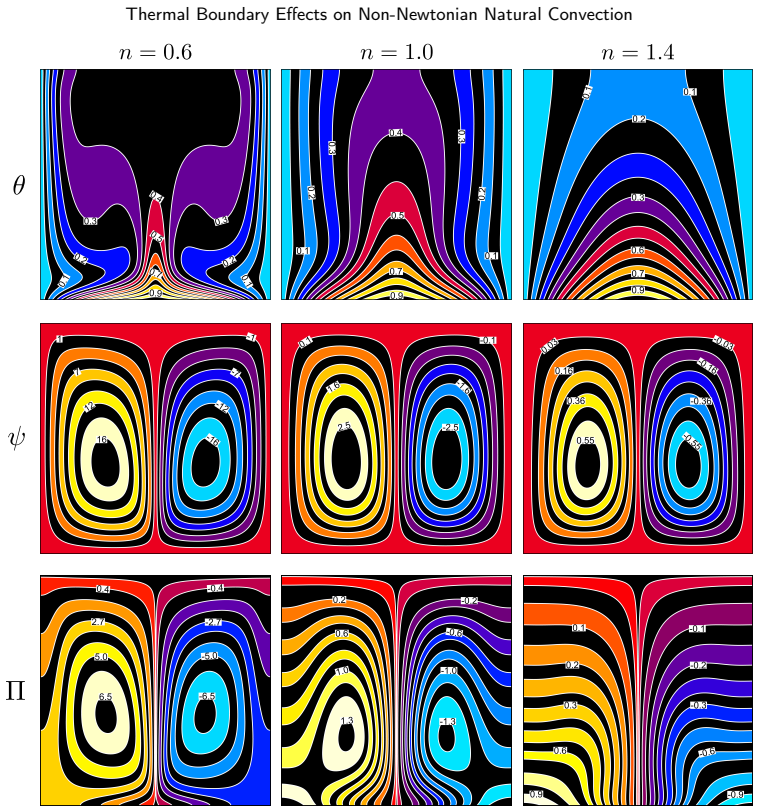
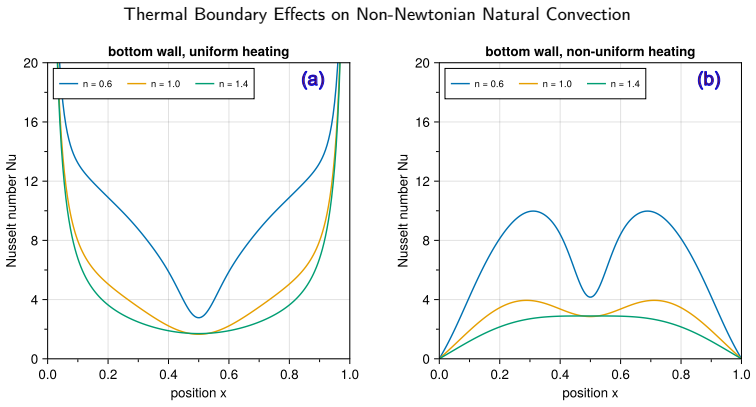
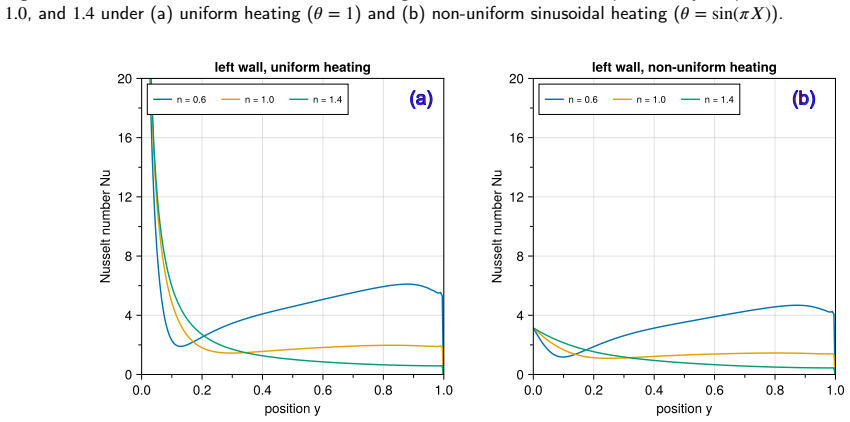
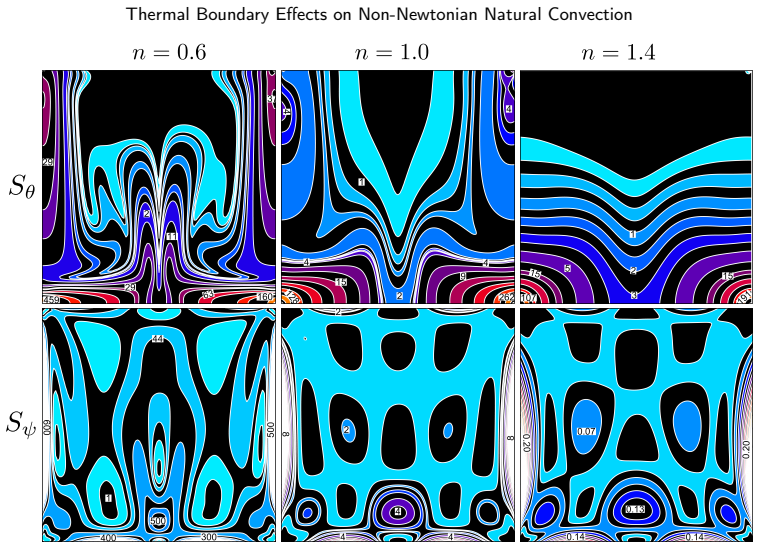
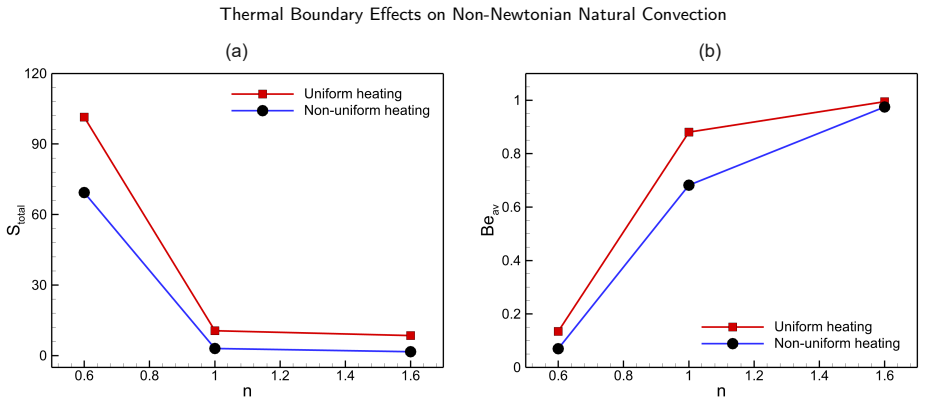
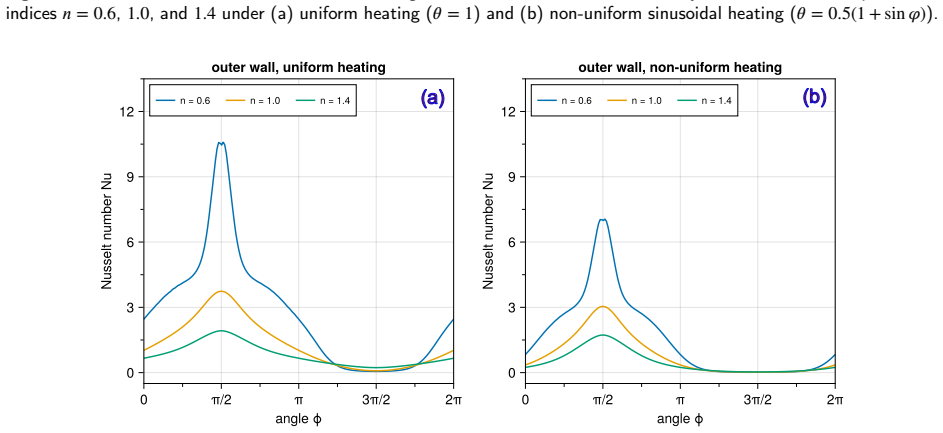
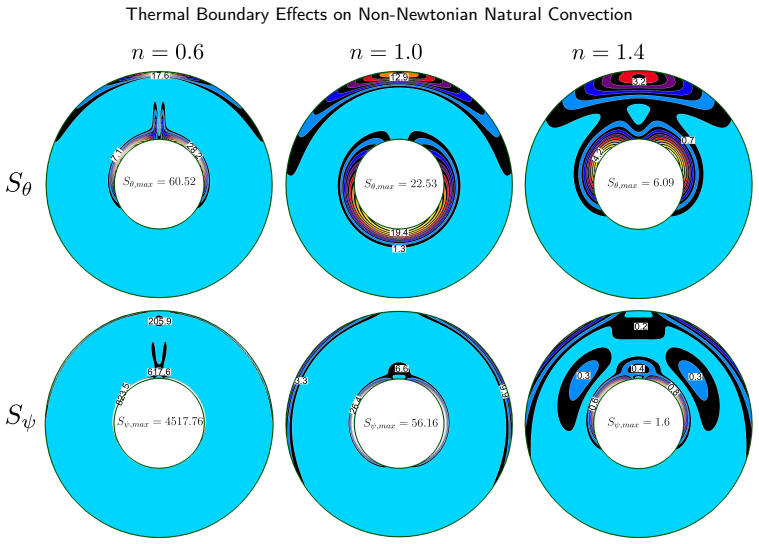
Thermal boundary conditions play an important role in controlling the intensity and spatial distribution of flow, heat transfer, and irreversibility. In both the square cavity and the concentric cylindrical annulus, uniform heating produces stronger and more distributed convective structures, while non-uniform sinusoidal heating localizes thermal forcing and consistently reduces total entropy generation. Shear-thinning fluids enhance buoyancy-driven circulation, steepen thermal gradients, and increase heat transfer, whereas shear-thickening fluids suppress convection and promote conduction-dominated transport. Viscous dissipation dominates irreversibility in shear-thinning fluids, whereas热转让
What carries the argument
The incompressible power-law fluid model under the Boussinesq approximation, solved by finite elements, to compare uniform and sinusoidal thermal boundary conditions.
If this is right
- Uniform heating increases convective strength and heat transfer rates relative to sinusoidal heating.
- Non-uniform sinusoidal heating lowers total entropy generation in both the square cavity and the cylindrical annulus.
- Shear-thinning fluids produce higher Nusselt numbers than Newtonian or shear-thickening fluids under the same conditions.
- Viscous dissipation accounts for most irreversibility at low power-law indices, while thermal irreversibility dominates at higher indices.
- Thermal boundary design combined with fluid rheology offers a route to control heat transfer and reduce thermodynamic losses.
Where Pith is reading between the lines
- Engineers could apply sinusoidal heating to non-Newtonian systems to cut energy dissipation while retaining acceptable heat transfer.
- The trends may inform heating strategies in polymer processing or chemical reactors that handle power-law fluids.
- Three-dimensional or time-dependent simulations at higher Rayleigh numbers could check whether the two-dimensional steady patterns persist.
Load-bearing premise
The flow remains steady and strictly two-dimensional across the full range of Rayleigh numbers and power-law indices examined.
What would settle it
Laboratory measurements of velocity fields, temperature distributions, and total entropy generation in physical enclosures with the same geometries and boundary conditions would show whether the predicted reduction under sinusoidal heating occurs.
Figures







read the original abstract
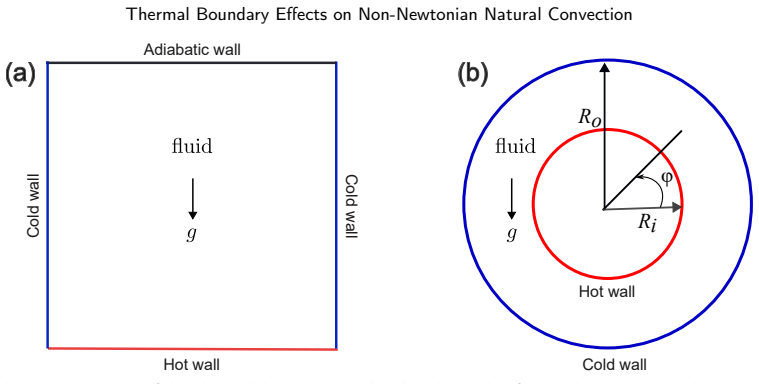
This study investigates the role of thermal boundary conditions on natural convection and entropy generation in non-Newtonian power-law fluids confined within a square cavity and a concentric cylindrical annulus. Steady, two-dimensional governing equations based on the incompressible power-law model and the Boussinesq approximation are solved using the Gridap.jl finite element framework. The numerical methodology is validated against benchmark solutions for both Newtonian and non-Newtonian convection, showing good agreement in terms of isotherm fields, streamlines, local Nusselt number distributions, and entropy generation. The effects of fluid rheology and heating mode are examined for shear-thinning, Newtonian, and shear-thickening fluids under uniform and non-uniform thermal boundary conditions. The results show that shear-thinning behavior enhances buoyancy-driven circulation, steepens thermal gradients, and increases heat transfer, whereas shear-thickening behavior suppresses convection and promotes conduction-dominated transport. Thermal boundary conditions are found to play an important role in controlling the intensity and spatial distribution of flow, heat transfer, and irreversibility. In both geometries, uniform heating produces stronger and more distributed convective structures, while non-uniform sinusoidal heating localizes thermal forcing and consistently reduces total entropy generation. An entropy analysis further reveals that viscous dissipation dominates irreversibility in shear-thinning fluids, whereas heat-transfer irreversibility becomes dominant as the power-law index increases. The study demonstrates that appropriate thermal boundary design, together with fluid rheology, provides an effective route for controlling heat transfer and minimizing thermodynamic losses in non-Newtonian convection systems. The source code and metadata are publicly available.
Editorial analysis
A structured set of objections, weighed in public.
Referee Report
Summary. This paper numerically studies the effects of uniform versus sinusoidal thermal boundary conditions on steady natural convection and entropy generation in power-law non-Newtonian fluids inside a square cavity and a concentric cylindrical annulus. The incompressible Boussinesq equations with the power-law viscosity model are discretized with the Gridap.jl finite-element framework and solved for shear-thinning (n<1), Newtonian (n=1), and shear-thickening (n>1) cases over a range of Rayleigh numbers. Validation is performed against published benchmark data for isotherms, streamlines, local Nusselt numbers, and entropy fields; the results indicate that uniform heating produces stronger, more distributed convection while sinusoidal heating localizes forcing and reduces total entropy generation, with viscous dissipation dominating irreversibility at low n.
Significance. If the computed fields remain representative, the work supplies concrete guidance on how thermal boundary design can modulate heat transfer and thermodynamic losses in non-Newtonian convection, a topic relevant to engineering applications involving polymer solutions or suspensions. The public release of the Gridap.jl source code is a clear strength that supports reproducibility and future extensions.
major comments (2)
- [§2] §2 (Governing equations and assumptions): The manuscript solves the steady, strictly two-dimensional form of the equations for the entire parameter space (all Ra and n examined) without reporting or testing the boundaries of the steady regime. For shear-thinning fluids the critical Rayleigh number for onset of unsteadiness is known to be lower than for Newtonian fluids; therefore the tabulated Nusselt numbers, streamline topologies, and entropy integrals (especially the viscous-dissipation contribution at low n) may correspond to parameter combinations where the flow is actually time-dependent or three-dimensional.
- [§4.2–4.3] §4.2–4.3 (Results for cylindrical annulus): The claim that sinusoidal heating “consistently reduces total entropy generation” is presented as a general conclusion, yet the quantitative reduction is shown only for selected n and Ra; no systematic table or figure quantifies the percentage change across the full matrix, making it difficult to assess how load-bearing the boundary-condition effect is relative to the rheology effect.
minor comments (3)
- [Figure 5] Figure 5 (entropy contours): The color scales are not uniform across panels with different n; this hinders direct visual comparison of the relative importance of viscous versus thermal irreversibility.
- [Table 2] Table 2 (validation): The maximum relative error for the average Nusselt number is reported, but the corresponding error for the total entropy generation rate is omitted; adding this quantity would strengthen the validation statement.
- [Notation] Notation: The symbol for the power-law consistency index is introduced as K in the text but appears as μ₀ in several equations; a single consistent symbol should be used throughout.
Simulated Author's Rebuttal
We thank the referee for the constructive and detailed review of our manuscript. We address each major comment point by point below, providing honest responses and indicating where revisions will be made to the next version of the paper.
read point-by-point responses
-
Referee: §2 (Governing equations and assumptions): The manuscript solves the steady, strictly two-dimensional form of the equations for the entire parameter space (all Ra and n examined) without reporting or testing the boundaries of the steady regime. For shear-thinning fluids the critical Rayleigh number for onset of unsteadiness is known to be lower than for Newtonian fluids; therefore the tabulated Nusselt numbers, streamline topologies, and entropy integrals (especially the viscous-dissipation contribution at low n) may correspond to parameter combinations where the flow is actually time-dependent or three-dimensional.
Authors: We appreciate the referee highlighting the importance of validating the steady-state assumption. Our work employs the standard steady 2D Boussinesq formulation with the power-law model, consistent with numerous prior studies on non-Newtonian natural convection. In the revised manuscript we will add a dedicated paragraph in §2 discussing the expected limits of the steady regime, referencing literature values for critical Rayleigh numbers in power-law fluids, and noting that our reported cases lie within ranges where steady solutions have been accepted in benchmarks. We monitored convergence to steady state via residuals for all presented results. A complete unsteady or 3D stability analysis for the full matrix lies outside the present scope. revision: partial
-
Referee: §4.2–4.3 (Results for cylindrical annulus): The claim that sinusoidal heating “consistently reduces total entropy generation” is presented as a general conclusion, yet the quantitative reduction is shown only for selected n and Ra; no systematic table or figure quantifies the percentage change across the full matrix, making it difficult to assess how load-bearing the boundary-condition effect is relative to the rheology effect.
Authors: We agree that systematic quantification strengthens the conclusions. In the revised manuscript we will insert a new table (or supplementary table) in §4.2–4.3 listing the percentage reduction in total entropy generation (sinusoidal vs. uniform heating) for every combination of n and Ra examined in the cylindrical annulus. This will make the relative magnitude of the boundary-condition effect versus the rheological effect transparent to readers. revision: yes
- We did not perform time-dependent or three-dimensional simulations; therefore we cannot definitively confirm the steadiness of every reported solution for low n and high Ra without substantial additional computations.
Circularity Check
No circularity: all quantities are direct outputs of numerical solution of governing equations
full rationale
The paper performs direct numerical simulation of the steady 2D incompressible power-law equations under the Boussinesq approximation using Gridap.jl. Reported fields, Nusselt numbers, streamlines, and entropy integrals are computed outputs, not derived quantities that reduce to fitted inputs or self-referential definitions. Validation is performed against external benchmark solutions for Newtonian and non-Newtonian cases. No self-citation chains, ansatzes smuggled via prior work, or uniqueness theorems are invoked to justify the central claims about boundary-condition effects. The steady-2D assumption is an explicit modeling choice whose validity is a separate question of applicability, not a circularity in the derivation chain itself.
Axiom & Free-Parameter Ledger
axioms (2)
- domain assumption Boussinesq approximation relating density variation linearly to temperature
- domain assumption Incompressible power-law viscosity model with constant consistency index
Reference graph
Works this paper leans on
-
[1]
F. P. Incropera, Convection heat transfer in electronic equipment cooling, J. Heat Transfer 110 (1988) 1097–1111. doi:10.1115/1.3250613
-
[2]
M.M. Al-Hazmy, Analysis of coupled natural convection–conduction effects on the heat transport through hollow building blocks, Energy Build. 38 (5) (2006) 515–521. doi:10.1016/j.enbuild.2005.08.010
-
[3]
S. Ali, A.M. Sadoun, A. Fathy, A.W. Abdallah, Numerical modeling of magnetohydrodynamic buoyancy-driven convection for enhanced energy applications, Case Stud. Therm. Eng. 52 (2023) 103823. doi:10.1016/j.csite.2023.103823
-
[4]
M.F. Pakdaman, A. Lashkari, H. Basirat Tabrizi, R. Hosseini, Performance evaluation of a natural-convection solar air-heater with a rectangular-finned absorber plate, Energy Convers. Manage. 52 (2) (2011) 1215–1225. doi:10.1016/j.enconman.2010.09.017
-
[5]
J.K. Novev, R.G. Compton, Natural convection effects in electrochemical systems, Curr. Opin. Electrochem. 7 (2018) 118–129. doi:10.1016/j.coelec.2017.09.010
-
[6]
Bejan, Convection Heat Transfer, 4th ed., Wiley, New York, 2013
A. Bejan, Convection Heat Transfer, 4th ed., Wiley, New York, 2013. doi:10.1002/9781118671627
-
[7]
V.V. Calmidi, R.L. Mahajan, Forced convection in high porosity metal foams, J. Heat Transfer 122 (3) (2000) 557–565. doi:10.1115/1.1287793
-
[8]
H. Buchberg, I. Catton, D.K. Edwards, Natural convection in enclosed spaces – a review of application to solar energy collection, J. Heat Transfer 98 (2) (1976) 182–188. doi:10.1115/1.3450516
-
[9]
L.Theisen,Automatedboundarylayermeshgenerationforsimulationofconvectivecooling,B.Sc.Thesis,RWTHAachenUniversity,2018. doi:10.18154/RWTH-2023-12261
-
[10]
A. Guha, K. Pradhan, Natural convection of non-Newtonian power-law fluids on a horizontal plate, Int. J. Heat Mass Transf. 70 (2014) 930–938. doi:10.1016/j.ijheatmasstransfer.2013.11.001
-
[11]
L. Yang, K. Du, A comprehensive review on the natural, forced, and mixed convection of non-Newtonian fluids (nanofluids) inside different cavities, J. Therm. Anal. Calorim. 140 (5) (2020) 2033–2054. doi:10.1007/s10973-019-08987-y
-
[12]
A.V. Shenoy, R.A. Mashelkar, Thermal convection in non-Newtonian fluids, Adv. Heat Transfer 15 (1982) 143–225. doi:10.1016/S0065- 2717(08)70174-6
-
[13]
K. Khanafer, K. Vafai, M. Lightstone, Buoyancy-driven heat transfer enhancement in a two-dimensional enclosure utilizing nanofluids, Int. J. Heat Mass Transf. 46 (19) (2003) 3639–3653. doi:10.1016/S0017-9310(03)00156-X
- [14]
-
[15]
R.P. Chhabra, J.F. Richardson, Non-Newtonian Flow and Applied Rheology: Engineering Applications, Butterworth-Heinemann, Oxford,
-
[16]
doi:10.1016/B978-0-7506-8532-0.X0001-7
-
[17]
R.I. Tanner, Engineering Rheology, 2nd ed., Oxford University Press, Oxford, 2000. doi:10.1093/oso/9780198564737.001.0001
-
[18]
A.B. Metzner, J.C. Reed, Flow of non-Newtonian fluids – correlation of the laminar, transition, and turbulent-flow regions, AIChE J. 1 (4) (1955) 434–440. doi:10.1002/aic.690010409
-
[19]
M. Hatami, D.D. Ganji, Natural convection of sodium alginate (SA) non-Newtonian nanofluid flow between two vertical flat plates by analytical and numerical methods, Case Stud. Therm. Eng. 2 (2014) 14–22. doi:10.1016/j.csite.2013.11.001
-
[20]
L. Khezzar, D. Siginer, I. Vinogradov, Natural convection of power law fluids in inclined cavities, Int. J. Therm. Sci. 53 (2012) 8–17. doi:10.1016/j.ijthermalsci.2011.10.020
-
[21]
M.R.Safaei,B.Rahmanian,M.Goodarzi,Numericalstudyoflaminarmixedconvectionheattransferofpower-lawnon-Newtonianfluidsin square enclosures by finite volume method, Int. J. Phys. Sci. 6 (33) (2011) 7456–7470. doi:10.5897/ijps11.1092
-
[22]
Metzner, Heat transfer in non-Newtonian fluids, Adv
A.B. Metzner, Heat transfer in non-Newtonian fluids, Adv. Heat Transfer 2 (1965) 357–397. doi:10.1016/S0065-2717(08)70264-8. Theisen and Singh:Preprint submitted to ElsevierPage 31 of 33 Thermal Boundary Effects on Non-Newtonian Natural Convection
-
[23]
T. Basak, S. Roy, A.R. Balakrishnan, Effects of thermal boundary conditions on natural convection flows within a square cavity, Int. J. Heat Mass Transf. 49 (23–24) (2006) 4525–4535. doi:10.1016/j.ijheatmasstransfer.2006.05.015
-
[24]
T. Basak, S. Roy, T. Paul, I. Pop, Natural convection in a square cavity filled with a porous medium: effects of various thermal boundary conditions, Int. J. Heat Mass Transf. 49 (7–8) (2006) 1430–1441. doi:10.1016/j.ijheatmasstransfer.2005.09.018
-
[25]
doi:10.1016/j.ijengsci.2005.01.002
S.Roy,T.Basak,Finiteelementanalysisofnaturalconvectioninasquarecavitywithnon-uniformlyheatedwall(s),Int.J.Eng.Sci.43(8–9) (2005) 668–680. doi:10.1016/j.ijengsci.2005.01.002
-
[26]
M.Sathiyamoorthy,T.Basak,S.Roy,I.Pop,Steadynaturalconvectionflowsinasquarecavitywithlinearlyheatedsidewall(s),Int.J.Heat Mass Transf. 50 (3–4) (2007) 766–775. doi:10.1016/j.ijheatmasstransfer.2006.06.019
-
[27]
R.Nouri,etal.,Non-Newtoniannatural-convectioninasquareboxsubmittedtohorizontalheatfluxandmagneticfield,Therm.Sci.28(4A) (2024) 3049–3061. doi:10.2298/TSCI231030079N
-
[28]
X. Pan, P. Wang, Y. Zhang, J. Song, B. Yang, Thermal convection characteristics of different thermal boundary condition defining methods in an aircraft cabin, Appl. Therm. Eng. 266 (2025) 125646. doi:10.1016/j.applthermaleng.2025.125646
-
[29]
T.Basak,S.Roy,C.Thirumalesha,Finiteelementanalysisofnaturalconvectioninatriangularenclosure:effectsofvariousthermalboundary conditions, Chem. Eng. Sci. 62 (9) (2007) 2623–2640. doi:10.1016/j.ces.2007.01.053
-
[30]
A. M’hadbi, M. El Ganaoui, H.B. Hamed, A. Guizani, K. Chtaibi, Natural convection of a power-law nanofluid in a square cavity with a vertical fin, Fluid Dyn. Mater. Process. 20 (9) (2024) 2091–2108. doi:10.32604/fdmp.2024.050763
-
[32]
N. Rehman, R. Mahmood, A.H. Majeed, I. Khan, A. Mohamed, Multigrid simulations of non-Newtonian fluid flow and heat transfer in a ventilated square cavity with mixed convection and baffles, Sci. Rep. 14 (1) (2024) 6694. doi:10.1038/s41598-024-57322-5
-
[33]
T. Basak, S. Roy, S.K. Singh, I. Pop, Effects of thermal boundary conditions on entropy generation during natural convection, Numer. Heat Transf. A 59 (5) (2011) 372–402. doi:10.1080/10407782.2011.549075
-
[34]
F.T. Mahmood, A. Das, T.S. Chowdhury, M.N. Hasan, Thermo-hydraulic perspectives of non-Newtonian channel flow with active flow modulation: A CFD study, J. Non-Newtonian Fluid Mech. 339–340 (2025) 105416. doi:10.1016/j.jnnfm.2025.105416
-
[35]
A.Bejan,Entropygenerationminimization:themethodofthermodynamicoptimizationoffinite-sizesystemsandfinite-timeprocesses,CRC Press, 1995. doi:10.1201/9781482239171
-
[36]
Bejan, A study of entropy generation in fundamental convective heat transfer, J
A. Bejan, A study of entropy generation in fundamental convective heat transfer, J. Heat Transf. 101 (4) (1979) 718–725. doi:10.1115/1.3451063
-
[37]
H.F. Oztop, K. Al-Salem, A review on entropy generation in natural and mixed convection heat transfer for energy systems, Renew. Sustain. Energy Rev. 16 (1) (2012) 911–920. doi:10.1016/j.rser.2011.09.012
-
[38]
M.H.Matin,I.Pop,S.Khanchezar,Naturalconvectionofpower-lawfluidbetweentwo-squareeccentricductannuli,J.Non-NewtonianFluid Mech. 197 (2013) 11–23. doi:10.1016/j.jnnfm.2013.02.002
-
[39]
S. Saouli, S. Aïboud-Saouli, Second law analysis of laminar falling liquid film along an inclined heated plate, Int. Commun. Heat Mass Transf. 31 (6) (2004) 879–886. doi:10.1016/S0735-1933(04)00074-0
-
[40]
S. Mahmud, R.A. Fraser, Second law analysis of heat transfer and fluid flow inside a cylindrical annular space, Exergy Int. J. 2 (4) (2002) 322–329. doi:10.1016/S1164-0235(02)00078-X
-
[41]
A. Acrivos, M.J. Shah, E.E. Petersen, Momentum and heat transfer in laminar boundary-layer flows of non-Newtonian fluids past external surfaces, AIChE J. 6 (2) (1960) 312–317. doi:10.1002/aic.690060227
-
[42]
H.Ozoe,S.W.Churchill,HydrodynamicstabilityandnaturalconvectioninOstwald–deWaeleandEllisfluids:thedevelopmentofanumerical solution, AIChE J. 18 (6) (1972) 1196–1207. doi:10.1002/aic.690180617
-
[44]
O. Turan, A. Sachdeva, R.J. Poole, N. Chakraborty, Laminar natural convection of power-law fluids in a square enclosure with differentially heated sidewalls subjected to constant wall heat flux, J. Heat Transf. 134 (12) (2012) 122504. doi:10.1115/1.4007123
-
[45]
G.B. Kim, J.M. Hyun, H.S. Kwak, Transient buoyant convection of a power-law non-Newtonian fluid in an enclosure, Int. J. Heat Mass Transf. 46 (19) (2003) 3605–3617. doi:10.1016/S0017-9310(03)00149-2
-
[46]
M. Lamsaadi, M. Naimi, M. Hasnaoui, Natural convection of non-Newtonian power law fluids in a shallow horizontal rectangular cavity uniformly heated from below, Heat Mass Transf. 41 (3) (2005) 239–249. doi:10.1007/s00231-004-0530-8
-
[47]
S. Badia, F. Verdugo, Gridap: An extensible finite element toolbox in Julia, J. Open Source Softw. 5 (52) (2020) 2520. doi:10.21105/joss.02520
-
[48]
F. Verdugo, S. Badia, The software design of Gridap: A finite element package based on the Julia JIT compiler, Comput. Phys. Commun. 276 (2022) 108341. doi:10.1016/j.cpc.2022.108341
-
[49]
J. Bezanson, A. Edelman, S. Karpinski, V.B. Shah, Julia: A fresh approach to numerical computing, SIAM Rev. 59 (1) (2017) 65–98. doi:10.1137/141000671
-
[50]
P.K.Mogensen,K.Carlsson,S.Villemot,S.Lyon,M.Gomez,C.Rackauckas,T.Holy,D.Widmann,T.Kelman,D.Karrasch,A.Levitt,A.N. Riseth, C. Lucibello, C. Kwon, D. Barton, Julia TagBot, M. Baran, M. Lubin, S. Choudhury, S. Byrne, S. Christ, T. Arakaki, T.A. Bojesen, benneti, M.R. Guzmán Macedo, JuliaNLSolvers/NLsolve.jl: V4.5.1, Zenodo (2020). doi:10.5281/zenodo.4404703
-
[51]
T.Basak,S.Roy,RoleofBejan’sheatlinesinheatflowvisualizationandoptimalthermalmixingfordifferentiallyheatedsquareenclosures, Int. J. Heat Mass Transf. 51 (13–14) (2008) 3486–3503. doi:10.1016/j.ijheatmasstransfer.2007.10.033
-
[52]
T.Basak,S.Roy,I.Pop,Heatflowanalysisfornaturalconvectionwithintrapezoidalenclosuresbasedonheatlineconcept,Int.J.HeatMass Transf. 52 (11–12) (2009) 2471–2483. doi:10.1016/j.ijheatmasstransfer.2009.01.020. Theisen and Singh:Preprint submitted to ElsevierPage 32 of 33 Thermal Boundary Effects on Non-Newtonian Natural Convection
-
[53]
Costa, Bejan’s heatlines and masslines for convection visualization and analysis, Appl
V.A.F. Costa, Bejan’s heatlines and masslines for convection visualization and analysis, Appl. Mech. Rev. 59 (3) (2006) 126–145. doi:10.1115/1.2177684
-
[54]
R.S.Kaluri,T.Basak,Entropygenerationminimizationversusthermalmixingduetonaturalconvectionindifferentiallyanddiscretelyheated square cavities, Numer. Heat Transf. A: Appl. 58 (6) (2010) 475–504. doi:10.1080/10407782.2010.511982
-
[55]
O. Turan, A. Sachdeva, N. Chakraborty, R.J. Poole, Laminar natural convection of power-law fluids in a square enclosure with differentially heated side walls subjected to constant temperatures, J. Non-Newton. Fluid Mech. 166 (17–18) (2011) 1049–1063. doi:10.1016/j.jnnfm.2011.06.003
-
[56]
M.H.Matin,W.A.Khan,Laminarnaturalconvectionofnon-Newtonianpower-lawfluidsbetweenconcentriccircularcylinders,Int.Commun. Heat Mass Transf. 43 (2013) 112–121. doi:10.1016/j.icheatmasstransfer.2013.02.006
-
[57]
H. C. Elman, D. J. Silvester, A. J. Wathen, Finite Elements and Fast Iterative Solvers: With Applications in Incompress- ible Fluid Dynamics, Numerical Mathematics and Scientific Computation, Oxford University Press, Oxford; New York, 2005. doi:10.1093/oso/9780198528678.001.0001
-
[58]
L. Theisen, S. Singh, Gemotion.jl: A Julia finite-element solver for steady two-dimensional Navier–Stokes–Fourier natural-convection problems with generalized material laws, Zenodo, v0.1.2 (2026). doi:10.5281/zenodo.20128652. Theisen and Singh:Preprint submitted to ElsevierPage 33 of 33
discussion (0)
Sign in with ORCID, Apple, or X to comment. Anyone can read and Pith papers without signing in.