Recognition: no theorem link
Europe and the Geopolitics of AGI: The Need for a Preparedness Plan
Pith reviewed 2026-05-14 17:40 UTC · model grok-4.3
The pith
Europe requires a coordinated preparedness agenda to manage the geopolitical shifts expected from AGI emerging between 2030 and 2040.
A machine-rendered reading of the paper's core claim, the machinery that carries it, and where it could break.
Core claim
Drawing on empirical trends in AI capabilities, expert forecasting surveys, and policy analysis, the central claim is that a plausible window for AGI emergence falls between 2030 and 2040, or potentially earlier, though substantial uncertainty remains. AGI could fundamentally alter the global distribution of economic and military power, intensify interstate competition, and strain existing governance frameworks. Europe has critical gaps in strategic awareness of frontier AI progress, structural weaknesses in compute infrastructure and talent retention, low rates of industrial AI adoption, and fragmented policy responses at both EU and Member State levels that do not match the potential scale
What carries the argument
The coordinated European preparedness agenda that builds institutional capacity for AGI situational awareness, strengthens Europe's position in the AI value chain, and develops frameworks for international stability in an era of capable AI systems.
If this is right
- AGI will alter the global distribution of economic and military power and intensify interstate competition.
- Europe must address limited strategic awareness and structural weaknesses in compute infrastructure and talent retention.
- Industrial AI adoption rates must rise to avoid falling behind other regions.
- Policy responses require coordination at EU and Member State levels to match the scale of potential disruption.
- International stability frameworks will be needed to govern an era of increasingly capable AI systems.
Where Pith is reading between the lines
- Europe could use the preparedness agenda to form targeted partnerships with non-European actors on AI governance rules.
- Ongoing tracking of specific capability milestones such as performance on broad cognitive benchmarks would help refine the timeline estimate.
- Without action, Europe risks greater dependence on external AI systems for both civilian and defense applications.
- The same gaps analysis could be applied to other regions to compare relative preparedness levels.
Load-bearing premise
Expert forecasting surveys and current capability trends provide a reliable basis for the 2030-2040 AGI timeline, and the listed infrastructure and policy gaps are the primary drivers of Europe's relative position.
What would settle it
New data showing AGI emergence well before 2030 or after 2040, or evidence that Europe's existing policies close the gaps in awareness, compute, talent, and adoption without a new coordinated agenda.
Figures






read the original abstract
Artificial general intelligence (AGI)--defined here as AI systems that match or exceed humans at most economically useful cognitive work--has moved from speculation to the centre of political and strategic debate. This paper examines three questions: how soon AGI might emerge, how it could reshape geopolitics, and whether Europe is adequately prepared. Drawing on empirical trends in AI capabilities, expert forecasting surveys, and policy analysis, we find that a plausible window for AGI emergence falls between 2030 and 2040, or potentially earlier, though substantial uncertainty remains. Our analysis of the geopolitical implications suggests that AGI could fundamentally alter the global distribution of economic and military power, intensify interstate competition, and strain existing governance frameworks. Assessing Europe's current positioning, we identify critical gaps: limited strategic awareness of frontier AI progress, structural weaknesses in compute infrastructure and talent retention, low rates of industrial AI adoption, and fragmented policy responses at both EU and Member State levels that do not match the potential scale of disruption.These findings point to a need for a coordinated European preparedness agenda. We outline policy options centred on building institutional capacity for AGI situational awareness, strengthening Europe's position in the AI value chain, and developing frameworks for international stability in an era of increasingly capable AI systems.
Editorial analysis
A structured set of objections, weighed in public.
Referee Report
Summary. The paper argues that AGI—defined as AI matching or exceeding humans at most economically useful cognitive tasks—is likely to emerge in a plausible window of 2030-2040 (or earlier), with substantial uncertainty. It claims this development will fundamentally reshape global economic and military power distributions, intensify interstate competition, and strain governance. Europe is assessed as unprepared due to gaps in strategic awareness of frontier AI, compute infrastructure, talent retention, industrial AI adoption, and fragmented EU/Member State policies. The authors call for a coordinated preparedness agenda focused on institutional capacity for situational awareness, strengthening the AI value chain, and international stability frameworks. The analysis draws on empirical AI trends, expert surveys, and policy review, framing all elements as plausible rather than definitive.
Significance. If the identified gaps and timeline plausibility hold, the paper offers a timely policy synthesis that could inform European strategic planning on AGI. It usefully aggregates existing survey data and trend observations into a call for action on awareness, infrastructure, and coordination, without introducing new quantitative models or causal claims. This positions it as a contribution to the policy literature rather than a technical advance, with potential value in highlighting coordination challenges across EU levels.
major comments (2)
- [Europe's current positioning] The section assessing Europe's gaps (compute, talent, adoption) asserts these as 'critical' and primary drivers of relative position without quantitative benchmarking against US/China baselines or sensitivity analysis on the cited trends; this weakens the load-bearing link between the gaps and the call for a preparedness agenda.
- [AGI emergence timeline analysis] The 2030-2040 AGI window is derived from expert forecasting surveys and capability trends, but the text does not address variance across surveys, recent updates to forecasts, or error margins, leaving the central timeline assumption without robustness checks that would strengthen the geopolitical implications section.
minor comments (2)
- [Introduction] Notation for 'AGI' is defined clearly in the abstract but should be restated at first use in the main text for readers who skip the abstract.
- [Policy recommendations] Some policy options in the final section could benefit from brief references to analogous past EU initiatives (e.g., on semiconductors or cybersecurity) to illustrate feasibility.
Simulated Author's Rebuttal
We thank the referee for the constructive comments and the recommendation for minor revision. We address each major comment below and will incorporate targeted revisions to strengthen the manuscript's clarity and robustness while preserving its policy-oriented scope.
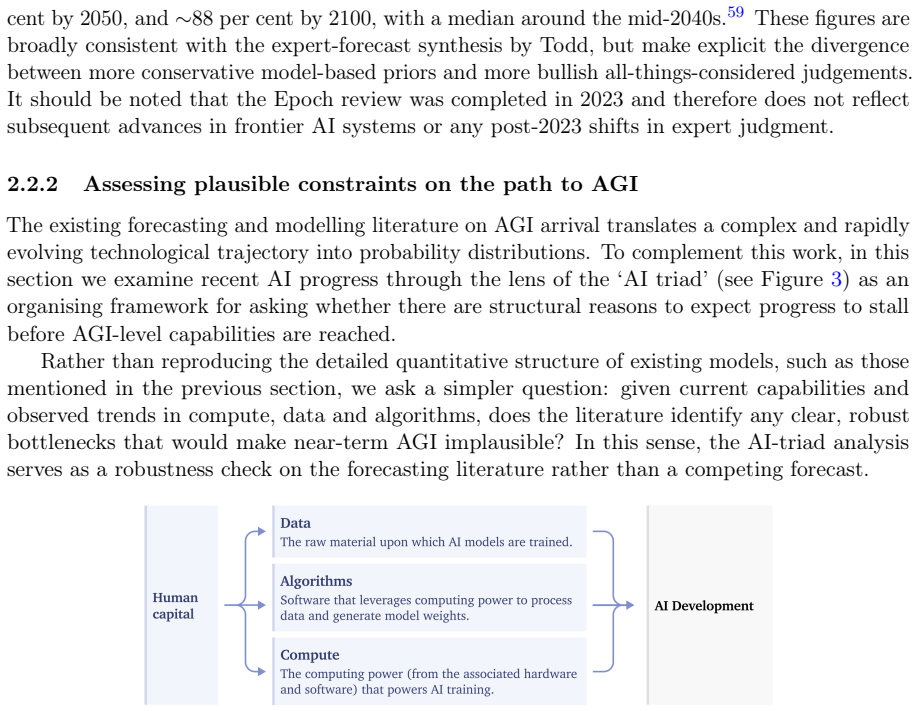
read point-by-point responses
-
Referee: The section assessing Europe's gaps (compute, talent, adoption) asserts these as 'critical' and primary drivers of relative position without quantitative benchmarking against US/China baselines or sensitivity analysis on the cited trends; this weakens the load-bearing link between the gaps and the call for a preparedness agenda.
Authors: We acknowledge the value of quantitative benchmarks to support the assessment of gaps. The analysis draws on existing empirical reports and trend data rather than new modeling. In revision, we will add specific comparative metrics from public sources (e.g., compute capacity figures and talent retention statistics) to benchmark against US and China baselines, and we will qualify the claims by noting the absence of formal sensitivity analysis given the paper's non-modeling nature. This will better link the gaps to the preparedness agenda. revision: yes
-
Referee: The 2030-2040 AGI window is derived from expert forecasting surveys and capability trends, but the text does not address variance across surveys, recent updates to forecasts, or error margins, leaving the central timeline assumption without robustness checks that would strengthen the geopolitical implications section.
Authors: We agree that discussing variance would improve robustness. The manuscript presents the window as plausible with noted uncertainty. In revision, we will add a concise discussion of forecast variance across surveys (including ranges from sources such as AI Impacts and Metaculus), reference recent updates, and note available error margins or confidence levels. These additions will support the geopolitical implications without changing the core timeline framing. revision: yes
Circularity Check
No significant circularity
full rationale
The paper is a policy synthesis that states a plausible AGI timeline (2030-2040) drawn from external empirical trends and expert surveys, then qualitatively discusses geopolitical implications and lists Europe's observable gaps in awareness, compute, talent, adoption, and coordination. No equations, fitted parameters, or derivations are present; recommendations follow directly from the listed gaps without reducing any claim to its own inputs by construction. No self-citation chains, uniqueness theorems, or ansatzes are invoked as load-bearing steps. The argument remains self-contained against external benchmarks.
Axiom & Free-Parameter Ledger
free parameters (1)
- AGI emergence window
axioms (1)
- domain assumption AGI systems will match or exceed humans at most economically useful cognitive work
Reference graph
Works this paper leans on
-
[1]
Abbott, John. 2025. ‘SoftBank, OpenAI, Oracle and MGX Commit to $100B for Stargate AI Infrastructure.’ S&P Global Market Intelligence. As of 3 December 2025:https: //www.spglobal.com/market-intelligence/en/news-insights/research/softbabnk- openai-oracle-and-mgx-commit-to-100b-for-stargate-ai-infrastructure 60
2025
-
[2]
Abecassis, Adrien, Jonathan Barry, Ima Bello, Yoshua Bengio, Antonin Bergeaud, Yann Bonnet, Philipp Hacker, et al. 2025. ‘A Blueprint for Multinational Advanced AI Develop- ment.’ As of 3 December 2025:https://aigi.ox.ac.uk/wp-content/uploads/2025/11/ A-Blueprint-for-Multinational-Advanced-AI-Development-1.pdf
2025
-
[3]
Abyazov, Emir. 2025. ‘China Spends $137.5 Billion for the AI Race.’ Coinpape, 27 January. As of 3 December 2025:https://coinpaper.com/7171/china-spends-137-5-billion- for-the-ai-race
2025
-
[4]
Acemoglu, Daron. 2024. ‘The Simple Macroeconomics of AI.’ Economic Policy 40(121): 13–58. doi: 10.1093/epolic/eiae042
-
[5]
Adamson, Georgia, & Gregory C. Allen. 2025. ‘Opportunities to Strengthen U.S. Biosecurity from AI- Enabled Bioterrorism: What Policymakers Should Know.’ Center for Strategic & International Studies. As of 3 December 2025: https://www.csis.org/analysis/opportunities-strengthen-us-biosecurity- ai-enabled-bioterrorism-what-policymakers-should
2025
-
[6]
Adamson, Georgia, Saif Khan, Tao Burga & Tim Fist. 2025. ‘Should the US Sell Blackwell Chips to China?’ IFP, 25 October. As of 3 December 2025:https://ifp.org/the-b30a- decision/
2025
-
[7]
The Economics of Trans- formative AI
Agrawal, Ajay K, Anton Korinek & Erik Brynjolfsson. 2025. “The Economics of Trans- formative AI.” NBER. As of 3 December 2025: https://www.nber.org/books-and- chapters/economics-transformative-ai
2025
-
[8]
Aguirre, Anthony. 2025. ‘Uncontained AGI Would Replace Humanity.’ AI Frontiers, 18 August. As of 3 December 2025:https://ai-frontiers.org/articles/uncontained- agi-would-replace-humanity
2025
-
[9]
AI Digest. 2025a. ‘I’m Gemini. I Sold T-Shirts. It Was Weirder than I Expected.’ AI Village, 28 July. As of 3 December 2025:https://theaidigest.org/village/blog/im-gemini- i-sold-t-shirts
2025
-
[10]
AI Digest. 2025b. ‘How Fast is AI Improving?’ As of 3 December 2025: https: //theaidigest.org/progress-and-dangers
2025
-
[11]
Allen, Gregory C., Georgia Adamson, Lennart Heim & Sam Winter-Levy. 2025. ‘The United Arab Emirates’ AI Ambitions.’ Center for Strategic & International Studies. As of 3 De- cember 2025: https://www.csis.org/analysis/united-arab-emirates-ai-ambitions
2025
-
[12]
Allen, Gregory C., & Isaac Goldston. 2025. ‘Understanding U.S. Allies’ Cur- rent Legal Authority to Implement AI and Semiconductor Export Con- trols.’ Center for Strategic & International Studies. As of 3 December 2025: https://www.csis.org/analysis/understanding-us-allies-current-legal- authority-implement-ai-and-semiconductor-export
2025
-
[13]
Altman, Sam. 2025. ‘Reflections.’ Blog post, 6 January. As of 3 December 2025:https: //blog.samaltman.com/reflections
2025
-
[14]
Amodei, Dario. 2024. ‘Machines of Loving Grace.’ As of 3 December 2025:https://www. darioamodei.com/essay/machines-of-loving-grace
2024
-
[15]
Anthropic. 2025a. ‘Agentic Misalignment: How LLMs Could Be Insider Threats.’ 20 June. As of 3 December 2025:https://www.anthropic.com/research/agentic-misalignment 61
2025
-
[16]
———. 2025b. ‘Project Vend: Can Claude Run a Small Shop? (and Why Does That Matter?).’ 27 June. As of 3 December 2025:https://www.anthropic.com/research/ project-vend-1
2025
-
[17]
Apollo Research. 2024. ‘We Need a ‘Science of Evals.’ 22 January. As of 3 December 2025: https://www.apolloresearch.ai/blog/we-need-a-science-of-evals
2024
-
[18]
———. 2025. ‘More Capable Models Are Better at In-Context Scheming.’ Apollo Research. 19 June. As of 3 December 2025:https://www.apolloresearch.ai/blog/more-capable- models-are-better-at-in-context-scheming
2025
-
[19]
Appel, Ruth, Peter Mccrory, Alex Tamkin, Miles Mccain, Tyler Neylon, Michael Stern, Alex Sanchez, et al. 2025. ‘The Anthropic Economic Index Report: Uneven Geographic and Enterprise AI Adoption.’ As of 3 December 2025:https://assets.anthropic.com/ m/218c82b858610fac/original/Economic-Index.pdf
2025
-
[20]
GDPRhub. 2025. ‘Article 5 GDPR.’ 7 November. As of 3 December 2025:https:// gdprhub.eu/Article_5_GDPR
2025
-
[21]
Artificial Analysis. 2025a. ‘Frontier Language Model Intelligence, Over Time.’ As of 3 December 2025: https://artificialanalysis.ai/#frontier-language-model- intelligence-over-time
2025
-
[22]
———. 2025b. ‘Magistral Medium 1 – Intelligence, Performance & Price Analysis.’ As of 3 December 2025:https://artificialanalysis.ai/models/magistral-medium
2025
-
[23]
———. 2025c. ‘State of AI: China. Highlights Report.’ As of 3 December 2025: https://artificialanalysis.ai/downloads/china-report/2025/Artificial- Analysis-State-of-AI-China-Q2-2025-Highlights.pdf
2025
-
[24]
Aschenbrenner, Leopold. 2024a. ‘II. From AGI to Superintelligence: The Intelligence Explosion.’ Situational Awareness, 29 May. As of 3 December 2025:https://situational- awareness.ai/from-agi-to-superintelligence/ RAND Europe
2025
-
[25]
———. 2024b. ‘IIId. The Free World Must Prevail.’ Situational Awareness, 29 May. As of 3 December 2025: https://situational-awareness.ai/the-free-world-must-prevail/
2025
-
[26]
ASML. 2025. ‘ASML, Mistral AI Enter Strategic Partnership.’ 9 September. As of 3 De- cember 2025: https://www.asml.com/en/news/press-releases/2025/asml-mistral- ai-enter-strategic-partnership
2025
-
[27]
Atkinson, David. 2023. ‘Direct Approach Interactive Model.’ Epoch AI, 31 May. As of 3 December 2025:https://epoch.ai/blog/direct-approach-interactive-model
2023
-
[28]
Barbier, Jérôme, Charles Martinet & Charbel-Raphaël Segerie. 2025. ‘Forging France’s Ex- pertise in AI Evaluation: INESIA’s Strategic Role.’ Centre Pour La Sécurité de L’IA. As of 3 December 2025: https://www.securite-ia.fr/en/publications/vers-une- expertise-francaise-en-evaluation-de-lia-le-role-strategique-de-linesia
2025
-
[29]
Baskaran, Gracelin, and Meredith Schwartz. 2025. ‘The Consequences of China’s New Rare Earths Export Restrictions.’ Center for Strategic & International Studies, 14 April. As of 3 December 2025: https://www.csis.org/analysis/consequences-chinas-new-rare- earths-export-restrictions 62
2025
-
[30]
Batur, Olga, & Roel Peeters. 2021. ‘European Union Data Challenge.’ European Par- liament. https://www.europarl.europa.eu/RegData/etudes/BRIE/2021/662939/IPOL_ BRI%282021%29662939_EN.pdf
2021
- [31]
-
[32]
Black, James, Mattias Eken, Jacob Parakilas, Stuart Dee, Conlan Ellis, Kiran Suman- Chauhan, Ryan Bain, et al. 2024. Strategic Competition in the Age of AI Emerging Risks and Opportunities from Military Use of Artificial Intelligence. Santa Monica, Calif.: RAND Corporation. RR-A3295-1. As of 3 December 2025:https://www.rand.org/pubs/ research_reports/RRA3...
2024
-
[33]
‘Taking AGI-Enabled Wonder Weapons Seriously, Not Literally.’ RAND Corporation
Blanchette, Nicholas, Joel Predd, Jim Mitre. ‘Taking AGI-Enabled Wonder Weapons Seriously, Not Literally.’ RAND Corporation. Unpublished manuscript
-
[34]
Jones, John Van Reenen & Michael Webb
Bloom, Nicholas, Charles I. Jones, John Van Reenen & Michael Webb. 2017. ‘Are Ideas Getting Harder to Find?’ National Bureau of Economic Research, Working Paper 23782. As of 3 December 2025:https://www.nber.org/papers/w23782
2017
-
[35]
Bondar, Kateryna. 2025. ‘Ukraine’s Future Vision and Current Capabilities for Waging AI-Enabled Autonomous Warfare.’ Center for Strategic & International Studies, 6 March. As of 3 December 2025: https://www.csis.org/analysis/ukraines-future-vision- and-current-capabilities-waging-ai-enabled-autonomous-warfare
2025
-
[36]
Bostrom, Nick. 2014. Superintelligence: Paths, Dangers, Strategies. Oxford: Oxford University Press
2014
-
[37]
Bown, Chad P. 2025. ‘US-China Trade War Tariffs: An Up-To-Date Chart.’ Peterson Institute for International Economics, 27 August. As of 3 December 2025:https://www. piie.com/research/piie-charts/2019/us-china-trade-war-tariffs-date-chart
2025
-
[38]
Bradford, Anu. 2019. The Brussels Effect: How the European Union Rules the World. Oxford: Oxford University Press. doi: 10.1093/oso/9780190088583.001.0001
-
[39]
Brown, Noam. 2025. ‘Scaling Test Time Compute to Multi-Agent Civilizations – Noam Brown, OpenAI.’ Latent Space, YouTube, 19 June. As of 3 December 2025:https: //www.youtube.com/watch?v=ddd4xjuJTyg
2025
-
[40]
Brown, Tom, Benjamin Mann, Nick Ryder, Melanie Subbiah, Jared Kaplan, Prafulla Dhariwal, Arvind Neelakantan, et al. 2020. ‘Language Models Are Few-Shot Learners.’ As of 3 December 2025:https://arxiv.org/pdf/2005.14165
work page internal anchor Pith review Pith/arXiv arXiv 2020
-
[41]
Buchanan, Ben. 2020. ‘The AI Triad and What It Means for National Security Strategy.’ Center for Security and Emerging Technology, August. As of 3 Decem- ber 2025: https://cset.georgetown.edu/publication/the-ai-triad-and-what-it- means-for-national-security-strategy/
2020
- [42]
-
[43]
Bulski, Krzysztof. 2025. ‘One Year after the Draghi Report: Europe Delivers Only 1 in 10 Promises.’ EU Insider. As of 3 December 2025:https://www.euinsider.eu/news/one- year-after-the-draghi-report-europe-delivers-only-1-in-10-promises 63
2025
-
[44]
Burdette, Zachary, & Hiwot Demelash. 2025a. ‘Will the Race for Advanced AI Cause Geopolitical Instability?’ Substack.com, Geopolitics of AGI, 10 July. As of 3 December 2025: https://geopoliticsagi.substack.com/p/will-the-race-for-advanced-ai-cause
2025
-
[45]
———. 2025b. Evaluating the Risks of Preventive Attack in the Race for Advanced AI. Santa Monica, Calif.: RAND Corporation. PE-A3691-13. As of 3 December 2025: https://www.rand.org/pubs/perspectives/PEA3691-13.html
2025
-
[46]
Heim, Edward Geist, David R
Burdette, Zachary, Dwight Phillips, Jacob L. Heim, Edward Geist, David R. Frelinger, Chad Heitzenrater & Karl P. Mueller. 2025. An AI Revolution in Military Affairs? How Artificial Intelligence Could Reshape Future Warfare. Santa Monica, Calif.: RAND Corporation. WR- A4004-1. As of 3 December 2025:https://www.rand.org/pubs/working_papers/ WRA4004-1.html
2025
-
[47]
Bureau of Industry & Security. 2025. ‘Department of Commerce Announces Rescission of Biden-Era Artificial Intelligence Diffusion Rule, Strengthens Chip- Related Export Controls.’ Bureau of Industry and Security. As of 3 Decem- ber 2025: https://www.bis.gov/press-release/department-commerce-announces- rescission-biden-era-artificial-intelligence-diffusion-...
2025
-
[48]
Capoot, Ashley. 2025. ‘Anthropic, Google, OpenAI and XAI Granted up to $200 Million for AI Work from Defense Department.’ CNBC, 14 July. As of 3 December 2025: https://www.cnbc.com/2025/07/14/anthropic-google-openai-xai-granted- up-to-200-million-from-dod.html RAND Europe
2025
-
[49]
Capoot, Ashley, & Kate Rooney. 2025. ‘OpenAI Hits $10 Billion in Annual Re- curring Revenue Fueled by ChatGPT Growth.’ CNBC, 9 June. As of 3 December 2025: https://www.cnbc.com/2025/06/09/openai-hits-10-billion-in-annualized- revenue-fueled-by-chatgpt-growth.html
2025
-
[50]
As of 3 December 2025:https://www.csis.org/analysis/eu-ai-continent- action-plan
Caroli, Laura.2025.‘TheEUAIContinentActionPlan.’CenterforStrategic&International Studies. As of 3 December 2025:https://www.csis.org/analysis/eu-ai-continent- action-plan
2025
-
[51]
Caulcutt, Clea, & Camille Gijs. 2025. ‘Macron Wants EU to Target US Big Tech after New Trump Tariff Threat.’ Politico, 28 August. As of 3 December 2025: https://www.politico.eu/article/emmanuel-macron-floats-coming-after- us-big-tech-response-donald-trump-threats-tariffs/
2025
-
[52]
Census Bureau, United States. 2025. ‘Business Trends and Outlook Survey.’ United States Census Bureau, 20 November. As of 3 December 2025:https://www.census.gov/hfp/ btos/data_downloads
2025
-
[53]
Chan, Jun Shern, Neil Chowdhury, Oliver Jaffe, James Aung, Dane Sherburn, Evan Mays, Giulio Starace, et al. 2024. ‘MLE-Bench: Evaluating Machine Learning Agents on Machine Learning Engineering.’ As of 3 December 2025:https://arxiv.org/abs/2410.07095
work page Pith review arXiv 2024
-
[54]
Chan, Kyle, Gregory Smith, Jimmy Goodrich, Gerard DiPippo & Konstantin F. Pilz. 2025. Full Stack: China’s Evolving Industrial Policy for AI. Santa Monica, Calif.: RAND Corpora- tion. PE-A4012- 1. As of 3 December 2025:https://www.rand.org/pubs/perspectives/ PEA4012-1.html
2025
-
[55]
The ‘East Data West Computation’ Project Is Progressing Steadily
Mu Miao. 2024. “The ‘East Data West Computation’ Project Is Progressing Steadily.” As of 3 December 2025:https://www.gov.cn/yaowen/liebiao/202404/content_6945169.htm 64
2024
-
[56]
Most Complicated Machine
Clark, Don. 2021. ‘The Tech Cold War’s “Most Complicated Machine” That’s out of China’s Reach.’ New York Times, 4 July. As of 3 December 2025:https://www.nytimes.com/ 2021/07/04/technology/tech-cold-war-chips.html
2021
-
[57]
Very Close
CNBC Television. 2025. ‘Anthropic CEO: More Confident than Ever That We’re “Very Close” to Powerful AI Capabilities.’ YouTube, 21 January. As of 3 December 2025:https: //www.youtube.com/watch?v=7LNyUbii0zw
2025
-
[58]
Cornish, Chloe, & Michael Acton. 2025. ‘OpenAI to Join US-UAE Plan to Build Vast Data Centre in Abu Dhabi.’ Financial Times, 16 May. As of 3 December 2025:https: //www.ft.com/content/4708c7a6-a26f-45a9-9a4f-25a9af4167df
2025
-
[59]
Cotra, Ajeya. 2020. ‘Draft Report on AI Timelines.’ Lesswrong, 19 September. As of 3 De- cember 2025: https://www.lesswrong.com/posts/KrJfoZzpSDpnrv9va/draft-report- on-ai-timelines
2020
-
[60]
Cottier, Ben. 2024. ‘How Much Does It Cost to Train Frontier AI Models?’ Epoch AI, 3 June. As of 3 December 2025:https://epoch.ai/blog/how-much-does-it-cost-to- train-frontier-ai-models
2024
-
[61]
———. 2025. ‘LLM Inference Prices Have Fallen Rapidly but Unequally across Tasks.’ Epoch AI. As of 3 December 2025:https://epoch.ai/data-insights/llm-inference- price-trends
2025
-
[62]
D’Souza, Joseph. 2025. ‘Mistral AI Statistics by Revenue and Facts (2025).’ Electro IQ, 9 May. As of 3 December 2025:https://electroiq.com/stats/mistral-ai-statistics/
2025
-
[63]
Damro, Chad. 2012. ‘Market Power Europe.’ Journal of European Public Policy 19(5): 682–99. As of 3 December 2025:https://www.pure.ed.ac.uk/ws/portalfiles/portal/ 10091990/DAMRO_2012_Market_power_Europe.pdf
2012
-
[64]
Dave, Paresh. 2024. ‘How Scrappy Cryptominer CoreWeave Transformed into the Multibillion-Dollar Backbone of the AI Boom.’ Wired, 3 May. As of 3 December 2025: https://www.wired.com/story/coreweave-scrappy-cryptominer- multibillion-dollar-ai/
2024
-
[65]
Davidson, Tom. 2025. ‘What a Compute-Centric Framework Says about Takeoff Speeds.’ Coefficient Giving, 18 November. As of 3 December 2025:https://coefficientgiving. org/research/what-a-compute-centric-framework-says-about-takeoff-speeds/
2025
-
[66]
Davidson, Tom, & Tom Houlden. 2025. ‘How Quick and Big Would a Software Intelligence Explosion Be?’ Forethought, 4 August. As of3 December 2025:https://www.forethought. org/research/how-quick-and-big-would-a-software-intelligence-explosion-be
2025
-
[67]
Davidson, Tom, Lukas Finnveden & Rose Hadshar. 2025. ‘AI-Enabled Coups: How a Small Group Could Use AI to Seize Power.’ Forethought, 15 April. As of 3 Decem- ber 2025: https://www.forethought.org/research/ai-enabled-coups-how-a-small- group-could-use-ai-to-seize-power
2025
-
[68]
Dealroom. 2025. ‘Opening Moves in Global AI AI, Startups & Venture Capital.’ As of 3 December 2025: https://dealroom.co/uploaded/2025/02/Dealroom-AI-Summit- 2025.pdf?x63517
2025
-
[69]
Delaney, Oscar. 2025. ‘Managing Risks from Internal AI Systems.’ Institute for AI Policy and Strategy, 21 July. As of 3 December 2025:https://www.iaps.ai/research/managing- risks-from-internal-ai-systems 65
2025
-
[70]
Dell’Acqua, Fabrizio, Saran Rajendran, Edward McFowland III, Lisa Krayer, Ethan Mollick, François Candelon, Hila Lifshitz-Assaf, Karim Lakhani & Katherine Kellogg
-
[71]
‘Navigating the Jagged Technological Frontier: Field Experimental Evidence of the Effects of AI on Knowledge Worker Productivity and Quality.’ As of 3 December 2025: https://www.hbs.edu/ris/Publication%20Files/24-013_d9b45b68-9e74-42d6- a1c6-c72fb70c7282.pdf
2025
-
[72]
Denain, Jean-Stanislas. 2025a. ‘The Huge Potential Implications of Long-Context Inference.’ Epoch AI, 19 September. As of 3 December 2025:https://epoch.ai/gradient-updates/ the-huge-potential-implications-of-long-context-inference
2025
-
[73]
How Many Digital Workers Could OpenAI Deploy?
Denain, Jean-Stanislas, Anson Ho, & Jaime Sevilla. 2025. “How Many Digital Workers Could OpenAI Deploy?” Epoch AI, 3 October. As of 3 December 2025:https://epoch. ai/gradient-updates/how-many-digital-workers-could-openai-deploy
2025
-
[74]
Desai, Dev, Shiv Kantliwala, Jyothi Vybhavi, Renju Ravi, Harshkumar Patel & Jitendra Patel. 2024. ‘Review of AlphaFold 3: Transformative Advances in Drug Design and Therapeutics.’ Cureus 16(7). doi: 10.7759/cureus.63646 RAND Europe
-
[75]
Ding, Jeffrey. 2024. Technology and the Rise of Great Powers. Princeton University Press
2024
-
[76]
———. 2025. Running the Right Artificial Intelligence Race: A National Strategy for AI Diffusion. Santa Monica, Calif.: RAND Corporation. PE-A4165-1. As of 3 December 2025: https://www.rand.org/pubs/perspectives/PEA4165-1.html
2025
-
[77]
Draghi, Mario. 2024. ‘The Draghi Report on EU Competitiveness.’ European Commis- sion, September. As of 3 December 2025:https://commission.europa.eu/topics/eu- competitiveness/draghi-report_en
2024
-
[78]
Dubey, Abhimanyu, Abhinav Jauhri, Abhinav Pandey, Abhishek Kadian, Ahmad Al-Dahle, Aiesha Letman, Akhil Mathur, et al. 2024. ‘The Llama 3 Herd of Models.’ As of 3 December 2025:https://arxiv.org/abs/2407.21783
work page internal anchor Pith review Pith/arXiv arXiv 2024
-
[79]
Econovis. 2025. ‘U.S. Trade.’ As of 3 December 2025:https://www.econovis.net/blog/ categories/united-states-trade
2025
-
[80]
Edelman, Yafah. 2025. ‘Compute Scaling Will Slow down due to Increasing Lead Times.’ Epoch AI, 5 September. As of 3 December 2025:https://epoch.ai/gradient-updates/ compute-scaling-will-slow-down-due-to-increasing-lead-times
2025
discussion (0)
Sign in with ORCID, Apple, or X to comment. Anyone can read and Pith papers without signing in.