Tracing the sulfur depletion in starless and pre-stellar cores
Pith reviewed 2026-05-14 18:04 UTC · model grok-4.3
The pith
Sulfur-bearing molecule abundances in starless cores vary due to local environmental conditions rather than a uniform evolutionary path.
A machine-rendered reading of the paper's core claim, the machinery that carries it, and where it could break.
Core claim
The central claim is that the variations in abundances across the cores and the lack of consistent correlations with evolutionary tracers imply that no single parameter can describe sulfur chemistry, and that local environmental conditions strongly influence the observed abundances of sulfur-bearing molecules.
What carries the argument
Comparison of observed abundances and ratios (such as CCS/34SO and C34S/34SO) to evolutionary tracers (H2 column density, N2D+/N2H+, CO depletion factor) and 0D chemical models with varying initial sulfur abundances.
If this is right
- Ratios tracing carbon- and oxygen-bearing species decrease with increasing H2 column density and N2D+/N2H+ ratio.
- 0D models reproduce OCS, H2CS, and HDCS reasonably well but fail to match all species simultaneously, especially between carbon- and oxygen-bearing molecules.
- Reproducing the full sample requires improved chemical networks and models that account for the core's physical structure.
- Local environmental conditions must be considered to explain differences such as low abundances in L1517B versus enhanced oxygen-bearing species in L1495B.
Where Pith is reading between the lines
- Observations in cores from other molecular clouds could test whether environmental influences on sulfur chemistry are universal.
- Incorporating 3D physical structures into chemical models might resolve discrepancies between carbon- and oxygen-bearing species.
- Filamentary environments may systematically enhance certain oxygen-bearing sulfur species, suggesting targeted follow-up in similar regions.
- Sulfur depletion mechanisms likely operate differently on small scales within the same cloud, affecting interpretations of total sulfur budgets.
Load-bearing premise
The chosen evolutionary tracers adequately capture the chemical history of the cores and that 0D models with adjusted initial sulfur abundances can represent the cores' physical structure and time evolution.
What would settle it
A larger sample of cores showing consistent correlations between abundances of all sulfur species and one single evolutionary tracer such as the CO depletion factor.
Figures


read the original abstract
Sulfur is one of the most abundant elements in the Universe, yet the sulfur budget inferred from the observed sulfur-bearing molecules in dense cores is significantly lower than expected. Starless and pre-stellar cores represent the earliest stages of star formation and provide a laboratory for studying the physical and chemical processes that cause sulfur depletion. We aim to constrain sulfur chemistry in dense cores by measuring abundances of sulfur-bearing molecules and how they reflect core evolution and environmental effects. We observed nine cores in the Taurus Molecular Cloud, targeting 13 sulfur-bearing molecules, including CS, CCS, C$_3$S, OCS, SO, SO$_2$, H$_2$CS, and isotopologs. Molecular abundances and six abundance ratios were compared to three evolutionary tracers: H$_2$ column density, N$_2$D$^+$/N$_2$H$^+$, and the CO depletion factor. We also compared observations with 0D chemical models with different initial sulfur abundances. We find variations in abundances across cores. L1517B exhibits low abundances and a high depletion factor, whereas L1495B shows enhanced levels in oxygen-bearing species within the L1495 filament. Ratios tracing carbon- and oxygen-bearing species (CCS/$^{34}$SO and C$^{34}$S/$^{34}$SO) decrease with increasing H$_2$ column density and N$_2$D$^+$/N$_2$H$^+$ ratio. Other species and ratios show weak or no correlation with tracers. Models reproduce OCS, H$_2$CS, and HDCS reasonably well, but not all species simultaneously, especially between carbon- and oxygen-bearing molecules. The variations and lack of consistent correlations suggest that a single evolutionary parameter cannot describe sulfur chemistry and that the local environmental conditions strongly influence the observed abundances. Reproducing the full sample of sulfur-bearing molecules would require improved chemical networks and models that account for the core's physical structure.
Editorial analysis
A structured set of objections, weighed in public.
Axiom & Free-Parameter Ledger
free parameters (1)
- initial sulfur abundance
axioms (1)
- domain assumption 0D chemical model assumptions hold for the cores
Reference graph
Works this paper leans on
-
[1]
2014, in Protostars and Planets VI, ed
André, P., Di Francesco, J., Ward-Thompson, D., et al. 2014, in Protostars and Planets VI, ed. H. Beuther, R. S. Klessen, C. P. Dullemond, & T. Henning, 27–51
work page 2014
- [2]
- [3]
-
[4]
Beers, Y ., Klein, G. P., Kirchhoff, W. H., & Johnson, D. R. 1972, J. Mol. Spec- trosc., 44, 553
work page 1972
-
[5]
Bogey, M., Demuynck, C., & Destombes, J. L. 1982, J. Mol. Spectrosc., 95, 35
work page 1982
-
[6]
Byrne, A. N., Shingledecker, C. N., Bergin, E. A., et al. 2026, ApJ, 998, 95
work page 2026
- [7]
-
[8]
M., Tafalla, M., Dore, L., & Myers, P
Caselli, P., Walmsley, C. M., Tafalla, M., Dore, L., & Myers, P. C. 1999, ApJ, 523, L165
work page 1999
- [9]
-
[10]
Ceccarelli, C., Dominik, C., López-Sepulcre, A., et al. 2014, ApJ, 790, L1
work page 2014
-
[11]
Chantzos, J., Spezzano, S., Caselli, P., et al. 2018, ApJ, 863, 126
work page 2018
-
[12]
Clark, W. W. & De Lucia, F. C. 1976, J. Mol. Spectrosc., 60, 332
work page 1976
-
[13]
Cleeves, L. I., Bergin, E. A., Alexander, C. M. O. D., et al. 2014, Sci., 345, 1590
work page 2014
-
[14]
Codella, C., Bianchi, E., Podio, L., et al. 2025, A&A, 696, A219
work page 2025
- [15]
- [16]
-
[17]
Drozdovskaya, M. N., Schroeder I, I. R. H. G., Rubin, M., et al. 2021, MNRAS, 500, 4901
work page 2021
-
[18]
Dubrulle, A., Demaison, J., Burie, J., & Boucher, D. 1980, Z. Naturforsch. A, 35, 471
work page 1980
-
[19]
Dutrey, A., Chapillon, E., Guilloteau, S., et al. 2024, A&A, 689, L7
work page 2024
-
[20]
Emprechtinger, M., Caselli, P., V olgenau, N. H., Stutzki, J., & Wiedner, M. C. 2009, A&A, 493, 89
work page 2009
-
[21]
B., Tercero, B., Cernicharo, J., et al
Esplugues, G. B., Tercero, B., Cernicharo, J., et al. 2013, A&A, 556, A143
work page 2013
-
[22]
Evans, II, N. J., Dunham, M. M., Jørgensen, J. K., et al. 2009, ApJS, 181, 321
work page 2009
- [23]
- [24]
-
[25]
Fuente, A., Rivière-Marichalar, P., Beitia-Antero, L., et al. 2023, A&A, 670, A114
work page 2023
-
[26]
Galli, P. A. B., Loinard, L., Bouy, H., et al. 2019, A&A, 630, A137
work page 2019
-
[27]
Goldsmith, P. F. & Langer, W. D. 1999, ApJ, 517, 209 Güdel, M., Briggs, K. R., Arzner, K., et al. 2007, A&A, 468, 353
work page 1999
- [28]
-
[29]
Hacar, A., Tafalla, M., Kauffmann, J., & Kovács, A. 2013, A&A, 554, A55
work page 2013
-
[30]
Hatchell, J., Thompson, M. A., Millar, T. J., & MacDonald, G. H. 1998, A&A, 338, 713
work page 1998
- [31]
-
[32]
Hily-Blant, P., Pineau des Forêts, G., Faure, A., & Lique, F. 2022, A&A, 658, A168
work page 2022
- [33]
-
[34]
S., Spezzano, S., Caselli, P., Grassi, T., & Haugbølle, T
Jensen, S. S., Spezzano, S., Caselli, P., Grassi, T., & Haugbølle, T. 2023, A&A, 675, A34 Jiménez-Serra, I., Vasyunin, A. I., Caselli, P., et al. 2016, ApJ, 830, L6
work page 2023
- [35]
-
[36]
Laas, J. C. & Caselli, P. 2019, A&A, 624, A108
work page 2019
- [37]
- [38]
- [39]
-
[40]
Lovas, F. J. 1985, J. Phys. Chem. Ref. Data, 14, 395
work page 1985
-
[41]
Mangum, J. G. & Shirley, Y . L. 2015, PASP, 127, 266 Margulès, L., Lewen, F., Winnewisser, G., Botschwina, P., & Müller, H. S. P. 2003, Phys. Chem. Chem. Phys., 5, 2770 Martín-Doménech, R., Jiménez-Serra, I., Muñoz Caro, G. M., et al. 2016, A&A, 585, A112
work page 2015
-
[42]
Milam, S. N., Savage, C., Brewster, M. A., Ziurys, L. M., & Wyckoff, S. 2005, ApJ, 634, 1126
work page 2005
-
[43]
Minowa, H., Satake, M., Hirota, T., et al. 1997, ApJ, 491, L63 Müller, H. S. P., Thorwirth, S., Roth, D. A., & Winnewisser, G. 2001, A&A, 370, L49
work page 1997
-
[44]
Myers, P. C. 2009, ApJ, 700, 1609
work page 2009
-
[45]
Nagy, Z., Spezzano, S., Caselli, P., et al. 2019, A&A, 630, A136
work page 2019
-
[46]
Penzias, A. A. 1981, ApJ, 249, 518
work page 1981
-
[47]
2005, in SF2A-2005: Semaine de l’Astrophysique Francaise, ed
Pety, J. 2005, in SF2A-2005: Semaine de l’Astrophysique Francaise, ed. F. Ca- soli, T. Contini, J.-M. Hameury, & L. Pagani, 72
work page 2005
-
[48]
Pickett, H. M., Poynter, R. L., Cohen, E. A., et al. 1998, J. Quant. Spectrosc. Radiat. Transf., 60, 883
work page 1998
-
[49]
Poch, O., Istiqomah, I., Quirico, E., et al. 2020, Sci., 367, aaw7462
work page 2020
-
[50]
Priestley, F. D., Clark, P. C., Glover, S. C. O., et al. 2023, MNRAS, 524, 5971
work page 2023
-
[51]
Priestley, F. D., Clark, P. C., Glover, S. C. O., et al. 2024, MNRAS, 531, 4408
work page 2024
-
[52]
Rebull, L. M., Padgett, D. L., McCabe, C.-E., et al. 2010, ApJS, 186, 259
work page 2010
-
[53]
Ruffle, D. P., Hartquist, T. W., Caselli, P., & Williams, D. A. 1999, MNRAS, 306, 691
work page 1999
-
[54]
1987, ApJ, 317, L115 Schöier, F
Saito, S., Kawaguchi, K., Yamamoto, S., et al. 1987, ApJ, 317, L115 Schöier, F. L., van der Tak, F. F. S., van Dishoeck, E. F., & Black, J. H. 2005, A&A, 432, 369
work page 1987
-
[55]
Scibelli, S., Drozdovskaya, M. N., Caselli, P., et al. 2025, A&A, 702, A127
work page 2025
-
[56]
Scibelli, S., Shirley, Y ., Vasyunin, A., & Launhardt, R. 2021, MNRAS, 504, 5754
work page 2021
-
[57]
Shingledecker, C. N., Lamberts, T., Laas, J. C., et al. 2020, ApJ, 888, 52 Sipilä, O., Caselli, P., & Harju, J. 2015, A&A, 578, A55 Sipilä, O., Caselli, P., & Harju, J. 2019, A&A, 631, A63
work page 2020
-
[58]
Slavicinska, K., Boogert, A. C. A., Tychoniec, Ł., et al. 2025, A&A, 693, A146
work page 2025
-
[59]
Spezzano, S., Caselli, P., Bizzocchi, L., Giuliano, B. M., & Lattanzi, V . 2017, A&A, 606, A82 Stäuber, P., Doty, S. D., van Dishoeck, E. F., & Benz, A. O. 2005, A&A, 440, 949
work page 2017
- [60]
-
[61]
Tafalla, M., Myers, P. C., Caselli, P., Walmsley, C. M., & Comito, C. 2002, ApJ, 569, 815
work page 2002
- [62]
-
[63]
Tieftrunk, A., Pineau des Forets, G., Schilke, P., & Walmsley, C. M. 1994, A&A, 289, 579
work page 1994
-
[64]
Tiemann, E. 1974, J. Phys. Chem. Ref. Data, 3, 259 van Gelder, M. L., Tabone, B., Tychoniec, Ł., et al. 2020, A&A, 639, A87
work page 1974
-
[65]
Vastel, C., Quénard, D., Le Gal, R., et al. 2018, MNRAS, 478, 5514
work page 2018
-
[66]
Wakelam, V ., Caselli, P., Ceccarelli, C., Herbst, E., & Castets, A. 2004, A&A, 422, 159
work page 2004
- [67]
-
[68]
Ward-Thompson, D., Motte, F., & Andre, P. 1999, MNRAS, 305, 143
work page 1999
- [69]
-
[70]
Wilson, T. L. & Rood, R. 1994, ARA&A, 32, 191
work page 1994
-
[71]
M., Occhiogrosso, A., Viti, S., et al
Woods, P. M., Occhiogrosso, A., Viti, S., et al. 2015, MNRAS, 450, 1256
work page 2015
-
[72]
Yamamoto, S., Saito, S., Kawaguchi, K., et al. 1987, ApJ, 317, L119
work page 1987
-
[73]
E., Yang, Y .-l., Zhang, Y ., et al
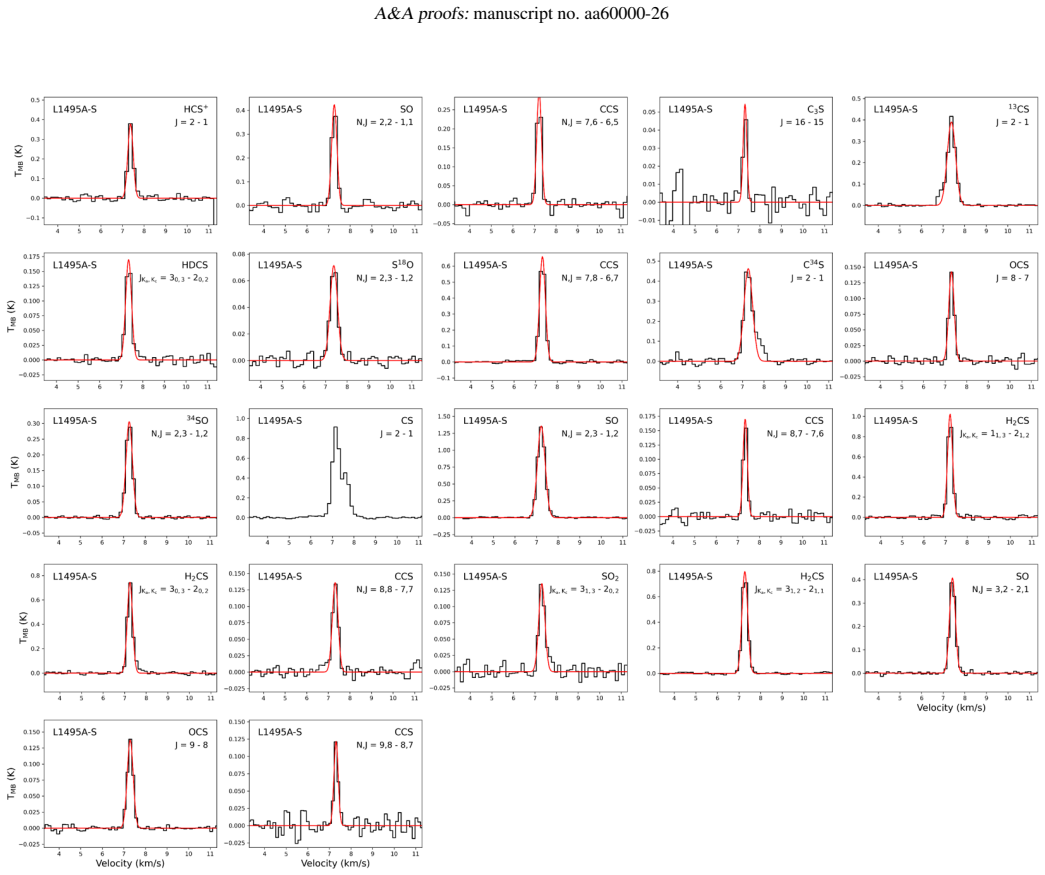
Zhang, Z. E., Yang, Y .-l., Zhang, Y ., et al. 2023, ApJ, 946, 113 Article number, page 15 of 21 A&A proofs:manuscript no. aa60000-26 Appendix A: Plots of observed spectra Figures A.1 - A.8 show the observed spectra of all sulfur-bearing molecules including a Gaussian Fit toward all sources in the sample. Fig. A.1: Same as Figure 1 but for the starless co...
work page 2023
discussion (0)
Sign in with ORCID, Apple, or X to comment. Anyone can read and Pith papers without signing in.