Recognition: unknown
Improving ecological inference and uncertainty quantification from camera trap data through the fusion of AI confidences and manual annotations
Pith reviewed 2026-05-14 17:51 UTC · model grok-4.3
The pith
A Bayesian hierarchical model fuses AI predictions with human annotations to improve ecological inferences from camera trap images.
A machine-rendered reading of the paper's core claim, the machinery that carries it, and where it could break.
Core claim
The authors introduce a Bayesian hierarchical data-fusion model in which AI confidence scores and manual annotations are treated as independent observations of an unobserved latent variable representing the true ecological state, such as an animal's body condition. This structure allows joint estimation of the latent states and their relationships to covariates like sex, reproductive status, and habitat type while propagating uncertainty from both data sources.
What carries the argument
Bayesian hierarchical data-fusion model treating AI confidences and manual annotations as conditionally independent observations of a latent ecological state.
If this is right
- Uncertainty quantification is available for all inferences and predictions.
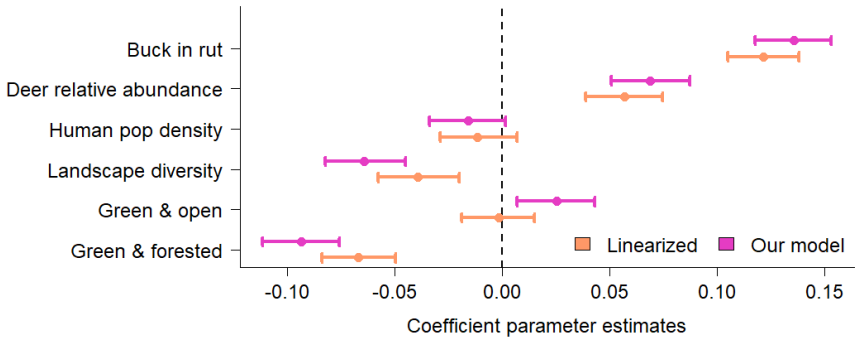
- Novel findings emerge on how rut status and habitat affect deer body condition.
- The model shows improved inference power over using only one data source.
- Results can be generalized to other ecological monitoring applications with mixed AI and human data.
Where Pith is reading between the lines
- Ecologists could use more AI-labeled data with reduced human effort while maintaining reliable uncertainty estimates.
- Extensions to multi-species or time-series data could further enhance monitoring efficiency.
- Validation against independent field measurements would test the practical gains in accuracy.
Load-bearing premise
AI confidence scores and manual annotations are conditionally independent observations of the latent state with no shared systematic biases.
What would settle it
If a dataset is constructed where AI and human annotations share correlated errors, the model's inferences would deviate from the true values in a way detectable by comparison to known ground truth.
Figures



read the original abstract
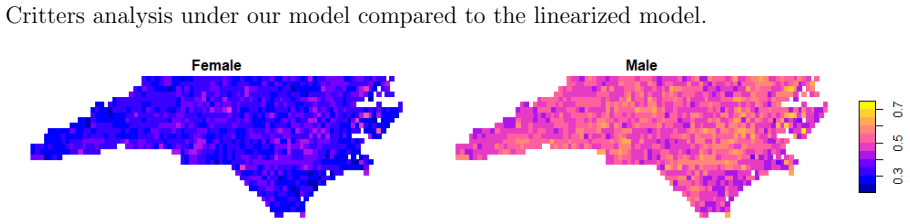
Camera traps have become a core tool in ecological research, enabling large-scale, noninvasive monitoring of wildlife populations and behavior. By automatically recording animals as they pass within view, these devices generate massive image datasets with minimal field effort. Yet this data richness introduces a new bottleneck when translating the images into usable information due to time and effort required for human annotation. Recently, artificial intelligent (AI) has been integrated into the workflow to improve this efficiency. However, the data procured from AI approaches are of a different nature, necessitating new statistical methods in order to obtain inference, make predictions, and quantify uncertainty. We propose a new Bayesian hierarchical data-fusion model which combines the strengths of human annotations and AI predictions. The benefits of our approach are an ability to provide uncertainty quantification as well as improved inference and prediction power, which we demonstrate using a simulation study. We apply our model to an AI analysis of the body condition of white-tailed deer (Odocoileus virginianus) from camera trap images from North Carolina to study the relationship between health and their environment. We find that bucks in rut have higher body condition than other deer and that green, open habitats are correlated with high body condition. Our new model derived novel ecological inference compared to a traditional approach using the same data.
Editorial analysis
A structured set of objections, weighed in public.
Referee Report
Summary. The paper proposes a Bayesian hierarchical data-fusion model that integrates AI confidence scores with manual annotations from camera-trap images as conditionally independent noisy observations of a latent ecological state (body condition). It demonstrates improved uncertainty quantification and prediction via simulation, then applies the model to white-tailed deer data from North Carolina, concluding that bucks in rut exhibit higher body condition and that green, open habitats correlate with higher body condition, yielding novel inferences relative to a traditional analysis of the same data.
Significance. If the conditional-independence assumption holds without covariate-dependent bias, the framework would offer a practical advance for scaling ecological inference from large camera-trap datasets by rigorously propagating uncertainty from both human and AI sources. The real-data findings on rut status and habitat associations would then constitute substantive new ecological insight.
major comments (3)
- [Methods] Methods (model specification): The hierarchical structure treats AI confidences and manual annotations as conditionally independent given the latent body-condition variable, with separate likelihoods but shared regression on rut status and habitat. No diagnostic is reported for residual correlation between AI error and these covariates; if such correlation exists (e.g., due to training-data imbalance or image quality), the posterior for the ecological coefficients will be biased even if the simulation recovers parameters under idealized noise.
- [Simulation study] Simulation study: The reported recovery of parameters occurs only under idealized noise; the study does not include a scenario in which AI confidence is systematically shifted by rut status or habitat type. Because the real-data claims rest on the regression coefficients for exactly these variables, the simulation does not test the load-bearing assumption.
- [Real-data application] Real-data results: The abstract states that the fused model 'derived novel ecological inference' compared with a traditional approach, yet no quantitative comparison (difference in posterior means, credible-interval overlap, or predictive scores) is supplied to substantiate the improvement or to show that the new inferences are not artifacts of the independence assumption.
minor comments (1)
- [Abstract] Abstract: Key model equations, prior specifications, and validation metrics are omitted, making it impossible to evaluate the central claim from the abstract alone.
Simulated Author's Rebuttal
We thank the referee for their constructive comments, which highlight important assumptions and validation needs in our Bayesian data-fusion model. We address each major comment below and will revise the manuscript to incorporate the suggested improvements.
read point-by-point responses
-
Referee: [Methods] Methods (model specification): The hierarchical structure treats AI confidences and manual annotations as conditionally independent given the latent body-condition variable, with separate likelihoods but shared regression on rut status and habitat. No diagnostic is reported for residual correlation between AI error and these covariates; if such correlation exists (e.g., due to training-data imbalance or image quality), the posterior for the ecological coefficients will be biased even if the simulation recovers parameters under idealized noise.
Authors: We agree that verifying the conditional independence assumption is essential, as covariate-dependent bias in AI errors could affect the ecological regression coefficients. In the revised manuscript, we will add a diagnostic section that examines AI prediction residuals plotted against rut status and habitat type, along with a sensitivity analysis introducing covariate-dependent noise to assess potential bias in the posteriors. revision: yes
-
Referee: [Simulation study] Simulation study: The reported recovery of parameters occurs only under idealized noise; the study does not include a scenario in which AI confidence is systematically shifted by rut status or habitat type. Because the real-data claims rest on the regression coefficients for exactly these variables, the simulation does not test the load-bearing assumption.
Authors: The referee is correct that the current simulation assumes idealized noise without covariate-dependent shifts. We will expand the simulation study to include additional scenarios where AI confidence scores are systematically biased according to rut status and habitat type. These new simulations will evaluate parameter recovery and uncertainty quantification under realistic misspecification, directly testing the robustness of inferences for the key ecological covariates. revision: yes
-
Referee: [Real-data application] Real-data results: The abstract states that the fused model 'derived novel ecological inference' compared with a traditional approach, yet no quantitative comparison (difference in posterior means, credible-interval overlap, or predictive scores) is supplied to substantiate the improvement or to show that the new inferences are not artifacts of the independence assumption.
Authors: We acknowledge that the abstract's claim of novel inferences would be strengthened by explicit quantitative comparisons. In the revision, we will add a dedicated comparison subsection reporting differences in posterior means and credible-interval overlap for the regression coefficients on rut status and habitat, as well as predictive performance metrics (e.g., log predictive density and cross-validated scores) between the fused model and the traditional analysis. This will substantiate the improvements and address concerns regarding the independence assumption. revision: yes
Circularity Check
No circularity: model derivation and inferences are self-contained
full rationale
The paper introduces a new Bayesian hierarchical data-fusion model treating AI confidences and manual annotations as conditionally independent noisy observations of a latent body-condition state, with shared ecological regression on covariates such as rut status and habitat type. The reported inferences (bucks in rut having higher body condition; green open habitats correlated with high body condition) are obtained by posterior estimation on real camera-trap data and are explicitly contrasted with results from a traditional non-fusion approach on the same data. No equations reduce a claimed prediction to a fitted quantity by construction, no self-citations are invoked to justify uniqueness or core modeling choices, and the simulation study is used only for validation under controlled conditions rather than to generate the ecological conclusions. The derivation chain therefore contains independent statistical content and does not collapse to its inputs.
Axiom & Free-Parameter Ledger
free parameters (1)
- hyperparameters of the hierarchical priors
axioms (1)
- domain assumption AI confidence scores and manual annotations are conditionally independent given the latent ecological state
Reference graph
Works this paper leans on
-
[1]
Steen-Adams , title =
Xiaoping Feng and Jun Zhu and Pei-Sheng Lin and Michelle M. Steen-Adams , title =. Environmental and Ecological Statistics , year =
-
[2]
Journal of the American statistical Association , volume=
Bayesian analysis of binary and polychotomous response data , author=. Journal of the American statistical Association , volume=. 1993 , publisher=
1993
-
[3]
Journal of the Royal Statistical Society: Series B (Methodological) , author =
John Aitchison , title =. Journal of the Royal Statistical Society: Series B (Methodological) , year =. doi:https://doi.org/10.1111/j.2517-6161.1982.tb01195.x , url =
-
[4]
Tilmann Gneiting and Adrian E. Raftery , title =. Journal of the American Statistical Association , volume =. 2007 , publisher =. doi:10.1198/016214506000001437 , URL =
-
[5]
Performance Metrics for Probabilistic Ordinal Classifiers , booktitle =
Galdran, Adrian , editor =. Performance Metrics for Probabilistic Ordinal Classifiers , booktitle =. 2023 , publisher =
2023
-
[6]
Ringwaldt and Jessie C
Elise M. Ringwaldt and Jessie C. Buettel and Scott Carver and Barry W. Brook , title =. Integrative Zoology , year =
-
[7]
Augusto , title =
Mateus Braga Oliveira and Heder Soares Bernardino and Alex Borges Vieira and Douglas A. Augusto , title =. Artificial Intelligence Review , year =
-
[8]
Scott Leorna and Todd Brinkman , keywords =. Human vs. machine: Detecting wildlife in camera trap images , journal =. 2022 , issn =. doi:https://doi.org/10.1016/j.ecoinf.2022.101876 , url =
-
[9]
Methods in Ecology and Evolution , year =
Cowans, Amber and Lambin, Xavier and Hare, Darragh and Sutherland, Chris , title =. Methods in Ecology and Evolution , year =. doi:https://doi.org/10.1111/2041-210X.14485 , url =
-
[10]
and Ryberg, Wade A
Binta Islam, Sazida and Valles, Damian and Hibbitts, Toby J. and Ryberg, Wade A. and Walkup, Danielle K. and Forstner, Michael R. J. , title =. Animals , volume =. 2023 , number =
2023
-
[11]
Henrich, Maik and Burgueño, Mercedes and Hoyer, Jacqueline and Haucke, Timm and Steinhage, Volker and Kühl, Hjalmar S. and Heurich, Marco , title =. Remote Sensing in Ecology and Conservation , volume =. doi:https://doi.org/10.1002/rse2.362 , url =. https://zslpublications.onlinelibrary.wiley.com/doi/pdf/10.1002/rse2.362 , year =
-
[12]
Aldana-Montes , title =
Margarita Mulero-P\'azm\'any and Sandro Hurtado, Crist\'obal Barba-Gonz\'alez and Mar\'ia Luisa Antequera-G\'omez and Francisco D\'iaz-Ruiz and Raimundo Real and Ismael Navas-Delgado and Jos\'e' F. Aldana-Montes , title =. Scientific Reports , year =
-
[13]
Goldstein, Benjamin R. and Jensen, Alex J. and Kays, Roland and Cove, Michael V. and McShea, William J. and Rooney, Brigit and Kierepka, Elizabeth M. and Pacifici, Krishna , title =. Methods in Ecology and Evolution , volume =. doi:https://doi.org/10.1111/2041-210X.14359 , url =. https://besjournals.onlinelibrary.wiley.com/doi/pdf/10.1111/2041-210X.14359 , year =
-
[14]
and Ortiz-Calo, Waldemar and Packer, Craig and Cusack, Jeremy J
Muneza, Arthur B. and Ortiz-Calo, Waldemar and Packer, Craig and Cusack, Jeremy J. and Jones, Trevor and Palmer, Meredith S. and Swanson, Alexandra and Kosmala, Margaret and Dickman, Amy J. and Macdonald, David W. and Montgomery, Robert A. , title =. Journal of Wildlife Diseases , volume =. 2019 , month =. doi:10.7589/2018-06-149 , url =
-
[15]
Camera trapping: wildlife management and research , publisher =
Paul Meek and Peter Fleming , editor =. Camera trapping: wildlife management and research , publisher =
-
[16]
McGraw, Amanda M. and Storm, Daniel J. and Bronson, Dustin R. and Pearson, Teresa , title =. The Journal of Wildlife Management , volume =. doi:https://doi.org/10.1002/jwmg.22176 , url =. https://wildlife.onlinelibrary.wiley.com/doi/pdf/10.1002/jwmg.22176 , year =
-
[17]
Smiley , title =
Rachel A. Smiley , title =. 2017 , school =
2017
-
[18]
Integrating technologies for scalable ecology and conservation , journal =. 2016 , issn =. doi:https://doi.org/10.1016/j.gecco.2016.07.002 , url =
-
[19]
Marcus and Kays, Roland and Kranstauber, Bart and Carbone, Chris and Jansen, Patrick A
Rowcliffe, J. Marcus and Kays, Roland and Kranstauber, Bart and Carbone, Chris and Jansen, Patrick A. , title =. Methods in Ecology and Evolution , volume =. doi:https://doi.org/10.1111/2041-210X.12278 , url =. https://besjournals.onlinelibrary.wiley.com/doi/pdf/10.1111/2041-210X.12278 , year =
-
[20]
and Burton, A Cole and Finlay, Caroline M
Caravaggi, Anthony and Banks, Peter B. and Burton, A Cole and Finlay, Caroline M. V. and Haswell, Peter M. and Hayward, Matt W. and Rowcliffe, Marcus J. and Wood, Mike D. , title =. Remote Sensing in Ecology and Conservation , volume =. doi:https://doi.org/10.1002/rse2.48 , url =. https://zslpublications.onlinelibrary.wiley.com/doi/pdf/10.1002/rse2.48 , year =
-
[21]
Frontiers in Ecology and Evolution , volume=
Next-generation camera trapping: systematic review of historic trends suggests keys to expanded research applications in ecology and conservation , author=. Frontiers in Ecology and Evolution , volume=. 2021 , publisher=
2021
-
[22]
Pawlowsky-Glahn and J
V. Pawlowsky-Glahn and J. J. Egozcue , title =. Geological Society, London, Special Publications , volume =. 2006 , doi =
2006
-
[23]
J. A. Martín-Fern\'ndez and S. Thi\'o-Henestrosa , title =. Geological Society, London, Special Publications , volume =. 2006 , doi =
2006
-
[24]
and Turek, Daniel and Kitzes, Justin , title =
Rhinehart, Tessa A. and Turek, Daniel and Kitzes, Justin , title =. Methods in Ecology and Evolution , volume =. doi:https://doi.org/10.1111/2041-210X.13905 , url =. https://besjournals.onlinelibrary.wiley.com/doi/pdf/10.1111/2041-210X.13905 , year =
-
[25]
2020 , isbn =
Applied Hierarchical Modeling in Ecology: Analysis of Distribution, Abundance and Species Richness in R and BUGS , publisher =. 2020 , isbn =
2020
-
[26]
Ornithological Applications , volume =
Cole, Jerry S and Michel, Nicole L and Emerson, Shane A and Siegel, Rodney B , title =. Ornithological Applications , volume =. 2022 , month =. doi:10.1093/ornithapp/duac003 , url =
-
[27]
Chase and Gurutzeta Guillera-Arroita and Mathew A
Florian Hartig and Nerea Abrego and Alex Bush and Jonathan M. Chase and Gurutzeta Guillera-Arroita and Mathew A. Leibold and Otso Ovaskainen and Loïc Pellissier and Maximilian Pichler and Giovanni Poggiato and Laura Pollock and Sara Si-Moussi and Wilfried Thuiller and Duarte S. Viana and David I. Warton and Damaris Zurell and Douglas W. Yu , keywords =. N...
-
[28]
and Socolar, Jacob and Kahl, Stefan and Peery, M
Wood, Connor M. and Socolar, Jacob and Kahl, Stefan and Peery, M. Zachariah and Chaon, Philip and Kelly, Kevin and Koch, Robert A. and Sawyer, Sarah C. and Klinck, Holger , title =. Journal of Applied Ecology , volume =. doi:https://doi.org/10.1111/1365-2664.14579 , url =. https://besjournals.onlinelibrary.wiley.com/doi/pdf/10.1111/1365-2664.14579 , year =
-
[29]
Remote Sensing in Ecology and Conservation , volume =
Dussert, Gaspard and Chamaillé-Jammes, Simon and Dray, Stéphane and Miele, Vincent , title =. Remote Sensing in Ecology and Conservation , volume =. doi:https://doi.org/10.1002/rse2.412 , url =. https://zslpublications.onlinelibrary.wiley.com/doi/pdf/10.1002/rse2.412 , year =
-
[30]
Trevor and Cruz, Jennyffer and Pilliod, David S
Zaiats, Andrii and Caughlin, T. Trevor and Cruz, Jennyffer and Pilliod, David S. and Cattau, Megan E. and Liu, Rongsong and Rachman, Richard and Maliha, Maisha and Delparte, Donna and Clare, John D. J. , title =. Methods in Ecology and Evolution , volume =. doi:https://doi.org/10.1111/2041-210X.14421 , url =. https://besjournals.onlinelibrary.wiley.com/do...
-
[31]
Lonsinger, Robert C. and Dart, Marlin M. and Larsen, Randy T. and Knight, Robert N. , title =. Remote Sensing in Ecology and Conservation , volume =. doi:https://doi.org/10.1002/rse2.356 , url =. https://zslpublications.onlinelibrary.wiley.com/doi/pdf/10.1002/rse2.356 , year =
-
[32]
Lisa and McLeod, Logan and Jetté, Jean-François , title =
Ware, Lena and Mahon, C. Lisa and McLeod, Logan and Jetté, Jean-François , title =. Canadian Journal of Zoology , volume =. 2023 , doi =
2023
-
[33]
The Annals of Applied Statistics , volume=
Assessing marine mammal abundance: A novel data fusion , author=. The Annals of Applied Statistics , volume=. 2024 , publisher=
2024
-
[34]
Kitzes, Justin and Chronister, Lauren and Czarnecki, Chapin and Fiss, Cameron and Freeland-Haynes, Louis and Goodman, Brooke D. and Lapp, Sam and Lyon, R. Patrick and Nossan, Hannah and Rhinehart, Tessa A. and Ruiz Guzman, Santiago and Syunkova, Alexandra and Viotti, Leonardo , year =. Integrating AI models into ecological research workflows: The case of ...
-
[35]
Candid Critters: Challenges and Solutions in a Large-Scale Citizen Science Camera Trap Project , year =
Lasky, Monica and Parsons, Arielle and Schuttler, Stephanie and Mash, Alexandra and Larson, Lincoln and Norton, Ben and Pease, Brent and Boone, Hailey and Gatens, Lisa and Kays, Roland , journal =. Candid Critters: Challenges and Solutions in a Large-Scale Citizen Science Camera Trap Project , year =
-
[36]
2025 , eprint=
Spatial Hyperspheric Models for Compositional Data , author=. 2025 , eprint=
2025
-
[37]
Bridges, Andrew S. and Noss, Andrew J. Behavior and Activity Patterns. Camera Traps in Animal Ecology: Methods and Analyses. 2011. doi:10.1007/978-4-431-99495-4_5
-
[38]
Doser, Jeffrey W. and Finley, Andrew O. and Weed, Aaron S. and Zipkin, Elise F. , title =. Methods in Ecology and Evolution , volume =. doi:https://doi.org/10.1111/2041-210X.13578 , url =. https://besjournals.onlinelibrary.wiley.com/doi/pdf/10.1111/2041-210X.13578 , year =
-
[39]
Terry, J. Christopher D. and Roy, Helen E. and August, Tom A. , title =. Methods in Ecology and Evolution , volume =. doi:https://doi.org/10.1111/2041-210X.13335 , url =. https://besjournals.onlinelibrary.wiley.com/doi/pdf/10.1111/2041-210X.13335 , year =
-
[40]
Learning niche features to improve image-based species identification , journal =
Congtian Lin and Xiongwei Huang and Jiangning Wang and Tianyu Xi and Liqiang Ji , keywords =. Learning niche features to improve image-based species identification , journal =. 2021 , issn =. doi:https://doi.org/10.1016/j.ecoinf.2021.101217 , url =
-
[41]
Joseph O. Sexton and Xiao-Peng Song and Min Feng and Praveen Noojipady and Anupam Anand and Chengquan Huang and Do-Hyung Kim and Kathrine M. Collins and Saurabh Channan and Charlene DiMiceli and John R. Townshend , title =. International Journal of Digital Earth , volume =. 2013 , publisher =. doi:10.1080/17538947.2013.786146 , URL =
-
[42]
Scientific data , volume=
A global map of terrestrial habitat types , author=. Scientific data , volume=. 2020 , publisher=
2020
-
[43]
and Hess, George and Cove, Michael V
Kays, Roland and Snider, Matthew H. and Hess, George and Cove, Michael V. and Jensen, Alex and Shamon, Hila and McShea, William J. and Rooney, Brigit and Allen, Maximilian L. and Pekins, Charles E. and Wilmers, Christopher C. and Pendergast, Mary E. and Green, Austin M. and Suraci, Justin and Leslie, Matthew S. and Nasrallah, Sophie and Farkas, Dan and Jo...
-
[44]
Simard, Anouk and Huot, Jean and De Bellefeuille, Sonia and C\^. Influences of habitat composition, plant phenology, and population density on autumn indices of body condition in a northern white-tailed deer population , journal =. doi:https://doi.org/10.1002/wmon.1010 , url =. https://wildlife.onlinelibrary.wiley.com/doi/pdf/10.1002/wmon.1010 , year =
-
[45]
2024 , howpublished =
Mohammad Alyetama and Matthew Snider , title =. 2024 , howpublished =
2024
-
[46]
Annual Estimates of the Resident Population for Counties: April 1, 2020 to July 1, 2024 (CO-EST2024-POP) , howpublished =
2020
-
[47]
The Environmental-Data Automated Track Annotation (Env-DATA) System: linking animal tracks with environmental data , journal=
Dodge, S and Bohrer, G and Weinzierl, R and Davidson, S C and Kays, R and Douglas, D and Cruz, S and Han, J and Brandes, D and Wilkelski, M , year=. The Environmental-Data Automated Track Annotation (Env-DATA) System: linking animal tracks with environmental data , journal=
-
[48]
Chronic Wasting Disease in Animals , year=
-
[49]
Jones, Phillip D. and Strickland, Bronson K. and Demarais, Stephen and Rude, Brian J. and Edwards, Scott L. and Muir, James P. , title =. Wildlife Biology , volume =. doi:https://doi.org/10.2981/10-041 , url =. https://nsojournals.onlinelibrary.wiley.com/doi/pdf/10.2981/10-041 , year =
-
[50]
and Jensen, Alex and Goldstein, Benjamin R
Rooney, Brigit and Kays, Roland and Cove, Michael V. and Jensen, Alex and Goldstein, Benjamin R. and Pate, Christopher and Castiblanco, Paula and Abell, Maggie E. and Adley, Jessie and Agenbroad, Briana and Ahlers, Adam A. and Alexander, Peter D. and Allen, David and Allen, Maximilian L. and Alston, Jesse M. and Alyetama, Mohammad and Anderson, Thomas L. ...
discussion (0)
Sign in with ORCID, Apple, or X to comment. Anyone can read and Pith papers without signing in.