Recognition: unknown
Multi-Property Temporal Logic Monitoring
Pith reviewed 2026-05-14 17:49 UTC · model grok-4.3
The pith
A shared directed acyclic graph reuses intermediate results when monitoring multiple past-time LTL and MTL properties at once.
A machine-rendered reading of the paper's core claim, the machinery that carries it, and where it could break.
Core claim
The central claim is that past-time LTL and MTL specifications can be compiled into a shared directed acyclic graph of subformulas with one output node per property; extending compositional sequential network construction to this shared setting allows reuse of intermediate results across properties while an arena-allocated double-buffered execution model maintains spatial locality and enables low-overhead incremental updates.
What carries the argument
Shared directed acyclic graph of subformulas together with an arena-allocated double-buffered memory layout that stores each subformula result in contiguous memory for incremental, locality-preserving updates.
If this is right
- Large specification sets become practical to monitor in real time without linear growth in computation.
- Per-property throughput rises 2x to 4.5x in moderate multi-property cases and 6x to 12x in larger configurations.
- The same compiled structure can be deployed on both high-performance servers and resource-constrained embedded devices.
- Redundant subformula evaluation disappears once properties are compiled together rather than in isolation.
Where Pith is reading between the lines
- The same compilation strategy could be applied to future-time operators or hybrid logics if their subformula sharing patterns are similar.
- Integration with existing trace-collection pipelines would let the monitor consume streaming data with minimal buffering changes.
- Hardware-specific tuning of arena sizes might further reduce cache misses on particular processors.
- The approach suggests that other runtime-verification tasks with overlapping subcomputations could benefit from analogous shared-graph compilation.
Load-bearing premise
Specifications in practice share enough subformulas that the shared graph produces meaningful reuse and the double-buffered arena layout incurs no hidden performance penalties on target hardware.
What would settle it
A benchmark run on a collection of properties with no common subformulas that shows throughput equal to or lower than running the same properties with separate single-property monitors.
Figures




read the original abstract
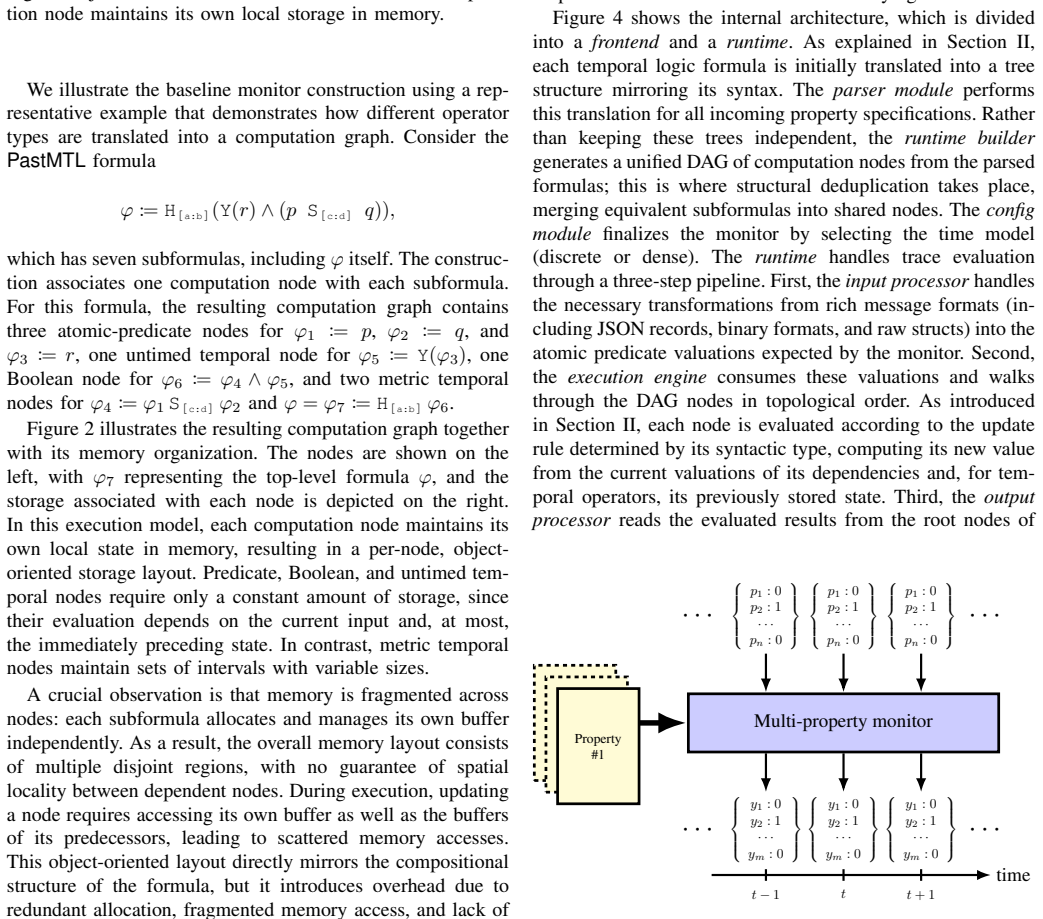
Runtime verification enables checking temporal logic specifications over individual execution traces and offers a scalable alternative to exhaustive formal verification. In practice, systems must satisfy dozens to hundreds of temporal properties simultaneously; however, existing approaches monitor each property in isolation, resulting in redundant computation and limited scalability. In this work, we present an online multi-property monitoring framework that compiles past-time LTL and MTL specifications into a shared directed acyclic graph of subformulas with one output per property. Unlike prior approaches that construct monitors independently, our method extends compositional sequential network-based temporal logic monitor construction to a shared setting, enabling reuse of intermediate results across properties while preserving their individual structure. Central to our approach is a data-oriented execution model based on an arena-allocated, double-buffered layout that stores intermediate results for each subformula in compact, contiguous memory. This design favors spatial locality and enables incremental updates with minimal overhead. Experimental results demonstrate per-property throughput improvements of 2x to 4.5x and 6x to 12x in multi-property configurations compared to conventional single-property monitoring, enabling scalability to large specification sets and deployment in high-performance and resource-constrained systems.
Editorial analysis
A structured set of objections, weighed in public.
Referee Report
Summary. The manuscript presents an online multi-property monitoring framework for past-time LTL and MTL specifications. Specifications are compiled into a shared directed acyclic graph (DAG) of subformulas with one output per property, extending compositional sequential network-based temporal logic monitor construction to a shared setting. This enables reuse of intermediate results across properties while preserving their individual structure. The approach relies on a data-oriented execution model using an arena-allocated, double-buffered memory layout to favor spatial locality and support incremental updates with minimal overhead. Experimental results are reported to show per-property throughput improvements of 2x to 4.5x and 6x to 12x in multi-property configurations compared to conventional single-property monitoring.
Significance. If the performance claims hold under realistic conditions, the work could improve scalability for runtime verification of systems with dozens to hundreds of simultaneous temporal properties. The extension of compositional monitor techniques to a shared DAG setting, combined with the optimized memory layout, offers a practical mechanism for reducing redundant computation without altering per-property semantics. This is particularly relevant for high-performance and resource-constrained deployments where monitoring multiple specifications concurrently is required.
major comments (2)
- [Experimental results] Experimental results section: The reported throughput improvements of 2x–4.5x and 6x–12x per property provide no details on the benchmark suites, baseline single-property monitor implementations, number of properties, subformula overlap statistics, or statistical measures such as error bars, preventing full assessment of the central performance claims and the practical value of the shared DAG reuse.
- [Memory layout and execution model] Memory layout and execution model section: The arena-allocated double-buffered layout is presented as delivering spatial locality and negligible overhead, yet no quantitative measurements of memory access patterns, synchronization costs, or allocation overhead across hardware platforms or property sets are supplied, leaving the key assumption about reuse benefits unverified.
minor comments (1)
- [Abstract] The abstract and introduction could include a brief statement of the precise fragments of past-time LTL and MTL that are supported to clarify the scope of the compilation and monitoring algorithms.
Simulated Author's Rebuttal
We thank the referee for the constructive comments on our manuscript. We address the two major points below and will revise the paper to provide the requested details and measurements.
read point-by-point responses
-
Referee: [Experimental results] Experimental results section: The reported throughput improvements of 2x–4.5x and 6x–12x per property provide no details on the benchmark suites, baseline single-property monitor implementations, number of properties, subformula overlap statistics, or statistical measures such as error bars, preventing full assessment of the central performance claims and the practical value of the shared DAG reuse.
Authors: We agree that additional experimental details are needed for full assessment. In the revised manuscript we will expand Section 5 to describe the benchmark suites (including property sources and generation method), the baseline single-property monitor (identical compositional construction without DAG sharing), the exact numbers of properties tested (5–100), subformula overlap statistics (average shared subformulas per configuration), and statistical measures (means with standard deviations and error bars from 10 runs per configuration). These additions will substantiate the reported per-property speedups. revision: yes
-
Referee: [Memory layout and execution model] Memory layout and execution model section: The arena-allocated double-buffered layout is presented as delivering spatial locality and negligible overhead, yet no quantitative measurements of memory access patterns, synchronization costs, or allocation overhead across hardware platforms or property sets are supplied, leaving the key assumption about reuse benefits unverified.
Authors: We acknowledge that quantitative validation of the memory layout is currently missing. In the revision we will add to Section 4 and the experimental evaluation hardware-counter measurements of cache misses and memory access patterns, synchronization overhead (when present), and allocation times, reported across two hardware platforms and multiple property-set sizes. This will confirm the claimed spatial locality and low overhead. revision: yes
Circularity Check
No significant circularity in the monitor construction derivation
full rationale
The paper presents a new online multi-property monitoring framework that extends prior compositional sequential network-based temporal logic monitor construction to a shared DAG setting with one output per property, using an arena-allocated double-buffered memory layout. No equations, fitted parameters, or results in the provided abstract reduce by construction to the paper's own inputs; the throughput claims (2x–12x improvements) are framed as experimental measurements rather than derived quantities that loop back to fitted values or self-referential definitions. The central construction is presented as an independent engineering contribution relying on subformula reuse and data-oriented execution, without load-bearing self-citations or ansatzes that collapse the argument to prior unverified claims within the same work.
Axiom & Free-Parameter Ledger
axioms (1)
- standard math Standard semantics of past-time LTL and MTL hold for the monitored traces
invented entities (2)
-
Shared directed acyclic graph of subformulas
no independent evidence
-
Arena-allocated double-buffered memory layout
no independent evidence
Reference graph
Works this paper leans on
-
[1]
The temporal logic of programs,
A. Pnueli, “The temporal logic of programs,” inProceedings of the Symposium on Foundations of Computer Science (FOCS), 1977, pp. 46–57
work page 1977
-
[2]
Specifying real-time properties with metric temporal logic,
R. Koymans, “Specifying real-time properties with metric temporal logic,”Real-Time Systems, vol. 2, no. 4, pp. 255–299, 1990
work page 1990
-
[3]
Online monitoring of metric temporal logic using sequential networks,
D. Ulus, “Online monitoring of metric temporal logic using sequential networks,”Logical Methods in Computer Science, vol. 22, 2026
work page 2026
-
[4]
Reelay: Online Temporal Logic Monitoring Framework
——, “Reelay: Online temporal logic monitoring framework,”arXiv preprint arXiv:2604.22384, 2026
work page internal anchor Pith review Pith/arXiv arXiv 2026
-
[5]
Parsing gigabytes of JSON per second,
G. Langdale and D. Lemire, “Parsing gigabytes of JSON per second,” The VLDB Journal, vol. 28, no. 6, pp. 941–960, 2019
work page 2019
-
[6]
Timescales: A benchmark generator for MTL monitoring tools,
D. Ulus, “Timescales: A benchmark generator for MTL monitoring tools,” inInternational Conference on Runtime Verification. Springer, 2019, pp. 402–412
work page 2019
-
[7]
Executing temporal logic programs: preliminary ver- sion,
B. Moszkowski, “Executing temporal logic programs: preliminary ver- sion,” inInternational Conference on Concurrency. Springer, 1984, pp. 111–130
work page 1984
-
[8]
The declarative past and imperative future: Executable tem- poral logic for interactive systems,
D. Gabbay, “The declarative past and imperative future: Executable tem- poral logic for interactive systems,” inTemporal Logic in Specification, ser. LNCS, vol. 398. Springer, 1989, pp. 409–448
work page 1989
-
[9]
The synchronous data flow programming language lustre,
N. Halbwachs, P. Caspi, P. Raymond, and D. Pilaud, “The synchronous data flow programming language lustre,”Proceedings of the IEEE, vol. 79, no. 9, pp. 1305–1320, 1991
work page 1991
-
[10]
Signal: A declarative language for synchronous programming of real-time systems,
T. Gautier, P. Le Guernic, and L. Besnard, “Signal: A declarative language for synchronous programming of real-time systems,” inCon- ference on Functional Programming Languages and Computer Archi- tecture. Springer, 1987, pp. 257–277
work page 1987
-
[11]
F. Boussinot and R. De Simone, “The esterel language,”Proceedings of the IEEE, vol. 79, no. 9, pp. 1293–1304, 1991
work page 1991
-
[12]
Efficient monitoring of safety properties,
K. Havelund and G. Ros ¸u, “Efficient monitoring of safety properties,” International Journal on Software Tools for Technology Transfer, vol. 6, no. 2, pp. 158–173, 2004
work page 2004
-
[13]
Copilot: A hard real-time runtime monitor,
L. Pike, A. Goodloe, R. Morisset, and S. Niller, “Copilot: A hard real-time runtime monitor,” inInternational Conference on Runtime Verification. Springer, 2010, pp. 345–359
work page 2010
-
[14]
C. Johannsen, P. Jones, B. Kempa, K. Y . Rozier, and P. Zhang, “R2u2 version 3.0: Re-imagining a toolchain for specification, resource estimation, and optimized observer generation for runtime verification in hardware and software,” inInternational Conference on Computer Aided Verification. Springer, 2023, pp. 483–497
work page 2023
-
[15]
D. Basin, F. Klaedtke, and E. Zalinescu, “The MonPoly monitoring tool,” inRV-CuBES 2017. An International Workshop on Competitions, Usability, Benchmarks, Evaluation, and Standardisation for Runtime Verification Tools, vol. 3, 2017, pp. 19–28
work page 2017
-
[16]
Dejavu: A monitoring tool for first- order temporal logic,
K. Havelund, D. Peled, and D. Ulus, “Dejavu: A monitoring tool for first- order temporal logic,” inProceedings of the Workshop on Monitoring and Testing of Cyber-Physical Systems (MT-CPS), 2018, pp. 12–13
work page 2018
-
[17]
Lola: Runtime monitoring of synchronous systems,
B. D’Angelo, S. Sankaranarayanan, C. S ´anchez, W. Robinson, B. Finkbeiner, H. B. Sipma, S. Mehrotra, and Z. Manna, “Lola: Runtime monitoring of synchronous systems,” inProceedings of the Symposium on Temporal Representation and Reasoning (TIME), 2005, pp. 166–174
work page 2005
-
[18]
Striver: Stream runtime verification for real-time event-streams,
F. Gorostiaga and C. S ´anchez, “Striver: Stream runtime verification for real-time event-streams,” inInternational Conference on Runtime Verification. Springer, 2018, pp. 282–298
work page 2018
-
[19]
Tessla–an ecosystem for runtime verification,
H. Kallwies, M. Leucker, M. Schmitz, A. Schulz, D. Thoma, and A. Weiss, “Tessla–an ecosystem for runtime verification,” inInterna- tional Conference on Runtime Verification. Springer, 2022, pp. 314– 324
work page 2022
-
[20]
Efficient verification of multi-property designs (the benefit of wrong assump- tions),
E. Goldberg, M. G ¨udemann, D. Kroening, and R. Mukherjee, “Efficient verification of multi-property designs (the benefit of wrong assump- tions),” in2018 Design, Automation & Test in Europe Conference & Exhibition (DATE). IEEE, 2018, pp. 43–48
work page 2018
-
[21]
Boosting verification scalability via structural grouping and semantic partitioning of properties,
R. Dureja, J. Baumgartner, A. Ivrii, R. Kanzelman, and K. Y . Rozier, “Boosting verification scalability via structural grouping and semantic partitioning of properties,” in2019 Formal Methods in Computer Aided Design (FMCAD). IEEE, 2019, pp. 1–9
work page 2019
-
[22]
PURSE: Property ordering using runtime statistics for efficient multi-property verification,
S. Das, A. Hazra, P. Dasgupta, S. Kundu, and H. Jain, “PURSE: Property ordering using runtime statistics for efficient multi-property verification,” in2024 Design, Automation & Test in Europe Conference & Exhibition (DATE). IEEE, 2024, pp. 1–6
work page 2024
-
[23]
S. Das, A. Hazra, P. Dasgupta, H. Jain, and S. Kundu, “Sisco: Selective invariant sharing, clustering and ordering for effective multi-property formal verification,” inProceedings of the 30th Asia and South Pacific Design Automation Conference, 2025, pp. 1343–1349
work page 2025
-
[24]
Mpbmc: Multi-property bounded model checking with gnn-guided clustering,
S. G. Roy, S. Ghosh, A. Banerjee, R. K. Gajavelly, and S. Surendran, “Mpbmc: Multi-property bounded model checking with gnn-guided clustering,” in2026 39th International Conference on VLSI Design & 25th International Conference on Embedded Systems (VLSID). IEEE, 2026, pp. 179–184
work page 2026
-
[25]
Automatic optimizations for stream-based monitoring languages,
J. Baumeister, B. Finkbeiner, M. Kruse, and M. Schwenger, “Automatic optimizations for stream-based monitoring languages,” inInternational Conference on Runtime Verification. Springer, 2020, pp. 451–461
work page 2020
-
[26]
An inter- mediate program representation for optimizing stream-based languages,
J. Baumeister, A. Correnson, B. Finkbeiner, and F. Scheerer, “An inter- mediate program representation for optimizing stream-based languages,” inInternational Conference on Computer Aided Verification. Springer, 2025, pp. 393–407
work page 2025
discussion (0)
Sign in with ORCID, Apple, or X to comment. Anyone can read and Pith papers without signing in.