Recognition: no theorem link
MQTT Across a Raspberry Pi 5 IoT Network Utilizing Quantum-resistant Signature Algorithms
Pith reviewed 2026-05-14 17:57 UTC · model grok-4.3
The pith
FALCON post-quantum signatures secure MQTT on Raspberry Pi 5 devices while exposing measurable performance overheads.
A machine-rendered reading of the paper's core claim, the machinery that carries it, and where it could break.
Core claim
The research integrates the FALCON digital signature scheme into MQTT-based IoT networks using three Raspberry Pi 5 boards. It maintains message authenticity and integrity across clients and brokers while measuring system performance to characterize the practical trade-offs of deploying lattice-based PQC on lightweight hardware.
What carries the argument
The FALCON digital signature scheme integrated into the MQTT protocol, which supplies quantum-resistant authenticity and integrity checks on resource-constrained Raspberry Pi 5 devices.
Load-bearing premise
Performance results from three Raspberry Pi 5 boards in a controlled lab will generalize to real IoT deployments that have intermittent connectivity, varied sensors, and higher message rates.
What would settle it
Running the same FALCON-MQTT setup on a larger network with real intermittent wireless links and production message rates yields substantially higher latency or packet loss than the lab measurements.
Figures


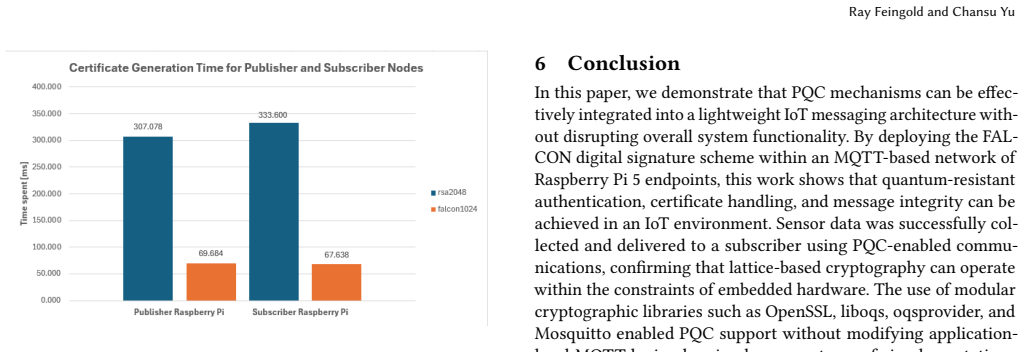
read the original abstract
The rapid expansion of the Internet of Things (IoT) has introduced millions of resource-constrained devices into critical infrastructures, consumer environments, and industrial systems. These devices rely on lightweight communication protocols such as MQTT to support low-power, intermittent, and bandwidth-limited operation. However, common TLS algorithms used to secure MQTT communications are vulnerable to quantum attacks made feasible by Shor's algorithm. As a result, IoT infrastructures must evaluate and adopt post-quantum cryptographic (PQC) methods capable of providing long-term resilience. This report investigates the implementation of PQC algorithms within an MQTT-based IoT networks using three Raspberry Pis. Specifically, it integrates the FALCON digital signature scheme, one of NIST's selected post-quantum signature algorithms, to maintain message authenticity and integrity across resource-constrained MQTT clients and brokers. By measuring system performance, the research characterizes the practical trade-offs of deploying lattice-based PQC on lightweight hardware.
Editorial analysis
A structured set of objections, weighed in public.
Referee Report
Summary. The manuscript describes an implementation of the FALCON post-quantum digital signature scheme within an MQTT-based IoT network deployed across three Raspberry Pi 5 devices. It integrates FALCON to secure message authenticity and integrity, then measures system performance to characterize the practical trade-offs of lattice-based PQC on resource-constrained hardware.
Significance. If the reported measurements prove robust, the work supplies timely empirical benchmarks on deploying a NIST-selected PQC signature algorithm in a lightweight MQTT setting. Such data can help practitioners evaluate quantum-resistant options for IoT infrastructures where classical TLS is vulnerable to Shor's algorithm.
major comments (2)
- [Abstract] Abstract: The central claim rests on performance measurements, yet the text provides no description of experimental design, number of trials, error bars, baseline comparisons (e.g., against classical TLS), message rates, or statistical methods. Without these details the reported trade-offs cannot be verified or reproduced.
- [Results/Evaluation] Results/Evaluation section: The manuscript does not specify how latency, throughput, or resource usage were quantified under controlled versus realistic IoT conditions, nor does it address variability across the three Raspberry Pi 5 boards. This omission is load-bearing because the paper's contribution is framed as an empirical characterization.
minor comments (2)
- [Results] Add explicit comparison tables or figures showing FALCON overhead versus standard TLS signatures to strengthen the trade-off analysis.
- [Implementation] Clarify the exact MQTT broker and client configurations (e.g., QoS levels, payload sizes) used in the experiments.
Simulated Author's Rebuttal
We thank the referee for the detailed and constructive comments. We agree that additional experimental details are necessary to support the claims and will revise the manuscript to address the points raised.
read point-by-point responses
-
Referee: [Abstract] Abstract: The central claim rests on performance measurements, yet the text provides no description of experimental design, number of trials, error bars, baseline comparisons (e.g., against classical TLS), message rates, or statistical methods. Without these details the reported trade-offs cannot be verified or reproduced.
Authors: We agree that the abstract is missing these critical details. In the revised version we will expand the abstract to include a concise description of the experimental design (three Raspberry Pi 5 nodes, MQTT broker/client setup), the number of repeated trials, reporting of standard deviation as error bars, direct comparison against classical TLS, the message rates used, and the statistical methods applied. revision: yes
-
Referee: [Results/Evaluation] Results/Evaluation section: The manuscript does not specify how latency, throughput, or resource usage were quantified under controlled versus realistic IoT conditions, nor does it address variability across the three Raspberry Pi 5 boards. This omission is load-bearing because the paper's contribution is framed as an empirical characterization.
Authors: We acknowledge the omission. The revised Results/Evaluation section will explicitly describe the measurement methodology for latency (end-to-end message signing and verification), throughput, and resource usage (CPU, memory, power), distinguish controlled lab conditions from realistic IoT traffic patterns, and report observed variability across the three Raspberry Pi 5 boards with per-device statistics. revision: yes
Circularity Check
Empirical measurement study with no derivations or self-referential reductions
full rationale
The paper reports an implementation and performance measurement of the FALCON post-quantum signature scheme on three Raspberry Pi 5 boards running an MQTT network. No equations, derivations, or fitted parameters are described that would reduce reported results to inputs by construction. The work contains no load-bearing self-citations, uniqueness theorems, or ansatzes imported from prior author work. All claims rest on direct experimental observations under controlled conditions, rendering the study self-contained with no circular steps.
Axiom & Free-Parameter Ledger
axioms (2)
- domain assumption FALCON provides quantum-resistant security under standard lattice hardness assumptions
- domain assumption Raspberry Pi 5 performance is representative of resource-constrained IoT devices
Reference graph
Works this paper leans on
-
[1]
K.-Y. Chen and J.-P. Chen. Masking floating-point number multiplication and addition of Falcon.IACR Transactions on Cryptographic Hardware and Embedded Systems, 2024(2):276–303, 2024. DOI: 10.46586/tches.v2024.i2.276-303
-
[2]
Build a Motion Detection System with a Raspberry Pi.open- source.com, 2020
Janěnas, Lukas. Build a Motion Detection System with a Raspberry Pi.open- source.com, 2020. Available at: https://opensource.com/article/20/11/motion- detection-raspberry-pi. Accessed February 5, 2026
2020
-
[3]
Introducing the MQTT Protocol – MQTT Essentials: Part 1
HiveMQ Team. Introducing the MQTT Protocol – MQTT Essentials: Part 1. HiveMQ Blog, 2024. Available at: https://www.hivemq.com/blog/mqtt-essentials- part-1-introducing-mqtt/. Accessed January 5, 2026
2024
-
[4]
Lin, X. et al. Thorough power analysis on Falcon Gaussian samplers and practical countermeasure. InLecture Notes in Computer Science, pages 229–258. Springer,
-
[5]
DOI: 10.1007/978-3-031-91820-9_8
-
[6]
Quantum-resistant and secure MQTT communication
Malina, Lukáš et al. Quantum-resistant and secure MQTT communication. In Proceedings of the 19th International Conference on A vailability, Reliability and Security, pages 1–8. ACM, 2024. DOI: 10.1145/3664476.3670463. MQTT Across a Raspberry Pi 5 IoT Network Utilizing Quantum-resistant Signature Algorithms
-
[7]
Shift Snare: Uncovering Secret Keys in Falcon via Single-Trace Analysis.IACR Cryptology ePrint Archive, 2025
Qiu, Jiaqi and Aydin Aysu. Shift Snare: Uncovering Secret Keys in Falcon via Single-Trace Analysis.IACR Cryptology ePrint Archive, 2025. Available at: https://eprint.iacr.org/2025/146. Accessed January 5, 2026
2025
-
[8]
Salih, K. O. et al. A comprehensive survey on the Internet of Things with the Industrial Marketplace.Sensors, 22(3):730, 2022. DOI: 10.3390/s22030730
-
[9]
Sarker, Arijit, Mehran Mozaffari Kermani, and Reza Azarderakhsh. Efficient error detection architectures for postquantum signature Falcon’s sampler and KEM Saber.IEEE Transactions on Very Large Scale Integration (VLSI) Systems, 30(6):794–802, 2022. DOI: 10.1109/TVLSI.2022.3156479
-
[10]
liboqs: C Library for Post-Quantum Cryptography
Open Quantum Safe Project. liboqs: C Library for Post-Quantum Cryptography. GitHub repository, 2025. Available at: https://github.com/open-quantum-safe/ liboqs. Accessed February 5, 2026
2025
-
[11]
OpenSSL: Cryptography and SSL/TLS Toolkit
OpenSSL Software Foundation. OpenSSL: Cryptography and SSL/TLS Toolkit. GitHub repository, 2025. Available at: https://github.com/openssl/openssl. Ac- cessed February 5, 2026
2025
-
[12]
OQS Provider for OpenSSL
Open Quantum Safe Project. OQS Provider for OpenSSL. GitHub repository,
-
[13]
Ac- cessed February 5, 2026
Available at: https://github.com/open-quantum-safe/oqs-provider. Ac- cessed February 5, 2026
2026
-
[14]
Eclipse Mosquitto MQTT Broker
Eclipse Foundation. Eclipse Mosquitto MQTT Broker. GitHub repository, 2025. Available at: https://github.com/eclipse-mosquitto/mosquitto. Accessed February 5, 2026
2025
-
[15]
OQS-Demos: Post-Quantum Mosquitto Demonstra- tion
Open Quantum Safe Project. OQS-Demos: Post-Quantum Mosquitto Demonstra- tion. GitHub repository, 2025. Available at: https://github.com/open-quantum- safe/oqs-demos/tree/main/mosquitto. Accessed February 5, 2026
2025
-
[16]
Post-Quantum Cryptog- raphy Standardization
National Institute of Standards and Technology (NIST). Post-Quantum Cryptog- raphy Standardization. Available at: https://csrc.nist.gov/projects/post-quantum- cryptography. Accessed May 6, 2026
2026
-
[17]
K. Kim, M. Tibouchi, A. Wallet, T. Espitau, Y. Yu, and Y. Kim. SOLMAE: Faster and simpler quantum-safe signature based on NTRU-lattices. Technical Report, Ver. 2.0, 2024. Available at: https://kpqc.or.kr/images/pdf/SOLMAE.pdf
2024
discussion (0)
Sign in with ORCID, Apple, or X to comment. Anyone can read and Pith papers without signing in.