Recognition: unknown
Phase Matching for a Generalized Grover's Algorithm
Pith reviewed 2026-05-14 17:49 UTC · model grok-4.3
The pith
In the generalized Grover's algorithm, optimal phases deviate from π as target probability approaches 1, breaking phase matching but raising success probability.
A machine-rendered reading of the paper's core claim, the machinery that carries it, and where it could break.
Core claim
For the generalized Grover iteration, the phases that maximize the increase in target amplitude are found by solving an optimization problem given the current state vector and the size of the search space. When the target probability is not close to 1, these optimal phases equal π and satisfy phase matching, recovering classical Grover's algorithm. As the target probability approaches 1, the optimal phases differ from π, no longer satisfy phase matching, and produce a higher final probability than the standard choice.
What carries the argument
The optimization statement that maximizes the gain in target probability by choosing the two phase changes at each iteration, given the current amplitude vector and database size N.
Load-bearing premise
The current amplitude vector is known exactly when selecting the next phases.
What would settle it
Solve the optimization for the 5-qubit example and verify numerically that the final target probability exceeds the value obtained from standard Grover phases of π.
Figures

read the original abstract
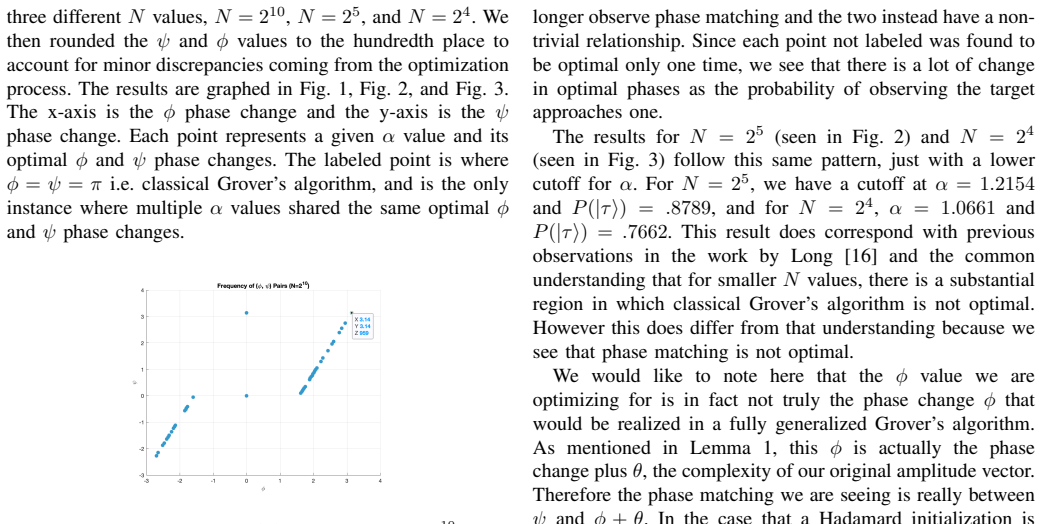
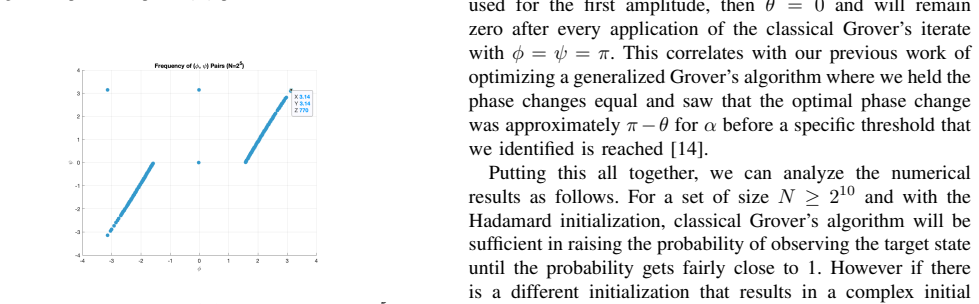
We study the fully generalized Grover's algorithm to find the optimal phase changes for each step of the iteration to maximize gain in probability of observation of the target, and when phase matching is required. We find that classical Grover's algorithm and phase matching remains to be optimal till the target probability gets close 1. However, as the probability of observation approaches 1, the optimal phase changes differ from $\pi$ and no longer observe phase matching. We provide the optimization statement to find the optimal phase changes given the current amplitude vector and the size of the set. To analyze this formula, we approach it from a numerical and analytical perspective, with the analytical perspective focusing on special cases that simplify the optimization and allow for general statements about its behavior. Finally, we provide an example of a 5 qubit system and show that for the final iteration the optimal phase changes differ from traditional Grover's algorithm and do not observe phase matching, but lead to an increase in the probability of the target.
Editorial analysis
A structured set of objections, weighed in public.
Referee Report
Summary. The manuscript examines the fully generalized Grover's algorithm and derives an optimization over phase changes at each iteration to maximize the probability of observing the target state. It claims that the classical choice of phases equal to π (with phase matching) remains optimal until the target probability approaches 1; beyond that point the optimal phases deviate from π, violate phase matching, and nevertheless produce a higher success probability. The optimization is expressed directly in terms of the current amplitude vector and the set size; the authors analyze the formula numerically and analytically (via special cases) and illustrate the final-iteration improvement with a concrete 5-qubit example.
Significance. If the central claim holds, the work shows that phase matching is not universally optimal in the terminal stages of generalized Grover search and that modest probability gains are available by relaxing the phase constraint once the target amplitude is large. This could guide fine-tuning of quantum search circuits on near-term hardware. The manuscript supplies an explicit optimization statement, special-case analytic reductions, and a worked 5-qubit demonstration, all of which are positive contributions provided the underlying assumptions can be made operational.
major comments (2)
- [Abstract] Abstract and optimization statement: the claimed optimum is conditioned on exact knowledge of the current amplitude vector. The manuscript supplies neither an estimation protocol nor a propagation-of-error analysis showing how measurement-induced uncertainty in the vector affects the selected phases or the reported probability gain. This assumption is load-bearing for any practical claim.
- [5-qubit example] 5-qubit example: the text asserts that non-standard phases increase target probability in the final iteration, yet no data tables, error bars, or full numerical output are provided. Without these it is impossible to verify the magnitude of the improvement or to exclude post-hoc tuning.
minor comments (1)
- The abstract refers to 'numerical and analytical methods' and 'special cases that simplify the optimization'; the main text should explicitly list the numerical optimizer employed and the precise analytic reductions used for each special case.
Simulated Author's Rebuttal
We thank the referee for the careful reading and constructive feedback. We respond to each major comment below, indicating the revisions we will incorporate.
read point-by-point responses
-
Referee: [Abstract] Abstract and optimization statement: the claimed optimum is conditioned on exact knowledge of the current amplitude vector. The manuscript supplies neither an estimation protocol nor a propagation-of-error analysis showing how measurement-induced uncertainty in the vector affects the selected phases or the reported probability gain. This assumption is load-bearing for any practical claim.
Authors: We agree that the derived optimization assumes exact knowledge of the amplitude vector; this is the mathematical setting in which we maximize the target probability for given amplitudes and set size. The manuscript is a theoretical analysis of when and why phase matching ceases to be optimal near probability 1. We will revise the abstract and introduction to state this assumption explicitly. A full amplitude-estimation protocol and error-propagation analysis lie outside the present scope, which focuses on the closed-form optimization and its analytic special cases. The reported probability gains are therefore conditional on exact amplitudes. revision: partial
-
Referee: [5-qubit example] 5-qubit example: the text asserts that non-standard phases increase target probability in the final iteration, yet no data tables, error bars, or full numerical output are provided. Without these it is impossible to verify the magnitude of the improvement or to exclude post-hoc tuning.
Authors: We will add a table in the revised manuscript that lists the pre-final-iteration amplitude vector, the numerically optimized phases, the resulting target probability, and the probability obtained with the standard all-π phases. The table will contain the exact numerical values used in the example so that the improvement can be reproduced and verified independently. revision: yes
Circularity Check
Optimization over external amplitude vector and set size; no reduction to fitted or self-referential inputs
full rationale
The paper states an explicit optimization problem whose inputs are the current amplitude vector and the size of the set. The claimed deviation from phase matching near probability 1 is obtained by solving this optimization for those inputs, without any equation that re-derives the optimum from a parameter fitted to the same data or from a self-citation whose content is itself the target result. Special-case analytical simplifications and the 5-qubit numerical example remain downstream of the stated inputs. The derivation chain is therefore self-contained against external benchmarks.
Axiom & Free-Parameter Ledger
axioms (2)
- domain assumption Grover iteration is realized by unitary operators whose only free parameters are the two phase angles applied at each step
- domain assumption The amplitude vector at the start of each iteration is known exactly
Reference graph
Works this paper leans on
-
[1]
A fast quantum mechanical algorithm for database search,
L. Grover, “A fast quantum mechanical algorithm for database search,” STOC’96: Proceedings of the twenty-eighth annual ACM symposium on Theory of Computing, pp. 212–219, 1996
1996
-
[2]
Tight bounds on quantum searching,
M. Boyer, G. Brassard, P. Høyer, and A. Tapp, “Tight bounds on quantum searching,”Fortschr. Phys., vol. 46, pp. 493–505, 1998
1998
-
[3]
Quantum Computing in the NISQ era and beyond,
J. Preskill, “Quantum Computing in the NISQ era and beyond,”Quan- tum, vol. 2, p. 79, 2018
2018
-
[4]
Quantum partial search algorithm with smaller oracles for multiple target items,
D. Li, L. Qian, Y . Zhou, and Y . Yang, “Quantum partial search algorithm with smaller oracles for multiple target items,”Quantum Inf Process, vol. 21, 2022
2022
-
[5]
Deterministic grover search with a restricted oracle,
T. Roy, L. Jiang, and D. Schuste, “Deterministic grover search with a restricted oracle,”Phys. Rev. Research, vol. 4, 2022
2022
-
[6]
Experimental demonstration of deterministic quantum search for multiple marked states without adjusting the oracle,
X. He, W. Zhao, W. Lv, C. Peng, Z. Sun, Y . Sun, S. QP., and C. Yang, “Experimental demonstration of deterministic quantum search for multiple marked states without adjusting the oracle,”Opt. Lett., vol. 48, no. 17, pp. 4428–4431, 2023
2023
-
[7]
Distributed grover’s algorithm,
D. Qiu, L. Luo, and L. Xiao, “Distributed grover’s algorithm,”Theor. Comput. Sci., vol. 993, 2024
2024
-
[8]
An optimized exact multi-target search algorithm,
S. Zhong, Y . Zhao, G. Dai, and D. Wu, “An optimized exact multi-target search algorithm,”Quantum Inf Process, vol. 24, 2025
2025
-
[9]
Phase matching in quantum searching,
G. Long, Y . Li, W. Zhang, and L. Niu, “Phase matching in quantum searching,”Physics Letters A, vol. 262, pp. 27–34, 1999
1999
-
[10]
Phase matching in grover’s algorithm,
P. Li and S. Li, “Phase matching in grover’s algorithm,”Physics Letters A, vol. 366, 2007
2007
-
[11]
Optimal number of queries for phase-matching quantum search,
R. Gut ¸oiu, A. T ˘an˘asescu, and P. Popescu, “Optimal number of queries for phase-matching quantum search,”Quantum Inf Process, vol. 24, 2025
2025
-
[12]
Robust quantum search with uncertain number of target states,
Y . Zhu, Z. Wang, Y . Bao, and S. Wei, “Robust quantum search with uncertain number of target states,”Entropy, vol. 23, no. 12, p. 1649, 2021
2021
-
[13]
Phase matching in quantum search algorithm,
S. Chowdhury, S. Baruah, and B. Dikshit, “Phase matching in quantum search algorithm,”EPL, vol. 141, 2023
2023
-
[14]
Optimal phase change for a generalized grover’s algorithm,
C. Cardullo and M. Kang, “Optimal phase change for a generalized grover’s algorithm,”arXiv, 2026. [Online]. Available: https://arxiv.org/abs/2509.20610
-
[15]
Quantum computers can search rapidly by using almost any transformation,
L. Grover, “Quantum computers can search rapidly by using almost any transformation,”Phys. Rev. Lett., vol. 80, pp. 4329–4332, 1998
1998
-
[16]
Grover algorithm with zero theoretical failure rate,
G. Long, “Grover algorithm with zero theoretical failure rate,”Phys. Rev. A, vol. 64, 2001
2001
discussion (0)
Sign in with ORCID, Apple, or X to comment. Anyone can read and Pith papers without signing in.