Recognition: unknown
"Like Taking the Path of Least Resistance": Exploring the Impact of LLM Interaction on the Creative Process of Programming
Pith reviewed 2026-05-14 17:36 UTC · model grok-4.3
The pith
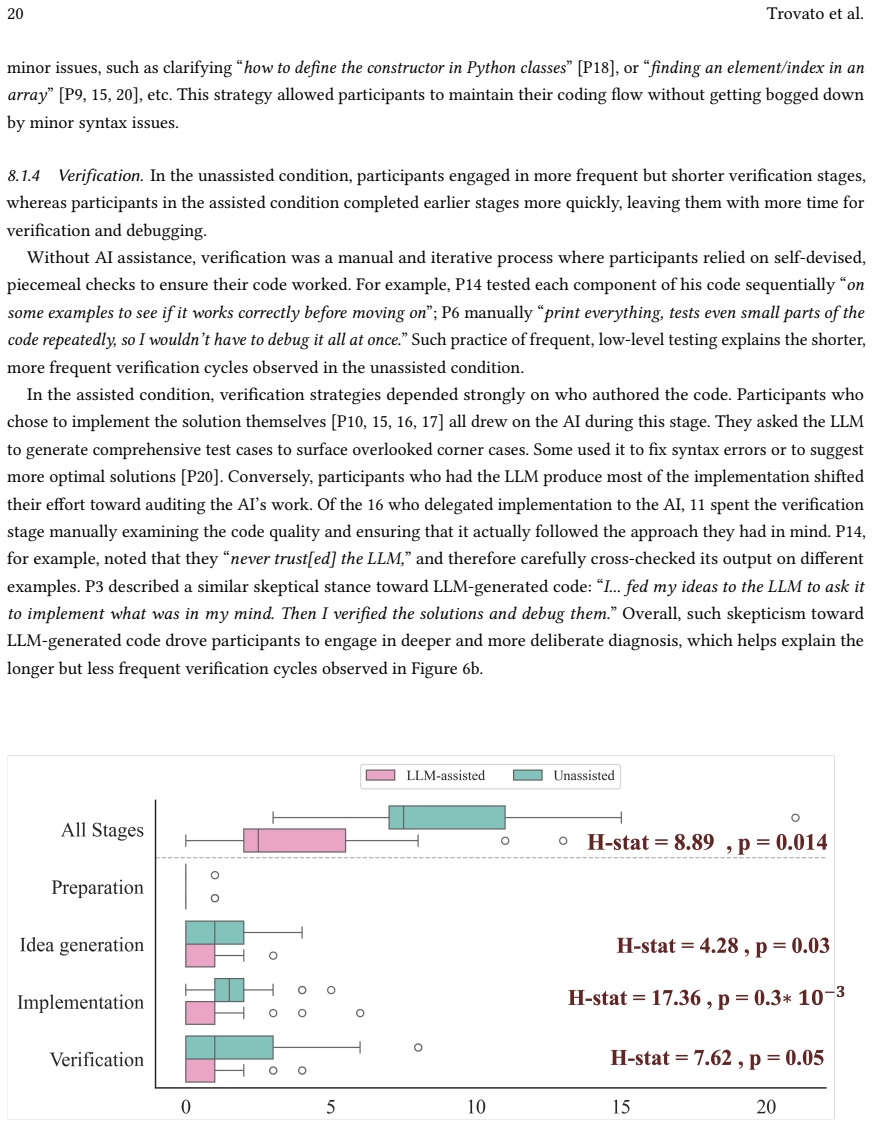
LLM assistance shortens idea-generation periods in programming and reduces creative moments while final solutions contain similar numbers of ideas.
A machine-rendered reading of the paper's core claim, the machinery that carries it, and where it could break.
Core claim
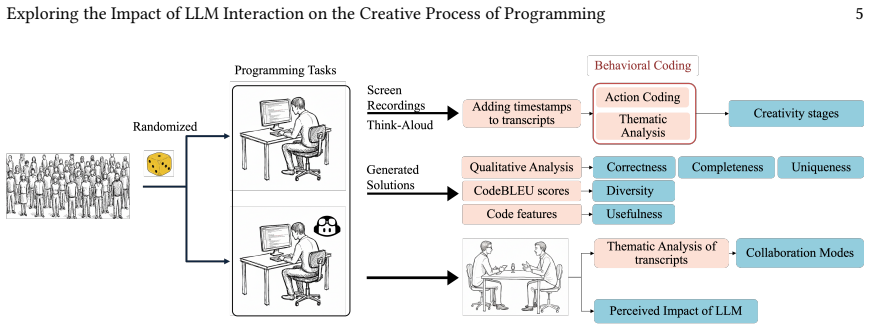
Through a within-subject study with 20 programmers, the authors found that LLM-assisted conditions led to significantly shorter idea-generation periods (p=0.0004) and fewer creative moments (p=0.002). Generated solutions in both conditions contained roughly the same number of ideas. Qualitative analysis identified four human-LLM collaboration modes that support different problem-solving strategies. LLMs helped produce more correct code but did not increase the idea count in solutions.
What carries the argument
Idea-generation periods and creative moments tracked across LLM-assisted and unassisted conditions, plus four identified human-LLM collaboration modes.
If this is right
- LLM tools may reduce the time programmers spend exploring ideas before settling on solutions.
- Final code solutions maintain comparable idea diversity with or without LLM assistance.
- Programmers adopt varied collaboration modes with LLMs depending on the task strategy.
- LLM design should consider ways to preserve creative moments alongside efficiency gains.
Where Pith is reading between the lines
- Future coding assistants could include prompts that deliberately extend ideation time to support more creative moments.
- Similar process shifts might appear in other creative fields such as writing or visual design when AI tools are introduced.
- Testing whether specific prompting styles can restore creative moment counts without slowing down the work would be a direct next step.
Load-bearing premise
That shorter idea-generation periods and fewer creative moments accurately capture reduced creativity in programming, and that the within-subject design controls for individual differences and learning effects.
What would settle it
A replication using think-aloud protocols and independent creativity ratings that finds equal idea-generation durations and creative moments across conditions would falsify the main process findings.
Figures





read the original abstract
Creativity is fundamentally human. As AI takes on more of the generative work that once required human imagination, despite documented limitations in creative ability, a critical question emerges: How does GenAI affect users' creativity? Through a within-subject study followed by retrospective interviews with (N=20) programmers, we investigated the impact of LLMs on participants' process of creative thinking in programming and the creativity of generated solutions. Across two conditions (LLM-assisted vs. unassisted), participants using LLMs had significantly shorter idea-generation periods (p=0.0004), leading to fewer creative moments (p=0.002). Qualitative analysis of participants' interactions and interviews revealed four different human-LLM collaboration modes supporting various problem-solving strategies. However, a comparative analysis of the generated solutions shows that while LLMs can help generate more correct and functional code, their solutions contain roughly the same number of ideas as participant-generated ones. Based on our findings, we discuss design implications and considerations for effectively using LLMs to support user creativity.
Editorial analysis
A structured set of objections, weighed in public.
Referee Report
Summary. The paper reports a within-subject study (N=20 programmers) comparing LLM-assisted vs. unassisted conditions on a creative programming task. It claims LLM use produces significantly shorter idea-generation periods (p=0.0004) and fewer creative moments (p=0.002), identifies four human-LLM collaboration modes, and finds that LLM-assisted solutions are more correct/functional but contain roughly the same number of ideas as unassisted ones.
Significance. If the causal attribution holds, the work provides empirical grounding for how LLM interaction alters the temporal structure of creative ideation in programming and offers design implications for tools that preserve creative moments while improving correctness. The identification of collaboration modes and the idea-count comparison are useful for distinguishing process effects from outcome effects.
major comments (2)
- [Methods / Experimental Design] The central statistical claims rest on a within-subject comparison, yet the manuscript provides no details on condition counterbalancing, session order randomization, or mixed-effects modeling to test for sequence-by-condition interactions. Without these, the reported shortening of idea-generation periods (p=0.0004) and reduction in creative moments (p=0.002) cannot be unambiguously attributed to LLM presence rather than learning or familiarity effects across sessions.
- [Methods / Results] The definitions and operationalization of 'idea-generation periods' and 'creative moments' are not fully specified (e.g., exact coding criteria, temporal granularity, or how they were distinguished from general problem-solving time). This measurement validity issue directly affects the interpretation of the p-values and the claim that shorter periods lead to fewer creative moments.
minor comments (3)
- [Results / Qualitative Analysis] The qualitative analysis identifies four collaboration modes but supplies limited illustrative quotes or interaction excerpts, making it difficult to evaluate how the modes map onto the observed quantitative differences.
- [Methods] Missing details include inter-rater reliability statistics for the qualitative coding, data exclusion criteria, and the exact statistical tests (e.g., whether paired t-tests or non-parametric equivalents were used given the within-subject structure).
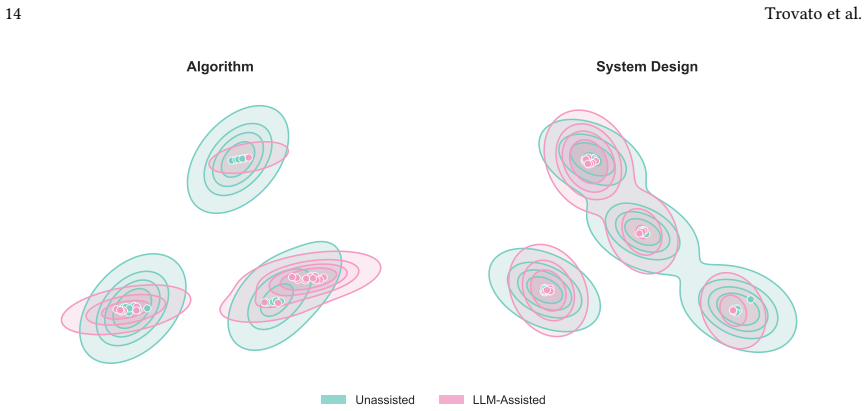
- [Results / Solution Comparison] The comparative solution analysis states that LLM solutions contain 'roughly the same number of ideas' but does not report the precise counts, variance, or statistical test used for this equivalence claim.
Simulated Author's Rebuttal
We thank the referee for their detailed and constructive comments on our manuscript. We have carefully considered each point and revised the paper to improve clarity on the experimental design and measurement procedures. Below we respond point-by-point.
read point-by-point responses
-
Referee: [Methods / Experimental Design] The central statistical claims rest on a within-subject comparison, yet the manuscript provides no details on condition counterbalancing, session order randomization, or mixed-effects modeling to test for sequence-by-condition interactions. Without these, the reported shortening of idea-generation periods (p=0.0004) and reduction in creative moments (p=0.002) cannot be unambiguously attributed to LLM presence rather than learning or familiarity effects across sessions.
Authors: We agree that the manuscript would benefit from more explicit details on these aspects of the experimental design. In the revised version, we have added a new subsection 'Experimental Design and Procedure' that specifies: (1) conditions were counterbalanced using a Latin square to ensure equal distribution of order across participants, (2) the order of sessions was randomized for each participant, and (3) we employed linear mixed-effects models with session order and condition as fixed effects, including their interaction, to assess potential sequence effects. The interaction term was not significant (p > 0.1), supporting that the observed effects are attributable to the LLM condition rather than order. We have also included the full model specifications and results in the supplementary materials. revision: yes
-
Referee: [Methods / Results] The definitions and operationalization of 'idea-generation periods' and 'creative moments' are not fully specified (e.g., exact coding criteria, temporal granularity, or how they were distinguished from general problem-solving time). This measurement validity issue directly affects the interpretation of the p-values and the claim that shorter periods lead to fewer creative moments.
Authors: We acknowledge that the operational definitions could be more precise in the original submission. We have revised the 'Data Analysis' section to provide detailed coding criteria: Idea-generation periods were identified from think-aloud transcripts as sequences of at least 30 seconds involving the articulation of novel programming concepts or approaches, coded at 10-second intervals by two independent raters (Cohen's kappa = 0.82). Creative moments were defined as discrete events where participants expressed or demonstrated a shift to a new idea or solution path, distinguished from routine problem-solving by the presence of 'aha' verbalizations or abrupt changes in code structure. We have added examples from the data and clarified how these were separated from implementation time. These revisions strengthen the validity of the reported statistical findings. revision: yes
Circularity Check
No significant circularity in empirical study
full rationale
This paper reports results from a within-subject empirical study (N=20) using standard statistical tests for p-values on idea-generation periods and creative moments, plus thematic analysis of interviews and solution comparisons. No mathematical derivations, equations, fitted parameters presented as predictions, or self-citation chains underpin the central claims. All findings rest on observed participant data and conventional analysis methods rather than any self-referential reduction or renaming of inputs.
Axiom & Free-Parameter Ledger
axioms (2)
- standard math Standard assumptions of within-subject statistical tests (normality, independence of observations after counterbalancing)
- domain assumption Qualitative themes from retrospective interviews accurately reflect participants' creative processes
Reference graph
Works this paper leans on
-
[1]
Selcuk Acar, Cyndi Burnett, and John F. Cabra. 2017. Ingredients of Creativity: Originality and More.Creativity Research Journal29 (2017), 133 –
2017
-
[2]
doi:10.1080/10400419.2017.1302776
-
[3]
Teresa M Amabile. 1983. The social psychology of creativity: a componential conceptualization.Journal of personality and social psychology45, 2 (1983), 357
1983
-
[4]
Mahta Amini, Jay A. Olson, and Zohreh Sharafi. 2024. Coding with a Creative Twist: Investigating the Link Between Creativity Scores and Problem-solving Strategies.2024 IEEE/ACM 46th International Conference on Software Engineering: New Ideas and Emerging Results (ICSE-NIER) (2024), 21–25. doi:10.1145/3639476.3639766 Manuscript submitted to ACM Exploring t...
-
[6]
Barrett R Anderson, Jash Hemant Shah, and Max Kreminski. 2024. Homogenization Effects of Large Language Models on Human Creative Ideation. Proceedings of the 16th Conference on Creativity & Cognition(2024). doi:10.1145/3635636.3656204
-
[7]
Tyler Angert, Miroslav Suzara, Jenny Han, Christopher Pondoc, and Hariharan Subramonyam. 2023. Spellburst: A Node-based Interface for Exploratory Creative Coding with Natural Language Prompts. InProceedings of the 36th Annual ACM Symposium on User Interface Software and Technology(San Francisco, CA, USA)(UIST ’23). Association for Computing Machinery, New...
-
[8]
Ars Technica Staff. 2025. Developer Survey Shows Trust in AI Coding Tools Is Falling as Usage Rises.Ars Technica(July 2025). https://arstechnica. com/ai/2025/07/developer-survey-shows-trust-in-ai-coding-tools-is-falling-as-usage-rises/ [Online; accessed 2025–09–12]
2025
-
[9]
Mia Magdalena Bangerl, Leonie Disch, Tamara David, and Viktoria Pammer-Schindler. 2025. CreAItive Collaboration? Users’ Misjudgment of AI-Creativity Affects Their Collaborative Performance. InProceedings of the 2025 CHI Conference on Human Factors in Computing Systems (CHI ’25). Association for Computing Machinery, New York, NY, USA, Article 195, 17 pages...
-
[10]
C. Bird, Denae Ford, Thomas Zimmermann, Nicole Forsgren, Eirini Kalliamvakou, Travis Lowdermilk, and Idan Gazit. 2022. Taking Flight with Copilot.Queue20 (2022), 35 – 57. doi:10.1145/3582083
-
[11]
Virginia Braun and Victoria Clarke. 2006. Using thematic analysis in psychology.Qualitative research in psychology3, 2 (2006), 77–101
2006
-
[12]
Tuhin Chakrabarty, Philippe Laban, Divyansh Agarwal, Smaranda Muresan, and Chien-Sheng Wu. 2024. Art or artifice? large language models and the false promise of creativity. InProceedings of the 2024 CHI Conference on Human Factors in Computing Systems. 1–34
2024
-
[13]
Tuhin Chakrabarty, Vishakh Padmakumar, Faeze Brahman, and S. Muresan. 2023. Creativity Support in the Age of Large Language Models: An Empirical Study Involving Emerging Writers.ArXivabs/2309.12570 (2023). doi:10.48550/arXiv.2309.12570
-
[14]
Tuhin Chakrabarty, Vishakh Padmakumar, Faeze Brahman, and S. Muresan. 2024. Creativity Support in the Age of Large Language Models: An Empirical Study Involving Professional Writers.Proceedings of the 16th Conference on Creativity & Cognition(2024). doi:10.1145/3635636.3656201
-
[15]
Z. Chen and J. Chan. 2024. Large Language Model in Creative Work: The Role of Collaboration Modality and User Expertise.Management Science 70 (2024), 9101–9117. doi:10.1287/mnsc.2023.03014
-
[16]
Erin Cherry and Celine Latulipe. 2014. Quantifying the creativity support of digital tools through the creativity support index.ACM Transactions on Computer-Human Interaction21, 4 (2014), 1–25
2014
-
[17]
G. E. Corazza, Sergio Agnoli, and Serena Mastria. 2022. The Dynamic Creativity Framework.European Psychologist(2022). doi:10.1027/1016- 9040/a000473
-
[19]
A. Doshi and O. Hauser. 2024. Generative AI enhances individual creativity but reduces the collective diversity of novel content.Science Advances 10 (2024). doi:10.1126/sciadv.adn5290
-
[20]
Shihan Dou, Haoxiang Jia, Shenxi Wu, Huiyuan Zheng, Weikang Zhou, Muling Wu, Mingxu Chai, Jessica Fan, Caishuang Huang, Yunbo Tao, Yan Liu, Enyu Zhou, Ming Zhang, Yuhao Zhou, Y. Wu, Rui Zheng, Ming bo Wen, Rongxiang Weng, Jingang Wang, Xunliang Cai, Tao Gui, Xipeng Qiu, Qi Zhang, and Xuanjing Huang. 2024. What’s Wrong with Your Code Generated by Large Lan...
- [21]
-
[22]
Giulia Di Fede, D. Rocchesso, Steven W. Dow, and S. Andolina. 2022. The Idea Machine: LLM-based Expansion, Rewriting, Combination, and Suggestion of Ideas.Proceedings of the 14th Conference on Creativity and Cognition(2022). doi:10.1145/3527927.3535197
-
[23]
Nicholas D Fila, Senay Purzer, and Paul D Mathis. 2014. I’m not the creative type: Barriers to student creativity within engineering innovation projects. In2014 ASEE Annual Conference & Exposition. 24–831
2014
-
[24]
Karan Girotra, Lennart Meincke, Gideon Nave, Christian Terwiesch, and Karl T. Ulrich. 2024. Using Large Language Models for Idea Generation in Innovation.A vailable at SSRN 4526071(September 2024). https://papers.ssrn.com/sol3/papers.cfm?abstract_id=4526071
2024
-
[25]
Ross, Michael J
Gabriel Enrique Gonzalez, Darío Andrés Silva Moran, Stephanie Houde, Jessica He, Steven I. Ross, Michael J. Muller, Siya Kunde, and Justin D. Weisz
-
[26]
InIUI Workshops
Collaborative Canvas: A Tool for Exploring LLM Use in Group Ideation Tasks. InIUI Workshops. https://api.semanticscholar.org/CorpusID: 269088798
-
[27]
The Dynamics of Creativity in Software Development
D. Graziotin. 2013. The Dynamics of Creativity in Software Development.ArXivabs/1305.6045 (2013). doi:10.6084/m9.figshare.703568
work page internal anchor Pith review Pith/arXiv arXiv doi:10.6084/m9.figshare.703568 2013
-
[28]
Luyten, Joost Vennekens, and Kris Aerts
Wouter Groeneveld, L. Luyten, Joost Vennekens, and Kris Aerts. 2021. Exploring the Role of Creativity in Software Engineering.2021 IEEE/ACM 43rd International Conference on Software Engineering: Software Engineering in Society (ICSE-SEIS)(2021), 1–9. doi:10.1109/icse-seis52602.2021.00009
-
[29]
Luyten, Joost Vennekens, and Kris Aerts
Wouter Groeneveld, L. Luyten, Joost Vennekens, and Kris Aerts. 2023. Students’ and professionals’ perceived creativity in software engineering: a comparative study.European Journal of Engineering Education48 (2023), 1351 – 1368. doi:10.1080/03043797.2023.2294126
-
[30]
Sarah Harvey and James W Berry. 2023. Toward a meta-theory of creativity forms: How novelty and usefulness shape creativity.Academy of Management Review48, 3 (2023), 504–529
2023
-
[31]
Gaole He, Gianluca Demartini, and U. Gadiraju. 2025. Plan-Then-Execute: An Empirical Study of User Trust and Team Performance When Using LLM Agents As A Daily Assistant.Proceedings of the 2025 CHI Conference on Human Factors in Computing Systems(2025). doi:10.1145/3706598.3713218 Manuscript submitted to ACM 30 Trovato et al
-
[32]
J. Heyman, S. Rick, G. Giacomelli, H. Wen, R. Laubacher, N. Taubenslag, M. Knicker, Y. Jeddi, P. Ragupathy, J. Curhan, and T. Malone. 2024. Supermind Ideator: How scaffolding Human-AI collaboration can increase creativity.Collective Intelligence3 (2024). doi:10.1145/3643562.3672611
-
[33]
Dong Huang, Qingwen Bu, J Zhang, Xiaofei Xie, Junjie Chen, and Heming Cui. 2023. Bias Testing and Mitigation in LLM-based Code Generation. ACM Transactions on Software Engineering and Methodology35 (2023), 1 – 31. doi:10.1145/3724117
-
[34]
Sarah Inman, Sarah D’Angelo, and Bogdan Vasilescu. 2024. Developer Productivity for Humans, Part 8: Creativity in Software Engineering.IEEE Softw.41 (2024), 11–16. doi:10.1109/ms.2023.3340831
-
[35]
Anna Kantosalo and Sirpa Riihiaho. 2019. Mapping the landscape of creativity support tools in HCI. InProceedings of the 2019 CHI Conference on Human Factors in Computing Systems. 1–14
2019
-
[36]
Zachary Kenton, Noah Y. Siegel, J’anos Kram’ar, Jonah Brown-Cohen, Samuel Albanie, Jannis Bulian, Rishabh Agarwal, David Lindner, Yunhao Tang, Noah D. Goodman, and Rohin Shah. 2024. On scalable oversight with weak LLMs judging strong LLMs.ArXivabs/2407.04622 (2024). doi:10.48550/arxiv.2407.04622
-
[37]
Bak, Jing Yao, Jianxun Lian, Muhua Huang, Shitong Duan, and Xing Xie
Hyunjin Kim, Xiaoyuan Yi, J. Bak, Jing Yao, Jianxun Lian, Muhua Huang, Shitong Duan, and Xing Xie. 2025. The Road to Artificial SuperIntelligence: A Comprehensive Survey of Superalignment.SuperIntelligence - Robotics - Safety & Alignment(2025). doi:10.70777/si.v2i1.13963
-
[38]
A. Lasisi. 2016. Creativity in software engineering : a systematic literature review. (2016)
2016
-
[39]
Mina Lee, Percy Liang, and Qian Yang. 2022. CoAuthor: Designing a Human-AI Collaborative Writing Dataset for Exploring Language Model Capabilities. InProceedings of the 2022 CHI Conference on Human Factors in Computing Systems. 1–19
2022
-
[40]
Dawei Li, Bohan Jiang, Liangjie Huang, Alimohammad Beigi, Chengshuai Zhao, Zhen Tan, Amrita Bhattacharjee, Yuxuan Jiang, Canyu Chen, Tianhao Wu, Kai Shu, Lu Cheng, and Huan Liu. 2025. From Generation to Judgment: Opportunities and Challenges of LLM-as-a-judge. InProceedings of the 2025 Conference on Empirical Methods in Natural Language Processing, Christ...
-
[41]
Paul Luo Li, Amy J Ko, and Andrew Begel. 2020. What distinguishes great software engineers?Empirical Software Engineering25, 1 (2020), 322–352
2020
-
[42]
Paul Luo Li, Amy J Ko, and Jiamin Zhu. 2015. What makes a great software engineer?. In2015 IEEE/ACM 37th IEEE International Conference on Software Engineering, Vol. 1. IEEE, 700–710
2015
-
[43]
G. Lim and S. Perrault. 2024. Rapid AIdeation: Generating Ideas With the Self and in Collaboration With Large Language Models.arXiv preprint arXiv:2403.12928(2024). doi:10.48550/arXiv.2403.12928
-
[44]
Ko, Will Jernigan, Alannah Oleson, Christopher J
Dastyni Loksa, Amy J. Ko, Will Jernigan, Alannah Oleson, Christopher J. Mendez, and Margaret M. Burnett. 2016. Programming, Problem Solving, and Self-Awareness: Effects of Explicit Guidance. InProceedings of the 2016 CHI Conference on Human Factors in Computing Systems(San Jose, California, USA)(CHI ’16). Association for Computing Machinery, New York, NY,...
-
[45]
Luminate. 2025. Luminate: Entertainment Industry Data, Analytics & Insights. https://luminatedata.com/ Accessed: 2025-09-11
2025
-
[46]
H. R. Maharani, Sukestiyarno Sukestiyarno, and B. Waluya. 2017. Creative Thinking Process Based on Wallas Model in Solving Mathematics Problem. 1 (2017), 177–184. doi:10.12928/IJEME.V1I2.5783
-
[47]
Tali R. Marron and M. Faust. 2019. Measuring spontaneous processes in creativity research.Current Opinion in Behavioral Sciences27 (2019), 64–70. doi:10.1016/j.cobeha.2018.09.009
-
[48]
N. Mayseless, A. Eran, and S. Shamay-Tsoory. 2015. Generating original ideas: The neural underpinning of originality.NeuroImage116 (2015), 232–239. doi:10.1016/j.neuroimage.2015.05.030
- [49]
-
[50]
Njoku, Mahta Amini, and Zohreh Sharafi
A. Njoku, Mahta Amini, and Zohreh Sharafi. 2024. Innovating Coding: Evaluating the Impact of Innovative Thinking in Programming.2024 IEEE/ACM 32nd International Conference on Program Comprehension (ICPC)(2024), 241–245. doi:10.1145/3643916.3644397
-
[51]
Sunday Oladele, Fiyin Iwa, et al. 2025. The Future of Work: Balancing Automation and Human Creativity in the AI Workplace Authors.Fiyin, The Future of Work: Balancing Automation and Human Creativity in the AI Workplace Authors (April 22, 2025)(2025)
2025
-
[52]
Felix Pinkow. 2022. Creative cognition: A multidisciplinary and integrative framework of creative thinking.Creativity and Innovation Management (2022). doi:10.1111/caim.12541
-
[53]
Ketai Qiu, Niccolò Puccinelli, Matteo Ciniselli, and Luca Di Grazia. 2024. From Today’s Code to Tomorrow’s Symphony: The AI Transformation of Developer’s Routine by 2030.ACM Transactions on Software Engineering and Methodology34 (2024), 1 – 17. doi:10.1145/3709353
- [54]
-
[55]
Leon Reicherts, Zelun Tony Zhang, Elisabeth von Oswald, Yuanting Liu, Yvonne Rogers, and Mariam Hassib. 2025. AI, help me think—but for myself: Assisting people in complex decision-making by providing different kinds of cognitive support. InProceedings of the 2025 CHI Conference on Human Factors in Computing Systems. 1–19
2025
-
[56]
Shuo Ren, Daya Guo, Shuai Lu, Long Zhou, Shujie Liu, Duyu Tang, Neel Sundaresan, Ming Zhou, Ambrosio Blanco, and Shuai Ma. 2020. Codebleu: a method for automatic evaluation of code synthesis.arXiv preprint arXiv:2009.10297(2020)
work page internal anchor Pith review arXiv 2020
-
[57]
M. Rietschel, F. Guo, and K. Steinfeld. 2024. Mediating Modes of Thought: LLM’s for design scripting.arXiv preprint arXiv:2411.14485(2024). doi:10.48550/arXiv.2411.14485
-
[58]
M. Runco and R. E. Charles. 1993. Judgments of originality and appropriateness as predictors of creativity.Personality and Individual Differences15 (1993), 537–546. doi:10.1016/0191-8869(93)90337-3 Manuscript submitted to ACM Exploring the Impact of LLM Interaction on the Creative Process of Programming 31
-
[59]
Bowden, and Mark Beeman
Carola Salvi, Emanuela Bricolo, John Kounios, Edward M. Bowden, and Mark Beeman. 2016. Insight solutions are correct more often than analytic solutions.Thinking & Reasoning22 (2016), 443 – 460. https://api.semanticscholar.org/CorpusID:9947798
2016
-
[60]
Simone Sandkühler and J. Bhattacharya. 2008. Deconstructing Insight: EEG Correlates of Insightful Problem Solving.PLoS ONE3 (2008). doi:10.1371/journal.pone.0001459
-
[61]
S. Setiawani, A. Fatahillah, Dafik, E. Oktavianingtyas, and D. Wardani. 2019. The students’ creative thinking process in solving mathematics problem based on wallas’ stages.IOP Conference Series: Earth and Environmental Science243 (2019). doi:10.1088/1755-1315/243/1/012052
-
[62]
O. Shaer, A. Cooper, O. Mokryn, A. Kun, and H. Shoshan. 2024. AI-Augmented Brainwriting: Investigating the use of LLMs in group ideation. In Proceedings of the 2024 CHI Conference on Human Factors in Computing Systems. doi:10.1145/3613904.3642414
-
[63]
Ben Shneiderman. 2002. Creativity support tools.Commun. ACM45, 10 (2002), 116–120
2002
-
[64]
Ben Shneiderman. 2007. Creativity support tools: accelerating discovery and innovation.Commun. ACM50, 12 (2007), 20–32
2007
-
[65]
R. Sternberg and Sareh Karami. 2021. An 8P Theoretical Framework for Understanding Creativity and Theories of Creativity.The Journal of Creative Behavior(2021). doi:10.1002/jocb.516
-
[66]
Hans Stuyck, B. Aben, Axel Cleeremans, and E. Bussche. 2021. The Aha! moment: Is insight a different form of problem solving?Consciousness and Cognition90 (2021). doi:10.1016/j.concog.2020.103055
-
[67]
S. Suh, M. Chen, B. Min, T. Li, and H. Xia. 2023. Luminate: Structured Generation and Exploration of Design Space with Large Language Models for Human-AI Co-Creation. InProceedings of the 2024 CHI Conference on Human Factors in Computing Systems
2023
-
[68]
Sangho Suh, Meng Chen, Bryan Min, Toby Jia-Jun Li, and Haijun Xia. 2023. Luminate: Structured Generation and Exploration of Design Space with Large Language Models for Human-AI Co-Creation.Proceedings of the 2024 CHI Conference on Human Factors in Computing Systems(2023). https://api.semanticscholar.org/CorpusID:269752103
2023
-
[69]
Sascha Topolinski and Rolf Reber. 2010. Gaining insight into the “Aha” experience.Current Directions in Psychological Science19, 6 (2010), 402–405
2010
-
[70]
1926.The Art of Thought
Graham Wallas. 1926.The Art of Thought. Harcourt Brace
1926
-
[71]
S. G. Wallas. 1970. The Art of Thought. Harcourt Brace & World Inc. 1926. https://api.semanticscholar.org/CorpusID:204720596
1970
-
[72]
It Felt Like Having a Second Mind
Qian Wan, Si-Yuan Hu, Yu Zhang, Pi-Hui Wang, Bo Wen, and Zhicong Lu. 2023. "It Felt Like Having a Second Mind": Investigating Human- AI Co-creativity in Prewriting with Large Language Models.Proceedings of the ACM on Human-Computer Interaction8 (2023), 1 – 26. https: //api.semanticscholar.org/CorpusID:259991355
2023
-
[73]
A. Wang, Z. Yin, Y. Hu, Y. Mao, and P. Hui. 2024. Exploring the Potential of Large Language Models in Artistic Creation: Collaboration and Reflection on Creative Programming.arXiv preprint arXiv:2402.09750(2024). doi:10.48550/arXiv.2402.09750
-
[74]
Wang, Chinmay Kulkarni, Lauren Wilcox, Michael Terry, and Michael Madaio
Zijie J. Wang, Chinmay Kulkarni, Lauren Wilcox, Michael Terry, and Michael Madaio. 2024. Farsight: Fostering Responsible AI Awareness During AI Application Prototyping. InProceedings of the 2024 CHI Conference on Human Factors in Computing Systems(Honolulu, HI, USA)(CHI ’24). Association for Computing Machinery, New York, NY, USA, Article 976, 40 pages. d...
-
[75]
Chi, Quoc V
Jason Wei, Xuezhi Wang, Dale Schuurmans, Maarten Bosma, Brian Ichter, Fei Xia, Ed H. Chi, Quoc V. Le, and Denny Zhou. 2022. Chain-of-thought prompting elicits reasoning in large language models. InProceedings of the 36th International Conference on Neural Information Processing Systems (New Orleans, LA, USA)(NIPS ’22). Curran Associates Inc., Red Hook, NY...
2022
-
[76]
Geraint A. Wiggins. 2006. A preliminary framework for description, analysis and comparison of creative systems.Knowl. Based Syst.19 (2006), 449–458. doi:10.1016/j.knosys.2006.04.009
-
[77]
Geraint A. Wiggins. 2019. A Framework for Description, Analysis and Comparison of Creative Systems. (2019), 21–47. doi:10.1007/978-3-319- 43610-4_2
-
[78]
Wong, Shangxin Guo, Ching Nam Hang, Siu-Wai Ho, and C
M. Wong, Shangxin Guo, Ching Nam Hang, Siu-Wai Ho, and C. Tan. 2023. Natural Language Generation and Understanding of Big Code for AI-Assisted Programming: A Review.Entropy25 (2023). doi:10.3390/e25060888
-
[79]
Richard W Woodman, John E Sawyer, and Ricky W Griffin. 1993. Toward a theory of organizational creativity.Academy of management review18, 2 (1993), 293–321
1993
-
[80]
Avissa Purnama Yanti, Budi Koestoro, and S. Sutiarso. 2018. The Students’ Creative Thinking Process based on Wallas Theory in Solving Mathematical Problems viewed from Adversity Quotient /Type Climbers.Al-Jabar : Jurnal Pendidikan Matematika(2018). doi:10.24042/AJPM.V9I1.2331
-
[81]
Ann Yuan, Andy Coenen, Emily Reif, and Daphne Ippolito. 2022. Wordcraft: Story writing with large language models. InProceedings of the 27th International Conference on Intelligent User Interfaces. 841–852
2022
-
[82]
JD Zamfirescu-Pereira, Eunice Jun, Michael Terry, Qian Yang, and Björn Hartmann. 2025. Beyond code generation: Llm-supported exploration of the program design space. InProceedings of the 2025 CHI Conference on Human Factors in Computing Systems. 1–17
2025
discussion (0)
Sign in with ORCID, Apple, or X to comment. Anyone can read and Pith papers without signing in.