Recognition: unknown
Finite-time blow-up in an elementary model of the 3D Navier-Stokes equations
Pith reviewed 2026-05-14 17:38 UTC · model grok-4.3
The pith
A realistic shell model of the 3D Navier-Stokes equations develops finite-time blow-up from smooth initial data and forcing.
A machine-rendered reading of the paper's core claim, the machinery that carries it, and where it could break.
Core claim
In this elementary yet realistic shell model of the 3D Navier-Stokes equations, finite-time blow-up occurs from smooth, rapidly decaying initial data under viscous dynamics with forcing. The inviscid unforced version develops a singularity at energy levels only slightly above the threshold where global regularity might otherwise hold. The model is constructed so that its interactions remain transparent reductions of the Euler nonlinearity rather than artificial regularizers.
What carries the argument
A dyadic shell model whose nonlinear interactions are smooth and rapidly decaying in frequency, chosen to remain faithful to the structure of the true Euler term.
If this is right
- Finite-time singularities can appear in the viscous forced case even when data and forcing start smooth.
- Singularity formation occurs in the inviscid case at energies only modestly above the critical level.
- The observed blow-up behavior is presented as potentially embeddable into the full Euler and Navier-Stokes equations.
- The model supplies a simplified setting in which the mechanism of blow-up can be isolated and studied directly.
Where Pith is reading between the lines
- If the shell interactions truly capture the essential nonlinearity, the result raises the possibility that the full 3D Navier-Stokes equations also permit finite-time blow-up from smooth data.
- Numerical experiments on this reduced model could be used to generate candidate initial data or forcing profiles that are then tested in the full PDE.
- The construction suggests that other reduced models previously thought to be regularizing should be re-examined for similar finite-time singularities when their interactions are made less artificial.
Load-bearing premise
The shell interactions are close enough to the real Euler nonlinearity that any observed blow-up reflects the underlying dynamics rather than an artifact of the reduction.
What would settle it
A higher-resolution simulation of the same shell model with the given smooth initial data that remains globally regular would show the blow-up result is an artifact of insufficient resolution or discretization.
Figures

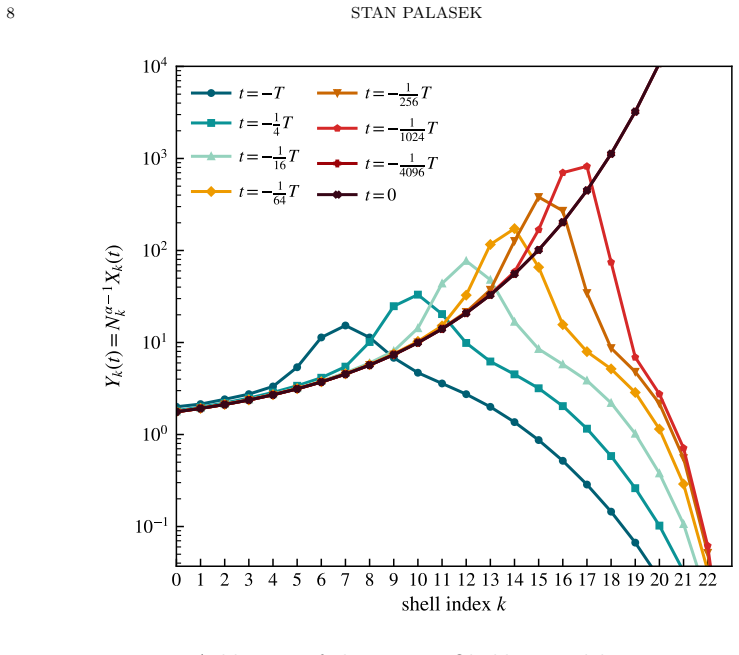
read the original abstract
We demonstrate finite-time blow-up in a simple, realistic shell model of the 3D Navier-Stokes equations, equipped with "smooth" (i.e., rapidly decaying in frequency) initial data and forcing. Previously studied models either exhibit a turbulent cascade that regularizes the three-dimensional viscous dynamics, or rely on highly artificial interactions not transparently realized in the true Euler nonlinearity. We also treat the inviscid, unforced case and obtain singularity formation just above the energy level. We conclude with a discussion of the prospects for embedding the behavior of the dyadic model into the full Euler and Navier-Stokes equations.
Editorial analysis
A structured set of objections, weighed in public.
Referee Report
Summary. The manuscript constructs a dyadic shell model of the 3D Navier-Stokes equations with explicitly chosen interaction rules asserted to be a realistic reduction of the Euler nonlinearity. It demonstrates finite-time blow-up for smooth (rapidly decaying) initial data and forcing in the viscous case, obtains singularity formation in the inviscid unforced case just above the energy level, and discusses prospects for embedding the observed behavior into the full Euler and Navier-Stokes equations.
Significance. If the chosen shell couplings faithfully reproduce the essential structure of the projected Euler nonlinearity, the result supplies an elementary, explicit example of finite-time blow-up with smooth data in a setting closer to the true 3D equations than prior artificial shell models. The explicit ODE formulation, treatment of both viscous and inviscid regimes, and discussion of embedding prospects are concrete strengths that could guide further analysis of singularity formation.
major comments (2)
- [§2] §2 (model definition): The nonlinear interaction coefficients in the dyadic system are introduced without a side-by-side comparison to the coefficients obtained by a standard Galerkin projection of the Euler equations onto the same frequency shells. This omission is load-bearing for the central claim that the blow-up is not an artifact of the reduction, as the paper itself contrasts the model with prior artificial interactions.
- [§4] §4 (blow-up analysis): The differential inequalities used to establish finite-time blow-up (e.g., the growth estimate for the high-frequency shell energies) depend on the precise signs and relative magnitudes of the retained triadic couplings. No sensitivity analysis or perturbation argument is supplied to show that the singularity persists under small changes to these coefficients, which would be required to confirm robustness.
minor comments (3)
- [Abstract] Abstract: The parenthetical clarification of 'smooth' as 'rapidly decaying in frequency' is helpful, but the precise Sobolev or Besov regularity class of the initial data and forcing should be stated explicitly for reproducibility.
- [§5] §5 (discussion): The embedding prospects are treated qualitatively; a concrete obstruction or a sketch of a lifting procedure (e.g., via a specific mollification or frequency-localization argument) would make this section more substantive.
- [Notation] Notation: Shell indices alternate between n and k in several displayed equations; a uniform convention would improve readability.
Simulated Author's Rebuttal
We thank the referee for the careful reading and constructive suggestions. We address the two major comments point by point below and will revise the manuscript to incorporate the requested clarifications and robustness discussion.
read point-by-point responses
-
Referee: [§2] §2 (model definition): The nonlinear interaction coefficients in the dyadic system are introduced without a side-by-side comparison to the coefficients obtained by a standard Galerkin projection of the Euler equations onto the same frequency shells. This omission is load-bearing for the central claim that the blow-up is not an artifact of the reduction, as the paper itself contrasts the model with prior artificial interactions.
Authors: We agree that a direct comparison would strengthen the central claim. In the revised manuscript we will add, in §2, an explicit side-by-side table (or displayed equations) comparing our chosen triadic coefficients with those obtained from a standard Galerkin projection of the Euler equations onto the same dyadic frequency shells. This addition will make transparent both the structural similarities and the simplifications inherent to the shell reduction. revision: yes
-
Referee: [§4] §4 (blow-up analysis): The differential inequalities used to establish finite-time blow-up (e.g., the growth estimate for the high-frequency shell energies) depend on the precise signs and relative magnitudes of the retained triadic couplings. No sensitivity analysis or perturbation argument is supplied to show that the singularity persists under small changes to these coefficients, which would be required to confirm robustness.
Authors: The referee correctly notes the absence of a sensitivity analysis. In the revision we will insert a short subsection (or appendix paragraph) showing that the key differential inequalities remain valid for all coefficient sets lying in a sufficiently small neighborhood of our chosen values, provided the signs of the interactions are preserved and the relative magnitudes continue to satisfy the same ordering used in the estimates. This perturbation argument will establish that the finite-time blow-up is robust under small changes to the model coefficients. revision: yes
Circularity Check
No circularity: model construction and blow-up analysis are independent of the target result
full rationale
The paper defines a new dyadic shell model via explicit ODE couplings chosen to approximate the Euler nonlinearity structure, then derives finite-time blow-up by direct analysis of the resulting system with smooth initial data. No equation reduces to its own input by construction, no parameter is fitted to a subset and then relabeled as a prediction, and no load-bearing step relies on a self-citation chain or imported uniqueness theorem. The faithfulness claim is an external modeling assumption rather than a definitional identity, so the derivation chain remains self-contained against the stated equations.
Axiom & Free-Parameter Ledger
axioms (2)
- domain assumption The shell interactions can be chosen so that they are transparently realized in the true Euler nonlinearity.
- standard math Standard Sobolev-type estimates and energy methods apply to the discrete shell system.
invented entities (1)
-
The dyadic shell model with chosen interaction rules
no independent evidence
Reference graph
Works this paper leans on
-
[1]
Barbato, F
D. Barbato, F. Morandin, and M. Romito. Smooth solutions for the dyadic model.Nonlinearity, 24(11):3083–3097, 2011
2011
-
[2]
Cheskidov
A. Cheskidov. Blow-up in finite time for the dyadic model of the Navier-Stokes equations.Trans. Amer. Math. Soc., 360(10):5101–5120, 2008
2008
-
[3]
Cheskidov, M
A. Cheskidov, M. Dai, and S. Friedlander. Dyadic models for fluid equations: a survey.J. Math. Fluid Mech., 25(3):Paper No. 62, 26, 2023
2023
-
[4]
A. Cheskidov, M. Dai, and S. Palasek. Instantaneous type I blow-up and non-uniqueness of smooth solutions of the Navier–Stokes equations.arXiv preprint arXiv:2511.09556, 2025
-
[5]
Cheskidov, S
A. Cheskidov, S. Friedlander, and N. Pavlovi´ c. Inviscid dyadic model of turbulence: the fixed point and Onsager’s conjecture.J. Math. Phys., 48(6):065503, 16, 2007
2007
-
[6]
Cheskidov, S
A. Cheskidov, S. Friedlander, and N. Pavlovi´ c. An inviscid dyadic model of turbulence: the global attractor.Discrete Contin. Dyn. Syst., 26(3):781–794, 2010
2010
-
[7]
M. P. Coiculescu and S. Palasek. Non-uniqueness of smooth solutions of the Navier–Stokes equa- tions from critical data.Invent. Math., 244(1):165–219, 2026
2026
-
[8]
C´ ordoba, L
D. C´ ordoba, L. Martinez-Zoroa, and F. Zheng. Finite time singularities to the 3D incompressible Euler equations for solutions inC ∞(R3 \ {0})∩C 1,α ∩L 2.Ann. PDE, 11(2):Paper No. 19, 56, 2025
2025
-
[9]
De Lellis and L
C. De Lellis and L. Sz´ ekelyhidi, Jr. Dissipative continuous Euler flows.Invent. Math., 193(2):377– 407, 2013. 20 STAN PALASEK
2013
-
[10]
Friedlander and N
S. Friedlander and N. Pavlovi´ c. Blowup in a three-dimensional vector model for the Euler equa- tions.Comm. Pure Appl. Math., 57(6):705–725, 2004
2004
-
[11]
Jeong and D
I.-J. Jeong and D. Li. A blow-up result for dyadic models of the Euler equations.Comm. Math. Phys., 337(2):1027–1034, 2015
2015
-
[12]
N. H. Katz and N. Pavlovi´ c. Finite time blow-up for a dyadic model of the Euler equations.Trans. Amer. Math. Soc., 357(2):695–708, 2005
2005
-
[13]
Kiselev and A
A. Kiselev and A. Zlatoˇ s. On discrete models of the Euler equation.Int. Math. Res. Not., (38):2315– 2339, 2005
2005
-
[14]
P. G. Lemari´ e-Rieusset.The Navier-Stokes problem in the 21st century. CRC Press, Boca Raton, FL, 2016
2016
-
[15]
J. Leray. Sur le mouvement d’un liquide visqueux emplissant l’espace.Acta Math., 63(1):193–248, 1934
1934
-
[16]
Looi.to appear, 2026
S. Looi.to appear, 2026
2026
-
[17]
A. Obukhov. Some general properties of equations describing the dynamics of the atmosphere. Academy of Sciences, USSR, Izvestiya, Atmospheric and Oceanic Physics, 7:471–475, 1971
1971
- [18]
-
[19]
S. Palasek. Non-uniqueness in the Leray-Hopf class for a dyadic Navier-Stokes model.Int. Math. Res. Not. IMRN, (22):Paper No. rnaf344, 32, 2025
2025
-
[20]
T. Tao. Finite time blowup for an averaged three-dimensional Navier-Stokes equation.J. Amer. Math. Soc., 29(3):601–674, 2016
2016
-
[21]
T. Tao. On the universality of potential well dynamics.Dyn. Partial Differ. Equ., 14(3):219–238, 2017
2017
-
[22]
T. Tao. On the universality of the incompressible Euler equation on compact manifolds.Discrete Contin. Dyn. Syst., 38(3):1553–1565, 2018
2018
-
[23]
T. Tao. On the universality of the incompressible Euler equation on compact manifolds, II. Non- rigidity of Euler flows.Pure Appl. Funct. Anal., 5(6):1425–1443, 2020
2020
-
[24]
F. Waleffe. On some dyadic models of the Euler equations.Proc. Amer. Math. Soc., 134(10):2913– 2922, 2006. Institute for Advanced Study, 1 Einstein Dr., Princeton, NJ 08540 Email address:palasek@ias.edu
2006
discussion (0)
Sign in with ORCID, Apple, or X to comment. Anyone can read and Pith papers without signing in.