Recognition: 1 theorem link
· Lean TheoremIntegrated ytterbium gain for visible-near-infrared photonics
Pith reviewed 2026-05-14 17:28 UTC · model grok-4.3
The pith
Ytterbium ions integrated into aluminum oxide deliver high-power near-infrared amplification and visible supercontinuum on chip.
A machine-rendered reading of the paper's core claim, the machinery that carries it, and where it could break.
Core claim
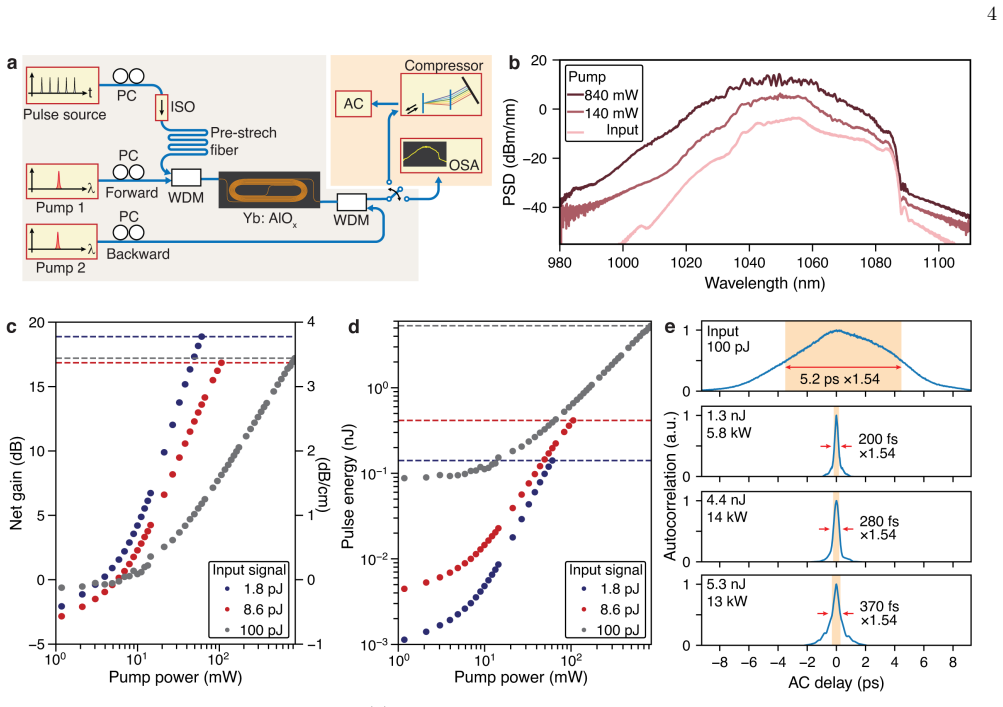
We demonstrate ytterbium-based optical gain integrated into an aluminum oxide photonic platform, achieving both single-mode lasing and optical amplification in the near-infrared regime. This platform delivers optical amplification with output powers exceeding 0.5 W, an optical-to-optical conversion efficiency above 70%, and a noise figure of 3.3 dB, approaching the quantum limit for phase-insensitive amplification. Furthermore, we achieve femtosecond pulse amplification to a record peak power of 14 kW, enabling supercontinuum generation with visible dispersive waves extending from 780 to 476 nm in conjunction with nonlinear photonic devices.
What carries the argument
Ytterbium-doped aluminum oxide waveguide platform that supplies the active gain medium for both continuous and pulsed amplification while remaining compatible with heterogeneous photonic integration.
If this is right
- Single-mode lasing and optical amplification become available in the near-infrared on a chip-scale platform.
- Amplification reaches output powers above 0.5 W at optical-to-optical efficiencies above 70 percent.
- Noise performance reaches 3.3 dB, close to the quantum limit for phase-insensitive amplifiers.
- Femtosecond pulses can be amplified to 14 kW peak power to drive visible supercontinuum generation.
Where Pith is reading between the lines
- Hybrid integration with silicon waveguides could extend the platform to full visible-NIR photonic systems.
- The near-quantum-limit noise suggests direct use in precision metrology or quantum optics experiments.
- Arrays of such amplifiers could support on-chip coherent sources for optical frequency standards.
- The demonstrated efficiency opens a route to lower-power on-chip alternatives to fiber amplifiers in the visible-NIR band.
Load-bearing premise
Ytterbium ions can be incorporated into the aluminum oxide matrix at sufficient concentration and uniformity to deliver the stated gain, efficiency, and low noise without quenching or fabrication-induced defects that would block integration.
What would settle it
A fabricated device that fails to reach 0.5 W output power or shows a noise figure well above 3.3 dB when measured in a standard photonic circuit layout would falsify the integration performance claim.
Figures



read the original abstract
Rare-earth gain media form the foundation of modern optical communications, emerging quantum hardware, and ultrafast optics. While chip-scale integration can enable fiber-like, and potentially beyond-fiber, functionality with unprecedented scalability, development in the visible and near-infrared remains in its early stages. Here, we demonstrate ytterbium-based optical gain integrated into an aluminum oxide photonic platform, achieving both single-mode lasing and optical amplification in the near-infrared regime. This platform delivers optical amplification with output powers exceeding 0.5 W, an optical-to-optical conversion efficiency above 70%, and a noise figure of 3.3 dB, approaching the quantum limit for phase-insensitive amplification. Furthermore, we achieve femtosecond pulse amplification to a record peak power of 14 kW, enabling supercontinuum generation with visible dispersive waves extending from 780 to 476 nm in conjunction with nonlinear photonic devices. This platform is compatible with heterogeneous integration into standard photonic circuits, laying the foundation for scalable visible-near-infrared photonic systems, including coherent laser arrays, mode-locked lasers, optical clocks, and microwave oscillators.
Editorial analysis
A structured set of objections, weighed in public.
Referee Report
Summary. The manuscript demonstrates ytterbium-based optical gain integrated into an aluminum oxide photonic platform, achieving single-mode lasing and amplification in the near-infrared with output powers >0.5 W, optical-to-optical efficiency >70%, noise figure of 3.3 dB, and femtosecond pulse amplification to a record 14 kW peak power that enables supercontinuum generation with visible dispersive waves from 780 to 476 nm, while claiming compatibility with heterogeneous integration into standard photonic circuits.
Significance. If the reported performance metrics hold under direct material validation, the work would advance chip-scale visible-NIR photonics by supplying a high-power, low-noise gain medium compatible with scalable integration, supporting applications such as coherent laser arrays, mode-locked lasers, optical clocks, and nonlinear devices beyond current fiber-based limits.
major comments (2)
- [Fabrication and Material Characterization] The central claims of >0.5 W output, >70% efficiency, 3.3 dB noise figure, and 14 kW peak power rest on uniform Yb incorporation into the Al2O3 matrix without quenching or scattering; however, the manuscript provides only indirect performance metrics (lasing thresholds, output curves) and lacks direct cross-sectional doping profiles, EDX maps, or fluorescence lifetime measurements on doped versus undoped reference waveguides to confirm ion distribution and concentration.
- [Amplification Results] Table 1 (or equivalent performance summary) reports the 3.3 dB noise figure as approaching the quantum limit, but without accompanying waveguide loss data on undoped Al2O3 references or raw spectral measurements, it is unclear whether fabrication-induced defects contribute to the observed value.
minor comments (2)
- [Abstract] The abstract states 'record peak power' without a brief comparison to prior integrated amplifiers; adding one sentence would clarify the advance.
- [Nonlinear Optics Results] Figure captions for the supercontinuum spectra should explicitly note the input pulse parameters and device lengths to allow direct comparison with simulations.
Simulated Author's Rebuttal
We are grateful to the referee for their thorough review and valuable suggestions. The comments have helped us identify areas where additional details can strengthen the manuscript. We have prepared point-by-point responses below and will incorporate the suggested revisions accordingly.
read point-by-point responses
-
Referee: [Fabrication and Material Characterization] The central claims of >0.5 W output, >70% efficiency, 3.3 dB noise figure, and 14 kW peak power rest on uniform Yb incorporation into the Al2O3 matrix without quenching or scattering; however, the manuscript provides only indirect performance metrics (lasing thresholds, output curves) and lacks direct cross-sectional doping profiles, EDX maps, or fluorescence lifetime measurements on doped versus undoped reference waveguides to confirm ion distribution and concentration.
Authors: We thank the referee for highlighting the importance of direct material validation. While the manuscript emphasizes device-level performance metrics, we agree that additional characterization would be beneficial. In the revised manuscript, we will include EDX maps and fluorescence lifetime measurements comparing doped and undoped waveguides to confirm uniform Yb incorporation without quenching. These data support the reported high efficiency and low noise figure by demonstrating the absence of significant scattering or ion clustering. revision: yes
-
Referee: [Amplification Results] Table 1 (or equivalent performance summary) reports the 3.3 dB noise figure as approaching the quantum limit, but without accompanying waveguide loss data on undoped Al2O3 references or raw spectral measurements, it is unclear whether fabrication-induced defects contribute to the observed value.
Authors: The 3.3 dB noise figure was obtained through careful measurements accounting for the amplifier's gain and input signal levels. To address this concern, we will add in the revision the propagation loss measurements from undoped Al2O3 waveguides fabricated under identical conditions, as well as the raw output spectra used in the noise figure calculation. These additions will clarify that the noise figure is not significantly impacted by fabrication defects, consistent with the high optical-to-optical efficiency exceeding 70%. revision: yes
Circularity Check
No circularity: experimental demonstration without derivation chain
full rationale
The manuscript reports direct experimental results on ytterbium-doped Al2O3 photonic devices, including measured output powers exceeding 0.5 W, optical-to-optical efficiencies above 70%, a noise figure of 3.3 dB, femtosecond pulse amplification to 14 kW peak power, and resulting supercontinuum spectra. No equations, fitted models, self-referential predictions, or derivation steps appear in the provided abstract or claims. All performance metrics are presented as measured outcomes rather than outputs of any internal calculation or ansatz. The central claims rest on fabrication and characterization data, not on any chain that reduces to its own inputs by construction. Self-citations, if present in the full text, are not load-bearing for any claimed derivation.
Axiom & Free-Parameter Ledger
Reference graph
Works this paper leans on
-
[1]
or effectiveχ (2) processes in silicon nitride [66– 68]. Looking forward, full integration of a pulse generator can be realized on the Yb-gain platform established in this work via a Mamyshev oscillator [9, 69], a passive Kerr soliton cavity [70], an electro- optic modulator [8], or a saturable absorber for mode locking [71, 72]. Furthermore, dispersion e...
-
[2]
Desurvire, E., Simpson, J. R. & Becker, P. High- gain erbium-doped traveling-wave fiber amplifier.Optics Letters12, 888–890 (1987)
1987
-
[3]
Hanna, D.et al.Continuous-wave oscillation of a monomode ytterbium-doped fibre laser.Electronics Letters24, 1111–1113 (1988)
1988
-
[4]
Anderegg, L.et al.An optical tweezer array of ultracold molecules.Science365, 1156–1158 (2019)
2019
-
[5]
J.et al.A tweezer array with 6,100 highly coherent atomic qubits.Nature647, 60–67 (2025)
Manetsch, H. J.et al.A tweezer array with 6,100 highly coherent atomic qubits.Nature647, 60–67 (2025)
2025
-
[6]
Steinmetz, T.et al.Laser frequency combs for astronomical observations.Science321, 1335–1337 (2008)
2008
-
[7]
R.et al.Ultrafast electro-optic light with subcycle control.Science361, 1358–1363 (2018)
Carlson, D. R.et al.Ultrafast electro-optic light with subcycle control.Science361, 1358–1363 (2018)
2018
-
[8]
M.et al.A six-octave optical frequency comb from a scalable few-cycle erbium fibre laser.Nature Photonics15, 281–286 (2021)
Lesko, D. M.et al.A six-octave optical frequency comb from a scalable few-cycle erbium fibre laser.Nature Photonics15, 281–286 (2021)
2021
-
[9]
Guo, Q.et al.Ultrafast mode-locked laser in nanophotonic lithium niobate.Science382, 708–713 8 (2023)
2023
- [10]
-
[11]
D., Boyd, M
Ludlow, A. D., Boyd, M. M., Ye, J., Peik, E. & Schmidt, P. O. Optical atomic clocks.Reviews of Modern Physics 87, 637–701 (2015)
2015
-
[12]
L.et al.Architecture for the photonic integration of an optical atomic clock.Optica6, 680– 685 (2019)
Newman, Z. L.et al.Architecture for the photonic integration of an optical atomic clock.Optica6, 680– 685 (2019)
2019
-
[13]
Kudelin, I.et al.Photonic chip-based low-noise microwave oscillator.Nature627, 534–539 (2024)
2024
-
[14]
Nakamura, T.et al.Low-noise microwaves from free- running frequency combs and electrical feed-forward phase noise compensation.Nature Photonics1–6 (2026)
2026
-
[15]
Paschotta, R., Nilsson, J., Tropper, A. C. & Hanna, D. C. Ytterbium-doped fiber amplifiers.IEEE Journal of Quantum Electronics33, 1049–1056 (1997)
1997
-
[16]
Chiu, N.-C.et al.Continuous operation of a coherent 3,000-qubit system.Nature646, 1075–1080 (2025)
2025
-
[17]
B.et al.An optical tweezer array of ultracold polyatomic molecules.Nature628, 282–286 (2024)
Vilas, N. B.et al.An optical tweezer array of ultracold polyatomic molecules.Nature628, 282–286 (2024)
2024
-
[18]
J., Friedl, P
Xu, C., Nedergaard, M., Fowell, D. J., Friedl, P. & Ji, N. Multiphoton fluorescence microscopy for in vivo imaging. Cell187, 4458–4487 (2024)
2024
-
[19]
Wilken, T.et al.A spectrograph for exoplanet observations calibrated at the centimetre-per-second level.Nature485, 611–614 (2012)
2012
-
[20]
J.et al.Stellar spectroscopy in the near- infrared with a laser frequency comb.Optica6, 233–239 (2019)
Metcalf, A. J.et al.Stellar spectroscopy in the near- infrared with a laser frequency comb.Optica6, 233–239 (2019)
2019
-
[21]
Van den Hoven, G.et al.Photoluminescence characterization of Er-implanted Al 2O3 films.Applied Physics Letters62, 3065–3067 (1993)
1993
-
[22]
& Polman, A
Fleuster, M., Buchal, C., Snoeks, E. & Polman, A. Rapid thermal annealing of MeV erbium implanted LiNbO 3 single crystals for optical doping.Applied Physics Letters 65, 225–227 (1994)
1994
-
[23]
Min, B.et al.Erbium-implanted high-Q silica toroidal microcavity laser on a silicon chip.Physical Review A-Atomic, Molecular, and Optical Physics70, 033803 (2004)
2004
-
[24]
& Pollnau, M
Bradley, J., Ay, F., W¨ orhoff, K. & Pollnau, M. Fabrication of low-loss channel waveguides in Al2O3 and Y2O3 layers by inductively coupled plasma reactive ion etching.Applied Physics B89, 311–318 (2007)
2007
-
[25]
D.et al.Monolithic erbium-and ytterbium- doped microring lasers on silicon chips.Optics Express 22, 12226–12237 (2014)
Bradley, J. D.et al.Monolithic erbium-and ytterbium- doped microring lasers on silicon chips.Optics Express 22, 12226–12237 (2014)
2014
-
[26]
& Blumenthal, D
Belt, M. & Blumenthal, D. J. Erbium-doped waveguide DBR and DFB laser arrays integrated within an ultra- low-loss Si3N4 platform.Optics Express22, 10655–10660 (2014)
2014
-
[27]
S., Sessions, N., Apostolopoulos, V
Aghajani, A., Murugan, G. S., Sessions, N., Apostolopoulos, V. & Wilkinson, J. Waveguide lasers in ytterbium-doped tantalum pentoxide on silicon. Optics Letters40, 2549–2552 (2015)
2015
-
[28]
B., Frankis, H
Bonneville, D. B., Frankis, H. C., Wang, R. & Bradley, J. D. Erbium-ytterbium co-doped aluminium oxide waveguide amplifiers fabricated by reactive co-sputtering and wet chemical etching.Optics Express28, 30130– 30140 (2020)
2020
-
[29]
C.et al.Erbium-doped TeO 2-coated Si 3N4 waveguide amplifiers with 5 dB net gain.Photonics Research8, 127–134 (2020)
Frankis, H. C.et al.Erbium-doped TeO 2-coated Si 3N4 waveguide amplifiers with 5 dB net gain.Photonics Research8, 127–134 (2020)
2020
-
[30]
Liu, Y.et al.A photonic integrated circuit–based erbium-doped amplifier.Science376, 1309–1313 (2022)
2022
-
[31]
Singh, N.et al.Watt-class silicon photonics-based optical high-power amplifier.Nature Photonics19, 307–314 (2025)
2025
-
[32]
& Garc´ ıa-Blanco, S
Jongebloed, B., Osornio-Martinez, C., Wang, K., Dijkstra, M. & Garc´ ıa-Blanco, S. Fiber-to-fiber gain in Nd-doped aluminium oxide waveguide amplifiers.Optics Express34, 4522–4534 (2026)
2026
-
[33]
& Garcia-Blanco, S
Osornio-Martinez, C., Bonneville, D., Dijkstra, M., do Nascimento Jr, A. & Garcia-Blanco, S. Broadband packaged erbium-doped polycrystalline Al2O3 waveguide amplifier with 24 dB external net gain.Optics Express 33, 28985–28994 (2025)
2025
-
[34]
J.et al.Integrated multi-wavelength control of an ion qubit.Nature586, 538–542 (2020)
Niffenegger, R. J.et al.Integrated multi-wavelength control of an ion qubit.Nature586, 538–542 (2020)
2020
-
[35]
A.et al.Extending the spectrum of fully integrated photonics to submicrometre wavelengths
Tran, M. A.et al.Extending the spectrum of fully integrated photonics to submicrometre wavelengths. Nature610, 54–60 (2022)
2022
-
[36]
Renaud, D.et al.Sub-1 Volt and high-bandwidth visible to near-infrared electro-optic modulators.Nature Communications14, 1496 (2023)
2023
-
[37]
Chen, H.-J.et al.Towards fibre-like loss for photonic integration from violet to near-infrared.Nature649, 338–344 (2026)
2026
-
[38]
Huang, G.et al.Thermorefractive noise in silicon-nitride microresonators.Physical Review A99, 061801 (2019)
2019
-
[39]
& Hamerly, R
Panuski, C., Englund, D. & Hamerly, R. Fundamental thermal noise limits for optical microcavities.Physical Review X10, 041046 (2020)
2020
-
[40]
Stern, L.et al.Ultra-precise optical-frequency stabilization with heterogeneous III–V/Si lasers.Optics Letters45, 5275–5278 (2020)
2020
-
[41]
K.et al.Frequency-stable nanophotonic microcavities via integrated thermometry.Nature Photonics20, 71–78 (2026)
Dacha, S. K.et al.Frequency-stable nanophotonic microcavities via integrated thermometry.Nature Photonics20, 71–78 (2026)
2026
-
[42]
Torab Ahmadi, P.et al.Low-loss and low-temperature Al2O3 thin films for integrated photonics and optical coatings.Journal of Vacuum Science & Technology A 42(2024)
2024
-
[43]
Nature Photonics3, 59–63 (2009)
Kang, Y.et al.Monolithic germanium/silicon avalanche photodiodes with 340 GHz gain–bandwidth product. Nature Photonics3, 59–63 (2009)
2009
-
[44]
Sun, C.et al.Single-chip microprocessor that communicates directly using light.Nature528, 534–538 (2015)
2015
-
[45]
H.et al.Integrating photonics with silicon nanoelectronics for the next generation of systems on a chip.Nature556, 349–354 (2018)
Atabaki, A. H.et al.Integrating photonics with silicon nanoelectronics for the next generation of systems on a chip.Nature556, 349–354 (2018)
2018
-
[46]
Churaev, M.et al.A heterogeneously integrated lithium niobate-on-silicon nitride photonic platform.Nature Communications14, 3499 (2023)
2023
-
[47]
M.et al.Monolithic 3D integration of tantalum pentoxide nonlinear photonics.Nature(2026)
Brodnik, G. M.et al.Monolithic 3D integration of tantalum pentoxide nonlinear photonics.Nature(2026)
2026
-
[48]
& Lahaye, T
Browaeys, A. & Lahaye, T. Many-body physics with individually controlled Rydberg atoms.Nature Physics 16, 132–142 (2020)
2020
-
[49]
Wu, K.et al.Vernier microcombs for integrated optical atomic clocks.Nature Photonics19, 400–406 (2025)
2025
-
[50]
A., Hagan, D
DeSalvo, R., Said, A. A., Hagan, D. J., Van Stryland, E. W. & Sheik-Bahae, M. Infrared to ultraviolet measurements of two-photon absorption andn 2 in wide bandgap solids.IEEE Journal of Quantum Electronics 9 32, 1324–1333 (1996)
1996
-
[51]
& Ballato, J
Dragic, P., Cavillon, M. & Ballato, J. The linear and nonlinear refractive index of amorphous Al 2O3 deduced from aluminosilicate optical fibers.International Journal of Applied Glass Science9, 421–427 (2018)
2018
-
[52]
Photorefractive waveguides in oxide crystals: fabrication, properties, and applications.Applied Physics B: Lasers & Optics67(1998)
Kip, D. Photorefractive waveguides in oxide crystals: fabrication, properties, and applications.Applied Physics B: Lasers & Optics67(1998)
1998
-
[53]
Jones, J.et al.Channel waveguide laser at 1µm in Yb- indiffused LiNbO3.Optics Letters20, 1477–1479 (1995)
work page 1995
-
[54]
Zeng, T.et al.Injection locking of integrated erbium- based laser.CLEO: Applications and Technology(2025)
work page 2025
-
[55]
Mu, J.et al.Monolithic integration of Al 2O3 and Si3N4 toward double-layer active–passive platform.IEEE Journal of Selected Topics in Quantum Electronics25, 1–11 (2019)
work page 2019
-
[56]
Paschotta, R.et al.Lifetime quenching in Yb-doped fibres.Optics Communications136, 375–378 (1997)
1997
-
[57]
Loiko, P.et al.Quantitative analysis of cooperative upconversion in Al 2O3: Yb 3+.Optical Materials162, 116798 (2025)
work page 2025
-
[58]
Optics Letters38, 1760–1762 (2013)
Purnawirmanet al.C- and L-band erbium-doped waveguide lasers with wafer-scale silicon nitride cavities. Optics Letters38, 1760–1762 (2013)
work page 2013
-
[59]
Gao, M.et al.Probing material absorption and optical nonlinearity of integrated photonic materials.Nature Communications13, 3323 (2022)
work page 2022
-
[60]
Strickland, D. & Mourou, G. Compression of amplified chirped optical pulses.Optics Communications55, 447– 449 (1985)
work page 1985
-
[61]
Agrawal, G. P. Nonlinear Fiber Optics. InNonlinear Science at the Dawn of the 21st Century, 195–211 (Springer, 2000)
work page 2000
-
[62]
E., Kruglov, V., Thomsen, B., Dudley, J
Fermann, M. E., Kruglov, V., Thomsen, B., Dudley, J. M. & Harvey, J. D. Self-similar propagation and amplification of parabolic pulses in optical fibers. Physical Review Letters84, 6010 (2000)
work page 2000
-
[63]
Lamee, K. F., Carlson, D. R., Newman, Z. L., Yu, S.- P. & Papp, S. B. Nanophotonic tantala waveguides for supercontinuum generation pumped at 1560 nm.Optics Letters45, 4192–4195 (2020)
work page 2020
-
[64]
Jung, H.et al.Tantala Kerr nonlinear integrated photonics.Optica8, 811–817 (2021)
work page 2021
-
[65]
Carollo, A. R.et al.Amorphous metal oxide mixtures for high-Q integrated nonlinear photonics.arXiv preprint arXiv:2508.14887(2025)
-
[66]
Y.et al.Coherent ultra-violet to near- infrared generation in silica ridge waveguides.Nature Communications8, 13922 (2017)
Oh, D. Y.et al.Coherent ultra-violet to near- infrared generation in silica ridge waveguides.Nature Communications8, 13922 (2017)
2017
-
[67]
Lu, X., Moille, G., Rao, A., Westly, D. A. & Srinivasan, K. Efficient photoinduced second-harmonic generation in silicon nitride photonics.Nature Photonics15, 131–136 (2021)
2021
-
[68]
& Br` es, C.-S
Nitiss, E., Hu, J., Stroganov, A. & Br` es, C.-S. Optically reconfigurable quasi-phase-matching in silicon nitride microresonators.Nature Photonics16, 134–141 (2022)
2022
-
[69]
Yuan, Z.et al.Efficient and wavelength-tunable second- harmonic generation toward the green gap.Science Advances11, eadw2781 (2025)
2025
-
[70]
M., Wright, L
Liu, Z., Ziegler, Z. M., Wright, L. G. & Wise, F. W. Megawatt peak power from a Mamyshev oscillator. Optica4, 649–654 (2017)
2017
-
[71]
Herr, T.et al.Temporal solitons in optical microresonators.Nature Photonics8, 145–152 (2014)
2014
-
[72]
Keller, U.et al.Semiconductor saturable absorber mirrors (SESAMs) for femtosecond to nanosecond pulse generation in solid-state lasers.IEEE Journal of Selected Topics in Quantum Electronics2, 435–453 (1996)
1996
-
[73]
Byun, H.et al.Integrated low-jitter 400-MHz femtosecond waveguide laser.IEEE Photonics Technology Letters21, 763–765 (2009)
2009
-
[74]
T.et al.An optical-frequency synthesizer using integrated photonics.Nature557, 81–85 (2018)
Spencer, D. T.et al.An optical-frequency synthesizer using integrated photonics.Nature557, 81–85 (2018)
2018
-
[75]
Qiu, Z.et al.Hybrid integrated multi-lane erbium-doped Si3N4 waveguide amplifiers.European Conference on Optical Communication1721–1724 (2024)
work page 2024
-
[76]
Strohh¨ ofer, C. & Polman, A. Absorption and emission spectroscopy in Er 3+–Yb3+ doped aluminum oxide waveguides.Optical Materials21, 705–712 (2003). 10 Supplementary Information for: Integrated ytterbium gain for visible-near-infrared photonics Tianyi Zeng1,†, Erik W. Masselink 1,2,†, Tsung-Han Wu3,4, Nathan Brooks 4, Peter Chang4, Grisha Spektor 5, Zach...
work page 2003
-
[77]
Oxide cladding Al Yb O2 e- e-
-
[78]
E-beam lithography SiO₂ Si Yb:AlOx Al YbO
-
[79]
Yb:AlOx deposition FIG. S2. Yb:AlO x photonic chip fabrication flow. a b c 300 500 700 900 1100 1300 1500 1700 1900 Wavelength (nm) 1.64 1.65 1.66 1.67 1.68 1.69 1.70 1.71 1.72 1.73Refractive index 0 100 200 300 400 500 X (nm) 0 100 200 300 400 500Y (nm) -0.4 -0.2 0.0 0.2 0.4 Roughness (nm) -0.4 -0.2 0.0 0.2 0.4 Roughness (nm) 0 500 1000 1500 2000 2500 30...
discussion (0)
Sign in with ORCID, Apple, or X to comment. Anyone can read and Pith papers without signing in.